


What Can AI Agents Do? 2026 Capabilities and Use Cases

Quick Summary: AI agents are autonomous software systems that use artificial intelligence to independently perform tasks, make decisions, and pursue goals on behalf of users. Unlike traditional AI assistants that simply respond to commands, AI agents can reason, plan, learn from their environment, and execute complex multi-step workflows with minimal human intervention. They're transforming business operations across industries by automating everything from customer service to data analysis and strategic planning.
The conversation around artificial intelligence has shifted. It's no longer just about chatbots that answer questions or tools that generate content. AI agents represent something fundamentally different—systems that don't just respond, but act.
These autonomous systems can pursue goals, design their own workflows, and make decisions without constant human oversight. They're already handling tasks that previously required dedicated teams: processing customer returns, analyzing procurement options, managing IT support tickets, and coordinating complex business operations.
But what exactly can these agents do? And more importantly, what should they do?
What AI Agents Actually Are
AI agents are software systems that autonomously perform tasks by designing workflows with available tools. They use artificial intelligence—particularly large language models and generative AI—to pursue goals and complete tasks on behalf of users.
Here's what sets them apart: reasoning, planning, and memory. Traditional software follows predetermined paths. AI agents analyze situations, consider options, and adapt their approach based on what they learn.
According to Google Cloud, AI agents can process multimodal inputs—text, images, audio, video—and use that information to make decisions. They show a level of autonomy that goes beyond simple automation.
The National Institute of Standards and Technology (NIST) launched the AI Agent Standards Initiative in February 2026 to ensure these systems can function securely on behalf of users and interoperate smoothly across the digital ecosystem. That's how seriously government agencies are taking this technology shift.
How They Differ From AI Assistants and Bots
Not every AI system qualifies as an agent. The distinction matters.
|
Feature |
AI Agent |
AI Assistant |
Bot |
|---|---|---|---|
|
Purpose |
Autonomously and proactively perform tasks |
Assisting users with tasks |
Automating simple tasks or conversations |
|
Autonomy Level |
High—makes independent decisions |
Medium—requires user direction |
Low—follows fixed rules |
|
Learning Capability |
Adapts and improves over time |
Limited learning from interactions |
No learning—static responses |
|
Complexity |
Handles complex, multi-step workflows |
Handles moderate tasks with guidance |
Handles simple, repetitive tasks |
|
Decision Making |
Makes strategic decisions independently |
Suggests options for user choice |
Executes predefined actions |
AI assistants help when asked. Bots execute scripts. Agents take initiative.
Core Capabilities: What AI Agents Can Do
The capabilities of AI agents extend across multiple dimensions. They're not limited to a single function or industry vertical.
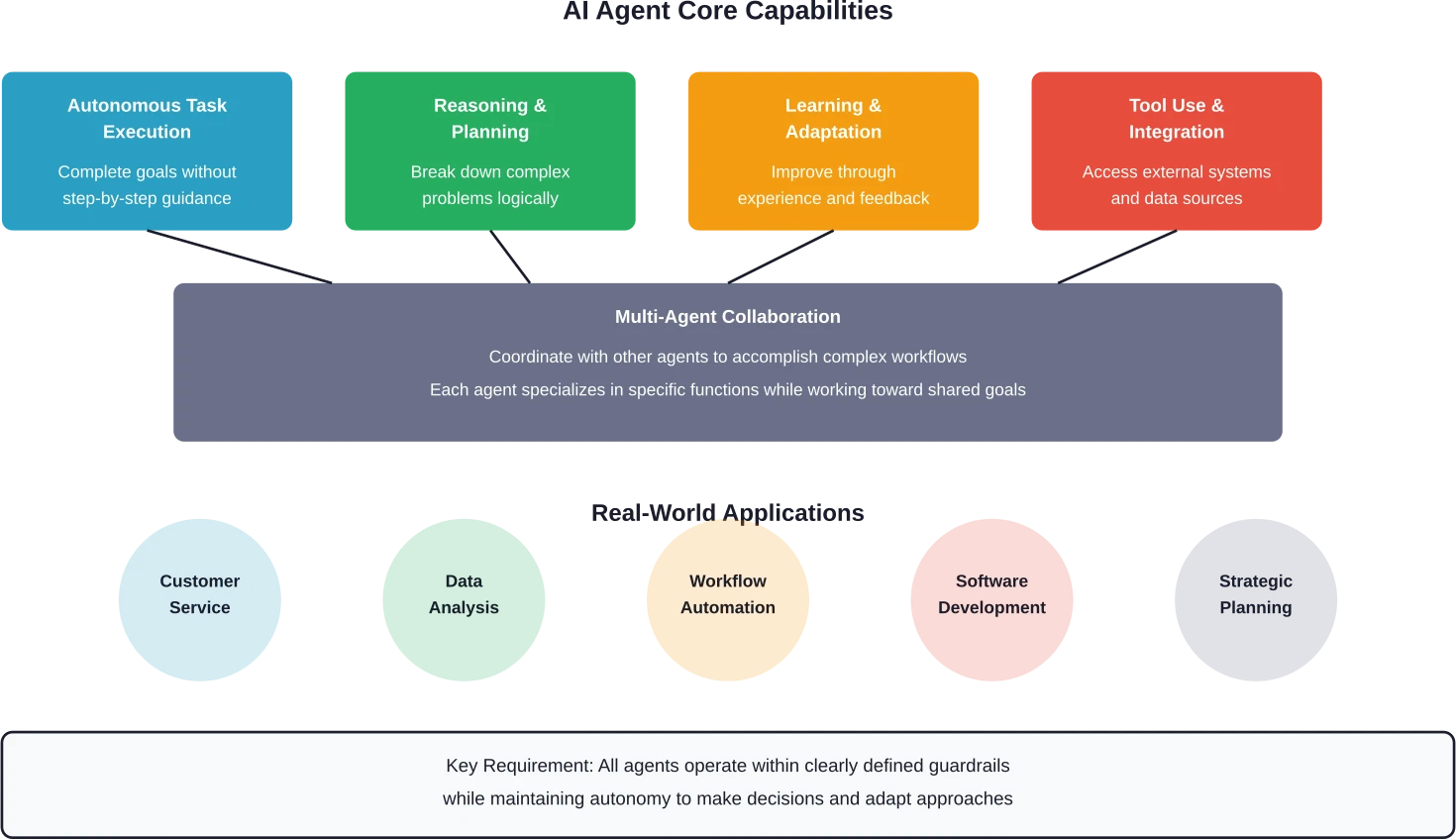
Autonomous Task Execution
AI agents complete tasks without waiting for step-by-step instructions. They understand the goal and figure out the path themselves.
In practice, this means handling returns processing on Monday morning while the team's caffeine kicks in. It means reviewing shipping invoices, updating field technicians, or providing IT support without human gatekeepers.
According to OpenAI's development documentation, agents are systems that intelligently accomplish tasks—from simple goals to complex, open-ended workflows. They operate within clearly defined guardrails but make their own decisions within those boundaries.
Reasoning and Planning
This is where agents diverge from traditional automation. They can break down complex problems into manageable steps.
When faced with a procurement decision, AI agents can read reviews, analyze metrics, and compare attributes across multiple vendors. In areas with many counterparties or substantial evaluation effort—startup funding, college admissions, B2B procurement—agents deliver value by systematically assessing options.
The reasoning happens in real-time. Agents don't need pre-programmed decision trees for every scenario. They apply logic to novel situations.
Learning and Adaptation
AI agents improve through experience. They recognize patterns, adjust strategies, and refine their approach based on outcomes.
This learning capability distinguishes agents from static software. A customer service agent that handles thousands of inquiries doesn't just repeat the same responses—it identifies which approaches resolve issues faster and adapts accordingly.
Tool Use and Integration
Agents don't work in isolation. They access tools to gather context and take action.
According to OpenAI's practical guide (openai.com), agents use available tools to execute workflows. This might include database queries, API calls, file systems, external services, or specialized software.
The agent decides which tools to use and when. If it needs pricing data, it queries the relevant database. If it needs to send notifications, it calls the messaging API. The orchestration happens autonomously.
Multi-Agent Collaboration
Some of the most powerful implementations involve multiple agents working together. Each agent handles a specialized function, and they coordinate to accomplish larger objectives.
One agent might focus on data collection, another on analysis, a third on generating reports, and a fourth on stakeholder communication. They divide labor like a high-functioning team.
According to arXiv research, autonomous multi-agent AI systems are poised to transform various industries, particularly software development and knowledge work.
Types of AI Agents
AI agents come in different forms, each suited to specific use cases and levels of complexity.
Simple Reflex Agents
These agents operate on condition-action rules. When they perceive a specific condition, they execute a predetermined action.
Think of a thermostat that turns on heating when temperature drops below a threshold. It's reactive, not strategic. Simple reflex agents don't consider history or future consequences.
Model-Based Reflex Agents
These maintain an internal model of the world. They track how their environment changes and use that context to make decisions.
A navigation agent that remembers traffic patterns and adjusts routes accordingly falls into this category. It's not just reacting to current conditions—it's incorporating knowledge about how the world works.
Goal-Based Agents
These agents work toward specific objectives. They consider future consequences and choose actions that move them closer to their goals.
A procurement agent tasked with finding the best vendor doesn't just pick the first option. It evaluates multiple candidates against the goal of optimizing for price, quality, and delivery time.
Utility-Based Agents
Beyond just achieving goals, utility-based agents optimize for the best outcome. They assign values to different states and choose actions that maximize expected utility.
When multiple solutions exist, these agents don't just find a solution—they find the optimal solution based on defined criteria.
Learning Agents
Learning agents improve their performance over time through experience. They have a learning element that modifies behavior based on feedback.
These are the agents transforming business operations today. They start with basic capabilities and become more effective as they handle more situations.
Real-World Use Cases: What Businesses Are Actually Doing
Community discussions and industry deployments reveal how organizations are implementing AI agents right now.
Customer Service and Support
AI agents handle customer inquiries, resolve issues, and escalate complex problems to human teams. They're available around the clock and can manage multiple conversations simultaneously.
The agents access customer history, product documentation, and troubleshooting guides to provide contextual responses. They don't just answer questions—they solve problems.
Data Analysis and Insights
Agents can process vast amounts of data, identify patterns, and generate actionable insights. They automate the entire analytics pipeline from data collection through reporting.
For businesses drowning in metrics, agents cut through the noise. They flag anomalies, track KPIs, and alert stakeholders when intervention is needed.
Business Process Automation
Repetitive workflows are prime targets. AI agents handle invoice processing, expense approvals, scheduling, and administrative tasks that consume hours of human time.
According to user experiences shared in community discussions, agents excel at tracking work hours, managing task lists, and streamlining operations that involve multiple steps and decision points.
Software Development
Coding agents assist with everything from writing boilerplate code to reviewing pull requests and identifying bugs. Some experimental evidence shows they can substantially boost productivity for development tasks.
They're particularly valuable for repetitive coding patterns, documentation generation, and test creation.
Procurement and Vendor Evaluation
When comparing options involves analyzing reviews, checking specifications, and evaluating pricing across dozens of vendors, agents handle the legwork.
They create comparison matrices, flag potential issues, and present ranked recommendations based on defined criteria.
Strategic Planning Support
More advanced applications involve agents that help with long-term planning, scenario analysis, and decision support for complex business challenges.
These agents consider multiple variables, run simulations, and provide strategic recommendations while leaving final decisions to humans.
Key Benefits Driving Adoption
Organizations aren't implementing AI agents for novelty. The benefits are tangible.
Scale and Efficiency
Agents handle volume that would require large teams. They work continuously without fatigue, breaks, or shifts.
A single well-designed agent can process thousands of requests daily. That scale changes economics.
Consistency and Accuracy
Humans have off days. Agents don't. They apply the same logic and attention to the thousandth task as the first.
For processes where consistency matters—compliance checks, data validation, quality control—agents deliver reliable performance.
Speed
Agents complete in seconds what might take humans hours. They access information instantly, process it rapidly, and execute actions without delay.
Real talk: the speed advantage is what sells executives. When proposal generation drops from three days to three hours, the ROI becomes obvious.
Cost Reduction
Automating tasks that previously required human labor cuts operational costs. But the savings go beyond wages.
Agents reduce errors, speed up processes, and free human workers to focus on higher-value activities. The compound effect on productivity can be substantial.
24/7 Availability
Agents don't sleep. For global operations or customer-facing functions, continuous availability eliminates wait times and geographic constraints.
Autonomy Levels and Risk Considerations
Here's where it gets interesting. Not all autonomy is created equal—and more isn't always better.
Academic research identifies different levels of autonomous AI, and the risks increase with autonomy. Multiple position papers argue that fully autonomous AI agents should not be developed due to significant safety concerns.
Levels of Agent Autonomy
Autonomy exists on a spectrum. At one end, agents execute tasks only when humans initiate them. At the other, agents take long sequences of actions independently.
Some researchers propose regulation based on the sequence of autonomous actions agents can take. The longer the autonomous action sequence, the higher the potential for unintended consequences.
The Case for Limited Autonomy
Research published on arXiv argues that fully autonomous AI agents should not be developed. The position is based on documented trade-offs between potential benefits and risks.
As autonomy increases, so do risks to people. Agents with long-term planning capabilities can pose significant risks if they operate without human oversight on extended action sequences.
The necessity of off-switches—mechanisms to halt agent behavior—is motivated by preventing critical harms. Critical harm is often defined in safety frameworks (such as California's SB 1047 or Frontier Model Forum policies) as causing mass casualties or at least $500,000,000 in economic damages.
Practical Guardrails
Most production AI agents today operate at semi-autonomous levels. They work independently within defined boundaries.
Guardrails include action limits, approval requirements for high-stakes decisions, monitoring systems that flag unusual behavior, and human oversight for strategic choices.
According to the White House's AI policies released in 2026, federal agencies must ensure AI systems operate safely and maintain human control over critical decisions.
Challenges and Limitations
AI agents aren't a silver bullet. Organizations face real obstacles in deployment.
Trust and Verification
How do teams verify that agents are making good decisions? When an agent operates autonomously, establishing trust requires transparency into its reasoning process.
The black box problem persists. Even when agents produce good results, understanding why they chose a particular approach can be difficult.
Error Handling
Agents encounter situations they weren't designed for. How they handle edge cases and unexpected errors determines whether they're genuinely useful or liability risks.
Robust error handling requires fallback mechanisms, graceful degradation, and clear escalation paths to human oversight.
Integration Complexity
Connecting agents to existing systems, data sources, and workflows isn't trivial. Legacy infrastructure often lacks the APIs and structure that agents need.
Organizations spend significant time on integration work before seeing value from agent deployments.
Security and Privacy
Agents that access sensitive data or execute privileged actions create security surfaces. Ensuring they can't be manipulated or exploited requires careful design.
The NIST AI Agent Standards Initiative specifically focuses on ensuring agents can function securely on behalf of users—recognition that security challenges are substantial.
Skill and Knowledge Gaps
Building and maintaining effective AI agents requires expertise. Many organizations lack the internal capabilities to design, deploy, and optimize these systems.
The talent gap is real. Demand for professionals who understand agentic AI systems exceeds supply.
Building Effective AI Agents: Key Considerations
What separates successful agent deployments from failures?
Start With Clear Goals
Vague objectives produce vague results. Effective agents need specific, measurable goals.
Instead of "improve customer service," define success as "resolve tier-1 support tickets within 5 minutes with 90% customer satisfaction." The specificity guides agent design.
Design Appropriate Autonomy Levels
Match the agent's autonomy to the stakes and complexity of decisions. High-risk actions should require human approval. Routine, low-risk tasks can be fully automated.
Autonomy is a design decision, separate from capability. Just because an agent can operate independently doesn't mean it should.
Invest in Tool Design
The tools available to an agent determine what it can accomplish. Well-designed tools are specific, reliable, and provide clear feedback.
According to OpenAI's practical guide from March 2026, tool design is one of the most critical factors in agent effectiveness. Generic tools produce generic results. Specialized tools enable specialized performance.
Implement Robust Guardrails
Define what the agent should never do. Set boundaries on data access, action scope, and decision authority.
Guardrails don't just prevent disasters—they make teams comfortable enough with agents to actually deploy them.
Plan for Monitoring and Optimization
Agent performance needs ongoing measurement. Track completion rates, error frequency, intervention requirements, and outcome quality.
The best deployments treat agents as evolving systems, not finished products. Continuous improvement based on real-world performance is essential.

Build AI Agents That Actually Fit Your Systems
Most AI agent ideas break when they meet real systems – legacy databases, internal tools, or messy workflows that don’t follow a clean structure. That’s usually where teams get stuck. It’s not about the model itself, but how it connects to what already exists. If you’re working with .NET, Node.js, or mixed environments, AI needs to be built around that reality, not on top of it.
OSKI Solutions works with companies that are already running real products and need AI to fit into them without slowing things down. That can mean integrating agents into ERP or CRM systems, automating parts of logistics or customer workflows, or building internal tools where AI supports day-to-day operations. The focus is usually on mid-size teams that need something stable, not experimental.
If you’re trying to move from AI ideas to something that actually runs inside your product or operations, reach out to OSKI Solutions and talk through your setup.
What Can AI Agents Do?
Discover how AI agents automate tasks, analyze data, and execute complex workflows across your business.
The Government and Standards Perspective
Policymakers are actively shaping how AI agents develop and deploy.
The National Institute of Standards and Technology announced the AI Agent Standards Initiative in February 2026. The initiative aims to ensure the next generation of AI is widely adopted with confidence, can function securely on behalf of users, and can interoperate smoothly across the digital ecosystem.
The White House released America's AI Action Plan in July 2025, identifying over 90 federal policy actions to accelerate AI leadership. This was followed by an executive order in December 2025 ensuring a national policy framework for artificial intelligence.
In April 2025, the Office of Management and Budget released revised policies on federal agency AI use and procurement. The directive: remove barriers to American leadership in AI while maintaining appropriate oversight.
The regulatory environment is evolving. Standards for interoperability, security, and accountability are being established now. Organizations building agents should track these developments—compliance requirements will follow.
What's Coming: The Future of AI Agents
Current trajectories suggest several developments on the horizon.
More Sophisticated Reasoning
Advances in AI foundation models continue to improve agent reasoning capabilities. Future agents will handle increasingly complex planning and decision-making.
Better Multi-Agent Coordination
As single-agent deployments mature, multi-agent systems will become more common. Agents that specialize and collaborate will tackle problems no single agent could solve.
Domain Specialization
Generic agents will give way to highly specialized systems trained for specific industries, functions, or workflows. A procurement agent will be fundamentally different from a software development agent.
Improved Human-Agent Collaboration
The question isn't whether agents will replace humans—it's how humans and agents will work together most effectively. Future interfaces and workflows will optimize for hybrid teams.
Standardization and Interoperability
The NIST initiative and similar efforts will produce standards that allow agents from different developers to work together. Interoperability will unlock network effects.
Should Organizations Adopt AI Agents Now?
The technology is ready for specific use cases. Not all of them, but some.
Organizations seeing success start small. They pick well-defined, lower-risk processes where autonomy makes sense and failure modes are manageable.
They invest in the infrastructure—APIs, data systems, monitoring tools—that agents need to function. They build internal expertise or partner with specialists who understand the technology.
And critically, they maintain realistic expectations. AI agents are powerful tools, not magic solutions. They excel at tasks that are repetitive, rules-based, or require processing large amounts of information. They struggle with true creativity, complex ethical judgments, and situations requiring deep contextual understanding that's hard to codify.
The organizations that benefit most are those that view agents as augmentation, not replacement. They free humans from tedious work so people can focus on problems that actually require human judgment.
Frequently Asked Questions
What is the main difference between an AI agent and a chatbot?
AI agents autonomously pursue goals, plan workflows, and take actions using tools. Chatbots mainly respond to queries and provide information without independent decision-making or task execution.
Can AI agents work without human supervision?
AI agents can operate semi-autonomously within defined guardrails. Most production systems still include human oversight, especially for high-risk or complex decisions.
What industries benefit most from AI agents?
Industries such as customer service, software development, data analysis, procurement, and business automation benefit the most due to repetitive workflows and data-heavy processes.
Are AI agents secure and how do they protect sensitive data?
Security depends on implementation. Best practices include access control, encryption, audit logging, secure integrations, and continuous monitoring to protect sensitive information.
How much does it cost to implement an AI agent?
Costs vary based on complexity and scale. Organizations should account for platform pricing, integration, development, and ongoing optimization when budgeting.
Do AI agents replace human workers?
AI agents augment human work by automating repetitive tasks, allowing people to focus on strategic, creative, and complex responsibilities.
What are the biggest risks of deploying AI agents?
Risks include incorrect decisions, security vulnerabilities, privacy issues, and unintended actions. These can be mitigated with guardrails, monitoring, and human oversight.
Conclusion: What AI Agents Mean for Work
AI agents represent a fundamental shift in how software systems operate. They don't just process information—they act on it. They don't just respond to commands—they pursue objectives.
The capabilities are real. Agents can autonomously complete tasks, reason through complex problems, learn from experience, and coordinate with other systems to accomplish goals that would require substantial human effort.
But the technology comes with important caveats. Autonomy creates risks that increase with the length of action sequences and stakes of decisions. Expert consensus suggests fully autonomous agents should not be developed, and government standards initiatives are establishing frameworks for secure, interoperable, and trustworthy agent systems.
For organizations considering AI agents, the path forward is deliberate deployment. Start with well-defined use cases where automation benefits are clear and risks are manageable. Build the infrastructure and expertise needed to deploy agents effectively. Implement guardrails and monitoring to ensure agents operate safely within intended boundaries.
The agents that succeed won't be those with the most autonomy—they'll be those designed with appropriate autonomy for their specific tasks, supported by robust tools, and integrated into workflows that optimize for human-agent collaboration.
The future of work isn't humans versus agents. It's humans and agents, each doing what they do best. Agents handle the repetitive, the scalable, the analyzable. Humans handle the creative, the contextual, the ethical.
That partnership is what makes AI agents genuinely transformative. Ready to explore how AI agents could transform your workflows? Start by identifying one repetitive, well-defined process in your organization and evaluate whether an agent could handle it more efficiently than current approaches.


