


Principles of Building AI Agents: 2026 Guide

Quick Summary: Building AI agents requires understanding core architectural patterns—memory, tool use, reasoning, and orchestration—alongside practical considerations like context management, error handling, and evaluation. Successful implementations prioritize composable patterns over complex frameworks, with clear separation between planning and execution. Recent advances in LLM capabilities have made agents viable for production systems across customer service, data analysis, and automation workflows.
AI agents represent a fundamental shift from static models to dynamic systems that combine foundation models with reasoning, planning, memory, and tool use. They're rapidly becoming the practical interface between natural-language intent and real-world computation.
But here's the thing—most successful implementations don't rely on complex frameworks or specialized libraries. They use simple, composable patterns.
According to arXiv research on AI agent systems, these agents integrate multiple capabilities to handle complex, multi-step tasks autonomously. The NIST AI Agent Standards Initiative, announced in February 2026, aims to ensure agents function securely and interoperate smoothly across digital ecosystems.
What Makes an AI Agent Different
Large language models alone process input and generate output. Agents go further.
They maintain state across interactions. They break down complex tasks into manageable steps. They use external tools to access information and execute actions. And they learn from outcomes to improve future performance.
OpenAI's practical guide on building agents emphasizes that advances in reasoning, multimodality, and tool use have unlocked this new category of LLM-powered systems. According to case studies, telecommunications implementations such as Vodafone have handled over 70% of customer inquiries autonomously.
The difference isn't just technical—it's architectural. Agents require orchestration, not just inference.
Core Architectural Components
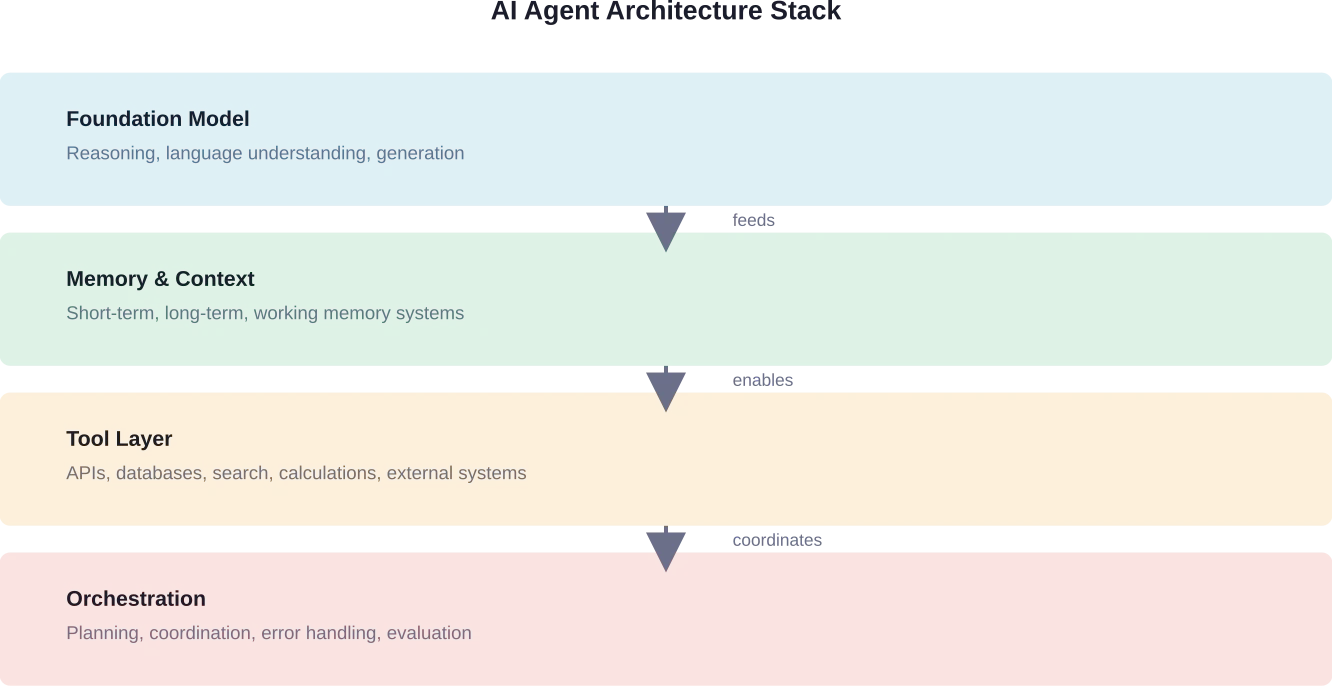
Every effective agent system builds on four foundational components that work together to enable autonomous operation.
Foundation Models and Providers
The model serves as the reasoning engine. Selection depends on task complexity, latency requirements, and cost constraints.
For customer-facing applications, response speed matters more than marginal accuracy improvements. For technical analysis, deeper reasoning capabilities justify longer processing times.
Models handle different aspects: planning, execution, evaluation. Some implementations use separate models for each role, optimizing for specific requirements.
Memory Systems
Agents need context that persists beyond individual interactions. Memory comes in multiple forms.
Short-term memory holds conversation history and immediate context. Long-term memory stores facts, preferences, and learned patterns. Working memory manages the current task state and intermediate results.
According to Anthropic's research on context engineering, the main agent coordinates with a high-level plan while subagents perform deep technical work. Each subagent might use tens of thousands of tokens but returns condensed summaries of 1,000-2,000 tokens.
Context is finite. Effective agents curate what matters.
Tool Integration
Tools extend agent capabilities beyond text generation. They enable database queries, API calls, calculations, file operations, and web searches.
The Model Context Protocol can empower agents with hundreds of tools to solve real-world tasks. But quantity doesn't equal quality.
Anthropic's guidance on writing effective tools emphasizes exposing response format parameters. Agents can control whether tools return concise or detailed responses, similar to GraphQL's field selection. This flexibility prevents context bloat while maintaining access to depth when needed.
Tool design matters as much as tool availability.
Reasoning and Planning
Breaking complex goals into executable steps requires structured reasoning. Agents need clear planning mechanisms that balance comprehensiveness with adaptability.
Some tasks require upfront decomposition—analyzing requirements, identifying subtasks, ordering operations. Others benefit from reactive planning that adjusts based on intermediate results.
The key is matching planning strategy to task characteristics.
Proven Design Patterns
Specific architectural patterns solve recurring coordination, error handling, and task decomposition challenges. Two have proven particularly powerful.
Orchestrator-Workers Pattern
For complex tasks where subtask quantity and nature can't be predetermined, this pattern provides scalability.
A central orchestrator analyzes incoming requests, decomposes them into subtasks, and distributes work to specialized worker agents. Workers execute their assigned tasks and return results. The orchestrator synthesizes outputs into coherent responses.
This separation of concerns enables parallel processing, specialized optimization, and independent scaling of coordination versus execution capabilities.
Research on the Orchestrator-Workers pattern shows this design approach excels for highly complex, variable workloads.
Reflexion Pattern for Reliability
Agents fail. The question is how they recover.
The Reflexion pattern enables self-healing through structured error analysis. When operations fail, agents don't just retry—they diagnose failure modes, analyze behavioral logs, and propose corrective changes.
Systems using reflexion patterns have demonstrated significant reduction in premature success notifications through self-healing approaches. The agent ingests execution logs, identifies what went wrong, and can even propose changes to its own prompts or code to prevent recurrence.
This transforms brittle automation into resilient systems.
|
Pattern |
Best For |
Key Benefit |
Complexity |
|---|---|---|---|
|
Orchestrator-Workers |
Variable, complex tasks |
Parallel processing, specialization |
Medium |
|
Reflexion |
Error-prone workflows |
Self-healing, reliability |
Medium-High |
|
Sequential Chain |
Fixed, ordered workflows |
Simplicity, predictability |
Low |
|
Hierarchical |
Nested planning problems |
Structured decomposition |
High |
Context Engineering Strategies
Context is critical but finite. Effective agents maximize relevance while minimizing bloat.
Start with selective inclusion. Not everything belongs in every context. Filter based on task requirements, relevance scoring, and recency.
Use hierarchical summarization for long histories. Keep detailed recent interactions but summarize older ones. This maintains temporal awareness without exhausting context windows.
Implement dynamic retrieval. Pull information on-demand rather than preloading everything. Tools can fetch specific facts when needed, keeping base context lean.
MIT CSAIL's EnCompass system, published February 5, 2026, demonstrated how backtracking and multiple attempts help find optimal LLM outputs. EnCompass reduced coding effort for implementing search by up to 80 percent across agents, such as an agent for translating code repos.
Tool Design Principles
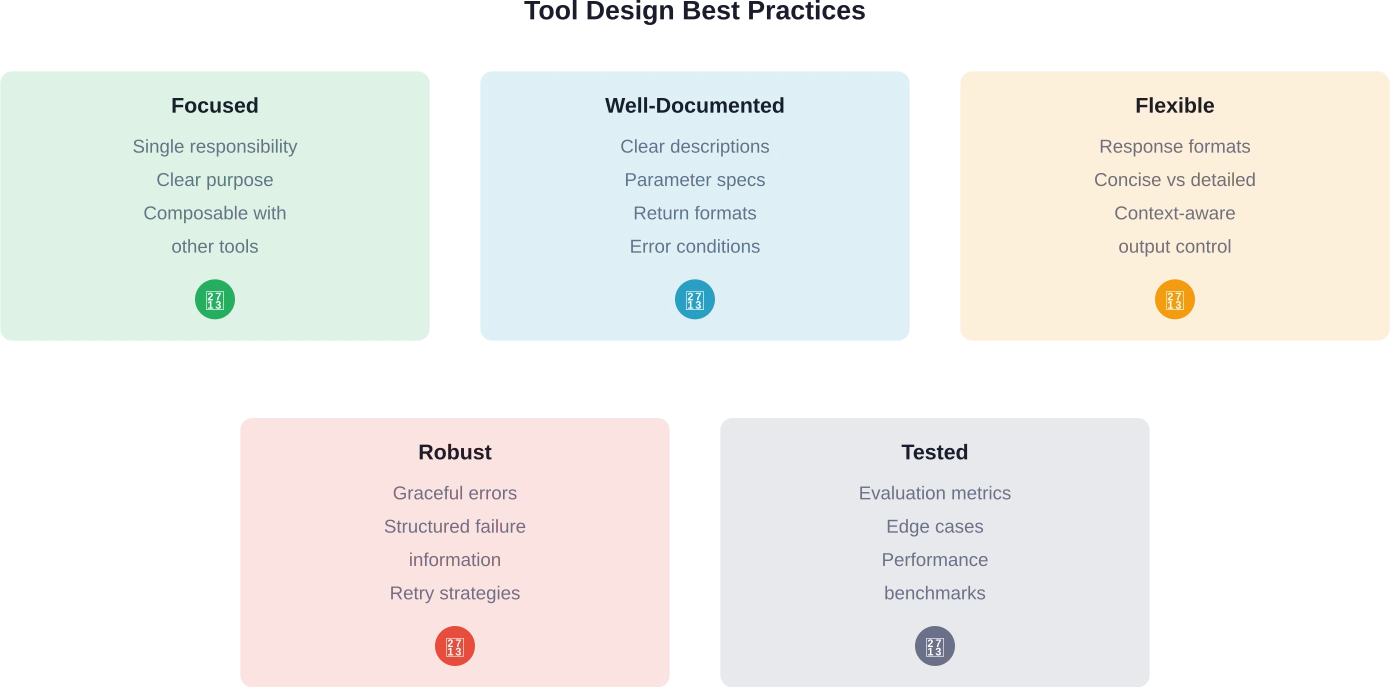
Agents are only as effective as their tools. Poor tool design creates bottlenecks even when the underlying model is capable.
Make tools focused and composable. Each tool should do one thing well. Complex operations compose multiple simple tools rather than creating monolithic functions.
Provide clear specifications. Tools need descriptions that explain purpose, parameters, return formats, and error conditions. The agent can't use what it doesn't understand.
Balance response detail. Anthropic's research shows exposing format parameters—concise versus detailed responses—prevents context waste. Agents can request minimal data for quick decisions or comprehensive information for complex analysis.
Handle errors gracefully. Tools should return structured error information, not just fail silently. This enables agents to diagnose issues and adjust strategies.
Evaluation and Guardrails
Building agents is iterative. Evaluation drives improvement.
Define success metrics that align with business objectives. Task completion rate matters more than abstract accuracy scores. Measure outcomes, not just outputs.
Research on Text Retrieval evaluation found large discrepancies between estimated and actual recall.
Implement guardrails at multiple levels. Input validation prevents malicious prompts. Output filtering catches inappropriate responses. Tool access controls limit potential damage from errors.
Test adversarially. Agents will encounter edge cases and hostile inputs in production. Proactive testing reveals vulnerabilities before deployment.
Practical Implementation Considerations
Theory meets reality during implementation. Several practical factors determine success.
Start simple. The most successful implementations use composable patterns, not complex frameworks. Add complexity only when simpler approaches prove insufficient.
Version everything. Prompts, tools, configurations—all should be version-controlled. Agent behavior changes with minor modifications. Reproducibility requires careful tracking.
Monitor continuously. Agents drift over time as models update and data distributions shift. Production monitoring catches degradation early.
Budget token usage carefully. Context windows are large but not infinite. Every token counts toward latency and cost.

Make AI Agent Principles Work In Your Product
Principles are a good starting point, but most teams hit friction when they try to apply them inside real systems. It usually comes down to integration, data flow, and how agents interact with existing tools.
OSKI Solutions focuses on implementing AI integrations within existing infrastructure. They use .NET, Node.js, and Python to connect agents with CRM, ERP, and other business systems, handling APIs, backend logic, and cloud environments on Azure or AWS. The goal is to make AI features work as part of the product, not as a separate layer.
If you’re planning to apply these principles in practice, it makes sense to review your setup with OSKI Solutions before building it out.
AI Agent Development Services
Build intelligent AI agents that automate workflows, make decisions, and scale your business operations. From strategy to deployment, we design custom solutions tailored to your needs.
Frequently Asked Questions
What's the difference between an AI agent and a standard LLM?
Standard LLMs generate responses in single interactions. AI agents operate across multiple steps, maintaining state, using tools, planning tasks, and adapting based on outcomes.
Which design pattern should I use for my agent?
Start with the simplest approach. Use sequential chains for fixed workflows, orchestrator-worker patterns for complex tasks, and Reflexion-style patterns when reliability and self-correction are important.
How do I manage context effectively?
Keep context minimal and relevant. Use summarization for long histories, retrieve information dynamically, and avoid loading unnecessary data into prompts.
What makes a good tool for an agent?
Good tools have a clear single purpose, structured inputs and outputs, strong documentation, and reliable error handling. They should integrate easily with other tools.
How do I evaluate agent performance?
Measure success based on task completion, quality of outcomes, efficiency, and business impact. Use both automated testing and human evaluation for best results.
Do I need a specialized framework to build agents?
No. Many effective systems rely on simple orchestration and prompt engineering. Frameworks should be introduced only when complexity requires additional structure.
What are the key risks in production agent deployments?
Risks include context overload, tool failures, hallucinations, security vulnerabilities, and rising costs. Mitigation requires monitoring, guardrails, and efficient system design.
Moving Forward with Agent Development
AI agents represent a paradigm shift in how intelligent systems interact with the world. The principles outlined here—composable architecture, effective context management, robust tool design, and continuous evaluation—provide a foundation for successful implementations.
Start with clear objectives. Understand what tasks agents should accomplish and why. Choose patterns that match problem characteristics, not architectural fashion.
Build iteratively. Simple implementations reveal requirements that theoretical planning misses. Ship early versions, measure outcomes, and refine based on evidence.
The agentic frontier is expanding rapidly. The NIST AI Agent Standards Initiative reflects growing recognition that interoperability and security standards will shape the field's future. Organizations that master these principles now position themselves to leverage advances as they emerge.
Ready to build? Start with one focused agent that solves a specific problem. Prove the value, learn from deployment, and expand systematically. The most successful agent implementations began as simple prototypes that demonstrated clear value.


