


Digital Transformation in Logistics: 2026 Guide

Quick Summary: Digital transformation in logistics involves adopting AI, IoT, automation, and data analytics to streamline operations, enhance visibility, and improve customer experience. The global digital logistics market is projected to grow from $37.64 billion in 2025 to $120.33 billion by 2032, with 70% of logistics companies already investing in these technologies.
The logistics sector is experiencing a seismic shift. Traditional methods that relied on paper trails and manual coordination are giving way to smart systems that predict, adapt, and optimize in real-time.
This isn't just about adopting new software. It's about fundamentally reimagining how goods move from origin to destination, how data flows through supply chains, and how companies respond to disruptions that once would have paralyzed operations for days.
But here's the thing—70% of logistics companies have already started their digital transformation journey. Yet the majority struggle with adoption and sustainability, not because the technology fails, but because the human element gets overlooked.
What Is Digital Transformation in Logistics?
Digital transformation in logistics represents the strategic integration of advanced technologies across the entire supply chain ecosystem. Technologies like artificial intelligence, machine learning, automation, and Big Data Analytics work together to streamline operations and improve customer experience.
Look, people have been using digital technologies in logistics for decades. What makes the current wave transformative?
The answer lies in connectivity and intelligence. New smart systems, AI, and Internet of Things devices don't just digitize existing processes—they create entirely new capabilities. Widespread digital documentation facilitates better standards of consistency and transparency that simply weren't possible with legacy systems.
According to MIT's Center for Transportation & Logistics, digital supply chain transformation is now the strategic imperative for competitive advantage in today's volatile landscape. It fundamentally reshapes operational capabilities, granting organizations the essential agility and resilience needed to thrive.
The Evolution From Digitization to Transformation
There's a critical distinction worth understanding. Digitization means converting analog information to digital format. Digitalization means using digital technologies to change business processes.
Digital transformation? That's the complete reimagining of business operations and value delivery through technology.
The logistics industry has progressed through several eras. Logistics 1.0 featured basic commercial exchanges. Logistics 2.0 emerged in the 19th century with the first automated systems. Logistics 3.0 came with computerization and improved traceability. Now, Supply Chain 4.0 combines advanced sensors, real-time analytics, and autonomous systems to create truly intelligent networks.
The Market Reality: Growth and Investment Trends
The numbers tell a compelling story. The global digital logistics market is predicted to grow from $37.64 billion in 2025 to $120.33 billion by 2032. That's a compound growth rate that far outpaces traditional logistics segments.
Investment patterns reveal even more. Digital transformation spending in logistics was only $3 billion in 2020. By 2023, estimates fluctuated around $60 billion. Expectations for 2030 exceed $120 billion.
This exponential growth reflects more than technological enthusiasm. It represents a fundamental business reality: companies that don't transform risk obsolescence.

Core Technologies Driving Transformation
Several technologies form the foundation of modern digital logistics. Each brings unique capabilities, but their real power emerges when integrated into cohesive systems.
Artificial Intelligence and Machine Learning
AI-powered tools process vast amounts of real-time data to improve demand forecasting accuracy. Companies can leverage these capabilities to optimize production and inventory plans across various locations and select the most cost-effective transportation routes.
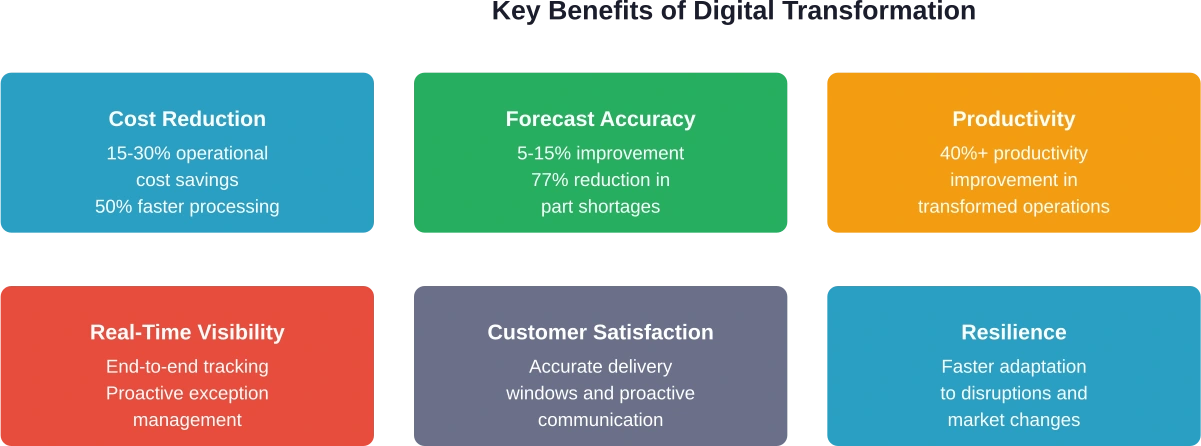
Real-world results from Dell's digital supply chain transformation demonstrate the impact. Their AI implementations drove a 5-15% improvement in long-range forecasts. More impressively, they achieved a 77% reduction in hard drive part shortages and delivered more than 40% productivity improvement.
The term artificial intelligence was first introduced in the 1950s, but practical application in logistics is relatively recent. The launch of accessible AI tools has accelerated adoption across the industry.
Internet of Things and Connected Devices
Approximately 90 percent of American adults currently own a smartphone. Virtual 3G/4G cellular networks and prevalent open WiFi networks enable travelers to experience uninterrupted connectivity.
This connectivity extends beyond personal devices. IoT sensors embedded in vehicles, containers, and warehouses provide continuous streams of location, temperature, humidity, and condition data. This real-time visibility enables proactive problem-solving rather than reactive firefighting.
Mobile applications have been developed to leverage this connectivity, giving logistics professionals access to critical information anywhere, anytime.
Automation and Robotics
Automation technologies reduce processing time by up to 50% in many logistics operations. Robotic systems handle repetitive tasks like sorting, packing, and loading with consistency that human workers simply can't match over extended periods.
But automation isn't about replacing humans entirely. It's about freeing logistics professionals from mundane tasks so they can focus on strategic decision-making, exception handling, and customer relationship management.
Big Data Analytics
The volume of data generated by modern logistics operations is staggering. GPS tracking, warehouse management systems, transportation management platforms, and customer interactions create millions of data points daily.
Big Data Analytics transforms this information overload into actionable intelligence. Patterns emerge that reveal inefficiencies, predict disruptions, and identify optimization opportunities that would be invisible to human analysis alone.
Measurable Benefits of Digital Transformation
Digital transformation delivers tangible improvements across multiple dimensions of logistics operations. These aren't theoretical advantages—they're documented outcomes from companies that have successfully implemented digital strategies.
Operational Efficiency and Cost Reduction
AI-driven route optimization lowers fuel consumption and reduces emissions. Automated systems minimize labor costs for repetitive tasks. Predictive maintenance prevents costly equipment failures and unplanned downtime.
The cumulative effect? Significant cost savings that directly impact the bottom line. Companies report operational cost reductions ranging from 15% to 30% after full digital transformation implementation.
Enhanced Visibility and Transparency
Real-time tracking capabilities provide end-to-end supply chain visibility. Stakeholders at every level—from warehouse managers to corporate executives to end customers—can access accurate, up-to-date information about shipment status and inventory levels.
Blockchain technology improves transparency in regulatory reporting and creates immutable records of custody transfers and compliance documentation.
Improved Customer Experience
Customer expectations have evolved dramatically. Same-day delivery, real-time tracking, and proactive communication about delays are no longer premium services—they're baseline requirements.
Digital transformation enables logistics companies to meet and exceed these expectations. Automated notifications, accurate delivery windows, and self-service tracking portals enhance satisfaction without requiring proportional increases in customer service staff.
Supply Chain Resilience
The COVID-19 pandemic exposed vulnerabilities in traditional supply chains. Companies with advanced digital capabilities adapted faster and recovered more quickly than those relying on legacy systems.
Digital twins—virtual replicas of physical supply chains—allow companies to simulate disruption scenarios and develop contingency plans before crises occur. This proactive approach builds resilience that protects business continuity during turbulent periods.
Critical Challenges and Obstacles
Digital transformation sounds great on paper. In practice, companies encounter significant hurdles that derail implementation efforts.
The People Problem
Here's a harsh truth: most digital transformation failures aren't technology failures. They're people's failures.
Employees resist changes that threaten familiar workflows. Middle managers worry about becoming obsolete. Executives struggle to articulate a compelling vision that motivates organizational buy-in.
Change management must be a catalyst for successful digital transformation in logistics. Without addressing the human dimension, even the most sophisticated technology implementations will fail to deliver expected returns.
Legacy System Integration
Many logistics companies operate on infrastructure built over decades. These legacy systems contain critical business logic and historical data that can't simply be discarded.
Integrating new digital platforms with existing systems requires careful planning, substantial investment, and often painful compromises. APIs and middleware can bridge some gaps, but technical debt accumulated over years creates persistent friction.
Data Quality and Standardization
Advanced analytics and AI require high-quality, standardized data inputs. Many logistics operations suffer from inconsistent data entry practices, siloed information repositories, and incomplete record-keeping.
Garbage in, garbage out. Before digital transformation can succeed, companies must establish data governance frameworks and cleanse existing datasets.
Cybersecurity Risks
Increased connectivity creates increased vulnerability. IoT devices, cloud platforms, and interconnected systems expand the attack surface available to malicious actors.
A ransomware attack that paralyzes logistics operations can cost millions in direct losses and reputational damage. Security must be built into digital transformation initiatives from day one, not bolted on afterward.
Competition and Market Disruption
Traditional logistics companies face heightened competition from tech-driven startups leveraging automation and AI-powered solutions from inception. These newcomers aren't burdened by legacy infrastructure or established organizational cultures resistant to change.
The competitive pressure forces incumbent companies to move faster than might be comfortable, sometimes leading to poorly planned implementations that create more problems than they solve.
Best Practices for Successful Implementation
Companies that successfully navigate digital transformation share common approaches. These best practices emerge from both academic research and real-world implementation experiences.
Start With Clear Strategic Objectives
Digital transformation isn't a goal unto itself—it's a means to achieve specific business outcomes. Define what success looks like before selecting technologies or launching initiatives.
Are you trying to reduce costs? Improve delivery speed? Enhance customer satisfaction? Increase supply chain resilience? Different objectives require different technology priorities and implementation sequences.
Adopt a People-Centric Approach
Driving sustainable digital transformation in logistics requires putting people at the center of change initiatives. That means:
- Communicating transparently about changes and their rationale
- Involving employees in design and implementation decisions
- Providing comprehensive training and ongoing support
- Addressing fears and resistance with empathy rather than mandates
- Celebrating early wins and recognizing adoption champions
Organizations that invest in change management alongside technology implementation achieve significantly higher success rates.
Take an Incremental Approach
Attempting comprehensive transformation all at once overwhelms organizations and increases risk. A phased approach allows learning, adjustment, and building momentum.
Start with pilot projects in limited scopes. Demonstrate value. Refine processes. Then scale successful initiatives while incorporating lessons learned.
Build Cross-Functional Teams
Digital transformation affects every aspect of logistics operations. Siloed implementations create integration nightmares and suboptimal outcomes.
Effective transformation requires collaboration between IT, operations, finance, customer service, and executive leadership. Cross-functional teams ensure diverse perspectives inform decisions and stakeholder buy-in develops organically.
Measure and Iterate
Establish clear metrics aligned with strategic objectives. Monitor performance continuously. Be willing to pivot when data indicates current approaches aren't delivering expected results.
Digital transformation is not a one-time project with a defined endpoint. It's an ongoing process of adaptation and improvement as technologies evolve and market conditions change.
|
Implementation Phase |
Key Activities |
Success Metrics |
Common Pitfalls |
|---|---|---|---|
|
Assessment |
Evaluate current state, identify gaps, define objectives |
Stakeholder alignment, clear business case |
Skipping this phase, unrealistic expectations |
|
Pilot |
Limited scope implementation, testing, learning |
Technical feasibility, user adoption, ROI validation |
Choosing too complex or too simple pilots |
|
Scale |
Broader rollout, process standardization, training |
Deployment speed, operational efficiency gains |
Scaling before pilot lessons incorporated |
|
Optimize |
Continuous improvement, advanced capabilities, integration |
Sustained performance improvement, user satisfaction |
Declaring victory too early, neglecting maintenance |

Bring Clarity And Control To Your Logistics Stack
In logistics, friction often shows up in day-to-day operations – delays in updates, mismatched data, and extra steps teams rely on just to keep things moving. These issues usually come from gaps between systems. OSKI Solutions helps address this by refining how platforms connect and how data moves across them.
They tend to work with teams that are already handling active operations and need more consistency as they grow. This can involve adjusting integrations between core systems, introducing more stable cloud setups, or building specific tools that remove recurring bottlenecks. The focus stays on making operations easier to track and manage over time. If your processes feel more complicated than they should be, it’s worth taking a closer look – contact OSKI Solutions and review what can be improved.
Accelerate Your Digital Transformation
Modernize your business with scalable technologies, automation, and data-driven strategies.
The Role of Leadership in Transformation
Executive leadership determines whether digital transformation initiatives succeed or fail. Technology leaders carry the responsibility for smoothing disruptions and driving adoption.
Effective leaders articulate a compelling vision that connects digital initiatives to business outcomes employees care about. They allocate resources—budget, personnel, and attention—proportional to transformation priorities.
But wait. Leadership isn't just about executives. Middle managers serve as critical translation layers, helping front-line workers understand how new technologies affect daily responsibilities.
Organizations must develop digital leadership capabilities at multiple levels to sustain transformation momentum over the multi-year timelines required for full implementation.
Emerging Trends Shaping the Future
Digital transformation in logistics continues evolving as new technologies mature and enter mainstream adoption.
Autonomous Vehicles and Drones
Self-driving trucks and delivery drones promise to revolutionize last-mile logistics. Regulatory frameworks are gradually adapting to accommodate these technologies, though widespread deployment remains several years away in most markets.
Advanced AI and Predictive Analytics
Machine learning models continue improving in accuracy and sophistication. Predictive analytics will transition from forecasting demand to prescribing optimal actions across entire supply chain networks.
Sustainability Integration
Environmental concerns are driving logistics companies to use digital tools for emissions tracking, route optimization that prioritizes fuel efficiency, and transparent reporting to meet regulatory requirements.
AI-driven route optimization can lower emissions significantly, while blockchain technology improves transparency in regulatory reporting.
5G and Edge Computing
Next-generation wireless networks enable more devices to connect with lower latency. Edge computing processes data closer to collection points, enabling real-time decision-making without cloud round trips.
These infrastructure improvements will unlock capabilities currently constrained by connectivity limitations.
Industry-Specific Applications
Digital transformation manifests differently across logistics segments. Each sector faces unique challenges and opportunities.
Freight and Trucking
Digital freight matching platforms connect shippers with available capacity more efficiently than traditional broker models. Electronic logging devices ensure compliance while generating data for route optimization.
Predictive maintenance sensors prevent breakdowns that create cascading delays across delivery networks.
Warehousing and Distribution
Automated storage and retrieval systems maximize space utilization and picking speed. Warehouse management systems integrated with AI optimize inventory placement based on demand patterns.
Robotic process automation handles repetitive administrative tasks like invoice processing and shipment documentation.
Last-Mile Delivery
Route optimization algorithms account for traffic patterns, delivery windows, and vehicle capacity to minimize costs and maximize on-time performance.
Customer communication platforms provide real-time tracking and enable flexible delivery options like contactless drop-off or secure locker pickup.
Frequently Asked Questions
What is the difference between digitization and digital transformation in logistics?
Digitization converts analog information to digital format, such as scanning paper documents. Digital transformation fundamentally reimagines business processes and operations using technology to create new capabilities and value. Transformation is strategic and comprehensive, while digitization is tactical and focused on specific conversions.
How long does digital transformation take in logistics companies?
Full digital transformation typically requires three to five years for enterprise logistics companies. Timelines depend on organization size, legacy system complexity, available resources, and scope. Most companies adopt phased approaches, with pilot projects delivering value within 6–12 months, while full transformation remains ongoing.
What percentage of logistics companies have started digital transformation?
Approximately 70% of enterprise logistics companies have initiated some level of digital transformation as of 2026. However, many face challenges with adoption and sustainability, particularly related to change management, employee resistance, and system integration complexity rather than technology limitations.
What ROI can companies expect from digital transformation investments?
Organizations report operational cost reductions of 15–30%, productivity improvements exceeding 40%, and forecast accuracy gains of 5–15%. Most companies achieve positive ROI within 18–24 months for well-executed initiatives, with increasing benefits as systems mature over time.
Do logistics companies need to replace all legacy systems for digital transformation?
No, full replacement is usually unnecessary. Successful strategies integrate new digital capabilities with existing systems using APIs, middleware, and phased migration approaches. Legacy systems can continue to operate while new platforms enhance functionality, provided data flows seamlessly across systems.
What skills do logistics professionals need for digital transformation?
Key skills include data analytics, system integration, and understanding of AI and IoT technologies. Equally important are soft skills such as adaptability, problem-solving, change management, and cross-functional collaboration. Many organizations prioritize upskilling their existing workforce through training programs.
How do small and mid-sized logistics companies compete with larger firms in digital transformation?
Smaller companies benefit from agility, fewer legacy constraints, and faster decision-making. They can leverage cloud-based solutions, partner with specialized technology providers, and focus on niche markets. Many succeed by adopting modern technologies faster than larger competitors burdened by legacy infrastructure.
Moving Forward: Your Digital Transformation Journey
Digital transformation in logistics isn't optional anymore—it's existential. The global market is expanding rapidly, competitive pressure is intensifying, and customer expectations continue rising.
Companies that successfully navigate this transformation will build resilient, efficient operations capable of adapting to whatever disruptions the future brings. Those that delay or execute poorly risk irrelevance in an increasingly technology-driven market.
The good news? You don't need to solve everything at once. Start with clear objectives tied to business outcomes. Involve your people in the journey. Choose pilot projects that can demonstrate value quickly. Learn, iterate, and scale what works.
Real talk: the technology exists to transform logistics operations dramatically. The limiting factor isn't capability—it's organizational willingness to embrace change and commit to the multi-year journey required for sustainable transformation.
The question isn't whether to pursue digital transformation. It's whether to lead the change or be forced to follow once competitors have established insurmountable advantages.
Ready to begin your digital transformation journey? Start by assessing your current state, defining success metrics aligned with business objectives, and identifying quick-win opportunities that build momentum for larger initiatives. The future of logistics is digital—and that future is now.


