


Digital Transformation in Higher Education: 2026 Guide

Quick Summary: Digital transformation in higher education is reshaping how institutions deliver education, manage operations, and serve students through technology integration. According to the U.S. Department of Education, strategic technology adoption improves student outcomes and institutional efficiency. Successful transformation requires modernizing infrastructure, enhancing digital literacy, leveraging data analytics, and aligning technology investments with institutional mission and student needs.
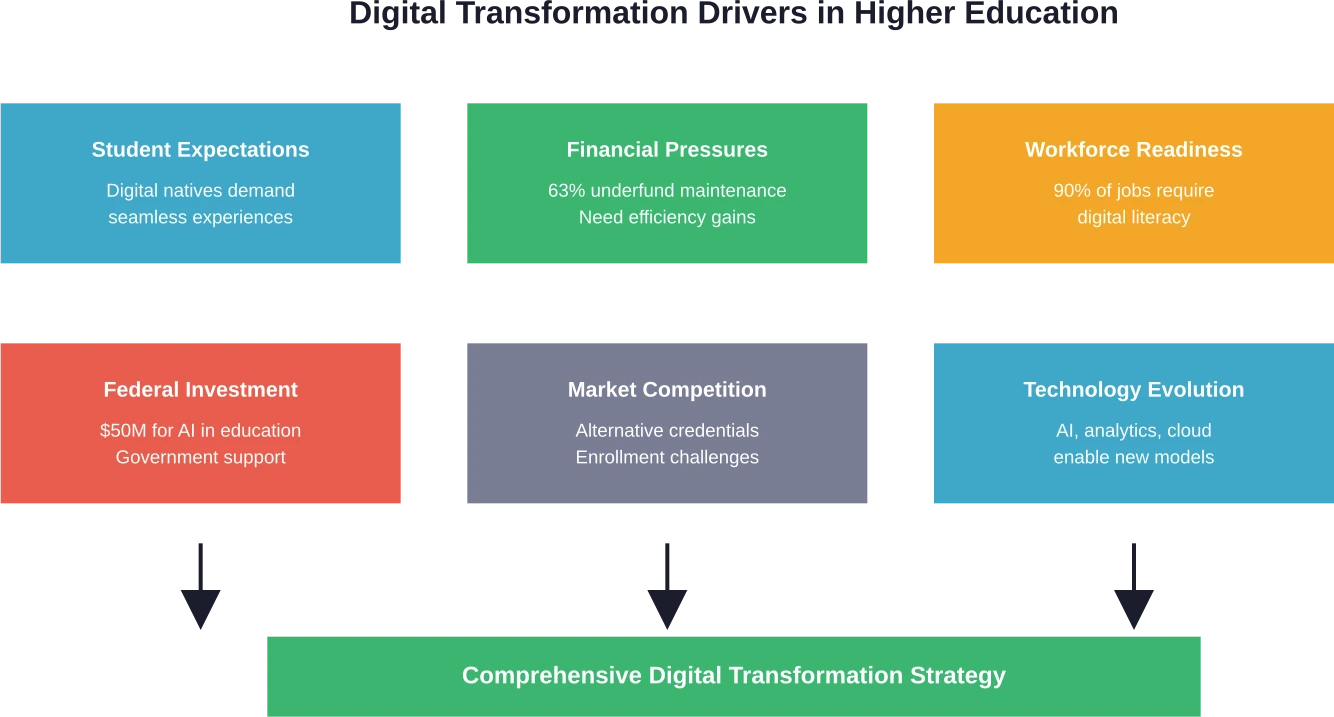
The higher education landscape has fundamentally changed. Students expect seamless digital experiences. Faculty demand better teaching tools. Administrators need data-driven insights.
And institutions that don't adapt? They're falling behind.
Digital transformation in higher education isn't just about installing new software or going paperless. It's a comprehensive reimagining of how colleges and universities operate, teach, and serve their communities. The COVID-19 pandemic accelerated what was already inevitable—a complete digital overhaul of institutional processes, learning delivery, and student engagement.
According to the U.S. Department of Education's priorities under the Fund for the Improvement of Postsecondary Education (FIPSE) for the FY 2025 competition, $50 million was allocated for the area of national need focusing on AI, divided into two priorities that leverage AI technology to improve student outcomes. These awards were expected by December 31, 2025, signaling how seriously federal agencies take digital transformation.
But here's the thing—throwing money at technology doesn't guarantee success. Institutions need strategic frameworks, clear implementation approaches, and realistic understanding of the challenges ahead.
What Digital Transformation Actually Means for Higher Education
Digital transformation goes beyond digitizing existing processes. It's about fundamentally rethinking how education happens.
Think about Netflix. The company didn't just put DVDs online—it transformed how people consume entertainment. According to research on digital transformation patterns, 89% of video streaming subscribers use Netflix, and 25% of single-service subscribers only use Netflix for streaming. That's transformation, not just digitization.
Higher education institutions face a similar paradigm shift. The application of data and technology creates innovation in the entire student experience—from recruitment through graduation and beyond.
Core Components of Digital Transformation
Digital transformation in higher education rests on several foundational elements that work together:
- Infrastructure modernization: Upgrading networks, cloud services, and digital platforms
- Data analytics and insights: Using predictive analytics to improve student success and operational efficiency
- Digital learning environments: Creating flexible, accessible educational experiences
- Process automation: Streamlining administrative tasks and workflows
- Cybersecurity and privacy: Protecting institutional and student data
- Digital literacy development: Building capabilities among faculty, staff, and students
Research indicates that 90% of future jobs require some level of digital literacy. Institutions aren't just serving today's students—they're preparing tomorrow's workforce.
The Strategic Imperative: Why Transform Now
Institutions can't afford to wait. Multiple forces are converging to make digital transformation urgent.
According to NACUBO's State of Higher Education report on the Top 5 Business Issues of 2025, more than 600 higher education business officers and other financial and administrative professionals identified pressing challenges that digital transformation directly addresses. The report highlighted institutional reputation, financial resilience, and operational efficiency as critical concerns.
The financial reality is stark. According to Inside Higher Ed data cited in NACUBO research, 63% of institutions funded less than a quarter of their maintenance needs in FY24. Moody's has projected up to $1 trillion in deferred maintenance costs across higher education.
Digital transformation offers a path to do more with less—automating processes, reducing operational costs, and reallocating resources to mission-critical activities.
Student Expectations Have Changed
Today's students are digital natives. They expect:
- Mobile-friendly interfaces for everything
- 24/7 access to services and support
- Personalized learning experiences
- Immediate feedback and communication
- Seamless integration between systems
Institutions that can't meet these expectations lose students to competitors who can. It's that simple.
Competitive Pressure and Market Dynamics
The higher education market is increasingly competitive. Enrollment challenges, demographic shifts, and alternative credentialing options put pressure on traditional institutions.
Digital transformation enables institutions to expand access, reach new student populations, and deliver education more flexibly. Online and hybrid programs aren't emergency measures anymore—they're permanent features of the educational landscape.
Seven Key Areas for Digital Transformation Investment
Not all digital investments deliver equal value. Institutions need to prioritize strategically.
Based on patterns from successful transformations, seven areas consistently deliver high impact:
1. Learning Management Systems and Digital Learning Platforms
The LMS isn't just a tool anymore—it's the central hub of the learning experience. Modern platforms integrate with video conferencing, assessment tools, plagiarism detection, and student support services.
But having an LMS isn't enough. According to research from EDUCAUSE and NACUBO, institutions need to make LMS data actionable. Analytics reveal which students struggle, which content works, and where interventions help.
Advanced institutions use predictive analytics to identify at-risk students before they fail or drop out.
2. Student Information Systems and Administrative Platforms
Outdated student information systems create bottlenecks throughout institutions. Modern cloud-based solutions integrate admissions, registration, financial aid, billing, and student services.
The goal? Students should complete most administrative tasks from their phones without visiting multiple offices or logging into separate systems.
3. Data Analytics and Business Intelligence
Data is everywhere in higher education. The challenge is turning it into insights.
Institutions generate data from enrollment, course performance, financial systems, facilities, library usage, and hundreds of other sources. Analytics platforms consolidate this information into dashboards that support decision-making.
Predictive analytics can forecast enrollment trends, identify retention risks, optimize course scheduling, and improve resource allocation.
4. Artificial Intelligence and Automation
According to EDUCAUSE research conducted in partnership with NACUBO, most higher education professionals are already using AI tools for various work activities. The report, based on survey responses from 1,960 higher education professionals, explores AI adoption, operational use cases, and institutional strategies.
AI applications in higher education include:
- Chatbots for student support and admissions questions
- Automated grading and feedback for certain assignment types
- Personalized learning recommendations
- Predictive modeling for student success
- Administrative process automation
The U.S. Department of Education's $50 million investment in AI for educational outcomes demonstrates the technology's strategic importance.
5. Cybersecurity and Data Privacy Infrastructure
Digital transformation expands the attack surface. More systems, more data, more access points—all create security vulnerabilities.
Institutions hold sensitive student data, research information, financial records, and health information. Breaches damage reputation, trigger legal liabilities, and erode trust.
Security can't be an afterthought. It needs to be embedded in every transformation initiative from day one.
6. Cloud Infrastructure and IT Modernization
The shift to cloud computing fundamentally changes how institutions manage technology. Cloud platforms offer scalability, flexibility, and often lower total cost of ownership compared to on-premises infrastructure.
According to the U.S. Department of Education's Digital Government Strategy, the 21st Century Integrated Digital Experience Act (21st Century IDEA) requires federal agencies—and by extension, federally-funded programs—to ensure mobile friendliness, accessibility, consistency of appearance, use of plain language, and non-duplicative content.
These same principles apply to higher education digital services.
7. Digital Accessibility and Inclusive Design
Digital transformation must be inclusive. Technology should expand access, not create new barriers.
Accessibility isn't just legal compliance—it's about serving all students effectively. Screen reader compatibility, captioning, alternative formats, and universal design principles ensure everyone can participate fully.
|
Investment Area |
Primary Benefit |
Implementation Complexity |
Typical Timeline |
|---|---|---|---|
|
Learning Management Systems |
Enhanced teaching and learning |
Medium |
6-12 months |
|
Student Information Systems |
Streamlined administration |
High |
12-24 months |
|
Data Analytics Platforms |
Data-driven decision making |
Medium-High |
9-18 months |
|
AI and Automation Tools |
Efficiency and personalization |
Medium |
3-12 months |
|
Cybersecurity Infrastructure |
Risk mitigation and compliance |
High |
Ongoing |
|
Cloud Migration |
Scalability and cost management |
High |
12-36 months |
|
Accessibility Improvements |
Inclusive access for all users |
Medium |
6-18 months |
Critical Challenges and Practical Dilemmas
Digital transformation sounds great in theory. Implementation reveals harder truths.
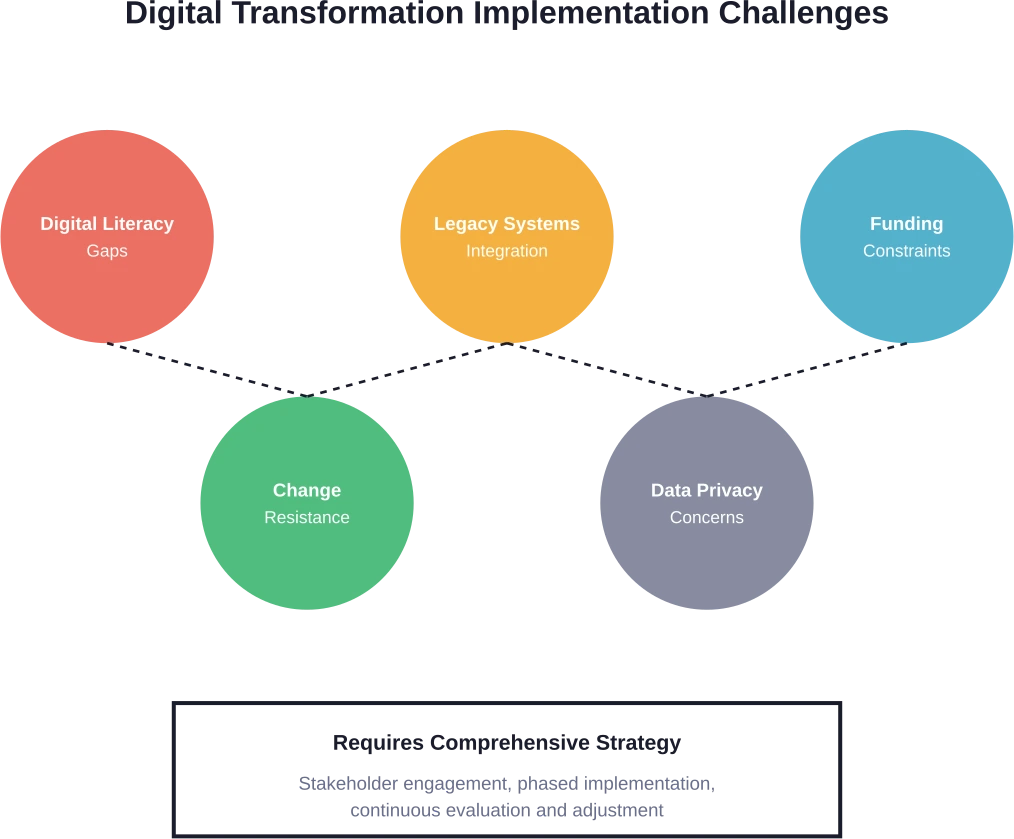
Disparate Digital Literacy Among Faculty and Students
Not everyone starts from the same place. Faculty digital literacy varies enormously—from tech-savvy early adopters to those who struggle with basic tools.
Research on digital transformation challenges identifies this as a primary barrier. Training programs help, but they require time, resources, and genuine commitment to professional development.
Students also show varying comfort levels with educational technology, despite being digital natives. Using social media doesn't automatically translate to learning management system proficiency or digital research skills.
Legacy Systems and Technical Debt
Many institutions run on decades-old systems. These legacy platforms don't integrate easily with modern tools. Data is siloed. Processes are inefficient.
But replacing legacy systems is expensive, risky, and disruptive. The University of Auckland's blueprint for improving administrative efficiency demonstrates how institutions can tackle this systematically—but it requires sustained effort and resources.
Funding Constraints and Competing Priorities
According to NACUBO's research, financial resilience remains a top concern for higher education business officers. Institutions face pressure to control costs while investing in transformation.
The 2023 NACUBO Tuition Discounting Study showed that private, nonprofit institutions provided institutional aid to more than 90% of first-time, full-time undergraduates, with aid covering on average 62% of listed tuition and fee price. This level of discounting puts additional pressure on operating budgets.
Digital transformation requires upfront investment. Demonstrating ROI takes time. Securing budget approval means competing with facility needs, academic programs, and student services.
Change Management and Organizational Culture
Technology is the easy part. People are harder.
Successful transformation requires cultural change. Faculty need to adopt new teaching approaches. Staff must learn new systems. Administrators have to embrace data-driven decision making.
Resistance is natural. People fear losing their jobs to automation. They're comfortable with familiar processes. They question whether new approaches actually improve outcomes.
Effective change management addresses these concerns through communication, training, support, and involving stakeholders in planning and implementation.
Data Privacy, Security, and Ethical Considerations
More data creates more responsibility. Institutions must protect student privacy while leveraging data for improvement.
AI raises additional ethical questions. How transparent should algorithms be? Who's accountable when automated systems make mistakes? How do institutions prevent bias in algorithmic decision-making?
These aren't just theoretical concerns—they have real implications for students and institutional reputation.
Proven Implementation Strategies
Successful digital transformation follows patterns. Institutions that do it well share common approaches.
Start With Strategic Alignment
Technology for technology's sake fails. Every digital initiative should connect to institutional mission, strategic priorities, and measurable outcomes.
Ask: How does this technology improve student success? Does it enhance operational efficiency? Will it expand access or strengthen the institution's competitive position?
If the answer isn't clear, reconsider the investment.
Build a Logical Framework
Research on digital transformation frameworks identifies several critical components that successful institutions address systematically:
- Vision and leadership: Senior leadership must champion transformation and communicate why it matters
- Governance structure: Clear decision-making processes and accountability
- Resource allocation: Dedicated funding and staff for transformation initiatives
- Technology infrastructure: Modern, scalable platforms that integrate effectively
- Professional development: Ongoing training and support for faculty and staff
- Assessment and iteration: Regular evaluation and adjustment based on outcomes
Take a Phased Approach
Trying to transform everything at once overwhelms institutions. Successful transformations happen in phases.
Start with high-impact, lower-complexity initiatives that build momentum and demonstrate value. Use early wins to secure support for more ambitious projects.
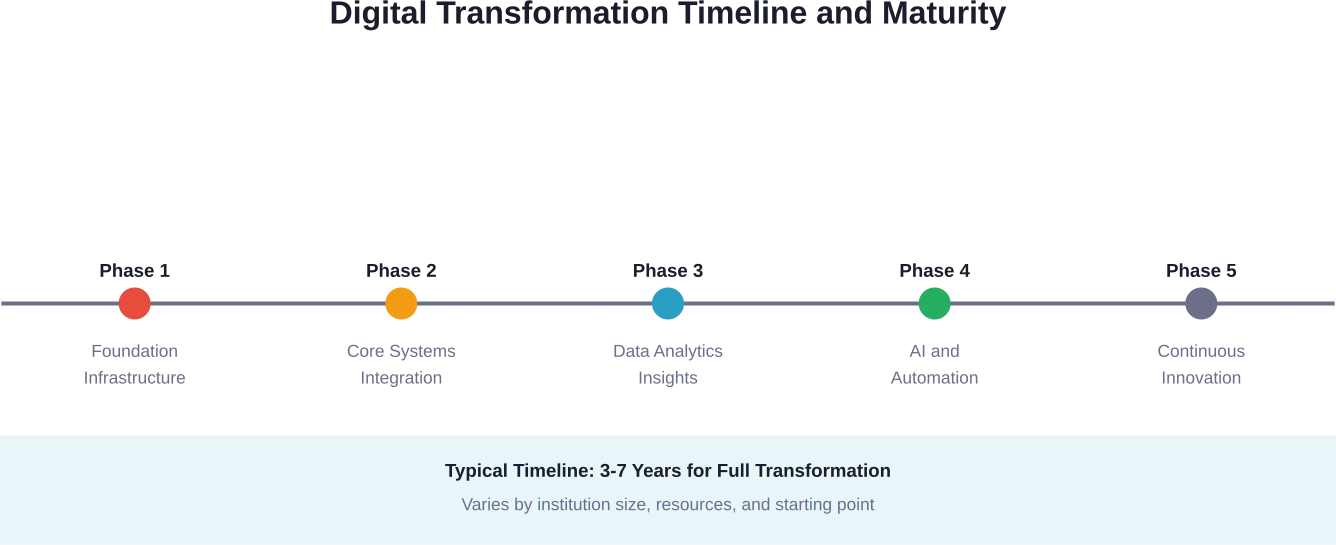
Typical phases might include:
- Foundation building: Infrastructure upgrades, cloud migration, cybersecurity improvements
- Core system implementation: Student information systems, LMS enhancements, key administrative platforms
- Data and analytics: Business intelligence tools, dashboards, predictive modeling
- Advanced technologies: AI applications, automation, personalization engines
- Continuous improvement: Ongoing optimization, new capabilities, emerging technologies
Prioritize User Experience
The best technology means nothing if people can't or won't use it. Design matters.
According to the 21st Century Integrated Digital Experience Act (21st Century IDEA) principles that guide federal digital services, systems should be mobile-friendly, accessible, consistent in appearance, use plain language, and avoid duplicative content.
These principles apply equally to higher education. Students, faculty, and staff shouldn't need extensive training to complete basic tasks.
Invest in Professional Development
Technology changes constantly. Skills development can't be a one-time event.
Institutions need ongoing professional development programs that help faculty integrate technology into teaching, support staff in using new systems effectively, and build digital literacy across the campus community.
Peer learning, communities of practice, and just-in-time support often work better than formal training sessions alone.
Measure What Matters
How do institutions know if transformation is working? They measure outcomes, not just outputs.
Don't just count how many people completed training or how many systems were implemented. Measure whether student outcomes improved, whether processes became more efficient, whether costs decreased, or whether satisfaction increased.
Link technology investments to institutional key performance indicators and strategic goals.

Fix What Slows Down Your Academic Systems
In higher education, digital transformation often runs into the same issue – too many disconnected systems. LMS platforms, student information systems, research tools, and internal admin software rarely evolve together. Over time, this creates gaps in data, duplicated work, and constant workarounds. Instead of replacing everything, most institutions need targeted improvements – better integrations, stable data exchange, and custom features that fit existing workflows. OSKI Solutions works on these kinds of problems, focusing on practical fixes that make systems easier to manage.
They usually support teams that already have functioning platforms but need to improve how those systems scale and interact. That can include extending LMS capabilities, integrating internal systems through APIs, or moving parts of the infrastructure to the cloud without disrupting daily operations. The approach is gradual – resolve bottlenecks first, then build on top of that. If your systems feel harder to manage than they should be, reach out to OSKI Solutions and take the next step.
Accelerate Your Digital Transformation
Modernize your business with scalable technologies, automation, and data-driven strategies.
The Role of Federal Investment and Policy
Federal support shapes digital transformation across higher education.
The U.S. Department of Education's initiatives demonstrate government commitment to advancing technology in postsecondary education. The $50 million allocation for AI advancement represents just one component of broader federal digital strategy.
According to the Information Technology & Innovation Foundation (ITIF, September 2025), a 20% reduction in federal R&D investments starting in FY26 (approximately $40 billion cut from FY25 levels) and maintained for 10 years would reduce cumulative U.S. GDP by $717 billion (with estimates ranging up to $1–1.5 trillion depending on the benchmark scenario).
Higher education institutions benefit from federal R&D funding both directly and indirectly. Federally funded research and development centers spent $31.7 billion on R&D in FY 2024, representing a $14.0 billion increase from FY 2014 in current dollars.
The Department of Defense funded R&D at more FFRDCs than any other federal agency, but the National Science Foundation also plays a critical role in supporting research and innovation that drives digital transformation.
Compliance and Modernization Requirements
Federal regulations increasingly require digital accessibility, data security, and modern user experiences. Institutions receiving federal funding must ensure their digital services meet these standards.
The 21st Century IDEA requires agencies to provide prioritized lists of their most-viewed or otherwise important public websites and digital services targeted for modernization. Higher education institutions receiving federal support face similar expectations.
Looking Ahead: Emerging Technologies and Future Trends
Digital transformation isn't a destination—it's an ongoing journey. Several emerging trends will shape the next phase.
Extended Reality and Immersive Learning
Virtual reality, augmented reality, and mixed reality create new possibilities for experiential learning. Students can explore historical sites, practice medical procedures, or conduct virtual lab experiments.
As the technology becomes more accessible and affordable, adoption will accelerate.
Blockchain for Credentials and Records
Blockchain technology offers secure, verifiable, portable credentials. Students could own their educational records and share them directly with employers or other institutions without intermediaries.
Several institutions are piloting blockchain-based credentials, though widespread adoption remains in early stages.
Advanced AI and Machine Learning Applications
AI capabilities continue evolving rapidly. Future applications might include:
- Fully personalized learning pathways that adapt in real-time
- Sophisticated tutoring systems that rival human support
- Automated curriculum design based on learning science and labor market data
- Predictive models that identify optimal interventions for individual students
The ethical implications grow alongside the capabilities. Institutions must thoughtfully consider how to deploy these technologies responsibly.
Internet of Things and Smart Campus Infrastructure
Connected devices throughout campus can optimize energy use, improve safety, enhance facilities management, and create responsive learning environments.
Smart classrooms adjust lighting and temperature automatically. Buildings report maintenance needs before systems fail. Campus apps guide students to available study spaces.
5G Networks and Enhanced Connectivity
Faster, more reliable connectivity enables new applications and experiences. 5G networks support real-time collaboration, high-quality streaming, IoT deployments, and bandwidth-intensive applications.
Institutions investing in network infrastructure position themselves to take advantage of emerging technologies.
Real-World Success Indicators
What does successful digital transformation actually look like in practice?
Institutions can assess their progress using several concrete indicators:
|
Success Metric |
What to Measure |
Target Outcome |
|---|---|---|
|
Student Satisfaction |
Surveys on digital service quality |
80%+ satisfaction with digital tools |
|
Administrative Efficiency |
Time to complete key processes |
30-50% reduction in processing time |
|
System Integration |
Number of manual data transfers |
90%+ automated data flow |
|
Digital Adoption |
Active users of key platforms |
85%+ regular platform usage |
|
Faculty Engagement |
Use of digital teaching tools |
75%+ faculty using advanced features |
|
Cost Savings |
Operational cost reductions |
15-25% efficiency gains over 3 years |
|
Student Outcomes |
Retention and completion rates |
5-10% improvement in key metrics |
|
Security Posture |
Incidents and vulnerabilities |
Zero major breaches, declining incidents |
Case Study Patterns
Research on digital transformation case studies reveals common patterns among successful institutions:
- Strong executive sponsorship: Presidents, provosts, or CFOs champion transformation and hold teams accountable.
- Cross-functional governance: Technology decisions involve academic affairs, student services, finance, and other stakeholders—not just IT departments.
- Dedicated resources: Institutions allocate specific budget and staff to transformation initiatives rather than expecting existing teams to absorb additional work.
- Iterative implementation: Rather than big-bang deployments, successful institutions pilot, learn, adjust, and scale.
- User-centered design: Students and faculty participate in planning and testing to ensure solutions meet actual needs.
Practical Next Steps for Institutions
Ready to advance digital transformation? Start here.
Conduct a Digital Maturity Assessment
Before planning where to go, understand where the institution currently stands. Assess:
- Current technology infrastructure and systems
- Digital capabilities of faculty, staff, and students
- Integration between systems and data quality
- User satisfaction with digital services
- Cybersecurity posture and compliance status
- Budget allocated to technology and transformation
This baseline assessment informs strategy and helps prioritize investments.
Define Clear Objectives and Success Metrics
What should digital transformation accomplish? Connect technology goals to institutional priorities.
If improving student retention is a priority, focus on early warning systems, advising tools, and engagement platforms. If operational efficiency matters most, prioritize automation, workflow optimization, and system integration.
Establish measurable targets and timelines.
Build a Coalition of Champions
Transformation requires support across the institution. Identify champions in academic departments, student services, administration, and other areas.
These champions advocate for change, provide feedback on initiatives, and help overcome resistance.
Start Small, Think Big
Select one or two high-impact initiatives to launch first. Quick wins build momentum and credibility for larger efforts.
But even while starting small, maintain the broader vision. Ensure early projects fit into the long-term transformation architecture.
Invest in Change Management
Technology projects fail when organizations neglect the people's side. Change management isn't optional—it's essential.
Communicate why transformation matters. Involve stakeholders in planning. Provide training and support. Celebrate successes. Address concerns openly.
Create Feedback Loops
Regular assessment and adjustment keep transformation on track. Establish mechanisms to gather user feedback, monitor metrics, and identify issues early.
Quarterly reviews with governance committees help maintain accountability and allow course corrections.
Common Mistakes to Avoid
Learning from others' mistakes saves time and resources.
Technology-First Thinking
Selecting technology before defining requirements leads to poor outcomes. Start with needs, processes, and desired outcomes—then find technology that fits.
Underestimating Change Management
Even the best technology fails without user adoption. Allocate at least 30% of transformation budgets to change management, training, and communication.
Ignoring Data Quality
Analytics and AI depend on clean, accurate data. Migrating bad data to new systems just creates expensive new problems.
Invest in data governance, cleanup, and quality processes before implementing advanced analytics.
Lack of Integration Planning
Buying best-of-breed point solutions creates integration nightmares. Plan how systems will connect and share data from the beginning.
Insufficient Security Consideration
Bolting on security after implementation costs more and works worse than building it in from the start. Include security requirements in every technology decision.
Unrealistic Timelines
Major system implementations take longer than vendors promise. Build buffers into timelines and set realistic expectations with stakeholders.
Frequently Asked Questions
What is digital transformation in higher education?
Digital transformation in higher education is the comprehensive integration of digital technologies into all aspects of institutional operations, teaching, and learning. It goes beyond simply digitizing existing processes to fundamentally rethinking how institutions deliver education, serve students, and manage operations. According to the U.S. Department of Education's digital strategy initiatives, transformation includes infrastructure modernization, data analytics, accessibility improvements, and the use of emerging technologies like AI to improve student outcomes.
How much does digital transformation cost for colleges and universities?
Costs vary significantly based on institution size, starting point, and scope. Comprehensive transformation requires sustained multi-year investment. Large-scale systems like student information platforms can cost millions for large institutions. The U.S. Department of Education allocated $50 million for AI advancement in FY 2025, reflecting the scale of investment. Institutions typically allocate 4–7% of operating budgets to technology, with additional funding for transformation initiatives.
What are the biggest challenges in digital transformation for higher education?
Key challenges include varying levels of digital literacy, legacy system integration, limited funding, resistance to organizational change, and data privacy concerns. NACUBO research highlights that many institutions underfund maintenance needs, creating competing priorities. Often, managing cultural change is more difficult than implementing technology itself.
How long does digital transformation take in higher education?
Digital transformation typically takes 3–7 years depending on institutional size and readiness. Infrastructure upgrades may take 6–18 months, core systems 12–24 months, and advanced capabilities like AI and analytics another 12–24 months. However, transformation is continuous as technologies and institutional needs evolve.
What role does AI play in higher education digital transformation?
AI is becoming central to transformation strategies. EDUCAUSE research shows widespread adoption among higher education professionals. Use cases include chatbots, automated grading, personalized learning, predictive analytics, and administrative automation. The U.S. Department of Education’s investment in AI highlights its importance in improving educational outcomes.
How can institutions measure digital transformation success?
Success should align with institutional goals and student outcomes. Key metrics include student satisfaction (80%+), administrative efficiency improvements (30–50% faster processes), system integration levels (90%+ automation), platform adoption rates (85%+ usage), cost savings (15–25% over 3 years), and improved retention and completion rates (5–10% gains). Continuous measurement ensures ongoing improvement.
What federal support is available for digital transformation in higher education?
Federal support includes funding programs and research investments. The U.S. Department of Education allocated $50 million for AI initiatives in FY 2025. Broader federal R&D spending and federally funded research centers also contribute to innovation. Regulatory frameworks like the 21st Century Integrated Digital Experience Act further drive modernization by requiring accessible, secure, and user-centered digital services.
Conclusion: Embracing the Digital Future
Digital transformation in higher education isn't optional anymore. It's the foundation for institutional relevance, student success, and operational sustainability.
The landscape is clear. Students expect seamless digital experiences. Faculty need powerful teaching tools. Administrators require data-driven insights. Federal policy increasingly mandates modern, accessible digital services.
Institutions that embrace transformation strategically—with clear vision, adequate resources, strong governance, and genuine commitment to change—position themselves for success. Those that delay or approach transformation haphazardly risk falling further behind competitors who move decisively.
The U.S. Department of Education's $50 million investment in AI for educational outcomes signals federal commitment to supporting this transformation. Research showing $31.7 billion in federally-funded R&D spending demonstrates ongoing innovation that drives new capabilities.
But technology alone doesn't guarantee success. The most sophisticated systems fail without user adoption. The most expensive platforms deliver no value if they don't serve actual needs. The most ambitious strategies collapse without sustained leadership and resources.
Successful transformation requires balancing ambition with pragmatism. Start with clear objectives tied to institutional priorities. Build strong governance and stakeholder engagement. Take a phased approach that delivers quick wins while progressing toward comprehensive change. Invest heavily in change management, training, and communication. Measure outcomes rigorously and adjust strategies based on evidence.
The digital transformation journey challenges institutions to reimagine fundamental aspects of their operations and mission. It's difficult work. It's also essential work.
Institutions that navigate this transformation effectively won't just survive—they'll thrive, delivering better outcomes for students, operating more efficiently, and fulfilling their missions more effectively than ever before.
The question isn't whether to pursue digital transformation. The question is how quickly and strategically institutions can execute it.
Ready to advance digital transformation at your institution? Start by assessing current digital maturity, defining clear objectives aligned with strategic priorities, and building coalitions of support across campus. The future of higher education is digital—the time to act is now.


