


Digital Transformation in Government: 2026 Guide

Quick Summary: Digital transformation in government modernizes public sector operations through technology adoption, improving service delivery, operational efficiency, and citizen experience. According to the U.S. Government Accountability Office, 24 major federal agencies are working to meet digital modernization requirements, though compliance varies. Successful transformation involves modernizing systems, improving data flows, and changing how agencies interact with citizens and businesses.
Government agencies face mounting pressure to deliver services at the speed citizens expect. The gap between private sector digital experiences and public sector capabilities grows wider each year. And that's creating real problems.
Digital transformation isn't just about launching new portals or mobile apps. It's about fundamentally changing how information flows between people, systems, and agencies. When done right, it reduces operational costs while making public sector employees more productive.
But here's the thing — transformation requires more than technology purchases. It demands strategic planning, compliance with regulations, and a willingness to rethink decades-old processes.
What Digital Transformation in Government Actually Means
Digital government transformation represents a fundamental shift in how public sector organizations deliver services, manage operations, and interact with constituents. Unlike simple digitization, which converts paper forms to PDFs, true transformation reimagines entire service delivery models.
The 21st Century Integrated Digital Experience Act established concrete requirements for federal agencies. According to the U.S. Government Accountability Office, these modernization requirements include making websites accessible, mobile-friendly, and searchable. The goal? User-friendly public-facing platforms that meet citizen expectations.
Real talk: many agencies still struggle with basic compliance. The GAO found that 24 CFO Act agencies submitted 84 out of 120 total required annual reports between December 2019 and December 2023 — that's 70 percent. Six agencies didn't submit 2023 reports at all, leaving their progress unknown.
So what does successful transformation actually look like? It's about changing how information moves through government systems. Traditional approaches trapped data in siloed departments. Modern strategies create interconnected systems where data flows securely between agencies, enabling faster decisions and better services.
Key Benefits Driving Government Digital Transformation
The push toward digital transformation delivers measurable advantages for both agencies and the people they serve. Let's break down what matters most.
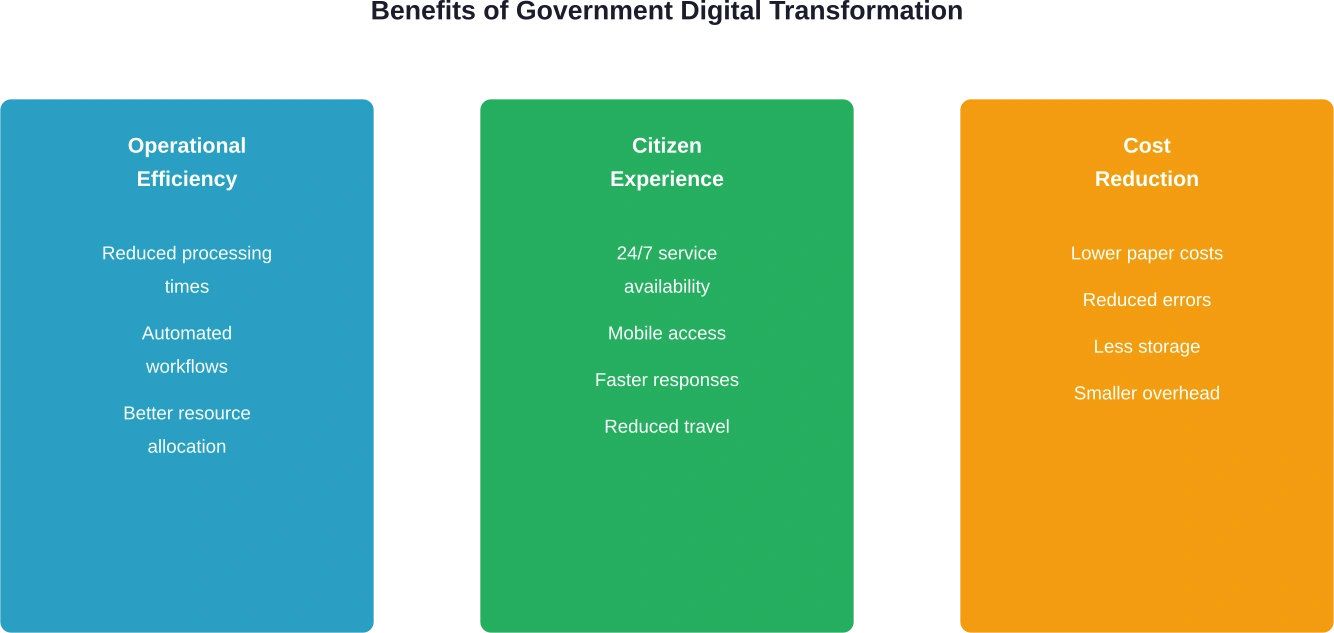
Improved Operational Efficiency
Automation and digital workflows eliminate repetitive manual tasks that consume employee time. This frees staff to focus on complex cases requiring human judgment rather than data entry.
Processing times drop dramatically when systems connect properly. Applications that once took weeks can be completed in days or hours. Paper-based approvals that required physical signatures become instant digital approvals with proper authentication.
Enhanced Citizen Experience
Citizens expect the same convenience from the government they get from private companies. Digital services available 24/7 meet this expectation. No more taking time off work to visit an office during business hours.
Mobile-friendly platforms make services accessible anywhere. That's especially important for rural communities where traveling to government offices means significant time and expense.
Cost Reduction and Resource Optimization
Digital systems reduce costs in multiple ways. Less paper, printing, and physical storage. Fewer manual processes means smaller administrative overhead. Better data means fewer errors requiring expensive corrections.
Agencies can reallocate resources toward higher-value activities. Staff who previously managed filing systems can transition to roles delivering direct constituent support.
Better Data-Driven Decision Making
Digital systems generate data that reveals patterns invisible in paper-based processes. Agencies can identify bottlenecks, predict demand spikes, and allocate resources more strategically.
Open data initiatives allow other organizations to build services on government data. This creates value beyond what agencies could develop internally.
Current State of Federal Digital Modernization
Federal agencies face a mixed landscape of progress and challenges. The 21st Century Integrated Digital Experience Act set clear targets, but implementation varies significantly across government.
The White House has made technology modernization a priority. In April 2025, a presidential memorandum addressed how the Government does not properly leverage technology to effectively and efficiently evaluate environmental permits, causing significant delay to important infrastructure projects. The directive emphasized applying modern technologies to longstanding problems to deliver results at "21st-century speeds."
That same focus extends to emerging technologies. On July 24, 2025, the White House unveiled a transformative strategy to propel the United States into a new era of artificial intelligence dominance. The blueprint establishes core tenets to accelerate innovation and fortify essential infrastructure. Private sector support includes substantial investments — Micron announced plans for $200 billion in manufacturing and R&D to create 90,000 American jobs and help ensure U.S. leadership in the AI era through a resilient and secure supply chain.
But wait. While leadership sets ambitious goals, implementation faces obstacles. The GAO's September 2024 report on digital experience compliance showed persistent gaps. Reports submitted by agencies had varying quality and completeness. That makes it difficult to assess true progress across the federal government.
Core Components of Successful Digital Transformation
Transformation initiatives that actually work share common elements. These aren't optional nice-to-haves — they're essential building blocks.
Modern Technology Infrastructure
Legacy systems create bottlenecks. Mainframes running code from the 1970s can't integrate with modern APIs. Cloud infrastructure provides the flexibility and scalability government services require.
That doesn't mean ripping out every existing system overnight. Successful agencies take incremental approaches that modernize components while maintaining critical services.
Data Integration and Interoperability
Siloed data prevents agencies from delivering seamless services. When departments can't share information securely, citizens must provide the same details multiple times. Proper data architecture enables information to flow where needed while maintaining security and privacy.
Standards matter here. Consistent data formats and APIs allow different systems to communicate reliably. Without standardization, each integration becomes a custom project.
User-Centered Design
Government services should work for the people using them. That means testing with actual users, not assuming what they need. Accessibility isn't optional — it's required by law and essential for inclusive service delivery.
Mobile-first design recognizes how people access services today. A website that looks great on desktop but fails on smartphones excludes significant populations.
Security and Privacy Frameworks
Digital transformation expands the attack surface for cyber threats. Security can't be an afterthought bolted on later. It must be built into architecture from the start.
Privacy protections are equally critical. Citizens trust the government with sensitive personal information. Breaches don't just expose data — they erode public confidence in digital services.
Overcoming Common Implementation Challenges
Every agency encounters obstacles during transformation. Understanding common challenges helps avoid preventable failures.
Legacy System Integration
Replacing every legacy system simultaneously isn't feasible or wise. Critical systems keep the government running. The key is creating integration layers that allow old and new systems to coexist during gradual modernization.
APIs serve as bridges between incompatible systems. A modern front-end can connect to legacy databases through properly designed interfaces. This delivers improved user experience without requiring complete backend replacement.
Budget Constraints and ROI Justification
Transformation requires significant investment. Budget cycles and appropriations processes complicate long-term technology projects. Building a clear business case with measurable benefits helps secure sustained funding.
Starting with high-impact, lower-cost initiatives builds momentum. Early wins demonstrate value and generate support for larger investments.
Change Management and Cultural Resistance
Technology changes faster than organizational culture. Employees comfortable with existing processes may resist new approaches. Leadership must communicate why transformation matters and how it benefits both staff and citizens.
Training and support are essential. Rolling out new systems without adequate preparation sets everyone up for frustration. Successful agencies invest heavily in change management alongside technology implementation.
|
Challenge |
Impact |
Mitigation Strategy |
|---|---|---|
|
Legacy Systems |
Integration complexity, technical debt |
API layers, incremental modernization |
|
Budget Constraints |
Delayed projects, incomplete implementations |
Clear ROI metrics, phased approach |
|
Cultural Resistance |
Low adoption, reduced effectiveness |
Change management, comprehensive training |
|
Skills Gaps |
Implementation delays, quality issues |
Hiring specialists, staff development programs |
|
Security Concerns |
Vulnerability risks, compliance failures |
Built-in security, regular audits |
Measuring Digital Transformation Success
What gets measured gets managed. Defining success metrics before starting transformation provides clear targets and accountability.
Citizen satisfaction scores reveal whether services actually improved from the user perspective. Processing time reductions demonstrate operational efficiency gains. Cost per transaction shows financial impact. Adoption rates indicate whether people actually use new digital services.
But here's what matters most — metrics should track outcomes, not just outputs. Launching a new portal doesn't equal success. Success is when citizens complete tasks faster with less effort.
Regular reporting maintains focus and enables course corrections. When metrics show problems, agencies can adjust strategies before small issues become major failures.
The Role of Emerging Technologies
New technologies create opportunities for government services that weren't possible previously. But not every emerging technology deserves immediate adoption.
Artificial intelligence shows promise for automating routine decisions and improving service recommendations. On July 24, 2025, the White House unveiled a transformative strategy to propel the United States into a new era of artificial intelligence dominance. This includes substantial private sector commitments to build the underlying technology base.
Cloud computing provides scalability and flexibility that on-premises infrastructure can't match. Agencies can expand capacity during peak demand periods without maintaining excess hardware year-round.
The key is matching technologies to real problems. Technology for its own sake wastes resources. The best implementations identify specific pain points that new capabilities can address.
Building a Digital Transformation Strategy
Strategy comes before technology selection. Agencies need clear visions of desired outcomes before evaluating solutions.
Successful strategies start with current state assessments. What works well today? What creates the most frustration? Where do bottlenecks occur? Understanding existing operations reveals the highest-value improvement opportunities.
Stakeholder engagement matters throughout the process. That includes employees who deliver services, citizens who use them, and leadership who allocate resources. Each perspective highlights different priorities and constraints.
Roadmaps should be realistic about timelines and dependencies. Trying to do everything at once guarantees nothing gets done well. Prioritizing initiatives based on impact and feasibility creates momentum through sequential wins.

Create Government Systems That Actually Work Together
Digital transformation in government usually comes down to integration, not reinvention. Different departments run on different systems, data is scattered, and even small updates can break existing workflows. In practice, the focus shifts to connecting platforms, stabilizing processes, and making sure new tools fit into what already exists. OSKI Solutions works in this space through custom development and system integration, helping organizations align internal tools without disrupting operations.
They typically support teams that need steady, long-term improvements rather than one-off projects. That can include API integrations between internal systems, cloud migration for better scalability, or building custom web applications where standard solutions fall short. The approach is usually incremental – fix what blocks progress first, then expand from there. If your systems are hard to connect or maintain, it makes sense to look at what can be simplified – contact OSKI Solutions and start with a practical discussion.
Accelerate Your Digital Transformation
Modernize your business with scalable technologies, automation, and data-driven strategies.
Frequently Asked Questions
What is the difference between digitization and digital transformation in government?
Digitization converts paper-based processes to digital formats — scanning documents or creating electronic forms. Digital transformation fundamentally redesigns how services work using technology. Transformation changes workflows, data flows, and how agencies interact with citizens, not just the format of existing processes.
How long does government digital transformation typically take?
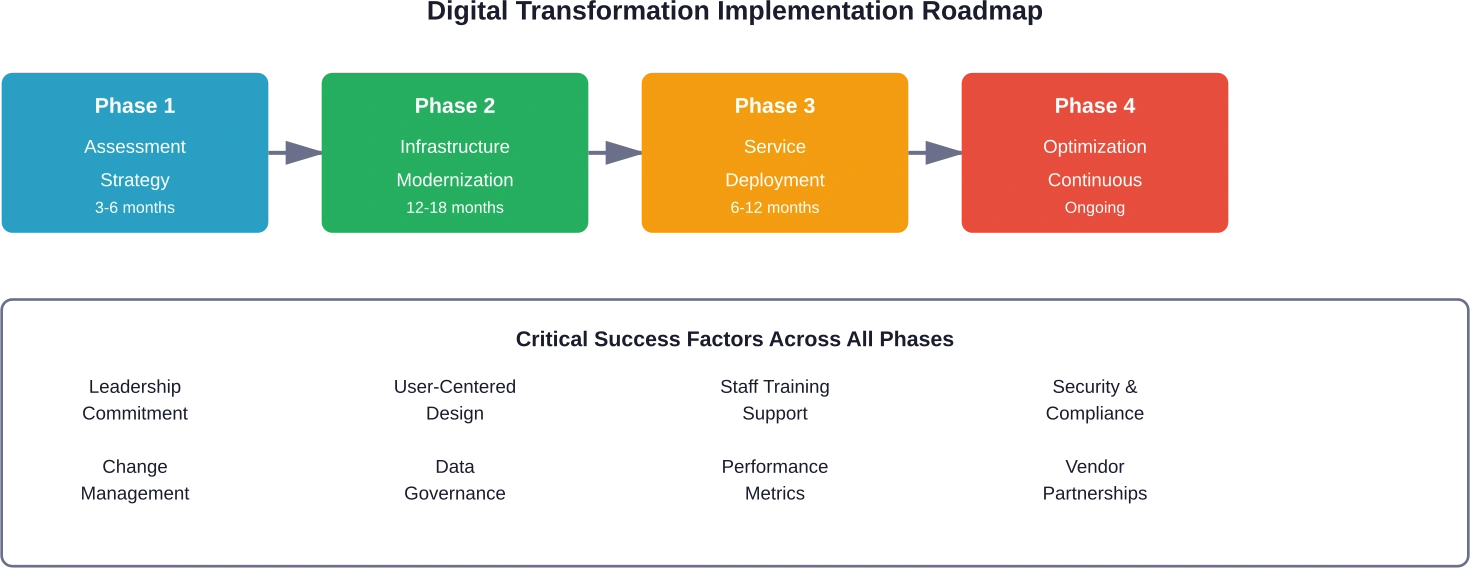
Timelines vary by scope and agency size. Initial assessments and strategy development take 3–6 months. Infrastructure modernization requires 12–18 months. Service deployment spans 6–12 months. Complete transformation is an ongoing process requiring continuous optimization rather than a one-time project with a fixed endpoint.
What are the main compliance requirements for federal digital services?
The 21st Century Integrated Digital Experience Act requires federal websites to be accessible, mobile-friendly, searchable, secure, and user-centered. Agencies must design services from the user perspective and ensure systems are customizable and consistent. According to the GAO, tracking compliance remains challenging as reporting quality varies across agencies.
How do agencies justify digital transformation budgets?
Strong business cases quantify both cost savings and improved outcomes. Cost reductions come from automation, reduced manual processing, and lower error rates. Benefits include faster service delivery, improved citizen satisfaction, and better resource allocation. Presenting concrete metrics and phased approaches helps secure sustained funding through budget cycles.
Can legacy government systems be modernized without complete replacement?
Yes, through integration layers and incremental modernization. APIs allow modern front-end systems to connect with legacy databases. This delivers improved user experience while maintaining critical backend functions. Agencies can gradually replace components as resources allow rather than requiring risky complete system replacements.
What role does staff training play in digital transformation success?
Training is essential for adoption and effectiveness. New systems fail when staff lack skills to use them properly. Comprehensive training programs help employees understand both technical operations and how changes benefit their work. Change management addressing cultural concerns alongside technical training significantly increases transformation success rates.
How do governments measure the success of digital transformation initiatives?
Effective measurement tracks outcomes rather than just outputs. Key metrics include citizen satisfaction scores, processing time reductions, cost per transaction, and adoption rates. Success means citizens complete tasks faster with less effort, not just that new systems launched. Regular reporting enables course corrections when metrics reveal problems.
Conclusion
Digital transformation represents a fundamental shift in how the government delivers services and operates internally. The journey requires strategic planning, sustained investment, and commitment to user-centered design.
Federal agencies face clear requirements under the 21st Century Integrated Digital Experience Act. While progress varies, leadership continues emphasizing technology modernization as essential for meeting citizen expectations and improving operational efficiency.
Successful transformation balances multiple priorities — modernizing legacy systems while maintaining critical services, securing data while enabling information flows, and adopting emerging technologies while managing risks. Agencies that take phased approaches, measure outcomes consistently, and invest in both technology and people position themselves for lasting success.
The digital divide between private sector experiences and government services continues narrowing. But work remains. Organizations that commit to transformation today will deliver better services tomorrow while operating more efficiently. Start by assessing current state capabilities, engaging stakeholders, and building realistic roadmaps focused on high-impact opportunities. The path forward requires persistence, but the benefits for citizens and agencies make the effort worthwhile.


