


Digital Transformation in Energy: 2026 Guide

Quick Summary: Digital transformation in energy is revolutionizing how utilities, power companies, and grid operators manage infrastructure, integrate renewable sources, and serve customers. By deploying smart grids, AI-driven analytics, IoT sensors, and cloud platforms, the energy sector is moving from reactive, rule-based operations to predictive, data-driven decision-making. Authoritative sources including the U.S. Department of Energy and the International Energy Agency highlight that this shift is essential for integrating variable renewable energy, modernizing aging grid infrastructure, and meeting rising electricity demand—with forecasts showing energy companies will invest US$713 billion on grid digitalization over the next six years.
The energy sector sits at a crossroads. Aging infrastructure meets surging demand. Renewable sources create grid volatility. Customers expect real-time control.
And the solution? Digital transformation.
This isn't about slapping software on old hardware. It's a fundamental rethinking of how power gets generated, transmitted, distributed, and consumed. According to the U.S. Department of Energy, America's electric grid is an engineering marvel with more than 9,200 electric generating units and over 600,000 miles of transmission lines—but that infrastructure was built for the 20th century, not the 21st.
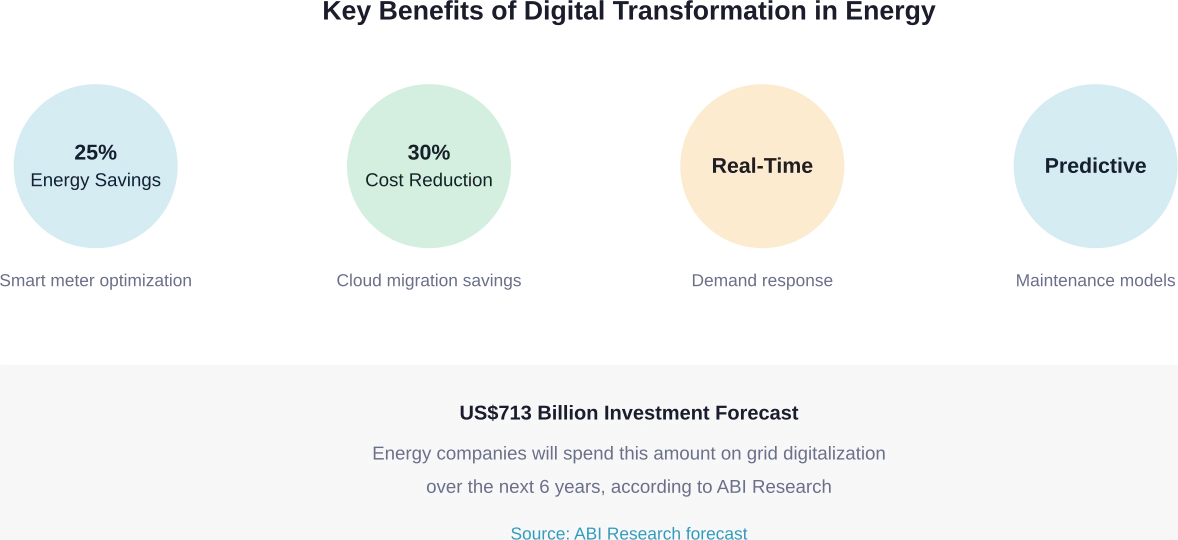
The energy industry now faces an imperative: evolve digitally or fall behind. ABI Research forecasts that energy companies will spend US$713 billion on grid digitalization over the next six years, signaling that this technological evolution is no longer optional.
So what does digital transformation actually look like in practice? How are utilities deploying smart grids, AI, and IoT to tackle everything from renewable integration to customer engagement? Let's break it down.
What Digital Transformation Means for the Energy Industry
Digital transformation in energy replaces legacy processes with intelligent, connected systems. That shift touches every layer of the value chain.
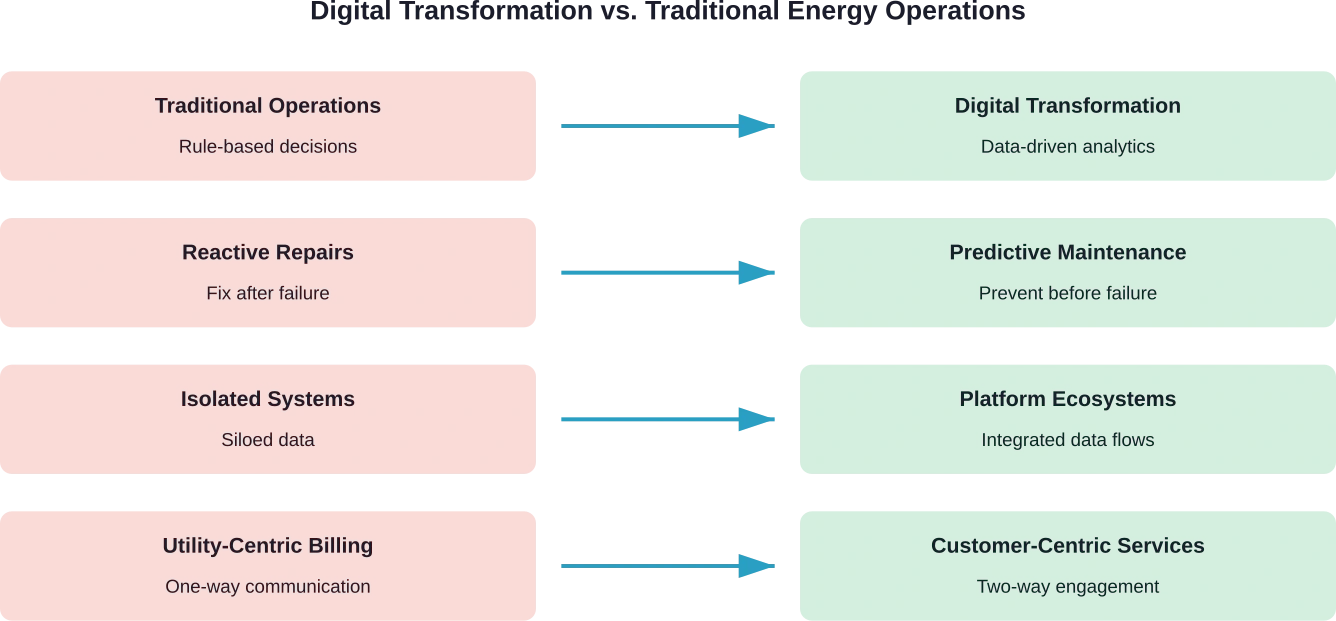
Instead of rule-based decision models, the sector now relies on data-driven analytics. Rather than waiting for equipment to fail, operators perform predictive maintenance. Platform ecosystems replace isolated legacy systems. Customer-centric digital services displace utility-centric billing models.
The International Energy Agency notes that digital technologies are everywhere, affecting how we live, work, travel, and play—and digitalisation is helping improve the safety, productivity, accessibility, and sustainability of energy systems around the world. But it also raises new security and privacy risks while disrupting markets, businesses, and workers.
From Automation to Intelligence
Here's the thing though—digital transformation isn't the same as automation. Installing automated turbine controls is automation. Building a platform that ingests real-time sensor data, runs machine learning models to predict failures, and dynamically adjusts output based on weather forecasts and grid demand? That's transformation.
The difference matters. Automation improves discrete tasks. Transformation reimagines entire workflows.
Why Energy Companies Can't Delay Digitalization
The stakes are high. Delaying digital transformation means missing the boat on renewable integration, losing customer trust, and watching operational costs spiral.
According to research from the National Renewable Energy Laboratory, flexible, strong, and smart grids play a crucial role in the integration of variable renewable energy. As high levels of variable renewable energy penetration become increasingly common, grid modernization becomes essential—not optional.
The Renewable Energy Challenge
Renewable sources like wind and solar are inherently variable. The sun doesn't shine at night. Wind speeds fluctuate. Without digital intelligence coordinating supply and demand in real time, grids buckle under the pressure.
Smart grids use sensors, communication networks, and analytics to balance variable generation with consumption patterns. They detect faults faster, reroute power automatically, and integrate distributed energy resources like rooftop solar without destabilizing the network.
Nearly 4 million households in some regions now have rooftop solar panels that generate more electricity than residual coal-fired power stations during peak sunlight hours. Managing that complexity requires digital orchestration.
Aging Infrastructure and Rising Demand
Utilities face peak load issues to meet growing demand and reduce unexpected outages. Equipment installed decades ago wasn't designed for today's loads or distributed generation models.
Digital twins—virtual replicas of physical infrastructure—let operators simulate grid behavior under different scenarios. They can test upgrades in software before deploying hardware, cutting costs and reducing downtime.
Core Technologies Driving Energy Sector Digitalization
Several technologies form the backbone of digital transformation in energy. They work together, not in isolation.
Smart Grids and Advanced Metering Infrastructure
Smart grids are the foundation. According to the U.S. Department of Energy, smart grid generally refers to a class of technology people are using to bring utility electricity delivery systems into the 21st century, using computer-based remote control and automation.
Smart meters sit at the edge of the network, collecting granular consumption data. That data feeds back to utilities in near real-time, enabling dynamic pricing, demand response programs, and faster outage detection.
For example, the implementation of smart meters has allowed Duke Energy (now Brookfield) to optimize energy consumption management by 25%. That's not a small gain—it translates to millions in operational savings and significant reductions in peak load stress.
Artificial Intelligence and Machine Learning
AI acts as the brain behind smarter energy grids. Machine learning models analyze historical and real-time data to forecast demand, predict equipment failures, and optimize dispatch schedules.
The International Energy Agency released a comprehensive report titled "Energy and AI" that examines both sides of the AI-energy relationship. On one hand, AI requires significant electricity for data centers—on average, data center servers account for around 60% of electricity demand in modern facilities. On the other hand, AI could transform how the energy industry operates if adopted at scale.
Generative AI is now entering the mix, enabling natural language interfaces for grid operators, automated report generation, and scenario planning tools that help utilities model complex "what-if" situations.
Internet of Things Sensors and Edge Computing
IoT sensors monitor everything from transformer temperature to wind turbine vibration. They generate massive data streams that need processing close to the source—that's where edge computing comes in.
Edge devices analyze data locally, sending only relevant insights to central systems. This reduces latency, cuts bandwidth costs, and enables faster response times when milliseconds matter.
Cloud Platforms and Data Analytics
Cloud infrastructure provides the scalable compute and storage capacity needed to handle petabytes of grid data. Major energy companies have migrated legacy systems to the cloud, unlocking agility and cost savings.
BP managed to reduce IT infrastructure costs by 30% after migrating to the cloud, enabling more efficient resource allocation for managing renewable energy projects. Cloud platforms also facilitate collaboration across geographically distributed teams and integrate third-party data sources like weather forecasts or commodity pricing feeds.
Digital Twins and Virtual Substations
Digital twins create virtual replicas of physical assets—entire substations, wind farms, or transmission networks. Operators can simulate upgrades, test failure scenarios, and optimize configurations without touching real equipment.
Virtual substations take this further by automating processes and cutting costs. They reduce the need for physical site visits, enable remote monitoring, and provide operators with dashboards that visualize evolving energy networks in real time.
Real-World Applications and Success Stories
Digital transformation isn't theoretical. Utilities and energy companies worldwide are deploying these technologies today.
Grid Modernization in the United States
The U.S. Department of Energy's Grid Modernization Initiative (GMI) works across DOE to create the modern grid of the future. The Grid Modernization Laboratory Consortium (GMLC) was established as a strategic partnership between DOE and national laboratories to develop advanced grid technologies.
Projects under this initiative focus on integrating distributed energy resources, enhancing grid resilience, and improving cybersecurity. The goal is to transform a grid that's fueled the nation's growth since the early 1900s into one ready for variable renewables, electric vehicles, and bidirectional power flows.
Renewable Energy Integration via Smart Grids
Countries are increasingly preparing their infrastructure for digitalisation. The European Union launched an action plan for Digitalising the energy system in 2022 to promote connectivity and interoperability, foster coordinated investments in smart grid technologies, empower customers, and enhance cybersecurity.
Reports from the Middle East show that energy companies in the region are setting the pace for digital power system transformation. Solar supply is strongest during the day in some countries, where over 4 million households have rooftop solar panels generating more electricity than residual coal-fired power stations. Managing that requires sophisticated digital coordination.
Predictive Maintenance and Asset Optimization
Utilities are using AI-driven predictive maintenance to cut unplanned downtime. Sensors on transformers, turbines, and transmission lines detect anomalies. Machine learning models flag equipment likely to fail within weeks or days, triggering preemptive repairs.
This shift from reactive to predictive maintenance saves millions. It extends asset lifespans, reduces emergency repair costs, and improves grid reliability.
Challenges Facing Energy Companies in Digital Transformation
Digital transformation promises huge upside. But the path forward isn't smooth.
Legacy Infrastructure and Technical Debt
Many utilities operate equipment installed 30, 40, even 50 years ago. Integrating modern software with legacy hardware is complex and expensive. Protocols don't match. Data formats vary. Systems that were never designed to communicate now need to interoperate.
Technical debt accumulates when quick fixes replace proper upgrades. Over time, that debt becomes a drag on innovation and a security risk.
Cybersecurity and Data Privacy Risks
The International Energy Agency warns that digitalisation raises new security and privacy risks. More connected devices mean more attack surfaces. A breach in a smart grid could cascade into widespread outages or data theft affecting millions of customers.
Utilities must harden infrastructure against cyber threats while complying with evolving data privacy regulations. That requires investment in security operations centers, threat intelligence platforms, and continuous monitoring.
Workforce Skills Gaps
According to the IEA's report "Mapping Green and Digital Energy Jobs," from 2021 to 2023, the share of online job postings in clean energy technologies—solar, wind, heat pumps, energy efficiency, batteries, and electric vehicles—increased for most countries. In 2023, digital jobs and skills in the energy sector showed rising demand.
But supply lags behind demand. Utilities struggle to recruit data scientists, AI engineers, and cybersecurity specialists. Traditional energy professionals need upskilling to work with digital tools.
Regulatory and Policy Barriers
Energy markets are heavily regulated. Introducing dynamic pricing, peer-to-peer energy trading, or new grid services requires regulatory approval. Policies often lag behind technology, creating friction and uncertainty.
Financing is another hurdle. Grid digitalization demands huge upfront investment. Utilities must justify costs to regulators and shareholders while managing rate pressures.
Interoperability and Standardization
Lack of common standards hampers integration. Different vendors use proprietary protocols. Data formats vary. Without interoperability, utilities end up with fragmented systems that don't talk to each other.
Industry consortia and standards bodies are working on solutions, but progress is slow compared to the pace of technological change.
|
Challenge |
Impact |
Mitigation Strategy |
|---|---|---|
|
Legacy Infrastructure |
Integration complexity, high costs |
Phased modernization, middleware layers |
|
Cybersecurity Risks |
Outages, data breaches, regulatory fines |
Zero-trust architecture, continuous monitoring |
|
Workforce Skills Gaps |
Delayed projects, innovation slowdown |
Upskilling programs, partnerships with universities |
|
Regulatory Barriers |
Slow adoption, uncertain ROI |
Engage regulators early, pilot programs |
|
Interoperability Issues |
Fragmented systems, data silos |
Adopt open standards, vendor collaboration |
How to Get Started with Digital Transformation in Energy
So how should utilities and energy companies begin? A structured approach reduces risk and accelerates value.
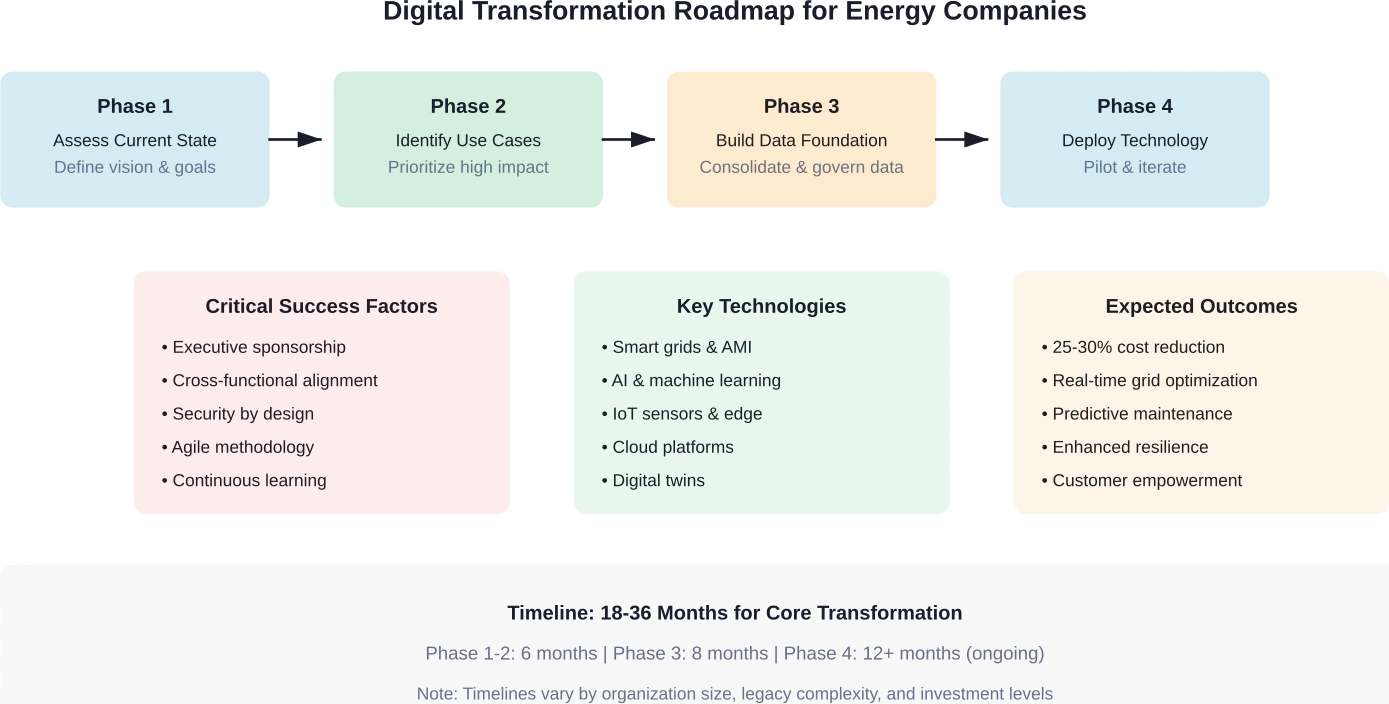
Step 1: Assess Current State and Define Vision
Start with a comprehensive assessment. Where does the organization stand today? What are the pain points? Which processes are most manual, error-prone, or costly?
Define a clear vision. What does success look like in three years? Five years? Align stakeholders—executives, operations, IT, and customer service—around shared goals.
Step 2: Identify High-Impact Use Cases
Not every initiative delivers equal value. Prioritize use cases with high impact and manageable complexity. Examples include:
- Predictive maintenance for high-value assets
- Demand forecasting to optimize dispatch
- Customer engagement portals for real-time usage data
- Grid fault detection and automated rerouting
Pilot these use cases before scaling. Learn fast, fail fast, iterate.
Step 3: Build a Data Foundation
Data is the fuel for digital transformation. Ensure data quality, governance, and accessibility. Consolidate siloed datasets into a unified platform. Implement master data management to maintain consistency.
Invest in data infrastructure—cloud storage, data lakes, analytics tools. Without this foundation, AI and IoT deployments will stumble.
Step 4: Choose the Right Technology Partners
Few utilities have all the expertise in-house. Partner with vendors who understand energy sector requirements. Look for proven track records, interoperable solutions, and strong security practices.
Avoid vendor lock-in. Choose platforms that support open standards and integrate with existing systems.
Step 5: Address Cybersecurity from Day One
Security can't be an afterthought. Design systems with security built in. Implement zero-trust principles, encrypt data in transit and at rest, and monitor continuously for anomalies.
Conduct regular penetration testing and vulnerability assessments. Train employees to recognize phishing and social engineering attacks.
Step 6: Upskill the Workforce
Invest in training programs. Teach traditional engineers how to work with data analytics tools. Bring data scientists up to speed on energy domain knowledge.
Partner with universities and technical schools to build talent pipelines. Offer internships and apprenticeships to attract the next generation.
Step 7: Measure, Learn, and Scale
Define KPIs for each initiative. Track performance rigorously. What's working? What's not? Use data to drive decisions.
Once a pilot proves value, scale it across the organization. Share learnings internally and celebrate wins to build momentum.

Make Energy Systems Work Together
Most energy companies don’t need another strategy deck. They need systems that actually work together – data pipelines, internal tools, and new components that don’t break under load. That usually means custom development and careful integration, not quick fixes. OSKI Solutions focuses on connecting existing infrastructure, aligning systems, and keeping operations stable as things scale.
They typically work with mid-sized companies and growing teams that can’t afford downtime or full rebuilds. That can include cloud migration, API integrations with ERP and monitoring platforms, or adding AI where it solves a real task. If your systems feel fragmented or hard to scale, start with a conversation – contact OSKI Solutions and see what can be improved first.
Accelerate Your Digital Transformation
Modernize your business with scalable technologies, automation, and data-driven strategies.
Emerging Trends Shaping the Future of Energy Digitalization
Digital transformation in energy isn't static. New technologies and business models continue to emerge.
AI and Generative AI Expansion
AI adoption is accelerating. The IEA's "Energy and AI" report highlights that widespread deployment of AI will reshape energy operations. Generative AI enables natural language queries against complex datasets, automated scenario planning, and intelligent virtual assistants for grid operators.
Expect AI to move beyond predictive analytics into autonomous decision-making—where algorithms optimize dispatch, manage demand response, and even negotiate energy trades in real time.
Blockchain for Energy Trading and Transparency
Blockchain enables peer-to-peer energy trading, transparent renewable energy certificates, and secure microgrid transactions. Community solar projects use blockchain to track production and allocate credits to participants.
While still in its early stage, blockchain could disintermediate traditional utility models and empower prosumers—customers who both produce and consume energy.
Electrification and EV Integration
Electric vehicles represent both challenge and opportunity. Charging EVs at scale stresses distribution networks. But EVs also act as mobile batteries—vehicle-to-grid (V2G) technology lets them discharge power back to the grid during peak demand.
Digital platforms coordinate EV charging schedules, balance loads, and enable V2G services. This bidirectional flow transforms vehicles from passive consumers into active grid participants.
Distributed Energy Resources and Microgrids
Rooftop solar, battery storage, and local generation create distributed energy resources (DERs). Managing millions of DERs requires sophisticated software that aggregates, forecasts, and dispatches them as virtual power plants.
Microgrids—localized grids that can disconnect from the main network—enhance resilience. Digital controls let them operate autonomously during outages and reconnect seamlessly when conditions stabilize.
Sustainability and Carbon Tracking
Customers and regulators demand transparency around carbon emissions. Digital platforms track the carbon intensity of electricity in real time, enabling utilities to offer green pricing tiers and customers to shift usage to lower-carbon periods.
The IT sector is a major source of pollution—software alone may account for around 14% of the global CO₂ footprint by 2040 (per Techstack analysis). Digital transformation must balance efficiency gains with the environmental cost of data centers and connectivity infrastructure.
Choosing the Right Digitalization Partner
Most utilities can't go it alone. The right partner accelerates transformation and reduces risk.
What to Look for in a Technology Partner
Domain expertise matters. Energy systems are complex. Look for partners with proven experience in power generation, transmission, distribution, or retail markets.
Check references. Have they deployed similar solutions at comparable scale? What were the outcomes? Talk to their existing customers.
Interoperability is critical. Avoid partners pushing proprietary lock-in. Choose vendors committed to open standards and integration with existing systems.
Security credentials matter. Ask about their security practices, certifications, and incident response capabilities.
In-House vs. Outsourced Development
Some capabilities should stay in-house. Core domain knowledge, strategic decision-making, and data governance belong inside the organization.
But specialized skills—AI model development, cloud architecture, cybersecurity—often make more sense to outsource or co-develop with partners. Blended teams combine internal domain expertise with external technical depth.
The Role of Policy and Regulation
Digital transformation doesn't happen in a vacuum. Policy frameworks shape what's possible.
Grid Modernization Policy
Governments worldwide are investing in grid modernization. The U.S. Department of Energy's Grid Modernization Initiative partners with industry to develop advanced grid technologies. Similar programs exist in Europe, Asia, and elsewhere.
These initiatives fund research, pilot projects, and infrastructure upgrades. They also convene stakeholders to develop standards and best practices.
Data Privacy and Security Regulations
Smart meters collect granular customer data. That data is valuable but sensitive. Regulations like GDPR in Europe and state-level privacy laws in the U.S. impose strict requirements on collection, storage, and use.
Utilities must ensure compliance while still extracting value from data. Anonymization, consent management, and transparent data policies become essential.
Market Design and Dynamic Pricing
Traditional rate structures don't fit digital grids. Fixed pricing doesn't incentivize customers to shift usage to low-demand periods. Time-of-use rates, critical peak pricing, and real-time pricing align customer incentives with grid conditions.
But introducing these models requires regulatory approval. Forward-thinking regulators are enabling pilots and phased rollouts.
Measuring Success: KPIs for Digital Transformation
Transformation initiatives need clear metrics. How do you know if it's working?
Operational KPIs
- System Average Interruption Duration Index (SAIDI): Measures total outage duration. Digital transformation should reduce SAIDI through faster fault detection and automated restoration.
- Asset utilization: Track how efficiently generation and transmission assets are used. Better forecasting and dispatch should increase utilization.
- Maintenance costs: Predictive maintenance should lower costs and extend asset life. Track spending trends.
Financial KPIs
- Operating expense ratio: Digital tools should reduce opex as a percentage of revenue.
- Capital efficiency: Better planning and simulation reduce waste in capex projects.
- Revenue per customer: New digital services can unlock additional revenue streams.
Customer KPIs
- Customer satisfaction scores: Digital self-service, real-time usage data, and proactive outage communication improve satisfaction.
- Engagement metrics: Track adoption of mobile apps, web portals, and demand response programs.
- Net Promoter Score (NPS): Would customers recommend the utility? Digital transformation should lift NPS.
Sustainability KPIs
- Renewable energy penetration: Measure the percentage of generation from renewables. Smart grids enable higher penetration.
- Carbon intensity: Track grams of CO₂ per kWh. Digital optimization should reduce emissions.
- Energy efficiency gains: Measure reductions in system losses and customer consumption.
|
KPI Category |
Example Metrics |
Target Impact |
|---|---|---|
|
Operational |
SAIDI, asset utilization, maintenance costs |
Reduce outages by 20%, cut maintenance spend by 15% |
|
Financial |
Opex ratio, capex efficiency, revenue per customer |
Lower opex 10-15%, improve capex ROI by 25% |
|
Customer |
CSAT, engagement, NPS |
Lift NPS by 10-15 points, double app adoption |
|
Sustainability |
Renewable %, carbon intensity, efficiency |
Increase renewables to 40%+, reduce carbon 20% |
Frequently Asked Questions
What is digital transformation in the energy sector?
Digital transformation in energy refers to the comprehensive integration of digital technologies—smart grids, AI, IoT, cloud platforms, and data analytics—into every aspect of how utilities and energy companies operate. It replaces rule-based, reactive processes with data-driven, predictive decision-making. According to the U.S. Department of Energy, this shift is essential for modernizing infrastructure, integrating variable renewable energy, and meeting rising electricity demand.
Why is digital transformation essential for utilities now?
Several factors make digital transformation urgent. Aging grid infrastructure requires modernization. Renewable energy sources like wind and solar are variable and need sophisticated coordination. Customer expectations have shifted toward real-time control and transparency. ABI Research forecasts that energy companies will invest US$713 billion on grid digitalization over the next six years, signaling that the industry recognizes transformation is no longer optional.
What are the main technologies driving energy digitalization?
The core technologies include smart grids and advanced metering infrastructure, AI and machine learning for predictive analytics, IoT sensors for real-time monitoring, cloud platforms for scalable compute and storage, and digital twins for virtual asset simulation. These technologies work together to enable real-time optimization, predictive maintenance, and seamless renewable integration.
What challenges do energy companies face in digital transformation?
Key challenges include integrating digital systems with legacy infrastructure, managing cybersecurity and data privacy risks, closing workforce skills gaps, navigating regulatory barriers, and achieving interoperability across diverse vendor systems. The International Energy Agency notes that digitalisation raises new security and privacy concerns that utilities must address proactively.
How does digital transformation support renewable energy integration?
Smart grids use sensors, communication networks, and analytics to balance variable renewable generation with real-time demand. Digital platforms forecast wind and solar output, coordinate distributed energy resources like rooftop solar, and enable demand response programs that shift consumption to periods of high renewable availability. According to the National Renewable Energy Laboratory, flexible, strong, and smart grids are crucial for integrating high levels of variable renewable energy.
What ROI can utilities expect from digital transformation?
Real-world examples show significant returns. Duke Energy optimized energy consumption management by 25% through smart meters. BP reduced IT infrastructure costs by 30% after cloud migration. Beyond direct cost savings, digital transformation delivers improved reliability, faster outage response, enhanced customer satisfaction, and increased capacity to integrate renewables—all of which contribute to long-term financial performance.
How long does it take to implement digital transformation in energy?
Timelines vary based on organization size, legacy complexity, and investment levels. A phased approach typically spans 18–36 months for core transformation. Initial assessment and use case identification might take 6 months, building the data foundation another 8 months, and deploying technology and scaling solutions 12+ months. Transformation is ongoing—utilities continuously iterate and expand as technologies evolve.
Looking Ahead: The Future of Energy is Digital
Digital transformation isn't a project with an end date. It's a continuous evolution.
The energy sector stands at a pivotal moment. Climate goals demand rapid decarbonization. Customers expect modern, digital experiences. Infrastructure needs urgent upgrades. And the technologies to address these challenges—AI, IoT, smart grids, cloud platforms—are mature and proven.
Utilities that embrace digital transformation will lead the energy transition. They'll integrate renewables faster, serve customers better, and operate more efficiently. Those that delay risk obsolescence.
The U.S. Department of Energy's Grid Modernization Initiative, the International Energy Agency's digitalisation research, and billions in industry investment all point in the same direction: the future of energy is digital. The grid of tomorrow will be intelligent, flexible, and resilient.
But transformation requires more than technology. It demands vision, leadership, and a willingness to rethink long-held assumptions. It requires investment not just in software and hardware but in people, processes, and partnerships.
The opportunity is immense. Digital transformation unlocks efficiency gains that seemed impossible a decade ago. It enables renewable penetration levels that would have destabilized older grids. It empowers customers to participate actively in energy markets. And it positions the energy sector to meet the challenges of the 21st century.
So where does your organization stand? Have you assessed your digital maturity? Identified high-impact use cases? Built the data foundation? The time to start is now. Digital transformation in energy isn't coming—it's here. The only question is whether you're ready to lead or will struggle to catch up.
Start small if necessary. Pilot a predictive maintenance project. Deploy smart meters in a single service area. Build a customer engagement portal. Learn, iterate, and scale. But start.
The grid of the future is being built today. Make sure your organization is part of shaping it.


