


Digital Transformation in Education: 2026 Complete Guide

Quick Summary: Digital transformation in education represents the systematic integration of technology to reimagine teaching, learning, and institutional operations. According to UNESCO, this transformation must be human-centred and sustainable, addressing the fact that only 40% of primary schools are connected to the internet. The goal is creating equitable, personalized learning experiences while preparing institutions for future disruptions.
Education stands at a crossroads. Technologies are transforming classrooms faster than ever before, yet the benefits aren't reaching everyone equally.
As powerful AI systems capture more classrooms, institutions face a fundamental question: How do we embrace digital transformation without losing sight of educational equity and human connection?
The answer isn't simple. But understanding what's actually happening—beyond the buzzwords—is the first step.
What Digital Transformation in Education Actually Means
Digital transformation goes far beyond installing smartboards or moving classes online. It's a fundamental reimagining of how educational institutions operate, deliver learning, and serve students.
The U.S. Department of Education's Digital Government Strategy aligns with digital initiatives already underway. This framework aimed at delivering better digital services has influenced educational institutions nationwide.
Here's the thing though—true transformation touches every aspect of education:
- Learning delivery and curriculum design
- Assessment and feedback mechanisms
- Administrative operations and data management
- Communication between students, faculty, and parents
- Resource allocation and institutional planning
UNESCO launched a common framework in September 2024 to ensure this transformation remains human-centred and sustainable. The framework supports the Global Digital Compact adopted during the UN Summit of the Future.
The Current State: Progress and Persistent Gaps
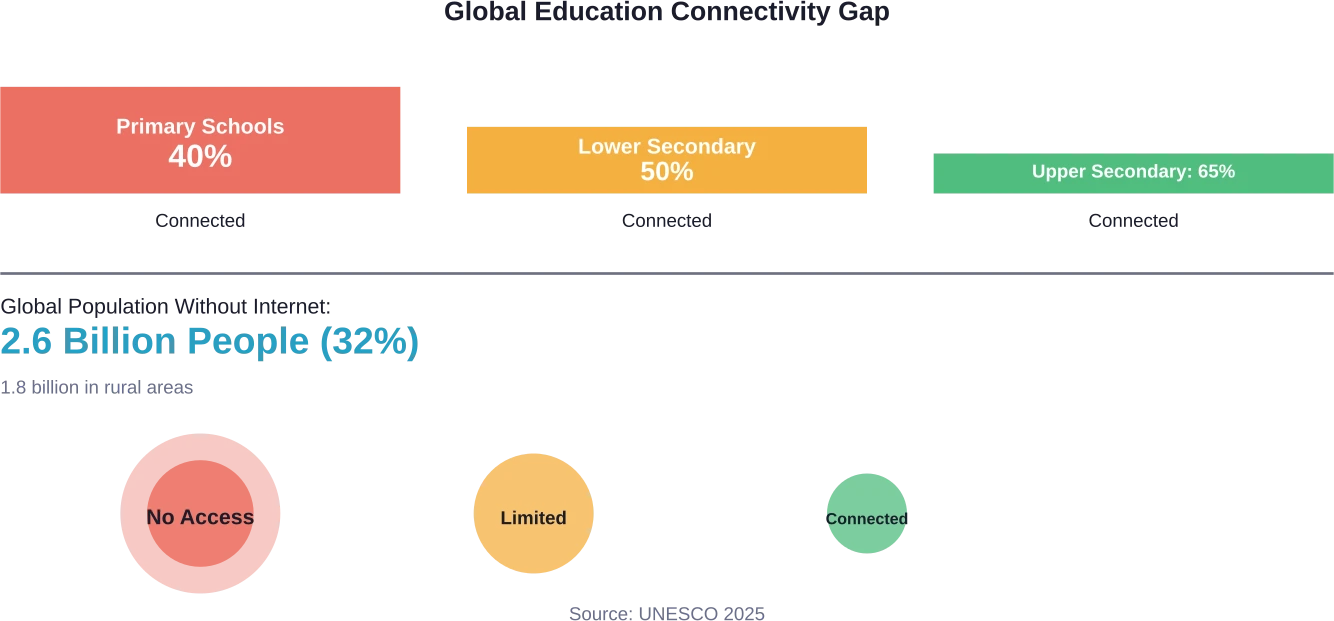
The digital divide remains stubbornly real. UNESCO reports that 2.6 billion people—32% of the global population—still lack internet access. That's 1.8 billion people living in rural areas without connectivity.
In education specifically, the numbers are sobering:
- Only 40% of primary schools are connected to the internet
- Only 50% of lower secondary schools are connected
- Only 65% of upper secondary schools are connected
These statistics from UNESCO's International Day for Digital Learning 2025 event held on March 31, 2025 reveal that digital transformation isn't just about adopting new tools. It's about addressing fundamental infrastructure challenges that prevent millions of students from accessing digital learning opportunities.
Artificial Intelligence Reshaping Educational Landscapes
AI has become central to education's digital transformation. In November 2025, the U.S. Department of Education unveiled seven priorities under the Fund for the Improvement of Postsecondary Education, with $50 million allocated specifically to advancing AI to improve educational outcomes.
The department expects to make awards by December 31, 2025, focusing on leveraging AI technology to improve student outcomes at the postsecondary level.
But here's where things get complicated. As education becomes a central arena for technological experimentation, countries increasingly look to UNESCO for guidance in a landscape heavily influenced by commercial interests.
The Sixth Annual Meeting of the Global Education Coalition took place on 24 March 2026 at UNESCO in Paris. The theme? "Turning vision into value: Transforming education together." Member States, Coalition partners, and education leaders gathered to discuss how digital transformation and artificial intelligence can advance equitable, quality education.
Key Priorities for Educational Institutions in 2026
Research shows that 40% of college students claim to work a full-time job while enrolled in classes. This reality demands educational experiences that fit diverse schedules and circumstances.
Next-generation institutions prioritize several critical areas:
Flexible Learning Delivery
Asynchronous learning options accommodate students balancing work, family, and education. Video platforms and learning management systems enable students to access content when it works for their schedules.
Traditional four-year programs don't serve everyone. Digital transformation enables institutions to offer modular, stackable credentials that let learners build skills incrementally.
Human-Centred Technology Integration
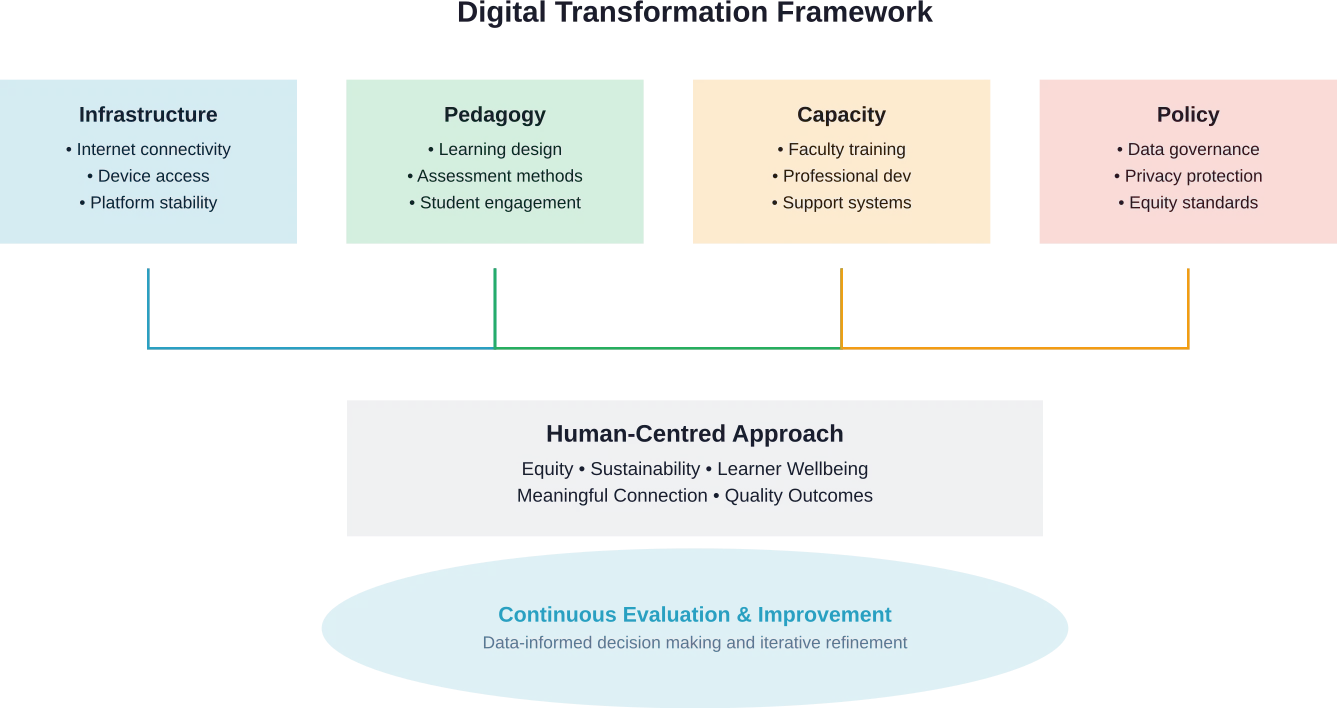
Technology should enhance human connection, not replace it. UNESCO's framework emphasizes that digital transformation must maintain focus on learner wellbeing, educational equity, and meaningful human interaction.
The most successful institutions balance digital tools with opportunities for mentorship, collaboration, and community building.
Data-Informed Decision Making
The U.S. Department of Education's EDFacts system collects and reports K-12 education performance data for policymakers. Digital transformation enables institutions to leverage data for understanding student needs, identifying learning gaps, and allocating resources effectively.
Learning From Global Initiatives
UNESCO and Jordan's Ministry of Education convened a Digital Transformation workshop in Amman in February 2026. Through the Digital Transformation Collaborative, they advanced inclusive, system-wide digital education reform.
These international efforts demonstrate that successful transformation requires:
- Cross-sector collaboration between government, education institutions, and technology providers
- Attention to local context and cultural considerations
- Investment in educator capacity building
- Commitment to equity and inclusion
The Education Innovation and Research program under section 4611 of the Elementary and Secondary Education Act provides early-phase, mid-phase, and expansion grants. The FY 2025 competition had an application deadline of October 14, 2025 - November 11:59 PM EDT, supporting innovative approaches to teaching and learning.
Challenges That Won't Disappear Overnight
Digital transformation solves some problems while creating others. Institutions wrestle with several persistent challenges:
The Equity Paradox
Technology can democratize access to education. But it can also widen existing gaps when students lack reliable internet, appropriate devices, or digital literacy skills.
Simply providing technology doesn't guarantee equitable outcomes. Institutions must address underlying disparities in resources, support systems, and opportunity structures.
Faculty Wellbeing and Adaptation
Research on the impact of digital transformation on academicians' wellbeing reveals significant stress factors. Rapid technological change demands constant learning and adaptation from educators already managing heavy workloads.
Successful institutions recognize that supporting faculty through transitions—with training, resources, and reasonable timelines—is essential for sustainable transformation.
Balancing Innovation With Proven Practices
Not everything needs digital transformation. UNESCO research notes that analogue technologies like pens and textbooks are making comebacks in some contexts.
The question isn't whether to go digital. It's when, how, and for what purposes technology genuinely enhances learning versus when traditional approaches work better.
Practical Steps for Moving Forward
Institutions don't need to transform everything simultaneously. Strategic, phased approaches tend to work better than wholesale overhauls.
Start by identifying specific pain points or opportunities where digital solutions can make measurable differences. Pilot new approaches with willing faculty and supportive student groups before scaling institution-wide.
Invest in professional development that goes beyond basic tool training. Educators need time and support to reimagine pedagogy, not just learn new software.
Build feedback loops that capture student and faculty experiences. The most valuable insights about what's working—and what isn't—come from people actually using the systems daily.

Improve How Your Education Platform Actually Runs
In education, the main issue isn’t always missing tools – it’s how everything fits together. Learning platforms, admin systems, and content tools often evolve separately, which makes daily work slower than it should be. Instead of replacing systems, many teams end up needing targeted fixes – better data flow, cleaner integrations, and small custom components that remove friction where it matters. OSKI Solutions works in that space, focusing on practical changes that improve how platforms operate day to day.
They usually support teams that are already running live products and need to improve stability, flexibility, or scalability without stopping ongoing work. That can involve extending LMS functionality, connecting internal tools through APIs, or moving parts of the system to the cloud in a controlled way. The goal is simple – make the platform easier to manage and easier to grow. If things feel harder than they should be, contact OSKI Solutions and discuss what can be adjusted first.
Accelerate Your Digital Transformation
Modernize your business with scalable technologies, automation, and data-driven strategies.
Frequently Asked Questions
What distinguishes digital transformation from simply using technology in classrooms?
Digital transformation represents systemic change in how institutions operate, deliver education, and serve learners. Using technology in classrooms is just one component. True transformation touches curriculum design, assessment methods, administrative processes, communication structures, and institutional culture. It's about reimagining education for the digital age, not just digitizing existing practices.
How can institutions address the digital divide while pursuing transformation?
Addressing the digital divide requires multi-pronged approaches. Institutions can provide device lending programs, create campus spaces with reliable connectivity, design courses that work with varying bandwidth levels, and offer offline alternatives when possible. Partnerships with community organizations and government programs can expand access beyond campus. The key is ensuring transformation is inclusive to avoid widening existing inequities.
What role should artificial intelligence play in education?
AI can personalize learning experiences, automate administrative tasks, provide immediate feedback, and help identify students needing additional support. However, UNESCO emphasizes that AI integration must be human-centred, transparent, and equitable. Technology should enhance educator capabilities and student learning, not replace human judgment or meaningful connections. Institutions must evaluate AI tools for bias, privacy implications, and real learning outcomes.
How can faculty members prepare for digital transformation?
Faculty preparation involves both technical skill development and pedagogical reimagining. Educators should engage in professional development focused on learning design, collaborate with peers, and start with small, low-risk experiments. Adaptation is a continuous process. Institutions should support faculty with training, realistic timelines, and recognition of effective teaching practices regardless of delivery format.
What metrics indicate successful digital transformation?
Success metrics should focus on learning outcomes, equity, and institutional effectiveness rather than just technology adoption. Key indicators include student engagement, completion rates, achievement data, faculty satisfaction, and operational efficiency. Qualitative feedback is equally important. True success improves educational quality and access while maintaining strong human connection and learner wellbeing.
How does digital transformation affect traditional educational credentials?
Digital transformation enables flexible credentialing models such as micro-credentials, digital badges, and stackable certificates. The IEEE Std 1484.2-2024 LER Ecosystem Standard provides guidance for Learning and Employment Record systems, allowing learners to build and showcase skills incrementally. These approaches complement traditional degrees with more granular and skills-based recognition.
What's the timeline for meaningful digital transformation?
Meaningful transformation typically takes years rather than months. While technology can be implemented quickly, cultural change, faculty development, and redesigning learning experiences require sustained effort. Successful institutions use phased approaches—starting with pilots, refining strategies, and scaling gradually based on feedback and outcomes.
Moving Forward With Purpose
Digital transformation in education isn't optional anymore. Technologies will continue reshaping how learning happens whether institutions engage strategically or not.
The real choice is whether transformation serves educational equity and human flourishing or merely follows commercial interests and technological trends.
UNESCO's framework offers a path forward—one that keeps learners at the center, addresses persistent inequities, and recognizes that technology should enhance rather than replace the human connections that make education transformative.
Start where meaningful change is possible. Build from there. And keep asking whether digital tools are actually serving students or just making institutions look innovative.
The future of education depends on getting this right.


