


Digital Transformation in Capital Markets 2026

Quick Summary: Digital transformation in capital markets involves adopting technologies like AI, cloud computing, blockchain, and tokenization to modernize trading, settlement, and operations. These innovations improve efficiency, reduce risk, and enable always-on markets, though they require robust investor protections and regulatory frameworks to ensure stability.
Global capital markets stand at a critical inflection point. The traditional infrastructure that's powered financial markets for decades faces mounting pressure from competition, volatility, and outdated systems. Meanwhile, distributed ledger technology, artificial intelligence, and cloud platforms promise to reshape everything from trade execution to settlement.
But here's the thing—this isn't just about adopting new tools. Digital transformation represents a fundamental shift in how capital markets operate, compete, and serve investors.
According to SIFMA's 2025 State of the Industry Briefing, U.S. markets demonstrated strong performance across asset classes throughout 2025, yet the October 10th crypto flash crash that wiped out more than $660 billion in reported value underscored critical gaps in investor protections for digital assets. The contrast reveals both the promise and peril of rapid digitalization.
The Technology Stack Reshaping Markets
Several core technologies drive the current transformation wave. Each brings distinct capabilities, though their real power emerges when deployed together.
Cloud Computing Takes Center Stage
Cloud adoption has accelerated dramatically. Research from FIS Global Innovation shows that 38% of C-level executives view embracing cloud computing as highly impactful for their digital transformation efforts.
Why the enthusiasm? Cloud platforms deliver time-series databases, parallel streaming capabilities, and comprehensive views of market activity—all at lower costs than legacy systems. Infosys found that around 70% of capital markets firms planned to adopt new cloud services or replace legacy systems with cloud computing, and that migration has only intensified.
The global cloud computing market reached $1,240 billion against an estimated $545.8 billion baseline, reflecting a compound annual growth rate of 17.9%. That growth translates directly into market infrastructure capabilities.

Artificial Intelligence Enhances Decision-Making
AI tools enable recognition of insightful data patterns and automation of regulatory document processes. According to Thomson Reuters research, 49% of survey respondents look to RegTech solutions to manage compliance more effectively.
The Bank for International Settlements noted in their October 2025 remarks that AI presents both opportunities and risks for monetary and financial stability. Central banks worldwide are exploring how machine learning algorithms can improve market surveillance, fraud detection, and systemic risk assessment.
Research examining 222 Chinese commercial banks from 2010-2019 (representing 75% of total assets in the Chinese banking industry) found that digital technology adoption through patents helped improve efficiency and reduce risk. The dataset included 26,168 patent records related to digital innovation.
Blockchain and Tokenization Create New Possibilities
Blockchain technology enables speedier, more accurate financial transactions. Electronic trading platforms built on distributed ledgers reduce settlement times from days to minutes or even seconds.
But tokenization represents something more transformative. According to the BIS Annual Economic Report from June 2025, tokenization paves the way for new arrangements in cross-border payments, securities markets, and beyond. Tokenized platforms incorporating central bank reserves, commercial bank money, and government bonds can underpin the next-generation monetary and financial system.
Real talk: this isn't just theoretical. Blockchain has already enabled new asset classes like cryptocurrencies and digital tokens, fundamentally changing how investors approach capital allocation.
Over 99% of stablecoins are U.S. dollar-denominated, with a growing cross-border presence. Cross-border transaction volumes tend to rise following episodes of high inflation and foreign exchange volatility in sending countries—a pattern that raises important questions about monetary sovereignty.
The Push Toward Always-On Markets
Capital markets are moving toward an always-on operating model. This shift responds to investor demands for 24/7 access and the technical capability to support continuous trading and settlement.
Distributed ledger technologies make this feasible by eliminating traditional batch processing windows. When settlement happens in real-time through smart contracts, the concept of market hours becomes increasingly obsolete.
That said, continuous markets introduce new operational challenges. Risk management protocols designed for discrete trading sessions need rethinking. Liquidity provision becomes more complex when markets never close.
Regulatory Evolution and Investor Protection
Technology advances faster than regulation. That gap creates tension—and risk.
SEC Chairman Paul Atkins addressed this challenge in his July 31, 2025 speech on American leadership in the digital finance revolution. The Commission has worked to balance innovation with investor protection, though the approach remains contentious.
SIFMA has emphasized that tokenized securities markets require strong investor protections, not broad exemptive relief. As SIFMA's December 2025 statement noted, fundamental investor protection and market integrity principles that have made U.S. markets successful must extend to tokenized markets.
The October 10, 2025 crypto flash crash proved this point. More than $660 billion in reported value vanished in minutes, demonstrating what happens when innovation outpaces safeguards. SIFMA stressed that guardrails continue to protect investors, ensure market stability and integrity, and mitigate risks that emerge in unregulated or lightly regulated digital-asset markets.
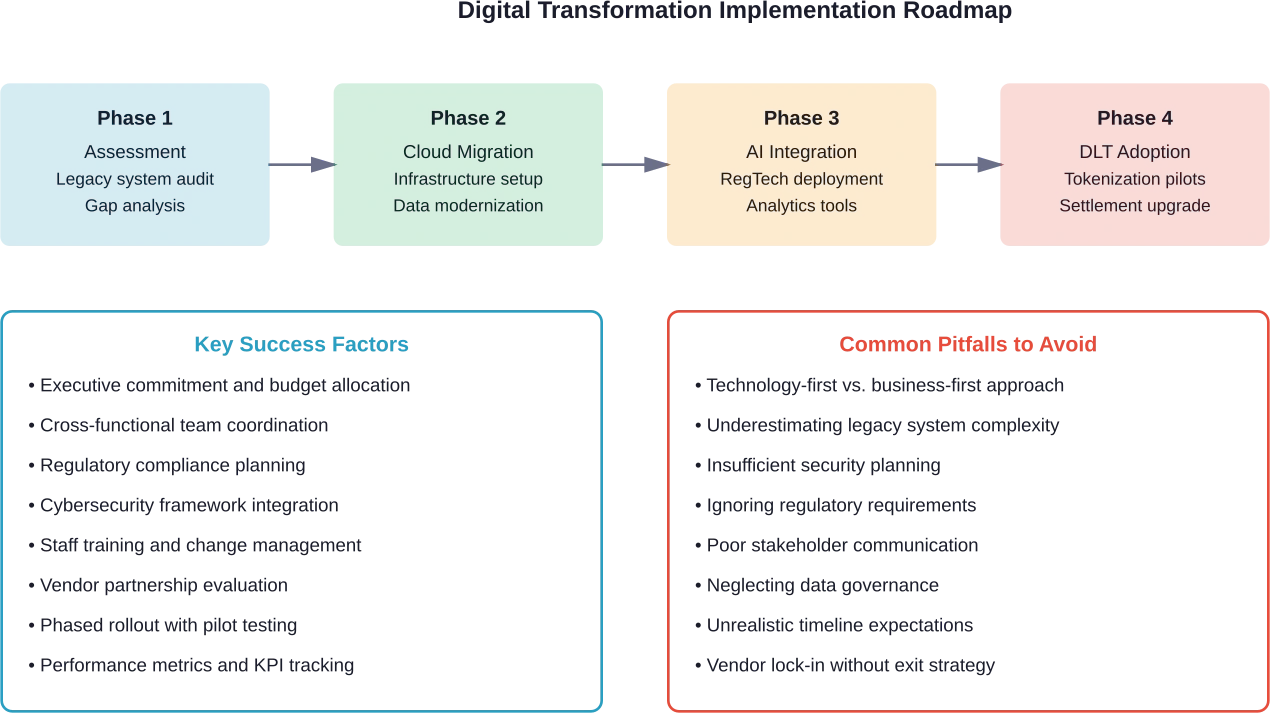
Democratization of Market Access
Digital platforms have lowered barriers to capital markets participation. Smaller companies and individual investors now access opportunities previously reserved for institutional players.
Crowdfunding platforms, peer-to-peer lending, and tokenized securities allow startups to bypass traditional intermediaries and connect directly with investors. This disintermediation reduces costs and expands the investor base.
But democratization brings risks alongside benefits. Retail investors entering complex markets without sufficient knowledge face potential losses. The question SIFMA's Ken Bentsen posed remains critical: "What's the most practical, prudent way for everyday investors to have exposure to these markets?" Access without understanding doesn't empower—it exposes.
Market Infrastructure Transformation Challenges
Modernizing market infrastructure isn't straightforward. Legacy systems often contain decades of accumulated business logic that's poorly documented and deeply embedded in operations.
Integration complexity multiplies when new technologies must interoperate with existing platforms. A bank can't simply flip a switch from centralized databases to distributed ledgers—the transition requires careful orchestration across multiple systems and counterparties.
Security concerns escalate as attack surfaces expand. Cloud platforms offer robust security features, but misconfiguration or inadequate access controls can expose sensitive data. Cybersecurity frameworks must evolve alongside technological adoption.
|
Technology |
Primary Benefits |
Implementation Challenges |
|---|---|---|
|
Cloud Computing |
Scalability, cost efficiency, processing power |
Data migration, security configuration, vendor selection |
|
Artificial Intelligence |
Pattern recognition, automation, predictive analytics |
Data quality requirements, model governance, bias mitigation |
|
Blockchain/DLT |
Settlement speed, transparency, immutability |
Scalability limits, energy consumption, regulatory uncertainty |
|
Tokenization |
Fractional ownership, liquidity, 24/7 trading |
Legal frameworks, custody standards, investor protection |
The Business Case for Digital Transformation
Financial firms face a clear imperative: transform or lose competitive ground.
Research from the University of Chicago examining FinTech firms found striking spending patterns. InsurTech firms allocate 40-60% of revenue to sales and marketing, compared to much more modest spending by traditional insurers. This aggressive customer acquisition strategy works because digital platforms reduce operational costs enough to fund it.
Efficiency gains from intelligent automation extend beyond cost reduction. Processing that previously required days now completes in hours or minutes. Staff shift from manual tasks to higher-value analysis and relationship management.
Revenue opportunities emerge through new products and services. Tokenized assets create markets where none existed. AI-powered advisory services scale personalized recommendations across mass-market segments.
Structural Modernization Across Multiple Pillars
At the 2026 Asset Management Derivatives Forum, hosted jointly by the Futures Industry Association and SIFMA Asset Management Group, three themes dominated discussions. One stood out: structural modernization is occurring across multiple pillars simultaneously.
Treasury clearing, refinancing mechanisms, and collateral optimization are all evolving together rather than sequentially. This parallel transformation creates both opportunities and coordination challenges.
Organizations that approach digital transformation holistically—addressing technology, processes, people, and governance together—achieve better outcomes than those focusing narrowly on individual tools.
Looking Ahead: The Next-Generation Financial System
What does the future hold? The BIS outlined a vision for next-generation monetary and financial systems built on tokenized unified ledgers incorporating central bank reserves, commercial bank money, and government bonds.
This architecture would enable programmable money, atomic settlement, and embedded compliance. Smart contracts could automatically enforce regulatory requirements, reducing friction and operational risk.
International coordination becomes essential as digital markets transcend borders. Standards for tokenized securities, cross-border settlement, and regulatory recognition need harmonization to realize the full potential of digital transformation.
Yet significant questions remain unresolved. How should jurisdictions balance innovation encouragement with investor protection? What governance models work for decentralized markets? How can traditional financial institutions compete with digital-native challengers while managing transformation risk?

Strengthen How Your Financial Systems Handle Growth
In capital markets, issues often come from systems falling out of sync – leading to delays and inconsistent data. OSKI Solutions works on improving how these systems connect and operate together.
They typically support teams that need to scale without increasing complexity. That can involve reworking API connections between systems, moving parts of the infrastructure to the cloud, or building specific tools where standard platforms fall short. The goal is to keep operations predictable and easier to manage as volumes grow.
If your systems feel harder to control than they should be, review what can be improved – contact OSKI Solutions and go through the next steps.
Accelerate Your Digital Transformation
Modernize your business with scalable technologies, automation, and data-driven strategies.
Frequently Asked Questions
What is digital transformation in capital markets?
Digital transformation in capital markets refers to adopting technologies like cloud computing, artificial intelligence, blockchain, and tokenization to modernize trading, settlement, operations, and market infrastructure. It involves replacing or enhancing legacy systems with digital platforms that enable faster, more efficient, and more transparent market operations.
How does tokenization change capital markets?
Tokenization converts traditional securities into digital tokens on blockchain platforms, enabling fractional ownership, faster settlement (often near real-time), 24/7 trading, and programmable features through smart contracts. According to the BIS, tokenization enables new models for cross-border payments and securities markets, supporting next-generation financial systems.
What role does AI play in capital markets transformation?
AI enables advanced analytics, pattern recognition in market data, automated regulatory compliance (RegTech), and improved risk assessment. Research from Thomson Reuters shows that many firms are adopting AI-driven solutions to manage compliance more efficiently and shift resources toward strategic initiatives.
Are digital capital markets safe for investors?
Safety depends on regulatory frameworks and market design. Organizations like SIFMA emphasize that tokenized securities must maintain the same investor protections as traditional assets. Market volatility events, such as major crypto market disruptions, highlight the importance of strong regulation, risk controls, and transparency.
Why are capital markets moving to cloud platforms?
Cloud platforms offer scalability, cost efficiency, and advanced capabilities such as real-time data processing and high-performance analytics. Industry research indicates that cloud adoption is a key driver of digital transformation, with many firms planning migrations to improve agility and operational efficiency.
What challenges do firms face implementing digital transformation?
Key challenges include legacy system complexity, integration across multiple platforms, cybersecurity risks, regulatory uncertainty, workforce skill gaps, and coordination across market participants. Firms must balance innovation with risk management and ensure compliance with evolving regulations.
How does digital transformation affect market access?
Digital platforms expand market access by lowering barriers for smaller firms and individual investors. Innovations such as crowdfunding, peer-to-peer platforms, and tokenized assets enable direct participation in capital markets. However, broader access also requires improved investor education and risk awareness.
Conclusion: Transformation Requires Strategy, Not Just Technology
Digital transformation in capital markets represents far more than technology adoption. Success requires coordinating infrastructure modernization, regulatory compliance, risk management, and cultural change across organizations and ecosystems.
The technologies exist. Cloud platforms, AI tools, blockchain networks, and tokenization protocols have proven capabilities. The challenge lies in implementing them thoughtfully—balancing innovation with stability, democratization with protection, and speed with security.
As SIFMA's 2025 Annual Meeting concluded, confidence in U.S. markets remains strong, grounded in innovation, resilience, and adaptability. That confidence depends on ensuring digital transformation strengthens rather than undermines the fundamental principles that have made capital markets successful.
Organizations that approach transformation strategically—with clear business objectives, robust governance, and commitment to investor protection—will lead the next era of capital markets. Those that treat it as merely a technology project risk falling behind or, worse, introducing new risks without capturing the benefits.
The digital revolution in capital markets is underway. The question isn't whether to transform, but how to do it right.


