


AI Agents News Enterprise 2026: Latest Developments

Quick Summary: AI agents are rapidly transforming enterprise operations in 2026, with major platforms from OpenAI, NVIDIA, and New Relic enabling businesses to automate complex workflows. According to NIST's new AI Agent Standards Initiative launched in February 2026, enterprises are adopting agents with structured oversight frameworks that treat them like digital employees with defined roles and permissions.
The enterprise AI landscape has shifted dramatically in early 2026. What started as experimental chatbot deployments has evolved into full-scale agentic systems that execute complex tasks across business operations.
But here's the thing—this isn't just another software rollout. Organizations are learning that deploying AI agents requires treating them like actual team members, complete with onboarding processes, defined roles, and accountability structures.
The numbers tell the story. According to research on enterprise AI agent systems, autonomous agents studied in insurance underwriting now parse insurance applications and supporting documents with over 95% accuracy. And that's just one vertical.
Government Standards Shape Enterprise Adoption
In February 2026, the National Institute of Standards and Technology (NIST) launched the AI Agent Standards Initiative, marking a pivotal moment for enterprise adoption. The initiative focuses on ensuring the next generation of AI operates securely on behalf of users while maintaining interoperability across digital ecosystems.
This wasn't a symbolic gesture. NIST's framework addresses the core concerns holding back large-scale deployments: trust, security, and standardization.
The White House has reinforced AI's strategic importance through multiple policy releases. In December 2025, an executive order established a national policy framework positioning U.S. leadership in artificial intelligence as critical to national and economic security. Follow-up policies in April 2025 removed barriers to federal agency AI adoption and streamlined procurement processes.
These regulatory developments matter because enterprises operate in compliance-heavy environments. Clear standards accelerate deployment by reducing legal uncertainty and establishing shared technical protocols.
Major Platform Launches Transform the Market
The first quarter of 2026 brought a cascade of enterprise-focused agent platforms that fundamentally changed what's possible at scale.
OpenAI Frontier Platform
In February 2026, OpenAI launched Frontier, an end-to-end platform designed specifically for enterprises to build and manage AI agents. The platform takes an open approach, allowing organizations to manage agents built outside OpenAI's ecosystem.
Frontier agents can connect to external data sources and applications, creating a unified management layer for heterogeneous agent deployments. This matters because enterprises don't want vendor lock-in—they need flexibility as the technology evolves.
NVIDIA Agent Toolkit
NVIDIA announced its Agent Toolkit on March 16, 2026, positioning it as infrastructure for what the company calls "the next industrial revolution in knowledge work." The toolkit includes NVIDIA OpenShell, an open-source runtime for building self-evolving agents with enhanced safety protocols.
Built with LangChain integration, the toolkit features the AI-Q Blueprint for hybrid architecture. This design uses frontier models for orchestration while relying on NVIDIA Nemotron open models for research tasks—a strategy that cuts query costs by more than 50% while maintaining high accuracy levels.
The cost reduction angle is significant. According to NVIDIA's implementation data, the hybrid approach delivers world-class accuracy without the expense of running frontier models for every operation.

New Relic Agentic Platform
New Relic entered the space on February 24, 2026, with a no-code agentic platform focused on data observability. The platform lets enterprises build AI agents that monitor company data systems to catch bugs and issues before they disrupt products.
The company acknowledges the crowded market but positions its offering around simplicity—organizations can assemble monitoring agents without writing code. This lowers the barrier for teams that understand their data challenges but lack specialized AI engineering resources.
The Context Problem and Startup Solutions
Despite these powerful platforms, enterprises face a fundamental challenge: context. AI agents can't scale effectively if they don't understand the complex corporate environments and processes where they operate.
Trace, a Y Combinator summer 2025 startup, launched in February 2026 with $3 million in seed funding to address exactly this gap. The company maps corporate environments and workflows to provide agents with the contextual information they need.
As Trace's positioning suggests, frontier AI models from OpenAI and Anthropic function like brilliant interns—highly capable but lacking institutional knowledge. Without proper context mapping, these "interns" can't navigate the complexity of enterprise systems effectively.
Another startup, Narada, is using what it calls large action models to automate complex, multistep workflows across enterprise systems. The company's approach focuses on understanding task sequences and dependencies rather than just individual operations.
Treating Agents Like Employees
Research published on arXiv emphasizes that generative AI agents require fundamentally different deployment strategies than traditional software. When agents gain the ability to execute tasks—updating records, issuing refunds, routing approvals—they introduce operational risks that standard tools don't.
The solution? Treat them like digital employees.
This means giving each agent a defined identity, limited authority based on role, trusted information sources, clear execution controls, and audit trails that make decisions explainable. Organizations that adopt this mindset and introduce autonomy gradually are far more likely to capture benefits without costly mistakes.
|
Agent Management Element |
Purpose |
Implementation Approach |
|---|---|---|
|
Defined Identity |
Accountability tracking |
Unique credentials and access logs |
|
Limited Authority |
Risk containment |
Role-based permissions and guardrails |
|
Trusted Data Sources |
Decision quality |
Curated knowledge bases and APIs |
|
Execution Controls |
Action oversight |
Approval workflows for critical tasks |
|
Audit Trails |
Explainability |
Logged reasoning and action history |
This framework addresses the unpredictable behavior and unclear responsibility issues that emerge when agents operate autonomously. Without these structures, enterprises can't confidently deploy agents at scale.
Enterprise Adoption Reality Check
Despite the platform launches and regulatory support, enterprise AI adoption faces persistent challenges. An MIT survey in August 2025 found that 95% of enterprises weren't getting a meaningful return on their investments in AI.
VCs remain optimistic about 2026, but this optimism has become familiar. According to TechCrunch's survey of 24 enterprise-focused VCs, strong enterprise AI adoption is predicted for the coming year—again. The pattern of predicted breakthroughs that don't materialize has created skepticism.
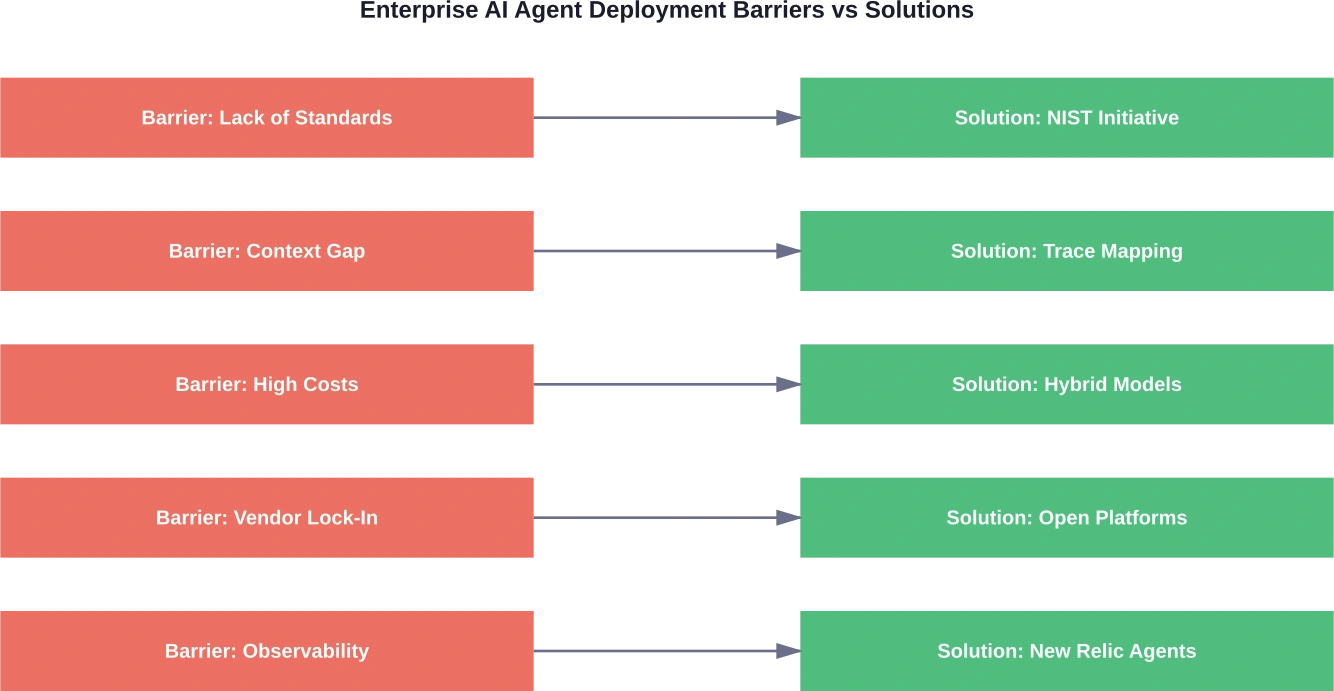
That said, the infrastructure launched in early 2026 represents a qualitative shift. Unlike previous waves of AI hype, these platforms address real deployment barriers: interoperability, security, context mapping, and cost management.
Orchestration and Multi-Agent Systems
As enterprises move beyond single-agent deployments, orchestration becomes critical. Research on multi-agent systems emphasizes that autonomous agents must collaborate through structured coordination and communication to achieve complex shared objectives.
Research published on arXiv outlines blueprint architectures for compound AI in enterprise settings, with papers submitted in April 2025. These frameworks address how agents and data interact across business operations, establishing protocols for agent communication, task delegation, and conflict resolution.
The insurance industry provides a concrete example. Specialized agent networks now handle underwriting processes that were previously labor-intensive. Multiple agents collaborate—one parsing applications, another assessing risk factors, a third checking compliance requirements—with an orchestration layer coordinating their outputs.
This approach reduces underwriting time from days to hours while maintaining accuracy levels that meet regulatory standards.
Investment and Market Dynamics
The venture capital flowing into the agent ecosystem reflects both opportunity and competition. LangChain, founded in 2022, has raised more than $150 million and established itself as a notable player in agent development frameworks. CrewAI, a smaller entrant, has secured more than $20 million despite launching more recently.
These funding levels indicate investor confidence that agents represent a fundamental shift in how software operates, not just an incremental improvement. But they also create pressure for rapid differentiation as multiple platforms compete for enterprise attention.
Transcend, recognized as a Leader in IDC's MarketScape for Worldwide Data Privacy Compliance Software, launched its Agentic Assist and MCP Server to help privacy teams automate compliance workflows. The company claims its tools reduce days of manual work to minutes of guided review.
Gartner predicts that 40% of enterprise apps will feature task-specific AI agents by 2026, up from negligible levels in previous years. If accurate, this represents one of the fastest enterprise technology adoption curves in recent history.

Make AI Agents Work Inside Your Existing Systems
Most AI agent projects don’t fail because of the model. They fail at integration. Internal tools, legacy systems, APIs, and data flows are where things get messy. If the agent can’t connect cleanly to CRM, ERP, or your core product, it stays a demo instead of something useful. OSKI Solutions works with companies that need to move past experiments and actually plug AI into real operations.
They build around existing stacks – .NET, Node.js, and cloud environments like Azure or AWS – and focus on practical things like API integrations, data pipelines, and system stability. The goal is to make AI agents part of everyday workflows, not something separate. If you’re serious about getting AI agents into real use, reach out to OSKI Solutions and talk through your setup. They’ll help you figure out what can actually be built and how to make it work in your environment.
Frequently Asked Questions
What are AI agents in enterprise contexts?
AI agents are autonomous systems that combine foundation models with reasoning, planning, memory, and tool usage to perform tasks. In enterprise environments, they automate workflows such as data processing, compliance checks, customer service, and system monitoring.
How does the NIST AI Agent Standards Initiative affect enterprises?
The initiative establishes frameworks for secure, interoperable, and trustworthy AI agent deployment. It helps enterprises reduce risk, standardize practices, and enable cross-platform agent collaboration.
What's the difference between OpenAI Frontier and NVIDIA Agent Toolkit?
OpenAI Frontier is a full platform for building and managing agents across organizations, while NVIDIA Agent Toolkit focuses on development infrastructure and cost-efficient architectures for deploying agents.
Why do experts recommend treating AI agents like employees?
AI agents introduce operational risks similar to human workers—decision-making, responsibility, and access to systems. Assigning roles, permissions, and audit controls helps manage these risks effectively.
What's preventing faster enterprise AI agent adoption?
Key challenges include unclear ROI, integration complexity, high costs, lack of process context, and evolving governance frameworks.
How do multi-agent systems work in practice?
Multi-agent systems coordinate specialized agents through orchestration layers. Each agent handles a specific task while a central orchestrator manages collaboration and workflow execution.
Are AI agent platforms vendor-specific or interoperable?
Modern platforms increasingly support interoperability. Many tools allow cross-platform integration, and industry standards are being developed to enable seamless collaboration between different systems.


