


AI Agents Commerce News: 2026 Transformation Guide

Quick Summary: AI agents are revolutionizing commerce by autonomously handling shopping tasks from browsing to checkout. Major players like Google, Microsoft, and Shopify are launching agentic commerce platforms that transform how consumers discover and buy products. This shift introduces new standards, tools, and challenges for retailers adapting to a future where AI agents become primary customers.
Commerce just changed forever. And it didn't happen with a press release.
In October 2025, Walmart partnered with OpenAI to bring shopping directly into ChatGPT through Instant Checkout. According to research from China Europe International Business School, this marks the transition of AI agents from information gateways to transaction enablers. Users browse, select, and complete purchases entirely within the ChatGPT interface while Walmart handles fulfillment.
However, in March 2026, Walmart ended its partnership with OpenAI's Instant Checkout due to accuracy and integration issues, opting instead to embed its own homegrown shopping assistant, Sparky, into platforms like ChatGPT and Google Gemini.
That's agentic commerce—AI systems autonomously executing shopping tasks without constant human oversight. What started as chatbots answering product questions evolved into agents comparing prices, evaluating options, and completing transactions independently.
Now every major tech company and retailer is racing to build platforms for this new reality.
What Makes Agentic Commerce Different
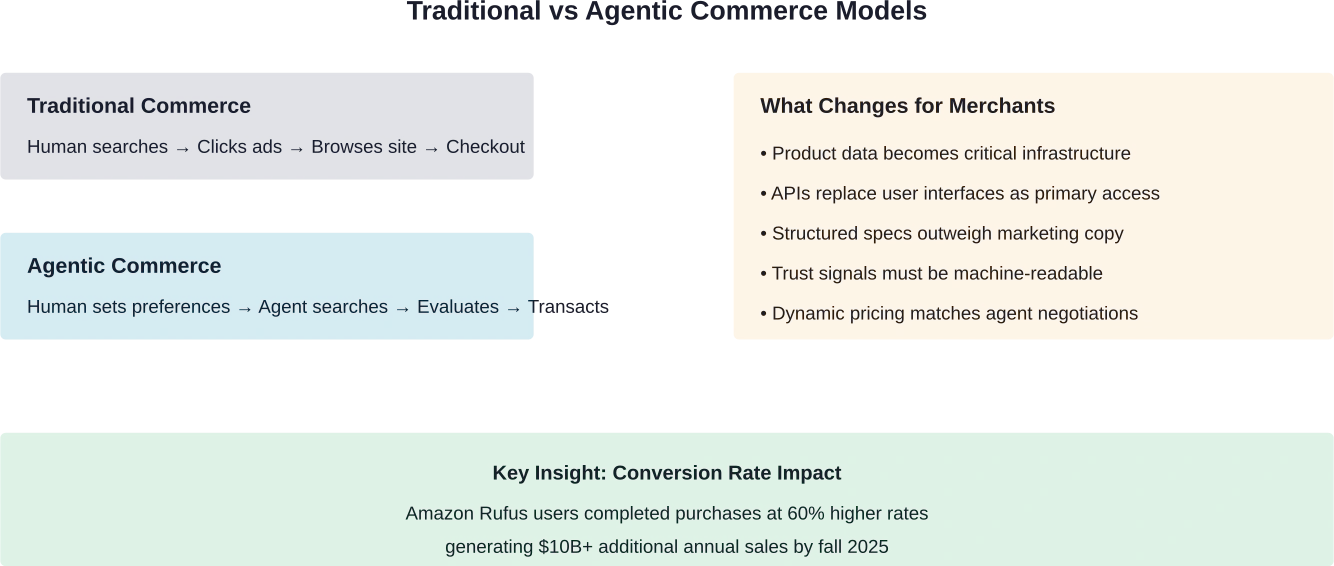
Traditional e-commerce puts humans in control. Browse Amazon, click products, add to cart, checkout. The AI might recommend items but you drive every decision.
Agentic commerce flips that script entirely.
According to research published on arXiv in August 2025, AI agents in e-commerce face challenges around evaluation, biases, and model dependence. The paper "What Is Your AI Agent Buying?" by researchers including Amine Allouah and Omar Besbes examines how agents make purchasing decisions with varying degrees of autonomy.
Here's what distinguishes agentic systems:
- Autonomous decision-making based on user preferences
- Multi-step task completion without intervention
- Cross-platform product discovery and comparison
- Direct transaction execution with merchant integration
- Continuous learning from user behavior patterns
Research from Perplexity analyzing early AI agent adoption found that Shopping for Goods is among the largest subtopics for agentic queries. The two largest topics—Productivity & Workflow and Learning & Research—account for 57% of all agentic queries, while the two largest subtopics—Courses and Shopping for Goods—make up 22%. Personal use constitutes 55% of queries, while professional and educational contexts comprise 30% and 16%, respectively.
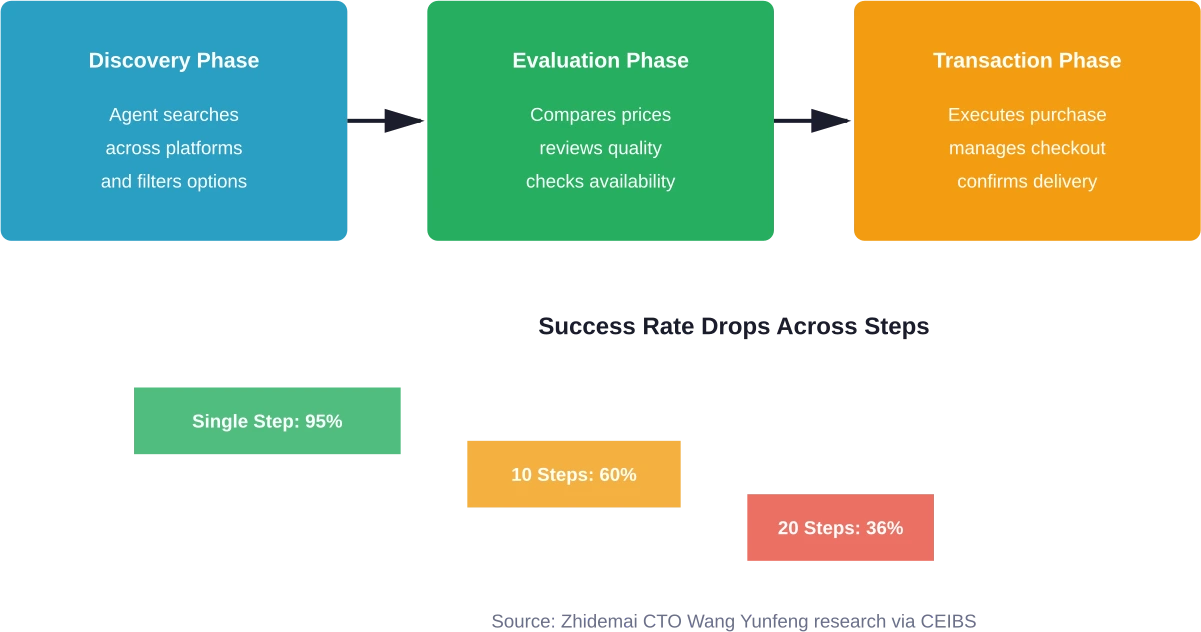
But here's the challenge: As noted by Zhidemai CTO Wang Yunfeng in CEIBS research, even if each step of a process has a 95% success rate, the overall success probability drops to about 36% across 20 steps. AI alone can't guarantee reliable transactions.
Google's Open Standard for Agentic Shopping
In January 2026, Google Cloud introduced the Universal Commerce Protocol (UCP), an open standard designed to facilitate seamless agent interactions across the retail ecosystem, alongside Gemini Enterprise for Customer Experience (CX).
Google Cloud's vice president Carrie Tharp emphasized that authentic intelligence platforms are already seeing adoption. Authentic Brands Group—owner of brands including Juicy Couture, Reebok, and SHAQ—launched its "Authentic Intelligence" platform with more than 80% of employees using it weekly across marketing and other functions.
The open standard matters because fragmented systems hurt everyone. Retailers need consistent ways for agents to access inventory, pricing, and checkout. Consumers need agents that work across platforms without switching contexts.
Microsoft and Shopify Enter the Arena
Microsoft announced agentic AI solutions for retail on January 8, 2026. The company positioned these capabilities as bringing intelligent automation to merchandising, supply chain, and customer service operations.
The timing wasn't coincidental. Microsoft is competing directly with Google and Amazon for the infrastructure layer of agentic commerce.
Then there's Shopify—the second-largest e-commerce provider in the U.S. behind Amazon. Speaking at the 2026 Upfront Summit in Los Angeles, president Harley Finkelstein said the company is preparing for "the transformation of a lifetime" by going all-in on agentic shopping.
That's significant because Shopify powers millions of independent merchants. If agentic commerce only worked with giant retailers, it would centralize power further. Shopify's platform democratizes access so smaller brands can participate when AI agents come shopping.
Research from arXiv on the FaMA system (Facebook Marketplace Assistant) demonstrates how agentic AI provides a lightweight alternative to traditional app interfaces for consumer-to-consumer marketplaces. The conversational paradigm allows users to manage marketplace activities with greater efficiency than clicking through multiple screens.
What Changes for Retailers Right Now
Retailers face immediate decisions. Wait and see isn't a viable strategy when agents already execute transactions.
According to California Management Review research, Amazon's Rufus assistant was driving over $10 billion in additional annual sales by fall 2025. Users who engaged the assistant completed purchases at 60% higher rates compared to traditional browsing.
That conversion lift explains why Amazon made a $30 billion bet despite already dominating e-commerce. The company wasn't optimizing for current customers—it was positioning for a future where agents mediate most digital transactions.
Here's what retailers should prioritize:
|
Priority Area |
Action Required |
Impact Timeline |
|---|---|---|
|
Product Data Quality |
Structured specifications and attributes |
Immediate |
|
API Accessibility |
Agent-friendly inventory and pricing feeds |
0-6 months |
|
Checkout Integration |
Streamlined authentication and payment flows |
3-12 months |
|
Offer Management |
Dynamic pricing for agent negotiations |
6-18 months |
|
Trust Signals |
Reviews, certifications, return policies |
Ongoing |
The Brookings Institution noted in November 2025 that generative AI market growth is accelerating around 40% annually. That growth requires massive data center infrastructure storing and processing information for AI services and agents. The physical backbone matters as much as the software layer.
The Accountability Gap Nobody's Solving
Real talk: The technology is moving faster than oversight.
Research examining AI agents reaching checkout found lagging accountability across browsers, business software, and automation platforms. When an agent makes a purchase that doesn't meet expectations, who's responsible? The AI company? The retailer? The user who set initial preferences?
According to a RAND Corporation analysis published October 2025, the question isn't whether to slow artificial intelligence development but how to ensure it strengthens rather than undermines democratic equality. That applies directly to commerce—if only wealthy consumers can afford sophisticated AI agents, inequality compounds.
The arXiv research on agentic e-commerce identified several concerns:
- Model dependence creating vendor lock-in
- Evaluation biases favoring certain merchants
- Lack of transparency in decision-making processes
- Privacy implications of persistent shopping profiles
MIT and Cambridge researchers analyzing AI agent behavior found insufficient disclosure about how agents make purchasing recommendations. Users often don't understand why an agent selected one product over alternatives.
Preparing for the Prompt Economy
The shift to agentic commerce creates what some call the "prompt economy"—where success depends on how effectively products and services respond to AI queries rather than human searches.
That fundamentally changes SEO, advertising, and brand positioning. Keywords matter less than structured data. Ad placements matter less than integration with agent workflows. Brand awareness matters less than programmatic trust signals agents can verify.
Ambiq Micro, which filed for IPO in July 2025, noted that its products power over 270 million devices with more than 40% running AI algorithms. The company is driving AI adoption at the edge in personal devices, medical/healthcare, industrial edge, and smart home markets. That edge computing capability enables local AI agents operating without constant cloud connectivity.
Turn AI Agent Ideas Into Working Commerce Flows
In commerce, AI agents only start to matter when they handle real tasks – updating product data, assisting with orders, syncing systems, or supporting internal teams. The gap is usually not the idea itself, but getting those agents to operate across tools that weren’t built to work together.

OSKI Solutions helps teams move from isolated AI use cases to connected workflows. Instead of adding another layer on top, they work inside existing systems – linking agents with CRM, ERP, and storefront logic, and making sure data moves correctly between them. This is especially relevant for companies running on mixed stacks where stability and control still matter.
If your goal is to make AI agents part of everyday commerce operations, not just a side experiment, it makes sense to talk through your setup with OSKI Solutions and see what can be realistically implemented.
AI Agents Driving Commerce Innovation
Follow how companies are using AI agents to automate sales, personalize experiences, and increase revenue.
Frequently Asked Questions
What exactly is agentic commerce?
Agentic commerce refers to AI systems that autonomously handle shopping tasks—product discovery, comparison, evaluation, and even completing purchases—based on user preferences with minimal human input.
Which companies are leading agentic commerce development?
Major players include Google Cloud, Microsoft, Amazon, Shopify, and Walmart. These companies are building platforms and integrations that enable AI-driven shopping experiences.
How do AI shopping agents make purchasing decisions?
Agents analyze structured data such as product specs, pricing, reviews, availability, and trust signals. They evaluate options step by step, though accuracy can decrease across complex multi-step decisions.
Do retailers need special technology to support AI agents?
Yes. Retailers need structured product data, API access for inventory and pricing, agent-friendly checkout flows, and machine-readable trust signals like reviews and policies.
What are the risks of agentic commerce?
Risks include bias in recommendations, lack of transparency, privacy concerns, vendor lock-in, and unclear accountability when purchases go wrong.
How does agentic commerce affect small retailers?
It can both help and challenge them. Platforms may improve discovery, but smaller retailers must invest in structured data and integrations to compete effectively.
When will agentic commerce become mainstream?
Adoption is already underway, with broader mainstream use expected within the next 2–5 years as infrastructure improves and consumer trust increases.
What Happens Next
Commerce is fragmenting into two parallel paths. Traditional browsing won't disappear—humans still enjoy discovery and comparison shopping. But autonomous agents will handle routine replenishment, price-sensitive purchases, and complex multi-criteria decisions.
Retailers succeeding in both models will dominate. Those optimizing only for human shoppers risk irrelevance as agent-mediated transactions scale.
The infrastructure decisions happening now determine which merchants get surfaced when millions of AI agents start shopping daily. Product data quality, API accessibility, and programmatic trust signals aren't nice-to-haves anymore.
They're survival requirements for the agentic commerce era that's already here.


