


AI Agent vs Chatbot: Key Differences in 2026

Quick Summary: AI agents are autonomous systems that can plan, make decisions, and execute multi-step tasks across multiple systems, while chatbots are conversational interfaces designed to respond to user queries within predefined parameters. The key difference: agents act independently to achieve goals, whereas chatbots react to prompts. Understanding this distinction helps businesses choose the right technology for their automation needs.
The confusion around AI agents and chatbots has reached a breaking point. Companies slap "AI agent" labels on what are basically glorified chatbots, while actual agentic systems quietly transform enterprise operations behind the scenes.
Here's the thing though—the distinction matters. Not in an academic, hair-splitting way, but in a "will this technology actually solve my problem" way.
According to research from arXiv on agentic AI systems, AI agents represent a transformative shift in artificial intelligence, moving from reactive systems to proactive, autonomous entities that can plan, execute, and adapt. But what does that actually mean for businesses evaluating these technologies?
What Is a Chatbot?
Chatbots are conversational interfaces. They're designed to understand natural language input and generate relevant responses based on training data, predefined rules, or retrieval mechanisms.
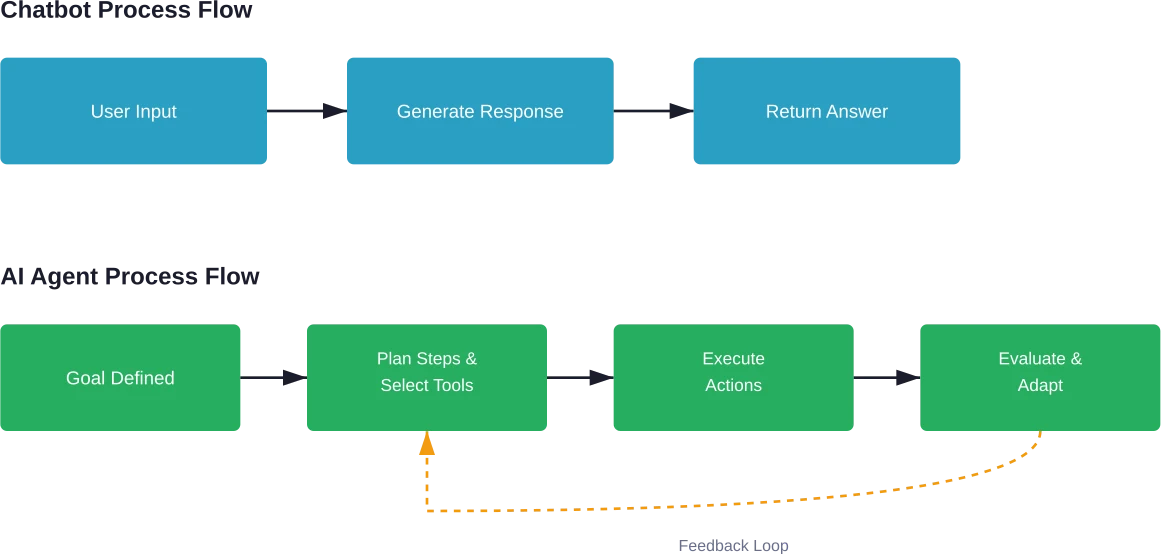
Think of them as interactive FAQ systems on steroids. Modern chatbots use large language models to understand context and generate human-like responses, but they're fundamentally reactive. A user asks a question. The chatbot provides an answer. Repeat.
The core characteristics:
- Reactive operation: Chatbots wait for user input before taking action
- Conversation-focused: Built primarily for dialogue and information exchange
- Limited scope: Typically operate within a single interface or platform
- Stateless or simple state: May remember conversation context but rarely maintain complex state across sessions
That doesn't make them useless. Chatbots excel at handling straightforward queries, according to common deployment patterns, guiding users through predefined flows, and providing instant responses to common questions.
Common Chatbot Use Cases
Chatbots have carved out clear territory where they deliver genuine value:
- Customer support triage: Answering frequently asked questions about products, services, policies, and procedures. When someone asks "What's your return policy?" a chatbot can deliver that answer instantly without involving human agents.
- Lead qualification: Engaging website visitors, collecting basic information, and routing qualified leads to sales teams. The chatbot asks qualifying questions, but a human closes the deal.
- Appointment scheduling: Handling booking requests by checking availability and confirming appointments. This works well when the logic is straightforward and the systems involved are limited.
- Internal knowledge bases: Helping employees find company information, HR policies, or technical documentation. Instead of searching through SharePoint or Confluence, employees ask conversational questions.
Real-world data from enterprise deployments shows that approximately 39% of dialogs in enterprise conversational assistant deployments involve multiple turns, according to goal-oriented evaluation of conversational agents, which focuses on whether user goals were fulfilled. These multi-turn dialogs contribute disproportionately to user frustration when systems can't maintain context or handle complexity.
What Is an AI Agent?
AI agents are autonomous systems designed to achieve goals through planning, decision-making, and action execution across multiple tools and environments.
The critical distinction: agents don't just respond—they act. They can break down complex objectives into subtasks, decide which tools to use, execute multi-step workflows, and adapt based on results.
According to OpenAI's practical guide to building agents, advances in reasoning, multimodality, and tool use have unlocked this new category of LLM-powered systems. These aren't incremental improvements over chatbots. They're fundamentally different architectures.
Key characteristics of AI agents:
- Autonomous operation: Can identify needs and take action without constant human prompting
- Multi-step planning: Break complex tasks into sequences of actions
- Tool use: Integrate with APIs, databases, and external systems to accomplish tasks
- Adaptability: Learn from outcomes and adjust approaches based on feedback
- Goal-oriented: Work toward defined objectives rather than just answering questions
The shift from reactive to proactive is what separates agents from chatbots. An agent given the goal "reduce customer churn by 15%" might analyze usage patterns, identify at-risk customers, draft personalized retention offers, and trigger outreach campaigns—all without step-by-step human guidance.
Real-World AI Agent Applications
Here they are:
- Autonomous customer service resolution: Companies like Lippert, which generates over $5.2 billion in annual sales, deploy agents that not only answer questions but investigate issues, pull data from multiple systems, coordinate with logistics, and follow through until resolution. The agent doesn't just tell customers what to do—it does it.
- Research and analysis: According to OpenAI's multi-agent portfolio collaboration guide, agents can conduct complex research by querying multiple data sources, synthesizing information, generating reports, and updating based on new data. This goes well beyond simple information retrieval.
- Workflow automation: Agents orchestrate entire business processes, handling exceptions and making decisions along the way. When an exception occurs, the agent evaluates options and chooses an appropriate path rather than failing or escalating immediately.
- Self-improvement systems: OpenAI's self-evolving agents cookbook describes systems that capture edge cases, diagnose failures, and autonomously retrain themselves. The optimization cycle continues until quality thresholds exceed 80% positive feedback, with the system deciding when to stop iterating.
Early 2025 saw the introduction of Manus AI, developed by Chinese startup Monica.im. According to arXiv research, Manus outperformed OpenAI's GPT-4 on the GAIA test—a benchmark assessing reasoning, tool use, and task automation—with early reports suggesting it exceeded the previous leaderboard champion's score of 65%.
Core Differences Between AI Agents and Chatbots
The distinctions aren't subtle once you know what to look for.
|
Capability |
Chatbots |
AI Agents |
|---|---|---|
|
Autonomy |
Require human prompts for each action |
Proactively identify needs and act independently |
|
Planning |
Limited or no planning capability |
Break complex goals into multi-step plans |
|
Tool Integration |
Typically single-interface operation |
Orchestrate multiple APIs and systems |
|
Learning |
Static or limited adaptation |
Continuously learn and improve performance |
|
Scope |
Conversation-centric |
Task and goal-centric |
|
Decision Making |
Rule-based or pattern matching |
Evaluate options and make contextual decisions |
Autonomy and Initiative
Chatbots are reactive by design. They sit idle until prompted. Even sophisticated chatbots with excellent context understanding still operate on a request-response cycle.
Agents operate with varying degrees of autonomy. Some require high-level goal setting but handle tactical decisions independently. Others monitor environments and initiate actions when conditions warrant.
The shift matters for business operations. A chatbot helping with customer service waits for customers to contact support. An agent monitoring customer health scores proactively reaches out when usage patterns indicate churn risk.
Complexity Handling
Chatbots handle straightforward queries effectively but struggle with multi-step problems requiring coordination across systems. When tasks require retrieving data from multiple sources, performing calculations, and triggering actions in external systems, chatbots typically fail or require extensive custom development.
Agents are architected for complexity. Research on agentic AI systems describes architectures that maintain state, context, and goals across extended interactions. They decompose high-level objectives into executable subtasks, much like a human would approach complex problems.
Learning and Adaptation
Traditional chatbots operate with fixed capabilities. Updates require retraining or reconfiguration by developers. Some modern systems adapt responses based on usage patterns, but this adaptation is typically limited.
Agent systems incorporate feedback loops that enable continuous improvement. According to the self-evolving agents cookbook from OpenAI, production agent systems capture failure cases, evaluate outcomes, and autonomously adjust their approaches. The optimization cycle continues until quality thresholds exceed 80% positive feedback, with the system deciding when to stop iterating.
The Enterprise Agentic AI Transformation
According to MIT Sloan Management Review research from November 2025, organizational adoption of traditional AI has climbed to 72% over the past eight years. But agentic AI adoption is happening faster—despite most organizations lacking clear strategies for deployment.
According to the California Management Review published at UC Berkeley (October 2025), the rise of the "agentic enterprise" marks a profound transformation in organizational operations. This isn't just automation of existing processes. It's a fundamental rethinking of how work gets done.
Standards bodies are racing to catch up. IEEE standards such as P3327 (Standard for Terms and Terminology of Enterprise AI Agents) and P3119 (Standard for the Procurement of AI Systems) are under development to address agent description and governance. These technical standards will shape how enterprise agents interact, what performance metrics matter, and how organizations evaluate agent capabilities.
Multi-Agent Systems
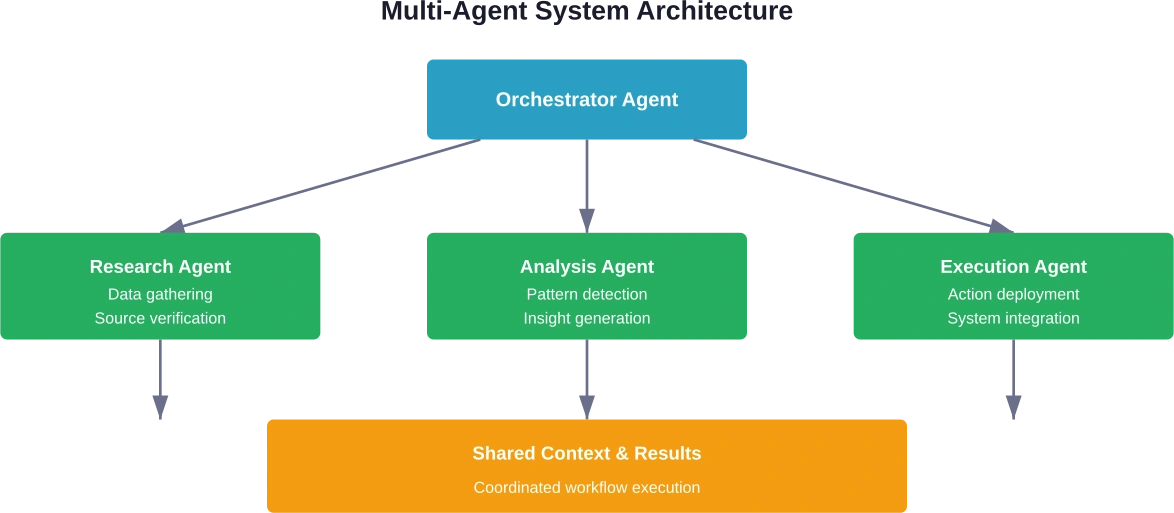
The most sophisticated enterprise deployments don't use a single agent—they orchestrate teams of specialized agents that collaborate on complex workflows.
OpenAI's multi-agent portfolio collaboration guide demonstrates systems where multiple agents with distinct capabilities work together. One agent handles research and data gathering. Another specializes in analysis. A third generates reports. They coordinate autonomously, passing context and results between specialized roles.
This mirrors human organizational structures but operates at machine speed and scale. For complex tasks, the multi-agent approach can reduce completion time from hours to minutes while maintaining or improving quality.
Choosing Between Agents and Chatbots
So which does a business actually need? The answer depends on the problems being solved and the organizational maturity to support each approach.
When Chatbots Make Sense
Deploy chatbots when:
- The primary need is conversational interaction—answering questions, providing information, or guiding users through known processes
- The scope is well-defined and doesn't require coordination across multiple systems
- Tasks are relatively simple and follow predictable patterns
- Budget or technical resources are constrained—chatbots are generally simpler to implement and maintain
- Risk tolerance is low—the bounded nature of chatbots makes them easier to control and audit
Chatbots remain the right choice for many customer-facing applications, especially when augmented with human escalation paths. They handle volume efficiently and provide instant responses at scale.
When AI Agents Deliver Value
Consider AI agents when:
- Tasks require multi-step workflows with decision points and branching logic
- Success depends on coordinating actions across multiple tools, APIs, or databases
- The problem space is complex enough that rigid rules and workflows become unmanageable
- Proactive identification and response add significant value—catching issues before they escalate
- Continuous improvement matters—the ability to learn from outcomes and optimize over time justifies the additional complexity
Agent deployments typically require more sophisticated infrastructure, clearer governance frameworks, and stronger technical capabilities. But for organizations with complex operations and the resources to support them, agents can deliver transformative productivity gains.
The Hybrid Approach
Many successful deployments combine both technologies. A chatbot handles initial customer interactions and simple queries. When complexity exceeds its capabilities, the conversation hands off to an agent that can orchestrate multi-step resolution workflows.
This approach balances cost, complexity, and capability. Chatbots handle the high-volume, straightforward interactions efficiently. Agents tackle the complex cases that would otherwise require human intervention.
|
Decision Factor |
Favor Chatbot |
Favor AI Agent |
|---|---|---|
|
Task Complexity |
Single-step, FAQ-style |
Multi-step, requires planning |
|
System Integration |
Single interface or platform |
Multiple systems, APIs, databases |
|
Autonomy Need |
User-initiated only |
Proactive monitoring and action |
|
Budget |
Cost-constrained |
ROI justifies investment |
|
Technical Maturity |
Limited AI/ML expertise |
Strong engineering capabilities |
|
Risk Profile |
Low tolerance for unexpected behavior |
Can manage autonomous systems |
Implementation Considerations
Regardless of which technology an organization chooses, successful deployment requires attention to several critical factors.
Guardrails and Control
Autonomous agents need constraints. OpenAI's practical guide emphasizes that production agent systems require guardrails that define acceptable behavior boundaries, enforce approval workflows for high-stakes actions, and implement monitoring to detect anomalous behavior.
Without proper controls, agents can make decisions that technically achieve goals but violate business rules, regulatory requirements, or common sense. The guardrails must be designed into the system, not bolted on afterward.
Tool Design
Agents are only as capable as the tools available to them. Well-designed tool APIs make specific capabilities accessible to agents with clear input requirements, explicit output formats, and comprehensive error handling.
Poor tool design forces agents to work around limitations, leading to unreliable execution and difficult debugging. Investment in clean, well-documented tool interfaces pays dividends in agent reliability and capability.
Evaluation and Monitoring
Both chatbots and agents require ongoing evaluation, but agents present unique challenges. Traditional metrics like response accuracy don't capture whether an agent successfully achieved its goal through multi-step execution.
Goal-oriented evaluation frameworks, such as those described in research on goal-oriented evaluation of conversational agents, which focuses on whether user goals were fulfilled rather than evaluating individual turns in isolation.
For agents, this means tracking task completion rates, decision quality, tool usage patterns, and outcome success. Monitoring must operate at both the micro level (individual actions) and macro level (overall goal achievement).
Replace Isolated Chatbots With Integrated AI Systems
Chatbots are usually easy to add, but they rarely connect deeply with how a business actually runs. Once you need access to internal data, workflows, or multiple systems, the setup quickly becomes more complex.
OSKI Solutions works on that level of implementation. They develop custom solutions and handle AI integrations using .NET, Node.js, and Python, connecting them with existing platforms like CRM, ERP, and other business tools through APIs. Their focus is on extending current systems and making AI part of the overall infrastructure, not a separate feature.
If you’re planning to move beyond basic chatbot functionality, contact OSKI Solutions and review how it can be implemented in your system.
AI Agent vs Chatbot
Understand the key differences between AI agents and chatbots—how they work, what they can do, and which one fits your business needs.
The Future Trajectory
The boundaries between chatbots and agents will continue to blur as technology advances. Many systems marketed as chatbots today incorporate agent-like capabilities, while agent systems often include conversational interfaces.
What's clear from current research and enterprise deployments: autonomous, goal-oriented AI systems represent a genuine shift in how organizations leverage artificial intelligence. This isn't just better natural language processing. It's a different operational paradigm.
Standards development through IEEE and other bodies will help establish common frameworks for agent interoperability, performance benchmarking, and governance. As these standards mature, enterprise adoption will accelerate and best practices will solidify.
Academic research continues to push boundaries. Work on agentic AI architectures, multi-agent collaboration, and self-evolving systems points toward increasingly sophisticated capabilities emerging over the next few years.
For organizations evaluating these technologies today, the key is matching capability to need. Not every problem requires autonomous agents. But for complex workflows, multi-system orchestration, and proactive operation, agents deliver capabilities that chatbots fundamentally cannot.
Frequently Asked Questions
Can a chatbot become an AI agent?
Not really. While chatbots can be extended with extra features, AI agents require deeper architectural components such as planning, tool orchestration, memory, and decision-making logic. Building an agent with a conversational interface is very different from simply upgrading a chatbot.
Are AI agents more expensive than chatbots?
In most cases, yes. AI agents usually need more advanced infrastructure, more compute, and more engineering effort to build and maintain. However, for complex workflows that would otherwise require significant human effort, agents can justify the higher cost through stronger ROI.
Do AI agents replace human workers?
AI agents are more likely to augment human work than replace it entirely. They are well suited for routine and process-driven tasks, while people remain essential for strategy, creativity, judgment, and handling exceptions.
How do I know if my business needs an AI agent versus a chatbot?
If your main need is answering questions and handling simple conversations, a chatbot is usually enough. If you need a system to coordinate actions, make contextual decisions, and complete multi-step workflows across tools or systems, an AI agent is the better fit.
What risks do autonomous AI agents introduce?
AI agents can make unexpected decisions, interact with systems in unintended ways, and create workflows that are harder to audit or explain. Strong guardrails, monitoring, approval steps, and fallback mechanisms are essential for safe deployment.
Can chatbots and AI agents work together?
Yes. Many organizations use chatbots as conversational front-ends that collect information and detect user intent, then hand tasks off to AI agents for more complex execution. This creates a balance between usability, cost, and capability.
How long does it take to implement an AI agent system?
Timelines depend on complexity. A simple proof of concept can be built in a few weeks, while a production-grade enterprise system with integrations, monitoring, and safeguards typically takes several months and ongoing refinement.
Making the Decision
The distinction between AI agents and chatbots isn't academic—it's practical. These technologies solve different problems and require different implementation approaches.
Chatbots excel at conversational interaction, information retrieval, and straightforward task guidance. They're accessible, relatively simple to deploy, and effective for well-defined use cases with clear boundaries.
AI agents tackle complexity through autonomous planning, multi-step execution, and adaptive decision-making. They coordinate across systems, proactively identify needs, and continuously improve through feedback. But they require more sophisticated infrastructure and governance.
The choice depends on organizational needs, technical capabilities, and the specific problems being solved. Many businesses benefit from both—deploying chatbots where conversation matters and agents where complex orchestration delivers value.
As these technologies mature and standards emerge, implementation will become more straightforward. But the fundamental distinction remains: chatbots converse, agents act. Understanding that difference is the first step toward choosing and deploying the right technology for each business challenge.
Ready to evaluate which technology fits your specific needs? Start by mapping your highest-value use cases, assessing technical requirements, and determining whether your organization needs better conversation or more capable automation. The right choice becomes clear once the actual business problems are properly defined.


