


AI Agent Use Cases: 50+ Real-World Applications in 2026

Quick Summary: AI agents are autonomous systems that can perceive, reason, and execute complex tasks across industries. From customer support automation to healthcare diagnostics, agentic AI is transforming how enterprises handle everything from logistics to financial forecasting. This guide explores proven use cases, implementation strategies, and real-world applications backed by recent data from NIST, MIT, and leading organizations.
The shift from simple chatbots to fully autonomous agents represents one of the biggest transformations in enterprise technology. Unlike previous AI tools that respond to single queries, agentic AI systems can plan multi-step workflows, make decisions, and execute actions across multiple software platforms without constant human oversight.
But here's the thing—the gap between theoretical potential and practical implementation remains significant. According to MIT Sloan research, less than 20% of effort behind deploying agentic systems ends up being dedicated to prompt engineering and model development. The real challenge lies in infrastructure and integration.
This guide cuts through the hype. What follows are actual use cases that organizations are deploying right now, organized by industry and function, with specifics about what works and what doesn't.
What Makes AI Agents Different from Traditional Automation
Traditional automation follows rigid if-then rules. AI agents operate differently.
They can perceive their environment through sensors or data inputs, reason about the best course of action using machine learning models, and execute complex sequences of tasks that adapt based on changing conditions. The National Institute of Standards and Technology (NIST) recently announced the AI Agent Standards Initiative on February 17, 2026 to ensure these next-generation systems can function securely and interoperate smoothly across digital ecosystems.
The distinction matters because it changes what's possible. A traditional workflow automation might process refunds when specific criteria are met. An AI agent can review customer history, analyze sentiment in support tickets, determine appropriate compensation, draft personalized messages, and execute the refund—all while flagging edge cases for human review.
Real talk: not every task needs this level of sophistication. Sometimes a simple script works better. The value emerges in scenarios with high variability, complex decision trees, or situations requiring coordination across multiple systems.
Customer Support and Service Operations
Customer support remains one of the most mature application areas for AI agents. The use cases here move well beyond simple chatbots.
Autonomous Technical Support Resolution
Technical support agents can now diagnose issues by accessing system logs, running diagnostic tests across infrastructure, identifying root causes, and implementing fixes without escalation. They connect to monitoring tools, documentation databases, and deployment systems.
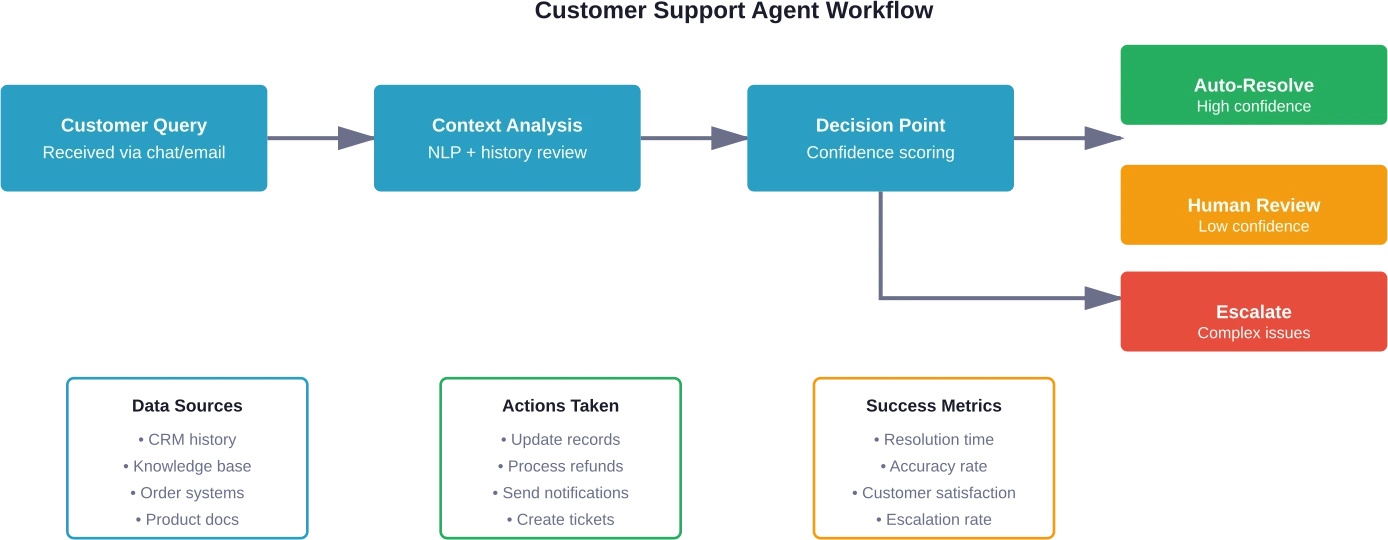
These systems use confidence thresholds to determine when autonomous action is safe. For straightforward issues with high confidence scores—say, 95% or above—the agent executes the fix immediately. Anything below that threshold gets queued for human review with all diagnostic work already completed.
The safety net matters. Teams report significant time savings on preparation work while maintaining oversight on complex edge cases.
Multilingual Customer Inquiry Handling
Agents handling customer inquiries across languages do more than translate. They maintain context across conversation threads, pull relevant account information, process requests that require actions in backend systems, and hand off to human agents with full conversation history and context.
The workflow typically involves natural language understanding, knowledge base retrieval, action execution in CRM systems, and sentiment analysis to detect escalation triggers.
Order Management and Tracking
Order-related inquiries often involve checking status across multiple systems, updating shipping addresses, processing modifications, handling return requests, and coordinating with logistics providers.
Agents handle these workflows by connecting to order management systems, warehouse management platforms, shipping carrier APIs, and payment processors. When a customer requests an address change, the agent checks fulfillment status, determines if modification is still possible, updates relevant systems, and confirms changes with all affected parties.
Sales and Marketing Applications
Sales and marketing teams deploy AI agents for lead qualification, personalized outreach, and campaign optimization.
Lead Qualification and Scoring
Lead qualification agents analyze incoming leads across multiple data points—company size, industry, engagement history, website behavior, and content downloads. They score leads, assign them to appropriate sales representatives based on territory and specialization, and trigger personalized follow-up sequences.
These agents integrate with marketing automation platforms, CRM systems, data enrichment services, and communication tools. The result is faster response times and better lead routing accuracy.
Content Creation and Optimization
Content agents generate first drafts based on topic briefs, optimize existing content for search engines, suggest related topics and internal linking opportunities, and adapt content for different channels and formats.
One study published in Science estimates a 36% increase in productivity among authors who used large language models to assist in writing, with data collected through July 2024. That research from Brookings Institution analyzed social science research patterns.
Email Campaign Management
Email marketing agents handle segmentation based on behavior and preferences, A/B test subject lines and content variations, optimize send times for different audience segments, and manage suppression lists and compliance requirements.
The sophistication lies in continuous learning—these agents analyze which combinations of messaging, timing, and audience characteristics produce the best engagement, then adjust future campaigns accordingly.
Social Media Monitoring and Response
Social listening agents track brand mentions across platforms, identify sentiment and emerging issues, draft responses for routine inquiries, and escalate crisis situations or complex questions to human team members.
They monitor multiple channels simultaneously, something that becomes impractical for human teams as scale increases.
Healthcare and Medical Applications
Healthcare represents one of the most promising yet challenging domains for AI agents. MIT Sloan research examining AI agent deployment in healthcare identified five critical implementation challenges, with more than 80% of the effort being consumed by infrastructure and implementation.
Patient Intake and Triage
Intake agents collect patient symptoms and medical history, ask relevant follow-up questions based on responses, assess urgency levels, and route patients to appropriate care settings—emergency, urgent care, scheduled appointment, or telehealth.
These systems need careful calibration. Conservative triage that over-escalates creates unnecessary emergency visits. Aggressive filtering that under-escalates creates safety risks. The balance requires ongoing monitoring and adjustment.
Appointment Scheduling and Management
Scheduling agents handle appointment booking across multiple providers, manage cancellations and rescheduling, send automated reminders, and optimize schedules to reduce gaps and maximize utilization.
They can account for complex constraints—provider availability, equipment requirements, preparation time for specific procedures, and patient preferences.
Treatment Plan Monitoring
Monitoring agents track patient adherence to medication schedules, collect data from wearable devices and home monitoring equipment, identify deviations from expected recovery patterns, and alert care teams to potential complications.
In chronic disease management, these agents maintain ongoing engagement that would be impractical through traditional care models.
Medical Documentation and Coding
Documentation agents generate clinical notes from voice recordings or structured inputs, suggest appropriate diagnostic and procedure codes, ensure documentation meets regulatory requirements, and flag potential coding errors or missing information.
Physicians spend significant time on documentation. Agents that reduce this burden without compromising accuracy create substantial value.
|
Healthcare Use Case |
Primary Benefit |
Key Challenge |
Human Oversight Level |
|---|---|---|---|
|
Patient Intake |
24/7 availability, consistent data collection |
Safety-critical triage accuracy |
High - review all urgent cases |
|
Appointment Scheduling |
Reduced administrative burden |
Complex constraint satisfaction |
Low - exception handling only |
|
Treatment Monitoring |
Continuous patient engagement |
Data quality from home devices |
Medium - daily review of alerts |
|
Medical Coding |
Faster billing, fewer errors |
Regulatory compliance requirements |
Medium - audit sample verification |
|
Diagnostic Support |
Pattern recognition at scale |
Liability and trust concerns |
High - physician final decision |
Financial Services and Banking
Financial institutions deploy agents for fraud detection, customer service, loan processing, and portfolio management.
Fraud Detection and Prevention
Fraud detection agents analyze transaction patterns in real-time, identify anomalies that deviate from established behavior, block suspicious transactions automatically, and request additional authentication when needed.
These systems balance security against user experience. Too many false positives create friction and customer frustration. Too few and fraud slips through.
Loan Application Processing
Lending agents collect and verify applicant information, pull credit reports and employment verification, calculate debt-to-income ratios and risk scores, and make initial approval or denial recommendations for straightforward cases.
Edge cases—self-employed applicants, non-traditional income sources, complex financial situations—still require human underwriters. But agents handle the routine cases that represent the majority of volume.
Investment Portfolio Management
Portfolio management agents rebalance holdings based on target allocations, execute tax-loss harvesting strategies, monitor for dividend payments and corporate actions, and generate performance reports.
They operate within parameters set by human advisors or client preferences, executing the mechanical aspects of portfolio maintenance.
Regulatory Compliance Monitoring
Compliance agents monitor transactions for reporting requirements, flag potential violations of trading rules, maintain audit trails and documentation, and generate regulatory filings.
Financial services face extensive regulatory requirements. Agents help ensure nothing falls through the cracks while reducing compliance team workload.
Human Resources and Talent Management
HR departments use agents throughout the employee lifecycle—from recruiting to onboarding to ongoing support.
Resume Screening and Candidate Matching
Recruiting agents parse resumes and extract relevant qualifications, match candidates to open positions based on skills and experience, schedule initial screening calls, and send automated updates to candidates.
The screening process needs careful oversight to avoid perpetuating biases. Agents trained on historical hiring data can amplify existing biases unless specifically designed to counteract them.
Employee Onboarding
Onboarding agents coordinate paperwork and documentation, schedule orientation sessions and training, provision system access and equipment, and answer common new employee questions.
New hires typically have similar questions. Agents provide immediate answers while freeing HR staff to focus on relationship building and culture integration.
Benefits Administration
Benefits agents explain coverage options and enrollment deadlines, process enrollment selections, handle routine changes like address updates or dependent additions, and answer questions about claims and coverage.
Benefits complexity creates confusion. Agents provide personalized explanations based on individual situations.
Performance Review Coordination
Performance management agents send review reminders and track completion, collect feedback from multiple sources, compile review packets for managers, and identify employees due for compensation reviews.
The administrative coordination of performance reviews consumes significant manager time. Agents handle the logistics while managers focus on substantive feedback.
Logistics and Supply Chain Operations
Supply chain agents optimize complex networks of suppliers, inventory, and distribution.
Inventory Management and Optimization
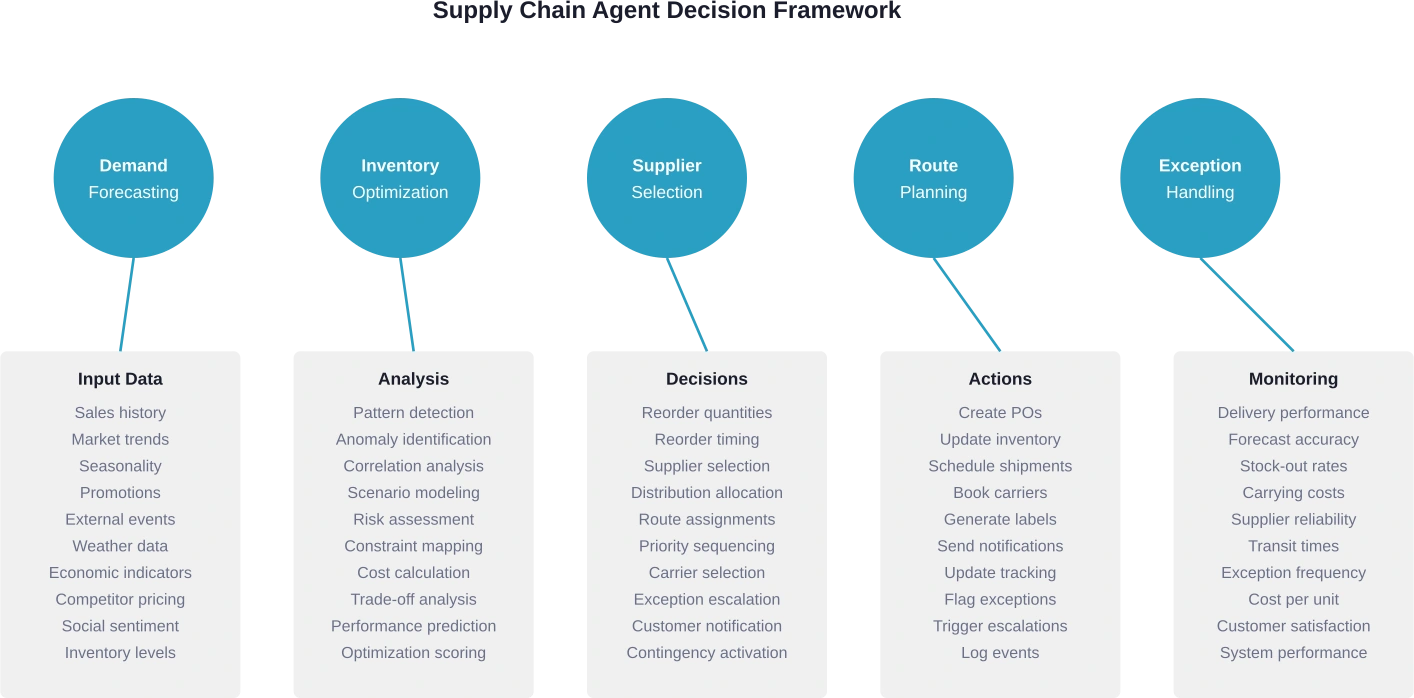
Inventory agents forecast demand based on historical patterns and external factors, automatically reorder items when stock levels reach thresholds, optimize inventory placement across distribution centers, and identify slow-moving items for clearance.
They balance competing objectives—maintaining availability while minimizing carrying costs.
Route Planning and Optimization
Logistics agents plan delivery routes considering traffic patterns, weather conditions, delivery time windows, and vehicle capacity constraints. They dynamically reroute drivers based on real-time conditions and coordinate multi-stop deliveries to minimize total distance and time.
The optimization problem grows exponentially complex with additional stops and constraints. Agents find near-optimal solutions faster than human planners.
Shipment Tracking and Exception Handling
Tracking agents monitor shipments across carriers, identify delays or exceptions, proactively notify customers of issues, and coordinate with carriers to resolve problems.
They catch issues early when solutions are still possible rather than after customer complaints.
Supplier Relationship Management
Procurement agents monitor supplier performance metrics, identify potential supply chain disruptions, manage purchase orders and invoicing, and suggest alternative suppliers when issues arise.
In areas involving multiple suppliers and substantial effort to evaluate options, agents deliver value by analyzing metrics and comparing attributes across options, according to MIT Sloan research on agentic AI applications.
Manufacturing and Industrial Operations
Manufacturing environments use agents for predictive maintenance, quality control, and production optimization.
Predictive Maintenance
Maintenance agents analyze sensor data from equipment, identify patterns indicating potential failures, schedule preventive maintenance before breakdowns occur, and optimize maintenance timing to minimize production disruption.
The shift from reactive to predictive maintenance reduces unplanned downtime and extends equipment life.
Quality Control and Inspection
Quality agents analyze images from production lines, identify defects or deviations from specifications, sort products into quality tiers, and track defect patterns to identify root causes.
Computer vision enables inspection at speeds and consistency levels beyond human capability.
Production Scheduling and Optimization
Scheduling agents balance production capacity against demand, sequence jobs to minimize changeover time, adjust schedules based on machine availability and maintenance windows, and coordinate across multiple production lines or facilities.
The optimization considers hundreds of variables simultaneously—something that becomes intractable for manual planning.
IT Operations and DevOps
IT teams deploy agents for monitoring, incident response, and system administration.
System Monitoring and Alerting
Monitoring agents track system metrics across infrastructure, identify anomalies and performance degradation, correlate events across multiple systems to identify root causes, and suppress duplicate alerts to reduce noise.
They distinguish between normal variation and meaningful deviations requiring attention.
Incident Response and Remediation
Response agents automatically restart failed services, scale resources to handle traffic spikes, implement known fixes for common issues, and create detailed incident timelines for post-mortems.
For well-understood failure modes, automated response is faster and more reliable than manual intervention.
Code Review and Security Scanning
Development agents scan code for security vulnerabilities, identify potential bugs and performance issues, suggest improvements for code quality, and ensure compliance with coding standards.
They catch issues before they reach production while allowing human reviewers to focus on architectural and business logic concerns.
Infrastructure Provisioning
Provisioning agents deploy new environments based on templates, configure security settings and access controls, set up monitoring and logging, and document infrastructure configurations.
Infrastructure-as-code combined with agents enables consistent, repeatable deployments.
Education and Training
Educational institutions use agents for personalized learning, administrative tasks, and student support.
Adaptive Learning and Tutoring
Learning agents assess student knowledge levels, adapt content difficulty based on performance, provide personalized explanations for difficult concepts, and identify topics requiring additional practice.
Personalization at scale becomes possible when agents handle the adaptation that would be impractical for human instructors with large class sizes.
Assignment Grading and Feedback
Grading agents evaluate objective assignments like multiple choice or structured problems, provide immediate feedback on common errors, identify patterns in student mistakes, and flag submissions requiring human review.
Quick feedback improves learning outcomes. Agents provide it immediately rather than after the delay typical of manual grading.
Student Advising and Support
Advising agents answer questions about course requirements and prerequisites, help students plan schedules, track degree progress, and identify students at risk of falling behind.
They provide 24/7 availability for routine questions while freeing human advisors to focus on complex situations requiring judgment.
Legal Services and Compliance
Law firms and legal departments deploy agents for document review, research, and contract analysis.
Document Review and Discovery
Review agents analyze large document sets in litigation, identify relevant documents based on search criteria, flag privileged communications, and categorize documents by topic or relevance.
Discovery in complex litigation can involve millions of documents. Agents dramatically reduce the time and cost of initial review.
Contract Analysis and Management
Contract agents extract key terms and obligations from agreements, identify non-standard clauses or risky provisions, track important dates and renewal deadlines, and compare contracts to standard templates.
Organizations with hundreds or thousands of contracts lack visibility into aggregate risk exposure without automated analysis.
Legal Research
Research agents find relevant case law and statutes, identify how courts have interpreted specific legal questions, track changes in regulations, and compile research summaries.
They accelerate the initial research phase while human attorneys evaluate argument quality and strategic implications.
Energy and Utilities
Utility companies use agents for grid management, demand forecasting, and customer service.
Demand Forecasting and Load Balancing
Energy agents forecast electricity demand based on weather, time of day, and historical patterns, balance load across generation sources, optimize use of renewable energy when available, and manage energy storage systems.
Grid stability requires constant balancing of supply and demand. Agents make real-time adjustments that would overwhelm human operators.
Outage Detection and Response
Outage agents detect power failures through sensor networks and customer reports, identify affected areas and estimated restoration times, dispatch repair crews to optimal locations, and update customers on status.
Quick response minimizes outage duration and customer impact.
Energy Efficiency Recommendations
Efficiency agents analyze customer usage patterns, identify opportunities for energy savings, recommend optimal rate plans, and provide personalized tips for reducing consumption.
Personalized recommendations based on actual usage patterns prove more effective than generic advice.
Insurance Operations
Insurance companies deploy agents throughout the policy lifecycle.
Claims Processing and Adjudication
Claims agents collect information about incidents, verify policy coverage, assess damage through photo or video analysis, calculate appropriate settlements for straightforward claims, and flag complex cases for adjuster review.
Routine claims—minor fender benders, small property damage—follow predictable patterns. Agents handle these while adjusters focus on complex or disputed claims.
Underwriting and Risk Assessment
Underwriting agents evaluate applications based on risk factors, pull relevant data from external sources, calculate appropriate premiums, and make binding decisions on standard risk profiles.
They standardize evaluation criteria and eliminate inconsistency in risk assessment.
Fraud Detection
Fraud detection agents identify suspicious patterns in claims, cross-reference claims data against external databases, flag inconsistencies in submitted information, and prioritize cases for investigation.
Insurance fraud costs billions annually. Agents help identify it earlier and more consistently.
Real Estate and Property Management
Property managers and real estate companies use agents for leasing, maintenance, and tenant services.
Property Showing and Leasing
Leasing agents schedule property tours, answer questions about amenities and lease terms, screen potential tenants, and process applications.
They provide immediate responses to inquiries, improving conversion rates from inquiry to application.
Maintenance Request Management
Maintenance agents receive and categorize repair requests, prioritize based on urgency, dispatch appropriate contractors, track completion, and follow up on tenant satisfaction.
They ensure nothing falls through the cracks while optimizing technician routing and scheduling.
Rent Collection and Accounting
Accounting agents send payment reminders, process payments, apply late fees according to lease terms, and flag delinquent accounts for collection action.
Consistent application of policies reduces disputes and improves collection rates.
Retail and E-commerce
Retailers deploy agents for personalization, inventory management, and customer service.
Product Recommendations
Recommendation agents analyze browsing and purchase history, identify products likely to interest specific customers, adjust suggestions based on inventory availability, and optimize for business objectives like margin or clearance.
Effective recommendations increase average order value and customer satisfaction simultaneously.
Dynamic Pricing
Pricing agents monitor competitor pricing, adjust prices based on demand and inventory levels, implement promotional strategies, and optimize for revenue or market share objectives.
Prices can change thousands of times daily based on market conditions—impossible to manage manually.
Customer Service Chatbots
Service agents handle order status inquiries, process returns and exchanges, answer product questions, and escalate complex issues to human agents with full context.
They provide immediate responses at any time while reducing support costs.
Keeping Humans in the Loop
Now, this is where it gets interesting. The most successful agent deployments don't eliminate human oversight—they redesign it.
Different tasks require different levels of supervision. Some agents operate fully autonomously with periodic audits. Others require approval for every action. Most fall somewhere in between.
The framework typically involves confidence scoring, where agents assess their certainty about proposed actions. High-confidence decisions proceed automatically. Low-confidence situations get flagged for human review. The thresholds get tuned based on error rates and risk tolerance.
Exception handling determines success. Agents need clear escalation paths for situations outside their training. The worst implementations leave agents stuck when they encounter edge cases, creating bad customer experiences. The best implementations hand off smoothly to human operators with full context.
Monitoring remains critical. Teams track agent performance metrics—accuracy rates, escalation frequency, customer satisfaction scores, processing time. These metrics identify when agents need retraining or when processes need redesign.
According to NIST research on AI agent security published on March 23, 2026, red-teaming competitions reveal new attack vectors and defensive strategies. Security considerations include ensuring agents operate only within authorized scope, validating all inputs to prevent prompt injection attacks, and maintaining audit trails of agent actions.
|
Oversight Model |
When to Use |
Implementation Approach |
Key Metrics |
|---|---|---|---|
|
Fully Autonomous |
High-volume, low-risk, well-defined tasks |
Confidence threshold >95%, periodic audits |
Accuracy rate, processing time, error rate |
|
Human-in-the-Loop |
Safety-critical, high-value, or regulated decisions |
Agent proposes, human approves all actions |
Time savings, approval rate, override frequency |
|
Exception-Based |
Mostly routine with occasional complexity |
Auto-execute high confidence, flag edge cases |
Automation rate, escalation rate, resolution quality |
|
Advisory |
Complex judgment calls, strategic decisions |
Agent provides analysis, human decides and acts |
Decision quality, analysis usefulness, time saved |
Implementation Challenges and Lessons Learned
Real talk: most agent implementations take longer and cost more than initial estimates.
The MIT Sloan research on healthcare agent deployment identified five critical challenges. More than 80% of the effort was consumed by infrastructure and implementation. Algorithm development proved relatively straightforward compared to integration work.
Data quality determines agent effectiveness. Agents trained on incomplete or biased data produce unreliable results. Organizations often discover data quality issues only after starting implementation. Cleaning up years of messy data becomes the blocking factor.
Integration complexity gets underestimated. Agents need connections to multiple systems—CRM, ERP, communication platforms, databases. Each integration requires custom work. Authentication, error handling, rate limiting, data transformation—the technical debt accumulates quickly.
Change management receives insufficient attention. Employees worry about job security when automation arrives. Without proper communication and training, resistance undermines adoption. Successful implementations involve affected teams early, clearly define new roles, and provide training on working alongside agents.
Security and compliance create constraints. Agents accessing sensitive data need appropriate controls. Regulatory requirements—GDPR, HIPAA, financial regulations—impose limitations on what agents can do autonomously. Compliance review adds time to deployment.
Research from the Brookings Institution found that more than 30% of all workers could see at least 50% of their occupation's tasks disrupted by generative AI. The greatest impacts appear in middle- to higher-paid occupations, clerical roles, with women disproportionately represented among affected workers.
But wait. That doesn't mean agents eliminate these jobs entirely. The pattern shows task automation rather than complete role replacement. Workers shift to higher-value activities that require judgment, creativity, or human interaction.

Make AI Agents Work in Your Existing Stack
Most AI agent examples look clean on paper. In reality, they have to work with existing systems, data, and workflows that are rarely clean. That’s usually where things slow down – not in the model itself, but in how it connects to your stack, your APIs, and your day-to-day operations.
OSKI Solutions works with companies that are already running real products and need AI to fit into that environment without breaking what’s already there. The focus is on practical integration – connecting agents to existing platforms, automating workflows, and extending current systems rather than rebuilding them.
If you’re looking at AI agents and trying to figure out how they would actually work inside your product or operations, it’s worth having a quick conversation with OSKI Solutions.
The Economics of AI Agents
Cost-benefit analysis for agent deployment requires looking beyond simple labor replacement calculations.
Development costs include platform fees or infrastructure, integration and customization work, training data preparation, and initial testing and refinement. These upfront investments can be substantial.
Ongoing costs include platform subscription or hosting fees, maintenance and monitoring, periodic retraining as conditions change, and human oversight and exception handling.
Benefits include labor cost reduction for routine tasks, increased speed and availability, improved consistency and accuracy, better resource utilization, and enhanced customer experience through faster response times.
The payback period varies significantly. Simple agents handling high-volume tasks may achieve positive ROI within months. Complex agents requiring extensive integration and training might take years.
Hidden costs often surface later—technical debt from rushed implementations, ongoing refinement as edge cases emerge, and organizational disruption during transition periods.
Brookings research on AI's productivity impact notes the difficulty in measuring innovation benefits. Healthcare represents over 17% of GDP, yet little advance in medical technology gets captured in productivity data. Similar measurement challenges apply to agent implementations—quantifying quality improvements or risk reduction proves harder than counting hours saved.
Future Directions and Emerging Trends
The AI agent landscape continues evolving rapidly.
Multi-agent collaboration represents the next frontier. Rather than single agents handling tasks in isolation, multiple specialized agents coordinate on complex objectives. One agent might handle research, another analysis, a third execution, with orchestration logic coordinating their efforts.
The NIST AI Agent Standards Initiative announced on February 17, 2026 focuses specifically on interoperability. Standards will enable agents from different vendors to work together, exchange information, and coordinate actions across organizational boundaries.
ArXiv research on agentic AI frameworks describes emerging architectures for specification, governance, and runtime execution of autonomous systems. These frameworks address the transition from generative AI—probabilistic generation of content—to agentic AI where systems execute actions in external environments on behalf of users.
Edge deployment moves agents closer to data sources. Rather than sending all data to cloud services for processing, edge agents run on local devices or infrastructure, reducing latency and addressing privacy concerns.
Industry-specific vertical agents emerge as vendors develop deep expertise in particular domains. Healthcare agents understand medical workflows and terminology. Legal agents know case law and contract structures. Financial agents handle regulatory compliance requirements. This specialization improves performance compared to general-purpose systems.
Enterprise-grade frontend development represents another emerging application. ArXiv research documents specialized multi-agent frameworks that take designs from Figma to production-ready code, handling everything from interpretation to testing to deployment.
Best Practices for Successful Implementation
Organizations that successfully deploy AI agents follow consistent patterns.
Start small with well-defined use cases. Pick high-volume, routine tasks with clear success metrics. Prove value before expanding scope. Early wins build organizational support for broader initiatives.
Invest in data quality upfront. Clean, structured data determines agent performance more than algorithm sophistication. Organizations often spend months preparing data before agent development begins.
Design for explainability from day one. Agents need to explain their reasoning, especially when human review is required. Black box systems that can't justify decisions create trust problems.
Build comprehensive testing frameworks. Test agents against edge cases, adversarial inputs, and failure scenarios. The situations agents never saw during training reveal weaknesses.
Establish clear governance policies. Define what agents can do autonomously, what requires approval, and what's prohibited. Document decision criteria and audit trails.
Monitor continuously and iterate. Track performance metrics, user feedback, and error patterns. Successful implementations treat deployment as the beginning, not the end.
Involve affected teams early. People who work with agents daily provide invaluable insights about edge cases, workflow constraints, and practical challenges. Their buy-in determines adoption success.
Plan for the unexpected. Agents will encounter situations their designers never anticipated. Graceful degradation—failing safely rather than catastrophically—matters enormously.
Frequently Asked Questions
What's the difference between AI agents and traditional chatbots?
Traditional chatbots respond within a conversation. AI agents go further—they plan multi-step workflows, use tools, maintain context, and take actions across systems to complete tasks.
How much does it cost to implement an AI agent?
Costs vary widely. Simple agents may cost a few thousand dollars plus subscriptions, while enterprise implementations can reach hundreds of thousands depending on complexity and integrations.
What tasks are best suited for AI agents?
AI agents work best on repetitive, structured tasks such as data processing, scheduling, customer support, and report generation. Tasks requiring creativity or deep human judgment are less suitable.
How do you measure AI agent success?
Common metrics include task completion rate, accuracy, time savings, cost reduction, customer satisfaction, and escalation rates. A combination of metrics provides the best evaluation.
What are the biggest risks of deploying AI agents?
Risks include incorrect decisions, security vulnerabilities, bias, privacy issues, and regulatory compliance challenges. Proper testing, monitoring, and safeguards are essential.
Can AI agents work together or do they operate independently?
AI agents can collaborate in multi-agent systems, coordinating tasks and sharing information through orchestration layers to handle complex workflows.
How long does it take to deploy an AI agent?
Simple deployments may take weeks, while enterprise systems can take months or longer due to integration, testing, and infrastructure requirements.
Conclusion
AI agents represent a fundamental shift from tools that respond to instructions toward systems that pursue goals autonomously. The use cases span every industry—from healthcare to logistics to financial services.
But here's what matters most: successful implementations focus on practical value, not theoretical capability. They start with well-defined problems, establish clear success metrics, maintain appropriate human oversight, and iterate based on real-world performance.
The technology continues maturing rapidly. Standards initiatives like NIST's interoperability effort will enable more sophisticated multi-agent collaboration. Vertical solutions will bring deeper domain expertise. Edge deployment will reduce latency and improve privacy.
Organizations that treat agent deployment as an ongoing capability—not a one-time project—position themselves to capture compounding benefits as the technology improves.
The question isn't whether AI agents will transform business operations. The evidence shows they already are. The question is how quickly organizations can deploy them effectively while managing the very real implementation challenges.
Start exploring specific use cases relevant to your industry. Identify high-volume, routine tasks where automation could create immediate value. Build the infrastructure and governance frameworks that enable safe deployment. And remember—the goal isn't replacing human judgment but augmenting it with systems that handle the mechanical aspects of complex work.


