


AI Agent Development Services: Complete Guide 2026

Quick Summary: AI agent development services help businesses build autonomous systems that make decisions, execute tasks, and automate workflows without constant human oversight. These services cover everything from strategy and design to deployment and maintenance, leveraging foundation models, reasoning capabilities, and tool integrations to create scalable, enterprise-grade solutions across industries like finance, healthcare, and logistics.
AI agents are reshaping how organizations operate. Unlike traditional software that waits for commands, these systems observe, plan, decide, and act independently. They handle everything from customer support to supply chain optimization without needing a human to babysit every step.
But building effective agents isn't just about picking a language model and writing prompts. Real production-grade agents require careful architecture, integration planning, security layers, monitoring systems, and ongoing refinement.
That's where specialized development services come in.
This guide breaks down what AI agent development services actually deliver, the core components they build, how they differ from standard AI consulting, and what to look for when evaluating vendors. Whether planning a first pilot or scaling an existing agentic system, understanding the landscape helps teams make informed decisions.
What Are AI Agent Development Services
AI agent development services encompass the full lifecycle of building autonomous AI systems. These services go beyond basic chatbot implementation or API integration—they deliver complete solutions that can perceive environments, reason through complex scenarios, use tools, and take meaningful action.
At the core, an agent combines instructions (what it should do), guardrails (what it should not do), and tools (what it can do) to operate on behalf of users. The National Institute of Standards and Technology announced the AI Agent Standards Initiative on February 17, 2026, emphasizing that next-generation AI must function securely, maintain user trust, and interoperate smoothly across digital ecosystems.
Development services typically include:
- Strategic planning and use case identification
- Architecture design and framework selection
- Model selection and fine-tuning
- Tool integration and API connectivity
- Memory system implementation
- Security and compliance configuration
- Testing and validation protocols
- Deployment and infrastructure setup
- Monitoring dashboards and observability
- Ongoing optimization and maintenance
These services transform abstract AI capabilities into operational business systems. A logistics company might engage a development partner to build agents that automatically reroute shipments based on weather patterns. A financial institution could deploy agents that monitor transactions, flag anomalies, and initiate fraud investigations.
The key differentiator? Autonomy. Traditional software requires explicit instructions for every scenario. Agents adapt to new situations using reasoning capabilities, tool access, and learning from interaction history.
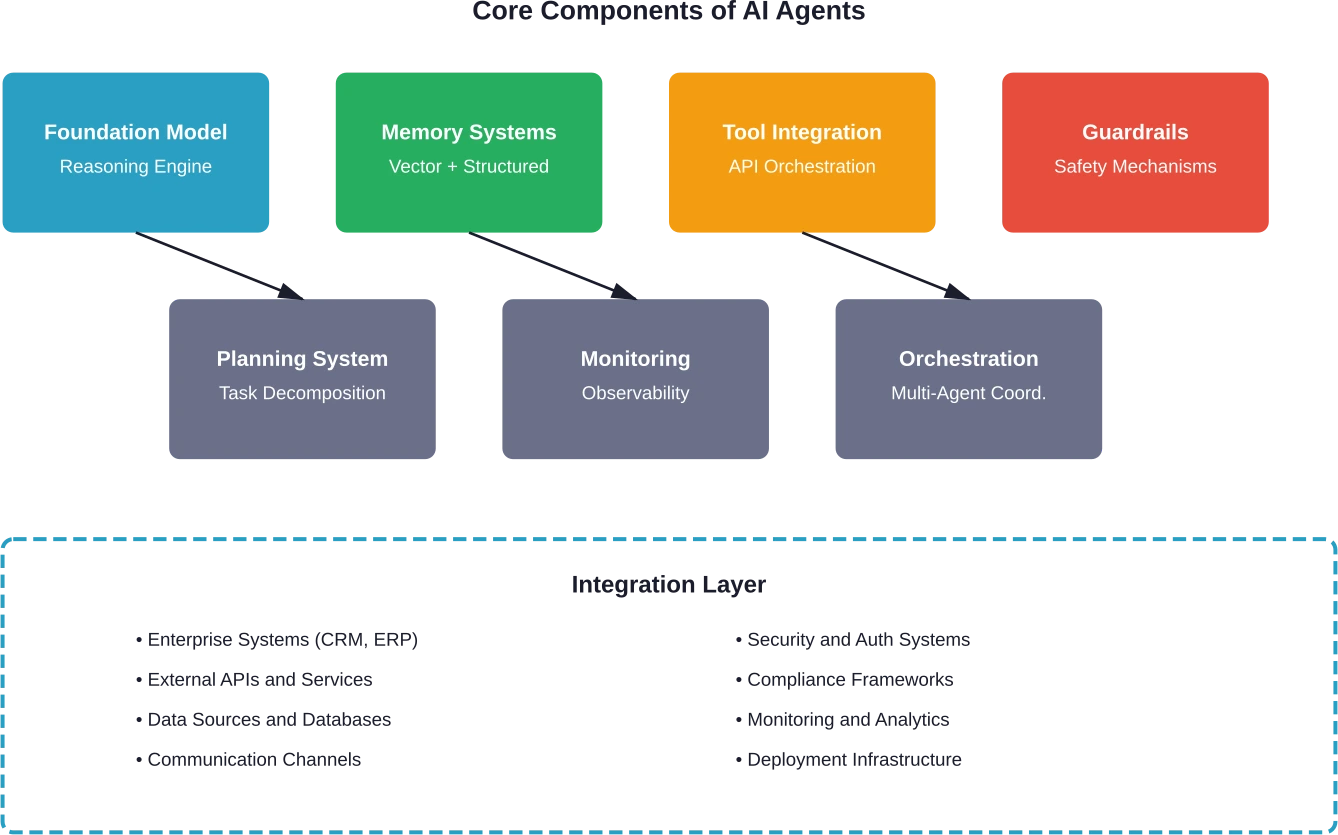
Core Components of Enterprise AI Agents
Building production-ready agents requires orchestrating multiple technical components into a cohesive system. Each element serves a specific function in enabling autonomous operation.
Foundation Models and Reasoning Engines
The brain of any agent starts with a foundation model—typically a large language model like GPT-4, Claude, Gemini, or domain-specific alternatives. But raw model capabilities aren't enough. Development services layer reasoning frameworks on top that enable multi-step planning, self-correction, and strategic thinking.
Research submitted on January 27, 2026 to arXiv describes agentic design patterns as system-theoretic frameworks that combine foundation models with structured reasoning loops. These patterns help agents break down complex goals into manageable subtasks, evaluate intermediate results, and adjust approaches when initial strategies fail.
Some agents rely purely on prompt engineering for reasoning. Others incorporate symbolic AI techniques, logic solvers, or custom reasoning modules built for specific domains.
Memory and Context Management
Effective agents remember. They maintain both short-term working memory (the current task context) and long-term memory (past interactions, learned preferences, domain knowledge).
Memory systems typically involve:
- Vector databases storing semantic representations of past interactions
- Structured databases tracking facts, relationships, and entity states
- Session management maintaining conversation threads
- Retrieval mechanisms surfacing relevant historical context
A customer support agent might recall that a user previously reported network issues three months ago and proactively check system status before suggesting troubleshooting steps. That contextual awareness transforms interactions from generic responses to personalized assistance.
Tool Integration and API Orchestration
Tools extend agent capabilities beyond language understanding. An agent might need to:
- Query databases for real-time information
- Execute code to perform calculations
- Call external APIs to book appointments or process payments
- Trigger workflows in existing business systems
- Generate visualizations or reports
- Send notifications through various channels
OpenAI's AgentKit, announced as part of their agents platform, provides a modular toolkit specifically for connecting agents to tools and deploying them in production environments. Development services handle the complex orchestration of determining when to use which tool, parsing tool outputs, handling failures, and managing rate limits.
This capability for contextual understanding and tool use significantly enhances operational value. According to research analyzing AI agent applications, telecommunications company Vodafone implemented an AI agent-based support system that handles over 70% of customer inquiries without human intervention.
Planning and Decision Systems
Agents don't just react—they plan ahead. Planning systems decompose high-level goals into actionable steps, anticipate obstacles, and develop contingency strategies.
Common planning approaches include:
- Chain-of-thought reasoning breaking problems into sequential steps
- Tree-search algorithms exploring multiple solution paths
- Hierarchical task networks structuring complex workflows
- Reinforcement learning optimizing decision sequences over time
A procurement agent tasked with "reducing supplier costs by 15%" might plan a multi-week strategy: analyze current spending patterns, identify high-cost categories, research alternative vendors, initiate trial orders, compare quality metrics, then gradually shift volume to preferred suppliers.
Guardrails and Safety Mechanisms
Autonomy without boundaries creates risk. Enterprise agents need multiple safety layers:
- Input filters blocking malicious instructions or prompt injections
- Output validation ensuring responses meet safety and compliance standards
- Action constraints preventing unauthorized or high-risk operations
- Human-in-the-loop triggers requiring approval for sensitive decisions
- Audit trails logging every decision and action for compliance review
IEEE standards for building trusted AI systems emphasize four conditions: effectiveness, competence, accountability, and transparency. Development services implement these principles through technical controls and governance frameworks.
Structured outputs constrain models to specific JSON schemas, ensuring predictable response formats. Output guardrails scan for policy violations before showing content to users. Action approval workflows route high-stakes decisions to human reviewers.
Types of AI Agents Development Services Build
Not all agents serve the same purpose. Development services typically specialize in building distinct agent categories based on business needs.
Reactive Agents
The simplest form—reactive agents respond to immediate inputs without maintaining internal state or memory. A spam filter agent classifies emails based on current content. A sentiment analysis agent scores customer feedback messages.
These agents excel at high-volume, stateless tasks where each decision stands independent of previous interactions. They're fast, predictable, and easy to scale horizontally.
Deliberative Agents
Deliberative agents maintain internal models of their environment and reason about future states before acting. They plan sequences of actions to achieve goals rather than reacting to individual stimuli.
A scheduling agent might consider calendar availability, meeting priorities, travel time, and participant preferences to propose optimal meeting times. It evaluates multiple scenarios before committing to a recommendation.
Learning Agents
Learning agents improve performance over time through experience. They start with baseline capabilities and adapt based on feedback, outcomes, and new data.
A content recommendation agent refines suggestions based on engagement signals. An inventory management agent adjusts reorder thresholds as it observes demand patterns and supplier reliability.
Collaborative Multi-Agent Systems
Complex workflows often require multiple specialized agents working together. One agent handles customer inquiries, another processes orders, a third manages inventory, and a fourth coordinates fulfillment.
Multi-agent architectures divide labor based on expertise. Development services design communication protocols, conflict resolution mechanisms, and coordination strategies so agents collaborate effectively rather than interfering with each other.
OpenAI's Agent Builder provides visual canvas tools for composing multi-step workflows where specialized agents hand off tasks and share context through typed inputs and outputs.
Domain-Specific Agents
Some agents target particular industries or functions:
- Financial agents analyzing market data and executing trades
- Healthcare agents triaging patient symptoms and scheduling appointments
- Legal agents reviewing contracts and flagging compliance issues
- Supply chain agents optimizing logistics and predicting disruptions
- HR agents screening candidates and answering policy questions
Domain-specific development often involves fine-tuning models on industry data, integrating specialized tools, and implementing sector-specific compliance controls.
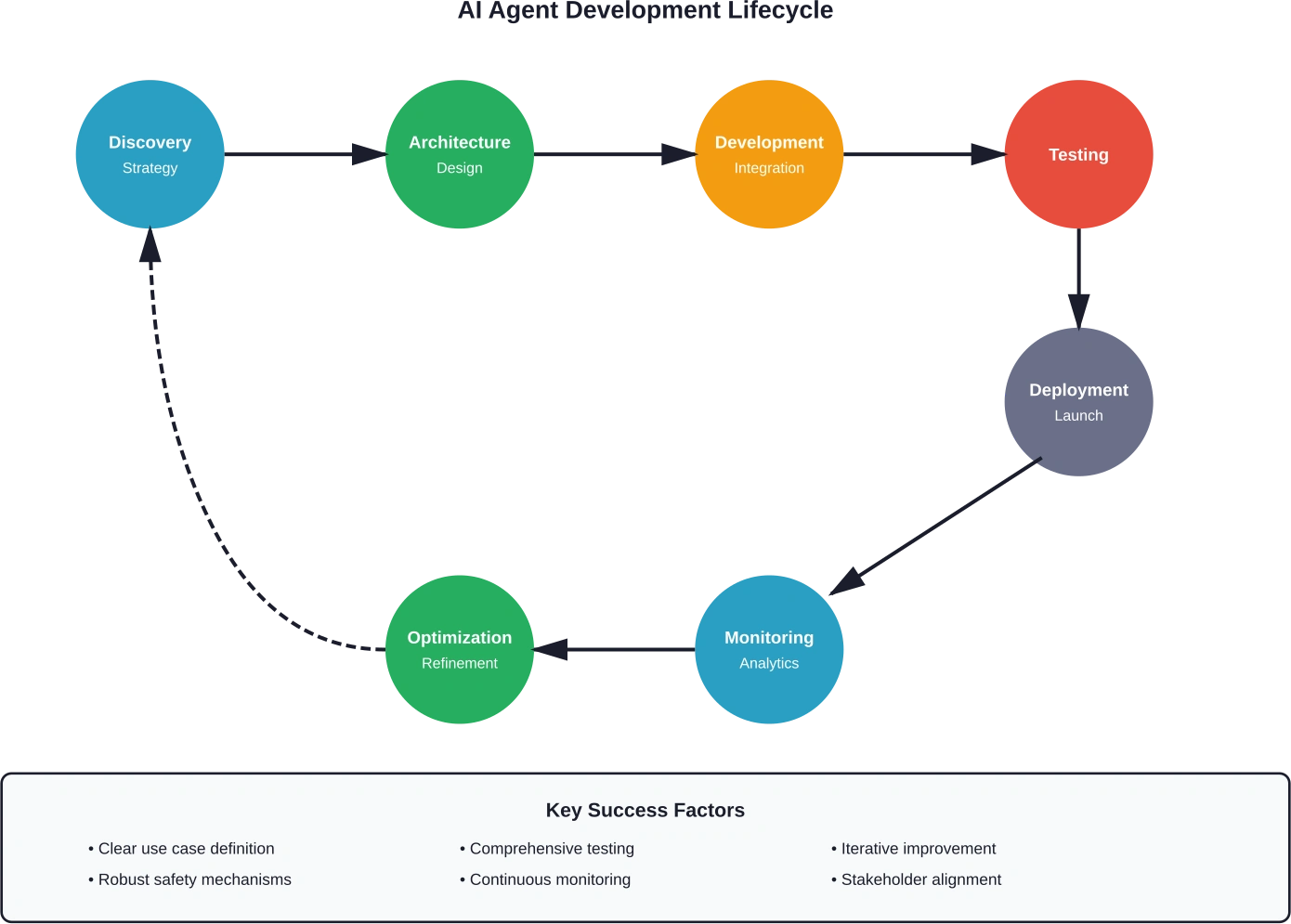
The AI Agent Development Process
Building production agents follows a structured process. Here's how professional development services typically approach projects.
Discovery and Strategy Phase
Every engagement starts with understanding business context. Development teams conduct workshops to identify:
- Pain points and inefficiencies in current processes
- High-value use cases where autonomy delivers impact
- Existing systems and data sources
- Compliance requirements and risk tolerance
- Success metrics and ROI expectations
Not every problem needs an agent. Sometimes traditional automation or simpler AI solutions work better. Good discovery separates genuine agent opportunities from hype-driven initiatives.
Architecture Design and Planning
Once use cases are validated, architects design the technical solution. This includes:
- Selecting foundation models and reasoning frameworks
- Designing memory and context systems
- Mapping tool integrations and data flows
- Defining agent boundaries and handoff protocols
- Planning security layers and compliance controls
- Architecting deployment infrastructure
Architecture decisions balance capability, cost, latency, and maintainability. A customer service agent might prioritize response speed over perfect accuracy. A financial analysis agent might prioritize precision and audit trails over conversational fluency.
Development and Integration
Implementation brings designs to life. Development teams:
- Configure and fine-tune foundation models
- Build reasoning loops and planning algorithms
- Implement memory systems and retrieval logic
- Integrate tools and APIs
- Develop guardrails and safety mechanisms
- Create monitoring dashboards
- Build user interfaces where needed
Modern development often leverages frameworks like LangChain, AutoGen, or proprietary platforms that abstract common agent patterns. But custom logic still dominates business-critical decision paths.
Testing and Validation
Agents operate in unpredictable environments. Comprehensive testing covers:
- Unit tests for individual components
- Integration tests for tool interactions
- End-to-end scenario testing
- Adversarial testing for safety and security
- Performance and scalability testing
- User acceptance testing with real users
Testing agents differs from testing traditional software because behavior emerges from model outputs rather than deterministic code paths. Teams develop test suites that validate capabilities and constraints without requiring identical outputs for identical inputs.
Deployment and Monitoring
Production deployment involves infrastructure setup, access controls, monitoring configuration, and rollout planning. Many services provide fully managed hosting handling orchestration, scaling, and uptime.
Post-launch monitoring tracks:
- Task completion rates and success metrics
- Latency and performance indicators
- Error rates and failure modes
- User satisfaction and engagement
- Cost per interaction
- Safety violations and edge cases
Monitoring feeds continuous improvement. Teams identify failure patterns, refine prompts, adjust reasoning strategies, and expand tool capabilities based on real-world usage.
Maintenance and Optimization
Agents aren't set-and-forget systems. Ongoing maintenance includes:
- Updating models as providers release improvements
- Refining prompts and reasoning templates
- Adding new tools and capabilities
- Adjusting guardrails based on observed issues
- Expanding training data for learning agents
- Optimizing costs through model selection and caching
The vector of software upkeep depends on agent architecture. Static agents relying on frozen datasets need regular model updates to minimize hallucination. Dynamic agents with retrieval-augmented generation need ongoing data pipeline maintenance.
Industry Applications and Use Cases
AI agents deliver measurable value across sectors. Here's where development services see the strongest adoption.
Customer Service and Support
Support agents handle inquiries, troubleshoot issues, and escalate complex cases to humans. They integrate with knowledge bases, ticketing systems, and product databases to provide contextual assistance.
Real-world impact? According to competitor content from Appinventiv, implementations have shown an 80% drop in repeated user questions and 35% growth in user engagement after deploying intelligent support agents.
Financial Services
Financial institutions deploy agents for:
- Fraud detection and prevention
- Portfolio management and rebalancing
- Compliance monitoring and reporting
- Customer onboarding and KYC processes
- Trading execution and market analysis
These agents process vast transaction volumes, identify anomalies, and make time-sensitive decisions within strict regulatory frameworks.
Healthcare Operations
Healthcare agents assist with:
- Patient triage and symptom assessment
- Appointment scheduling and reminders
- Medical record summarization
- Insurance verification and claims processing
- Medication adherence monitoring
Agents augment clinical staff rather than replacing them, handling administrative burden so humans focus on patient care.
Supply Chain and Logistics
Logistics agents optimize operations through:
- Route planning and optimization
- Inventory management and demand forecasting
- Supplier coordination and procurement
- Shipment tracking and exception handling
- Warehouse automation coordination
According to case studies from development service providers, a global manufacturing firm reported a 40% reduction in supply delays and a logistics firm achieved 60% savings in HR service delivery costs through agent-based automation.
Human Resources
HR agents streamline people operations:
- Candidate screening and interview scheduling
- Employee onboarding and training
- Benefits enrollment and policy questions
- Performance review coordination
- Compliance tracking and reporting
These agents reduce administrative overhead while improving employee experience through faster responses and consistent policy application.
Sales and Marketing
Commercial agents drive revenue through:
- Lead qualification and scoring
- Personalized outreach campaigns
- Meeting scheduling and follow-up
- Content generation and optimization
- Campaign performance analysis
Agents handle high-volume, repetitive tasks that traditionally consumed sales teams' time, letting humans focus on high-value relationship building.
Research and Analysis
Research agents accelerate knowledge work:
- Literature review and synthesis
- Data collection and analysis
- Market research and competitive intelligence
- Trend identification and forecasting
- Report generation and visualization
According to service provider case studies, research teams have reported productivity gains of approximately 60% after deploying agent-based research automation.
Selecting an AI Agent Development Partner
Choosing the right development service determines project success. Here's what to evaluate.
Technical Expertise and Experience
Look for teams with demonstrated experience building production agents in relevant domains. Ask about:
- Previous agent implementations and outcomes
- Model selection and optimization approaches
- Framework and platform preferences
- Integration experience with existing systems
- Testing and validation methodologies
Generic AI consulting differs from specialized agent development. Agents require specific architectural patterns, orchestration expertise, and operational knowledge that generic consultants may lack.
Security and Compliance Capabilities
Enterprise agents handle sensitive data and make consequential decisions. Development partners should demonstrate expertise in:
- Data encryption and access controls
- Compliance frameworks (GDPR, HIPAA, SOC 2, etc.)
- Audit trail implementation
- Safety testing and red-teaming
- Incident response procedures
Ask how they implement guardrails, validate outputs, and prevent unauthorized actions. Request examples of compliance documentation from previous projects.
Deployment and Infrastructure Options
Some vendors provide fully managed hosting. Others deliver agents as code for internal deployment. Understand:
- Cloud platform requirements and preferences
- Scaling mechanisms and capacity limits
- Monitoring and observability tools
- Uptime guarantees and support SLAs
- Cost models and pricing structures
Managed hosting reduces operational burden but may limit customization. Self-hosted deployments provide control but require infrastructure expertise.
Ongoing Support and Optimization
Post-launch support determines long-term success. Clarify:
- Maintenance and update procedures
- Response times for issues and bugs
- Optimization and refinement services
- Model upgrade paths
- Knowledge transfer and training
Some vendors offer continuous optimization as part of ongoing engagements. Others deliver code and documentation then step back. Match support models to internal capabilities.
Cultural and Process Fit
Development projects require close collaboration. Evaluate:
- Communication styles and responsiveness
- Project management methodologies
- Flexibility and adaptability
- Stakeholder engagement approaches
- Documentation quality and thoroughness
The best technical team won't succeed if collaboration breaks down. Chemistry matters.
|
Evaluation Criteria |
What to Look For |
Red Flags |
|---|---|---|
|
Track Record |
Documented case studies, measurable outcomes, relevant domain experience |
Vague claims, no references, generic portfolios |
|
Technical Depth |
Specific framework expertise, custom development capabilities, testing rigor |
Over-reliance on no-code tools, shallow technical discussions |
|
Security Focus |
Compliance certifications, security-first design, audit trail expertise |
Dismissive of security concerns, unclear data handling |
|
Partnership Approach |
Collaborative planning, transparent communication, knowledge transfer |
Black-box delivery, poor documentation, vendor lock-in |
|
Cost Structure |
Clear pricing, value-based models, transparent cost drivers |
Hidden fees, unclear scope boundaries, pay-per-query surprises |
Make Your AI Agent Work Inside Your Product
AI agents don’t fail because of the model – they fail when they need to run inside real products. Syncing with databases, handling business logic, working with existing APIs, and staying stable under load is where things usually get complicated.
OSKI Solutions works with companies building AI-based functionality as part of larger systems. This includes backend development, API integrations, and connecting AI-driven services (C#, Python) to existing stacks like .NET or Node.js across cloud environments such as Azure or AWS. The focus stays on practical implementation – something your team can actually use and maintain.
If you're developing an AI agent and need it to fit into your current product or infrastructure, contact OSKI Solutions and walk through your setup with their team.
AI Agent Development Services
Build intelligent AI agents that automate workflows, make decisions, and scale your business operations. From strategy to deployment, we design custom solutions tailored to your needs.
Costs and Pricing Models
AI agent development costs vary widely based on complexity, scope, and vendor. Understanding pricing structures helps budget effectively.
Common Pricing Models
Development services typically use one of these approaches:
- Fixed-price projects: Predetermined scope and cost. Works for well-defined use cases with clear requirements.
- Time and materials: Hourly or daily rates. Provides flexibility for exploratory projects or evolving requirements.
- Value-based pricing: Cost tied to business outcomes. Aligns incentives but requires clear success metrics.
- Managed service subscriptions: Ongoing monthly fees covering hosting, maintenance, and support.
Most projects combine models—fixed price for initial development, then monthly managed service fees for operations.
Cost Drivers
Several factors influence total cost:
- Complexity: Simple reactive agents cost less than sophisticated multi-agent systems with complex reasoning.
- Integration requirements: Connecting to many enterprise systems increases effort.
- Customization: Pre-built agents cost less than fully custom solutions.
- Compliance needs: Regulated industries require additional security and audit capabilities.
- Data preparation: Poor data quality increases preprocessing costs.
- Model selection: Premium models like GPT-4 cost more per interaction than smaller alternatives.
Ongoing Operational Costs
Beyond development, budget for:
- Model API costs (typically per token or request)
- Infrastructure and hosting
- Monitoring and observability tools
- Ongoing maintenance and optimization
- Support and incident response
Model costs often dominate operational budgets. Teams optimize by caching responses, using smaller models where appropriate, and batching requests.
For current pricing on specific platforms and services, check official websites as costs change frequently.
Challenges and Risk Mitigation
Agent development presents unique challenges. Awareness enables proactive mitigation.
Hallucination and Accuracy
Language models sometimes generate plausible but incorrect information. Agents acting on hallucinated facts cause real problems.
Mitigation strategies:
- Retrieval-augmented generation grounding responses in verified data
- Structured outputs constraining responses to factual schemas
- Verification steps where agents check their own outputs
- Human review for high-stakes decisions
- Confidence scoring and uncertainty acknowledgment
Security and Prompt Injection
Malicious users attempt to manipulate agents through crafted inputs. Prompt injection attacks override system instructions, causing agents to leak data or take unauthorized actions.
Defense mechanisms:
- Input sanitization and validation
- Instruction hierarchy preventing user inputs from overriding system prompts
- Output filtering for sensitive information
- Least-privilege tool access
- Regular security testing and red-teaming
Reliability and Edge Cases
Agents operate in unpredictable environments. Unusual inputs, system failures, or API outages cause unexpected behavior.
Robustness techniques:
- Graceful degradation when tools fail
- Retry logic with exponential backoff
- Fallback strategies routing to humans when confidence is low
- Comprehensive error handling and logging
- Chaos engineering testing failure scenarios
Cost Control
Autonomous agents can rack up API costs quickly if not properly constrained. A runaway agent looping through expensive model calls creates budget overruns.
Cost management approaches:
- Rate limiting and request caps
- Budget alerts and circuit breakers
- Model selection matching task requirements
- Response caching for repeated queries
- Batch processing where real-time isn't required
Bias and Fairness
Agents inherit biases present in training data and amplify them through autonomous decision-making. Biased hiring agents or discriminatory service agents create legal and ethical problems.
Fairness techniques:
- Diverse training data and bias testing
- Regular fairness audits across demographic groups
- Transparent decision explanations
- Human oversight for consequential decisions
- Bias mitigation in model fine-tuning
Change Management and Adoption
Technical excellence doesn't guarantee user adoption. Employees resist agents perceived as threatening their roles. Customers distrust opaque automated systems.
Organizational change strategies:
- Clear communication about agent roles and limitations
- Training programs for working alongside agents
- Gradual rollouts with early wins
- Transparency about when users interact with agents
- Feedback channels for continuous improvement
According to Nerdery, a development firm specializing in AI services, organizational change management is key to successful agent deployments.
The Future of AI Agent Development
Agent capabilities evolve rapidly. Several trends shape the near-term landscape.
Standards and Interoperability
NIST's AI Agent Standards Initiative announced in February 2026 aims to ensure agents can interoperate smoothly across platforms. Standard protocols for agent communication, authentication, and task delegation will reduce integration friction and enable agent marketplaces.
As standards mature, expect plug-and-play agent components and easier migration between platforms.
Improved Reasoning and Planning
Current agents struggle with complex multi-step reasoning. Research into agentic design patterns published in January 2026 demonstrates system-theoretic frameworks improving planning capabilities.
Next-generation agents will handle more sophisticated workflows with less human intervention. Better self-correction and learning from mistakes will reduce failure rates.
Specialized Vertical Agents
Generic agents give way to domain-specific solutions optimized for particular industries. Financial agents understanding regulatory requirements, healthcare agents trained on medical knowledge, and legal agents versed in case law deliver higher accuracy and compliance.
Development services increasingly specialize in vertical markets rather than offering horizontal platforms.
Federated and Decentralized Agents
Privacy concerns and data sovereignty requirements drive interest in agents operating on local data without sending information to centralized services. Federated learning allows agents to improve without exposing raw data.
Expect more edge-deployed agents running locally with occasional cloud coordination.
Human-Agent Collaboration Models
Rather than full automation, effective deployments blend human expertise with agent capabilities. Humans handle edge cases, provide oversight, and make final decisions while agents handle routine tasks and information gathering.
Development services focus on designing smooth handoff protocols and collaborative workflows rather than pursuing complete autonomy.
Frequently Asked Questions
What's the difference between AI agents and chatbots?
Chatbots respond to user inputs, while AI agents take autonomous actions toward goals. Agents can track issues, interact with systems, and proactively solve problems beyond simple conversation.
How long does it take to develop a custom AI agent?
Development timelines depend on complexity. Simple agents may take 4–8 weeks, while more advanced systems can take 2–4 months or longer. Highly complex enterprise solutions may require 6–12 months.
Can AI agents integrate with existing enterprise systems?
Yes. AI agents can integrate with CRM, ERP, databases, APIs, and communication tools using REST APIs, webhooks, or direct connections. Integration complexity depends on the systems involved.
What security measures protect AI agents from misuse?
Security measures include input validation, output filtering, access controls, audit logs, rate limiting, human approval workflows, and регулярне тестування для виявлення вразливостей.
How do you measure AI agent success and ROI?
Metrics include task completion rate, response time, accuracy, cost per interaction, user satisfaction, and overall business impact such as reduced workload and increased efficiency.
What happens when an AI agent makes a mistake?
Agents use fallback mechanisms such as escalation to humans, requesting clarification, and logging actions for review. Continuous monitoring and updates help reduce future errors.
Do AI agents replace human workers?
AI agents typically augment human work by handling repetitive tasks, allowing employees to focus on complex, strategic, and creative responsibilities.
Taking the Next Step
AI agents represent a fundamental shift in how organizations leverage artificial intelligence. Moving from passive tools to autonomous systems that observe, reason, plan, and act opens new possibilities for efficiency and scale.
But realizing that potential requires more than enthusiasm. Successful agent deployments demand careful planning, robust architecture, thoughtful integration, rigorous testing, and continuous optimization.
Development services provide the expertise, frameworks, and operational support that bridge the gap between AI capabilities and business value. They transform abstract possibilities into production systems that reliably deliver outcomes.
Organizations considering agent development should start by identifying high-value use cases where autonomy solves real problems. Look for workflows that are repetitive yet complex, data-rich, and currently constrained by human capacity. Validate use cases through discovery workshops with potential development partners.
Evaluate vendors based on relevant experience, technical depth, security expertise, and cultural fit. Ask for case studies, references, and detailed technical proposals. Understand pricing models, support commitments, and ownership structures.
Start with focused pilots that deliver value quickly while building organizational capability. Learn from initial deployments before scaling. Invest in monitoring, security, and change management alongside technical development.
The agent revolution is underway. Organizations that thoughtfully implement agentic AI now will establish competitive advantages that compound over time. Those that wait risk falling behind as autonomous systems become operational expectations rather than experimental novelties.
Ready to explore how AI agents could transform specific operations? Connect with development services that specialize in relevant domains, bring technical depth, and demonstrate success delivering production systems. The right partner turns agent potential into measurable business impact.


