


Virtual Agents AI: Complete Guide + Use Cases
Quick Summary: Virtual agents AI are sophisticated software programs powered by artificial intelligence, natural language processing, and machine learning that can understand and respond to human queries in real-time. Unlike basic chatbots, these intelligent systems handle complex multi-step interactions, integrate with backend systems to execute tasks, and continuously improve through learning—delivering scalable, 24/7 customer support and operational automation across industries.
The line between human agents and AI is getting blurrier every day. Virtual agents powered by artificial intelligence have evolved far beyond simple scripted responses—they now understand context, execute complex workflows, and actually learn from every interaction.
But here's the thing: not all virtual agents are created equal. The technology behind them ranges from basic rule-based systems to sophisticated AI-powered platforms that leverage large language models and process automation. Understanding these differences matters if organizations want real ROI from AI investments.
According to the National Institute of Standards and Technology (NIST), artificial intelligence and machine learning technology is transforming traditional expert systems into next-generation intelligent virtual agents. This evolution represents a fundamental shift in how businesses handle customer interactions, internal support, and operational workflows.
What Makes a Virtual Agent "Intelligent"?
A virtual agent combines natural language processing, intelligent search, and robotic process automation in a conversational interface. That's the technical definition. The practical reality? It's software that can hold a conversation, understand what users actually mean (not just what they type), and take action on their behalf.
Virtual agent technology brings together several AI capabilities:
Natural Language Processing (NLP): Deciphers user intent from conversational text or speech, handling variations in phrasing, typos, and context
Machine Learning: Improves accuracy over time by analyzing interaction patterns and outcomes
Knowledge Management: Accesses and retrieves information from databases, documentation, and systems
Process Automation: Executes tasks across integrated systems without human intervention
Contextual Memory: Maintains conversation history to handle multi-turn dialogues effectively
The combination of these technologies creates something fundamentally different from traditional chatbots. Basic chatbots follow predetermined decision trees—ask A, if yes go to B, if no go to C. Intelligent virtual agents understand intent, context, and can navigate ambiguity.
Research from Stanford HAI demonstrates the sophistication achievable with modern AI agents. In one study, interview-based AI agents achieved 85% accuracy matching participants' answers on survey questions—as accurately as participants matched their own responses two weeks apart. These agents also showed 80% correlation on personality tests, suggesting they can capture nuanced human preferences and behaviors.
Virtual Agent vs. Chatbot vs. Virtual Assistant
These terms get tossed around interchangeably, which creates confusion. They're related but distinct.
The key distinction? Scope and autonomy. Chatbots handle narrow, predefined interactions. Virtual assistants like Siri or Alexa focus on personal productivity for individual users. Virtual agents sit between these extremes—enterprise-grade systems designed to handle business processes with sophisticated AI capabilities.
Recent research on LLM-powered intelligent virtual assistants highlights this evolution. While systems like Siri and Alexa pioneered voice interaction, modern virtual agents leverage large language models for more sophisticated reasoning and broader task handling across organizational workflows.

Develop Virtual Agents With OSKI
OSKI helps companies design, build, and maintain software with AI and LLM capabilities. Their work includes frontend and backend development, cloud setup, API integrations, DevOps, and custom AI components.
Need a Virtual Agent That Fits Your Workflow?
OSKI can help with:
building custom virtual agent software
integrating LLMs with company systems
connecting agents to data and APIs
supporting deployment and updates
👉 Contact OSKI to discuss your project.
Virtual Agents AI
Enhance customer support and business operations with AI-powered virtual agents that automate conversations, improve engagement, and deliver 24/7 assistance.
Core Technologies Powering Virtual Agents
Understanding what happens under the hood helps explain why modern virtual agents perform so differently from older systems.
Natural Language Processing and Understanding
NLP enables virtual agents to parse human language—breaking down sentences, identifying entities, extracting intent. But natural language understanding (NLU) goes deeper, grasping context, sentiment, and implied meaning.
Consider this interaction:
User: "I still haven't received my refund from last week."
A basic chatbot might trigger on the word "refund" and provide generic refund policy information. An intelligent virtual agent understands this is a status inquiry about a specific pending transaction, pulls the customer's account history, identifies the relevant refund request, checks its processing status, and provides a specific answer—all in seconds.
Large Language Models and Generative AI
The emergence of large language models reshaped virtual agent capabilities. LLMs enable agents to generate contextually appropriate responses rather than selecting from pre-written scripts, handle broader conversational topics, and demonstrate cross-domain reasoning.
According to recent research on LLM-powered AI agent systems, current agents can process diverse data modalities including text, images, audio, and video. This multi-modal capability expands use cases significantly—agents can analyze product images, interpret documents, or understand voice inquiries with equal facility.
Machine Learning and Continuous Improvement
Machine learning enables virtual agents to improve through experience. Each interaction provides training data. The agent identifies patterns: which responses resolved issues successfully, which queries confused the system, where escalation to humans proved necessary.
Research on agent introspection demonstrates measurable improvement. An approach called Introspection of Thought (INoT) showed an average performance improvement of 7.95% across six benchmarks for three different tasks, proving that self-reflection mechanisms within AI systems can enhance accuracy while reducing computational costs.
Robotic Process Automation Integration
RPA gives virtual agents hands. Where conversation provides the interface, RPA enables action—updating databases, processing forms, triggering workflows, interacting with other systems through APIs or interface automation.
This integration transforms virtual agents from information kiosks into operational tools. Need to reset a password, update an address, schedule a service appointment, and send confirmation? An RPA-enabled virtual agent handles the entire workflow autonomously.
Key Benefits Organizations Actually Experience
Theory sounds great. What happens when organizations deploy virtual agents in production?
Measurable Cost Reduction
Virtual agents handle routine queries at a fraction of the cost of human agents. One customer doesn't dramatically change economics—but when thousands of inquiries deflect from live agents to AI, labor costs drop significantly.
The math works because virtual agents scale without proportional cost increases. Adding capacity for 1,000 more conversations doesn't require hiring more agents or expanding infrastructure substantially. The same system handles 10,000 or 100,000 interactions with minimal marginal cost.
24/7 Availability Without Staffing Challenges
Humans need sleep. Virtual agents don't. Organizations can provide consistent support around the clock without night-shift staffing complications, timezone coverage gaps, or weekend scheduling issues.
This matters particularly for global operations. When customers span multiple continents, maintaining human agent coverage across all hours becomes expensive and logistically complex. Virtual agents eliminate that constraint entirely.
Consistency in Service Quality
Human agents have bad days. They forget details. They interpret policies differently. Virtual agents deliver the same quality every time—same accuracy, same tone, same process adherence.
That consistency extends to compliance. When regulations require specific disclosures or documentation, virtual agents follow those requirements without exception. Every interaction meets the standard.
Improved Human Agent Experience
Here's something counterintuitive: virtual agents make human agents happier. How? By handling the repetitive, mundane inquiries that drain motivation.
Industry data shows conversation intelligence and automation can reduce after-call work by up to 20% through post-call transcriptions and real-time AI summaries. Human agents spend less time on documentation and more time solving complex, engaging problems that require human judgment and creativity.
Data-Driven Insights at Scale
Every virtual agent interaction generates structured data. Organizations gain visibility into common customer questions, pain points, confusion areas, and service gaps across thousands of conversations.
That aggregated intelligence informs product improvements, documentation updates, policy refinements, and training priorities in ways that sampling human agent interactions cannot match.
Real-World Use Cases Across Industries
Virtual agents AI deploy differently depending on organizational needs and customer expectations. Here's where they're making the biggest impact.
Customer Service and Support
This remains the dominant use case. Virtual agents handle account inquiries, order status checks, policy questions, basic troubleshooting, and service requests.
The best implementations layer virtual agents with human escalation. AI handles the first interaction and resolves straightforward cases. Complex issues route to human agents automatically, with full context transfer so customers don't repeat themselves.
E-Commerce and Retail
Shopping assistants powered by virtual agents answer product questions, provide recommendations based on natural language descriptions, explain sizing and specifications, clarify pricing and promotions, and assist with checkout issues.
The recommendation capability proves particularly valuable. Instead of browsing category by category, customers describe what they want—"I need a waterproof jacket for hiking in cold weather under $200"—and the agent surfaces relevant options instantly.
Healthcare and Patient Support
Virtual agents help patients schedule appointments, access test results, understand medication instructions, find in-network providers, and navigate insurance coverage questions.
Research on virtual teaching assistants using natural language processing and deep learning demonstrates similar applications in education, where AI agents support students with course materials, assignment questions, and learning resources—suggesting transferable patterns for patient education and support.
Banking and Financial Services
Financial institutions deploy virtual agents for balance inquiries, transaction history, fund transfers, card activation, fraud alerts, loan application status, and basic financial guidance.
Security and authentication become critical here. Virtual agents must verify identity rigorously before accessing sensitive information or executing financial transactions.
IT Service Management and Internal Support
Organizations increasingly turn virtual agents inward, automating internal help desk functions. Employees get instant assistance with password resets, software access requests, hardware troubleshooting, policy questions, and onboarding processes.
According to IEEE standards work on autonomous and intelligent systems, standardizing interfaces for intelligent diagnostic reasoners and representations of diagnostic knowledge enables more sophisticated troubleshooting capabilities in IT service management contexts.
Human Resources and Employee Services
HR virtual agents answer benefits questions, explain time-off policies, guide through open enrollment, provide onboarding information, and facilitate routine HR transactions.
This reduces HR workload significantly while giving employees instant access to information exactly when they need it, rather than waiting for email responses or scheduled meetings.
Building an Effective Virtual Agent: Key Considerations
Deploying a virtual agent isn't just selecting software and flipping a switch. Success requires thoughtful design and ongoing refinement.
Define Clear Objectives and Scope
What should the agent accomplish? Which types of inquiries should it handle versus escalating to humans? What defines success?
Starting narrow often works better than attempting comprehensive coverage immediately. Identify high-volume, straightforward interaction types and build there. Expand scope as the system proves itself and the team gains expertise.
Knowledge Base Development
Virtual agents are only as good as the information they can access. Building a comprehensive, well-structured knowledge base becomes foundational work.
This means documenting policies, procedures, product information, troubleshooting steps, and common questions in formats the AI can parse and utilize. Unstructured documentation scattered across systems won't cut it.
Training Data Quality
Machine learning models require training data that reflects actual customer language patterns, question variations, and conversation flows. Historical chat logs, support tickets, and email inquiries provide valuable training material.
The data needs cleaning and labeling—categorizing inquiries by intent, identifying entities mentioned, and marking appropriate responses. This preparation work determines model accuracy more than algorithm selection in many cases.
Integration Architecture
Virtual agents need access to backend systems to provide personalized, actionable assistance. That requires integration with CRM platforms, order management systems, knowledge bases, authentication services, and any other relevant data sources.
API-first architectures simplify this integration substantially. Agents can query customer records, submit requests, update information, and trigger workflows through standardized interfaces.
Conversation Design
How the agent communicates matters as much as what it says. Tone, personality, message length, use of emojis or formatting, and error handling all shape user experience.
Conversation designers map dialogue flows, write prompts, define response variations, and establish escalation triggers. This discipline combines UX design, copywriting, and system logic.
Human Handoff Protocols
Virtual agents won't resolve every inquiry. Smooth escalation to human agents when necessary preserves customer satisfaction. The handoff should transfer full conversation context so customers don't repeat information.
Equally important: defining clear escalation criteria. When does complexity, sentiment, or confusion signal the need for human intervention? Those thresholds need careful tuning.
Measuring Virtual Agent Performance
What gets measured gets managed. Virtual agent deployments require ongoing monitoring and optimization.
Resolution Rate
What percentage of conversations does the virtual agent resolve without escalation? This core metric indicates overall effectiveness.
Track this both overall and by inquiry type. Some categories may show strong performance while others consistently require human assistance, pointing to areas for improvement.
Customer Satisfaction Scores
Do customers find virtual agent interactions helpful? Post-interaction surveys provide direct feedback. CSAT scores for virtual agent interactions should approach or match scores for human agent interactions.
Low satisfaction despite high resolution rates suggests the agent solves problems but creates frustration in the process—perhaps through excessive back-and-forth, unclear responses, or tone issues.
Average Handle Time
How quickly does the agent resolve inquiries? Faster isn't always better if accuracy suffers, but virtual agents should typically handle routine questions more quickly than humans.
Comparing handle time across inquiry types reveals where the agent performs efficiently versus where conversations drag.
Containment Rate
Of customers who start with the virtual agent, what percentage complete their interaction without requesting human assistance? This differs from resolution rate by focusing on customer choice to escalate.
High containment means customers trust the virtual agent and find it adequate for their needs.
Intent Recognition Accuracy
Does the agent correctly understand what customers want? Intent classification accuracy directly impacts every downstream interaction. Misunderstanding the question makes providing the right answer impossible.
Monitoring misclassification patterns highlights where training data needs expansion or model refinement is necessary.
Knowledge Gap Analysis
Which questions stump the agent most frequently? Tracking these gaps guides knowledge base development and helps prioritize content creation.
If dozens of customers ask about a topic the agent cannot address, that represents both an immediate problem and a clear development priority.
Challenges and Limitations to Consider
Virtual agents solve real problems, but they're not magic. Understanding limitations helps set realistic expectations and plan accordingly.
Handling Ambiguity and Edge Cases
Human language is messy. Sarcasm, idioms, cultural references, vague descriptions, and complex scenarios still challenge AI systems.
Virtual agents handle common paths well but can struggle with unusual combinations or ambiguous phrasing. That's why human escalation remains essential rather than optional.
Emotional Intelligence Gaps
AI can detect sentiment through text analysis, but understanding nuanced emotional states and responding with appropriate empathy remains difficult.
Research on empathetic virtual agents explores this challenge. Designing systems that demonstrate care and understanding while acknowledging their artificial nature requires balancing honesty about system limitations with supportive interaction patterns.
Context Retention Across Channels
Customers start conversations on one channel, then continue on another. Maintaining context when someone switches from web chat to mobile app to phone creates technical complexity.
Unified customer data platforms help, but seamless cross-channel virtual agent experiences require significant integration work.
Training Data Bias
Machine learning models reflect biases present in training data. If historical data contains demographic disparities in service quality, response times, or outcomes, the AI may perpetuate those patterns.
According to Stanford HAI's 2023 AI Index, the year marked newfound public scrutiny of AI systems, with bias and fairness concerns receiving significant attention. Organizations deploying virtual agents must audit for bias systematically.
Maintenance and Update Requirements
Virtual agents aren't set-and-forget systems. Products change, policies update, new questions emerge, and system performance drifts over time.
Continuous monitoring, knowledge base updates, model retraining, and conversation refinement become ongoing operational requirements, not one-time implementation tasks.
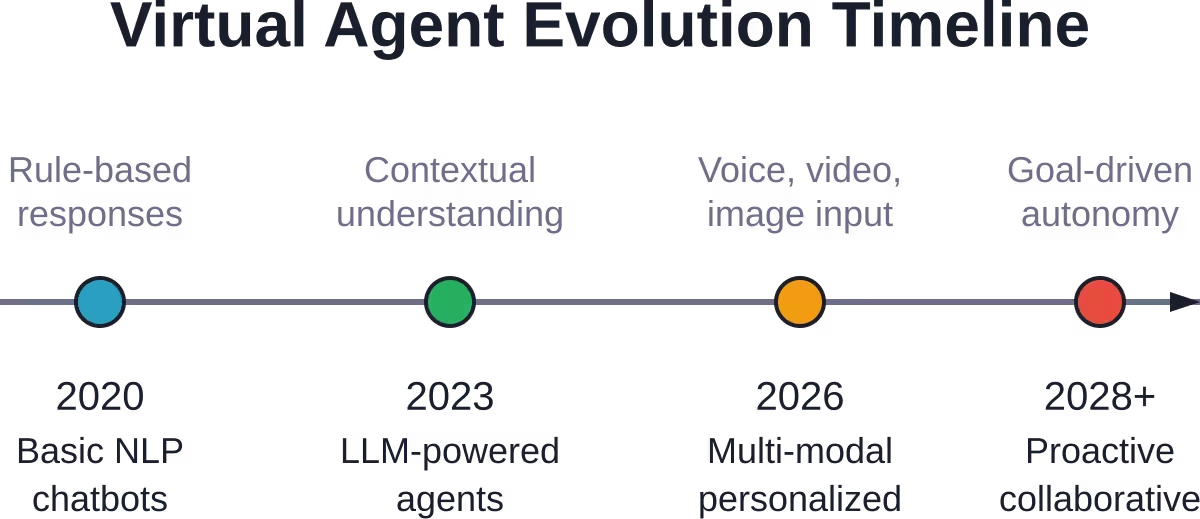
The Future: Where Virtual Agents AI Are Heading
Technology continues evolving rapidly. What's coming next for virtual agents?
Multi-Modal Interactions
Text-only conversations are giving way to systems that handle voice, video, images, and documents simultaneously. Upload a product photo and describe what's wrong—the agent analyzes both inputs together.
Stanford faculty predictions for AI in 2025 highlighted collaborative agents as a key trend, with systems increasingly working alongside humans and other AI agents in coordinated workflows rather than operating in isolation.
Proactive Assistance
Rather than waiting for users to ask questions, virtual agents will anticipate needs based on behavior patterns, trigger alerts about relevant issues, and suggest actions before problems escalate.
Think less chatbot, more intelligent assistant monitoring contexts and stepping in when helpful.
Deeper Personalization
Virtual agents will leverage richer customer profiles, preferences, and history to tailor interactions individually. Not just using a customer's name—understanding their communication style, technical expertise level, previous concerns, and preferences.
Research showing AI agents can simulate individual personalities with 85% accuracy on survey responses and 80% correlation on personality tests suggests increasingly sophisticated personalization becomes technically feasible.
Cross-System Orchestration
Advanced virtual agents will coordinate actions across multiple systems and services to complete complex workflows. Instead of executing single tasks, they'll manage entire processes from initiation through completion.
This evolution toward agentic AI—systems that pursue goals autonomously across multi-step processes—represents a significant capability expansion beyond current conversational interfaces.
Collaborative Agent Networks
Rather than single monolithic agents, organizations may deploy specialized agent networks where different AI systems handle specific domains, collaborating and routing work between them based on expertise.
One agent handles initial triage, another manages account operations, a third specializes in technical support, and they coordinate seamlessly behind the scenes.
Selecting the Right Virtual Agent Platform
Dozens of vendors offer virtual agent solutions. How do organizations evaluate options?
Core Capability Assessment
Does the platform provide the fundamental technologies required—NLP, machine learning, knowledge management, and integration capabilities? Some platforms excel at conversation but lack RPA integration. Others offer strong automation but weaker language understanding.
Industry-Specific Features
Healthcare, finance, and retail have unique requirements around compliance, security, and specialized workflows. Platforms with pre-built industry knowledge and compliance frameworks reduce implementation time and risk.
Integration Ecosystem
Which systems does the platform integrate with out of the box? Pre-built connectors for major CRM, helpdesk, e-commerce, and communication platforms simplify deployment substantially.
API flexibility matters equally. Custom integrations become necessary for proprietary or legacy systems.
Customization vs. No-Code Options
Some platforms require technical expertise and development work. Others emphasize drag-and-drop configuration and pre-built templates.
Organizations need to match platform complexity with their internal capabilities and resources. The most sophisticated platform means nothing if the team cannot configure and maintain it effectively.
Scalability and Pricing Model
Pricing varies widely across providers—per-conversation, per-resolution, monthly flat fees, or usage-based models. Calculate total cost at expected scale, not just entry-level pricing.
Performance at scale matters too. Some platforms handle thousands of concurrent conversations efficiently; others bog down under load.
Analytics and Reporting
What visibility does the platform provide into performance, conversation patterns, user sentiment, and system health? Rich analytics enable ongoing optimization. Limited reporting leaves teams flying blind.
Implementation Best Practices
Technology alone doesn't ensure success. Implementation approach matters enormously.
Start with Pilot Projects
Prove value in controlled environments before organization-wide rollout. Select a high-volume, straightforward use case where success is measurable and impacts are visible.
Learn from that pilot. What worked? What confused users? Where did the agent struggle? Apply those lessons before expanding scope.
Build Cross-Functional Teams
Successful virtual agent projects require collaboration across customer service, IT, legal/compliance, operations, and subject matter experts. No single department has all necessary knowledge.
Establish clear ownership and governance. Who makes decisions about conversation design? Who approves knowledge base content? Who monitors performance and drives iteration?
Plan for Continuous Improvement
Initial deployment is just the beginning. Allocate resources for ongoing monitoring, knowledge base updates, conversation refinement, and capability expansion.
Organizations that treat virtual agents as evolving systems rather than fixed deployments achieve substantially better long-term results.
Communicate Transparently
Tell customers they're interacting with AI. Transparency builds trust. Pretending virtual agents are human creates frustration when limitations become apparent.
Frame the experience positively: instant 24/7 assistance with easy escalation to humans when needed.
Empower Human Agents
Virtual agents should augment human capabilities, not replace jobs wholesale. Position the technology as handling routine work so human agents can focus on complex, high-value interactions.
Include frontline agents in design and refinement. They understand customer pain points, common questions, and process gaps better than anyone.
FAQs About Virtual Agents AI
What's the difference between a virtual agent and a chatbot?
Virtual agents use advanced AI, natural language understanding, and machine learning to handle complex, multi-step interactions with context awareness and learning capabilities. Chatbots typically follow rule-based scripts with simple keyword matching. Virtual agents can execute tasks across integrated systems, while basic chatbots mainly provide information from predetermined responses.
How much does implementing a virtual agent cost?
Costs vary dramatically based on platform selection, deployment scale, customization requirements, and integration complexity. Pricing models range from per-conversation charges to monthly subscriptions to enterprise licenses. Check vendor websites for current pricing, as rates change frequently. Total cost of ownership includes platform fees, implementation services, integration work, training data preparation, and ongoing maintenance.
Can virtual agents completely replace human customer service agents?
No. Virtual agents excel at routine, high-volume inquiries but struggle with complex situations requiring empathy, nuanced judgment, or creative problem-solving. The best implementations combine AI handling of straightforward cases with seamless escalation to human agents when needed. This hybrid approach delivers cost efficiency while maintaining service quality for complex issues.
How long does it take to deploy a virtual agent?
Implementation timelines range from weeks for simple deployments using pre-built templates to several months for sophisticated custom implementations with extensive integrations. Typical enterprise deployments take 2-4 months including planning, knowledge base development, training data preparation, integration work, testing, and phased rollout. Starting with narrow pilot projects accelerates time to value.
What happens when a virtual agent doesn't understand a question?
Well-designed virtual agents recognize when they cannot handle an inquiry and gracefully escalate to human agents while transferring full conversation context. They might also ask clarifying questions, provide alternative resources, or acknowledge limitations transparently. Tracking these failures guides knowledge base expansion and system improvement.
Are virtual agents secure enough for sensitive information?
Enterprise-grade virtual agent platforms implement encryption, access controls, audit logging, and compliance frameworks for regulations like GDPR, HIPAA, and PCI-DSS. Security depends heavily on proper configuration, integration security, authentication mechanisms, and data handling policies. Organizations handling sensitive data should conduct thorough security assessments of both platform capabilities and implementation practices.
How do virtual agents improve over time?
Machine learning enables virtual agents to learn from interactions continuously. They analyze which responses resolved issues successfully, identify patterns in customer inquiries, recognize new question types, and refine intent classification. Performance improvement also requires active management—adding knowledge base content, expanding training data, adjusting conversation flows, and tuning escalation thresholds based on analytics.
Moving Forward with Virtual Agents AI
Virtual agents have moved from experimental curiosity to operational necessity for organizations serious about scalable customer experience and operational efficiency.
The technology continues advancing rapidly. What required extensive custom development two years ago now comes pre-built. What seemed impossibly complex becomes achievable through improved natural language models and lower-code platforms.
But technology is never the whole story. Success requires thoughtful strategy, cross-functional collaboration, realistic expectations about capabilities and limitations, and commitment to continuous improvement.
Organizations approaching virtual agents as evolving systems rather than finished products—investing in knowledge development, monitoring performance rigorously, iterating based on data, and maintaining human escalation paths—achieve substantial returns. Those treating deployment as a one-time technology purchase often face disappointment.
The question isn't whether to adopt virtual agent technology. For most customer-facing and internal-support operations, the efficiency gains and experience improvements make adoption inevitable. The question is how to implement thoughtfully, measuring carefully, and improving continuously.
Start somewhere. Pick a specific, manageable use case. Deploy. Learn. Refine. Expand. The organizations building expertise now position themselves to leverage increasingly sophisticated capabilities as the technology continues its rapid evolution.


