


Digital Transformation in Transportation: 2026 Guide
Quick Summary: Digital transformation in transportation encompasses the integration of connected vehicles, autonomous systems, IoT sensors, and real-time data analytics to modernize mobility infrastructure. Government agencies and private enterprises are deploying technologies that enhance safety, reduce congestion, and shift traditional asset ownership toward mobility-on-demand services. With vehicles sitting idle 96 percent of the time, digital solutions are reshaping how transportation systems operate and how people access mobility.
Transportation stands at a crossroads. Traditional operations—built on fixed schedules, manual coordination, and isolated systems—can't keep pace with growing demand, environmental pressures, and customer expectations.
Digital transformation offers a way forward. But it's not just about adding technology. It's about rethinking how mobility works from the ground up.
Here's what that transformation looks like today.
What Digital Transformation Actually Means for Transportation
Digital transformation in transportation represents the systematic integration of advanced technologies into every layer of mobility infrastructure, from vehicles themselves to the corridors they travel and the systems that manage them.
The Federal Highway Administration describes this as technology application and deployment support activities that advance the capabilities of state and local transportation agencies to safely and effectively integrate emerging technologies into operational aspects of their roadway systems.
Real talk: this isn't about slapping a GPS tracker on a truck and calling it innovation. It's about fundamentally changing how transportation systems collect data, make decisions, and deliver services.
The Core Components
Connected and automated vehicles form the backbone of modern transportation digitalization. These aren't separate concepts—they work together to create intelligent mobility ecosystems.
Real-time data management represents another critical element. Transportation agencies that once relied on monthly reports now monitor conditions second-by-second, adjusting signals, routing, and resource allocation dynamically.
Integrated corridor management pulls these pieces together. Rather than optimizing individual roads or transit lines in isolation, agencies coordinate across all available assets—highways, arterials, transit services, and emerging mobility options—as unified systems.
Technologies Driving the Transformation
Several technology categories power modern transportation systems. Understanding which tools solve which problems matters more than chasing buzzwords.
Vehicle-to-Everything Communication
Vehicle-to-Everything (V2X) communication lets vehicles exchange data with infrastructure, other vehicles, pedestrians, and networks. This creates awareness beyond what any single sensor can detect.
When a connected truck detects ice forming on a bridge, it can alert the transportation management center, which broadcasts warnings to approaching vehicles before they reach the hazard. That's prevention, not just reaction.
Internet of Things Sensors
IoT sensors embedded in roadways, bridges, signals, and transit vehicles generate continuous streams of condition data. Pavement sensors detect moisture and temperature. Bridge sensors monitor structural stress. Transit sensors track ridership patterns in real time.
This granular visibility enables predictive maintenance—fixing problems before they cause failures—and dynamic resource allocation based on actual demand rather than historical averages.
Artificial Intelligence and Machine Learning
Transportation generates massive data volumes. Making sense of it requires AI systems that identify patterns, predict outcomes, and optimize decisions faster than humans can.
Machine learning algorithms optimize traffic signal timing based on current conditions, predict where congestion will develop before it happens, and route transit vehicles around developing delays.
The Society of Automotive Engineers published use cases for artificial intelligence in ground vehicle systems, recognizing this as a standardization priority for the industry.
Cloud Computing and Edge Processing
Some transportation decisions need immediate responses—collision avoidance can't wait for round-trip communication to a distant data center. Edge computing processes critical data locally on vehicles or roadside equipment.
Cloud platforms handle computationally intensive tasks: analyzing historical patterns, training predictive models, coordinating regional traffic management, and providing centralized oversight across distributed systems.

Modernize Transportation Systems With OSKI
OSKI builds custom software and AI integrations for companies that need technology to work inside existing operations. Their work includes backend systems, API integrations, cloud infrastructure, DevOps, frontend development, and AI components.
For transportation teams, this can support logistics dashboards, route-related tools, fleet data workflows, reporting systems, or AI features connected to operational platforms.
Need Software Connected to Transport Workflows?
OSKI can help with:
building custom operational software
integrating APIs and business platforms
adding AI tools for data-heavy workflows
deploying and maintaining cloud systems
👉 Contact OSKI to discuss your project.
Digital Transformation in Transportation
Optimize transportation operations with AI, automation, and connected logistics systems.
Mobility-on-Demand and the Ownership Shift
Here's where things get interesting. Digital transformation isn't just changing how transportation operates—it's changing what transportation means.
Vehicles sit idle 96 percent of the time, according to Federal Highway Administration research. That's an expensive asset delivering value only 4 percent of the day.
Mobility-on-demand models flip this equation. Rather than owning vehicles, people purchase trips. Autonomous electric vehicle fleets coordinate routing and charging to maximize utilization while minimizing costs.
Stanford's Bits & Watts Initiative explores autonomous EV fleet coordination, examining how electrification and autonomy together drive down total cost of ownership for applications like passenger mobility, delivery, and medium-range trucking.
The implications extend beyond personal transportation. Freight operators explore similar models—accessing capacity when needed rather than maintaining underutilized fleets.
Real-World Implementation Challenges
Digital transformation sounds compelling in presentations. Implementation hits obstacles that case studies often gloss over.
Institutional Fragmentation
Transportation systems cross jurisdictional boundaries. A single corridor might involve state departments of transportation, multiple city traffic agencies, transit authorities, toll operators, and private mobility providers.
Getting these entities to share data, coordinate investments, and align operational priorities requires overcoming institutional inertia, legal barriers, and competing incentives.
Legacy Infrastructure Constraints
Existing infrastructure wasn't designed for digital integration. Retrofitting sensors, communication equipment, and processing capabilities into decades-old systems creates technical and financial challenges.
Some upgrades require physical construction. Others face compatibility issues between new technology and legacy systems that must continue operating during transitions.
Data Standardization Gaps
Transportation data comes in countless formats. When five transit operators use different data specifications, passengers need five apps to get directions. When all use General Transit Feed Specification (GTFS), one app suffices.
According to the Institute for Transportation and Development Policy, a staggering 86 percent of cities worldwide don't have publicly available digital maps—a foundational requirement for digital transportation services.
Funding and ROI Uncertainty
Digital transformation requires upfront investment with benefits that accrue over time. Transportation agencies operating on tight budgets struggle to justify spending on technology when immediate infrastructure needs compete for the same dollars.
Proving return on investment gets complicated when benefits include avoided congestion, improved safety, and enhanced service quality—outcomes that don't show up directly in revenue columns.
The Logistics and Supply Chain Dimension
Transportation transformation extends beyond passenger mobility into freight movement and logistics operations.
Analyses indicate according to McKinsey, digitalization could increase the speed of logistics by 30 percent by 2030, through optimized routing, automated loading and unloading, streamlined customs clearance, and real-time shipment visibility.
From Static Routes to Dynamic Networks
Traditional logistics relied on predetermined routes and schedules. Digital platforms enable dynamic routing that adapts to current conditions—weather, traffic, equipment availability, delivery windows, and emerging priority shipments.
Route optimization software recalculates paths continuously, finding the fastest or most cost-effective options as conditions change. What once required manual planning now happens automatically in seconds.
Supply Chain Visibility
Shippers gain end-to-end visibility into where goods are, when they'll arrive, and what conditions they're experiencing during transit. IoT sensors monitor temperature, humidity, shock, and other environmental factors for sensitive cargo.
This transparency transforms customer service. Rather than vague delivery windows, businesses provide precise arrival times and proactive exception notifications.
Safety and Operational Efficiency Gains
Digital transformation delivers tangible benefits that justify the investment and disruption.
Connected vehicle technology enables collision warnings, hazard notifications, and cooperative adaptive cruise control that reduce accident rates. When vehicles communicate their intentions and detect threats beyond driver sightlines, safety improves measurably.
Operational efficiency gains come from multiple sources. Dynamic signal timing reduces congestion. Predictive maintenance prevents breakdowns. Optimized routing cuts fuel consumption and emissions. Real-time coordination improves asset utilization.
Wayne State University research on smart, sustainable mobility examines how digital solutions improve safety, reduce emissions, and expand access simultaneously—addressing multiple challenges through integrated approaches.
What's Coming Next
Transportation digitalization continues accelerating. Several trends deserve attention.
Autonomous vehicle deployment will expand beyond controlled environments into broader commercial and public applications. The technical foundation exists; regulatory frameworks and public acceptance are catching up.
Integration between transportation and energy systems will deepen as electric vehicle adoption grows. Smart charging coordination, vehicle-to-grid services, and renewable energy integration create new optimization opportunities and challenges.
Artificial intelligence capabilities will advance from reactive systems that respond to current conditions toward predictive systems that anticipate needs, prevent problems, and optimize across longer time horizons.
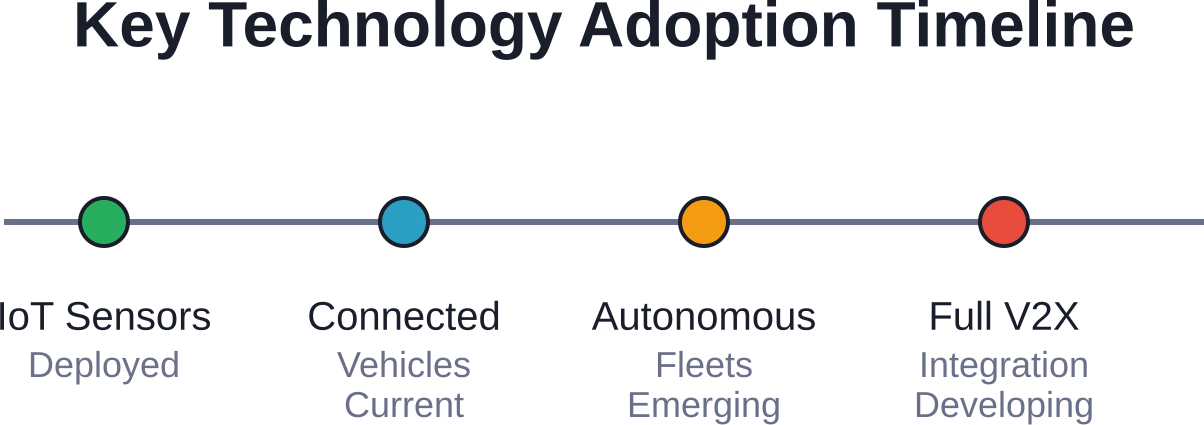
Data standardization efforts will mature. IEEE standards development, including the Standard for Digital Transformation Architecture and Framework, provides technical foundations for interoperable systems.
Making It Work: Implementation Principles
Organizations pursuing digital transformation should follow principles that improve success odds.
Start with clear problems, not shiny technologies. Identify specific operational challenges or service gaps, then evaluate which digital solutions address them effectively. Technology for its own sake rarely delivers value.
Prioritize interoperability from day one. Closed systems that don't communicate with existing infrastructure create islands of capability rather than integrated networks. Standards compliance and open APIs matter more than proprietary features.
Build institutional partnerships early. Digital transformation crosses organizational boundaries. Formal agreements, joint governance structures, and shared funding mechanisms prevent coordination failures later.
Pilot before scaling. Small-scale deployments test technical feasibility, identify unforeseen issues, and demonstrate value to stakeholders who control funding for broader rollouts.
Invest in workforce development alongside technology. New systems require new skills. Training, hiring, and organizational change management determine whether technology gets used effectively or sits underutilized.
Moving Forward
Digital transformation in transportation has moved beyond concept to operational reality. Government agencies deploy connected vehicle infrastructure. Private fleets adopt autonomous technologies. Cities integrate real-time data into traffic management.
The transformation isn't complete—far from it. Technical, institutional, and financial challenges remain. But the direction is clear and the momentum building.
Transportation organizations that treat digitalization as strategic priority rather than IT project position themselves to deliver better service, operate more efficiently, and adapt to changing mobility patterns. Those that delay face growing gaps between customer expectations and operational capabilities.
The question isn't whether digital transformation will reshape transportation. It's whether organizations will lead that transformation or scramble to catch up after competitors and peer agencies have already moved ahead.
Start by identifying specific operational challenges digital solutions can address. Build partnerships with agencies whose cooperation enables integrated approaches. Pilot technologies that show promise. Invest in workforce capabilities alongside technical infrastructure.
Transportation's digital future is taking shape today. The organizations succeeding are those treating transformation as ongoing evolution rather than one-time project—continuously learning, adapting, and improving as technologies and needs develop.
Frequently Asked Questions
What is digital transformation in transportation?
Digital transformation in transportation involves integrating advanced technologies like connected vehicles, IoT sensors, artificial intelligence, and real-time data analytics into mobility systems. It fundamentally changes how transportation infrastructure operates, how services are delivered, and how people and goods move through networks.
How do connected vehicles improve transportation safety?
Connected vehicles communicate with infrastructure, other vehicles, and networks to share real-time information about hazards, traffic conditions, and vehicle intentions. This awareness beyond individual sensor range enables collision warnings, cooperative braking, and hazard alerts that reduce accident rates measurably.
What challenges do transportation agencies face implementing digital technologies?
Major challenges include institutional fragmentation across multiple agencies, legacy infrastructure that wasn't designed for digital integration, lack of data standardization between systems, and difficulty proving return on investment for technologies whose benefits include avoided costs and improved service quality rather than direct revenue.
How does mobility-on-demand differ from traditional vehicle ownership?
Mobility-on-demand models provide transportation services rather than vehicle assets. Instead of owning cars that sit idle 96 percent of the time, users access shared autonomous electric fleets for specific trips. This shifts costs from fixed asset ownership to variable service consumption while potentially improving utilization and reducing total system costs.
What role does artificial intelligence play in transportation systems?
AI processes massive data volumes from sensors, vehicles, and infrastructure to identify patterns, predict outcomes, and optimize decisions in real time. Applications include dynamic signal timing, predictive maintenance, congestion forecasting, and automated routing—tasks that exceed human processing capabilities at the required scale and speed.
What standards support transportation digital transformation?
Key standards include General Transit Feed Specification (GTFS) for transit data, Dedicated Short-Range Communications (DSRC) for vehicle connectivity, IEEE standards for digital transformation architecture, and various SAE standards for autonomous and connected vehicle systems. These enable interoperability between systems from different vendors and jurisdictions.


