

WordPress Website Development Cost: 2026 Pricing Guide

Summary: WordPress website development costs range from $100 to $50,000+ depending on complexity. A basic site costs $500-$3,000, mid-level business sites run $5,000-$15,000, and complex e-commerce or custom platforms exceed $20,000. Core expenses include hosting ($3-$300/month), domain ($10-$50/year), themes ($0-$200), plugins ($0-$500+/year), and developer fees ($30-$150/hour).
WordPress powers more than 42% of all websites on the internet, according to recent data. That dominance makes sense when considering the platform's flexibility and scalability. But here's what nobody tells entrepreneurs at the start: WordPress itself is free, yet building a professional WordPress website can cost anywhere from a few hundred dollars to more than the price of a compact car.
The range is staggering. One business owner might launch a site for $300. Another might invest $40,000 for what looks like a similar result. What accounts for this massive difference?
Understanding WordPress pricing requires breaking down every component that goes into a functioning website. Hosting, domains, themes, plugins, security, design work, custom development, ongoing maintenance—each adds a line item to the final bill. Some costs are one-time. Others recur monthly or annually.
This guide dissects the real numbers behind WordPress website development in 2026. No marketing fluff. Just the actual costs businesses face when building WordPress sites, backed by current pricing data from hosting providers, development agencies, and freelance marketplaces.
The Two Versions of WordPress (And Why It Matters for Cost)
Before diving into pricing, clear up a common point of confusion. WordPress exists in two distinct versions, and choosing between them fundamentally changes the cost structure.
WordPress.com: The Hosted Platform
WordPress.com operates as a fully hosted service. Sign up, pick a plan, and start building. No server management, no separate hosting purchases, no technical configuration required.
According to official WordPress.com pricing data, plans include free and paid tiers starting at $4/month and progressing to higher levels. The Business plan includes advanced customization features.
WordPress.com bundles hosting, security, backups, and basic support into these prices. Simple and predictable, but limited. Professional developers rarely build client sites on WordPress.com due to customization restrictions.
WordPress.org: The Self-Hosted Platform
WordPress.org provides free, open-source software that installs on any web hosting account. This version offers unlimited customization potential. Install any theme, add any plugin, modify any code.
The catch? Everything else costs extra. Web hosting, domain registration, SSL certificates, themes, premium plugins, security tools, backups—each requires a separate purchase. Development and design work also come as additional expenses.
Most professional WordPress sites use the .org version despite the higher complexity. The flexibility justifies the effort for businesses that need specific features or custom functionality.
|
Aspect |
WordPress.com |
WordPress.org |
|---|---|---|
|
Software Cost |
Included in plan ($0-$45/month) |
Free (open source) |
|
Hosting |
Included |
$3-$300+/month (separate purchase) |
|
Domain |
Free first year on paid plans |
$10-$50/year (separate purchase) |
|
Customization |
Limited (full access on Business+ plans) |
Unlimited |
|
Maintenance |
Handled by WordPress.com |
Self-managed or hire help |
|
Best For |
Simple sites, blogs, beginners |
Business sites, custom projects, e-commerce |
The rest of this guide focuses primarily on WordPress.org pricing since that's what businesses typically choose for professional websites.

Know the Cost of WordPress Website Development
WordPress website cost depends on design scope, custom functionality, plugins, and integrations. OSKI Solutions evaluates required features before estimating development work. The budget includes theme customization, plugin configuration, and performance setup. You receive a clear WordPress development cost estimate.
Ready to Estimate Your WordPress Website Budget?
Talk with OSKI Solutions to:
- define required pages and functionality
- estimate customization effort
- receive a detailed WordPress cost breakdown
👉 Request a WordPress website development quote from OSKI Solutions.
Build a Powerful WordPress Website
We design and develop fast, secure, and SEO-optimized WordPress websites tailored to your business goals.
Core Cost Components: Breaking Down the Essentials
Every WordPress website, regardless of complexity, requires certain fundamental components. These form the baseline budget before considering design or development work.
Domain Name: $10-$50 Per Year
The domain name serves as the website's address. Costs vary based on the top-level domain (TLD) extension and registrar pricing.
Domain name costs vary widely, from budget registrations to premium domain prices reaching tens of thousands of dollars. Most businesses register standard domains in the $10-$20 annual range.
.com domains typically cost $10-$15 per year. Country-specific domains (.ca, .co.uk) run $15-$30 annually. Specialty extensions (.tech, .store, .ai) can reach $30-$50 per year at standard registrars.
Real talk: Don't overspend on fancy domain extensions. A .com domain almost always delivers better recognition and trust than creative alternatives.
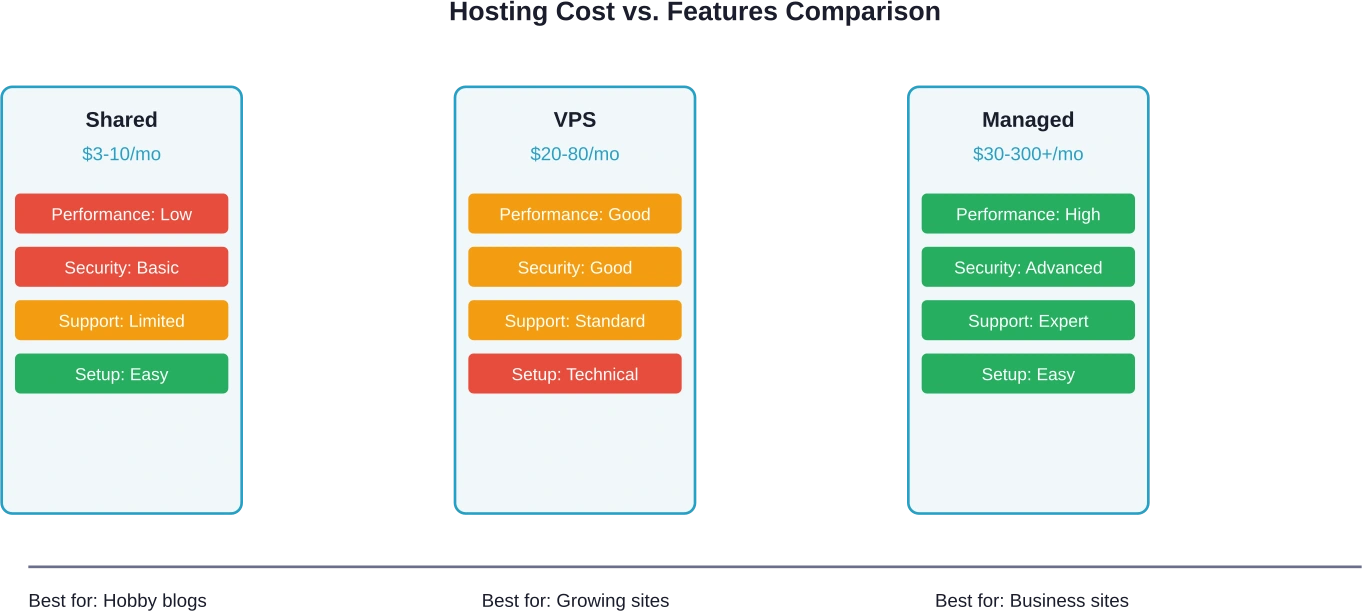
Web Hosting: $3-$300+ Per Month
Hosting represents one of the most variable costs in WordPress development. The spectrum runs from budget shared hosting to enterprise-grade managed platforms.
- Shared Hosting ($3-$10/month): The entry point for WordPress hosting. Providers like Bluehost, HostGator, and SiteGround offer WordPress-optimized shared plans starting around $3-$5 monthly with multi-year prepayment. Shared hosting plans can start at less than $5 per month, though websites share server resources with hundreds of other sites, creating potential security risks and performance issues.
- VPS Hosting ($20-$80/month): Virtual Private Servers provide dedicated resources without managing physical hardware. Better performance and security than shared hosting, with more technical responsibility. Suitable for mid-sized business sites with steady traffic.
- Managed WordPress Hosting ($30-$300+/month): Specialized hosting providers handle WordPress-specific optimization, security, backups, and updates. Managed hosting typically ranges from about $30 per month for entry plans to several hundred per month for enterprise-grade solutions.
WP Engine's managed hosting plans start at entry-level pricing around $30 per month, while the Core plan begins at €371 EUR per month according to official pricing data. These plans include features like isolated resources, 99.99% uptime SLAs, AI-powered plugin updates, and 24/7 WordPress-specific support.
The price differences reflect tangible benefits. Managed hosts monitor sites around the clock, patch security vulnerabilities immediately, optimize caching for speed, and provide WordPress-expert support. For businesses where downtime costs money, managed hosting often justifies the premium.
SSL Certificate: $0-$100 Per Year
SSL certificates encrypt data transmission between visitors and websites. Google prioritizes HTTPS sites in search rankings, making SSL effectively mandatory for modern websites.
Most hosting providers now include free SSL certificates through Let's Encrypt. Paid SSL certificates ($50-$100 annually) offer extended validation and warranty protection, though free options provide identical encryption for most business needs.
Budget $0 for SSL if using modern hosting. Only specialized use cases require paid certificates.
WordPress Themes: $0-$200
Themes control a WordPress site's visual design and layout structure. Options range from free themes in the WordPress repository to premium themes from marketplaces like ThemeForest or StudioPress.
Free themes work for basic sites but often lack advanced customization options and dedicated support. Premium themes typically cost $50-$90 for a lifetime license with one year of updates and support. Some theme developers sell annual subscriptions ($99-$200/year) that include unlimited sites and ongoing updates.
For businesses wanting a unique appearance, custom theme development runs $3,000-$15,000 depending on design complexity and functionality requirements.
WordPress Plugins: $0-$1,000+ Per Year
Plugins extend WordPress functionality beyond core features. The WordPress plugin repository hosts over 60,000 free plugins covering everything from contact forms to SEO optimization.
Most professional sites require at least a few premium plugins for advanced features. Common premium plugin costs include:
- SEO plugins (Rank Math Pro, SEO Press): $60-$100/year
- Page builders (Elementor Pro, Divi): $50-$100/year
- E-commerce (WooCommerce extensions): $50-$300/year per extension
- Security plugins (Wordfence Premium, Sucuri): $100-$300/year
- Backup solutions (UpdraftPlus Premium, BackupBuddy): $70-$150/year
- Forms and marketing tools: $50-$200/year
A typical business website uses 5-15 plugins total, with 2-5 being premium options. Annual plugin costs commonly fall between $200-$600 for most sites, though e-commerce sites with multiple extensions can easily exceed $1,000 annually.
Development and Design Costs: Where Budgets Diverge
The previous components apply to virtually all WordPress sites. Design and development costs vary wildly based on approach, scope, and who does the work.
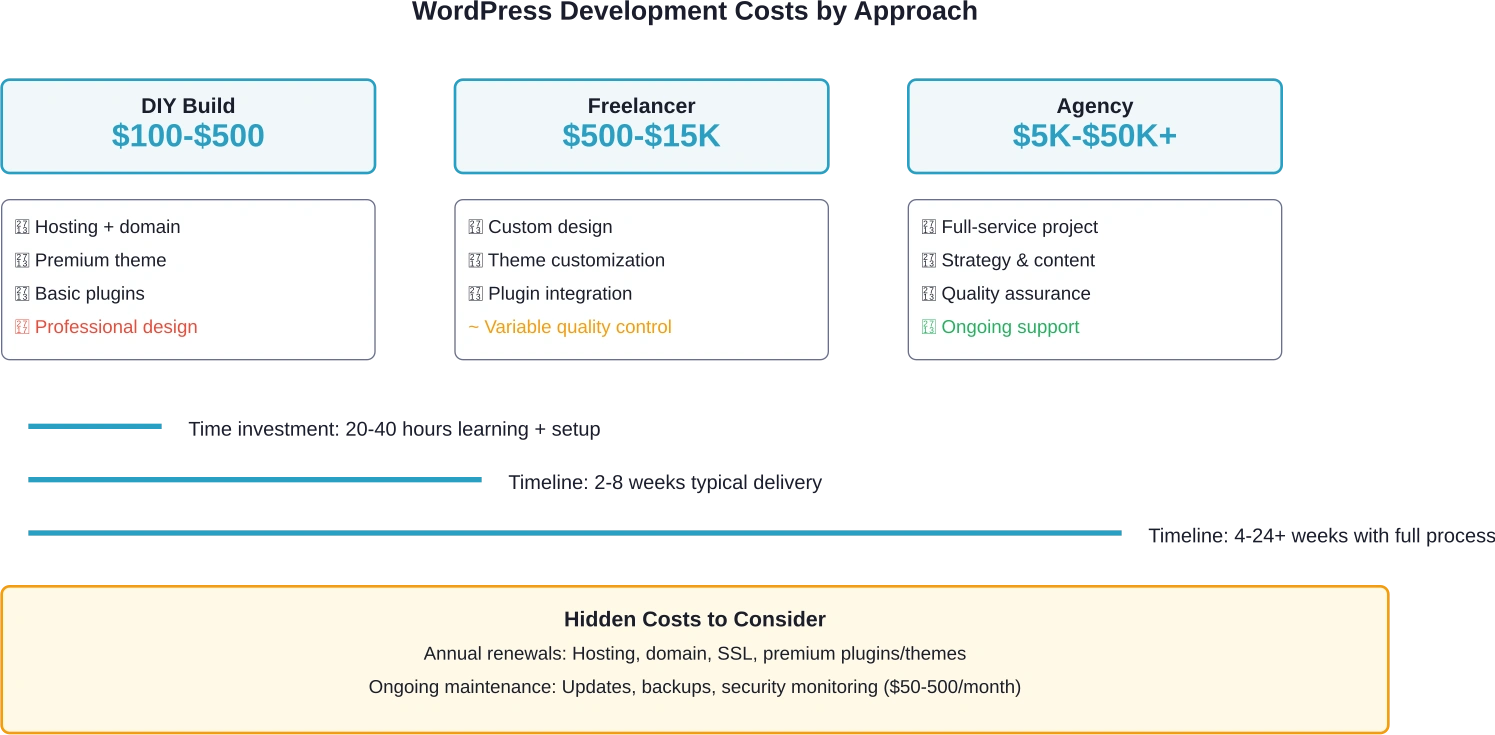
DIY WordPress Sites: $100-$500
For entrepreneurs with time and technical aptitude, building a WordPress site independently minimizes costs. DIY WordPress.org sites can start at $100 to $300 initially, with ongoing hosting fees typically ranging from $10 to $50 per month.
This budget covers:
- One year of basic hosting ($36-$60)
- Domain registration ($10-$15)
- Premium theme ($60-$90)
- 1-2 essential plugins ($50-$100)
The DIY approach works for simple business card sites, personal blogs, or minimum viable products testing market demand. Expect to invest 20-40 hours learning WordPress basics, theme customization, and content creation.
The hidden cost? Time. Entrepreneurs often underestimate how long WordPress setup and customization actually takes. That time has opportunity cost—hours spent wrestling with page builders could go toward business development instead.
Freelance Developers: $500-$15,000+
Hiring a WordPress developer typically ranges from $500 to $15,000+ per project, or $30 to $150+ per hour, depending on developer experience, project scope, and geographic location.
Freelance pricing tends to cluster around these tiers:
- Entry-Level Freelancers ($500-$2,000): New developers building portfolios often charge $25-$40 hourly. Suitable for straightforward sites using pre-built themes with minor customization. Expect 15-25 hours of work for a basic 5-7 page business site.
- Intermediate Freelancers ($2,000-$5,000): Experienced developers with 2-5 years in WordPress charge $50-$75 hourly. Can handle custom theme modifications, plugin integration, basic e-commerce setups, and responsive design implementation. Projects at this level typically involve 30-50 hours.
- Advanced Freelancers ($5,000-$15,000+): Senior developers and specialists command $80-$150+ hourly. These professionals build custom themes from scratch, develop custom plugins, architect complex database structures, and optimize for performance and security. Large-scale projects can span 100+ hours.
Freelancer platforms like Upwork, Fiverr, and Toptal provide access to global talent pools. Offshore developers from Eastern Europe, India, or Southeast Asia often charge 40-60% less than North American counterparts—though communication barriers and time zone differences can complicate projects.
WordPress Development Agencies: $5,000-$50,000+
Professional agencies provide comprehensive services including strategy, design, development, content creation, and often ongoing support. Agency custom design typically ranges from $1,000-$10,000, with custom development and unique features adding substantially more.
Typical agency pricing by project scope:
- Small Business Sites ($5,000-$10,000): Custom-designed 10-15 page sites with standard functionality (contact forms, blog, service pages, about/team sections). Includes responsive design, basic SEO setup, and content management training. Project duration: 4-8 weeks.
- Mid-Market Business Sites ($10,000-$25,000): Sophisticated multi-page sites with custom features like appointment booking, member portals, advanced forms, API integrations, or custom post types. Includes content strategy, professional copywriting for key pages, conversion optimization, and technical SEO. Duration: 8-16 weeks.
- E-commerce Sites ($15,000-$50,000+): Full WooCommerce stores with product catalogs, payment gateway integration, inventory management, customer accounts, and shipping calculations. Complex stores with extensive product customization, subscription functionality, or multi-vendor marketplaces can exceed $50,000. Duration: 12-24+ weeks.
- Enterprise Websites ($50,000-$200,000+): Large-scale sites with custom application development, multi-site networks, advanced user roles and permissions, CRM integrations, custom APIs, and extensive quality assurance. Reserved for corporations and organizations with complex requirements.
Agency pricing reflects overhead costs beyond development hours. Agencies employ project managers, designers, developers, QA testers, and support staff. That structure ensures quality and reliability but commands a premium over individual freelancers.
Ongoing Costs: The Long-Term Budget Reality
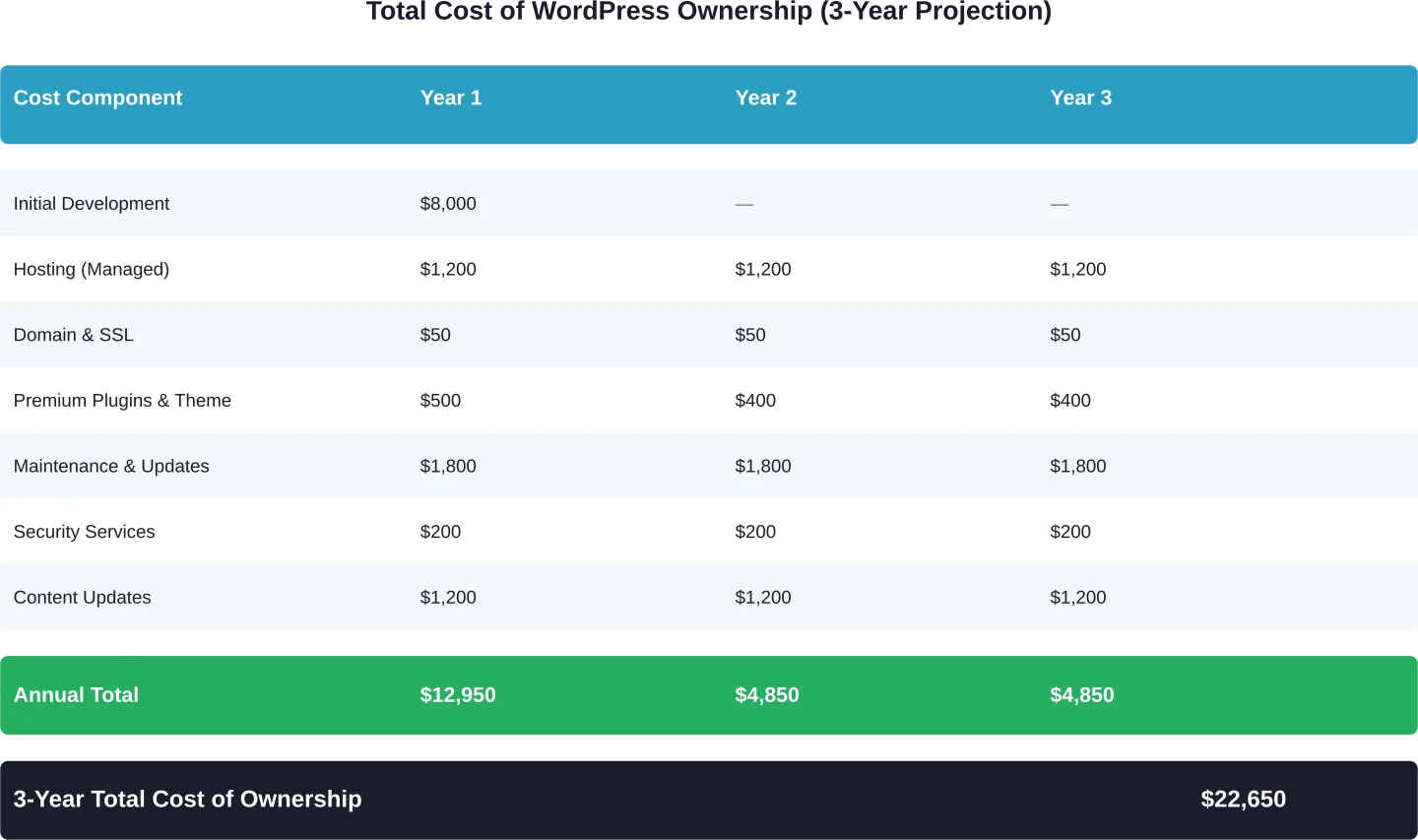
Launch costs represent only part of WordPress's total cost of ownership. Ongoing expenses accumulate year after year, often catching business owners off guard.
Maintenance and Updates: $50-$500 Per Month
WordPress releases regular core updates, as do theme and plugin developers. Keeping everything current prevents security vulnerabilities and compatibility issues. Neglect updates long enough, and sites break or get compromised.
Options for handling maintenance:
- Self-Managed ($0 direct cost): Handle updates, backups, and monitoring independently. Requires technical knowledge and time investment. The actual cost is opportunity cost—hours spent on maintenance instead of business activities.
- Basic Maintenance Plans ($50-$100/month): Services include core WordPress updates, plugin updates, theme updates, weekly backups, uptime monitoring, and basic security scans. Most providers fix simple issues but charge additional fees for major problems.
- Comprehensive Maintenance ($150-$500/month): Adds proactive security monitoring, malware removal, performance optimization, monthly reports, content updates (limited hours), and priority support. Suitable for business-critical sites where downtime directly impacts revenue.
Managed WordPress hosts like WP Engine include many maintenance tasks in hosting fees, reducing or eliminating separate maintenance costs. Self-hosting on shared or VPS providers almost always requires paid maintenance services or significant time investment.
Security and Backups: $100-$500 Per Year
WordPress's popularity makes it a frequent target for attacks. Comprehensive security requires multiple layers of protection.
Essential security components include:
- Web Application Firewall (WAF): $100-$200/year
- Malware scanning and removal: $100-$200/year
- Automated off-site backups: $50-$150/year
- SSL certificate (if not included): $0-$100/year
- Two-factor authentication: Often free via plugins
Again, managed WordPress hosts bundle these features. Sites on basic hosting need separate security subscriptions. Wordfence Premium ($119/year) and Sucuri ($199-$500/year) represent popular options providing comprehensive protection.
The cost of not investing in security? Data loss, malware infections, blacklisting by Google, customer data breaches, and expensive recovery services. Security is not optional for professional websites.
Content and Marketing: Highly Variable
Building a website is step one. Driving traffic requires ongoing content creation and marketing efforts.
Budget considerations include:
- Content Creation: Professional blog posts cost $150-$500 each. Case studies, whitepapers, and detailed guides run $500-$2,000+. Many businesses produce 2-4 pieces of content monthly ($600-$2,000/month).
- SEO Services: Professional SEO services typically cost $1,700-$5,000 for implementation. Ongoing SEO services often run $500-$2,000 monthly depending on competition and market size.
- Email Marketing: Email service providers charge based on subscriber count. Expect $10-$100 monthly for lists under 10,000 subscribers.
- Social Media Management: Managing social accounts requires either internal time or external services ($500-$2,000/month for professional management).
These marketing costs extend well beyond the WordPress platform itself but represent essential investments for websites that need to attract customers rather than just exist online.
Real-World Project Cost Examples
Abstract ranges help establish boundaries. Real scenarios illustrate how costs accumulate for specific project types.
Basic Business Website: $1,200-$3,500
A small local business needs a professional online presence. The site includes homepage, about page, services overview, contact form, and blog. No e-commerce, no complex features.
Year One Costs:
- Domain registration: $15
- Hosting (basic managed): $360 ($30/month)
- Premium theme: $70
- Essential plugins (contact form, SEO, security): $150
- Freelance setup and design: $800-$2,500
- Total: $1,395-$3,095
Ongoing Annual Costs:
- Hosting renewal: $360
- Domain renewal: $15
- Plugin renewals: $150
- Basic maintenance: $600 ($50/month)
- Total: $1,125/year
This budget delivers a functional, professional site managed primarily through do-it-yourself efforts with freelance help for initial setup.
Mid-Sized Business Website: $8,000-$15,000
A growing company needs custom design reflecting brand identity, 20-25 pages of content, blog functionality, appointment booking, client testimonials, team profiles, and resource downloads.
Year One Costs:
- Domain: $15
- Hosting (mid-tier managed): $1,200 ($100/month)
- Custom theme design: $4,000
- Premium plugins (forms, SEO, bookings, security): $500
- Professional copywriting (10 key pages): $2,000
- Agency development and launch: $8,000
- Total: $15,715
Ongoing Annual Costs:
- Hosting: $1,200
- Domain: $15
- Plugins: $500
- Maintenance plan: $1,800 ($150/month)
- Content updates: $1,200 ($100/month)
- Total: $4,715/year
Projects at this level typically engage agencies or senior freelancers who handle strategy, design, development, and launch as a comprehensive package.
E-commerce Store: $15,000-$35,000+
An online retail business requires WooCommerce configuration, product catalog setup (100-500 products), payment gateway integration, shipping configuration, tax calculations, inventory management, customer accounts, order tracking, and email automation.
Year One Costs:
- Domain: $15
- Hosting (e-commerce optimized): $2,400 ($200/month)
- Custom theme design: $6,000
- WooCommerce extensions: $1,000
- Premium plugins: $800
- Payment gateway setup: $500
- Agency development: $18,000-$30,000
- Product photography and descriptions: $2,000-$5,000
- Total: $30,715-$45,715
Ongoing Annual Costs:
- Hosting: $2,400
- Domain: $15
- Plugin and extension renewals: $1,500
- Comprehensive maintenance: $3,600 ($300/month)
- Security monitoring: $300
- Total: $7,815/year
E-commerce projects carry higher complexity and risk. Payment processing, inventory management, and customer data handling require careful implementation and ongoing monitoring. The investment reflects these elevated requirements.
|
Website Type |
Year One Cost |
Annual Ongoing Cost |
Timeline |
|---|---|---|---|
|
Personal Blog (DIY) |
$100-$300 |
$150-$300 |
1-2 weeks |
|
Basic Business Site |
$1,200-$3,500 |
$1,100-$1,800 |
2-6 weeks |
|
Professional Business Site |
$8,000-$15,000 |
$4,000-$6,000 |
6-12 weeks |
|
E-commerce Store |
$15,000-$35,000+ |
$7,000-$12,000 |
12-20 weeks |
|
Enterprise Website |
$50,000-$200,000+ |
$15,000-$50,000+ |
20-40+ weeks |
Cost-Saving Strategies That Actually Work
Smart decisions reduce WordPress costs without sacrificing quality. Here's what actually makes a difference.
Start Simple, Scale Later
Launch with core features only. Add advanced functionality after validating market demand and generating revenue. That $15,000 custom booking system can wait until manually managing appointments becomes genuinely unmanageable.
Minimum viable websites cost 40-60% less than feature-complete versions. Use the savings to invest in marketing that drives traffic to the simple site rather than building elaborate features nobody sees.
Choose Hosting Strategically
Managed WordPress hosting seems expensive compared to $3/month shared hosting. But calculate total cost of ownership. Shared hosting requires separate security subscriptions ($100-$200/year), backup services ($50-$100/year), performance optimization ($100-$300/year), and maintenance time or fees ($600-$1,200/year).
That $3/month hosting actually costs $1,000-$2,000 annually when properly maintained. A $30/month managed host ($360/year) that bundles security, backups, and performance optimization often costs less overall while delivering superior results.
Leverage Quality Free Plugins
Premium plugins provide advanced features, but many excellent free alternatives exist. Before purchasing premium plugins, test free options. WPForms Lite, Rank Math, UpdraftPlus, and Wordfence Free deliver substantial functionality at zero cost.
Reserve plugin budgets for capabilities unavailable in free versions. Premium plugins should solve specific problems, not replace perfectly adequate free alternatives.
Invest in Custom Design, Not Custom Development
Custom theme design ($3,000-$6,000) creates unique brand identity without the expense of building functionality from scratch. Pair custom design with proven plugins for features like forms, bookings, or e-commerce. This approach delivers 80% of custom-built benefits at 40% of the cost.
Full custom development makes sense for unique requirements that plugins can't address. For standard business needs, existing solutions work perfectly well beneath custom designs.
Plan for Ongoing Costs from Day One
Underestimating ongoing costs creates budget crises months after launch. Factor annual renewal and maintenance expenses into business planning before building the site.
Maintenance isn't optional. Updates prevent security vulnerabilities, and backups enable recovery from disasters. Budget $1,000-$3,000 annually for ongoing costs depending on site complexity and hosting choices.
Common Cost Mistakes to Avoid
Experience reveals patterns in how businesses overspend or create problems through false economies.
Choosing Hosting Based Solely on Price
The cheapest hosting almost always becomes expensive long-term. Poor performance drives customers away. Security breaches require costly remediation. And when sites go down, cheap hosts provide minimal support.
Hosting represents infrastructure, not an expense to minimize. The $15-$20 monthly difference between budget and quality hosting costs less than a single lost customer.
Skipping Security Until After Problems Occur
Malware cleanup services cost $200-$1,500 depending on infection severity. Recovery from hacks requires hours of developer time. Google blacklisting devastates organic traffic for weeks.
Proactive security ($100-$300/year) costs a fraction of reactive remediation. This is among the easiest cost-benefit calculations in web development.
Building Everything Custom When Plugins Exist
Custom development costs $5,000-$20,000+ for functionality that existing plugins provide for $50-$200. Unless requirements are truly unique, proven plugins deliver faster and more reliably than custom code.
Custom development makes sense for competitive advantages and unique workflows. Standard features benefit from using standard solutions.
Underinvesting in Design
Design directly impacts conversion rates and brand perception. The difference between a $70 template and $3,000 custom design can mean 20-30% better conversion rates.
For businesses where the website generates leads or sales, design investment pays for itself quickly. The $3,000 design that converts 4% instead of 3% generates substantially more value than saving $2,930 on a template.
Neglecting Mobile Optimization
More than 60% of web traffic comes from mobile devices. Sites that look great on desktops but break on phones lose more than half their potential audience.
Responsive design is non-negotiable. Every WordPress project should include mobile optimization from the start. Testing across devices prevents expensive redesigns later.
Factors That Increase WordPress Development Costs
Certain project characteristics reliably drive costs upward. Recognizing these factors helps set realistic budgets.
Custom Features and Functionality
Any feature unavailable through existing plugins requires custom development. Unique calculators, complex user interfaces, custom databases, API integrations with proprietary systems—each adds development hours at $50-$150 per hour.
Complex features can easily add $5,000-$20,000 to project costs. When requesting custom functionality, ask whether existing solutions can be adapted first.
Content Volume and Complexity
Sites with 50-100+ pages require substantially more time for design, development, organization, and testing. Each additional page adds content creation, design application, and quality assurance costs.
Large sites also need sophisticated navigation, search functionality, and content organization—all increasing complexity and cost.
Multi-Language Support
Translating sites into multiple languages requires translation plugins (often premium), translated content for every page, and testing across languages. Professional translation services cost $0.10-$0.25 per word.
A 20-page site with 10,000 total words translated into three additional languages costs $3,000-$7,500 for translation alone, plus development time for multi-language setup.
Advanced E-commerce Requirements
Basic WooCommerce stores are relatively straightforward. Advanced requirements like subscription products, membership tiers, product customization tools, complex shipping rules, multi-vendor marketplaces, or custom checkout flows dramatically increase complexity.
Each advanced e-commerce feature adds $1,000-$5,000+ in development costs beyond basic store setup.
Integrations with External Systems
Connecting WordPress to CRM systems (Salesforce, HubSpot), email platforms (Mailchimp, ConvertKit), accounting software (QuickBooks, Xero), or custom internal tools requires API development and testing.
Simple integrations using existing plugins cost $500-$1,500. Custom API integration development runs $2,000-$10,000+ depending on complexity and external system documentation quality.
Comparing WordPress to Alternative Platforms
WordPress isn't the only website option. How does its cost structure compare to alternatives?
WordPress vs. Website Builders (Wix, Squarespace, Shopify)
Website builders offer all-in-one subscriptions typically ranging $15-$45 monthly for business plans. That includes hosting, templates, basic plugins, and support.
Benefits of builders include simplicity and fixed monthly costs. Drawbacks include limited customization, proprietary platforms (can't export to other systems), and feature constraints as businesses grow.
WordPress offers superior flexibility and scalability but requires more technical knowledge and has variable costs. For businesses expecting significant growth or needing specific custom features, WordPress's flexibility typically outweighs builders' simplicity.
WordPress vs. Custom-Built Websites
Fully custom websites built from scratch without using CMS platforms cost $30,000-$200,000+ for professional results. Custom development eliminates all platform constraints but requires substantially higher investment.
Custom builds make sense for large enterprises with unique requirements and substantial budgets. For the vast majority of businesses, WordPress provides 95% of the benefits at 20-30% of the cost.
WordPress.com vs. WordPress.org
As established earlier, WordPress.com offers simpler fixed-price plans ($0-$45/month) with limited flexibility. WordPress.org requires managing separate services but provides unlimited customization potential.
For simple blogs and basic sites, WordPress.com works fine. For professional business websites, WordPress.org's flexibility justifies the additional complexity.
Frequently Asked Questions
How much does a basic WordPress website cost?
A basic WordPress website typically costs $500-$3,000 for initial development, including domain registration ($10-$50/year), hosting ($120-$600/year), a premium theme ($50-$100), essential plugins ($100-$300/year), and either DIY setup or freelance developer assistance ($300-$2,000). Ongoing costs add $500-$1,500 annually for hosting, domain renewal, plugin subscriptions, and basic maintenance.
Is WordPress free to use?
WordPress.org software is free and open-source. However, running a WordPress website requires paid services including web hosting ($3-$300/month), domain registration ($10-$50/year), and typically premium themes or plugins ($50-$500/year). WordPress.com offers hosted plans ranging from free (with limitations) to $45/month for business features. The software is free; the infrastructure and services required to run it are not.
How much should I pay a developer to build a WordPress site?
WordPress developers charge $30-$150 per hour or $500-$15,000+ per project depending on experience level and project scope. Entry-level developers charge $500-$2,000 for basic sites. Experienced freelancers charge $2,000-$5,000 for mid-complexity business sites. Senior developers and specialists charge $5,000-$15,000+ for advanced projects with custom features. Agencies typically charge $5,000-$50,000+ for comprehensive projects including strategy, design, development, and support.
What are the ongoing costs of maintaining a WordPress website?
Ongoing WordPress costs typically range from $500-$5,000 annually depending on site complexity. Essential annual expenses include hosting renewal ($120-$3,600), domain renewal ($10-$50), premium plugin subscriptions ($200-$1,000+), SSL certificate renewal ($0-$100), security services ($100-$300), and maintenance services or time investment ($600-$6,000). E-commerce sites and business-critical websites typically require higher maintenance budgets than simple blogs or brochure sites.
How much does WordPress hosting cost?
WordPress hosting costs vary widely based on hosting type and features. Shared hosting starts at $3-$10 monthly but requires separate security and maintenance investments. VPS hosting ranges from $20-$80 monthly with better performance. Managed WordPress hosting, which bundles optimization, security, backups, and expert support, typically costs $30-$300+ monthly. Managed plans start around entry-level pricing and reach $400+/month for business-grade hosting with enterprise features.
Should I use WordPress.com or WordPress.org?
WordPress.com suits beginners wanting simple, fixed-price plans with everything included. Plans range from free to $45/month, with business features requiring higher tiers. WordPress.org provides the full-featured platform with unlimited customization but requires managing separate hosting, domains, security, and maintenance. Most professional business websites use WordPress.org despite higher complexity because customization flexibility and long-term scalability outweigh the convenience of WordPress.com's managed approach. Choose .com for simplicity; choose .org for serious business websites.
How much does a WordPress e-commerce site cost?
WordPress e-commerce sites using WooCommerce typically cost $15,000-$35,000+ for initial development, depending on product catalog size, custom features, and design complexity. This includes hosting setup, WooCommerce configuration, payment gateway integration, shipping setup, custom theme design, essential extensions, and product migration. Basic stores with standard features cost $15,000-$20,000. Stores with subscriptions, memberships, custom product options, or complex shipping rules cost $25,000-$50,000+. Annual ongoing costs for e-commerce sites typically range $7,000-$12,000 covering hosting, security, plugin renewals, and maintenance.
Making the Right Investment Decision
WordPress website development costs depend entirely on business needs, technical capabilities, and growth ambitions.
The critical insight? WordPress serves everyone from solo bloggers to Fortune 500 corporations precisely because it scales across this massive cost spectrum. A $500 site and a $50,000 site both run WordPress—just with dramatically different implementations.
Start by honestly assessing requirements. Does the site need to simply exist online, or must it actively generate leads and sales? Will traffic be 100 visitors monthly or 100,000? Does the business need unique features competitors don't offer?
Match budget to business value. An e-commerce store projecting $500,000 annual revenue should invest $20,000-$30,000 in professional development. A local service business testing online presence can start with $2,000-$5,000 and scale later.
Building a website can cost as little as a few dollars a month or soar into thousands, with real-world price averages varying by website type and business requirements.
The websites that fail aren't usually victims of insufficient budgets. They fail because businesses built the wrong things, neglected ongoing maintenance, underinvested in security, or expected websites to generate results without traffic and marketing investment.
WordPress provides the platform. Success requires strategy, execution, and ongoing commitment beyond the initial development investment.
Take the Next Step
Understanding WordPress costs provides the foundation for smart decision-making. The next move depends on specific business circumstances.
For businesses ready to move forward:
- Define Requirements First: Document exactly what the website needs to accomplish. List required pages, features, integrations, and functionality before approaching developers. Clear requirements produce accurate quotes and prevent scope creep.
- Request Multiple Quotes: Get proposals from at least three developers or agencies. Compare not just pricing but approach, timeline, included services, and ongoing support options. The cheapest quote rarely delivers the best value.
- Review Portfolios Carefully: Examine previous work from potential developers. Do their past projects reflect the quality and style needed? Can they demonstrate experience with similar industries or feature requirements?
- Plan for the Long Term: Build relationships with developers who can support the site after launch. One-time projects with no ongoing relationship often leave businesses stranded when issues arise months later.
- Start Small, Iterate Smart: Launch with core features rather than trying to build everything upfront. Real user feedback beats internal assumptions every time. Use early revenue to fund expanded features based on actual needs rather than predicted ones.
WordPress development costs reflect priorities and choices more than any inherent expense. The platform accommodates budgets from hundreds to hundreds of thousands of dollars precisely because businesses operate at vastly different scales with dramatically different needs.
Success comes not from spending the right amount but from investing strategically in capabilities that drive business results. Sometimes that's a $1,500 freelancer setup. Sometimes it's a $30,000 agency project. The right budget matches business value to website investment.
Ready to build a WordPress website that actually delivers results? Start by documenting requirements, researching qualified developers, and allocating budget for both development and ongoing maintenance. The businesses that succeed online don't just build websites—they invest in digital infrastructure that generates value for years.


