

What Is Umbraco: A Complete Guide to the Open-Source .NET CMS

If you’ve spent time in web development or digital marketing, you’ve probably heard of Umbraco. It’s not the loudest name in the room like WordPress or Drupal, but in the background, it quietly powers thousands of websites for major brands and organizations. From small business sites to enterprise platforms, Umbraco has become a trusted tool for building flexible, fast, and reliable digital experiences.
This article breaks down what Umbraco is, what makes it different, and how it helps both developers and content teams create websites that actually work the way they’re supposed to.
Understanding Umbraco CMS
Umbraco is a free, open-source content management system (CMS) built on Microsoft’s .NET framework. In simple terms, it’s a platform that lets developers build websites and applications while giving non-technical users an easy way to manage content.
The project started back in 2004 in Denmark and has grown into one of the most widely used .NET-based CMS platforms in the world. Today, it’s supported by a global community of developers, agencies, and businesses who continuously improve its features and security.
What sets Umbraco apart is its combination of flexibility and simplicity. It’s developer-friendly without being overwhelming, and it’s editor-friendly without being restrictive. It gives you the structure to build efficiently but doesn’t dictate how your website should look or behave.
What You Can Build with Umbraco
Umbraco isn’t limited to one type of project. It can be used for almost any web-based application, from simple websites to advanced enterprise systems.
Here are a few examples of what it’s commonly used for:
- Corporate websites with rich content and multiple language versions
- E-commerce platforms with secure payment and product management systems
- Enterprise portals for internal communication and collaboration
- Community sites or membership portals
- Headless CMS setups for apps and multi-device delivery
- Educational and government websites that need strong data handling and accessibility
This versatility is one reason why agencies often choose Umbraco for clients who need something more tailored than what generic website builders can provide.
Why Businesses Choose Umbraco
While WordPress dominates in popularity, Umbraco has built its reputation around reliability, customization, and performance. Companies that need scalable and secure systems often turn to it for long-term projects.
Some of the world’s most recognized brands use Umbraco to manage their websites. They’re drawn to it for a few main reasons:
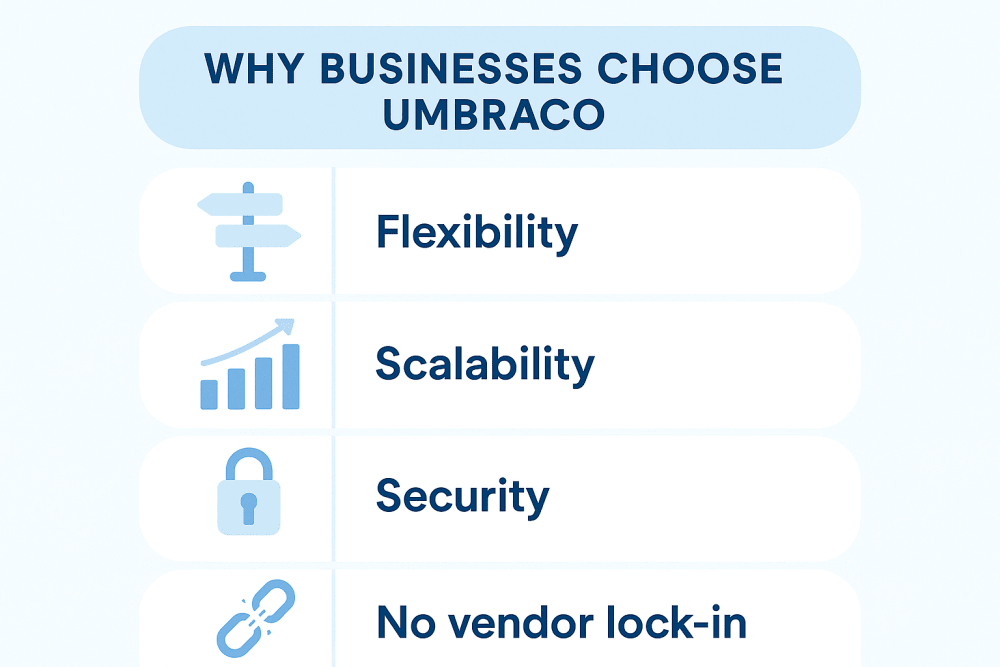
- Flexibility: Developers can tailor every aspect of a site, from design to functionality, without fighting against prebuilt limitations.
- Scalability: Umbraco handles everything from small websites to enterprise-level portals, growing easily as traffic and data expand.
- Security: Built on Microsoft’s .NET framework, it inherits strong security standards and regular updates.
- No vendor lock-in: Being open source, you have full control of your project’s codebase and hosting choices.
- Cost-effective: The CMS itself is free, and even its commercial tools come at fair, transparent prices.

Building with Umbraco: Our Approach at OSKI
At OSKI, we’ve worked with a wide range of content management systems, and Umbraco consistently stands out as one of the most reliable and adaptable platforms for modern business needs. When we design and build digital solutions, our goal is always to balance performance, flexibility, and long-term stability. Umbraco allows us to do exactly that. Its open-source foundation and integration with the .NET ecosystem give us the freedom to create customized, scalable websites and applications that fit seamlessly into our clients’ workflows. Whether we’re developing a corporate site, an e-commerce portal, or a data-driven web app, Umbraco’s clean architecture lets us focus on what really matters: efficient performance and effortless content management.
We’ve seen firsthand how Umbraco’s flexibility benefits our clients. Its composable structure makes it easy to add or modify features as business requirements evolve, without unnecessary complexity. Combined with our experience in cloud technologies like Azure and AWS, and our deep expertise in .NET and frontend frameworks such as React and Angular, we can deliver solutions that are both technically strong and simple to maintain. For organizations looking to modernize legacy systems or unify their digital presence, Umbraco provides the right foundation, and we provide the engineering precision to make it shine.
Build Umbraco That Actually Scales
Custom development, clean architecture, and long-term support done properly
Built on the Microsoft .NET Framework
The technical foundation of Umbraco is what gives it stability and performance. The CMS is written mainly in C# and runs on the .NET framework, a well-established platform from Microsoft that supports high-performance, secure, and maintainable software.
With the release of Umbraco 9 and later versions, the platform fully supports .NET Core (now .NET 5+). This shift made Umbraco cross-platform, meaning it can run on Windows, Linux, or macOS servers. It also opened the door to faster performance and easier cloud deployment.
For developers already familiar with Microsoft tools like Visual Studio or Azure, Umbraco feels like a natural fit. Its integration with Microsoft technologies ensures a smoother workflow and better compatibility across systems.
Open Source with Commercial Support
One of Umbraco’s biggest advantages is its hybrid nature. It’s open source, which means the code is freely available on GitHub, and the community can contribute to its growth. But it also has commercial backing from Umbraco HQ, the company that maintains and supports the platform.
This model offers the best of both worlds: the freedom and transparency of open source with the reliability of professional support when needed. Businesses can rely on a community-driven ecosystem that’s constantly innovating while still having the option for enterprise-level assistance.
The Core Philosophy: Flexibility Without Complexity
Umbraco was designed with one guiding idea in mind: make things simpler without taking control away from the user.
Many CMS platforms overload users with features they’ll never use. Umbraco keeps things lean. It provides essential tools for managing content, structure, and integrations, but leaves room for developers to decide what to include.
For marketers and editors, this means fewer distractions and a clean, intuitive interface. They can add or update content easily without relying on developers for every small change. For developers, it means full access to the codebase, the ability to extend the system however they like, and the freedom to integrate with almost any external service or platform.
Umbraco Cloud and Hosting Options
When it comes to deployment, Umbraco offers a few paths depending on how much control or automation you want.
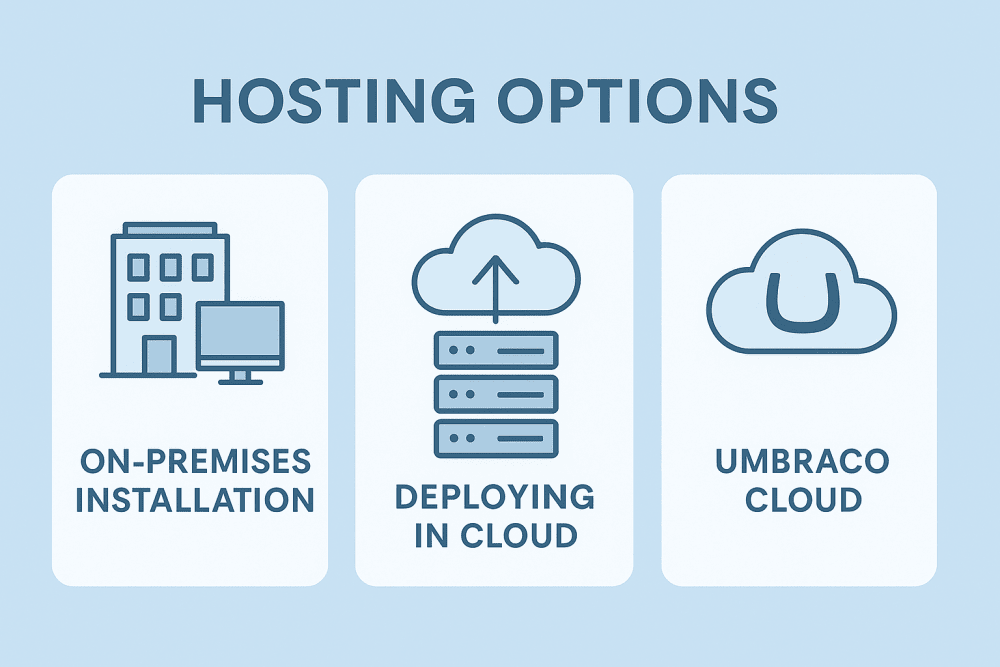
On-Premises Installation
You can host Umbraco on your own servers, giving you full control over infrastructure, security, and compliance. This option suits organizations with specific IT policies or custom network setups.
Deploying in Your Own Cloud
If you’re already using a cloud service like AWS or Azure, you can deploy Umbraco there. It integrates smoothly with Microsoft Azure in particular, making it easy to scale resources and manage costs.
Umbraco Cloud
For those who prefer a hands-off approach, there’s Umbraco Cloud – a fully managed Platform-as-a-Service (PaaS) solution. It handles hosting, upgrades, and patches automatically, so your team can focus on building and maintaining content rather than managing servers.
Umbraco Cloud is especially useful for agencies managing multiple sites, since it simplifies deployment and version control while keeping everything secure and up to date.
Composable Architecture and Add-Ons
Umbraco follows a composable model, meaning you can start with the core CMS and add what you need as your project grows. It doesn’t force extra tools on you, which helps keep things lightweight.
Some of the most popular add-ons include:
- Umbraco Heartcore: A headless CMS option for delivering content across websites, apps, and devices via API.
- Umbraco Forms: An easy way to build and manage contact or data collection forms without external plugins.
- Umbraco Engage: Tools for personalization, A/B testing, and analytics to improve user engagement.
- Umbraco Workflow: Custom approval and publishing workflows for larger teams.
- Umbraco Deploy: Streamlined content and schema deployment across development environments.
This modular setup means businesses only pay for what they actually use, rather than investing in bulky software packages with features they don’t need.
Headless Capabilities
As content delivery evolves, many businesses are moving toward headless CMS setups, where the backend (content management) is separated from the frontend (what users see). Umbraco supports both traditional and headless configurations.
With Umbraco Heartcore, developers can manage content in one place and distribute it across websites, apps, or digital displays via APIs. This approach is perfect for organizations that run multi-channel platforms or use modern frontend frameworks like React, Vue, or Angular.
Integration Capabilities
A modern CMS should fit smoothly into a company’s broader digital ecosystem, and Umbraco does this well. Its API-friendly design makes it easy to connect with third-party tools and systems.
Here are just some of the integrations commonly used with Umbraco:
- Analytics tools: Google Analytics, Adobe Analytics
- CRM systems: Salesforce, Microsoft Dynamics, HubSpot
- ERP platforms: SAP, Oracle, or custom-built systems
- Marketing automation: Mailchimp, Marketo, HubSpot
- E-commerce: Shopify, uCommerce, Vendr
- Customer service tools: Zendesk, Freshdesk
Developers can use REST or SOAP APIs to build custom integrations, making it easy to pull or send data between systems
Ideal Use Cases for Umbraco
Umbraco isn’t designed to fit every possible project, but it truly stands out in certain situations. It’s a strong choice for large enterprises that need tight control, solid security, and reliable performance, as well as for agencies that manage multiple client websites under one platform. Developers appreciate it for the freedom it provides to work directly with the codebase and customize every layer of the system. At the same time, marketers find its interface simple and intuitive, allowing them to update content quickly without relying on technical help. Umbraco also integrates naturally with Microsoft technologies like Azure and Dynamics, making it a natural fit for organizations already using that ecosystem. Industries such as finance, education, healthcare, manufacturing, and e-commerce often turn to Umbraco because of its ability to combine flexibility with strong data protection and consistent performance under heavy use.
Final Thoughts
So, what is Umbraco in plain terms? It’s a CMS built for people who want both freedom and structure. It doesn’t overwhelm you with gimmicks or try to lock you into its ecosystem. Instead, it gives you a clean foundation to build on, whether you’re running a small marketing site or managing a global digital platform.
For developers, it’s a well-documented and flexible framework. For marketers, it’s intuitive and practical. For businesses, it’s cost-effective and reliable.
In an industry crowded with choices, Umbraco stands out for doing what a good CMS should do: making content management simple while giving you the tools to grow without limitations.
If you’re planning your next digital project and want something that’s open, modern, and built to last, Umbraco deserves a serious look. It’s not the loudest platform out there, but that’s part of its strength. It just works – quietly, efficiently, and exactly how you need it to.
Frequently Asked Questions
What exactly is Umbraco used for?
Umbraco is a content management system that helps businesses and developers create, manage, and maintain websites and web applications. It’s built on Microsoft’s .NET framework, which means it’s especially good for organizations that want secure, high-performing solutions that integrate smoothly with other Microsoft tools like Azure and Dynamics. From small company websites to enterprise-level portals, Umbraco offers a balance of flexibility, stability, and ease of use.
Is Umbraco free to use?
Yes, the core version of Umbraco is completely free and open source. You can download it, modify it, and use it for any type of project without license fees. There are optional paid services like Umbraco Cloud or Umbraco Heartcore, which provide hosting, automatic updates, and additional enterprise-grade features, but using the CMS itself doesn’t cost anything.
What makes Umbraco different from WordPress or Drupal?
While WordPress and Drupal are excellent platforms, Umbraco stands out because of its .NET foundation and flexibility. It’s designed to handle complex, data-heavy projects while keeping things simple for content editors. You get full control over the codebase and integrations, without being limited by plugins or templates. It’s also less prone to performance bottlenecks, which makes it a strong choice for larger or growing businesses.


