

Website Redesign Cost 2026: Complete Pricing Guide

Brief Overview: Website redesign costs typically range from $2,000 to $80,000 in 2026, depending on whether you choose DIY tools ($800-$5,000), freelancers ($3,000-$10,000), or agencies ($5,000-$75,000). The final price depends on site complexity, number of pages, custom features, integrations, and ongoing maintenance needs.
The question "how much does a website redesign cost?" doesn't have a simple answer. A small business refreshing five static pages faces completely different pricing than an e-commerce platform with thousands of products and custom integrations.
Here's what makes this tricky: the same project can get quoted at $3,000 by one provider and $50,000 by another. Both might be legitimate, but they're offering fundamentally different approaches, quality levels, and long-term value.
This guide breaks down what actually drives website redesign costs in 2026. No fluff, no generic advice—just the specific factors that determine whether a redesign runs $2,000 or $80,000, and how to figure out what makes sense for a particular situation.
Average Website Redesign Costs by Provider Type
The biggest cost variable? Who's doing the work. Three main options exist, each with distinct price ranges and tradeoffs.
DIY and In-House Redesigns
Building or redesigning a website using platforms like Wix, Squarespace, or WordPress with pre-built themes typically costs between $800 and $5,000. Some projects come in under $100 if sticking to basic templates and free tools.
But there's a catch. The real cost here isn't just dollars—it's time. According to SBA resources on website redesign best practices, many business owners underestimate the learning curve and time investment required to create professional results.
The price breakdown usually includes:
- Domain registration: $10-$50 annually
- Website builder subscription: $100-$500 annually
- Premium templates: $50-$200 one-time
- Stock images and assets: $50-$300
- Basic plugins or extensions: $100-$500
This approach works best for microbusinesses, personal projects, or tech-savvy owners who enjoy hands-on work and have realistic timelines. The tradeoff? Limited customization and the need to handle all technical troubleshooting personally.
Freelancer Website Redesigns
Hiring a freelance web designer or developer typically runs between $3,000 and $10,000 for most small to medium business sites. This range assumes a site with 10-20 pages, some custom design work, and moderate functionality.
Freelancers offer more flexibility than DIY but less infrastructure than agencies. One person handles design, development, and often content—which can be efficient but creates bottlenecks if that person gets busy or unavailable.
Pricing varies significantly based on the freelancer's experience, location, and specialization. According to 2024 salary data, IT professionals and software developers saw varied compensation, with senior roles commanding substantially higher rates than entry-level positions.
The middle-ground pricing makes sense for businesses that need custom design but can't justify agency-level investment. Just verify the freelancer's portfolio matches the desired style and complexity level.
Agency Website Redesigns
Web design agencies charge between $5,000 and $75,000 for most redesign projects. Some enterprise sites with extensive custom development push past $100,000.
Why such a wide range? Agencies vary dramatically in capabilities, team size, and specialization. A boutique shop might charge $5,000-$15,000 for a straightforward business site. Full-service digital agencies handling complex e-commerce, custom integrations, and ongoing optimization can easily reach $50,000-$75,000.
Agencies bring teams—designers, developers, strategists, project managers, and QA testers. This means faster turnarounds, specialized expertise, and accountability. The downside? Higher overhead costs passed to clients.
|
Provider Type |
Cost Range |
Best For |
Main Tradeoff |
|---|---|---|---|
|
DIY/In-House |
$800 - $5,000 |
Microbusinesses, simple sites |
Significant time investment |
|
Freelancer |
$3,000 - $10,000 |
Small to medium businesses |
Limited team resources |
|
Agency |
$5,000 - $75,000+ |
Established businesses, complex projects |
Higher cost |

Calculate Website Redesign Costs Before You Start
Website redesign may include UX updates, migration, and performance improvements. OSKI Solutions evaluates current structure and defines required changes. The estimate is based on actual redesign tasks. This helps avoid unexpected costs during implementation.
Ready to Estimate Your Website Redesign?
Talk with OSKI Solutions to:
- review your current website
- define redesign scope
- calculate timeline and cost
👉 Request a website redesign cost estimate from OSKI Solutions.
Give Your Website a Modern Upgrade
We redesign outdated websites into fast, modern, and conversion-focused digital experiences.
Key Factors That Determine Website Redesign Costs
Provider type matters, but it's not everything. Specific project characteristics drive the actual price within those ranges.
Website Size and Complexity
More pages mean more work. A five-page brochure site redesign costs fundamentally less than a 50-page content site or a 500-product e-commerce platform.
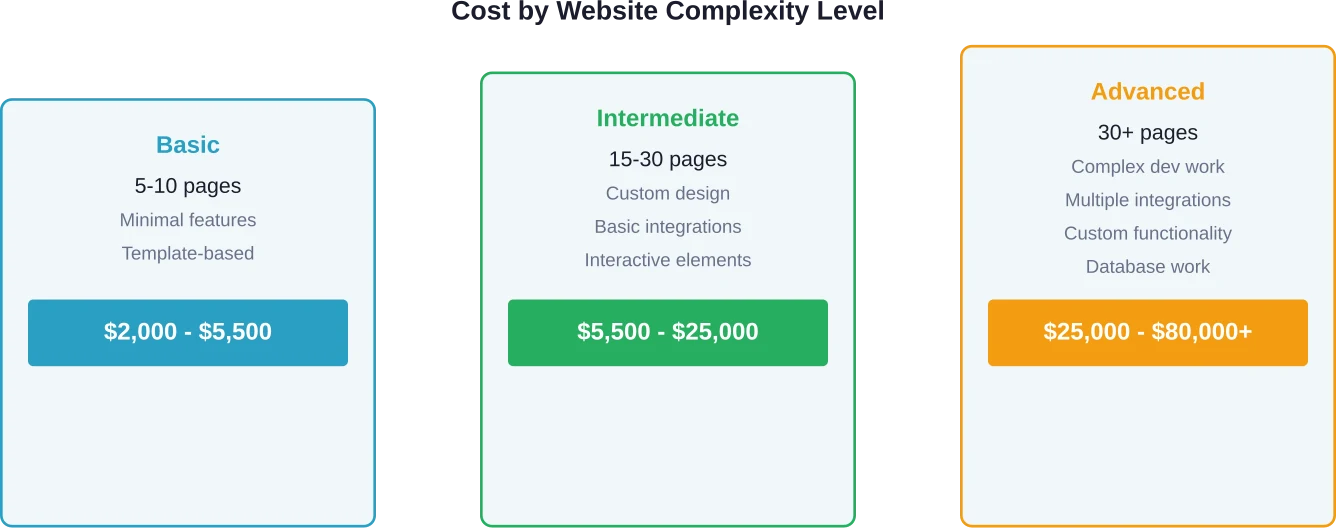
Basic redesigns covering 5-10 pages with minimal custom features typically cost $2,000-$5,500. These projects focus on visual refreshes, mobile responsiveness, and basic content updates.
Intermediate redesigns handling 15-30 pages with moderate customization—custom forms, basic integrations, some interactive elements—usually run $5,500-$25,000.
Advanced redesigns involving 30+ pages, extensive custom development, complex databases, or sophisticated user interactions can hit $25,000-$80,000 or more.
But page count alone doesn't tell the whole story. A 10-page site with a custom booking system, payment processing, and CRM integration can cost more than a 40-page content site with straightforward layouts.
Custom Features and Functionality
Every custom feature adds development time and cost. Standard features like contact forms or image galleries? Usually included in base pricing. Custom calculators, member portals, booking systems, or proprietary tools? Those require significant additional investment.
According to IEEE research on software development cost estimation, custom feature development represents one of the most variable cost factors in web projects. Each unique requirement needs specification, design, coding, testing, and refinement.
Common custom features and their typical cost impact:
- E-commerce functionality: $2,000-$15,000 depending on catalog size and payment options
- Member login and user accounts: $1,500-$8,000
- Custom search and filtering: $1,000-$5,000
- Booking or scheduling systems: $2,000-$10,000
- Interactive tools or calculators: $1,500-$7,000
- Custom dashboards or reporting: $3,000-$15,000
These aren't add-ons thrown on at the end. They're integrated throughout the site architecture, affecting design, development, and testing phases.
Third-Party Integrations
Modern websites rarely operate in isolation. They connect to CRMs, email platforms, payment processors, analytics tools, inventory systems, and marketing automation.
Each integration adds complexity. Some platforms offer simple plugins that work out of the box. Others require custom API development, authentication setup, and ongoing maintenance.
Basic integrations (Google Analytics, standard payment gateways, email signup forms) typically add $500-$2,000 to project costs. Complex integrations (custom CRM connections, ERP systems, proprietary databases) can add $3,000-$15,000 or more.
The challenge? Integrations break. APIs change. Services update. This creates ongoing maintenance considerations beyond the initial redesign.
Content Migration and Creation
Moving content from an old site to a new one sounds straightforward. It's not.
Content migration involves more than copy-paste. Pages need reformatting for new layouts. Images require resizing and optimization. URLs need mapping to preserve SEO value. Metadata gets transferred and updated.
Small sites with 10-20 pages might include migration in base pricing. Larger sites with hundreds of pages often charge $1,000-$5,000 for migration services.
Creating new content costs even more. Professional copywriting runs $100-$300 per page depending on length and research requirements. Custom photography ranges from $500 to $5,000 for a full shoot. Professional video production starts around $1,000 per finished minute.
Many businesses underestimate content costs and find themselves stuck with a beautiful new design but outdated, poorly written content that undermines the entire investment.
Design Customization Level
Template-based designs cost less because designers start with existing layouts and modify them. Custom designs start from scratch, requiring more design hours, revision rounds, and client collaboration.
Template customization (selecting a theme and adjusting colors, fonts, and layouts) typically adds $500-$2,000 to project costs. Semi-custom design (unique layouts using some template elements) runs $2,000-$8,000. Fully custom design (everything built from wireframes) can add $5,000-$25,000 depending on complexity.
Custom design isn't automatically better. Templates have improved dramatically. For many businesses, a well-chosen template with thoughtful customization delivers 90% of the value at 40% of the cost.
Types of Website Redesigns and Their Costs
Not all redesigns are created equal. Three main approaches exist, each with different scope and pricing.
Visual Refresh
A visual refresh updates appearance without changing structure or functionality. New colors, fonts, images, and layouts make the site look modern while keeping the same pages and features.
This approach typically costs $2,000-$10,000 and works well when the existing site functions properly but looks dated. It's faster than a full rebuild, usually taking 3-6 weeks instead of 3-6 months.
Visual refreshes preserve existing SEO value, require less content work, and minimize the risk of breaking working functionality. The downside? They can't fix fundamental structural or technical problems.
Structural Redesign
Structural redesigns reorganize site architecture, navigation, and information hierarchy while updating design. This approach costs $8,000-$35,000 for most business sites.
When does this make sense? When user research or analytics show visitors struggle to find information. When business offerings have evolved beyond the original site structure. When conversion rates lag despite decent traffic.
Structural redesigns require more strategy work upfront—user research, information architecture planning, and navigation testing. The investment pays off through improved user experience and better conversion paths.
Complete Platform Migration
Moving to an entirely new platform (switching from WordPress to Shopify, or from a custom CMS to a modern framework) represents the most extensive redesign type. Costs typically range from $15,000 to $80,000 or more.
Platform migrations require rebuilding everything—design, content, functionality, and integrations. Research on digital platform designs shows platform selection significantly impacts long-term performance and scalability.
This approach makes sense when the current platform can't support needed features, has security vulnerabilities, or lacks modern capabilities. But it's the riskiest and most time-consuming option, often requiring 4-9 months from planning to launch.
Hidden and Ongoing Website Redesign Costs
The initial redesign price tells only part of the story. Several ongoing costs catch businesses off guard.
Domain and Hosting
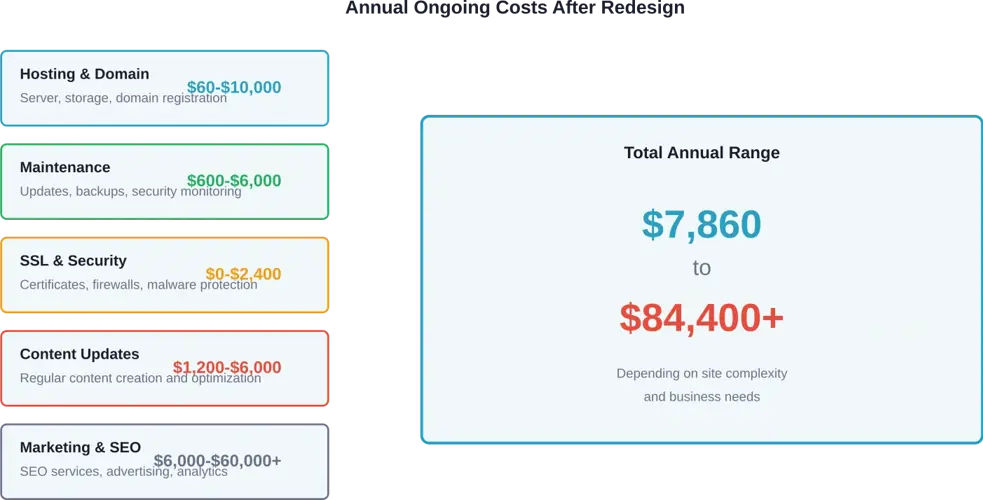
Domain registration runs $10-$50 annually for standard domains. Premium domains can cost thousands or require ongoing lease payments.
Hosting varies dramatically based on traffic, storage, and performance needs. Shared hosting starts around $50-$200 annually. VPS hosting runs $200-$1,000 annually. Dedicated servers or cloud hosting for high-traffic sites can hit $2,000-$10,000+ annually.
Maintenance and Updates
Websites require ongoing maintenance—security updates, plugin updates, backup management, and uptime monitoring. DIY maintenance costs nothing but time. Professional maintenance plans run $50-$500 monthly depending on site complexity.
Many agencies offer maintenance packages covering technical updates, security monitoring, and minor content changes. These typically cost 10-20% of the initial project cost annually.
SSL Certificates and Security
SSL certificates (the "https" in web addresses) are now table stakes for any professional site. Basic certificates cost $0-$50 annually through many hosting providers. Advanced certificates for e-commerce or enterprise sites run $100-$500 annually.
Additional security measures—malware scanning, firewall protection, DDoS mitigation—add $10-$200 monthly depending on threat level and business requirements.
Content Updates and Optimization
Static websites become outdated quickly. Regular content updates keep sites relevant and support SEO. In-house content management costs staff time. Outsourced content services run $100-$500+ monthly for regular blog posts, page updates, and optimization.
Marketing and SEO Services
A redesigned website without traffic generates zero value. SEO services typically cost $500-$5,000+ monthly depending on competition and market. Paid advertising budgets vary wildly based on industry and goals but typically start at several hundred dollars monthly for meaningful results.
How to Choose the Right Website Redesign Approach
Budget matters, but it shouldn't be the only consideration. The right approach depends on business goals, timeline, and internal capabilities.
When DIY Makes Sense
DIY redesigns work for businesses with limited budgets, simple needs, and someone internally who enjoys web work. They're perfect for solo practitioners, early-stage startups, or businesses where the website plays a supporting role rather than driving revenue.
Red flags that DIY might not work? Needing custom functionality, lacking technical skills internally, or requiring the site to launch within a tight deadline. Template limitations become frustrating fast when specific features or layouts are non-negotiable.
When to Hire a Freelancer
Freelancers offer the best middle ground for many small businesses. Custom work without agency overhead. Personal attention without DIY time investment.
Look for freelancers with portfolios showing similar project types and complexity levels. Check references. Discuss communication style and availability upfront. Clarify what's included in pricing—revisions, training, post-launch support.
The main risk? Dependency on one person. If they get busy, sick, or move on, projects stall. Some freelancers maintain better backup systems than others.
When to Invest in an Agency
Agencies justify higher costs when stakes are high. E-commerce sites where downtime means lost revenue. Complex projects requiring multiple specialties. Businesses where the website drives significant customer acquisition.
Agencies bring accountability, infrastructure, and redundancy. Someone's always available. Projects keep moving even when individuals take vacation. Quality assurance processes catch problems before launch.
But not all agencies are equal. Technology-driven efficiency gains vary significantly by sector and implementation approach, which applies to web agencies as well.
Evaluate agencies based on relevant portfolio work, client testimonials, team expertise, and cultural fit. The cheapest agency rarely delivers the best value.
Cost-Saving Strategies That Don't Sacrifice Quality
Smart budget management doesn't mean cutting corners. It means strategic prioritization.
Phase the Project
Launch with core functionality and add features in phases. Get the essential pages live first, then add the blog, then the resource library, then the member portal. Spreading costs over time makes bigger projects feasible.
Phasing also reduces risk. Test the initial site with real users before building additional features. Gather data on what actually gets used versus what seemed important in planning.
Reuse Quality Content
Don't recreate everything from scratch. Good existing content can transfer to new designs with minor updates. Professional photos from previous shoots can get optimized and reused. Effective copy might just need formatting adjustments.
Focus new content budgets on high-impact pages—homepage, key service pages, and conversion-critical landing pages. Lower-priority pages can use adapted existing content.
Choose Platforms Wisely
Platform choice dramatically impacts long-term costs. WordPress offers flexibility but requires more technical maintenance. Squarespace simplifies management but limits customization. Shopify excels for e-commerce but adds transaction fees.
Evaluate platforms based on the most critical business needs. Don't pay for enterprise features that won't get used. Don't choose limited platforms that can't grow with the business.
Handle Some Work Internally
Even when outsourcing design and development, handling content entry, image selection, and review coordination internally saves money. Most agencies charge $75-$150 per hour for project management and basic content work that internal staff can handle.
Set clear boundaries. Let professionals handle technical work and design decisions. Take ownership of content, internal communication, and approval processes.
|
Strategy |
Potential Savings |
Best Application |
|---|---|---|
|
Phased rollout |
20-40% |
Large projects with multiple feature sets |
|
Content reuse |
$2,000-$8,000 |
Sites with quality existing content |
|
Strategic platform selection |
15-30% long-term |
Matching platform to actual needs |
|
Internal project management |
$1,500-$5,000 |
Teams with available bandwidth |
|
Template customization vs. custom design |
$3,000-$15,000 |
Businesses comfortable with template starting points |
Red Flags in Website Redesign Pricing
Some pricing approaches signal potential problems. Watch for these warning signs.
Too-Good-To-Be-True Pricing
A full custom e-commerce site for $2,000? Probably not happening. When pricing seems dramatically lower than market rates, something's missing—experience, quality, scope, or honesty.
Unrealistically low bids often mean providers don't understand project complexity. What starts at $2,000 balloons to $8,000 through constant change orders and scope additions.
Vague Scope Definitions
"We'll build you a great website for $10,000" means nothing without specifics. How many pages? What features? How many revision rounds? What's included in ongoing support?
Professional proposals detail deliverables, timelines, revision policies, and post-launch support. Vague proposals lead to scope creep and budget overruns.
No Discovery Process
Quality redesigns start with discovery—understanding business goals, user needs, technical requirements, and success metrics. Providers who skip discovery and jump straight to proposals are guessing.
Good discovery doesn't always require paid engagements. But it does require substantive conversations about objectives, audiences, and requirements before pricing gets finalized.
Lack of Portfolio Evidence
Every web professional should show relevant portfolio examples. No portfolio? That's a red flag. Only showing different project types than what's being proposed? Another warning sign.
Ask to see similar projects in complexity, industry, and functionality. Contact those clients if possible. Past performance predicts future results better than promises.
Timeline Expectations and How They Affect Cost
Faster timelines cost more. Rush charges apply when developers drop other projects to prioritize urgent work.
Typical timeline expectations:
- Simple template-based redesign: 2-4 weeks
- Custom small business site: 6-10 weeks
- Intermediate custom site: 10-16 weeks
- Complex custom site or platform migration: 16-30 weeks
These assume reasonable client responsiveness. Projects stall when feedback takes weeks, content arrives late, or stakeholders can't align on decisions. Provider delays happen too—other projects overrun, team members leave, technical challenges emerge.
Build buffer time into launch plans. A website needed for a specific event or deadline should start 2-3 months earlier than the absolute minimum timeline suggests.
Questions to Ask Before Committing to a Redesign
Smart buying starts with smart questions. Use these to evaluate providers and proposals.
About Pricing and Scope
- What exactly is included in the quoted price?
- How many revision rounds are included?
- What triggers additional charges?
- What's not included that typically costs extra?
- How are change requests handled and priced?
About Process and Timeline
- What's the expected timeline from kickoff to launch?
- What's required from the client and when?
- How is communication handled?
- Who's the point of contact throughout the project?
- What happens if timelines slip?
About Post-Launch Support
- What training is provided?
- What's included in post-launch support?
- How long does post-launch support last?
- What are ongoing maintenance options and costs?
- How are bugs or issues handled after launch?
About Technical Details
- What platform will the site use and why?
- Who owns the final website and its code?
- How is hosting handled?
- What's the approach to mobile responsiveness?
- How is SEO addressed during redesign?
- What analytics and tracking will be implemented?
The Real Value Beyond Initial Cost
Here's what matters more than the price tag: return on investment.
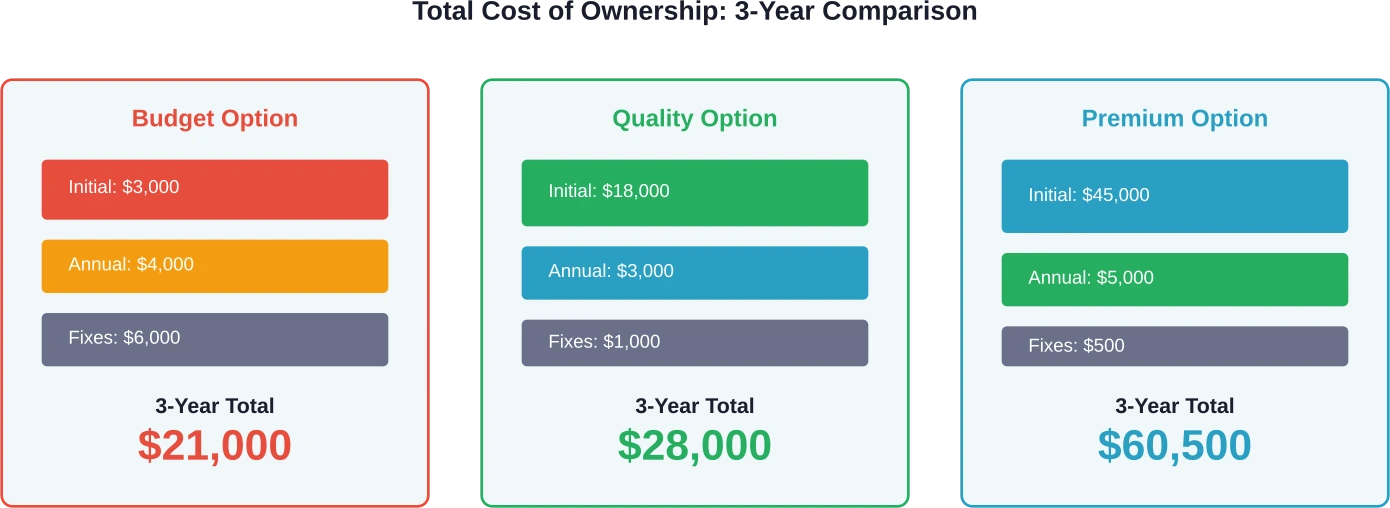
A $5,000 site that converts 2% of visitors into customers beats a $25,000 site that converts 0.5%. A $15,000 investment that generates $100,000 in new business over three years delivers exceptional value. A $3,000 site that requires $10,000 in fixes and updates over the same period costs more in the long run.
Evaluate redesign investments based on expected business impact, not just design aesthetics. According to SBA guidance on website readiness, businesses that prepare their digital presence for diverse visitors position themselves for revenue opportunities.
The lowest bid rarely delivers the best long-term value. The highest bid doesn't guarantee superior results either. The right investment balances upfront costs with ongoing performance, maintenance requirements, and business outcomes.
Frequently Asked Questions
How much does a simple website redesign cost?
A simple website redesign typically costs between $2,000 and $8,000 for a small business site with 5-15 pages. This includes basic design updates, mobile responsiveness, and standard functionality like contact forms. DIY options using platforms like Wix or Squarespace can cost as little as $800-$3,000, while professional freelancers typically charge $3,000-$8,000 for straightforward projects.
Should I hire an agency or freelancer for my website redesign?
Freelancers work well for small to medium projects with budgets under $15,000, offering personal attention and lower overhead costs. Agencies make sense for complex projects requiring multiple specialties (design, development, content strategy, SEO), tighter timelines, or when the website plays a critical role in revenue generation. Agencies cost more—$5,000 to $75,000 versus $3,000 to $10,000 for freelancers—but provide team redundancy and broader expertise.
What factors increase website redesign costs the most?
Custom features and integrations drive costs up significantly. E-commerce functionality adds $2,000-$15,000. Custom member portals or booking systems add $1,500-$10,000. Complex third-party integrations (CRM, ERP, proprietary systems) can add $3,000-$15,000. Content creation—professional copywriting, photography, video—adds $2,000-$10,000+ depending on volume. Platform migrations (switching to an entirely new system) represent the highest-cost redesign type at $15,000-$80,000.
How long does a typical website redesign take?
Timeline varies by complexity. Simple template-based redesigns take 2-4 weeks. Custom small business sites require 6-10 weeks. Intermediate custom sites need 10-16 weeks. Complex sites or platform migrations take 16-30 weeks. These timelines assume reasonable client responsiveness for feedback and content. Rush projects cost 15-30% more due to prioritization charges and overtime work.
What ongoing costs should I budget after the redesign?
Budget for hosting and domains ($60-$10,000 annually depending on traffic), maintenance and updates ($600-$6,000 annually), SSL certificates and security ($0-$2,400 annually), content updates ($1,200-$6,000 annually), and marketing/SEO services ($6,000-$60,000+ annually). Total ongoing costs typically range from $7,860 to $84,400+ annually. Many businesses underestimate these continuing expenses when planning redesign budgets.
Can I redesign my website in phases to manage costs?
Phased redesigns work well for managing budgets and reducing risk. Launch core pages first (homepage, key service pages, contact), then add features like blogs, resource libraries, or member portals in later phases. This approach can save 20-40% on initial costs while allowing testing with real users before building additional functionality. Phasing makes sense for larger projects where not all features need to launch simultaneously.
How do I know if a website redesign quote is fair?
Compare quotes to market averages: DIY ($800-$5,000), freelancers ($3,000-$10,000), agencies ($5,000-$75,000). Verify the scope details—how many pages, what features, how many revisions, what's included post-launch. Suspiciously low pricing often signals inexperience or incomplete scope understanding. Request detailed proposals that break down deliverables, timelines, and assumptions. Check portfolios for similar project complexity and contact previous clients about their experience.
Making the Right Investment Decision
Website redesign costs vary dramatically—from under $1,000 for basic DIY work to over $80,000 for complex custom development. But the number itself matters less than the value delivered.
The right investment depends on specific business context. A startup with limited resources might wisely choose a $3,000 template-based site that can evolve over time. An established e-commerce business might find a $50,000 custom platform pays for itself in six months through improved conversion rates.
Start by defining clear objectives. What should the redesigned site accomplish? More leads? Better user experience? Updated brand perception? Higher conversion rates? Specific goals guide smart budget decisions.
Research providers thoroughly. Review portfolios. Check references. Compare detailed proposals. Ask tough questions about scope, timeline, and post-launch support. The cheapest option rarely delivers the best value, but the most expensive doesn't guarantee superior results.
Consider total cost of ownership, not just initial investment. Factor in ongoing maintenance, content updates, hosting, security, and marketing costs. A budget-friendly redesign that requires constant fixes and updates can cost more over three years than a quality investment with lower ongoing expenses.
Most importantly, remember that a website is a business tool, not a one-time expense. The right redesign pays dividends for years through improved customer acquisition, better user experience, and stronger brand positioning. Invest accordingly.
Ready to move forward? Start by documenting current site problems, defining clear objectives, and establishing a realistic budget range. Then reach out to 3-5 potential providers for discovery conversations. The best redesign decisions come from informed evaluation, not rushed commitments.


