

Website Development Cost Estimation Guide 2026

Summary: Website development costs range from $1,000 for basic sites to $100,000+ for complex web applications, varying based on design complexity, functionality, technology stack, and team location. Accurate estimation requires breaking down projects into discovery, design, development, content, and maintenance phases, with each contributing different percentages to the total budget. Using estimation calculators, understanding hourly rates across regions, and accounting for hidden costs like hosting, security, and ongoing updates ensures realistic budgeting.
Standing at the starting line of a website project without knowing what it'll cost feels like planning a road trip with no idea how much gas costs. The frustration is real—and expensive.
Website development cost estimation isn't guesswork. It's a structured process that combines technical understanding, market awareness, and realistic planning. The difference between a project that stays on budget and one that spirals out of control often comes down to how well costs were estimated upfront.
According to the GoodFirms Web Development Costs Survey 2024, establishing an online store spans the $5,000 to $50,000+ range, requiring 4–16 weeks of development. That's a massive range, and understanding where projects fall within it requires dissecting what actually drives those numbers.
Understanding What Drives Website Development Costs
Website development costs aren't arbitrary numbers pulled from thin air. They reflect real resources, time, expertise, and technology stacks. Breaking down what's actually being paid for transforms vague budget discussions into concrete planning.
The core cost components span five distinct phases, each demanding different resources and expertise.
Discovery and Planning Phase
This initial phase typically consumes 10-15% of the total budget. Discovery involves requirements gathering, competitive analysis, user research, and technical specifications documentation. Skipping or rushing this phase creates downstream problems that cost exponentially more to fix.
Planning deliverables include project scope documents, technical architecture diagrams, feature specifications, and timeline estimates. This groundwork prevents scope creep and ensures all stakeholders share the same vision before a single line of code gets written.
Design Phase Allocation
Design work claims 20-25% of most project budgets. This covers user experience (UX) research, wireframing, interface design, responsive layouts, and design system creation. Complex animations, custom illustrations, or brand development push this percentage higher.
The design phase produces mockups, prototypes, style guides, and asset libraries. Quality design work directly impacts user engagement and conversion rates, making this investment crucial for business-focused websites.
Development Work
Development represents the largest cost center at 40-50% of total budget. This includes front-end development (what users see), back-end development (server logic and databases), API integrations, security implementation, and quality assurance testing.
Technology choices dramatically affect development costs. A WordPress site with existing themes costs substantially less than a custom-coded React application with Node.js backend. The complexity of features—user authentication, payment processing, real-time updates—multiplies development hours.
Content Creation and Migration
Content work takes 10-15% of budgets. This covers copywriting, content strategy, SEO optimization, image sourcing or creation, video production, and migrating existing content from old systems. Many businesses underestimate content costs, assuming they'll "just handle it themselves" and then discovering how time-consuming quality content creation actually is.
Launch and Post-Launch Activities
The final 5-10% covers deployment, DNS configuration, analytics setup, training, documentation, and initial monitoring. Post-launch support during the critical first weeks catches issues early and ensures smooth operation.

Know the True Website Development Cost
Website costs depend on structure, CMS, design scope, and integrations. OSKI Solutions reviews functional requirements before estimating effort. The budget reflects development, testing, and deployment work. This gives you a clear website cost estimate.
Ready to Plan Your Website Budget?
Talk with OSKI Solutions to:
- define structure and features
- estimate design and development effort
- receive a transparent website cost breakdown
👉 Request a website development quote from OSKI Solutions.
Build a Website That Drives Results
We design and develop high-performance websites optimized for speed, user experience, and conversion.
Website Development Cost Ranges by Project Type
Not all websites cost the same, obviously. The type of site being built creates the primary framework for cost estimation. Here's what different project categories actually cost in 2026.
|
Website Type |
Price Range |
Timeline |
Key Features
|
|---|---|---|---|
|
Portfolio/Personal Site |
$300 - $1,500 |
1-2 weeks |
5-10 pages, basic contact form, image galleries |
|
Small Business Website |
$1,000 - $5,000 |
2-4 weeks |
10-20 pages, CMS, contact forms, basic SEO |
|
eCommerce Store |
$3,000 - $20,000+ |
4-16 weeks |
Product catalogs, payment processing, inventory |
|
SaaS/Web Application |
$10,000 - $100,000+ |
3-12 months |
User accounts, dashboards, complex functionality |
|
Enterprise Platform |
$50,000 - $500,000+ |
6-18 months |
Custom architecture, integrations, scalability |
Basic Informational Websites
Simple informational sites represent the entry point for website development, ranging from $1,000 to $5,000. These projects include a handful of pages—home, about, services, contact—with straightforward layouts and minimal custom functionality.
CMS platforms like WordPress dominate this category. WordPress powers about 40% of all websites and offers a balance of functionality and cost-effectiveness. Using existing themes with minor customizations keeps development hours low while still delivering professional results.
eCommerce Websites
Online stores start around $3,000 for basic setups using platforms like WooCommerce or Shopify, but custom eCommerce solutions easily reach $20,000 to $50,000+. The cost variance depends on product catalog size, payment gateway integrations, shipping calculations, inventory management, and customer account features.
Security requirements for eCommerce sites add costs. Payment Card Industry (PCI) compliance, SSL certificates, fraud detection, and secure checkout flows require specialized expertise and ongoing maintenance.
Web Applications and SaaS Platforms
Custom web applications represent the high end of development costs, starting at $10,000 and frequently exceeding $100,000. These projects involve complex user authentication, database architecture, API development, real-time features, and extensive testing.
SaaS platforms require additional infrastructure for multi-tenant architecture, subscription management, usage tracking, and scalability planning. The technical complexity and extensive quality assurance needed for applications that handle sensitive user data or business-critical processes justifies the higher investment.
Key Factors That Impact Website Development Costs
Beyond project type, specific variables create cost variations even within the same category. Understanding these factors helps refine estimates from broad ranges to precise budgets.
Design Complexity and Customization
Off-the-shelf templates cost hundreds of dollars. Custom designs cost thousands. The difference lies in uniqueness, brand alignment, and competitive differentiation.
Design complexity encompasses visual sophistication, animation and interactions, responsive behavior across devices, and accessibility compliance. Each additional layer of polish adds design hours. A site with custom illustrations, micro-interactions, and elaborate animations can triple design costs compared to a clean, minimalist approach.
Functionality and Feature Set
Features drive development time more than any other factor. Every interactive element, integration, or custom behavior requires coding, testing, and documentation.
Common features and their relative complexity include contact forms (simple), user registration and login (moderate), payment processing (complex), and real-time notifications (very complex). The combination and interdependencies between features create multiplicative rather than additive cost effects.
Content Management System Selection
CMS choice significantly impacts both initial development and long-term maintenance costs. WordPress offers extensive plugins and themes but may require customization for unique needs. Proprietary systems or headless CMS solutions offer more flexibility but demand higher initial development investment.
Headless CMS architectures separate content management from presentation, enabling multi-channel publishing but requiring API development and more complex deployment. This architectural choice typically adds 30-50% to development costs compared to traditional CMS implementations.
Third-Party Integrations
Most modern websites don't exist in isolation. They connect with payment processors, email marketing platforms, CRM systems, analytics tools, and various APIs.
Each integration requires development time for implementation, testing, error handling, and ongoing maintenance. Simple integrations using well-documented APIs might take 5-10 hours. Complex integrations with legacy systems or limited documentation can consume 40+ hours per connection.
Geographic Location of Development Team
Developer hourly rates vary dramatically by region. Understanding these differences enables strategic decisions about team composition and budget allocation.
|
Region |
Hourly Rate Range |
Typical Skill Level
|
|---|---|---|
|
North America |
$75 - $200+ |
All levels, specialized expertise |
|
Western Europe |
$60 - $150 |
Strong technical skills, good English |
|
Eastern Europe |
$30 - $75 |
High technical quality, growing market |
|
Asia |
$15 - $50 |
Variable quality, communication considerations |
|
Latin America |
$25 - $60 |
Improving quality, timezone advantages for US |
Geographic arbitrage—hiring developers from lower-cost regions—can reduce budgets by 50-70%, but introduces coordination challenges, potential communication barriers, and quality variability. The lowest hourly rate doesn't guarantee the lowest total cost if projects take longer or require extensive revisions.
How to Calculate Website Development Costs Step-by-Step
Moving from rough estimates to accurate budgets requires a systematic calculation approach. Here's how development teams actually build estimates.
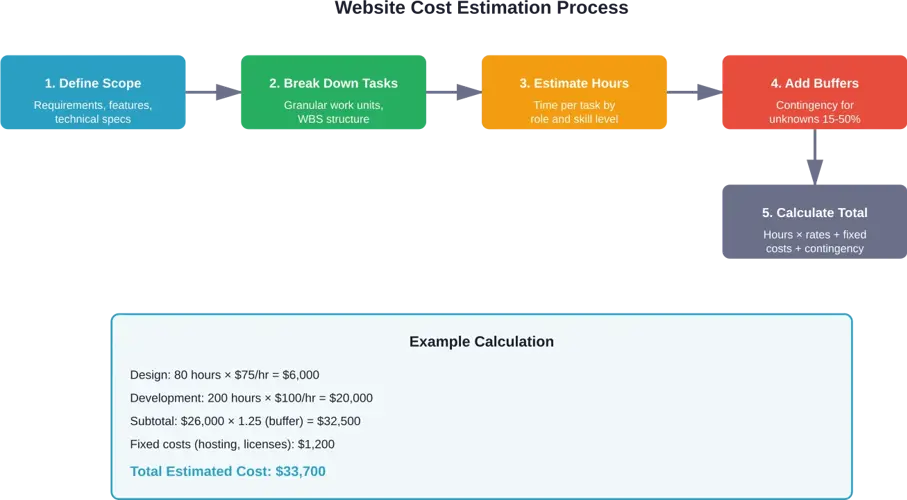
Define Project Scope Thoroughly
Accurate estimation starts with detailed scope definition. Vague requirements produce unreliable estimates. Create comprehensive documentation covering every page, feature, integration, and technical requirement.
Scope documents should specify functional requirements (what the system does), technical requirements (technologies and platforms), design requirements (visual standards and brand guidelines), and content requirements (who creates what content and when).
Break Down Work into Granular Tasks
Divide the project into the smallest reasonable work units. Instead of "build contact page," break it down: design contact form layout, implement form HTML/CSS, add form validation, create server-side processing, set up email delivery, add success/error messages, test across browsers.
This granular approach, often called Work Breakdown Structure (WBS), reveals hidden complexity and prevents underestimation. Tasks under 4 hours are probably detailed enough. Tasks over 40 hours need further breakdown.
Estimate Hours for Each Task
For each task, estimate the hours required by someone with appropriate skill level. Junior developers take longer than seniors, but cost less per hour. The calculation balances efficiency against hourly rates.
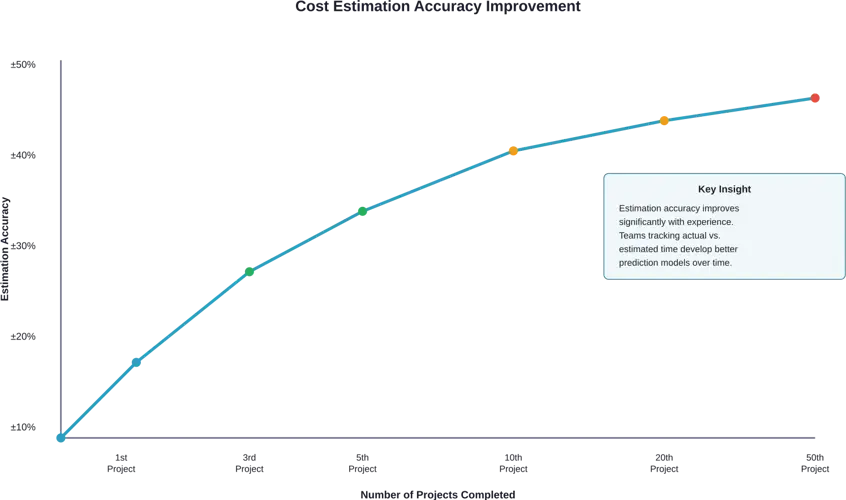
IEEE research on software development cost estimation emphasizes the importance of historical data. Teams that track actual time spent on tasks in previous projects produce increasingly accurate estimates over time. Without historical data, estimates often miss by 25-50%.
Apply Contingency Buffers
No project goes exactly as planned. Buffer time accounts for requirement changes, technical challenges, bug fixes, and revision rounds.
Industry practice suggests 15-25% contingency for well-defined projects with experienced teams, and 30-50% for projects with significant unknowns, new technologies, or changing requirements. Agile methodologies embrace this uncertainty by estimating in ranges rather than fixed numbers.
Calculate Total Costs
Multiply estimated hours by hourly rates for each team member or role. Sum these figures across all tasks and phases. Add contingency buffer. Then add fixed costs for hosting, domains, licenses, stock assets, and third-party services.
The formula looks like: Total Cost = (Sum of all task hours × corresponding hourly rates) × (1 + contingency percentage) + fixed costs.
Website Development Cost Estimation Tools and Calculators
Manual estimation works, but specialized tools speed up the process and reduce calculation errors. Several approaches exist, each with different strengths.
Online Cost Calculators
Free online calculators provide quick ballpark estimates by answering questions about project type, features, design complexity, and timeline. These tools work well for preliminary budgeting but lack the nuance of detailed estimation.
Limitations include oversimplification of complex requirements, inability to account for project-specific factors, and broad ranges that don't help with precise budgeting. Use calculators for initial conversations, not final proposals.
Estimation Templates and Spreadsheets
Spreadsheet templates provide structure while allowing customization. Teams can build templates that reflect their specific hourly rates, typical task durations, and common project patterns.
Effective templates include task breakdowns by phase, hourly rate variables for different roles, automatic subtotal and total calculations, contingency buffer settings, and comparison views for different scenarios. Templates improve with each project as teams refine their understanding of how long tasks actually take.
Project Management and Estimation Software
Dedicated project management platforms include estimation features that integrate with time tracking, enabling continuous improvement of estimation accuracy. These systems track estimated versus actual hours, revealing patterns in estimation bias.
Advanced tools use historical project data to suggest estimates for new tasks based on similarity to past work. This data-driven approach, referenced in IEEE research on software development cost estimation optimization, significantly improves accuracy over time.
AI-Assisted Estimation
Emerging AI tools analyze project requirements and historical data to generate cost estimates. These systems identify patterns across thousands of projects, suggesting estimates based on feature combinations and technical specifications.
But AI estimation tools require extensive training data and struggle with novel projects or unique requirements. They work best as a starting point that human expertise then refines rather than as definitive answers.
Hidden Costs That Impact Website Development Budgets
Initial development represents just part of total ownership costs. Several often-overlooked expenses affect the true investment required for a successful website.
Domain Registration and SSL Certificates
Domains cost $12-$50 annually depending on the extension and registrar. SSL certificates for secure HTTPS connections range from free (Let's Encrypt) to $200+ annually for extended validation certificates.
Premium domains or acquiring existing domains can cost thousands or even millions if they're particularly desirable. Budget for domain acquisition early if a specific name is required.
Hosting and Infrastructure
Shared hosting starts around $5-$15 monthly but limits performance and scalability. Virtual Private Servers (VPS) run $20-$100 monthly. Dedicated servers or cloud infrastructure for high-traffic sites costs $100-$1,000+ monthly.
Infrastructure costs scale with traffic and performance requirements. Sites expecting significant growth should budget for infrastructure upgrades or architect for cloud scalability from the start.
Security and Compliance
Security tools—firewalls, malware scanning, DDoS protection, backup systems—add $20-$500+ monthly depending on requirements. Sites handling sensitive data need additional security audits, penetration testing, and compliance certifications.
GDPR, CCPA, HIPAA, or PCI-DSS compliance introduces legal and technical requirements that increase both development and ongoing costs. Compliance isn't optional for sites subject to these regulations, making it a necessary budget item.
Ongoing Maintenance and Updates
Websites aren't static. They require regular updates for security patches, plugin updates, content changes, and feature additions. Maintenance typically costs 15-25% of initial development annually.
Neglecting maintenance creates security vulnerabilities, compatibility issues, and eventual site failures that cost more to fix than preventive maintenance would have cost. Budget for ongoing maintenance from day one.
Content Creation and Marketing
Building the website is step one. Filling it with quality content and driving traffic requires additional investment. Professional copywriting costs $50-$300 per page. Photography, video production, and ongoing content creation add thousands annually.
SEO optimization, paid advertising, email marketing, and social media promotion represent separate budget lines that determine whether the website actually achieves business goals. A $20,000 website with no marketing budget often performs worse than a $5,000 site backed by strategic promotion.
Common Mistakes in Website Development Cost Estimation
Even experienced teams make estimation errors. Recognizing common pitfalls helps avoid them.
Underestimating Revision Rounds
Most estimates assume stakeholders will approve work in 1-2 review cycles. Reality often involves 3-5 rounds as organizations refine their vision through seeing actual implementations.
Build revision expectations into estimates explicitly. Define how many rounds are included and what additional rounds cost. This prevents disputes when revision requests arrive.
Ignoring Content Preparation Time
Developers assume content will arrive ready for implementation. Clients assume developers will request content when needed. The gap between these assumptions creates delays and cost overruns.
Specify content delivery timelines, formats, and responsibilities in project scope. If developers are waiting for content, the project timeline extends and costs increase.
Overlooking Browser and Device Testing
Sites must work across dozens of browser versions, screen sizes, and operating systems. Thorough testing across this matrix takes significant time but often gets reduced to checking Chrome on one laptop.
Comprehensive quality assurance testing should consume 15-20% of development time. Cutting testing corners creates user experience problems and bug-fixing costs post-launch.
Forgetting About Deployment Complexity
Moving from development environment to production server involves DNS configuration, database migration, environment variables, SSL setup, and testing in production conditions. These steps take longer than expected, especially on first deployment.
Budget 5-10% of development time for deployment and launch activities, plus additional time for troubleshooting unexpected production environment issues.
Neglecting Project Management Overhead
Someone needs to coordinate tasks, communicate with stakeholders, track progress, manage changes, and resolve blockers. Project management consumes 10-15% of total project time but frequently gets excluded from estimates.
Include explicit project management hours in estimates, or factor PM overhead into hourly rates. Projects without adequate coordination take longer and cost more than well-managed ones.
Strategies to Reduce Website Development Costs Without Sacrificing Quality
Tight budgets don't automatically mean compromised quality. Strategic decisions can significantly reduce costs while maintaining professional standards.
Start with Minimum Viable Features
The Minimum Viable Product (MVP) approach launches with core functionality first, then adds features based on user feedback. This prevents over-building features nobody uses.
Prioritize features ruthlessly. What absolutely must exist at launch versus what can wait for phase two? Delaying nice-to-have features to post-launch can cut initial development costs by 30-50%.
Leverage Existing Themes and Templates
Starting with quality themes or templates reduces design and development time. Customization still creates unique branding while benefiting from tested, production-ready code.
Premium themes cost $50-$200 but include hundreds of hours of development work. Custom modifications to themes cost far less than building from scratch.
Use Established Platforms and Tools
WordPress, Shopify, Webflow, and similar platforms provide proven infrastructure. Building custom solutions only makes sense when specific requirements can't be met with existing platforms.
Platform limitations feel constraining but prevent reinventing solved problems. The time not spent building user authentication, content management, or payment processing systems gets redirected to business-specific features.
Clearly Define Scope Before Development Starts
Scope changes mid-project create the largest cost overruns. Every "small change" ripples through design, development, testing, and documentation.
Invest heavily in discovery and planning phases. The time spent clarifying requirements before coding begins prevents exponentially more time fixing misaligned implementations later.
Establish Fixed-Price Contracts for Defined Scope
Time-and-materials billing makes sense for exploratory projects, but fixed-price contracts work better when scope is well-defined. Fixed pricing incentivizes efficient development and provides budget certainty.
The trade-off is that fixed-price contracts require detailed specifications upfront and include change order processes for scope additions. Changes cost more under fixed-price models than time-and-materials, creating pressure to nail scope definition before signing.
Consider Hybrid Team Models
Mixing in-house staff with contractors, combining local project management with offshore development, or using specialized contractors for specific components can optimize cost versus quality.
Hybrid models require clear communication protocols and strong project management but enable accessing specialized skills without full-time hiring or paying premium rates for routine work.
Real-World Website Development Cost Examples
Abstract discussions become clearer with concrete examples. Here's what actual projects typically cost.
Small Business Informational Site
A local service business needs 8 pages—home, services, about, team, testimonials, blog, contact, privacy policy. The site uses WordPress with a customized premium theme, includes a contact form and appointment request form, and integrates with Google Analytics.
Discovery and planning: 10 hours. Design: 30 hours. Development: 50 hours. Content: 20 hours. Launch: 8 hours. At $75/hour average rate, total cost comes to $8,850 plus $500 in hosting, domain, and licenses. Final budget: approximately $9,350.
eCommerce Store with 50 Products
An online retail business selling specialty products needs product catalog with filtering, shopping cart, secure checkout, customer accounts, order management, email notifications, and basic shipping integration.
The project uses WooCommerce on WordPress with custom theme development. Discovery and planning: 20 hours. Design: 60 hours. Development: 120 hours. Product setup and content: 40 hours. Testing and launch: 20 hours. At $90/hour average, development costs $23,400. Add $2,000 for payment gateway setup, SSL, and first-year hosting. Total: approximately $25,400.
SaaS Application MVP
A software startup needs user registration and authentication, subscription management with Stripe, user dashboards with data visualization, RESTful API, and responsive design. Technology stack includes React frontend and Node.js backend.
Discovery and architecture: 40 hours. Design: 80 hours. Frontend development: 200 hours. Backend development: 250 hours. API development: 100 hours. Testing and deployment: 80 hours. At $125/hour average, development costs $93,750. Infrastructure setup, third-party services, and first six months of cloud hosting add $8,000. Total: approximately $101,750.
How to Choose Between Different Pricing Models
Development teams offer various pricing structures. Each model suits different project characteristics and risk tolerances.
Fixed-Price Projects
Fixed-price contracts specify total cost for defined deliverables. Clients get budget certainty. Developers assume risk that work takes longer than estimated.
This model works best when scope is clear, requirements are stable, and both parties agree on detailed specifications before work begins. Changes require formal change orders with additional costs.
Time and Materials
Hourly billing charges for actual time spent regardless of how long tasks take. Clients pay for exactly the work done. Developers don't risk underestimating complex tasks.
Time-and-materials suits exploratory projects, evolving requirements, or situations where full scope can't be defined upfront. The risk shifts to clients—projects might cost more than initial estimates if work takes longer than expected.
Retainer Arrangements
Monthly retainers provide guaranteed availability for a set number of hours. Organizations with ongoing development needs get dedicated attention without project-by-project negotiations.
Retainers work well for maintenance, continuous improvement, or organizations that release features regularly. Unused hours might roll over or expire depending on agreement terms.
Value-Based Pricing
Some developers price based on the business value delivered rather than hours worked. A website generating $500K in annual revenue might cost more than one generating $50K, even if development effort is similar.
Value-based pricing requires deep understanding of client business models and strong track records demonstrating ROI. It aligns developer and client interests but needs trust that pricing reflects fair value rather than maximizing fees.
|
Pricing Model |
Best For |
Client Risk |
Developer Risk
|
|---|---|---|---|
|
Fixed Price |
Well-defined scope, stable requirements |
Low (budget certainty) |
High (estimation accuracy crucial) |
|
Time & Materials |
Evolving scope, exploratory projects |
High (budget uncertainty) |
Low (paid for actual work) |
|
Retainer |
Ongoing work, continuous improvement |
Medium (predictable monthly cost) |
Low (guaranteed income) |
|
Value-Based |
High-ROI projects, strategic initiatives |
Medium (depends on value realization) |
Medium (depends on value demonstration) |
Evaluating Website Development Proposals and Quotes
Not all proposals deserve equal consideration. Evaluating competing bids requires looking beyond bottom-line numbers.
Understanding What's Included
Compare scope carefully. The lowest bid might exclude design, content creation, testing, training, or post-launch support that other proposals include.
Request detailed breakdowns showing what's included in each phase. Proposals should specify deliverables, not just general descriptions. "Responsive design" could mean anything from basic mobile compatibility to sophisticated progressive enhancement across device classes.
Assessing Team Experience and Portfolio
Review previous work similar to the proposed project. Experience with the industry, technology stack, and project scale matters more than total years in business.
Request references and actually contact them. Ask about communication quality, adherence to timelines and budgets, problem-solving when issues arose, and post-launch support quality.
Evaluating Technical Approach
How will the site be built? What technologies, platforms, and architecture are proposed? Does the technical approach align with maintenance capabilities and future growth plans?
A cutting-edge technology stack might be impressive but create maintenance challenges if the organization can't find developers familiar with it. Established technologies offer easier long-term support.
Clarifying Post-Launch Support
What happens after launch? How long is support included? What's covered—bugs only, or also training and minor changes? What do support and maintenance cost after included period expires?
Proposals should specify warranty periods (typically 30-90 days) covering bugs and issues, plus options for ongoing maintenance contracts.
Red Flags to Watch For
Prices significantly below market rate often indicate inexperience, offshoring to unknown teams, or missing scope items. Unrealistically short timelines suggest inadequate planning or overcommitment.
Proposals lacking detail about process, deliverables, or technical approach indicate teams that haven't thoroughly analyzed requirements. Reluctance to provide references or portfolio examples raises serious concerns.
Future Trends Affecting Website Development Costs
The web development landscape continuously evolves. Understanding emerging trends helps anticipate how costs might shift.
AI and No-Code Tools
AI-powered design tools and no-code platforms lower barriers to basic website creation. Tools like those discussed in the SBA's March 2026 webinar on building professional sites with platforms like Gamma enable creating sites without traditional coding.
These tools reduce costs for simple projects but don't eliminate need for developers on complex builds. The effect is bifurcation—very simple sites become cheaper while complex applications remain expensive.
Progressive Web Apps
PWAs blur lines between websites and native mobile apps, offering app-like experiences through browsers. Building one PWA instead of separate website and native apps reduces total development costs.
But PWAs require specific technical expertise and architecture decisions that traditional websites don't. Initial development might cost more while long-term maintenance costs decrease.
Jamstack Architecture
Jamstack separates frontend presentation from backend services, using static generation and APIs. This architecture improves performance and security while reducing hosting costs.
The trade-off involves higher initial development costs for the architectural setup, paid back through lower hosting expenses and easier scalability as traffic grows.
Enhanced Security Requirements
Privacy regulations and security threats drive increasing investment in security features. SSL is now baseline. Two-factor authentication, privacy consent management, data encryption, and regular security audits are becoming standard rather than optional.
Security features add 10-20% to development costs but prevent exponentially more expensive data breaches and regulatory penalties.
Accessibility Compliance
Web Content Accessibility Guidelines (WCAG) compliance evolves from nice-to-have to legal requirement in many jurisdictions. Accessible design and development requires additional consideration throughout the project.
Building accessibility in from the start costs 10-15% extra. Retrofitting accessibility into existing sites costs 2-3× that amount. Organizations should budget for accessibility as baseline requirement rather than optional feature.
Questions to Ask Development Teams Before Getting Estimates
The questions asked during vendor evaluation directly impact estimate quality and project success.
About Their Process
How do they handle requirements gathering? What's the design approval process? How do they manage changes during development? What project management methodology do they use?
Understanding process reveals whether the team works systematically or reactively. Structured processes correlate with predictable outcomes and accurate estimates.
About Communication
Who will be the primary contact? How often are status updates provided? What communication channels do they use? How quickly do they typically respond to questions?
Communication breakdowns create most project friction. Clear expectations about availability and responsiveness prevent frustration.
About Quality Assurance
What testing do they perform? Which browsers and devices do they test on? Do they have a formal QA process or does developer testing suffice? How are bugs tracked and resolved?
Quality assurance separates professional development from amateur work. Comprehensive testing should be explicitly included in estimates.
About Technology Decisions
Why are they recommending specific platforms or frameworks? What alternatives were considered? What are the long-term implications of technology choices? What happens if the team becomes unavailable—how maintainable is the codebase?
Technology decisions impact total cost of ownership for years. Teams should articulate reasoning, not just push familiar tools.
About Post-Launch
What training is provided? How long is warranty support included? What's covered versus not covered in that support? What do ongoing maintenance and hosting cost? How are emergency fixes handled?
The website's life extends far beyond launch day. Understanding post-launch support before signing contracts prevents unpleasant surprises.
Frequently Asked Questions About Website Development Costs
How much should a basic website cost?
A basic informational website with 5-10 pages typically costs between $1,000 and $5,000. This range assumes using a content management system like WordPress with a customized theme, basic functionality like contact forms, and professional design. DIY approaches using website builders can reduce this to $300-$1,500, though with less customization. The final cost depends on design complexity, content volume, and whether professional copywriting and photography are included.
What's the difference between design and development costs?
Design costs cover the visual appearance and user experience—creating layouts, selecting colors and typography, designing interfaces, and producing mockups. This typically represents 20-25% of project budgets. Development costs cover the technical implementation—writing code that makes the design functional, integrating databases, implementing features, and connecting third-party services. Development usually comprises 40-50% of budgets. Both are essential, but development generally requires more hours due to technical complexity and testing requirements.
How long does website development take?
Timelines vary dramatically by complexity. Simple sites take 2-4 weeks. Business websites with custom features require 4-12 weeks. eCommerce platforms need 8-16 weeks. Complex web applications span 3-12 months or longer. These timelines assume no major delays in content delivery, prompt feedback on designs, and reasonable scope stability. Projects with multiple stakeholders, complex approval processes, or evolving requirements typically take 50-100% longer than initial estimates.
Should I use a freelancer or agency for my website?
Freelancers offer lower hourly rates ($30-$100) but limited bandwidth and skill range. They work well for smaller projects with straightforward requirements. Agencies charge more ($75-$200+ per hour) but provide complete teams covering design, development, project management, and quality assurance. Agencies suit larger projects, complex functionality, or situations requiring diverse expertise. The decision hinges on project complexity, timeline flexibility, and budget constraints. Simple sites favor freelancers; complex projects need agency resources.
What ongoing costs should I budget for after launch?
Ongoing costs include hosting ($5-$500+ monthly depending on traffic and performance needs), domain renewal ($12-$50 annually), SSL certificates ($0-$200 annually), security and backup services ($20-$200 monthly), content updates (varies by frequency), and maintenance for software updates and bug fixes (typically 15-25% of initial development cost annually). Sites with heavy traffic, eCommerce functionality, or frequent content changes require higher ongoing budgets. Minimal sites might run $500-$1,000 annually; active business sites need $3,000-$10,000+ yearly.
How accurate are online website cost calculators?
Online calculators provide rough ballpark figures, typically accurate within ±30-50% for straightforward projects. They work by categorizing common project types and features, applying average market rates. However, they can't account for project-specific complexities, technical challenges, design customization levels, or integration requirements. Use calculators for initial budget conversations and reality checks, but don't treat their outputs as binding quotes. Accurate estimates require detailed scope discussions with actual development teams who understand specific requirements.
What factors increase website development costs the most?
Custom functionality adds costs faster than anything else—complex user systems, payment processing, real-time features, or custom integrations each add significant development hours. Design complexity and animation also substantially increase budgets. Geographic location of developers creates 3-5× cost variations. Third-party integrations multiply costs, especially with poorly documented or legacy systems. eCommerce functionality, multi-language support, and accessibility compliance each increase budgets by 20-40%. The combination of multiple complexity factors creates multiplicative rather than additive cost effects.
Making Your Website Development Budget Work Harder
Cost estimation isn't about finding the cheapest option. It's about understanding value and investing strategically in what matters most for business goals.
The websites that deliver best ROI typically don't have every possible feature or the most elaborate designs. They focus ruthlessly on core user needs and business objectives, execute those priorities exceptionally well, and plan for iterative improvement based on actual user behavior.
Start by defining what success looks like. Is the website generating leads? Selling products? Building brand awareness? Supporting customer service? Clear goals enable evaluating whether specific features justify their costs.
Prioritize features using a value-versus-effort matrix. Features delivering high business value with moderate development effort get built first. Low-value features requiring high effort get deferred indefinitely. This disciplined prioritization keeps projects on budget while maximizing impact.
Build relationships with development teams rather than treating every project as a one-time transaction. Teams familiar with the business, codebase, and goals work more efficiently. Ongoing relationships also smooth communication and create motivation for quality work that extends beyond individual project boundaries.
Track actual costs against estimates on every project. This data becomes invaluable for future planning. Organizations that systematically compare estimated versus actual costs improve estimation accuracy by 40-60% after just 3-5 projects, according to data synthesis research on Agile software cost estimation.
Taking Action on Website Development Estimation
Accurate cost estimation transforms website projects from unpredictable gambles into strategic investments. The difference between projects that deliver strong ROI and those that drain resources often traces back to how well costs were estimated and managed from the beginning.
Start estimation early, before committing to timelines or making promises to stakeholders. Involve technical experts in estimation—developers understand complexity better than project managers or business leaders. Use multiple estimation methods to triangulate reasonable ranges.
Document assumptions explicitly. Every estimate rests on assumptions about scope stability, resource availability, technical approaches, and stakeholder responsiveness. When assumptions prove wrong, estimates change—but documented assumptions make those changes understandable rather than appearing arbitrary.
Build contingency explicitly into budgets. Contingency isn't padding or waste—it's acknowledgment of inherent uncertainty in complex creative work. Projects without contingency either cut corners when challenges arise or exceed budgets. Neither outcome serves anyone well.
The SBA resources on website redesign best practices emphasize that websites remain incredibly popular destinations for site traffic and work harder online than almost any other business asset. This importance justifies investing in proper estimation and planning rather than rushing into development with vague budgets.
Ready to move forward with website development? Start by clearly defining the project scope, identifying the must-have features versus nice-to-haves, and getting detailed estimates from at least three qualified development teams. Compare not just bottom-line numbers but what's included, what's excluded, and how each team approaches the work.
Accurate estimation isn't magic—it's methodical analysis combined with realistic assessment of complexity and risk. Teams that estimate systematically, track actual versus estimated performance, and continuously refine their processes produce increasingly accurate budgets that enable confident decision-making and successful project outcomes.


