

Web Portal Development Cost 2026: Complete Breakdown

Summary: Web portal development costs typically range from $10,000 to $500,000 in 2026, depending on complexity, features, and team location. Basic portals start around $10,000-$40,000, mid-range solutions cost $40,000-$150,000, while enterprise-grade platforms exceed $150,000. Key cost drivers include portal type, feature scope, design complexity, technology stack, third-party integrations, and ongoing maintenance.
Planning a custom web portal can feel like staring into a financial black hole. Should the budget be $20,000 or $200,000?
The answer depends on dozens of interconnected factors—from the number of user roles to the complexity of third-party integrations. Here's the thing though: most businesses approach portal budgeting backward, focusing on total cost before understanding what drives those numbers.
This guide breaks down web portal development costs using real project data. Whether the goal is a simple client portal or an enterprise-grade solution with advanced automation, the following sections explain exactly where the money goes and how to plan accordingly.
What Is a Web Portal and Why Does It Matter?
A web portal is a private, secure gateway that delivers personalized content and functionality to specific user groups. Unlike public websites that serve information to anyone, portals authenticate users and provide role-based access to tools, documents, and services.
Think customer self-service hubs, employee intranets, vendor management systems, or partner collaboration platforms. These aren't just websites with login pages—they're sophisticated applications that connect to databases, integrate with existing business systems, and automate workflows.
The value proposition is straightforward. Portals reduce support workloads by enabling self-service. Research shows that businesses with customer portals often report around 63% reduction in customer service tasks (per WeWeb portal development guide). They centralize scattered information, eliminate manual data entry, and create transparent communication channels.
Web Portal Development Cost by Complexity Level
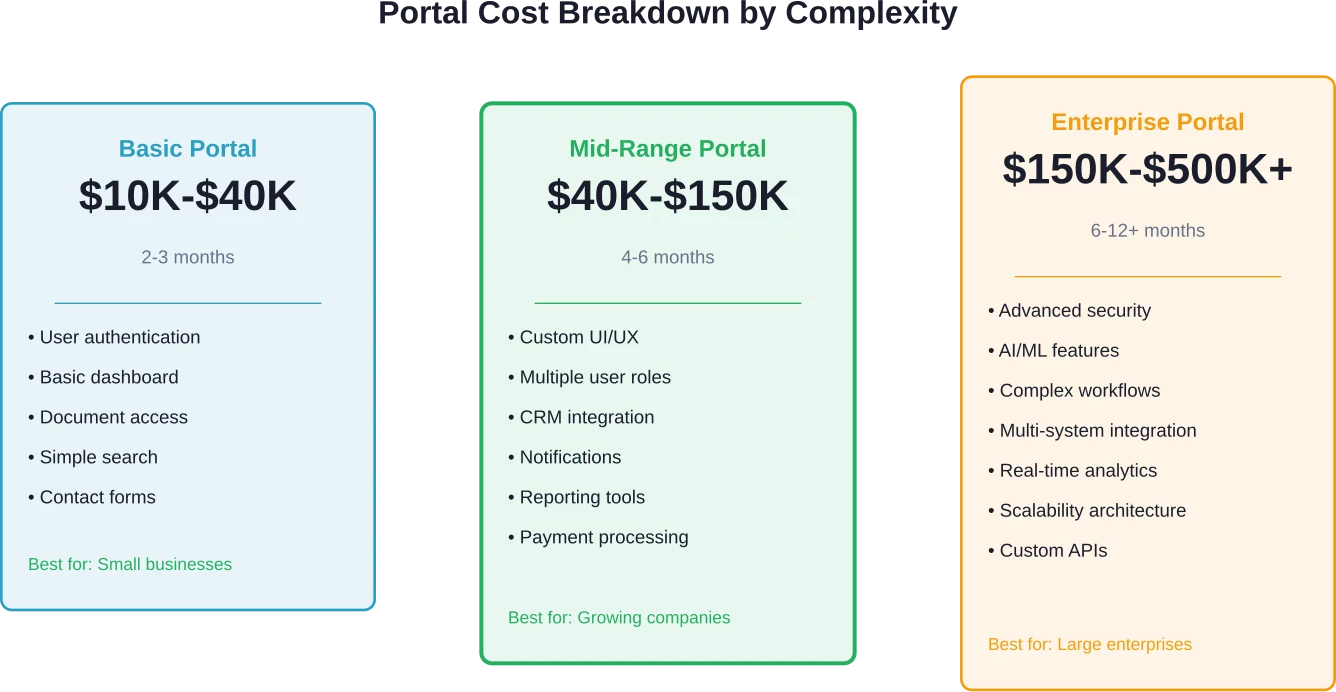
Portal costs vary dramatically based on functionality scope and technical requirements. The following breakdown reflects current market rates for different complexity tiers.
|
Complexity Level |
Cost Range |
Timeline |
Typical Features |
|---|---|---|---|
|
Basic Portal |
$10,000 - $40,000 |
2-3 months |
User authentication, basic dashboard, document access, simple search, contact forms |
|
Mid-Range Portal |
$40,000 - $150,000 |
4-6 months |
Custom UI/UX, multiple user roles, CRM integration, notifications, reporting, payment processing |
|
Enterprise Portal |
$150,000 - $500,000+ |
6-12+ months |
Advanced security, AI/ML features, complex workflows, multi-system integration, real-time analytics, scalability architecture |
Basic portals handle straightforward use cases with limited functionality. They're built on standard templates with minimal customization. Perfect for small businesses needing simple client access to documents or basic project updates.
Mid-range solutions offer significant customization. These portals connect to existing business systems, support complex user hierarchies, and include branded design work. Most growing companies find themselves in this range.
Enterprise-grade platforms serve thousands of users with mission-critical operations. They require robust security frameworks, sophisticated data architecture, and extensive integration work. Expect substantial ongoing maintenance costs as well.
7 Critical Factors That Determine Portal Development Cost
Understanding cost drivers helps with realistic budget planning. These seven factors account for most price variation between portal projects.
1. Portal Type and Purpose
Different portal categories serve distinct purposes and come with different price tags. Customer portals let clients access account information, submit support tickets, and manage subscriptions. These typically fall in the $30,000-$100,000 range depending on integration requirements.
Client portals (common in B2B services) share project files, facilitate collaboration, and track deliverables. Legal firms, agencies, and consultancies rely on these heavily. Cost range: $25,000-$120,000.
Employee portals centralize HR resources, company documents, time tracking, and internal communications. They often integrate with existing HR systems and payroll platforms. Expect $40,000-$200,000+ for comprehensive solutions.
Vendor portals manage supplier relationships, purchase orders, inventory data, and compliance documentation. These require robust security and complex data synchronization. Budget $50,000-$250,000.
Partner portals enable channel partners to access marketing materials, sales tools, lead management, and training resources. These demand sophisticated permission systems and often include e-commerce functionality. Cost: $60,000-$300,000.
2. Feature Scope and Functionality
Each feature adds development time and cost. User authentication and role-based access control form the foundation—budget $3,000-$8,000 for basic implementation, more for advanced security like two-factor authentication or single sign-on integration.
Document management systems with version control, search, and permission settings add $5,000-$15,000. Advanced search with filters and full-text indexing costs another $4,000-$10,000.
Dashboard customization allowing users to personalize their view runs $8,000-$20,000. Real-time notifications via email, SMS, or in-app alerts add $3,000-$8,000.
Payment processing integration with gateways like Stripe or PayPal costs $5,000-$12,000. Reporting and analytics features range from $6,000 for basic reports to $30,000+ for advanced business intelligence dashboards.
Communication tools like messaging, forums, or video chat add $10,000-$40,000 depending on complexity. Workflow automation and approval processes run $15,000-$50,000 for sophisticated implementations.
3. Design Requirements and User Experience
Design work typically consumes 20-25% of the development budget. Template-based designs using existing UI kits cost $5,000-$15,000. These work fine for straightforward portals where branding isn't critical.
Custom design with branded elements, original illustrations, and tailored user flows runs $15,000-$50,000. This includes user research, wireframing, mockups, and multiple revision rounds.
Enterprise-grade design systems with comprehensive component libraries, accessibility compliance, and extensive user testing can exceed $75,000. These make sense for large organizations needing consistent design language across multiple applications.
Responsive design ensuring proper function across devices is now standard but adds complexity. Mobile-first approaches or dedicated mobile apps increase costs by 30-50%.
4. Technology Stack Selection
The chosen technology stack significantly impacts development costs. Content management systems like WordPress offer cost-effective starting points. WordPress powers about 40% of all websites and provides balance between functionality and cost-effectiveness (per industry sources). Portal development on WordPress typically costs $15,000-$60,000.
Custom builds using modern frameworks like React, Angular, or Vue.js for frontend, paired with Node.js, Python/Django, or Ruby on Rails for backend, offer more flexibility but cost more. Expect $50,000-$200,000+ depending on requirements.
Enterprise platforms like SharePoint or Liferay provide extensive built-in features but require specialized expertise. Licensing fees add to development costs. Total investment: $100,000-$500,000+.
Low-code platforms can reduce development time by 40-60% but may limit customization options. These work well for standardized use cases. Cost: $20,000-$80,000.
5. Development Team Composition and Location
Team structure directly affects costs. A minimal team includes a project manager, UI/UX designer, frontend developer, backend developer, and QA tester. Larger projects add database architects, DevOps engineers, and security specialists.
Geographic location creates substantial cost differences. According to the U.S. Bureau of Labor Statistics, the 2024 median pay for computer programmers in the United States is $98,670 per year. Software developers command higher rates at $133,080 annually.
Hourly rates vary dramatically by region:
|
Region |
Hourly Rate Range |
Quality Level |
Communication |
|---|---|---|---|
|
North America |
$100 - $250/hour |
High |
Excellent |
|
Western Europe |
$80 - $180/hour |
High |
Excellent |
|
Eastern Europe |
$40 - $100/hour |
High |
Very Good |
|
Latin America |
$35 - $85/hour |
Medium-High |
Good |
|
Asia (India, Philippines) |
$25 - $65/hour |
Medium-High |
Good |
In-house development provides maximum control but comes with overhead—salaries, benefits, office space, equipment, and management time. Outsourcing to agencies or freelancers reduces administrative burden but requires clear specifications and project management.
6. Third-Party Integrations
Modern portals rarely operate in isolation. Integration with existing systems forms a significant cost component. Each integration requires API development, data mapping, authentication setup, error handling, and testing.
Simple integrations with well-documented APIs (Stripe, Mailchimp, Google Analytics) cost $2,000-$5,000 each. Complex integrations with legacy systems, custom APIs, or data transformation requirements run $8,000-$25,000 per system.
Common integration needs include CRM systems (Salesforce, HubSpot), ERP platforms (SAP, Oracle), accounting software (QuickBooks, Xero), marketing automation tools, and inventory management systems.
Real-time synchronization costs more than periodic batch updates. Bidirectional data flow (portal and system both update each other) adds complexity compared to one-way integration.
7. Security and Compliance Requirements
Security implementation ranges from basic to military-grade depending on industry and data sensitivity. Standard security (SSL certificates, encrypted passwords, basic authentication) is included in most quotes.
Enhanced security features add costs: penetration testing ($5,000-$20,000), security audits ($10,000-$40,000), advanced encryption methods ($8,000-$25,000), and intrusion detection systems ($10,000-$30,000).
Regulatory compliance drives significant expenses. GDPR compliance for European users requires specific data handling, storage, and deletion capabilities—add $15,000-$50,000. HIPAA compliance for healthcare portals demands extensive security controls and documentation, adding $30,000-$100,000+.
PCI DSS compliance for payment card processing, SOC 2 certification for service providers, and industry-specific regulations all increase development scope and cost.

Estimate Your Web Portal Development Cost
Web portal cost depends on user types, access control, integrations, and content management logic. OSKI Solutions reviews functional requirements and technical stack before calculating development effort. The estimate reflects actual portal architecture and deployment needs. This reduces uncertainty before development begins.
Ready to Plan Your Web Portal Budget?
Talk with OSKI Solutions to:
- define portal structure and user roles
- estimate backend and integration effort
- receive a structured portal cost breakdown
👉 Request a web portal development quote from OSKI Solutions.
Build Powerful Web Portals
We develop secure and scalable web portals that centralize data, streamline workflows, and enhance user experience.
Hidden Costs in Web Portal Development
Initial development represents just part of the total investment. Several less obvious costs catch businesses off guard.
Content migration from existing systems to the new portal takes time. Simple data imports might cost $2,000-$5,000, while complex migrations with data cleaning and transformation run $10,000-$40,000.
User training ensures adoption. Budget for documentation creation, video tutorials, and training sessions—typically $3,000-$15,000 depending on user base size and complexity.
Performance optimization and load testing become critical for portals expecting significant traffic. These services cost $5,000-$20,000 but prevent expensive downtime and poor user experience.
Third-party service subscriptions add up. Cloud hosting, email services, SMS notifications, backup solutions, monitoring tools, and API usage fees can total $200-$2,000+ monthly.
Legal review for terms of service, privacy policies, and compliance documentation costs $2,000-$10,000 depending on jurisdiction and complexity.
Frontend vs Backend: Where the Budget Goes
Understanding the frontend-backend split helps with priority decisions during budget constraints.
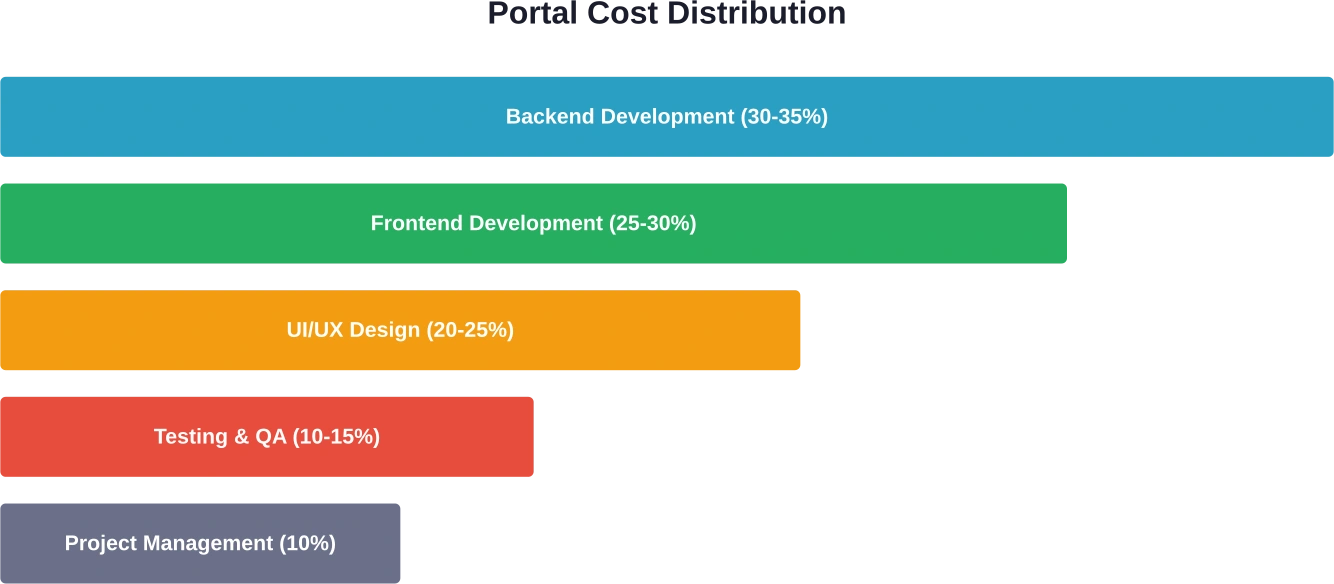
Backend development typically consumes 30-35% of the budget. This includes server setup, database architecture, API development, business logic implementation, authentication systems, and integration work. Backend complexity scales with data volume, user concurrency, and system integrations.
Backend costs remain relatively hidden to end users but determine portal reliability, speed, and scalability. Cutting corners here creates technical debt that becomes expensive to fix later.
Frontend development takes 25-30% of the budget. This covers the user interface, client-side logic, responsive design implementation, animations, and form handling. Frontend work is highly visible—users judge portal quality primarily on frontend execution.
The remaining budget divides between design (20-25%), testing and QA (10-15%), and project management (10%). This distribution shifts based on project specifics. Data-heavy portals with minimal UI skew toward backend, while consumer-facing portals with rich interactions lean frontend.
Custom Development vs SaaS vs Open Source
Three main approaches exist for portal creation, each with distinct cost profiles.
Custom development builds the portal from scratch to exact specifications. This offers maximum flexibility and complete control over features, design, and data. Initial costs are highest—$40,000-$500,000+—but long-term ownership costs can be lower with no subscription fees. Best for unique requirements that off-the-shelf solutions can't meet.
SaaS (Software-as-a-Service) platforms provide ready-made portal solutions with monthly or annual subscriptions. Setup costs range from $5,000-$50,000 for configuration, customization, and data import. Monthly fees typically run $100-$5,000+ depending on users and features. Total 3-year cost often exceeds custom development. Best for standard use cases needing quick deployment.
Open-source platforms like WordPress, Drupal, or Joomla offer middle ground. The core software is free, but customization, hosting, security, and maintenance require investment. Total cost: $15,000-$150,000 depending on customization level. Best for budget-conscious projects with some technical flexibility.
|
Approach |
Initial Cost |
Ongoing Costs |
Flexibility |
Best For |
|---|---|---|---|---|
|
Custom Development |
$40,000-$500,000+ |
$15,000-$80,000/year |
Complete |
Unique requirements, long-term ownership |
|
SaaS Platform |
$5,000-$50,000 |
$3,000-$60,000+/year |
Limited |
Standard needs, quick launch, predictable costs |
|
Open Source |
$15,000-$150,000 |
$8,000-$40,000/year |
Moderate |
Budget constraints, standard features |
Post-Launch Costs: Maintenance and Updates
Launch day isn't the finish line. Ongoing costs keep portals secure, functional, and relevant.
Hosting infrastructure costs vary by portal size and traffic. Shared hosting for small portals runs $20-$100/month. VPS (Virtual Private Server) for medium portals costs $100-$500/month. Dedicated or cloud infrastructure for enterprise portals ranges from $500-$5,000+/month.
Maintenance contracts typically cost 15-25% of initial development cost annually. A $100,000 portal requires $15,000-$25,000/year for maintenance. This covers bug fixes, security patches, server monitoring, backup management, and technical support.
Feature updates and enhancements run separately. Minor updates (UI tweaks, new fields) cost $2,000-$8,000. Major features (new modules, integrations) cost $10,000-$50,000+ depending on complexity.
Security is an ongoing expense. SSL certificate renewals ($50-$500/year), security monitoring tools ($100-$1,000/month), and annual security audits ($5,000-$20,000) protect against evolving threats.
Content updates depend on whether internal staff or external developers handle changes. Budget $1,000-$5,000/month for regular content management if outsourcing.
8 Ways to Reduce Web Portal Development Cost
Strategic planning can significantly reduce costs without sacrificing quality.
Start with an MVP (Minimum Viable Product) approach. Launch with core features only, validate with users, then add functionality based on actual usage patterns. This prevents spending on features that seem important but go unused.
Use proven technology stacks rather than cutting-edge frameworks. Mature technologies have better documentation, more developers, and fewer unexpected issues. This reduces development time and troubleshooting costs.
Leverage existing UI component libraries and design systems. Starting with Material UI, Bootstrap, or Ant Design cuts design time by 30-40% compared to designing every element from scratch.
Prioritize integrations carefully. Connect only systems that genuinely need real-time synchronization. Periodic batch updates or manual data transfer might suffice for less critical systems.
Consider phased rollout to specific user groups rather than launching to everyone simultaneously. This spreads costs across multiple budget cycles and allows course correction based on early feedback.
Reuse existing infrastructure where possible. Building on current hosting, using existing authentication systems, or extending current databases reduces setup and integration costs.
Create detailed requirements documentation before development starts. Vague requirements lead to scope creep, rework, and budget overruns. Investing $5,000-$15,000 in thorough planning saves $20,000-$60,000 in development waste.
Balance team composition between senior and mid-level developers. Not every task requires senior expertise. Appropriate skill matching reduces hourly costs by 25-35%.
How Industry Affects Portal Development Cost
Certain industries face higher portal development costs due to specific requirements.
Healthcare portals need HIPAA compliance, patient privacy protections, integration with electronic health records (EHR), and robust security. These requirements add 40-60% to baseline costs. Expect $80,000-$400,000 for healthcare portal development.
Financial services require PCI DSS compliance for payment processing, SOC 2 certification, advanced fraud detection, and audit trails. Regulatory overhead adds 30-50% to costs. Budget $70,000-$350,000.
Education portals often need learning management system (LMS) functionality, grade tracking, assignment submission, video content delivery, and accessibility compliance. Costs range from $40,000-$200,000 depending on institution size.
E-commerce portals with product catalogs, shopping carts, inventory management, and payment processing cost $50,000-$300,000 based on catalog size and feature complexity.
Manufacturing and logistics portals managing supply chains, vendor relationships, and inventory tracking require extensive integration work. Expect $60,000-$350,000.
Questions to Ask Before Starting Portal Development
These questions clarify requirements and prevent costly assumptions.
What problem does this portal solve? Be specific. "Improve communication" is vague. "Reduce client email inquiries by 50% through self-service document access" is actionable.
Who are the primary users and what are their technical capabilities? Portal complexity should match user sophistication. Overly complex interfaces for non-technical users guarantee poor adoption.
Which systems must the portal integrate with? List every system, database, or tool that needs connection. Research API availability and documentation quality—poor APIs double integration costs.
What data does the portal need to store and process? Data volume, sensitivity, and regulatory requirements drive architecture decisions and costs.
What's the expected user load at launch and in 12-24 months? Scalability planning prevents expensive rebuilds when traffic exceeds capacity.
Who will maintain the portal after launch? Internal team handoff requires training and documentation. Ongoing vendor relationships need clear service level agreements.
What's the success metric? Define measurable goals—time saved, support tickets reduced, revenue generated. This justifies investment and guides feature prioritization.
Portal Development Timeline: What to Expect
Development duration directly impacts costs through team time allocation.
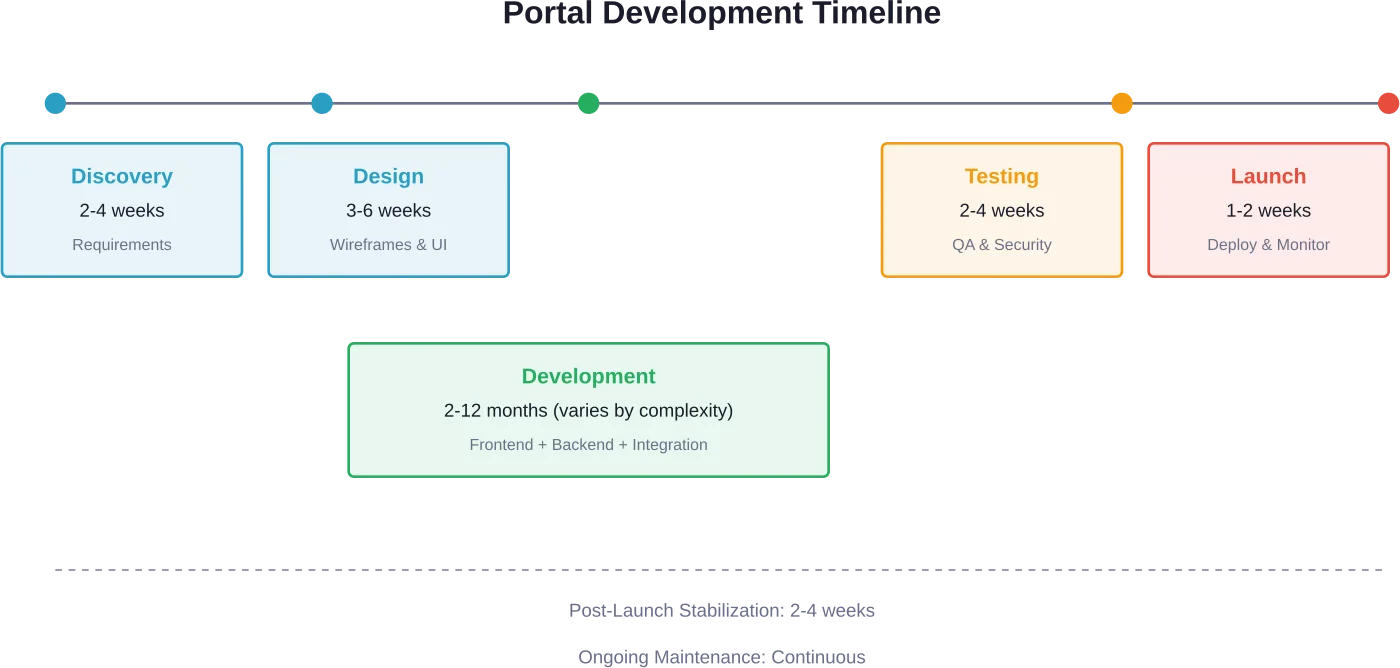
Discovery and planning (2-4 weeks) includes requirements gathering, user research, competitive analysis, technical architecture planning, and project roadmap creation. Rushing this phase causes expensive mid-project changes.
Design phase (3-6 weeks) produces wireframes, mockups, design systems, and interactive prototypes. Multiple stakeholders and revision rounds extend timelines.
Development sprint structure varies but typically runs in 2-week cycles. Basic portals need 4-6 sprints (2-3 months), mid-range portals require 8-12 sprints (4-6 months), and enterprise portals demand 12-24+ sprints (6-12 months).
Testing and QA (2-4 weeks) runs partially concurrent with development but intensifies pre-launch. This includes functional testing, security testing, performance testing, and user acceptance testing.
Deployment and launch (1-2 weeks) involves final server configuration, data migration, DNS updates, and monitoring setup.
Post-launch stabilization (2-4 weeks) addresses bugs discovered in production, monitors performance, and implements quick fixes.
Compressed timelines increase costs. Rushing development requires larger teams or overtime work, both expensive. A realistic timeline with buffer for unexpected issues actually reduces total cost.
ROI Considerations for Web Portal Investment
Portal development represents significant investment. Understanding return helps justify the expense.
Labor cost reduction forms the most immediate ROI. Portals automate tasks that previously required manual staff time. Calculate hourly cost of staff handling requests, multiply by hours saved monthly, project annually. A portal saving 100 staff hours monthly at $40/hour generates $48,000 annual savings—justifying a $100,000 portal in roughly two years.
Support ticket reduction translates to measurable savings. Research indicates customer portals can reduce service tasks by around 63%. Track current support costs, apply realistic reduction percentage, calculate annual savings.
Revenue impact varies by portal type. E-commerce portals generate direct revenue. Partner portals enable channel sales growth. Customer portals improve retention, increasing customer lifetime value. Quantify these carefully—overly optimistic projections undermine credibility.
Productivity improvements are harder to measure but significant. Time employees spend searching for information, waiting for approvals, or duplicating data entry adds up. Even 5% productivity improvement across 50 employees generates substantial value.
Risk reduction through better security, compliance automation, and audit trails has monetary value. Calculate potential cost of data breach, regulatory fine, or compliance failure. Portals mitigating these risks provide insurance value.
Common Portal Development Mistakes That Inflate Costs
Avoiding these pitfalls keeps projects on budget.
Building features for potential future users rather than current needs wastes resources. That hypothetical enterprise customer might never materialize. Build for actual requirements, scale when needed.
Skipping proper requirements documentation causes endless change orders. Each change disrupts development flow, requires rework, and extends timeline. The $10,000 saved on planning analysis costs $40,000 in development chaos.
Choosing technology based on trends rather than project needs creates problems. That cutting-edge framework might be exciting but lacks mature libraries, clear documentation, and experienced developers. Stick with proven technology unless compelling reasons exist otherwise.
Underestimating integration complexity is extremely common. "We just need to pull data from our CRM" sounds simple until discovering the CRM has incomplete API documentation, rate limits, and requires complex authentication. Thoroughly research integration requirements early.
Ignoring scalability until traffic overwhelms the system requires expensive emergency refactoring. Planning for growth costs 15-20% more initially but prevents 200-300% costs later when rebuilding under pressure.
Poor mobile experience kills adoption. Over 50% of web traffic comes from mobile devices. Portals that work poorly on phones frustrate users and fail regardless of desktop quality. Mobile must be first-class, not afterthought.
Frequently Asked Questions
How much does a basic web portal cost in 2026?
Basic web portals with standard features like user authentication, document access, and simple dashboards typically cost between $10,000 and $40,000. This assumes using template-based design, proven technology stacks, and straightforward functionality without complex integrations. Development timeline runs 2-3 months. Ongoing maintenance adds $3,000-$8,000 annually.
What's the difference between a website and a web portal?
Websites deliver public information to any visitor, while web portals provide authenticated access to personalized content and functionality for specific user groups. Portals include user accounts, role-based permissions, private data, and often integrate with backend systems. A company website explains services; a client portal lets customers access their account, submit support tickets, and download invoices.
How long does web portal development take?
Development timelines vary by complexity. Basic portals require 2-3 months, mid-range solutions take 4-6 months, and enterprise-grade platforms need 6-12+ months. This includes discovery, design, development, testing, and deployment phases. Compressed timelines increase costs through larger teams or overtime work. Budget 2-4 weeks post-launch for stabilization and bug fixes.
Should we build a custom portal or use a SaaS solution?
Custom development makes sense for unique requirements, long-term ownership goals, or specific integrations that SaaS platforms can't support. Initial costs are higher ($40,000-$500,000+) but no ongoing subscription fees. SaaS platforms work well for standard use cases, quick deployment needs, and predictable subscription budgets. 3-year total cost often exceeds custom development but offers faster launch and lower upfront investment.
What are typical ongoing maintenance costs for web portals?
Annual maintenance typically costs 15-25% of initial development investment. A $100,000 portal requires $15,000-$25,000 yearly for hosting, security patches, bug fixes, backups, and technical support. Add $200-$2,000 monthly for third-party services like cloud hosting, email, monitoring tools, and API usage. Major feature updates and enhancements run separately, costing $10,000-$50,000+ per significant addition.
How do we ensure our portal development stays on budget?
Start with detailed requirements documentation before development begins. Use MVP (Minimum Viable Product) approach, launching with core features then adding based on user feedback. Choose proven technology stacks rather than experimental frameworks. Get fixed-price quotes with clear scope definitions and change order processes. Build in 10-15% contingency budget for unexpected issues. Monitor project progress weekly and address scope creep immediately.
What features drive web portal costs the most?
Complex integrations with existing business systems create the highest costs, running $8,000-$25,000 per system for sophisticated implementations. Advanced security and compliance requirements (HIPAA, PCI DSS) add $30,000-$100,000+. Custom workflow automation and approval processes cost $15,000-$50,000. Real-time analytics and business intelligence dashboards range from $15,000-$60,000. Mobile app development alongside web portal adds 40-60% to total costs.
Planning Your Portal Development Budget
Web portal development costs reflect project complexity, feature scope, and team expertise. Most projects fall between $10,000 for basic solutions and $500,000+ for enterprise platforms.
The key is matching investment to actual business needs. Start with core functionality that solves specific problems, measure results, then expand based on demonstrated value. A $50,000 portal that users actually adopt delivers better ROI than a $200,000 platform that sits unused.
Successful portal projects begin with clear requirements documentation. They choose appropriate technology stacks rather than trendy frameworks. They plan for integration complexity, security needs, and scalability from day one. They budget for ongoing maintenance, not just initial development.
According to the U.S. Bureau of Labor Statistics, employment in computer and information technology occupations is projected to grow much faster than average from 2024 to 2034, with about 317,700 openings projected each year (U.S. Bureau of Labor Statistics). This growing demand for technology talent affects development costs but also signals expanding opportunities for digital transformation through portals.
The question isn't whether portal investment makes sense—for most businesses, it clearly does. The question is how to structure that investment for maximum return. Start with MVP, validate with users, scale based on data. This approach controls costs while building toward comprehensive solutions that truly serve business goals.
Ready to start planning a web portal? Begin with detailed requirements gathering, research integration needs thoroughly, get quotes from multiple development teams, and build that 15% contingency into the budget. The investment pays dividends through reduced support costs, improved productivity, and better customer experiences.


