

Web Application Development Cost Estimation for 2026

Executive Summary: Web application development costs in 2026 typically range from $20,000 for simple apps to over $500,000 for complex enterprise platforms. The final price depends on app complexity, team location, feature scope, tech stack, and development approach. Understanding cost drivers and estimation models helps businesses budget accurately and avoid the unexpected expenses that cause 55% of tech projects to fail.
Budgeting for a web application is one of those tasks that keeps founders and executives up at night. The numbers thrown around online vary wildly—$10,000 here, $500,000 there—and nobody seems to agree on what's actually reasonable.
Here's the thing though: web application development costs aren't arbitrary. They're shaped by specific, measurable factors that you can understand and control. And in 2026, with the web development services market expected to reach roughly USD 80.6 billion, understanding these cost drivers has never been more critical.
This guide breaks down exactly what influences web application development cost, what you should expect to pay based on your project scope, and how to estimate accurately without getting blindsided by hidden expenses halfway through development.
Understanding Web Application Development Cost Ranges
The cost to build a web application varies dramatically based on complexity, features, and technical requirements. But there are recognizable patterns across different project types.
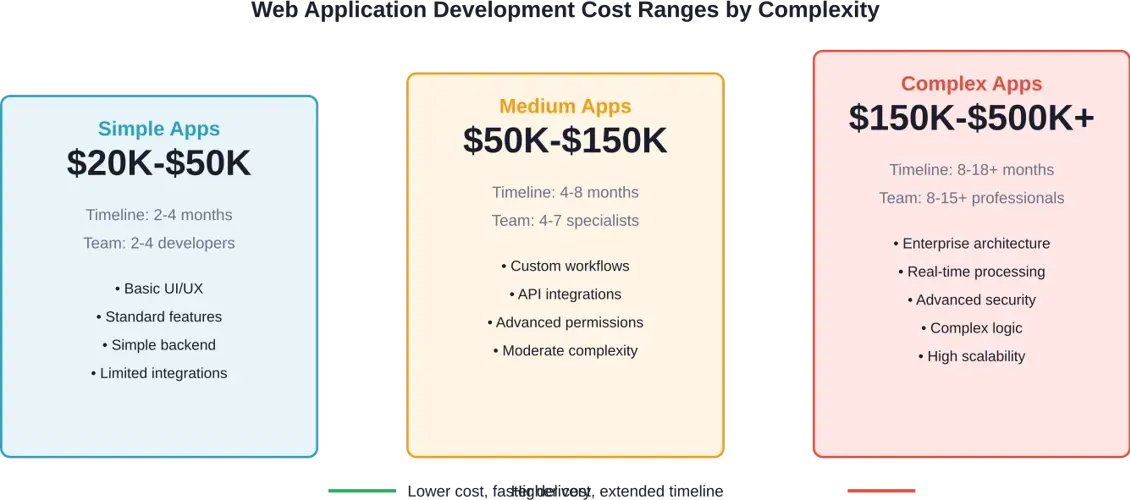
According to industry data, web application development costs can range from $20,000 to over $500,000, depending on app complexity, team composition, and feature scope. That's a massive range, which is why understanding where your project fits is essential before you start conversations with development teams.
Simple Web Applications
Simple web apps with basic functionality typically cost between $20,000 and $50,000. These projects involve straightforward user interfaces, limited backend complexity, and standard features like user authentication, basic CRUD operations, and simple data visualization.
Think of booking systems with limited customization, simple inventory management tools, or basic customer portals. The development timeline usually spans 2-4 months with a small team of 2-4 developers.
Medium Complexity Applications
Mid-range web applications with moderate feature sets and integrations fall between $50,000 and $150,000. These projects include custom workflows, third-party API integrations, advanced user roles and permissions, and more sophisticated data processing.
Examples include customer relationship management (CRM) systems, learning management platforms (LMS), or marketplace applications with payment processing. Development typically requires 4-8 months with a team of 4-7 specialists.
Complex Enterprise Applications
Enterprise-grade applications with advanced functionality, extensive integrations, and high scalability requirements start at $150,000 and often exceed $500,000. These projects demand sophisticated architecture, real-time data processing, advanced security measures, and complex business logic.
Financial platforms, healthcare management systems, or supply chain coordination tools fall into this category. Development timelines extend 8-18 months or longer with teams of 8-15+ professionals.

Estimate Your Web Application Budget Accurately
If you need a reliable web application cost estimate and an experienced delivery team, OSKI Solutions can help. The company builds scalable web platforms with complex backend logic and third party integrations. Their specialists analyze user roles, infrastructure needs, and feature scope before calculating development effort. This ensures your web application budget reflects real technical requirements.
Ready to Plan Your Web Application Budget?
Talk with OSKI Solutions to:
- define core features and user flows
- estimate backend and integration complexity
- prepare a structured web application cost breakdown
👉 Request a web app development estimate from OSKI Solutions.
Build Scalable Web Applications
We design and develop secure, high-performance web applications tailored to your business processes and growth strategy.
Key Factors That Determine Web Application Development Cost
Understanding what drives costs up or down gives you leverage during planning and vendor negotiations. These factors interact in complex ways, but each one significantly impacts the final budget.
Application Type and Architecture
The architectural approach fundamentally affects development cost. Multi-Page Applications (MPAs) suit eCommerce, education portals, and content-heavy platforms. Typical MPA development budgets range from $40,000 to $150,000+ depending on the number of pages, integrations, and complexity of user flows.
Single-Page Applications (SPAs) load a single HTML page and dynamically update content as users interact with the app. SPAs provide smoother user experiences but require more sophisticated frontend architecture. Development costs typically range from $30,000 to $120,000+.
Progressive Web Apps (PWAs) combine the best of web and mobile apps, offering offline functionality, push notifications, and native-like experiences. Because they require additional service worker implementation and offline data strategies, PWAs generally cost between $50,000 and $200,000+.
Feature Complexity and Scope
Every feature adds development time, testing requirements, and maintenance overhead. Basic features like user authentication, profile management, and simple forms are relatively straightforward. But once you add real-time collaboration, advanced search with filters, payment processing, or multi-language support, costs escalate quickly.
Real talk: feature creep is one of the biggest budget killers. Teams start with a defined scope, then incrementally add "just one more small thing" until the project balloons 40% beyond initial estimates.
Design Requirements
Design work typically accounts for 15-20% of total development cost. Simple, template-based designs minimize expense, while custom UI/UX design with detailed user research, prototyping, and multiple revision rounds significantly increases investment.
Custom animations, micro-interactions, and brand-specific design systems add polish but require additional design and development effort. The question isn't whether good design matters—it does—but rather how much customization your project genuinely requires versus what feels nice to have.
Technology Stack Selection
The technologies chosen for frontend, backend, and infrastructure influence both development cost and long-term maintenance expenses. Popular stacks like React with Node.js or Vue.js with Python Django have large developer pools, which can moderate costs.
Specialized or cutting-edge technologies might offer performance advantages but come with higher developer rates and longer development times due to smaller talent pools. Legacy systems requiring integration with older technologies can also increase complexity and cost.
Third-Party Integrations
Most modern web applications don't exist in isolation. Payment gateways, CRM systems, marketing automation platforms, analytics tools, and cloud storage services all require integration work.
Simple REST API integrations might add $2,000-$5,000 per service. Complex integrations involving custom data transformations, real-time synchronization, or working with poorly documented APIs can cost $10,000-$30,000 or more per integration.
Development Team Location and Structure
Team location creates dramatic cost variations. According to available data, hourly rates vary significantly by region:
|
Role |
In-house USA |
Outsource Eastern Europe/Asia |
Freelance
|
|---|---|---|---|
|
Front-end Developer |
$41/hour |
$20-$45/hour |
$15-$35/hour |
|
Back-end Developer |
$58/hour |
$20-$60/hour |
$20-$40/hour |
|
UI/UX Designer |
$45-$65/hour |
$20-$50/hour |
$20-$40/hour |
|
Project Manager |
$60-$80/hour |
$25-$55/hour |
$25-$45/hour |
|
QA Engineer |
$40-$55/hour |
$18-$40/hour |
$15-$30/hour |
The Bureau of Labor Statistics reports that computer programmers held about 121,200 jobs in 2024, with median pay at $98,670 annually. For workers in computer and information technology fields with relevant degrees, median wages reached $100,000 in 2023, according to government employment data.
But cost alone doesn't tell the whole story. Communication overhead, time zone differences, and quality consistency matter. A lower hourly rate means nothing if it takes twice as long to complete the work or results in extensive rework.
Quality Assurance and Testing
QA and security validation typically consume 15-20% of the development budget. Comprehensive testing includes functional testing, usability testing, performance testing, security audits, and cross-browser compatibility checks.
Automated testing frameworks reduce long-term maintenance costs but require upfront investment. Manual testing is more flexible for early-stage products but scales poorly as the application grows.
Compliance and Security Requirements
Applications handling sensitive data face additional requirements. HIPAA compliance for healthcare, PCI-DSS for payment processing, GDPR for European user data, or SOC 2 certification for enterprise clients all demand specific security measures, audit trails, and documentation.
These requirements can add 20-40% to base development costs, depending on the stringency of standards and the amount of sensitive data handled.
Web Application Development Cost Breakdown by Project Phase
Breaking costs down by development phase reveals where budget gets allocated throughout the project lifecycle. This visibility helps identify optimization opportunities and sets realistic expectations.
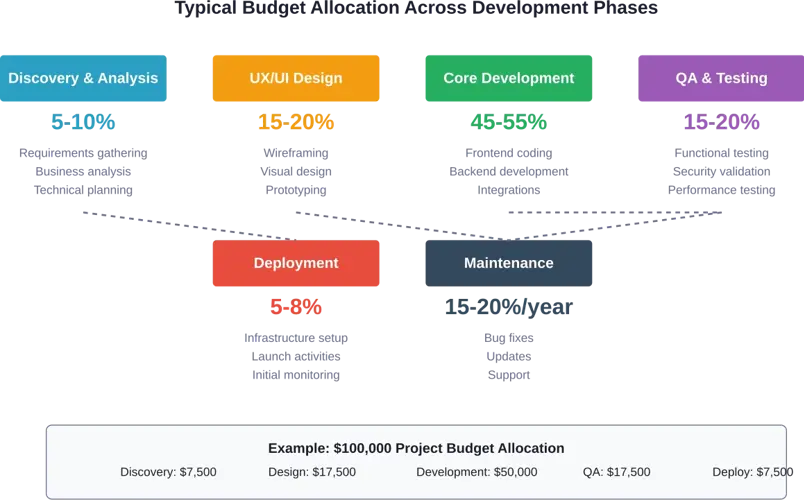
Discovery and Business Analysis (5-10%)
This initial phase involves requirements gathering, stakeholder interviews, competitive analysis, and technical feasibility assessment. Teams define project scope, identify risks, and create detailed specifications.
Skipping or rushing discovery is tempting but dangerous. Projects without thorough discovery work experience higher rates of scope changes, feature rework, and budget overruns. The 5-10% invested here typically saves 20-30% in downstream costs.
UX/UI Design (15-20%)
Design work encompasses user research, information architecture, wireframing, visual design, and interactive prototyping. This phase establishes the user experience foundation and visual identity.
Quality design reduces development rework. When developers receive detailed, well-thought-out designs, they spend less time making UI decisions and can focus on implementation. Poor or incomplete designs lead to constant clarification requests and multiple revision cycles.
Core Development (45-55%)
The largest budget allocation goes to actual coding—frontend development, backend logic, database architecture, API development, and third-party integrations. This phase translates designs and specifications into functional software.
Development complexity directly impacts timeline and cost. Clean, well-documented code costs more upfront but reduces technical debt and maintenance expenses over time. Rushed development with inadequate code reviews creates problems that compound exponentially.
Quality Assurance and Security Validation (15-20%)
Comprehensive testing includes functional testing, usability testing, performance optimization, security audits, and cross-browser compatibility verification. QA teams identify bugs, validate business logic, and ensure the application meets specifications.
Research on software development cost estimation emphasizes the importance of thorough testing phases. IEEE technical publications highlight how inadequate testing leads to expensive post-launch fixes and potential security vulnerabilities.
Deployment and Infrastructure (5-8%)
Deployment involves server configuration, database setup, DNS configuration, SSL certificate installation, continuous integration/continuous deployment (CI/CD) pipeline setup, and launch activities.
Cloud infrastructure costs vary based on expected traffic, data storage requirements, and redundancy needs. Initial setup is one expense; ongoing hosting and infrastructure represent recurring operational costs.
Hidden Costs and Budget Considerations
According to TeamStage data cited in industry research, 55% of tech companies face unexpected expenses during web development. These hidden costs often derail budgets and timelines.
Scope Creep and Change Requests
Scope creep happens gradually. A small feature addition here, a design tweak there—individually minor but collectively significant. Each change requires specification updates, design modifications, development work, testing, and documentation.
Establishing a formal change request process with impact assessments helps control scope creep. Not every idea is bad, but understanding the cost and timeline impact of each change enables informed decisions.
Technical Debt Accumulation
Technical debt refers to the implied cost of rework caused by choosing quick solutions over better approaches. IEEE research on estimating technical debt through code changes shows how shortcuts compound over time.
Taking the fast path occasionally makes sense under deadline pressure. But accumulated technical debt eventually demands repayment—through slower feature development, increased bug rates, and eventually necessary refactoring projects.
Third-Party Service Fees
Beyond integration costs, many services charge ongoing subscription fees, transaction fees, or usage-based pricing. Payment processors take 2-3% per transaction. Email services charge based on subscriber counts. Cloud storage scales with data volume.
These operational costs don't appear in initial development budgets but significantly impact long-term profitability. Factor them into financial projections from day one.
Post-Launch Support and Maintenance
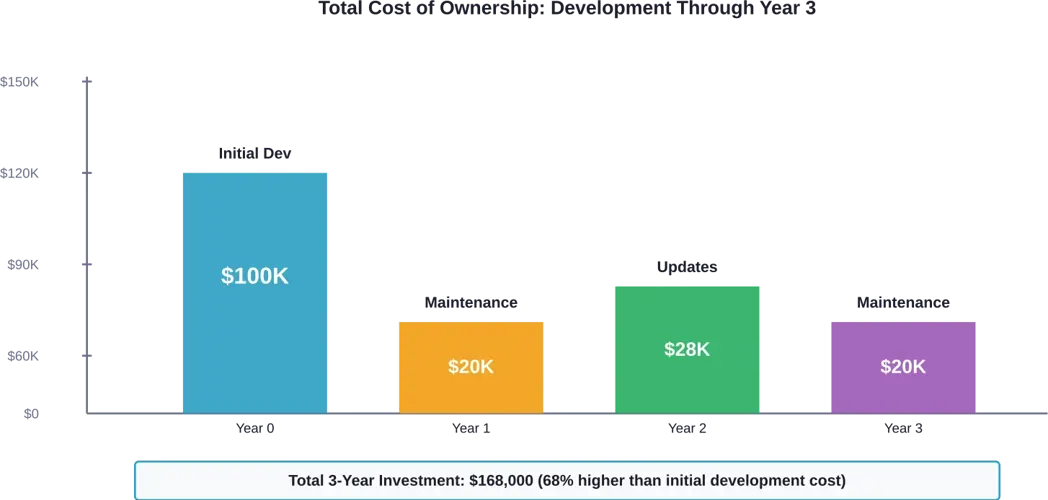
Applications require ongoing maintenance—security patches, dependency updates, bug fixes, performance optimization, and user support. Annual maintenance typically costs 15-20% of initial development investment.
Some businesses underestimate this recurring expense and find themselves unable to properly maintain their applications, leading to security vulnerabilities, degraded performance, and frustrated users.
Cost Estimation Methods and Models
Several established methodologies help estimate software development costs with varying degrees of accuracy and complexity.
Expert Judgment Method
Experienced developers and project managers estimate effort based on their knowledge of similar projects. This approach is quick and requires minimal documentation but depends heavily on individual expertise and can be subjective.
IEEE research on expert-integrated stacking models for estimating software development effort shows that combining multiple expert opinions improves accuracy compared to relying on a single estimator.
Analogous Estimation
This method compares the planned project to similar completed projects, adjusting for differences in scope, complexity, and team composition. It works well when historical data from comparable projects exists.
The challenge lies in accurately identifying truly analogous projects and properly accounting for differences that affect cost and timeline.
Parametric Estimation
Parametric models use statistical relationships between historical data and project variables to generate estimates. Teams calculate cost per function point, cost per line of code, or other metrics based on past projects.
These models provide quantitative, repeatable estimates but require substantial historical data and may not account for unique project characteristics.
Bottom-Up Estimation
Bottom-up approaches break projects into small components, estimate each piece individually, then aggregate for total cost. This method produces detailed, accurate estimates but demands significant upfront analysis.
The time investment required for bottom-up estimation makes it most appropriate for larger projects where accuracy justifies the effort.
Agile Estimation Techniques
Agile methodologies use story points, planning poker, and t-shirt sizing to estimate relative effort rather than absolute time. IEEE research on advancing agile software cost estimation through data synthesis examines various techniques for improving Agile cost prediction.
These approaches acknowledge uncertainty and work iteratively, refining estimates as teams learn more about requirements and technical challenges.
Custom Development vs. Off-the-Shelf Solutions
The build-versus-buy decision significantly impacts budget, timeline, and long-term outcomes. Neither option is universally superior—the right choice depends on specific business needs.
When Custom Development Makes Sense
Custom development suits businesses with unique requirements, competitive differentiation needs, or complex workflows that off-the-shelf products can't accommodate. Complete control over features, user experience, and technical architecture enables competitive advantages.
But custom development requires substantial investment, longer timelines, and ongoing maintenance responsibility. It makes sense when the application is central to business strategy and generates significant value.
When Off-the-Shelf Solutions Work Better
Pre-built platforms and SaaS tools solve common problems quickly and affordably. Standard business functions like accounting, email marketing, or customer support often don't require custom solutions.
Off-the-shelf options reduce upfront costs and maintenance burden but offer limited customization, potential vendor lock-in, and recurring subscription fees that accumulate over time.
Hybrid Approaches
Many successful projects combine custom development for core differentiating features with off-the-shelf tools for supporting functions. This balanced approach optimizes cost while maintaining flexibility where it matters most.
|
Consideration |
Custom Development |
Off-the-Shelf
|
|---|---|---|
|
Initial Cost |
High ($20K-$500K+) |
Low ($50-$500/month) |
|
Time to Market |
Longer (2-18 months) |
Immediate to weeks |
|
Customization |
Complete control |
Limited options |
|
Scalability |
Designed for your needs |
Fixed by vendor |
|
Maintenance |
Your responsibility |
Vendor handles updates |
|
Competitive Advantage |
High potential |
Low (competitors use same tools) |
|
Best For |
Core business functions, unique workflows |
Standard processes, supporting functions |
Strategies to Optimize Web Application Development Cost
Reducing cost without sacrificing quality requires strategic planning and smart trade-offs. These approaches help maximize value while respecting budget constraints.
Start with Minimum Viable Product (MVP)
Build the simplest version that solves the core problem and delivers value. Launch quickly, gather user feedback, then iterate based on real usage data rather than assumptions.
MVP approaches typically cost 40-60% less than full-featured initial releases and reduce the risk of building unwanted features. Many successful applications started as MVPs and evolved based on market response.
Prioritize Features Ruthlessly
Use frameworks like MoSCoW (Must have, Should have, Could have, Won't have) to categorize features. Focus initial development on must-haves that deliver core value. Defer nice-to-have features for future releases.
This isn't about building inferior products—it's about delivering value faster and avoiding development waste on features users don't need.
Choose Appropriate Technology
Selecting proven, well-supported technologies with large developer communities reduces costs. Mature frameworks have extensive documentation, abundant tutorials, and available talent pools.
Bleeding-edge technology sounds exciting but often leads to longer development times, harder debugging, and difficulty finding experienced developers.
Invest in Planning and Design
Thorough planning prevents costly mid-development changes. Detailed specifications and comprehensive designs enable developers to work efficiently without constant clarification requests.
The discovery and design phases represent 20-30% of initial budget but typically save 30-50% in development rework and scope changes.
Consider Development Team Location
Nearshore or offshore development offers significant cost advantages while maintaining quality. Eastern European, Asian, and Latin American development teams provide strong technical skills at 40-60% lower rates than North American teams.
Success requires clear communication protocols, detailed documentation, and potentially overlapping work hours to enable real-time collaboration.
Use Modular Architecture
Building applications with independent, loosely coupled modules enables parallel development, easier testing, and incremental delivery. Modular designs also simplify future updates and feature additions.
Initial architectural investment pays dividends throughout the project lifecycle through faster development, easier debugging, and reduced technical debt.
Automate Testing and Deployment
Automated testing catches bugs earlier when they're cheaper to fix. Continuous integration and continuous deployment (CI/CD) pipelines reduce manual deployment effort and minimize human error.
While setting up automation requires upfront investment, it reduces QA costs by 30-50% over the project lifecycle and improves overall code quality.
Selecting the Right Development Partner
Choosing a development team or company significantly impacts project success, final cost, and long-term satisfaction. Several factors beyond hourly rate deserve consideration.
Evaluate Technical Expertise
Review portfolios of similar projects. Ask about specific technologies, development methodologies, and architectural approaches. Request code samples or conduct technical interviews to assess capabilities.
Technical competence directly affects development efficiency, code quality, and long-term maintainability. A skilled team costs more per hour but often delivers faster with fewer bugs.
Assess Communication and Project Management
How teams communicate, handle changes, and manage projects matters as much as technical skills. Request references and speak with past clients about their experiences.
Clear communication, proactive problem-solving, and transparent reporting prevent misunderstandings and keep projects on track.
Understand Pricing Models
Fixed-price contracts provide cost certainty but offer limited flexibility for changes. Time-and-materials arrangements adapt to evolving requirements but carry budget risk. Dedicated team models balance flexibility and predictability.
No pricing model is inherently better—the right choice depends on project certainty, required flexibility, and risk tolerance.
Consider Long-Term Partnership Potential
Web applications require ongoing maintenance, updates, and enhancements. Teams that built the application understand the codebase and can work more efficiently on future iterations.
Factor post-launch support availability and cost into initial vendor selection. Switching development teams later requires knowledge transfer, ramp-up time, and potential refactoring.
Real-World Cost Examples by Industry
Examining typical costs for specific application types provides useful benchmarks for planning and budgeting.
E-commerce Platforms
Basic online stores with product catalogs, shopping carts, and payment processing range from $30,000 to $80,000. Multi-vendor marketplaces with advanced features like seller dashboards, commission management, and sophisticated search cost $100,000 to $300,000+.
SaaS Applications
Simple SaaS tools with core functionality, user management, and subscription billing start around $50,000 to $120,000. Complex multi-tenant platforms with advanced features, integrations, and enterprise capabilities range from $150,000 to $500,000+.
Healthcare Applications
HIPAA-compliant patient portals with appointment scheduling and basic health records cost $80,000 to $200,000. Comprehensive electronic health record (EHR) systems or telemedicine platforms require $250,000 to $1,000,000+ due to regulatory requirements and complexity.
Financial Services Platforms
Personal finance dashboards with account aggregation and basic analytics range from $60,000 to $150,000. Banking platforms, investment management systems, or trading applications with high-security requirements and regulatory compliance cost $200,000 to $800,000+.
Educational Platforms
Basic learning management systems (LMS) with course delivery and progress tracking cost $40,000 to $100,000. Comprehensive platforms with interactive content, video streaming, assessment engines, and certification management range from $120,000 to $350,000+.
Post-Launch Costs and Ongoing Investment
Launch day isn't the finish line—it's the starting point for ongoing investment in maintenance, updates, and improvements.
Hosting and Infrastructure
Cloud hosting costs vary dramatically based on traffic, data storage, and performance requirements. Small applications might run on $50-$200 monthly. Medium-traffic applications typically cost $500-$2,000 monthly. High-traffic enterprise applications can require $5,000-$20,000+ monthly for infrastructure.
Maintenance and Bug Fixes
Expect to invest 15-20% of initial development cost annually for maintenance. This covers security patches, dependency updates, bug fixes, and minor improvements that keep the application running smoothly.
Feature Enhancements
User feedback and market changes drive ongoing feature development. Budget 20-30% of initial development cost annually if continuously evolving the product, or plan for periodic larger updates every 12-18 months.
Security and Compliance Updates
Security threats evolve constantly. Regular security audits, penetration testing, and vulnerability remediation require ongoing investment. Compliance requirements change over time, sometimes demanding substantial updates to maintain certification.
Common Mistakes That Inflate Web Application Costs
Learning from others' mistakes costs less than making them yourself. These common pitfalls drive up expenses unnecessarily.
Unclear Requirements
Vague specifications lead to misaligned expectations, frequent changes, and development rework. Teams build features that don't meet needs, then rebuild them correctly—essentially paying twice.
Investing time upfront to document clear, detailed requirements saves exponentially more during development.
Skipping User Research
Building features based on assumptions rather than user needs wastes resources on functionality nobody wants. User research reveals what actually solves problems versus what sounds good in planning meetings.
Choosing the Wrong Team
Selecting developers based solely on the lowest hourly rate often backfires. Inexperienced teams take longer, produce lower-quality code, and require more management overhead.
The cheapest option rarely proves cheapest in total cost. Look for the best value—balancing expertise, communication, and reasonable rates.
Over-Engineering Solutions
Building for hypothetical future needs that may never materialize adds unnecessary complexity and cost. Design for current requirements with extensibility in mind, but don't implement features until they're needed.
Neglecting Technical Debt
Postponing refactoring and cleanup work to hit deadlines creates technical debt that compounds. Eventually, the codebase becomes so tangled that even simple changes require extensive effort.
Allocating 15-20% of development time to addressing technical debt maintains code health and prevents larger refactoring projects later.
Poor Communication
Inadequate communication between stakeholders, designers, and developers causes misalignment, duplicated work, and feature gaps. Regular check-ins, clear documentation, and collaborative tools keep everyone synchronized.
Future Trends Affecting Web Application Development Costs
Technology evolution and market shifts continuously reshape development economics. Understanding emerging trends helps with long-term planning.
AI-Powered Development Tools
Artificial intelligence tools increasingly assist with code generation, debugging, and testing. These tools accelerate certain development tasks but require skilled developers to guide them and review output.
AI won't eliminate development costs but may reduce time spent on routine coding tasks by 20-30% over the next few years.
Low-Code and No-Code Platforms
Visual development platforms enable faster application creation for standard use cases. They work well for simple applications and prototypes but have limitations for complex, custom requirements.
These platforms shift cost from development to licensing fees and may reduce customization flexibility.
Serverless Architecture
Serverless computing models charge based on actual usage rather than provisioned capacity. This can dramatically reduce infrastructure costs for applications with variable traffic patterns.
But serverless introduces new complexity in architecture, monitoring, and debugging that requires specialized expertise.
Progressive Web Apps Adoption
PWAs continue gaining adoption as they provide app-like experiences without separate mobile development. Building one codebase that works across devices reduces development and maintenance costs compared to separate web and mobile applications.
Increased Security Requirements
Growing cyber threats and evolving regulations drive increased security investment. Applications require more robust authentication, encryption, monitoring, and compliance measures—all of which add cost.
Security is no longer optional or something to add later. It must be built into architecture from the beginning.
FAQs About Web Application Development Cost Estimation
How much does it cost to build a web application in 2026?
Web application development costs range from $20,000 for simple applications to over $500,000 for complex enterprise platforms. Most business applications with moderate complexity fall between $50,000 and $150,000. The final cost depends on feature complexity, design requirements, technology stack, team location, and project timeline.
What's the difference between web application and website development costs?
Websites primarily deliver content with limited interactivity, typically costing $5,000-$30,000. Web applications provide interactive functionality, process data, and enable complex user workflows, costing $20,000-$500,000+. Applications require more sophisticated backend development, database architecture, and ongoing maintenance than content-focused websites.
How long does it take to develop a web application?
Development timelines vary by complexity. Simple applications take 2-4 months, medium complexity projects require 4-8 months, and complex enterprise applications need 8-18+ months. Timeline directly affects cost, as extended projects require longer team engagement. Rushing development by adding more developers doesn't proportionally reduce timeline due to communication overhead.
Should I choose fixed-price or time-and-materials pricing?
Fixed-price contracts work best when requirements are completely defined and unlikely to change. They provide cost certainty but limit flexibility. Time-and-materials pricing suits projects with evolving requirements, offering flexibility but requiring active budget management. Most complex applications benefit from time-and-materials or dedicated team models that balance predictability and adaptability.
How can I reduce web application development costs without sacrificing quality?
Start with an MVP that focuses on core features, launch quickly, then iterate based on user feedback. Prioritize features ruthlessly using frameworks like MoSCoW. Choose proven technologies with large developer communities. Invest in thorough planning and design to prevent expensive mid-development changes. Consider nearshore or offshore development teams that offer strong capabilities at lower rates than domestic options.
What ongoing costs should I budget for after launch?
Plan for annual maintenance costs of 15-20% of initial development investment for security patches, updates, and bug fixes. Budget 20-30% annually for feature enhancements if continuously evolving the product. Infrastructure costs range from $50-$20,000+ monthly depending on traffic and performance requirements. Don't forget third-party service fees, which can add $500-$5,000+ monthly for payment processing, email services, analytics, and other tools.
Is offshore development a good way to save money?
Offshore and nearshore development can reduce costs by 40-60% while maintaining quality, but success requires careful vendor selection and strong project management. Look for teams with relevant experience, clear communication skills, and positive references. Establish detailed documentation, regular check-ins, and potentially overlapping work hours. The cost savings are real, but they require more active coordination than working with local teams.
Conclusion: Making Informed Decisions About Web Application Development Costs
Web application development represents a significant investment, but understanding cost drivers, estimation methods, and optimization strategies enables informed budget planning and realistic expectations.
The $20,000 to $500,000+ range isn't helpful in isolation. What matters is understanding where your specific project falls within that spectrum based on complexity, features, team composition, and quality requirements.
Successful projects balance three competing factors: scope, timeline, and budget. You can optimize two, but rarely all three simultaneously. Want faster delivery with full features? Budget will increase. Need to minimize cost? Either reduce scope or extend timeline.
The businesses that succeed with web application development share common characteristics. They invest in thorough planning before coding begins. They prioritize features based on user value rather than internal preferences. They choose development partners based on capability and communication, not just hourly rates. And they plan for ongoing investment beyond initial launch.
According to IEEE systematic reviews of software development cost estimation studies, the most accurate estimates combine multiple estimation methods, incorporate expert judgment, and continuously refine predictions as projects progress and uncertainty decreases.
The web development services market alone is expected to be worth roughly USD 80.6 billion as of 2025, with steady growth toward 2030. This expansion reflects increasing digital transformation, cloud adoption, and demand for interactive business systems across industries.
Your web application represents more than a development expense—it's an investment in business capability, competitive advantage, and customer value. The question isn't whether you can afford to build it, but whether you can afford not to in an increasingly digital business environment.
Ready to estimate your web application development cost? Start by clearly defining your core value proposition and the minimum features needed to deliver that value. Document requirements thoroughly. Research development partners with relevant experience. Request detailed proposals that break down costs by phase. And remember that the cheapest option rarely provides the best value.
The businesses that succeed are those that approach web application development as a strategic investment, not a commodity purchase. They build relationships with development partners, plan for long-term evolution, and make informed decisions based on data rather than assumptions.
What will your web application enable your business to achieve? That's the question that matters most—and the one that should guide every decision about budget, timeline, and scope throughout the development journey.


