

System Development Cost Estimation: 2026 Methods Guide

Executive Summary: System development cost estimation is the process of forecasting the effort, time, and budget required to build software systems. According to McKinsey research, IT projects go 45% over budget and 7% over time on average, making accurate estimation critical. The process involves analyzing project scope, complexity, team composition, and applying proven methodologies like function point analysis, expert judgment, and analogous estimation.
The numbers are brutal. McKinsey research shows that IT projects go 45% over budget and 7% over time on average. Large projects face even bigger issues, with some exceeding budgets by far more dramatic margins.
But here's the thing—these failures aren't inevitable.
Software cost estimation is a systematic process used to forecast the amount of effort, duration, and financial cost required to develop, deploy, and maintain a software product. When done right, it becomes a foundational step in the software project management lifecycle, ensuring stakeholders can make informed decisions and projects are delivered on time, within budget.
The challenge? Accurate estimation requires balancing technical complexity with business realities. Teams must account for variables ranging from feature counts to integration requirements, from developer experience levels to unforeseen technical debt.
What Makes System Development Cost Estimation So Critical
Cost estimation shapes every major decision in software project management. It determines whether projects get greenlit, how resources get allocated, and which features make the cut.
The stakes extend beyond budget sheets. Poor estimates create cascading problems—rushed development, cut corners on quality assurance, burned-out teams, and disappointed stakeholders. Research shows multitasking can reduce efficiency significantly, making it even more challenging when teams juggle too many tasks due to compressed timelines from bad estimates.
Accurate estimation enables realistic project planning. Development teams can set achievable milestones. Project managers can allocate resources efficiently. Business stakeholders can make informed investment decisions.
The quality of project planning directly impacts the success or failure of a project, making accurate scope estimation particularly crucial. When estimates miss the mark, projects spiral—scope creeps in, deadlines slip, and budgets balloon.
Core Components of Development Cost Estimation
Breaking down cost estimation reveals three fundamental components that interact in complex ways.
Effort Estimation
Effort represents the person-hours or person-months required to complete development work. This isn't just coding time—it encompasses requirements gathering, design, implementation, testing, deployment, and maintenance.
Consider a practical example from real project data: estimating the ability to view specific data required breaking down tasks precisely. The team identified what needed completion and estimated total work at 56 hours, distributed across specific tasks:
- Ability to view all records: 8 hours
- Filtration by field 1: 8 hours
- Filtration by field 2: additional hours for secondary features
This granular approach prevents underestimation by forcing teams to think through every component.
Duration Estimation
Duration measures calendar time from project kickoff to completion. This differs from effort because team members don't work in parallel on everything, and real-world constraints like meetings, code reviews, and dependencies create gaps.
A task requiring 40 hours of effort might take two weeks of calendar time when accounting for collaboration, waiting periods, and context switching.
Financial Cost
Financial cost translates effort and duration into actual budget requirements. This includes direct costs like salaries and indirect costs like infrastructure, tools, and overhead.
Based on current market data, developer compensation varies significantly by experience:
- Junior developers: $60,000-$90,000 per year
- Mid-level developers: $90,000-$130,000 per year
- Senior developers: $130,000-$200,000+ per year
- Project managers: $80,000-$140,000 per year
Geographic location dramatically impacts these figures. North American rates typically run higher than other regions, affecting overall project costs based on team composition and location.

Get a Clear System Development Cost Estimate
System development often includes APIs, databases, and integrations. OSKI Solutions defines technical architecture and calculates effort based on system complexity. The estimate includes development, testing, and deployment tasks. You receive a structured project budget.
Ready to Estimate Your System Development Project?
Talk with OSKI Solutions to:
- define architecture and integrations
- calculate development effort
- receive a detailed cost breakdown
👉 Request a system development estimate from OSKI Solutions.
Build Robust System Architecture
We design and develop scalable, secure systems tailored to complex business environments and mission-critical operations.
Primary Factors Driving Estimation Complexity
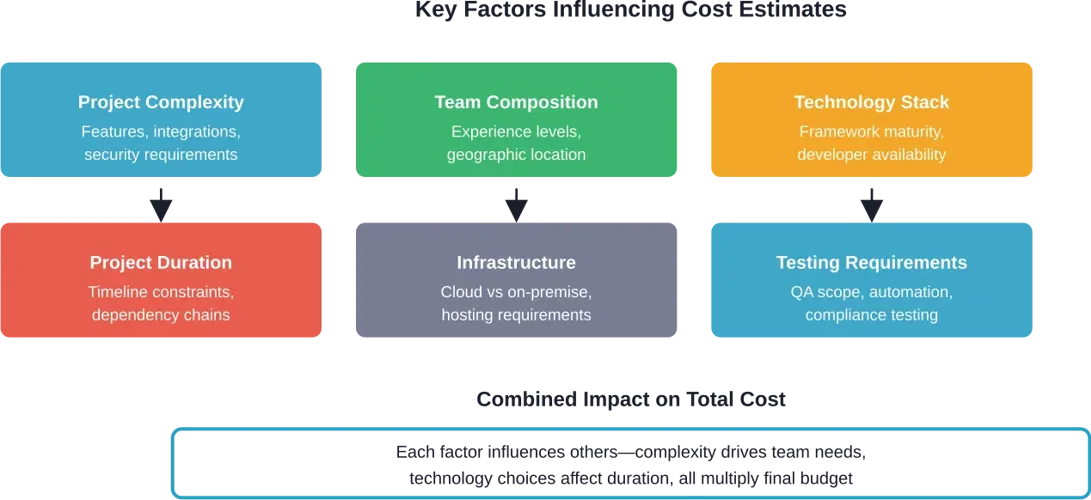
Multiple variables influence how much system development actually costs. Understanding these factors helps create more accurate estimates.
Project Complexity and Scope
A simple e-commerce website costs far less than a comprehensive enterprise resource planning system. Project complexity is determined by several interconnected elements.
The number of features and functionalities creates the foundation. Each feature requires design, development, testing, and integration work. But features don't exist in isolation—they interact in ways that multiply complexity.
Integration requirements with external systems add substantial complexity. Connecting to payment gateways, third-party APIs, legacy databases, or external services requires additional development and testing effort.
Data management complexity matters too. Systems handling large data volumes, complex data structures, or stringent data integrity requirements need more sophisticated architecture and development approaches.
User interface sophistication affects both design and development effort. Complex dashboards, interactive visualizations, or multi-platform interfaces demand more resources than basic forms.
Security requirements can't be afterthoughts. Systems handling sensitive data, financial transactions, or operating in regulated industries require additional security layers, compliance work, and testing.
Team Composition and Experience
Team structure dramatically impacts both productivity and cost. A senior developer completes tasks faster and with fewer errors than a junior developer, but costs significantly more per hour.
The optimal mix depends on project complexity. Straightforward projects might succeed with mostly junior and mid-level developers supervised by one senior lead. Complex systems requiring architectural decisions benefit from more senior expertise upfront.
Geographic distribution affects costs and coordination overhead. Distributed teams across time zones face communication challenges that can slow progress, even as they potentially reduce labor costs.
Technology Stack Decisions
Technology choices ripple through the entire project. Mature, well-documented frameworks with large developer communities typically reduce development time. Cutting-edge technologies might offer advantages but come with steeper learning curves and less community support.
The availability of developers skilled in chosen technologies affects both hiring costs and development speed. Common stacks like JavaScript/React or Python/Django have abundant talent. Niche technologies command premium rates.
Proven Cost Estimation Techniques
Multiple methodologies exist for estimating development costs. Each has strengths and weaknesses depending on project characteristics and available information.
Expert Judgment
Expert judgment relies on the experience and intuition of seasoned professionals who've seen similar projects. Experts draw on pattern recognition from past successes and failures to estimate new work.
This technique works best early in projects when detailed specifications don't yet exist. An experienced architect can provide ballpark estimates based on high-level requirements, helping stakeholders decide whether to proceed.
The limitation? Expert judgment depends entirely on the expert's actual experience with comparable projects. Biases creep in. Optimism clouds judgment. And even experts struggle with genuinely novel projects outside their experience base.
Analogous Estimation
Analogous estimation bases costs on previous similar projects. If building an e-commerce platform cost $200,000 last year, a similar platform this year might cost roughly the same, adjusted for scope differences.
This approach requires maintaining detailed records from past projects—actual effort spent, costs incurred, and scope delivered. Organizations with mature project tracking gain significant advantages.
The key word is "similar." Projects must genuinely share characteristics for analogies to hold. Different technology stacks, team compositions, or complexity levels invalidate comparisons.
Top-Down Estimation
Top-down estimation starts with the overall project goal and works backward to component estimates. Leadership might allocate a $500,000 budget, then divide that across major system modules.
This technique aligns with budget constraints and strategic planning. It helps organizations make go/no-go decisions quickly without detailed analysis.
The downside? Top-down estimates can disconnect from technical reality. Allocating $100,000 to a module doesn't mean that module can actually be built for $100,000. Teams risk accepting unrealistic budgets that lead to the very overruns estimation should prevent.
Bottom-Up Estimation
Bottom-up estimation builds costs from granular task-level estimates. Teams break down every feature into specific development tasks, estimate each task individually, then sum to project totals.
Consider the practical example mentioned earlier—estimating data viewing functionality at 56 total hours by breaking down individual capabilities. This granularity reveals hidden complexity and creates more defensible estimates.
A realistic breakdown might look like this:
|
Developer Tasks |
Hours |
QA Expert Tasks |
Hours |
|---|---|---|---|
|
Tech task breakdown |
0.5 |
Specification review |
1 |
|
Frontend development |
12 |
Test cases preparation |
1 |
|
Backend development |
6 |
Test cases execution |
4 |
|
Integration work |
8 |
Bug verification |
2 |
|
Code review and fixes |
4 |
Regression testing |
3 |
Bottom-up estimation takes more time upfront but produces more accurate results. The challenge lies in ensuring nothing gets missed—forgotten tasks become budget surprises later.
Function Point Analysis
Function point analysis provides a standardized method for measuring software size based on functionality delivered to users. It quantifies system complexity independent of technology choices or team productivity.
The technique counts different types of functions—inputs, outputs, inquiries, internal files, and external interfaces. Each type receives a complexity rating, which translates into function points. Function points then convert to effort estimates based on historical productivity data.
Function point analysis offers objectivity and comparability across projects. Teams can benchmark productivity, compare vendor proposals, and track improvement over time. IEEE research indicates function point analysis remains widely studied in systematic reviews of software development cost estimation approaches.
The learning curve is steep, though. Proper function point counting requires training and practice. Smaller organizations might find the overhead unjustified.
Building Realistic Estimates: A Practical Process
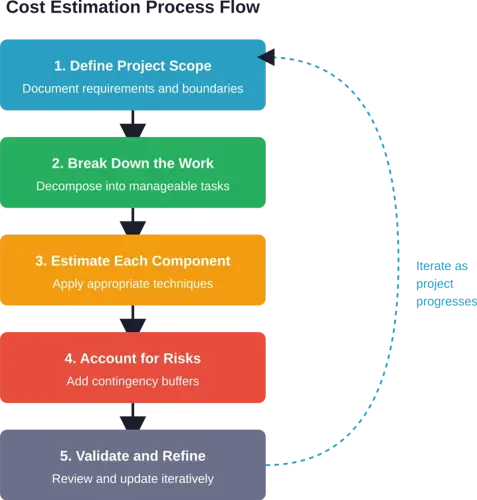
Estimation shouldn't be a one-time activity at project kickoff. Effective estimation follows a structured, iterative process that refines as more information becomes available.
Step 1: Define Project Scope
Clear scope definition prevents the single biggest estimation killer—scope creep. Document what the system will and won't do. Identify all major features, integrations, and technical requirements.
Incomplete scope makes accurate estimation impossible. Teams estimate based on assumptions, then discover crucial requirements later that double the work.
Involve stakeholders across business and technical functions. Product owners understand user needs. Architects identify technical constraints. Security teams flag compliance requirements. Comprehensive input creates comprehensive estimates.
Step 2: Break Down the Work
Decompose the project into manageable components. Start with major modules or features, then break those into specific tasks.
How granular should task breakdown go? Generally speaking, tasks should represent 4-40 hours of work. Anything smaller creates administrative overhead. Anything larger hides complexity that will bite later.
This breakdown serves multiple purposes. It clarifies what actually needs building. It reveals dependencies between components. And it creates the foundation for bottom-up estimation.
Step 3: Estimate Each Component
Apply appropriate estimation techniques to each component. Simple, well-understood tasks might use expert judgment. Complex, novel work benefits from multiple estimation approaches cross-validated.
Include time for all activities, not just coding. Requirements refinement, design, testing, code review, deployment, and documentation all consume time.
Don't forget quality assurance. The example breakdown showed QA tasks consuming roughly 30% of development effort—specification review, test case preparation and execution, bug verification, regression testing. Skimping on QA estimates creates technical debt and emergency bug fixes that cost more later.
Step 4: Account for Risks and Uncertainties
Every project faces uncertainties. New technologies might have steeper learning curves than expected. Third-party APIs might have undocumented quirks. Team members might leave.
Add contingency buffers proportional to uncertainty. Well-understood work in familiar technologies might need 10-15% contingency. Cutting-edge approaches in unfamiliar domains might need 30-50%.
Document assumptions underlying estimates. When assumptions prove wrong, estimates need updating.
Step 5: Validate and Refine
Review estimates with multiple stakeholders. Developers might spot technical complexities product owners missed. Operations teams might identify deployment challenges architects overlooked.
Compare estimates against analogous past projects. Significant deviations warrant investigation—either the new project differs substantially, or the estimate needs adjustment.
Refine estimates as the project progresses and uncertainty resolves. Initial estimates provide planning guidance. As requirements crystallize and work begins, update estimates based on actual progress and emerging information.
Common Estimation Pitfalls and How to Avoid Them
Even experienced teams fall into estimation traps. Recognizing common pitfalls helps avoid them.
The Planning Fallacy
People consistently underestimate how long tasks take, even when aware of past underestimates. The planning fallacy causes teams to ignore historical data in favor of optimistic scenarios.
Counter this by anchoring estimates in actual past performance, not idealized scenarios. Track actual versus estimated effort religiously. Use that data to calibrate future estimates.
Scope Creep
Requirements evolve. Stakeholders request "small changes." The system that starts as a simple dashboard becomes a complex analytics platform.
Scope creep kills estimates. The original $100,000 budget made sense for the original scope. But the expanded scope might legitimately require $180,000.
Combat scope creep through rigorous change control. Document the initial scope clearly. When changes arise—and they will—re-estimate their impact and update the project plan accordingly. Small changes accumulate into major cost overruns.
Overlooking Non-Development Activities
Estimates often focus on coding while forgetting everything else. Meetings, code reviews, deployment, documentation, training, and project management all consume time.
In practice, actual coding might represent only 40-50% of total project time. The rest goes to collaboration, coordination, and all the activities that support development.
Use historical data to establish realistic ratios. If past projects showed 30% of time in meetings and coordination, factor that into new estimates.
Ignoring Team Productivity Variations
Not all developers deliver at the same pace. Senior developers work faster than juniors. Developers familiar with the codebase outpace newcomers. Productivity varies by individual, technology, and problem domain.
Abstract "person-hours" hide these variations. Estimate based on the actual team composition. A feature taking a senior developer 20 hours might take a junior developer 40 hours.
Underestimating Integration Complexity
Components might work perfectly in isolation but struggle when integrated. API documentation might be incomplete. Data formats might not align. Authentication flows might conflict.
Integration represents disproportionate risk. Allocate explicit time for integration work separate from component development. Build integration time into the schedule, not as an afterthought.
Real-World Cost Ranges and Examples
Abstract principles help, but concrete numbers ground expectations. What do different types of systems actually cost?
Project costs vary enormously based on all the factors discussed—complexity, team composition, location, technology choices. That said, general patterns emerge from industry data.
Simple Applications
Basic websites, simple mobile apps, or straightforward internal tools might cost $25,000-$75,000. These projects typically involve:
- Limited feature sets (5-10 major features)
- Standard technology stacks
- Small teams (2-3 developers)
- Short timelines (2-3 months)
- Minimal integration requirements
Think content management systems, basic e-commerce sites, or simple data collection apps.
Medium Complexity Systems
More sophisticated business applications, multi-platform solutions, or systems with moderate integration needs might range from $100,000-$500,000. Characteristics include:
- Moderate feature counts (15-30 major features)
- Multiple user roles and permissions
- Third-party integrations (payment processing, analytics, CRM)
- Teams of 4-8 developers
- Development timelines of 4-9 months
Examples include customer portals, inventory management systems, or booking platforms.
Enterprise-Scale Solutions
Large-scale enterprise systems, comprehensive ERP implementations, or complex platform builds can range from $500,000 into the millions. Microsoft released Windows XP in 2001 after significant development investment—and modern software development hasn't gotten cheaper.
These projects involve:
- Extensive feature sets (50+ major features)
- Complex data models and business logic
- Multiple system integrations
- High security and compliance requirements
- Large teams (10+ developers plus specialists)
- Extended timelines (12+ months)
Think comprehensive ERP systems, financial trading platforms, or large-scale SaaS products.
Strategies for More Accurate Estimates
Improving estimation accuracy requires systematic approaches and organizational discipline.
Build Historical Databases
Track actual effort, costs, and outcomes from every project. Record initial estimates alongside final actuals. Note what went right and what went wrong.
This historical data becomes invaluable for future estimates. Patterns emerge. Analogous estimation improves. Teams learn which types of work they consistently over or underestimate.
Use Multiple Estimation Methods
Different techniques catch different blind spots. Expert judgment might miss details that bottom-up estimation reveals. Function point analysis might expose complexity that analogous estimation overlooks.
Estimate important projects using multiple approaches. When methods converge, confidence increases. When they diverge significantly, investigation reveals hidden assumptions or misunderstandings.
Involve the Right People
Estimation shouldn't fall solely to project managers or executives. Developers doing the work understand technical complexity. QA engineers know testing requirements. Operations teams identify deployment challenges.
Collaborative estimation produces better results. It surfaces assumptions, identifies risks, and builds team buy-in.
Estimate in Ranges, Not Point Values
Single-number estimates create false precision. A task might take 20 hours—or it might take 35 if complications arise.
Range estimates reflect uncertainty honestly. Provide best-case, expected-case, and worst-case scenarios. This helps stakeholders understand risk and make better decisions.
Re-estimate Regularly
Initial estimates guide planning, but they shouldn't be sacred. As work progresses, update estimates based on actual progress and new information.
Agile methodologies embrace this through sprint planning and velocity tracking. Teams estimate work in small batches, then use actual velocity to project remaining effort.
Regular re-estimation prevents surprises. When projects risk overrunning, early detection enables corrective action—cutting scope, adding resources, or extending timelines.
|
Estimation Technique |
Best Used When |
Advantages |
Limitations |
|---|---|---|---|
|
Expert Judgment |
Early stages, limited information |
Fast, leverages experience |
Subjective, bias-prone |
|
Analogous Estimation |
Similar past projects exist |
Based on real data |
Requires comparable projects |
|
Bottom-Up Estimation |
Detailed requirements available |
Comprehensive, detailed |
Time-consuming, can miss items |
|
Function Point Analysis |
Need objective size metrics |
Standardized, comparable |
Complex, requires training |
|
Top-Down Estimation |
Budget constraints drive planning |
Aligns with business goals |
May disconnect from reality |
Tools and Technologies Supporting Estimation
Software tools can improve estimation accuracy and efficiency, though they can't replace human judgment.
Project Management Platforms
Tools like Jira, Asana, or Azure DevOps help teams break down work, track effort, and measure velocity. They provide data for refining future estimates and enable transparent communication about progress.
These platforms excel at making estimation collaborative. Teams can discuss, refine, and commit to estimates collectively rather than having them imposed top-down.
Time Tracking Software
Accurate estimation requires knowing how long tasks actually take. Time tracking tools capture this data, revealing where estimates were accurate and where they missed.
The data becomes invaluable for calibrating future estimates. If database integration tasks consistently take twice as long as estimated, future database work needs adjusted estimates.
Estimation-Specific Tools
Specialized estimation tools support specific methodologies. Function point analysis tools guide users through counting processes. Monte Carlo simulation tools model uncertainty and generate probability distributions.
These tools add rigor but require investment in learning and integration with existing workflows.
The Role of Agile Methodologies in Estimation
Agile approaches have transformed software estimation by embracing uncertainty rather than fighting it.
Story Points and Velocity
Instead of estimating in hours, agile teams often use relative sizing with story points. Teams estimate work relative to reference stories, avoiding the false precision of hour estimates.
Velocity—the amount of work completed per sprint—emerges from actual delivery. Teams use historical velocity to project future capacity, creating estimates grounded in demonstrated performance rather than hopeful planning.
Iterative Refinement
Agile estimation happens continuously. Backlog grooming refines upcoming work. Sprint planning estimates the next batch. Retrospectives examine estimation accuracy and adjust approaches.
This iterative approach acknowledges that perfect upfront estimation is impossible. Instead, teams aim for "good enough" estimates that guide the next few weeks, then re-estimate as information improves.
Embracing Change
Traditional estimation treats scope changes as failures. Agile estimation expects change and builds processes to accommodate it.
When priorities shift or requirements evolve, teams re-estimate affected work and adjust plans accordingly. The project adapts rather than rigidly adhering to outdated estimates.
Communicating Estimates to Stakeholders
Accurate estimates matter little if stakeholders misunderstand or misuse them.
Set Proper Expectations
Explain that estimates are projections based on current information, not guarantees. Communicate the confidence level and underlying assumptions.
Distinguish between estimates (informed projections), targets (desired outcomes), and commitments (promises). These are different concepts that stakeholders often conflate.
Provide Context
Raw numbers lack meaning without context. Explain what's included in estimates and what's excluded. Clarify assumptions about team composition, availability, and working conditions.
If estimates depend on certain conditions—requirements not changing, key personnel remaining available, third-party services working as documented—state those dependencies explicitly.
Update Regularly
Keep stakeholders informed as estimates evolve. When actual progress diverges from projections, communicate early. When new information changes estimates, explain why.
Regular updates prevent surprises and maintain trust. Stakeholders tolerate uncertainty better than being blindsided by last-minute revelations.
Frequently Asked Questions
What is the most accurate method for system development cost estimation?
No single method dominates all situations. Bottom-up estimation combined with function point analysis tends to produce the most accurate results for well-defined projects, but requires significant upfront effort. For early-stage projects with limited detail, expert judgment validated against analogous past projects often provides the best balance of speed and accuracy. Many experts suggest using multiple estimation approaches and comparing results—convergence increases confidence while divergence reveals hidden assumptions worth investigating.
How much contingency should be added to software development estimates?
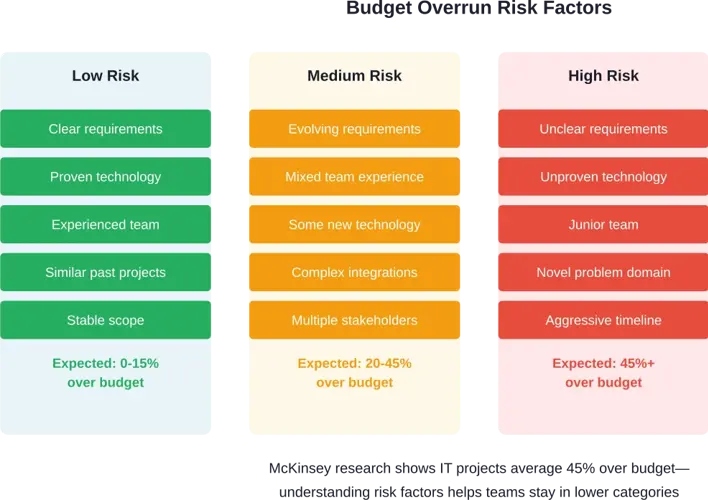
Contingency buffers should reflect project uncertainty and risk. Generally speaking, well-understood projects using proven technologies might warrant 10-15% contingency. Projects with moderate complexity, some new technologies, or evolving requirements typically need 20-30% buffers. High-risk projects involving novel technologies, unclear requirements, or inexperienced teams may require 40-50% or more. Rather than arbitrary percentages, assess specific risk factors—unclear requirements, technology unknowns, team experience gaps—and add contingency proportional to identified risks.
Why do software projects consistently go over budget?
McKinsey research demonstrates that IT projects go 45% over budget on average. Multiple factors contribute: scope creep as requirements evolve, overly optimistic initial estimates, underestimating integration complexity, insufficient contingency buffers, and failing to account for non-development activities like meetings and coordination. The planning fallacy causes teams to underestimate duration even when aware of past underestimates. Additionally, research shows multitasking can reduce efficiency significantly, compounding delays when teams juggle too many tasks due to compressed timelines.
How often should cost estimates be updated during a project?
Estimates should be living documents, not one-time exercises. Agile teams typically re-estimate during each sprint planning session, updating projections every 1-2 weeks based on actual velocity. Traditional projects benefit from monthly estimate reviews at minimum, with immediate re-estimation when significant scope changes occur or major assumptions prove incorrect. Early detection of budget variance enables corrective action—adjusting scope, adding resources, or extending timelines. The longer teams wait to update estimates, the harder it becomes to address overruns.
Should estimates be provided as single numbers or ranges?
Range estimates better reflect reality and manage stakeholder expectations. Single-point estimates create false precision—suggesting more certainty than actually exists. Provide three-point estimates: optimistic (best case if everything goes smoothly), expected (most likely scenario), and pessimistic (worst case if complications arise). This acknowledges uncertainty honestly and helps stakeholders understand risk. For critical business planning, consider probability distributions showing likelihood of different cost outcomes rather than single numbers.
How do remote and distributed teams affect cost estimation?
Distributed teams introduce both opportunities and challenges for cost estimation. Geographic distribution can reduce labor costs, with developers in different regions commanding different salary levels. However, coordination overhead increases with distribution—time zone differences complicate meetings, communication friction slows decision-making, and knowledge sharing becomes harder. In practice, teams should add 15-25% overhead for coordination when working across multiple time zones, while potentially reducing direct labor costs based on geographic salary differences. The net effect depends on team maturity, communication practices, and project complexity.
What percentage of total project time should quality assurance consume?
QA typically represents 25-35% of total development effort, though this varies by project criticality and quality requirements. The practical example breakdown showed QA tasks consuming roughly 30% of development time—specification review, test case preparation and execution, bug verification, and regression testing. Systems with high reliability requirements, regulatory compliance needs, or significant user safety implications need higher QA ratios. Conversely, internal prototypes or proof-of-concept systems might reduce QA effort. Teams that skimp on QA estimates inevitably face emergency bug fixes and technical debt that cost more later than proper testing upfront.
Moving Forward with Better Estimates
The 45% budget overrun statistic doesn't have to be destiny. Better estimation practices produce better outcomes.
Start by building organizational discipline around estimation. Track actual versus estimated effort religiously. Build historical databases. Review what went right and wrong in past estimates. Learn from both successes and failures.
Use multiple estimation techniques and validate them against each other. Involve the right people—developers, QA engineers, operations teams, and stakeholders. Break work down granularly. Account for all activities, not just coding.
Embrace uncertainty rather than pretending it doesn't exist. Provide range estimates. Add appropriate contingency buffers. Update estimates regularly as information improves.
Communicate clearly with stakeholders. Set proper expectations about what estimates represent. Explain assumptions and dependencies. Keep everyone informed as situations evolve.
The goal isn't perfect estimates—those don't exist. The goal is estimates good enough to support sound business decisions and realistic project planning. Estimates that help teams deliver valuable software on reasonable timelines within acceptable budgets.
System development cost estimation remains part art, part science. The science provides frameworks, techniques, and data. The art lies in applying them wisely based on project context, team capabilities, and organizational realities.
Organizations that invest in better estimation practices see returns in project success rates, stakeholder satisfaction, and team morale. Developers work more sustainably when not perpetually racing against unrealistic deadlines. Stakeholders make better investment decisions with accurate cost projections. Projects deliver more reliably when planned based on realistic estimates rather than wishful thinking.
The journey toward better estimation starts with acknowledging current challenges, then systematically addressing them through better processes, tools, and organizational practices. Each project becomes an opportunity to learn, refine approaches, and incrementally improve estimation accuracy.
Start today. Review recent projects—how did actuals compare to estimates? What caused variances? What would improve future estimates? Use those insights to refine the next estimation effort. Small improvements compound over time into significantly better outcomes.


