

Software Development Cost Estimation Guide 2026

Summary: Software development cost estimation is the process of forecasting the effort, time, and financial resources needed to build, deploy, and maintain software. Accurate estimates typically combine multiple techniques like analogous estimation, parametric modeling, and bottom-up analysis, with costs ranging from $20,000 for basic MVPs to over $500,000 for complex enterprise systems depending on scope, team location, and complexity.
Getting software development costs wrong can derail an entire project before a single line of code gets written. According to community discussions and industry sources, teams consistently struggle with the same challenge: initial estimates that sound reasonable turn out wildly inaccurate once development actually starts.
The stakes couldn't be higher. Budget overruns don't just strain finances—they damage stakeholder trust, force uncomfortable scope cuts, and sometimes kill projects entirely.
But here's the thing: software development cost estimation isn't guesswork. It's a systematic process with proven techniques, clear frameworks, and quantifiable factors. When done properly, estimation becomes a strategic tool that helps teams plan resources, set realistic expectations, and deliver successfully.
This guide breaks down everything needed to create accurate software cost estimates in 2026, from fundamental methods to real-world pricing factors.

What Software Cost Estimation Actually Means
Software cost estimation is a systematic process used to forecast the amount of effort, duration, and financial cost required to develop, deploy, and maintain a software product. It's a foundational step in the software project management lifecycle, ensuring that stakeholders can make informed decisions and that projects are delivered on time, within budget, and to specification.
The process goes beyond simple number-crunching. It involves analyzing project requirements, assessing team capabilities, evaluating technical constraints, and accounting for risks that might emerge during development.
Real talk: no estimate will ever be perfect. Software development involves too many variables, unknowns, and human factors. The goal isn't perfection—it's creating a realistic forecast that accounts for uncertainty and gives teams enough information to plan effectively.
Core Components of Cost Estimation
Every comprehensive software cost estimate includes three fundamental elements:
Effort estimation measures the person-hours or person-months required to complete development work. This represents the human capital investment—how many developers working for how long.
Duration estimation calculates calendar time from project kickoff to delivery. Duration differs from effort because team members don't work in perfect parallel, dependencies exist, and real-world constraints like meetings and context-switching reduce productive hours.
Financial cost translates effort and duration into actual budget numbers. This includes salaries, infrastructure expenses, tools and licenses, third-party services, and overhead costs like office space and equipment.
Get a Real Software Development Cost Estimate
Planning a software project requires clear scope and structured budgeting. OSKI Solutions analyzes your requirements and prepares a realistic breakdown of time and cost.
Ready to Estimate Your Software Project?
Talk with OSKI Solutions to:
- clarify your functional requirements
- break the scope into measurable development stages
- receive a transparent cost and timeline estimate
👉 Start by requesting a detailed software development quote from OSKI Solutions.
Build Software That Drives Business Growth
We design and develop scalable, secure software solutions tailored to your operational and strategic goals.
Why Accurate Cost Estimation Matters
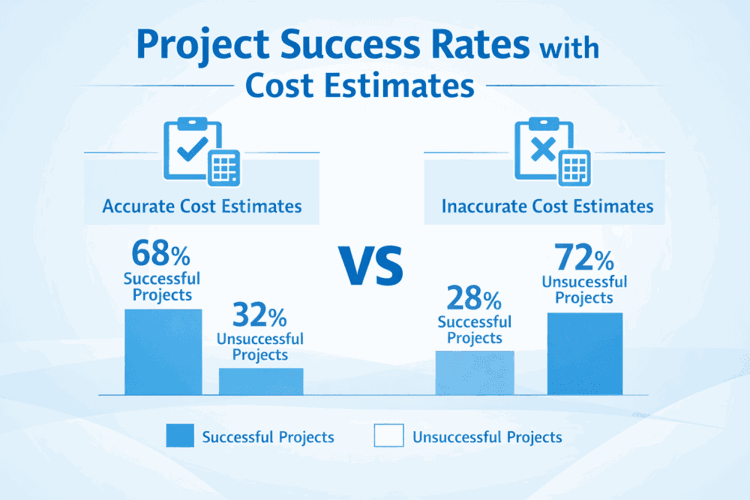
Getting cost estimates right can make or break a software project. When done well, accurate estimates help teams plan resources, set expectations, and deliver successfully. When done poorly, projects risk going off track, blowing budgets, and damaging stakeholder relationships.
Project planning becomes nearly impossible without reliable cost data. Organizations can't allocate resources effectively, prioritize competing initiatives, or make informed build-versus-buy decisions. Finance teams need accurate forecasts for budgeting cycles and cash flow management.
But wait—there's more at stake than just internal planning. Client relationships depend heavily on setting realistic expectations from the start. Nothing erodes trust faster than a project that costs twice the original estimate or takes three times longer than promised.
Accurate estimation also surfaces potential problems early. The process of breaking down requirements and analyzing complexity often reveals technical challenges, missing specifications, or unrealistic timelines before they become expensive surprises mid-development.
Proven Cost Estimation Techniques
Multiple estimation approaches exist, each with distinct strengths and ideal use cases. Most successful teams combine several techniques rather than relying on a single method.
Expert Judgment
This technique relies on the experience and intuition of seasoned developers, architects, and project managers who've built similar systems before. Experts review requirements and provide estimates based on their accumulated knowledge of what comparable projects actually cost.
Expert judgment works best for early-stage estimates when detailed specifications don't yet exist. It's fast and requires minimal formal process. However, it's also subjective and vulnerable to cognitive biases—experts tend toward either excessive optimism or unnecessary pessimism based on recent experiences.
Analogous Estimation
Analogous estimation uses costs from previous similar projects as the baseline. If a team built an e-commerce platform last year for $200,000, a new e-commerce project with comparable scope might cost something similar, adjusted for differences in complexity and requirements.
This approach provides grounding in actual historical data rather than theoretical calculations. The challenge? Finding truly comparable projects. Software varies dramatically—what seems similar on the surface often involves fundamentally different technical requirements.
Parametric Estimation
Parametric models use mathematical formulas that correlate project parameters with cost. The most common example: multiplying the number of features by an average cost per feature, then applying complexity multipliers.
These models work well once an organization has enough historical data to establish reliable patterns. Teams track actual costs across multiple projects, identify correlations between measurable characteristics and final expenses, then build formulas that predict future costs based on those relationships.
According to IEEE research, optimization techniques for parametric models, including genetic algorithms, can improve estimation accuracy by analyzing large datasets of past projects.
Bottom-Up Estimation
Bottom-up estimation breaks the project into individual tasks, estimates each task separately, then aggregates everything into a total. This produces the most detailed and potentially accurate estimates, but requires well-defined requirements and significant upfront analysis effort.
Breaking work into smaller tasks and using proven techniques helps improve accuracy substantially. The granular approach also makes it easier to identify which components carry the most cost and where optimization efforts should focus.
Three-Point Estimation
Instead of a single number, three-point estimation calculates optimistic, pessimistic, and most-likely scenarios, then combines them into a weighted average. This acknowledges uncertainty explicitly rather than pretending estimates are precise predictions.
The formula typically weights the most-likely scenario four times higher than the optimistic and pessimistic extremes, producing a more realistic middle ground that accounts for potential variations.
|
Estimation Technique |
Best Use Case |
Accuracy Level |
Effort Required |
|---|---|---|---|
|
Expert Judgment |
Early-stage, minimal requirements |
Low to Medium |
Low |
|
Analogous Estimation |
Projects similar to past work |
Medium |
Low to Medium |
|
Parametric Estimation |
Organizations with historical data |
Medium to High |
Medium |
|
Bottom-Up Estimation |
Well-defined requirements |
High |
High |
|
Three-Point Estimation |
Projects with significant uncertainty |
Medium to High |
Medium |
Key Factors That Drive Software Development Costs
Understanding what actually influences costs is critical for creating realistic estimates. Several major factors determine whether a project costs $50,000 or $500,000.
Project Scope and Complexity
A simple e-commerce website will cost far less than a comprehensive enterprise resource planning system. Project complexity is determined by the number of features and functionalities, integration requirements with external systems, data management complexity, user interface sophistication, and security requirements.
According to available data, basic MVPs designed for market validation typically range from $20,000 to $100,000. Mid-sized custom applications with more advanced features generally fall between $100,000 and $500,000. Large-scale enterprise systems often exceed $500,000 and can reach several million dollars.
Complexity multiplies costs non-linearly. A project twice as complex doesn't cost twice as much—it often costs three or four times more because complexity creates exponentially more integration points, testing requirements, and potential failure modes.
Team Composition and Location
Developer salaries vary dramatically by experience level and geographic location. Based on current market data, typical annual salaries break down as follows:
- Junior developers: $60,000-$90,000/year
- Mid-level developers: $90,000-$130,000/year
- Senior developers: $130,000-$200,000+/year
- Project managers: $80,000-$140,000/year
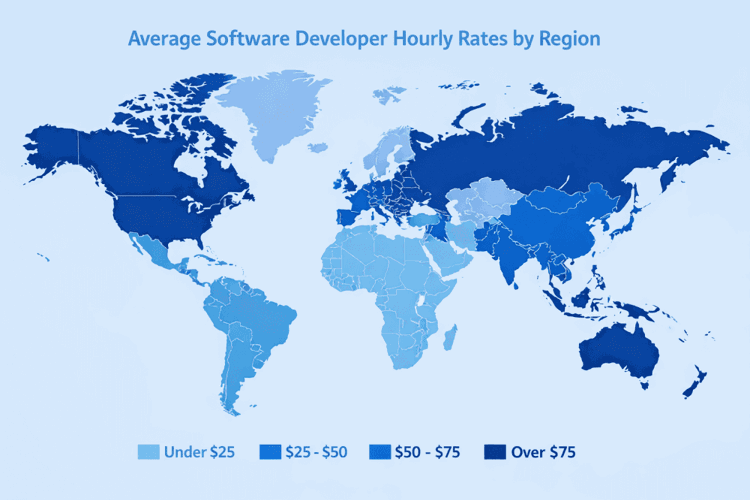
Geographic location creates massive cost variations. North American development teams command premium rates, while offshore teams in Eastern Europe, Asia, or Latin America can reduce costs by 40-70% compared to domestic alternatives.
The tradeoff isn't just about saving money. Offshore development introduces coordination challenges, potential communication barriers, and time zone complications that can extend timelines and reduce efficiency. Teams need to factor these hidden costs into their analysis.
Technology Stack Choices
Some technologies cost more to develop with than others. Specialized or emerging tech stacks often require scarce talent that commands premium rates. Legacy systems might need rare expertise that's expensive to hire.
Open-source frameworks reduce licensing costs but may require more custom development. Proprietary platforms include support and maintenance but come with recurring license fees that accumulate over the product lifecycle.
Integration Requirements
Software rarely exists in isolation. Most applications need to integrate with payment processors, CRM systems, analytics platforms, authentication services, or legacy databases.
Each integration adds development complexity, testing requirements, and ongoing maintenance overhead. Third-party APIs might charge based on usage volume, adding variable costs that grow with success.
User Interface and Experience Design
A basic functional interface costs far less than a polished, custom-designed user experience. Projects requiring extensive UX research, custom animations, responsive design across multiple devices, or accessibility compliance will see design costs increase substantially.
Design iteration cycles also impact costs. Teams that expect multiple rounds of feedback and refinement need to budget for that iterative process.
Quality Assurance and Testing
Testing typically represents 20-30% of total development budget for most projects. Comprehensive testing includes unit testing, integration testing, performance testing, security testing, and user acceptance testing.
Projects with stringent quality requirements, regulatory compliance needs, or high user expectations require more extensive testing coverage, which translates directly to higher costs.
Project Timeline and Urgency
Compressed timelines almost always increase costs. Rushing development might require overtime pay, additional contractors, or parallel work streams that create coordination overhead.
Conversely, projects that drag on too long accumulate costs through extended team salaries, opportunity costs from delayed launch, and increased risk of scope creep.
The Software Development Cost Estimation Process
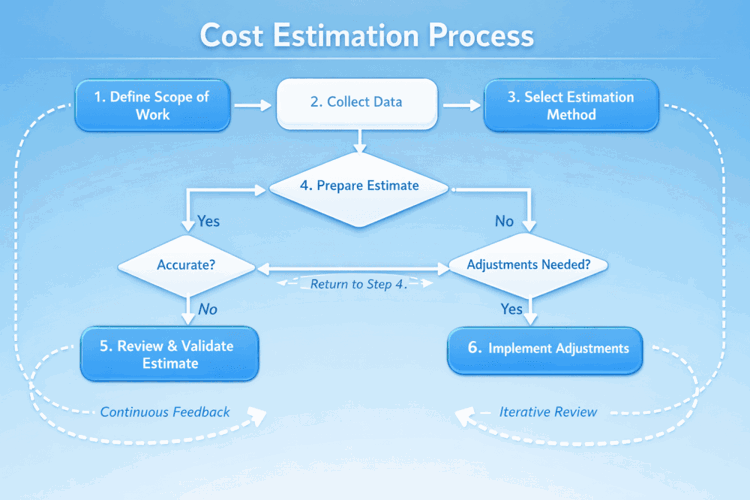
Creating accurate estimates requires a structured approach rather than pulling numbers from thin air. Here's how successful teams build their forecasts.
Step 1: Gather and Analyze Requirements
Everything starts with understanding what needs to be built. Requirements gathering involves stakeholder interviews, user research, competitive analysis, and technical feasibility assessment.
The more detailed and stable the requirements, the more accurate the estimate can be. Vague or constantly changing requirements make estimation nearly impossible.
Step 2: Break Down the Work
Decompose the project into manageable components using a work breakdown structure. This hierarchical decomposition identifies all deliverables, features, and tasks required to complete the project.
ISO standards for project management emphasize the importance of work breakdown structures for effective planning and estimation. Breaking complex projects into smaller pieces makes them easier to understand, estimate, and track.
Step 3: Estimate Each Component
Apply appropriate estimation techniques to each work package. Some components might use analogous estimation based on similar past work, while others require detailed bottom-up analysis.
Involve people who'll actually do the work in the estimation process. Developers understand technical complexity better than project managers or stakeholders, and their input improves accuracy while building ownership.
Step 4: Account for Risk and Uncertainty
Most projects benefit from a 10-20% contingency buffer for unexpected changes. This padding accounts for requirements that weren't fully understood, technical challenges that emerge during development, and minor scope additions.
Higher-risk projects need larger buffers. Projects using unfamiliar technology, working with distributed teams, or lacking clear requirements should include 25-40% contingency.
Step 5: Aggregate and Validate
Sum up individual estimates into a total project cost. Then validate that total against sanity checks: does it align with similar past projects? Does it fit within stakeholder budget constraints? Are there any obvious gaps or overlooked components?
Cross-validation using multiple estimation techniques helps catch errors. If bottom-up estimation produces $300,000 but parametric modeling suggests $150,000, something's wrong and needs investigation.
Step 6: Document Assumptions
Every estimate rests on assumptions about scope, team composition, timeline, technology choices, and external dependencies. Document these explicitly so stakeholders understand what the estimate includes—and what it doesn't.
Clear documentation also makes it easier to update estimates when assumptions change. If stakeholders add features or compress timelines, the documented baseline shows exactly how those changes impact costs.
Common Cost Estimation Mistakes to Avoid
Even experienced teams fall into predictable estimation traps. Recognizing these pitfalls helps avoid them.
Excessive Optimism
The planning fallacy causes people to underestimate how long tasks will take and how much they'll cost. Developers remember the coding time but forget about debugging, testing, code review, documentation, and meetings.
Combat optimism bias by basing estimates on actual historical data rather than aspirational best-case scenarios. What did similar work actually cost in the past, not what it should have cost in theory?
Ignoring Non-Development Costs
Development salaries aren't the only expenses. Projects also require infrastructure and hosting, development tools and licenses, project management overhead, design and UX work, testing and quality assurance, documentation, and training.
These supporting costs often add 30-50% on top of pure development expenses.
Underestimating Integration Complexity
Making two systems talk to each other sounds simple but rarely is. Data format mismatches, authentication challenges, rate limiting, error handling, and maintaining integrations as third-party APIs evolve all create hidden complexity.
Teams frequently underestimate integration work by 2-3x. What seems like a week of work often becomes a month.
Forgetting Maintenance and Updates
Software costs don't end at launch. Ongoing maintenance, bug fixes, security patches, feature updates, and infrastructure costs continue indefinitely.
Annual maintenance typically runs 15-25% of initial development cost. A $200,000 project might require $30,000-$50,000 per year to keep running smoothly.
Scope Creep Blindness
Requirements change during development—always. Stakeholders think of new features, user research reveals missing functionality, technical constraints force design changes.
Estimates that assume perfectly stable requirements are fantasy. Build in explicit processes for evaluating and pricing scope changes rather than absorbing them invisibly.
Cost Estimation for Agile Development
Traditional estimation techniques assume waterfall development with fixed requirements known upfront. Agile methodologies flip that model, embracing changing requirements and iterative development.
IEEE research on advancing Agile software cost estimation through data synthesis examines techniques to improve estimation accuracy in iterative development environments where requirements evolve continuously.
Story Points and Velocity
Agile teams often estimate in story points rather than hours—abstract units that represent relative complexity and effort. After several sprints, teams establish velocity: how many story points they typically complete per sprint.
This velocity becomes the basis for cost estimation. If a backlog contains 200 story points and the team completes 20 points per two-week sprint, the work will take roughly 10 sprints or 20 weeks.
Rolling Wave Planning
Instead of estimating the entire project upfront, Agile teams estimate in detail only for the immediate next sprint or two. Longer-term work gets rough estimates that become more precise as it approaches.
This acknowledges that detailed estimation of distant work is largely wasted effort—requirements will change before that work happens anyway.
Minimum Viable Product Costing
Agile projects often start by estimating an MVP: the minimum feature set needed to deliver core value and validate market fit. This provides a concrete initial budget while deferring decisions about additional features until market feedback is available.
The MVP approach reduces risk by limiting initial investment and allowing data-driven decisions about what to build next.
Tools and Models for Cost Estimation
Various tools and formal models help teams create more accurate estimates.
COCOMO II Model
The Constructive Cost Model (COCOMO II) is one of the most established parametric estimation frameworks. It estimates effort and schedule based on project size (typically measured in source lines of code or function points) adjusted by cost drivers like product complexity, team experience, and tool support.
Research comparing COCOMO II implementations shows that while the model provides a solid foundation, calibration to an organization's specific context significantly improves accuracy.
Software Cost Estimation Calculators
Online cost calculators provide quick rough estimates based on project characteristics. Users input details about features, complexity, team location, and timeline, and the calculator generates an estimated cost range.
These tools work well for ballpark figures but shouldn't replace detailed estimation for actual projects. They're most valuable for initial feasibility assessment or rough budgeting before investing in comprehensive analysis.
Specialized Estimation Software
Project management platforms often include estimation features that track historical data, facilitate expert judgment sessions, and aggregate bottom-up estimates. These tools help teams apply consistent methodologies and learn from past projects.
The best tools don't just calculate numbers—they facilitate collaboration, document assumptions, and make it easy to update estimates as conditions change.
|
Estimation Approach |
Strengths |
Limitations |
|---|---|---|
|
COCOMO II |
Well-researched, industry-standard, handles complexity factors |
Requires calibration, assumes certain development processes |
|
Online Calculators |
Fast, accessible, good for rough estimates |
Generic assumptions, limited customization, low accuracy |
|
Story Points/Velocity |
Works well for Agile, improves with team maturity |
Team-specific, requires historical data, abstract units |
|
Function Point Analysis |
Technology-independent, standardized counting rules |
Time-consuming, requires training, still somewhat subjective |
Strategies for Managing and Reducing Costs
Accurate estimation is only half the battle. Teams also need strategies to control costs and maximize value.
Prioritize Ruthlessly
Not every feature provides equal value. Focus development effort on high-impact capabilities that directly support core business goals. Defer nice-to-have features until after the essential functionality is working.
The 80/20 rule often applies: 20% of features deliver 80% of user value. Identify that critical 20% and build it first.
Consider Offshore Development
Offshore development can reduce total cost of ownership significantly when managed properly. The key is choosing partners carefully, investing in clear communication processes, and maintaining appropriate oversight.
Cost savings mean nothing if quality suffers or timelines extend due to coordination problems. Successful offshore relationships require more than just hiring the cheapest available developers.
Leverage Existing Solutions
Building everything from scratch maximizes costs. Modern development relies heavily on open-source libraries, third-party services, and platform-as-a-service solutions that handle common functionality.
Payment processing, authentication, email delivery, analytics, and many other capabilities are usually cheaper and more reliable when outsourced to specialized services rather than built in-house.
Implement Proper Project Management
Strong project management prevents costly inefficiencies. Clear requirements reduce wasted development effort. Effective communication minimizes misunderstandings and rework. Proactive risk management catches problems early before they become expensive crises.
The ISO standards for project management provide frameworks for governance, planning, and execution that help teams deliver on time and on budget.
Adopt Iterative Development
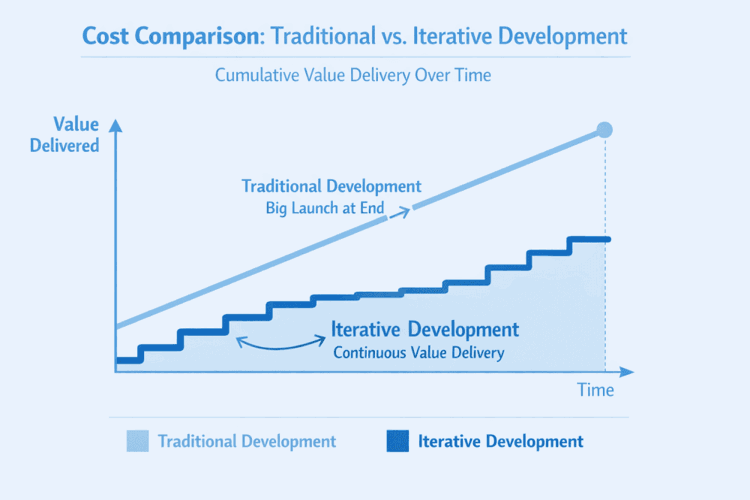
Iterative approaches allow course correction based on real feedback rather than building everything according to initial assumptions that might be wrong. This reduces the risk of investing heavily in features that users don't actually want or use.
Regular releases also generate value earlier, potentially creating revenue streams that fund continued development.
Real-World Cost Examples
Abstract frameworks help, but concrete examples provide context for what software actually costs.
Basic Business Website
A standard business website with 5-10 pages, contact forms, and basic SEO typically costs $5,000-$15,000. This assumes template-based design with minor customization and straightforward content management system implementation.
E-commerce Platform
A custom e-commerce site with product catalog, shopping cart, payment processing, order management, and customer accounts generally ranges from $30,000-$150,000 depending on the number of products, complexity of pricing rules, and integration requirements.
Mobile Application
Consumer mobile apps with moderate complexity—think social features, user profiles, backend integration, and polished UI—typically cost $75,000-$250,000 for both iOS and Android platforms.
Enterprise Software System
Custom enterprise resource planning systems, CRM platforms, or other complex business applications regularly exceed $500,000 and can reach several million dollars. These projects involve extensive integration with existing systems, complex business logic, high security requirements, and comprehensive reporting capabilities.
SaaS Platform
Multi-tenant software-as-a-service platforms with subscription management, role-based access control, API access, and scalable infrastructure typically start around $150,000 and can easily reach $500,000+ for full-featured implementations.
The Role of Technical Debt in Cost Estimation
Technical debt—the accumulated cost of shortcuts and suboptimal decisions made during development—significantly impacts long-term project costs.
According to IEEE research on estimating technical debt through code smells, technical decisions create ongoing costs that compound over time. Quick-and-dirty implementations might save money initially but create maintenance burdens that eventually exceed the original savings.
Smart cost estimation accounts for technical debt explicitly. Teams can choose to incur some debt consciously to ship faster, but they should quantify the expected future cost and plan for eventual remediation.
Technical debt typically creates significant future costs through reduced development velocity, increased bug rates, and eventual refactoring requirements.
When to Re-Estimate
Estimates aren't set in stone. Several situations warrant updated forecasts.
Significant scope changes require re-estimation. If stakeholders add major features or fundamentally change requirements, the original estimate no longer applies.
Major technical discoveries also trigger updates. Finding that a critical integration is impossible or that performance requirements need completely different architecture affects costs substantially.
Team composition changes can invalidate estimates. Losing key senior developers or adding junior team members changes velocity and capability.
After completing 20-30% of a project, teams should validate whether actual costs are tracking to estimates. Significant variances at this point predict problems that will only worsen without intervention.
Communicating Estimates to Stakeholders
How estimates are presented matters almost as much as the numbers themselves.
Present ranges rather than single numbers. "$200,000-$250,000" communicates uncertainty more honestly than "$225,000" which implies false precision.
Explain confidence levels explicitly. "We have high confidence in this estimate because we've built similar systems before" differs from "This is preliminary because requirements are still evolving."
Break down costs into major categories so stakeholders understand where money goes. Showing that 40% is development, 20% is design, 20% is testing, and 20% is project management helps justify the total.
Document what's included and what isn't. Stakeholders often assume estimates include everything when they actually cover only core development, excluding hosting, ongoing maintenance, or future feature additions.
Frequently Asked Questions
How accurate should software cost estimates be?
Early rough estimates might have ±50% accuracy, meaning a $100,000 estimate could reasonably end up between $50,000-$150,000. As requirements solidify and design progresses, estimates should tighten to ±20% or better. Detailed estimates for well-defined projects can achieve ±10% accuracy, though perfect precision is never possible given software development's inherent uncertainty.
What percentage of project budget should go to testing?
Testing typically represents 20-30% of total development budget for most projects. High-reliability systems like medical software or financial platforms might allocate 40-50% to testing. Projects with aggressive timelines sometimes cut testing to 10-15%, but this increases risk of quality issues and post-launch bug fixes that often cost more than proper testing would have.
Should estimates include maintenance costs?
Initial project estimates typically cover development through launch but should clearly state whether they include ongoing maintenance. Annual maintenance usually costs 15-25% of initial development investment. Organizations need to budget for both the one-time development cost and recurring maintenance expenses to understand total cost of ownership.
How do you estimate projects with unclear requirements?
When requirements are vague, provide a range-based estimate with explicit assumptions and plan for iterative refinement. Consider estimating a discovery phase first—a 2-4 week effort to clarify requirements and create a more accurate detailed estimate. Alternatively, propose building an MVP with fixed scope and budget, then reassessing based on learnings before committing to full development.
What's the best estimation technique for small projects?
Small projects under $50,000 benefit most from analogous estimation combined with expert judgment. The overhead of formal parametric models or detailed bottom-up estimation often isn't justified. Find similar past projects, adjust for differences, and add a reasonable contingency buffer. The entire estimation process shouldn't take more than a few hours.
How do you account for unknown unknowns in estimates?
Build contingency buffers into estimates explicitly—typically 10-20% for known risks and another 10-20% for unforeseen challenges. For projects with high uncertainty, consider using agile approaches with fixed time/budget increments rather than trying to estimate the entire project upfront. This limits exposure while preserving flexibility to adapt as unknowns become known.
Can AI or machine learning improve cost estimation accuracy?
Research shows that machine learning techniques can improve estimation accuracy when organizations have substantial historical project data. AI models can identify patterns in past projects and predict costs based on project characteristics. However, these approaches require significant data volume and quality to work effectively. Most organizations benefit more from improving their basic estimation processes before investing in AI-enhanced tools.
Moving Forward with Confidence
Software development cost estimation isn't about predicting the future perfectly—it's about making informed decisions with incomplete information.
The techniques and frameworks covered here provide structure for that decision-making process. Combining multiple estimation approaches, understanding key cost drivers, accounting for uncertainty explicitly, and learning from past projects all contribute to increasingly accurate forecasts.
Start by choosing estimation techniques appropriate to your project's stage and requirements clarity. Document assumptions carefully. Involve the people who'll do the work. Build in reasonable contingency. And update estimates as conditions change rather than treating initial numbers as unchangeable commitments.
The organizations that excel at cost estimation share a common trait: they treat estimation as a core competency worth investing in, not an annoying administrative requirement to rush through. They track actual costs against estimates, analyze variances, and continuously refine their approaches.
That same commitment to improvement can transform estimation from a source of project anxiety into a strategic advantage that enables better planning, stronger stakeholder relationships, and more successful software delivery.
Ready to improve your software cost estimation process? Start by reviewing your last three projects—compare initial estimates to actual costs, identify where the biggest variances occurred, and determine what you'd estimate differently next time. That retrospective analysis creates the foundation for more accurate future forecasts.


