

SaaS Development Cost 2026: Complete Budget Guide

Highlights: Building a SaaS application in 2026 costs between $15,000 for a basic MVP and $500,000+ for enterprise-grade platforms. Key factors include development complexity, team location, feature scope, and infrastructure needs. Most founders should budget $40,000-$150,000 for a competitive mid-market SaaS product with essential features.
The SaaS market shows no signs of slowing down. According to Statista Market Insights, revenue in the Software as a Service market worldwide is projected to reach US$512.27 billion in 2026. With that kind of market potential, founders everywhere are asking the same question: what does it actually cost to build a SaaS product right now?
Here's the thing though—SaaS development costs vary wildly depending on what gets built, who builds it, and how fast it needs to launch. A simple automation tool might run $20,000. A complex enterprise platform could hit $300,000 before launch.
This guide breaks down real-world SaaS development costs based on actual project data, not theoretical estimates. The numbers reflect current 2026 market rates, including how AI tools and modern development practices have shifted the economics of building software.
SaaS Development Cost: The Quick Numbers
Most founders want the bottom line first. Based on analysis of current market rates and project scopes, here's what SaaS development actually costs in 2026:
|
SaaS Complexity Level |
Cost Range |
Timeline |
What's Included |
|---|---|---|---|
|
Micro-SaaS / Prototype |
$15,000 – $30,000 |
4 – 8 weeks |
Basic core function, standard UI, essential features only |
|
Basic MVP |
$25,000 – $60,000 |
8 – 16 weeks |
Core features, user auth, basic integrations, responsive design |
|
Mid-Level Product |
$60,000 – $150,000 |
3 – 6 months |
Advanced features, multiple integrations, custom UI/UX, API |
|
Enterprise-Grade Platform |
$150,000 – $500,000+ |
6 – 12+ months |
Complex architecture, compliance, security, scalability, multi-tenancy |
These numbers represent total development costs from initial design through launch. But wait. The actual number for any specific project depends on dozens of variables that can push costs up or down by 50% or more.

Estimate Your SaaS Development Cost
SaaS development costs depend on multi tenant architecture, subscription logic, integrations, and scalability requirements. OSKI Solutions defines system architecture first and then calculates development effort based on real functionality. The estimate includes backend, frontend, infrastructure, and deployment stages. You receive a structured budget instead of a broad range.
Ready to Plan Your SaaS Budget?
Talk with OSKI Solutions to:
- define core SaaS functionality and user roles
- estimate infrastructure and scalability effort
- receive a detailed SaaS cost breakdown
👉 Request a SaaS development quote from OSKI Solutions.
Build a Scalable SaaS Platform
We design and develop secure, cloud-native SaaS products engineered for performance, growth, and reliability.
Breaking Down SaaS Development Costs by Phase
SaaS development isn't a single expense. It's a series of phases, each with distinct costs. Understanding this breakdown helps founders allocate budget more effectively and identify where to cut costs without killing the product.
Discovery and Planning Phase
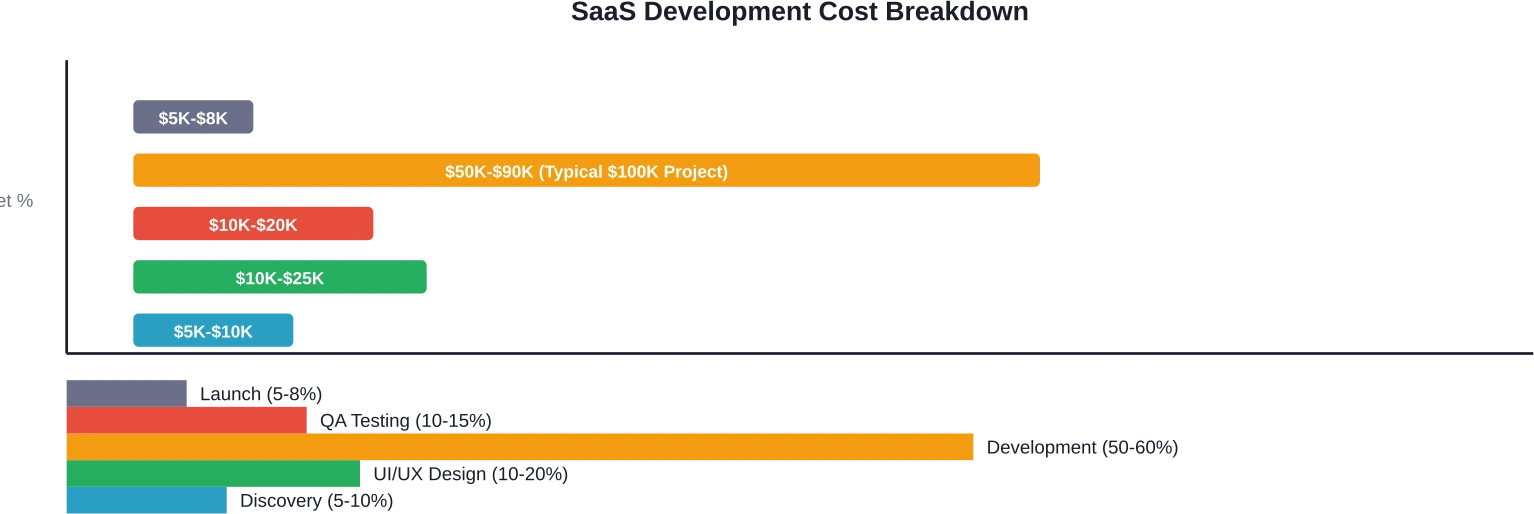
Before writing a single line of code, successful SaaS projects start with discovery. This phase typically costs $3,000 to $15,000 depending on project complexity.
Discovery includes market research, competitive analysis, feature prioritization, technical architecture planning, and user flow mapping. Teams that skip this phase often end up rebuilding features or pivoting mid-development, which costs far more than proper planning.
For a $100,000 total project budget, expect to allocate 5-10% to discovery and planning. The percentage drops for larger projects and increases for innovative products without clear market precedent.
UI/UX Design Phase
Design costs represent 10-20% of total SaaS development budgets. For a mid-level SaaS project, that translates to $8,000 to $25,000.
This phase covers wireframing, user interface design, user experience optimization, design systems, and responsive layouts across devices. Quality design directly impacts user adoption and retention, making it one of the worst places to cut corners.
Modern design tools and component libraries have reduced design costs somewhat in 2026, but custom, conversion-optimized interfaces still require significant investment.
Core Development Phase
Development represents the largest cost center, typically consuming 50-60% of the total budget. For a $100,000 project, that's $50,000 to $60,000 in pure development costs.
This phase includes frontend development, backend architecture, database design, API development, third-party integrations, and authentication systems. The tech stack chosen here dramatically impacts both initial costs and long-term maintenance expenses.
Development costs have shifted in 2026 due to AI-assisted coding tools. Some developers report 20-30% productivity gains using AI pair programming tools, though the impact varies significantly based on project complexity and developer experience.
Quality Assurance and Testing
QA typically costs 10-15% of development budgets, or $7,000 to $20,000 for mid-market SaaS products. This covers functional testing, integration testing, performance testing, security testing, and user acceptance testing.
Cutting QA costs is tempting but dangerous. Bugs discovered after launch cost 5-10 times more to fix than those caught during development, not counting the reputational damage and customer churn.
Deployment and Launch
Getting a SaaS product live costs $2,000 to $8,000 for most projects. This includes server setup, domain and SSL configuration, CI/CD pipeline setup, monitoring and logging implementation, and initial security hardening.
Cloud infrastructure choices significantly impact launch costs. A basic AWS or DigitalOcean setup might run $500-$1,000 to configure, while complex multi-region deployments on enterprise cloud platforms can exceed $5,000 just for setup.
The 7 Factors That Control SaaS Development Costs
Two seemingly similar SaaS products can have wildly different price tags. These seven factors explain most of the variation in development costs across projects.
1. Feature Complexity and Scope
Feature count matters, but feature complexity matters more. A simple CRUD application with user authentication might take 100-150 development hours. Add real-time collaboration features like Figma or Notion, and that jumps to 400+ hours.
Each major feature category adds cost layers. Payment processing integration costs $3,000-$8,000. Real-time notifications add $4,000-$10,000. Advanced search with filters costs $5,000-$15,000. Multi-language support adds $8,000-$20,000.
The trap most founders fall into is building everything at once. An MVP should validate core assumptions, not showcase every possible feature. Feature creep is the number one cause of budget overruns in SaaS development.
2. Development Team Location and Structure
Where the development team sits determines hourly rates, which multiply across hundreds or thousands of hours. North American developers charge $100-$200+ per hour. Eastern European teams charge $40-$80 per hour. South Asian developers charge $20-$50 per hour.
For a 500-hour project, that's the difference between $10,000 and $100,000 in labor costs alone. But hourly rate isn't the only factor. Communication efficiency, time zone overlap, code quality, and project management overhead all impact total cost and timeline.
According to data from Modall, Canadian SaaS development offers approximately a 30-40% discount due to currency arbitrage and favorable government incentives, with Canadian developers in the $80-$120 hourly range compared to US Silicon Valley rates.
3. Technology Stack Decisions
Technology choices ripple through every cost category. Some stacks enable faster development but higher hosting costs. Others require more upfront development time but scale more efficiently.
Modern JavaScript frameworks like React or Vue paired with Node.js backends represent the most common mid-market SaaS stack, balancing development speed with performance. This approach typically costs 10-20% less than enterprise Java or .NET stacks for equivalent functionality.
Serverless architectures reduce initial infrastructure costs but may increase per-transaction costs at scale. Traditional server deployments cost more upfront but offer predictable scaling economics.
4. Integration Requirements
Most SaaS products don't exist in isolation. Integration with payment processors, CRM systems, marketing tools, analytics platforms, and industry-specific software is standard.
Simple API integrations cost $1,000-$3,000 each. Complex integrations with custom data mapping, webhook handling, and error recovery cost $5,000-$15,000 per integration. Products requiring 5-10 integrations should budget $20,000-$50,000 just for connectivity.
5. Security and Compliance Needs
Basic security practices are table stakes, but regulatory compliance adds substantial costs. GDPR compliance implementation costs $10,000-$30,000. HIPAA compliance for healthcare SaaS adds $30,000-$100,000. SOC 2 certification costs $20,000-$50,000 annually.
Financial services, healthcare, and government-focused SaaS products face the highest compliance burdens. Consumer SaaS products with basic data protection needs sit at the lower end of security costs.
6. Scalability and Performance Requirements
Building for 100 users costs far less than building for 100,000. A basic application handling modest traffic might run on a $50/month server. An application designed for viral growth needs load balancers, database clustering, caching layers, and CDN integration from day one.
Infrastructure architecture for scale adds 20-40% to development costs. But premature scaling is expensive too. Most successful SaaS products start simple and scale incrementally as user growth demands it.
7. Design Customization Level
Template-based designs using component libraries like Material UI or Chakra UI cost 40-60% less than fully custom interfaces. A template-based design might run $5,000-$12,000 versus $15,000-$40,000 for custom design work.
The right choice depends on competitive positioning. In crowded markets, distinctive design creates differentiation. In emerging categories, speed to market matters more than visual polish.
Hidden Costs That Blow SaaS Budgets
The initial development budget is just the beginning. Smart founders account for costs that emerge during and after development.
Third-Party Services and Tools
SaaS products typically rely on 10-20 third-party services. Email delivery through SendGrid or Mailgun costs $10-$100+ monthly. Error tracking with Sentry runs $25-$100 monthly. Analytics tools cost $50-$300 monthly. Customer support platforms cost $50-$200+ monthly.
These subscriptions seem small individually but compound quickly. Budget $200-$800 monthly for essential services even before launch, scaling to $1,000-$5,000+ monthly as the product grows.
Infrastructure and Hosting
Cloud hosting costs start low but scale with usage. A typical SaaS MVP runs on $100-$500 monthly infrastructure. That grows to $500-$2,000 monthly at 1,000 active users, and $2,000-$10,000+ monthly at 10,000+ users.
Database costs, file storage, bandwidth, and computing resources all scale independently. Unexpected viral growth can generate surprise infrastructure bills. Usage-based pricing sounds attractive until usage explodes.
Ongoing Maintenance and Updates
Launching isn't the finish line. Bug fixes, security patches, dependency updates, and minor improvements consume 15-25% of the original development cost annually. A $100,000 initial build requires $15,000-$25,000 yearly just to maintain.
Major feature additions, redesigns, and platform expansions cost extra. Most successful SaaS products spend 30-50% of the original development cost annually on improvements and new features.
Customer Acquisition and Marketing
Building great software means nothing if nobody uses it. Customer acquisition costs vary wildly by market, but B2B SaaS companies typically spend $1-$5 to acquire $1 of monthly recurring revenue.
To reach $10,000 MRR, expect to invest $10,000-$50,000 in marketing and sales. Enterprise SaaS with complex sales cycles can require $100,000+ in marketing spend to reach meaningful revenue levels.
Regional Cost Differences: Where Development Happens
Geography remains one of the biggest cost variables in SaaS development, even as remote work becomes standard.
|
Region |
Average Hourly Rate |
500-Hour Project Cost |
Key Considerations |
|---|---|---|---|
|
US (Silicon Valley) |
$150 – $250 |
$75,000 – $125,000 |
Highest quality, best local market knowledge, expensive |
|
US (Other Markets) |
$100 – $175 |
$50,000 – $87,500 |
High quality, moderate costs, easier collaboration |
|
Canada |
$80 – $130 |
$40,000 – $65,000 |
Strong talent, favorable exchange rate, government incentives |
|
Western Europe |
$70 – $120 |
$35,000 – $60,000 |
Quality talent, potential time zone challenges with US clients |
|
Eastern Europe |
$40 – $80 |
$20,000 – $40,000 |
Strong technical skills, moderate communication barriers |
|
South Asia |
$20 – $50 |
$10,000 – $25,000 |
Lowest costs, significant time zone and communication challenges |
Lower rates don't always mean lower total costs. Communication overhead, revision cycles, and quality issues can offset hourly savings. A $30/hour developer who needs extensive guidance and produces buggy code costs more than a $100/hour developer who works independently and ships clean code.
How AI Has Changed SaaS Development Economics
AI code generation tools have legitimately changed development economics in 2026, though not as dramatically as some claim. Real talk: AI isn't replacing developers, but it's making good developers faster.
Experienced developers report 20-30% productivity gains using tools like GitHub Copilot, ChatGPT, and Claude for coding assistance. That translates to real cost savings on straightforward development tasks.
But here's the catch—AI productivity gains concentrate in commodity code. Database CRUD operations, API endpoint boilerplate, form validation, and standard UI components get faster. Complex business logic, architectural decisions, performance optimization, and debugging still require full human attention.
For a typical SaaS project, AI tools might reduce development time by 15-20% overall, translating to cost savings of $10,000-$20,000 on a $100,000 project. Substantial, but not revolutionary.
Some developers now advertise AI-accelerated development with lower pricing. Treat these claims carefully. The best developers were already using productivity tools and weren't overcharging. The worst developers using AI might produce more code faster, but code volume isn't quality.
The Changing Economics of SaaS Pricing Models
Something significant is shifting in how SaaS companies think about pricing, which impacts how to structure development investments.
IDC predicts that by 2028, pure seat-based pricing will be obsolete, with 70% of software vendors refactoring their pricing strategies around new value metrics such as consumption, outcomes, or organizational capability.
What does this mean for development costs? Products built around seat-based models optimize for user management, permission systems, and per-seat feature gating. Products built around usage-based models optimize for metering, rate limiting, and consumption tracking.
The technical architecture supporting usage-based pricing typically costs 15-30% more to implement than simple seat-based systems. But it may better align with how customers want to buy software in 2026 and beyond.
Cost Optimization Strategies That Actually Work
Smart founders find legitimate ways to reduce costs without compromising product viability.
Start With the Minimum Viable Product
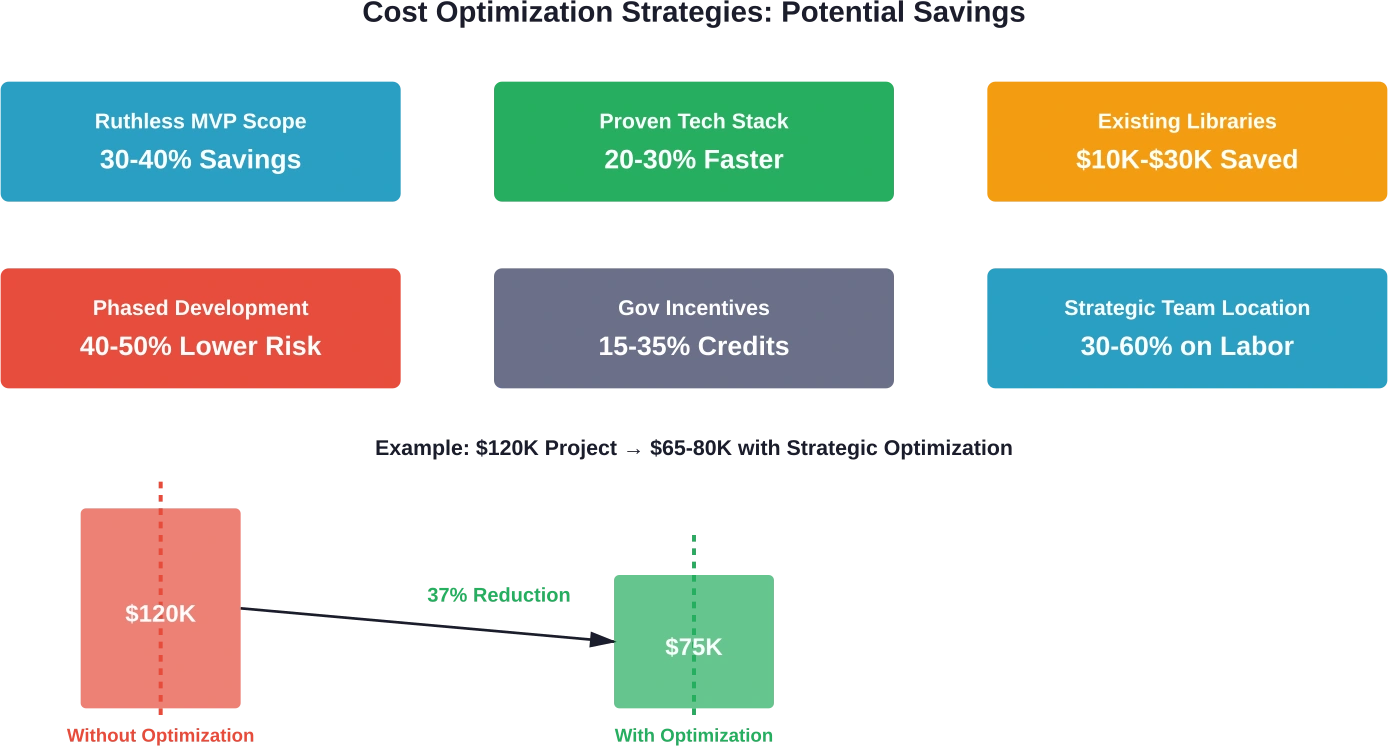
The most effective cost control is ruthless scope management. Every feature added to the initial release multiplies costs and delays launch.
A true MVP includes only features absolutely necessary to test core assumptions. User authentication? Required. Social login? Maybe not. Basic dashboard? Required. Advanced analytics? Later. Payment processing? Only if monetization is the core assumption being tested.
Cutting an MVP from 15 features to 8 features doesn't reduce costs by 50%, because core infrastructure remains constant. But it typically reduces costs by 30-40% while accelerating time to market dramatically.
Choose Proven Technology Stacks
Exotic technology choices increase costs. Developers charge premiums for unusual stacks, and fewer developers means higher rates and less competition.
Popular stacks like React/Node.js, Vue/Laravel, or Rails offer abundant talent, extensive documentation, rich ecosystem libraries, and clear best practices. These advantages translate to 20-30% faster development than niche alternatives.
Use Existing Components and Libraries
Building custom solutions for solved problems wastes money. Authentication systems, payment processing, email delivery, file uploads, and user interfaces have mature, well-tested libraries available.
A custom-built authentication system might cost $8,000-$15,000 and introduce security risks. Auth0, Firebase Auth, or similar services cost $50-$300 monthly and provide enterprise-grade security out of the box.
The break-even point where custom solutions make economic sense usually sits around 10,000+ active users for most features.
Plan for Phases, Not Perfection
Launching with 70% of the envisioned product costs far less than launching with 100%, and gets market feedback months earlier. That feedback typically reshapes priorities anyway, making some planned features irrelevant.
Budget for 2-3 development phases. Phase 1 validates core assumptions with an MVP. Phase 2 adds features based on actual user feedback. Phase 3 scales and optimizes based on real usage patterns.
This approach feels slower but actually reaches product-market fit faster and cheaper than trying to build the complete vision upfront.
Leverage Government Incentives
Several jurisdictions offer incentives for software development. Canada's SR&ED (Scientific Research and Experimental Development) program provides tax credits covering up to 35% of development costs for qualifying projects.
These programs require additional documentation and have specific eligibility criteria, but can significantly reduce net development costs for qualifying companies. Similar programs exist in Australia, UK, and several US states.
When to Build In-House vs. Outsource
The build-versus-buy decision extends to the development team itself. Each approach has distinct cost implications.
In-House Development Costs
Building an internal team means hiring developers, designers, and product managers as full-time employees. According to the U.S. Bureau of Labor Statistics, the median annual wage for computer programmers was $98,670 in May 2024, while software developers earned $133,080 annually according to 2024 projections.
Total employment costs run 1.3-1.5x base salary when accounting for benefits, taxes, equipment, and overhead. A three-person team (two developers, one designer) costs $300,000-$450,000 annually in total compensation, not counting management overhead.
In-house development makes sense for companies with ongoing development needs, complex proprietary technology, or strict IP protection requirements. For first-time founders building an initial MVP, it's usually cost-prohibitive.
Agency and Contractor Costs
Outsourcing transfers project risk and timeline pressure to the vendor while eliminating long-term employment obligations. Agencies charge $100-$250 per hour depending on location and expertise, with project minimums typically starting around $25,000.
Contractors provide flexibility between full outsourcing and in-house teams. Experienced independent contractors charge $75-$200 per hour depending on skills and location.
The main risk with outsourcing is misalignment. Vendors optimize for billable hours and project completion, not long-term product success. Clear requirements, detailed specifications, and active project oversight are essential.
Hybrid Approaches
Many successful SaaS companies start with a hybrid model. A technical co-founder or CTO provides strategic direction and core architecture, while contractors or agencies handle execution velocity.
This approach costs 20-30% more in direct expenses versus pure outsourcing but dramatically reduces risk of building the wrong thing or accumulating technical debt.
Real-World SaaS Development Cost Examples
Abstract numbers help, but concrete examples make costs tangible. Based on actual project data, here's what different types of SaaS products cost to build in 2026.
Simple Productivity Tool
A task management or note-taking application with user accounts, basic CRUD operations, and simple sharing features typically costs $25,000-$50,000 to build. Timeline runs 8-12 weeks. This assumes template-based design, standard tech stack, and no complex integrations.
Monthly operating costs run $300-$800 for hosting, tools, and services. This model works for micro-SaaS products targeting niche markets where speed to market matters more than feature richness.
Industry-Specific Business Tool
A specialized SaaS product for a specific industry, like a contractor estimation tool or salon scheduling system, costs $60,000-$120,000. These products need industry-specific features, moderate complexity integrations, custom workflows, and professional design.
Timeline runs 3-5 months. Monthly operating costs reach $800-$2,000. Customer acquisition costs per user typically run higher due to targeted marketing requirements, but lifetime value is also higher in specialized verticals.
Collaboration Platform
A product enabling team collaboration, like project management, document sharing, or communication tools, costs $100,000-$250,000. These require real-time features, complex permission systems, multi-user coordination, and scalable architecture.
Timeline extends to 6-10 months. Monthly costs run $2,000-$5,000+ depending on active usage. Competition is fierce in collaboration software, requiring substantial ongoing feature development to stay relevant.
Enterprise SaaS Platform
Full-featured platforms targeting enterprise customers with complex workflows, compliance requirements, extensive integrations, and advanced security cost $250,000-$500,000+. Some enterprise products exceed $1 million in initial development costs.
Timeline runs 9-18+ months. Monthly operating costs start at $5,000 and scale rapidly with enterprise customer onboarding. But enterprise contracts typically range from $50,000-$500,000+ annually, justifying the investment.
Post-Launch Costs: The First Year
Launch day marks the beginning of ongoing expenses. First-year costs typically exceed initial development costs for successful products.
A SaaS product with $100,000 initial development costs should budget:
- $15,000-$25,000 for maintenance, bug fixes, and security updates
- $20,000-$50,000 for feature additions based on customer feedback
- $30,000-$80,000 for customer acquisition and marketing
- $12,000-$24,000 for infrastructure and third-party services
- $10,000-$30,000 for customer support and success operations
Total first-year costs run $87,000-$209,000, nearly equaling or exceeding the initial build cost. The second year typically costs 60-80% of the first year as processes stabilize and customer acquisition becomes more efficient.
The SaaS Market Context in 2026
Understanding market dynamics helps founders make informed investment decisions about development budgets.
According to Statista Market Insights, revenue in the Software as a Service market worldwide is projected to reach US$512.27 billion in 2026, with revenue expected to grow at 14.71% annually through 2030, reaching $887.05 billion. The average spend per employee globally is anticipated to reach $136.34 in 2026.
This growth creates opportunities but also intensifying competition. In most categories, dozens or hundreds of SaaS products compete for attention. Standing out requires either distinctive functionality, superior user experience, or focused positioning on underserved niches.
Employment in computer and information technology occupations is projected to grow much faster than the average for all occupations from 2024 to 2034, according to the U.S. Bureau of Labor Statistics, with about 317,700 openings projected each year on average.
Strong developer demand keeps development costs elevated. Founders hoping for declining development costs in coming years will likely be disappointed. Productivity tools like AI assistants create modest savings, but developer salaries continue climbing in most markets.
Common Cost Overrun Causes
Most SaaS projects exceed initial budgets. Understanding why helps founders avoid predictable pitfalls.
Scope Creep
The number one cause of budget overruns is adding features during development. Each "small addition" seems reasonable in isolation, but ten small additions equals a 40-60% budget increase.
Disciplined product management treats the initial scope as fixed. New ideas go on a post-launch roadmap, not into the MVP.
Underestimating Integration Complexity
Third-party integrations consistently take longer than estimated. API documentation is incomplete, authentication flows are confusing, webhook implementations are flaky, and error handling requires extensive testing.
Budget 1.5-2x the initial estimate for integration work. A seemingly simple payment integration estimated at $5,000 often costs $7,500-$10,000 by the time edge cases are handled.
Inadequate Testing and QA
Cutting QA time during development creates expensive problems after launch. A bug that takes 2 hours to fix during development takes 10+ hours after launch, including hot-fix deployment, customer communication, and reputation management.
Allocate 15-20% of development time to testing, even when timelines are tight. The alternative is shipping broken software and losing early customers.
Technical Debt
Rushing development creates technical shortcuts that require expensive refactoring later. Poor database design, inadequate caching, hardcoded values, and missing abstraction layers all seem to save time initially but create multiplication problems.
Technical debt isn't inherently bad—some shortcuts make sense for MVPs. But founders should understand which shortcuts are being taken and budget for cleanup once product-market fit is validated.
Calculating ROI on SaaS Development Investment
Development costs mean nothing without context about expected returns. SaaS businesses benefit from recurring revenue models that can generate substantial lifetime value from each customer.
A typical B2B SaaS product priced at $50-$200 per month generates $600-$2,400 in annual revenue per customer. With 3-5 year average customer lifetimes (varies dramatically by category), lifetime value per customer runs $1,800-$12,000.
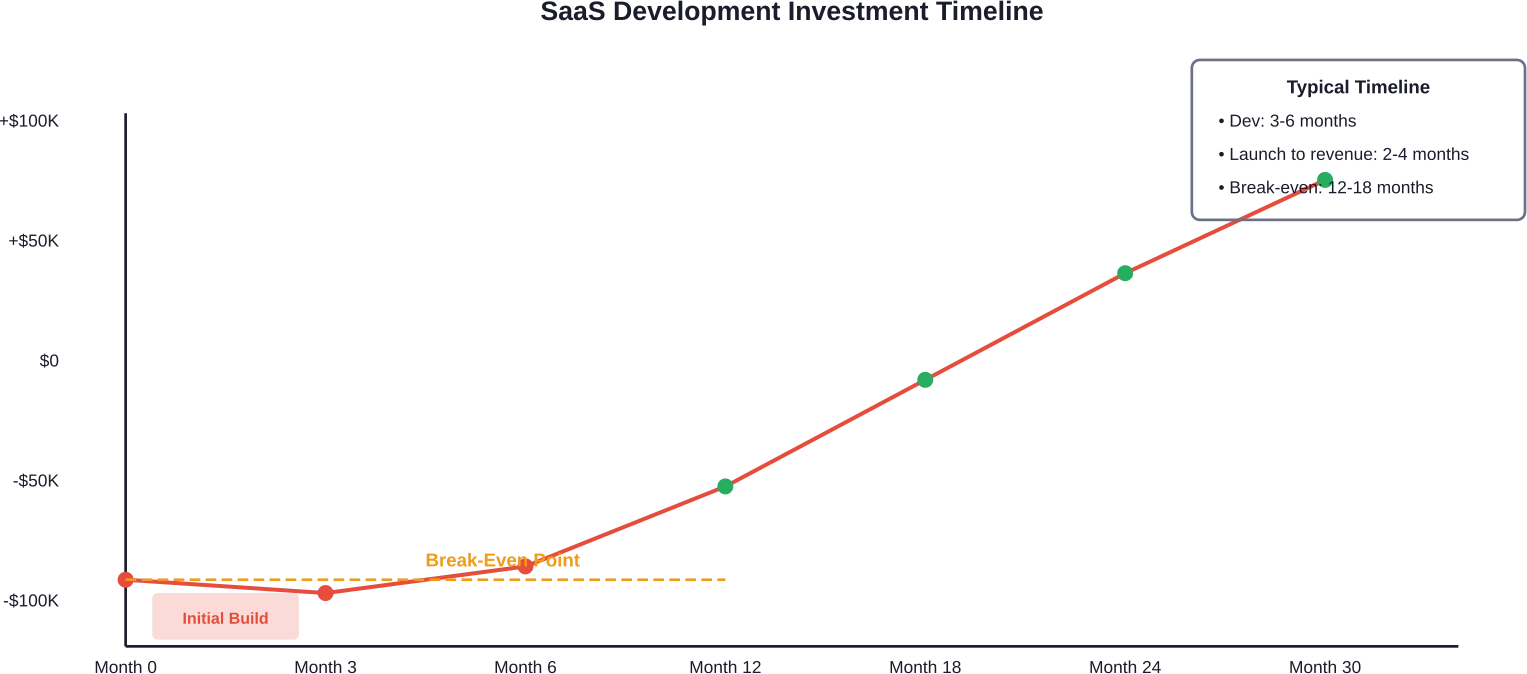
A $100,000 development investment breaks even at roughly 10-50 customers, depending on pricing and costs. Most SaaS products reach break-even within 12-24 months if product-market fit is achieved.
The key word there is "if." Most SaaS products fail to achieve meaningful traction. Development costs should be considered risk capital that may generate zero return. Founders should only invest amounts they can afford to lose entirely.
Making the Build Decision
After reviewing costs, some founders question whether building custom SaaS makes sense. Alternative approaches exist, each with tradeoffs.
No-Code Platforms
Tools like Bubble, Webflow, and Airtable enable building functional applications without code. Costs run $5,000-$20,000 for a no-code MVP, a fraction of custom development.
The limitations are real though. No-code platforms struggle with complex business logic, performance at scale, custom integrations, and unique functionality. They work brilliantly for simple applications but hit walls quickly as requirements grow.
White-Label Solutions
Some industries have white-label SaaS platforms that can be rebranded and resold. Setup costs run $2,000-$15,000 versus building from scratch.
The tradeoff is differentiation. White-label products offer limited customization, making it hard to stand out from competitors using the same underlying platform. These work better for service businesses bundling software with consulting than pure SaaS plays.
Custom Development
Building custom software costs more upfront but provides maximum flexibility, complete IP ownership, unlimited scalability, and full differentiation potential. For founders with venture ambitions or planning to dominate a category, custom development is the only real option.
Funding Your SaaS Development
Most founders can't write a $100,000 check for SaaS development. Funding options include:
Bootstrapping: Self-funding provides complete control and ownership but limits scope. Bootstrapped founders should ruthlessly minimize MVP scope and potentially start with no-code or simple solutions before investing in custom development.
Pre-sales: Selling annual subscriptions before building generates development capital and validates demand simultaneously. Landing 10-20 customers at $3,000-$5,000 annual contracts funds a $30,000-$100,000 MVP. This approach requires strong sales skills and a compelling vision.
Angel Investment: Angel investors provide $25,000-$250,000 typically in exchange for 10-25% equity. Angels often provide valuable advice and connections beyond capital. The tradeoff is dilution and accountability to investors.
Venture Capital: VC funding starts around $500,000 and scales to millions for later rounds. VC makes sense for businesses needing significant capital to capture winner-take-all markets. The tradeoff is substantial dilution and pressure for rapid growth.
Grants and Incentives: Government programs in various jurisdictions provide non-dilutive funding for technology development. These require extensive applications and reporting but don't cost equity.
Frequently Asked Questions
How much does it cost to build a basic SaaS MVP in 2026?
A basic SaaS MVP costs between $25,000 and $60,000 in 2026, covering core features, user authentication, basic integrations, and responsive design. Development typically takes 8-16 weeks. This assumes using established technology stacks, template-based design, and experienced developers. Micro-SaaS products with extremely limited scope can sometimes be built for $15,000-$30,000, while complex MVPs with advanced features easily exceed $60,000.
What factors most significantly impact SaaS development costs?
Feature complexity drives costs more than any other factor. Real-time collaboration, complex business logic, and advanced integrations multiply development time dramatically. Developer location creates 3-5x cost differences, with North American developers charging $100-$200+ hourly versus $20-$50 for South Asian developers. Technology stack choices affect development speed by 20-30%, and compliance requirements like HIPAA or SOC 2 can add $30,000-$100,000 to budgets.
How have AI tools affected SaaS development costs in 2026?
AI coding assistants like GitHub Copilot reduce development time by approximately 15-25% for experienced developers working on standard features. This translates to cost savings of $10,000-$25,000 on typical $75,000-$125,000 projects. The impact concentrates on commodity code like CRUD operations, API boilerplate, and standard UI components. Complex business logic, architecture decisions, and debugging still require full human attention, limiting overall AI productivity gains.
What ongoing costs should I budget after launching my SaaS product?
First-year post-launch costs typically match or exceed initial development costs. Budget 15-25% of development costs annually for maintenance and updates. Infrastructure costs start at $100-$500 monthly and scale with users. Third-party services cost $200-$1,000+ monthly. Customer acquisition often requires $1-$5 in marketing spend per $1 of monthly recurring revenue. Total first-year operating costs for a $100,000 initial build typically run $75,000-$200,000 depending on growth rate.
Is it cheaper to build a SaaS product in Canada versus the United States?
Canadian SaaS development costs approximately 30-40% less than Silicon Valley rates while maintaining comparable quality, according to development agencies operating in both markets. Canadian developers charge $80-$130 hourly versus $150-$250 in major US tech hubs. Canada also offers government incentives like SR&ED tax credits covering up to 35% of development costs. A project costing $120,000 in California might cost $70,000-$85,000 in Canada before factoring in tax credits.
Should I use a development agency or hire individual contractors?
Agencies provide complete teams, project management, and accountability but charge premium rates ($100-$250 hourly) with typical minimums around $25,000. Individual contractors cost less ($75-$150 hourly) and offer flexibility but require more management oversight and carry single-point-of-failure risk. For first-time founders without technical backgrounds, agencies reduce risk despite higher costs. Technical founders comfortable managing development often save 20-30% using contractors while maintaining quality control.
Can I build a competitive SaaS product for under $50,000?
Building a competitive SaaS product for under $50,000 is possible but requires strategic constraints. Focus on micro-SaaS serving a specific niche rather than competing broadly. Use established technology stacks and existing libraries for standard functionality. Implement template-based design rather than custom UI work. Start with minimal viable features and plan to iterate based on customer feedback. Many successful SaaS companies including early-stage products that later raised millions started with sub-$50,000 MVPs by ruthlessly prioritizing core functionality over polish.
Final Recommendations for SaaS Founders
Building SaaS products requires balancing ambition with budget reality. These guidelines help founders make smart investment decisions:
- Start smaller than instinct suggests. The urge to build a complete product is strong, but MVPs need only enough functionality to test core assumptions. A $40,000 MVP that launches in 12 weeks beats a $150,000 perfect product that launches in 9 months, every time.
- Invest in planning. Spending $5,000-$10,000 on proper discovery and specification prevents $20,000-$50,000 in development waste. Clear requirements reduce scope creep and rework dramatically.
- Choose developers carefully. The cheapest option is rarely the best value. A skilled developer at $120/hour who works independently and ships clean code costs less than a junior developer at $40/hour who requires extensive guidance and creates technical debt.
- Plan for phases. Budget and plan for 2-3 development phases rather than trying to build everything upfront. Phase 1 validates the concept. Phase 2 optimizes based on real feedback. Phase 3 scales proven success.
- Don't skimp on quality assurance. Bugs found after launch cost 5-10x more to fix than those caught during development. Allocate 15-20% of development time to testing regardless of timeline pressure.
- Account for hidden costs. Third-party services, infrastructure scaling, ongoing maintenance, customer acquisition, and support operations all require budget beyond initial development. Budget 50-100% of development costs for the first year post-launch.
- Validate before building. The most expensive mistake is building something nobody wants. Validate demand through landing pages, pre-sales, or lightweight prototypes before committing six figures to development.
Conclusion
SaaS development costs in 2026 range from $15,000 for simple micro-SaaS products to $500,000+ for enterprise platforms. Most competitive mid-market products land in the $60,000-$150,000 range, requiring 3-6 months of development time.
The specific number for any project depends on feature complexity, team location, technology choices, integration requirements, and scalability needs. AI tools have created modest productivity gains of 15-25% for experienced developers, but development costs remain substantial.
Smart founders optimize costs through ruthless scope management, proven technology stacks, existing libraries, phased development, and strategic team location. Government incentives in jurisdictions like Canada can reduce net costs by 15-35%.
Remember that initial development costs represent only the beginning. First-year operating costs typically match or exceed the initial build budget. SaaS is a long-term investment requiring sustained funding through product-market fit and beyond.
The SaaS market continues growing at 14.71% annually. Despite increasing competition, opportunities remain for well-executed products solving real problems for defined audiences.
Success in SaaS comes not from minimizing development costs but from maximizing value creation per dollar spent. Build the simplest version that tests core assumptions, launch quickly, learn from real users, and iterate based on evidence rather than assumptions.
Ready to start planning your SaaS project? Begin with clear problem definition, target customer identification, and core feature prioritization. Get detailed quotes from 3-5 development teams, compare not just on price but on understanding of the project and track record in similar domains. Budget conservatively and plan for phases rather than perfection.
The companies that win in SaaS aren't necessarily those that spend the most on development. They're the ones that spend strategically, iterate rapidly, and stay laser-focused on solving real customer problems better than alternatives.


