

RPA Implementation Cost: 2026 Pricing and ROI Guide

Key Takeaways: RPA implementation costs typically range from $5,000 to $15,000 per bot for licensing, with total project costs spanning $20,000 to over $300,000 depending on complexity, infrastructure requirements, and vendor selection. Setup expenses vary from a few thousand dollars for simple automations to $100,000+ for enterprise-scale deployments. Most organizations achieve ROI within 6-12 months through productivity gains averaging 86% and cost reductions of 59% according to industry studies.
Making the business case for robotic process automation sounds straightforward. Who wouldn't want software robots handling repetitive tasks while humans focus on strategic work? But when finance teams start asking about actual numbers, things get complicated fast.
The reality? RPA implementation costs vary wildly. A simple automation might run a few thousand dollars. An enterprise deployment could hit six figures.
Here's what makes RPA pricing so tricky: licensing is just the starting point. Infrastructure setup, development time, ongoing maintenance, and hidden integration costs all add up. And that's before considering whether a subscription model or one-time licensing makes more financial sense for the organization.
This guide breaks down the real costs of RPA implementation in 2026, from bot licensing to total project expenses. More importantly, it shows how to calculate whether the investment actually pays off.
Understanding the Basic Cost Structure
RPA pricing isn't a single line item. Think of it as several interconnected cost categories that scale based on deployment complexity and business requirements.
The foundation starts with bot licensing. On average, a single bot costs somewhere between $5,000 and $15,000 according to industry sources, though costs can range from $1,000 to $5,000 per bot in some cases. But that's just licensing—not the full picture.
Setup costs involve initial configuration to align the RPA software with specific business requirements. These expenses range from a few thousand dollars for straightforward task automation to over $100,000 for intricate workflows involving multiple systems.
What Actually Gets Included
Bot licenses typically cover the core automation engine and runtime environment. Some vendors bundle orchestration capabilities, while others charge separately for management dashboards and monitoring tools.
Development environments typically come with their own pricing tier, ranging from $420-$600 monthly for developer/studio access. Testing infrastructure adds another layer. And if the deployment requires high availability or disaster recovery capabilities, infrastructure costs multiply.
Many organizations underestimate these peripheral expenses. The bot license might be $10,000, but supporting infrastructure, development tools, and initial setup easily double or triple that baseline cost.
Breaking Down RPA Licensing Models
Vendors structure their pricing in fundamentally different ways. Choosing the wrong model can mean overpaying by 40-50% for the same automation capacity.
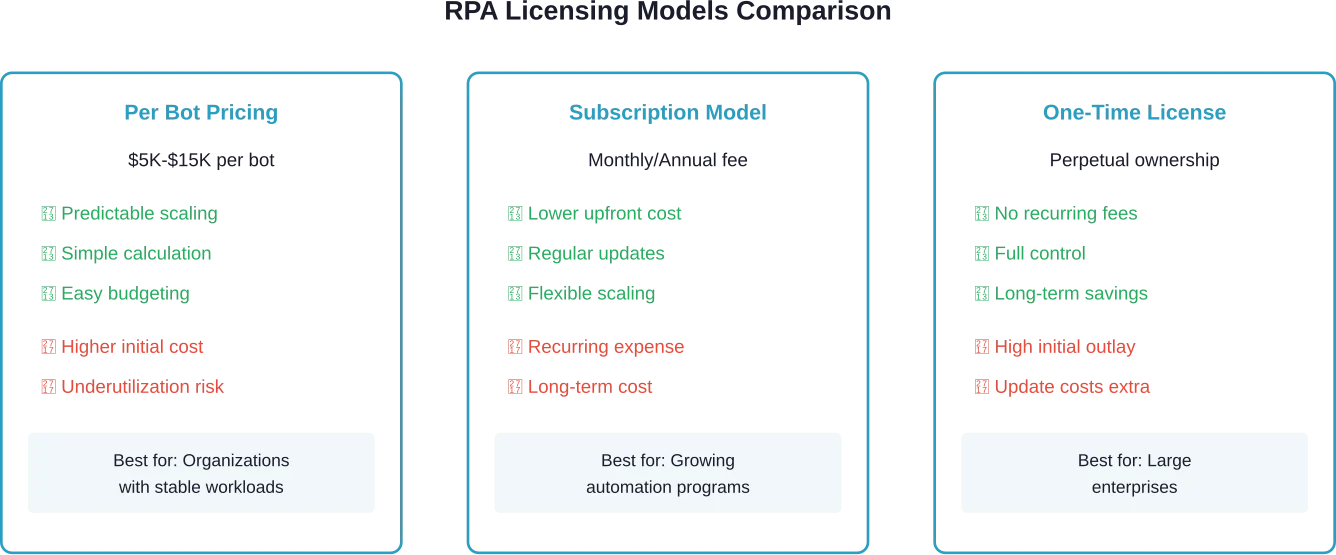
Per Bot Pricing
This straightforward model charges based on the number of software robots deployed. Each bot gets a license, and costs scale linearly with deployment size.
The advantage? Predictable budgeting. Deploy ten bots, pay for ten licenses. The challenge comes when bot utilization varies—paying for a bot that runs four hours daily feels wasteful compared to one running 24/7.
Subscription-Based vs. One-Time Licensing
Subscription models involve recurring payments, either monthly or annually. One-time licensing requires significant upfront capital but eliminates recurring fees.
|
Pricing Model |
Initial Cost |
Year 1 Total |
3-Year Total |
Best For |
|---|---|---|---|---|
|
Subscription (Monthly) |
Low |
$12,000-$18,000 |
$36,000-$54,000 |
Testing/scaling phases |
|
Subscription (Annual) |
Moderate |
$10,000-$15,000 |
$30,000-$45,000 |
Established programs |
|
One-Time License |
High |
$15,000-$25,000 |
$18,000-$30,000 |
Long-term deployments |
Over three years, one-time licensing typically costs less. But subscription models offer flexibility during the critical early stages when automation requirements remain uncertain.
Estimate Your RPA Implementation Cost
RPA implementation cost depends on the number of processes, system integrations, and automation complexity. OSKI Solutions reviews your current workflows and identifies automation candidates before estimating effort. The calculation includes both development, testing, and deployment. You receive a clear cost breakdown based on actual processes.
Ready to Plan Your RPA Budget?
Talk with OSKI Solutions to:
- analyze processes suitable for automation
- estimate bot development and integration effort
- receive a structured RPA implementation cost estimate
👉 Request an RPA implementation quote from OSKI Solutions.
Automate Your Business with RPA
Implement robotic process automation to eliminate repetitive tasks, reduce errors, and improve operational efficiency.
Implementation Expenses Beyond Licensing
Bot licenses represent roughly 25-35% of total RPA implementation costs according to industry analysis. The remaining 65-75% comes from other essential components.
Development and Configuration
Building automation workflows requires skilled developers or business analysts trained in RPA platforms. Development costs depend on process complexity and the number of systems being integrated.
Simple automations—think data entry, report generation, or basic file transfers—might require 40-80 hours of development time. Complex processes involving decision trees, exception handling, and multiple system integrations can demand 200-500 hours.
At typical consulting rates, this translates to $5,000-$15,000 for straightforward automations and $25,000-$75,000 for sophisticated workflows.
Infrastructure and Integration
RPA platforms need somewhere to run. Cloud-hosted solutions reduce infrastructure overhead but introduce recurring hosting fees. On-premises deployments require server capacity, networking configuration, and IT support.
Integration complexity drives costs significantly. Pre-built connectors for common enterprise systems keep integration expenses manageable. Custom integrations with legacy applications or proprietary systems require dedicated development effort—sometimes matching or exceeding the bot development cost itself.
Training and Change Management
Automation changes how work gets done. Teams need training on monitoring bots, handling exceptions, and understanding when to escalate issues.
Organizations often underestimate these soft costs. Training programs, documentation creation, and change management support can add 10-20% to total implementation expenses.
Key Cost Drivers That Multiply Expenses
Several factors dramatically impact final implementation costs. Understanding these variables helps build realistic budgets and avoid mid-project surprises.
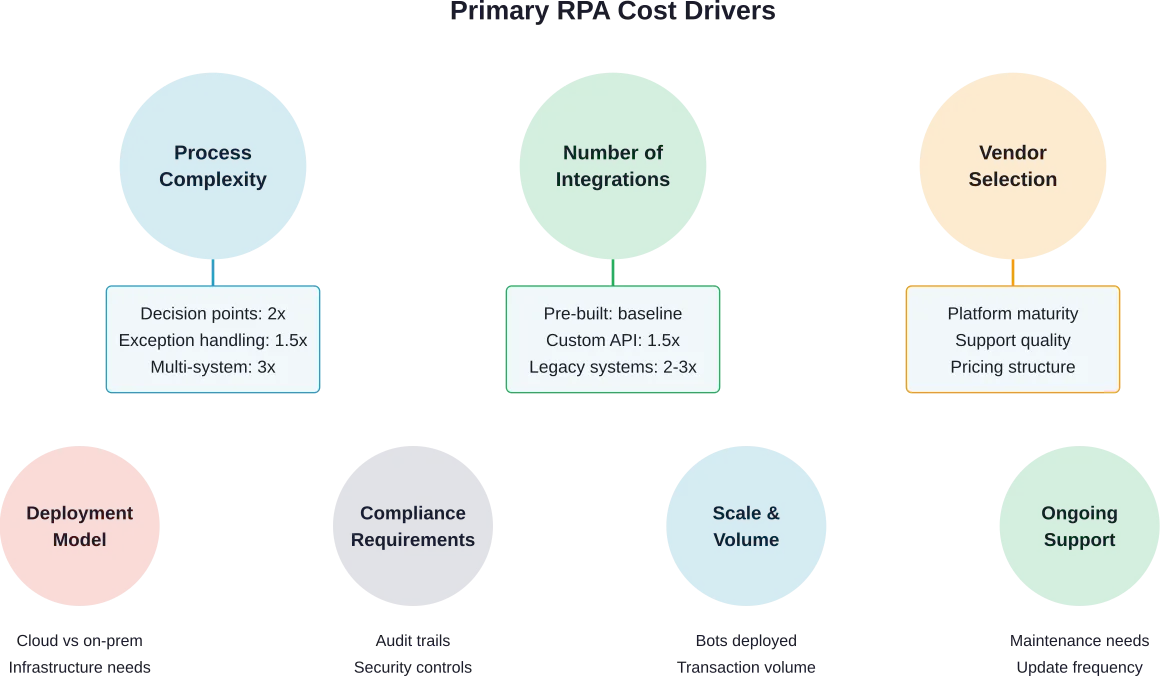
Process Complexity Multipliers
Automating a single-system data entry task costs fundamentally less than orchestrating workflows across six enterprise applications with conditional logic and error handling.
Each decision point in a process adds development time. Exception handling—what happens when the automation encounters unexpected data or system states—requires additional logic and testing cycles.
Integration Requirements
RPA tools offer pre-built integrations with common enterprise systems. These connectors reduce development effort significantly.
Custom integrations tell a different story. Connecting to legacy mainframe systems, proprietary databases, or applications without APIs requires specialized skills and extended development timelines. In some cases, integration work exceeds the core automation development cost.
Vendor Selection Impact
Major RPA vendors structure pricing differently and target different market segments. Enterprise platforms from established vendors typically cost more but include comprehensive support, mature feature sets, and extensive integration libraries.
Emerging vendors often offer competitive pricing to gain market share. The tradeoff involves potentially limited integration options, smaller support teams, and less mature tooling.
Real-World Implementation Cost Scenarios
Abstract cost ranges become clearer through specific deployment scenarios. Here's what different automation initiatives actually cost.
Small-Scale Deployment: Single Department
A finance team automating invoice processing and monthly report generation might deploy 2-3 bots handling relatively straightforward workflows.
Cost breakdown:
- Bot licenses: $10,000-$30,000
- Development and setup: $8,000-$20,000
- Infrastructure (cloud-hosted): $2,000-$5,000 annually
- Training: $3,000-$5,000
- Total first-year cost: $23,000-$60,000
Medium-Scale Deployment: Cross-Functional
An organization automating processes across HR, finance, and operations might deploy 8-12 bots with moderate complexity and multiple system integrations.
Cost breakdown:
- Bot licenses: $50,000-$120,000
- Development and integration: $40,000-$100,000
- Infrastructure and orchestration: $15,000-$30,000 annually
- Training and change management: $10,000-$20,000
- Total first-year cost: $115,000-$270,000
Enterprise-Scale Deployment
Large organizations deploying 50+ bots across global operations with complex workflows, extensive integrations, and high-availability requirements face substantially higher costs.
Cost breakdown:
- Bot licenses: $250,000-$500,000
- Development, integration, and customization: $150,000-$400,000
- Infrastructure (dedicated environment): $40,000-$80,000 annually
- Governance framework and CoE setup: $50,000-$100,000
- Total first-year cost: $490,000-$1,080,000
Hidden Costs That Catch Organizations Off Guard
Budgets built solely around licensing and initial development miss several ongoing expense categories that emerge post-deployment.
Maintenance and Updates
Bots break when underlying systems change. Application UI updates, API modifications, and infrastructure changes all require bot updates.
Maintenance typically consumes 15-25% of initial development costs annually. Organizations should budget for ongoing support whether handled internally or through vendor maintenance agreements.
Scaling Infrastructure
Successful automation programs grow. That pilot project with three bots might expand to twenty within a year. Infrastructure initially sized for small deployments becomes inadequate.
Cloud-hosted solutions scale more gracefully but introduce variable costs tied to usage. On-premises deployments require periodic infrastructure investments to accommodate growth.
Governance and Compliance
Enterprise automation programs need governance frameworks: standards for development, security controls, audit capabilities, and change management processes.
Building a center of excellence (CoE) to manage automation at scale represents a significant investment—typically $50,000-$200,000 depending on organizational size and complexity.
Calculating RPA Return on Investment
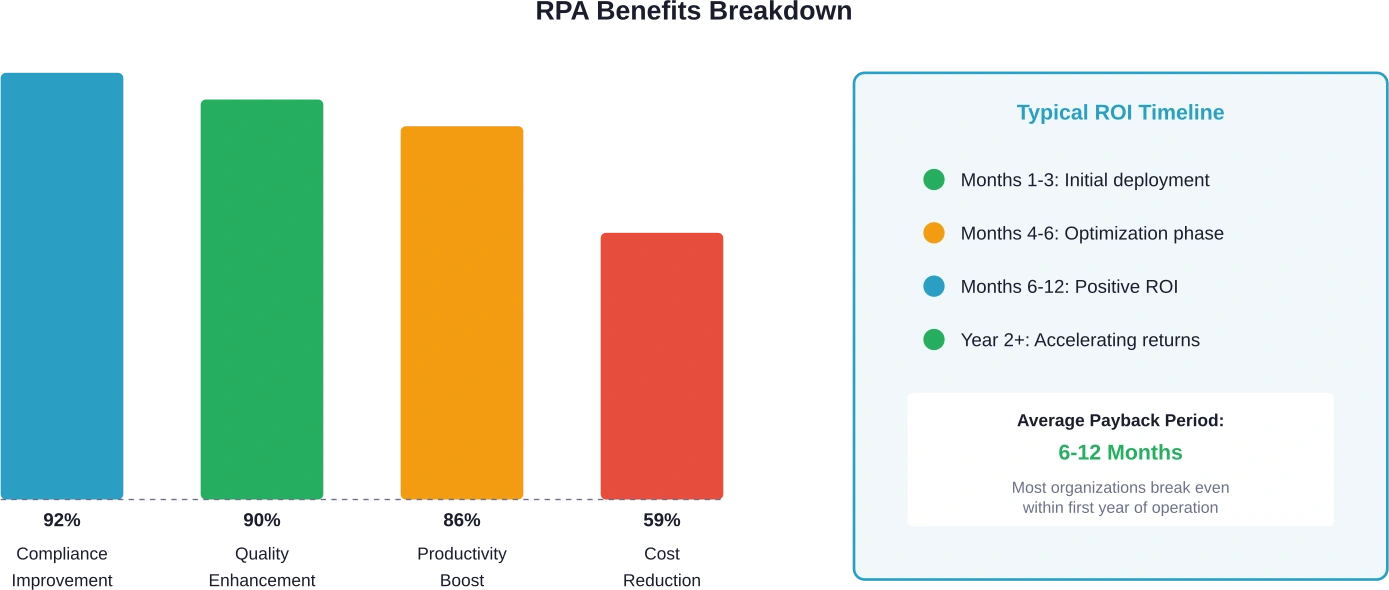
Cost analysis means little without understanding returns. According to studies cited in the source material, RPA delivers measurable benefits across multiple dimensions.
Research shows organizations achieve 92% improvement in compliance, 86% boost in productivity, 90% enhancement in quality, and 59% reduction in costs following RPA implementation.
Quantifying Labor Savings
The most straightforward ROI calculation involves labor hours eliminated. If a bot automates a process consuming 20 hours weekly at a loaded labor rate of $35/hour, annual savings reach approximately $36,400.
With implementation costs of $15,000-$25,000 for a moderately complex automation, payback occurs within 6-10 months. Subsequent years deliver pure savings.
Quality and Compliance Benefits
Error reduction has real financial impact. Processing errors trigger rework, customer service costs, and potential compliance penalties. Eliminating errors delivers value that extends beyond simple time savings.
Organizations in regulated industries particularly benefit from improved audit trails and consistent process execution. These compliance improvements prove difficult to quantify but represent significant risk reduction.
Real Case Study: Banking Automation
According to a documented case study, Calvetti Ferguson achieved $8+ million in gross ROI from automation projects over three years, with $2+ million in cost avoidance.
In one documented implementation, automation of the onboarding process contributed to a 30% reduction in cycle time, while across functions ongoing mining and optimization yielded broader improvements. These real-world results demonstrate the substantial returns possible with strategic RPA deployment.
Vendor Comparison and Pricing Structures
Major RPA platforms structure pricing differently, making direct comparison challenging without understanding what each license tier includes.
|
Vendor Tier |
Monthly Cost Range |
Typical Features |
Best Use Case |
|---|---|---|---|
|
Developer/Studio |
$420-$600 |
Development environment, testing |
Building and testing automations |
|
Unattended Bot |
$1,380-$2,000 |
Autonomous execution, scheduling |
Back-office automation |
|
Attended Bot |
$500-$800 |
Human-bot collaboration |
Assisted desktop automation |
|
Orchestrator/Control Room |
$1,930-$3,000 |
Centralized management, monitoring |
Enterprise-scale deployments |
These ranges represent typical market pricing but vary based on contract terms, volume discounts, and bundled services. Always request detailed quotes that itemize exactly what's included at each tier.
What to Look for in Vendor Pricing
Beyond base license costs, evaluate what vendors include in their pricing structure:
- Support response times and availability
- Update frequency and upgrade policies
- Pre-built integration library size and coverage
- Training resources and documentation quality
- Community size and ecosystem maturity
The cheapest option rarely proves most cost-effective when accounting for total cost of ownership over 3-5 years.
Making the Financial Case for RPA Investment
Securing budget approval requires a compelling business case that addresses both quantitative returns and strategic benefits.
Building the Business Case
Start with a detailed process assessment. Document current-state labor hours, error rates, and process cycle times. This baseline establishes the foundation for ROI projections.
Identify automation candidates systematically: high-volume, rule-based processes with digital inputs and outputs make ideal starting points. Calculate potential savings for each process based on eliminated labor hours and error reduction.
Include both hard savings (reduced labor costs, eliminated overtime) and soft benefits (improved employee satisfaction, faster cycle times, better compliance).
Phased Implementation Strategy
Rather than proposing a massive upfront investment, structure implementation in phases. Start with a pilot targeting 2-3 high-impact processes. Use pilot results to validate assumptions and build confidence before scaling.
This approach reduces initial capital requirements and provides real data for subsequent funding requests. Demonstrated success in phase one makes approval for phase two substantially easier.
Risk Mitigation in Budget Planning
Build contingency into cost estimates. Unexpected integration challenges, process complexity discoveries, and timeline extensions happen frequently in automation projects.
A 15-20% contingency buffer protects against common overruns without appearing unrealistic. Better to deliver under budget than return requesting additional funds mid-project.
Frequently Asked Questions
How much does a single RPA bot actually cost?
A single bot license typically ranges from $5,000 to $15,000 depending on vendor, bot type (attended vs. unattended), and contract terms. However, total implementation cost including development, integration, and infrastructure runs $10,000-$40,000 per bot for moderately complex automations. Simple bots at the low end might cost a few thousand dollars total, while sophisticated bots with extensive integrations can exceed $50,000.
What's the typical ROI timeline for RPA implementation?
Most organizations achieve positive ROI within 6-12 months of deployment according to industry benchmarks. Simple automations with clear labor hour savings may reach payback in 3-4 months. Complex enterprise deployments typically require 12-18 months to demonstrate positive returns. Research indicates 86% productivity improvements and 59% cost reductions are common once automation stabilizes.
Are subscription models cheaper than one-time licensing?
Subscription models have lower initial costs, making them attractive for testing and pilot programs. However, over 3-5 years, one-time licensing typically costs 30-40% less in total. Subscriptions make sense when automation requirements remain uncertain or during scaling phases. One-time licenses benefit established programs with stable, long-term automation needs.
What hidden costs do organizations typically miss?
The most commonly overlooked expenses include ongoing maintenance (15-25% of initial development costs annually), infrastructure scaling as deployments grow, change management and training programs, governance framework development, and integration work for legacy systems. Custom integrations alone can match or exceed core bot development costs when working with proprietary or older systems lacking modern APIs.
How much should I budget for RPA maintenance?
Plan for 15-25% of initial development costs annually for maintenance and updates. A bot that cost $20,000 to develop likely requires $3,000-$5,000 yearly for maintenance. This covers updates when underlying systems change, performance optimization, and minor enhancements. Organizations with rapidly changing IT environments should budget toward the higher end of this range.
Can small businesses afford RPA implementation?
Absolutely. Small-scale deployments automating 1-3 processes can run $15,000-$40,000 total in the first year. Cloud-hosted solutions reduce infrastructure costs, and many vendors offer small business pricing tiers. The key is starting with high-impact processes where automation delivers clear ROI. Even at smaller scales, the 59% cost reduction and 86% productivity improvement documented in studies apply.
What factors most significantly impact RPA costs?
Process complexity drives costs more than any other factor. Multi-system integrations, extensive decision trees, and sophisticated exception handling multiply development time substantially. Number of integrations ranks second—pre-built connectors keep costs manageable while custom integrations add significant expense. Vendor selection matters third, as platform capabilities, support quality, and pricing structures vary dramatically across the market.
Conclusion: Making Smart RPA Investment Decisions
RPA implementation costs span a wide range—from $5,000 for simple single-bot deployments to over $1 million for enterprise-scale programs. Understanding the full cost structure beyond just licensing prevents budget surprises and sets realistic expectations.
The financial case for automation remains compelling. With 86% productivity improvements, 59% cost reductions, and typical payback periods under 12 months, RPA delivers measurable returns when deployed strategically.
Success requires moving beyond licensing costs to account for development, integration, infrastructure, and ongoing maintenance. Organizations that build comprehensive budgets covering these elements avoid the mid-project funding gaps that derail automation initiatives.
Start small. Pilot with 2-3 high-impact processes, demonstrate value, then scale based on proven results. This approach minimizes initial investment while building organizational confidence and capabilities.
The question isn't whether automation delivers value—research clearly shows it does. The real question is whether your organization can implement it strategically, budget realistically, and execute effectively. With proper planning and realistic cost expectations, RPA transforms from an intimidating capital expense into a measurable driver of operational excellence and competitive advantage.
Ready to explore RPA for your organization? Start by documenting your most time-consuming, rule-based processes. Calculate current labor hours and error rates. Then request detailed vendor quotes that break down exactly what's included at each pricing tier. That foundation positions you to make informed investment decisions backed by data rather than vendor promises.


