

Payment Gateway API Integration Costs: A Technical and Financial Overview

Payment gateway API integration costs vary based on technical depth, security needs, and platform architecture. For businesses building scalable products, understanding these drivers is vital for strategic planning. The process requires robust infrastructure for sensitive data, high availability, and regulatory compliance. This overview examines expenses from initial development through long-term maintenance.
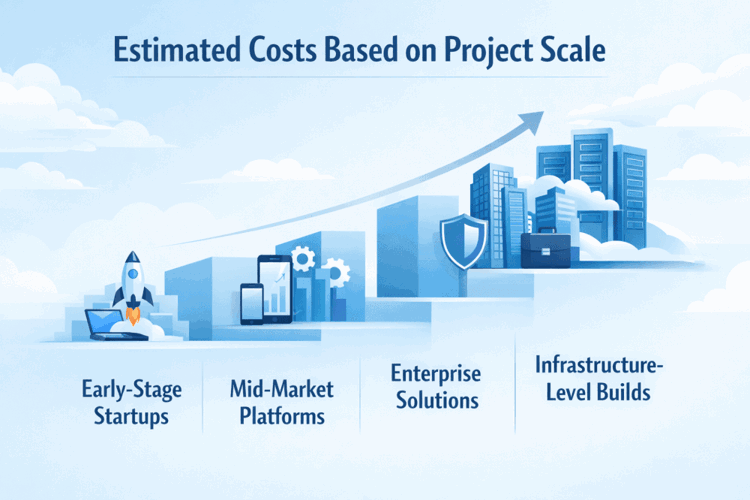
Estimated Costs Based on Project Scale
The total investment required for a payment gateway integration depends heavily on the complexity of the digital product and the anticipated transaction volume. Small-scale projects often rely on existing ecosystems, while enterprise solutions require custom architecture to maintain performance and security.
Typical cost distributions for different project tiers include:
- Early-stage startups ($5,000 - $15,000): Focusing on standard API integrations with providers like Stripe or PayPal using native SDKs.
- Mid-market platforms ($20,000 - $60,000): Requiring custom workflows, multi-currency support, and enhanced fraud protection layers.
- Enterprise solutions ($100,000 - $300,000+): Full-cycle development involving custom-built gateways, complex ERP/CRM integrations, and high-level PCI compliance audits.
- Infrastructure-level builds ($150,000 - $800,000): Development of private processing infrastructure, including dedicated server environments and full security certifications.
Primary Cost Drivers in API Integration
The total expenditure for integrating a payment gateway is influenced by the complexity of the business model and the required user experience. Simple setups often rely on standard plugins, whereas enterprise-grade solutions require custom API development to support unique workflows.
Integrating a payment gateway API typically involves the following technical components:
- Standard plugin integrations for platforms like Shopify or WooCommerce usually start between $5,000 and $10,000.
- Custom API development for web platforms or non-standard architectures can range from $10,000 to $30,000.
- Dedicated integration for mobile applications, requiring specific SDKs and native handling, often costs between $15,000 and $50,000.
- Full-scale custom-built gateways designed for high-volume or multi-region operations can exceed $100,000 to $300,000.
Beyond the initial code, the geography of activity and the number of supported currencies also play a role. A gateway operating solely in a local market faces fewer regulatory hurdles compared to a global system that must integrate with various regional banking networks and follow diverse data protection laws.
Development and Personnel Costs
The most significant portion of the budget is usually allocated to human resources. Building a reliable integration requires a multidisciplinary team, including backend developers, security experts, and quality assurance engineers. The time commitment for a medium-to-complex integration typically spans two to five months of active development.
Engineering Hours and Resource Allocation
Engineers spend a significant amount of time not only writing the initial integration but also diagnosing and resolving issues that arise during the synchronization of data between the merchant and the processor. A single integration can consume hundreds of engineering hours per year in maintenance alone. For an organization paying an average salary of $150,000 for a senior engineer, the time spent on a single integration can represent nearly $50,000 in annual internal costs.

High-Performance Payment Systems Built By OSKI Solutions for Long-Term Value
At OSKI Solutions, we view payment gateway API integration as a foundational pillar of your digital infrastructure. We specialize in partnering with mid-size enterprises and high-growth startups that demand sophisticated, custom-engineered financial ecosystems rather than off-the-shelf checkout components. By leveraging our deep expertise in .NET, Node.js, and C#, we design and deploy bespoke integration layers capable of handling complex transaction logic for FinTech, E-commerce, and Logistics. Our approach focuses on modernizing legacy financial systems and automating mission-critical processes to eliminate operational bottlenecks and ensure reliability in high-load environments.
We deliver end-to-end digital products where technical excellence meets strategic business objectives. Our commitment to Cloud and DevOps excellence using AWS or Azure ensures that every integration is secure, resilient, and inherently future-ready.
For B2B organizations that rely on technology as a core competitive advantage, OSKI Solutions acts as a strategic partner rather than a vendor. We bridge skill gaps and provide the execution power necessary to ensure your platform scales seamlessly alongside your revenue growth and global ambitions.
Modernize Your Systems with API Integration
Connect legacy software, third-party platforms, and internal tools into one seamless ecosystem.
Technical Support and Maintenance Expenses
Technical support staff and customer success departments also contribute heavily to the long-term expenses of an API integration. Customer success managers often act as intermediaries between clients and technical teams when integration issues occur, requiring a deep understanding of both the business logic and the technical implementation.
Operational Overhead and Support Ticket Management
Managing support tickets, troubleshooting client-side configuration errors, and coordinating updates can add another $15,000 to $20,000 to the annual personnel budget for a single payment channel. These costs are recurring and scale with the number of integrations a business maintains, highlighting the need for efficient documentation and robust error-handling protocols to minimize manual intervention.
Security Infrastructure and Compliance Standards
Security is not an optional feature but a core requirement of the payment ecosystem. Ensuring that a system is safe from cyber threats and compliant with industry standards requires significant investment in both technology and audits. A robust security layer protects not only the merchant but also the end consumer from potential data breaches and financial loss.
Essential security and compliance investments include:
- Implementation of PCI DSS standards to ensure the secure handling of cardholder information.
- Tokenization services where sensitive card data is replaced by a unique identifier to minimize data exposure.
- Advanced encryption protocols for all data in transit and at rest within the payment environment.
- Automated fraud detection systems that analyze transaction patterns in real-time to prevent unauthorized activity.
Most businesses allocate approximately 15-20% of their total integration budget specifically to security and compliance. This equates to an expenditure of $5,000 to $50,000 depending on the volume of transactions and the level of PCI DSS compliance required. In addition to technical implementation, there are recurring costs for security audits and penetration testing. These assessments are necessary to identify vulnerabilities and maintain compliance. For high-volume merchants, annual PCI audits can be a substantial recurring expense that must be factored into the long-term operational budget.
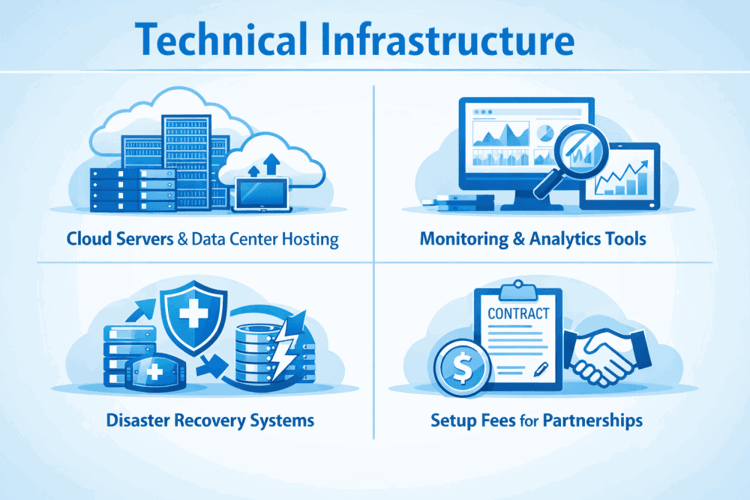
Technical Infrastructure and Third-Party Partnerships
The underlying infrastructure that supports the API integration must be scalable and highly available. This usually involves cloud-based transaction processing solutions that can handle traffic spikes without downtime.
Operational costs for infrastructure include:
- Cloud servers and data center hosting, which typically range from $1,000 to $5,000 per month for basic setups.
- Monitoring and analytics tools to track transaction success rates and system performance.
- Disaster recovery systems and real-time backups to prevent data loss.
- Setup fees for partnerships with card networks like Visa and Mastercard, which can cost between $5,000 and $50,000 initially.
Partnership costs are an often-overlooked aspect of the budget. Many enterprise organizations require formal agreements and sandbox access fees. These agreements may include Service Level Agreements (SLAs) that ensure a certain level of uptime and support, but they often come with annual price tags in the thousands or tens of thousands of dollars.
Long-Term Maintenance and Optimization
Maintaining a payment API requires constant intervention to align with gateway updates, security mandates, and evolving fee structures. These ongoing efforts ensure the payment flow remains stable as the external ecosystem changes.
Routine System Upkeep
Annual maintenance for a single integration typically costs between $1,000 and $5,000. This budget covers:
- Updating software libraries and dependencies.
- Patching security vulnerabilities.
- Adjusting code for server environment compatibility.
Performance Optimization
To handle increasing transaction volumes and reduce checkout latency, regular code optimization is required. For complex systems, major annual updates cost between $8,000 and $15,000 to maintain scalability and future-readiness.
Integration Monitoring and Debugging
Continuous monitoring identifies failed transactions and synchronization errors. Developers must resolve issues caused by external API format changes, which can break custom integrations. Subscription fees for dedicated monitoring tools further contribute to the annual budget.
Indirect Resource Redirection
Integration maintenance carries a high opportunity cost. When senior engineers focus on troubleshooting and compliance audits, they are redirected from developing new features. This shift in focus can slow innovation and delay the core product roadmap.
Transactional and Operational Fees
While the development and integration costs are often one-time or annual, transactional fees are ongoing and scale with the business. These fees are usually a combination of a percentage of the transaction value and a flat fee per payment.
Common transactional expenses include:
- Standard processing fees, usually 2.9% plus a $0.30 fixed charge for each transaction.
- Cross-border and international processing fees, which often add an extra 1% to the transaction cost.
- Chargeback handling fees, ranging from $15 to $20 per incident depending on the provider.
- Monthly gateway fees for specific providers, typically around $25 for premium features.
For businesses with high transaction volumes, these fees can quickly exceed the initial integration costs. Strategic team augmentation or the use of specialized integration platforms can sometimes help in optimizing these workflows and reducing the operational burden on internal teams. For enterprise-level custom gateways, the development of the underlying infrastructure can range from $150,000 to $800,000, covering engineering resources, SSL certification, and full PCI DSS compliance.
Conclusion
The cost of integrating a payment gateway API is a multifaceted investment that extends beyond the initial development phase. A simple plugin setup might serve a small e-commerce site, but as a business scales, the requirements for custom workflows, robust security, and multi-region compliance will drive costs toward the higher end of the spectrum. Success in this area requires a balance between technical excellence and strategic budget allocation, ensuring that the chosen solution provides long-term value and the scalability needed for future growth.
FAQ
What is the average cost of a basic payment gateway integration?
A basic integration using standard plugins or ready-made SDKs typically costs between $5,000 and $10,000. This includes the initial setup, configuration on a standard e-commerce platform, and basic testing.
Why are custom API integrations more expensive?
Custom integrations require bespoke code to connect with specific business logic, unique user interfaces, or non-standard backend architectures. They also involve higher costs for security implementation and testing, ranging from $10,000 to $30,000 or more.
How much should be budgeted for security and compliance?
Businesses should generally allocate 15-20% of their total integration budget for security. This covers the implementation of PCI DSS standards, encryption, tokenization, and regular security audits.
What are the ongoing maintenance costs for a payment API?
Ongoing maintenance usually costs between $1,000 and $5,000 per year for a single gateway. This includes API updates, security patches, and ensuring compatibility with the latest software versions.
Do mobile apps require a different type of integration?
Yes, mobile apps often require specific mobile SDKs and native handling of payment flows. Due to the complexity of maintaining security across different mobile operating systems, these integrations typically cost between $15,000 and $50,000.
What hidden costs should a business watch out for?
Hidden costs often include partnership fees for accessing certain banking networks, internal personnel time spent on troubleshooting, and opportunity costs when developers are occupied with integration maintenance instead of product innovation.
How do transaction fees impact the total cost of ownership?
While integration is an upfront or annual cost, transaction fees are a continuous operational expense. At 2-3% per transaction plus flat fees, these costs can become the largest financial component of a payment system as the business grows.


