

NetSuite ERP Implementation Cost: 2026 Budget Guide

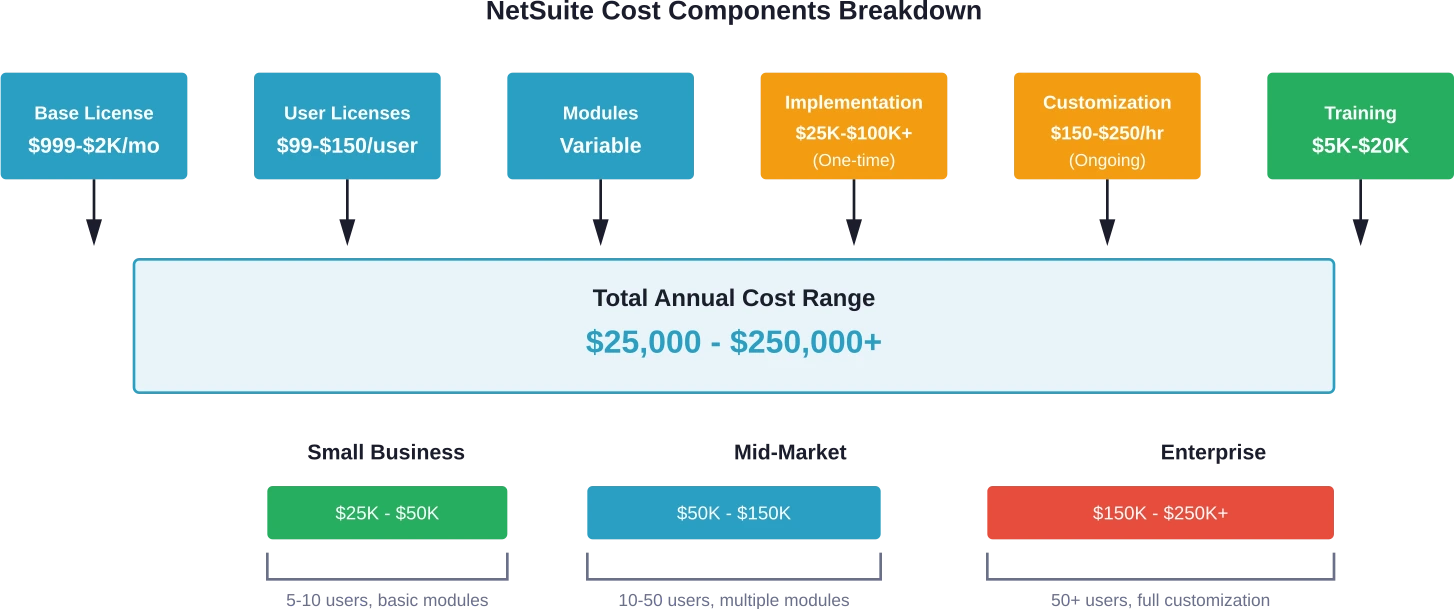
Highlights: NetSuite ERP implementation costs typically range from $25,000 to $250,000+ annually, including base licensing ($999-$2,000/month), user licenses ($99-$150/user/month), modules, and one-time implementation fees ($25,000-$100,000+). Total investment depends on business size, customization needs, number of users, modules selected, and implementation complexity.
If you've searched for NetSuite pricing and come away more confused than when you started, that's by design. NetSuite doesn't publish fixed prices because the platform operates on a modular subscription model—what one company pays can differ wildly from another.
But here's the thing: even without a published price list, NetSuite costs follow predictable patterns. Once you understand the variables that drive pricing, you can estimate your investment with surprising accuracy.
This guide breaks down every component of NetSuite ERP implementation costs in 2026, from licensing structures to hidden fees most buyers discover too late.
How NetSuite Pricing Actually Works
NetSuite uses a subscription-based pricing model with several moving parts. Unlike traditional software where you pay once and own a license forever, NetSuite charges annually for access to the platform.
The pricing structure includes three core components: a base platform license, individual user licenses, and optional modules that extend functionality. Each piece adds to the total annual cost.
According to the official NetSuite website, cloud-based ERP platforms have grown significantly in popularity, with almost 97% of companies surveyed considering cloud-based solutions (NetSuite, 2026). This shift has made ERP more accessible for small and medium-sized businesses, though "affordable" remains relative.
The Modular Pricing Model Explained
NetSuite built its platform around modules—think of them as add-on capabilities for specific business functions. Financial management forms the core, while inventory, CRM, ecommerce, and manufacturing modules extend the system.
This modularity means two things: you only pay for what you need, and your costs grow as your requirements expand. A startup might begin with financials and basic CRM, while a growing manufacturer needs inventory management, quality control, and supply chain planning.
The official NetSuite modules guide confirms that the platform pulls data from numerous modules built to help various departments perform their individual functions, serving as a single source of truth across the organization.
NetSuite Cost Breakdown for 2026
Real talk: most businesses pay between $25,000 and $250,000+ per year for NetSuite. That wide range reflects the flexibility—and complexity—of the pricing model.
Here's where your money actually goes:
|
Cost Component |
What It Includes |
Typical Price Range |
|---|---|---|
|
Base License |
Core platform access, system features |
$999 – $2,000 per month |
|
User Licenses |
Role-based access for each user |
$99 – $150 per user/month |
|
Modules |
Additional functionality (inventory, CRM, etc.) |
Varies significantly |
|
Implementation |
Setup, configuration, data migration |
$25,000 – $100,000+ (one-time) |
|
Customization |
Custom fields, workflows, scripts |
$150 – $250 per hour |
|
Integrations |
Connecting third-party systems |
$0 – $10,000+ per integration |
|
Training |
User onboarding and education |
$5,000 – $20,000+ |
|
Support |
Ongoing technical assistance |
Included or premium tiers |
These numbers represent typical ranges based on current market data. Actual costs depend on specific business requirements and negotiation.
Base Platform and User Licensing
The base license gets you access to the NetSuite platform itself. This runs between $999 and $2,000 monthly depending on the tier selected and business size.
User licenses stack on top. Each person who needs system access requires a license, priced between $99 and $150 per user per month. A company with 20 users might spend $2,000-$3,000 monthly just on user access.
As the official NetSuite website notes, licensing costs are likely to increase as more users are added or more functions are integrated into the base software. Plan for growth when budgeting.
Module Costs and Add-Ons
Modules represent the biggest variable in NetSuite pricing. Financial management comes standard, but everything else—inventory, manufacturing, CRM, ecommerce—costs extra.
Popular modules and their typical use cases:
- Inventory Management: Essential for product-based businesses tracking stock levels
- CRM: Sales pipeline and customer relationship tracking
- Advanced Financials: Multi-currency, revenue recognition, fixed assets
- SuiteCommerce: Integrated ecommerce capabilities
- Manufacturing: Work orders, bill of materials, shop floor control
- Project Management: Project accounting and resource allocation
NetSuite doesn't publish individual module pricing, but each addition increases annual costs. A basic financial-only implementation differs drastically from a full-featured system with manufacturing, ecommerce, and advanced inventory.

Understand NetSuite ERP Implementation Cost
NetSuite ERP implementation cost depends on modules, data migration, and integration complexity. OSKI Solutions evaluates your current systems and defines required configuration work before estimating effort. The budget includes setup, customization, migration, and testing stages. This gives you a structured ERP implementation cost overview.
Ready to Plan Your NetSuite ERP Implementation?
Talk with OSKI Solutions to:
- define required modules and workflows
- estimate data migration and integration effort
- receive a detailed implementation cost estimate
👉 Request a NetSuite ERP implementation quote from OSKI Solutions.
Implement NetSuite ERP with Confidence
We help businesses deploy and configure ERP systems to streamline operations, improve visibility, and scale efficiently.
NetSuite Implementation Costs: The One-Time Investment
Implementation costs represent a separate category from annual licensing. This one-time expense covers setup, configuration, data migration, and getting the system ready for production use.
Most businesses pay between $25,000 and $100,000+ for NetSuite implementation, though complex deployments can exceed $150,000. The wide range reflects dramatically different scope levels.
Implementation Tiers and Pricing
Implementation approaches generally fall into three tiers, each with different costs and complexity:
|
Implementation Tier |
Typical Cost Range |
Best For |
Timeline |
|---|---|---|---|
|
SuiteSuccess (Template) |
$25,000 - $30,000 |
Startups, simple processes, standard workflows |
8-12 weeks |
|
Hybrid (Semi-Custom) |
$35,000 - $60,000 |
Growing businesses with some custom needs |
3-5 months |
|
Enterprise Build |
$70,000 - $150,000+ |
Complex operations, heavy customization |
6-12+ months |
SuiteSuccess uses pre-built templates and best practices, minimizing customization and keeping costs down. According to the official NetSuite website, NetSuite prides itself on assisting small businesses to achieve their ROI goals by shortening the time to implementation.
Hybrid implementations blend templates with custom configurations. This middle ground works for companies that need specific workflows but don't require completely bespoke solutions.
Enterprise builds involve extensive customization, complex integrations, and detailed process mapping. Companies with unique industry requirements or significant legacy systems typically fall into this category.
What Drives Implementation Costs Higher
Several factors push implementation costs toward the higher end of the range:
- Data migration complexity: Moving years of historical data from multiple legacy systems requires significant effort. Clean, well-organized data costs less to migrate than messy, inconsistent records spread across spreadsheets and outdated software.
- Customization requirements: Every custom field, workflow, script, or report adds development time. Businesses with highly specialized processes pay more than those comfortable with standard configurations.
- Integration scope: Connecting NetSuite to existing systems—payment processors, shipping platforms, warehouse management, CRM—adds both cost and complexity. Each integration requires development, testing, and ongoing maintenance.
- Change management: Companies switching from established legacy systems need more training and support than those moving from basic accounting software. User adoption doesn't happen automatically.
Real-World NetSuite Pricing Scenarios
Abstract ranges only tell part of the story. Here's what NetSuite actually costs for different business profiles:
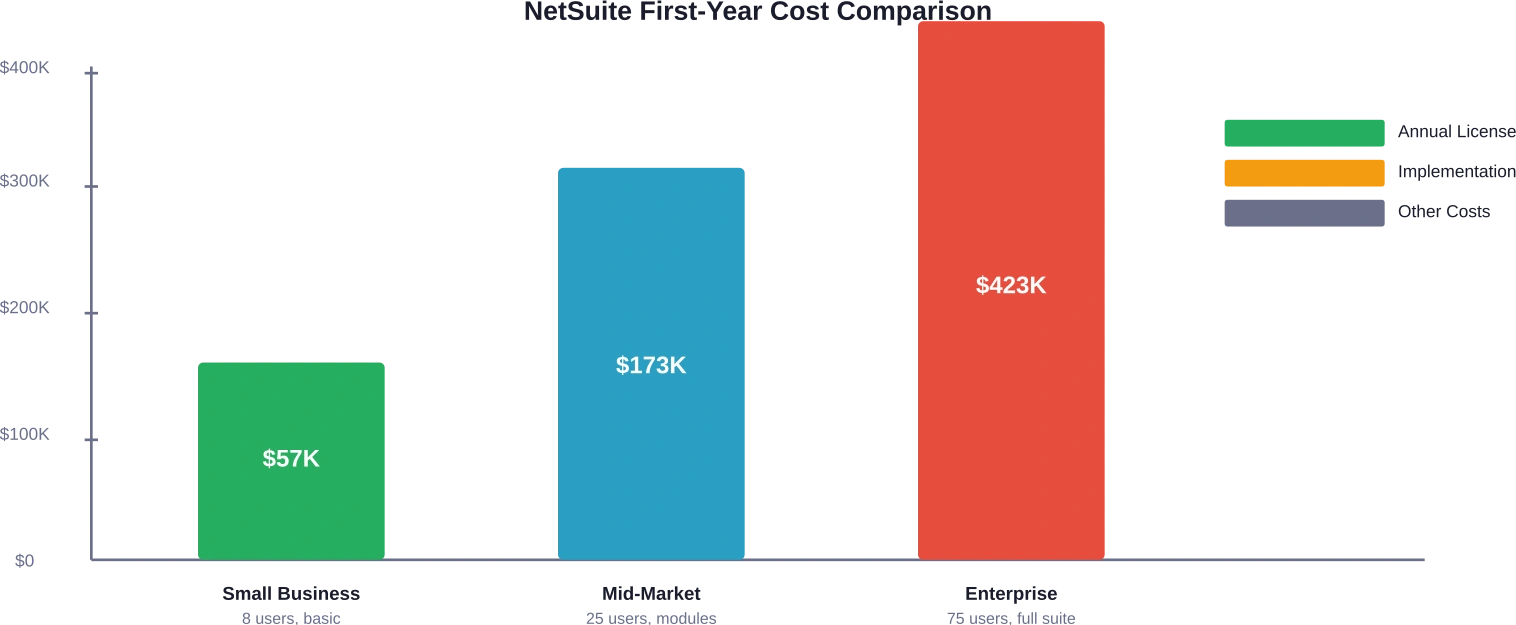
Small Business: Basic Financials
A small distribution company with 8 users needs financial management, basic inventory, and order management. No ecommerce, no manufacturing, minimal customization.
- Base license: $1,200/month
- 8 user licenses at $99 each: $792/month
- Basic modules included: $0
- Annual licensing: ~$24,000
- Implementation (SuiteSuccess): $28,000
- Training: $5,000
- First-year total: ~$57,000
- Ongoing annual: ~$24,000
According to market research, typical first-year investment for a small business often starts in the $25,000 to $50,000 range, covering both the annual license and a straightforward implementation.
Mid-Market: Multiple Modules
A growing manufacturer with 25 users requires advanced financials, full inventory management, manufacturing modules, CRM, and project management. Moderate customization for specific workflows.
- Base license: $1,800/month
- 25 user licenses at $120 each: $3,000/month
- Module additions: ~$1,500/month
- Annual licensing: ~$76,000
- Implementation (Hybrid): $55,000
- Customization: $15,000
- Training: $12,000
- Integrations (3 systems): $15,000
- First-year total: ~$173,000
- Ongoing annual: ~$76,000
Enterprise: Full Deployment
A multi-entity corporation with 75 users across several locations needs everything: advanced financials with multi-currency and consolidation, full manufacturing, SuiteCommerce, advanced inventory, WMS, and extensive integrations with legacy systems.
- Base license: $2,000/month
- 75 user licenses at $130 each: $9,750/month
- Premium modules: ~$3,500/month
- Annual licensing: ~$183,000
- Implementation (Enterprise): $125,000
- Customization: $40,000
- Integrations (8+ systems): $50,000
- Training: $25,000
- First-year total: ~$423,000
- Ongoing annual: ~$183,000
Hidden Costs and Budget Surprises
The obvious costs—licensing, implementation, modules—appear in most quotes. But several less visible expenses catch buyers off guard.
Data Storage Overages
NetSuite includes a base amount of data storage with each license tier. Exceed that threshold and monthly storage fees apply. Companies with extensive historical data, large file attachments, or high transaction volumes sometimes hit these limits.
Ongoing Customization and Maintenance
Initial implementation gets the system running, but business needs evolve. New reports, modified workflows, additional custom fields, and script updates require ongoing development at $150-$250 per hour.
Plan for at least 5-10 hours monthly for system adjustments. That's $9,000-$30,000 annually just keeping pace with changing requirements.
Integration Maintenance
Third-party systems update their APIs. NetSuite releases new versions twice yearly. Integrations that work perfectly today might break after an update, requiring fixes and testing.
Each active integration needs periodic maintenance. Budget $2,000-$5,000 annually per integration for ongoing support.
Premium Support Tiers
Standard support comes with NetSuite licensing, but response times and available resources are limited. Premium support tiers offer faster response, dedicated support engineers, and direct access to technical resources—at additional cost.
Companies running business-critical operations on NetSuite often need premium support. This typically adds 10-15% to annual licensing costs.
Additional User Growth
Most businesses underestimate how quickly user needs grow. That department that didn't need access during implementation? They'll want it six months in.
At $99-$150 per user monthly, adding 10 users increases annual costs by $12,000-$18,000. Factor growth into initial budgets.
Factors That Drive NetSuite Pricing Variation
Why does NetSuite cost $50,000 for one company and $250,000 for another? Several variables account for the dramatic range.
Deployment Model Considerations
NetSuite operates as a cloud-based platform, which fundamentally differs from on-premises ERP systems. According to the official NetSuite website, deployment type can have a major impact on the price—both initially and over time.
On-premises ERP systems tend to require large up-front costs to purchase the software, servers, storage and any other hardware needed to run the system. Cloud-based solutions eliminate most of these infrastructure costs but create ongoing subscription expenses instead.
The shift to cloud deployment has made ERP more accessible. NetSuite's cloud-native architecture means businesses avoid massive hardware investments but commit to recurring annual fees.
Business Complexity and Industry Requirements
A simple service business with basic financial needs pays far less than a multi-location manufacturer with complex supply chains, quality control requirements, and regulatory compliance.
Industry-specific needs drive costs up. Food and beverage companies need lot tracking and expiration management. Life sciences require validated systems and audit trails. Each specialized requirement adds modules, customization, and implementation complexity.
Number of Legal Entities
Companies operating multiple legal entities—subsidiaries, divisions, international branches—face higher costs. Multi-entity management requires advanced financial modules, inter-company transactions, and consolidation capabilities.
Each additional entity typically increases both licensing and implementation costs. A single-entity business might implement for $30,000, while a five-entity structure could cost $75,000+ for the same core functionality.
Geographic Footprint
International operations introduce currency management, tax compliance across jurisdictions, and localization requirements. These capabilities require advanced modules and more complex configurations.
Companies operating across multiple countries also need more implementation time for setup, testing, and validation of region-specific requirements.
How to Reduce NetSuite Implementation Costs
NetSuite isn't cheap, but strategic decisions can significantly reduce total investment without sacrificing functionality.
Start with Core Modules
Implement essential functionality first. Get financials and critical operations running, then add modules as the business grows and needs expand.
This phased approach spreads costs over time and ensures the team masters core functionality before adding complexity. Companies often discover they don't need every module they initially thought essential.
Embrace Standard Processes
Every custom workflow costs money to build and maintain. Where possible, adapt business processes to NetSuite's standard functionality rather than customizing the system to match existing processes.
This doesn't mean compromising on critical differentiators, but many processes can work perfectly well with standard configurations. Custom development should serve genuine business needs, not preserve legacy habits.
Choose the Right Implementation Partner
NetSuite implementation partners vary dramatically in approach, expertise, and pricing. Some prioritize rapid deployment using templates. Others offer comprehensive custom builds.
Select partners aligned with business needs and budget. Overpaying for enterprise-level implementation when SuiteSuccess templates would work wastes money. Conversely, choosing the cheapest option for a complex deployment often leads to costly rework.
Clean Data Before Migration
Migrating messy, inconsistent data takes significantly more time than moving clean, well-organized records. Dedicate resources to data cleanup before implementation begins.
Every hour spent cleaning data beforehand saves multiple hours of implementation time at much higher consultant rates.
Plan for Training Investment
Inadequate training leads to poor adoption, support tickets, and eventually expensive fixes to address misused functionality. Invest appropriately in user training upfront.
Well-trained users require less support, make fewer mistakes, and extract more value from the system. This reduces long-term costs even though initial training represents an upfront expense.
NetSuite vs. Other ERP Pricing
How does NetSuite pricing compare to other enterprise systems? Context helps evaluate whether the investment makes sense.
|
ERP System |
Typical Annual Cost |
Implementation Range |
Best For |
|---|---|---|---|
|
NetSuite |
$25K - $250K+ |
$25K - $100K+ |
Growing mid-market, multi-subsidiary |
|
QuickBooks Enterprise |
$2K - $8K |
$5K - $15K |
Small businesses, simple needs |
|
Microsoft Dynamics 365 |
$30K - $300K+ |
$30K - $150K+ |
Microsoft ecosystem, enterprise |
|
SAP Business One |
$20K - $100K |
$25K - $75K |
Small to mid-market |
|
Sage Intacct |
$15K - $80K |
$15K - $50K |
Financial-focused mid-market |
|
Oracle ERP Cloud |
$100K - $1M+ |
$150K - $500K+ |
Large enterprise |
NetSuite sits in the mid-market range—more expensive than small business accounting software, less costly than enterprise-grade solutions like full Oracle ERP Cloud or SAP S/4HANA.
The value proposition centers on getting enterprise capabilities without enterprise-level investment. Companies outgrowing QuickBooks but not ready for SAP often find NetSuite's pricing and functionality well-matched to their needs.
Is NetSuite Worth the Investment?
NetSuite costs real money—there's no way around that reality. Whether the investment makes sense depends on what the business gains.
Quantifiable Benefits
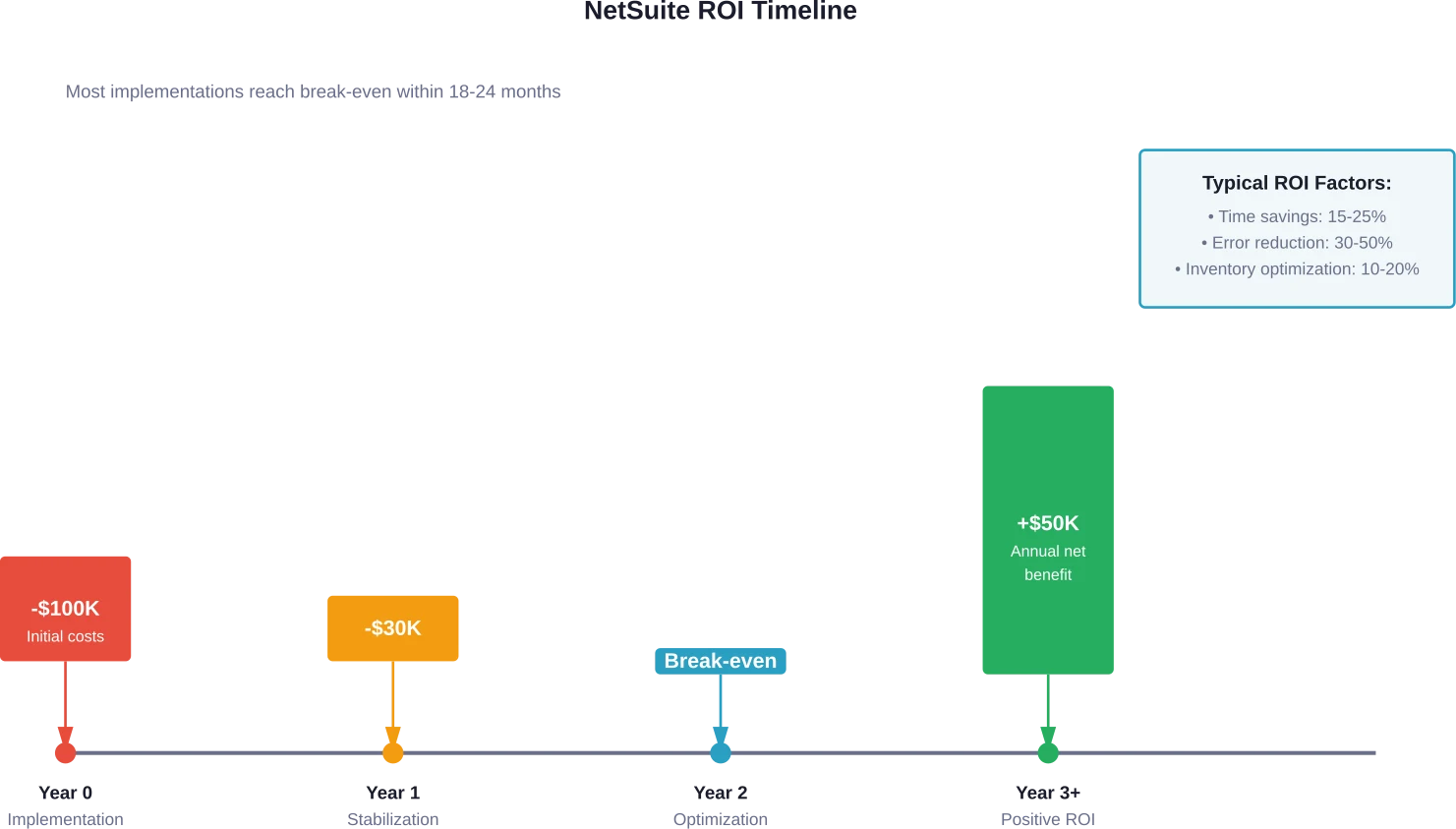
NetSuite's centralized data architecture boosts performance by minimizing miscommunication and streamlining operations, according to the official website. This manifests in several measurable ways:
- Time savings: Automated processes, integrated data, and streamlined workflows reduce manual work. Financial close that previously took two weeks might complete in three days.
- Error reduction: Manual data entry between disconnected systems creates errors. Unified data eliminates duplicate entry and the mistakes it causes.
- Inventory optimization: Real-time visibility and demand planning reduce excess inventory and stockouts, freeing working capital and preventing lost sales.
- Scaling efficiency: Companies typically outgrow basic accounting software around $5-10 million in revenue. NetSuite scales to $100+ million without requiring a system replacement.
Strategic Advantages
Beyond measurable ROI, NetSuite provides capabilities that enable growth:
Real-time visibility across the business supports faster, better-informed decisions. Executives access live dashboards instead of waiting for month-end reports.
Multi-subsidiary management in a single system simplifies operations for companies with multiple entities, currencies, or tax jurisdictions. This becomes critical for businesses pursuing acquisitions or international expansion.
Built-in compliance and audit trails matter increasingly in regulated industries. Having proper controls and documentation isn't optional—it's table stakes.
When NetSuite Doesn't Make Sense
NetSuite isn't right for every business. Small companies with simple needs often find the cost and complexity excessive. QuickBooks or similar solutions serve them better.
Businesses with minimal growth plans might not need enterprise capabilities. If current systems work adequately and expansion isn't planned, expensive upgrades don't generate returns.
Companies with extremely specialized processes might need industry-specific solutions. While NetSuite offers broad functionality, niche industries sometimes require purpose-built software.
Planning a NetSuite Budget: Practical Steps
Developing an accurate NetSuite budget requires understanding specific business needs and requirements.
Assess Current State
Document existing systems, processes, and pain points. Identify what works today and what needs improvement. This assessment guides decisions about required modules and customization scope.
Count current and projected users across departments. Factor in growth over the next 2-3 years—adding users later is easy but increases ongoing costs.
Define Requirements
List must-have capabilities versus nice-to-have features. Focus initial implementation on critical functionality that delivers immediate value.
Identify required integrations with existing systems. Each connection adds cost and complexity, so prioritize those essential to operations.
Get Multiple Quotes
Implementation partner pricing varies significantly. Request detailed quotes from 3-5 partners, ensuring they're bidding on identical scope.
Evaluate partners on expertise, approach, and timeline—not just price. The cheapest option often proves most expensive when rework becomes necessary.
Build in Contingency
Budget 15-20% above quoted estimates for unexpected requirements, scope changes, and discoveries during implementation. Projects rarely come in under budget; planning for overruns prevents mid-project budget crises.
Plan for Ongoing Costs
First-year costs differ dramatically from ongoing annual expenses. Separate one-time implementation costs from recurring licensing when building financial models.
Factor in support, training refreshers, customization updates, and integration maintenance when calculating total cost of ownership beyond year one.
Frequently Asked Questions
What is the minimum cost to implement NetSuite?
The minimum realistic NetSuite investment starts around $25,000 for the first year, covering basic annual licensing and a simple SuiteSuccess implementation. This applies to small businesses with straightforward requirements, minimal customization, and fewer than 10 users. Most businesses should plan for $40,000-$60,000 first-year investment for a properly implemented system.
How long does NetSuite implementation typically take?
Implementation timelines range from 8-12 weeks for template-based SuiteSuccess deployments to 6-12 months for complex enterprise implementations. Most mid-market implementations complete in 3-5 months. Timeline depends on business complexity, customization requirements, data migration scope, and team availability during the project.
Can I implement NetSuite myself without a partner?
While technically possible, self-implementation rarely makes financial sense. NetSuite's complexity means most businesses lack the specialized knowledge for efficient deployment. Companies attempting self-implementation typically spend more time and money than partner-led projects, often requiring remediation work later. Partners bring proven methodologies, technical expertise, and experience that accelerate implementation and avoid costly mistakes.
How does NetSuite pricing compare to keeping multiple separate systems?
Companies often underestimate the total cost of maintaining separate accounting, CRM, inventory, and ecommerce systems. When factoring in multiple software subscriptions, integration maintenance, duplicate data entry, and error correction, separate systems frequently cost more than consolidated ERP. NetSuite eliminates redundant software costs and the hidden expenses of disconnected systems—manual reconciliation, data errors, and limited visibility.
What hidden costs should I watch for with NetSuite?
Common hidden costs include data storage overages, ongoing customization and maintenance ($9,000-$30,000 annually), integration upkeep ($2,000-$5,000 per integration yearly), premium support tiers (10-15% of licensing), and additional users as the business grows. Budget for these ongoing expenses beyond initial licensing and implementation fees.
Does NetSuite offer pricing for startups or small businesses?
NetSuite offers options positioned for smaller organizations with simpler structures—often with lower user caps and limited entities. These "starter" packages typically accommodate up to 10 users and one legal entity with reduced operational complexity. First-year costs for small business implementations often range from $25,000 to $50,000, covering both annual licensing and straightforward implementation.
How quickly can I expect ROI from NetSuite?
Most implementations reach break-even within 18-24 months as efficiency gains, error reduction, and time savings compound. Companies typically see measurable benefits—faster financial close, reduced inventory carrying costs, improved order accuracy—within 6-12 months of go-live. ROI depends heavily on how well the business leverages new capabilities and whether implementation included proper training and change management.
Making the NetSuite Investment Decision
NetSuite represents a significant financial commitment. For businesses at the right stage—outgrowing basic accounting software, managing increasing complexity, planning growth—the investment typically delivers strong returns.
The key lies in realistic budgeting that accounts for total cost of ownership, not just initial licensing. Companies that budget appropriately, choose implementation partners wisely, and commit to proper training position themselves for success.
Those that underestimate costs, rush implementation, or skimp on training often struggle with adoption and fail to realize expected benefits.
Start by thoroughly assessing business requirements and getting detailed quotes from multiple implementation partners. Factor in hidden costs and ongoing expenses. Build realistic financial models that separate first-year investment from ongoing annual costs.
NetSuite works best for companies between $5 million and $500 million in revenue—large enough to justify the investment but not so large they need full enterprise-grade solutions. Within that range, the platform scales effectively as businesses grow.
The total investment depends entirely on specific business needs, but understanding the cost components, typical scenarios, and factors driving variation enables accurate budget planning. Armed with realistic expectations and proper planning, businesses can make informed decisions about whether NetSuite's capabilities justify the expense for their particular situation.
Ready to explore whether NetSuite fits your budget and requirements? Connect with certified implementation partners who can provide detailed quotes based on your specific business needs and create a realistic implementation plan that aligns with financial constraints.


