

MVP Development Cost Estimation Guide 2026

Key Points: MVP development costs range from $10,000 to $150,000 in 2026, depending on complexity, features, tech stack, and team structure. Simple MVPs with basic features typically cost $15,000-$30,000 and take 6-8 weeks, while complex builds with AI integration can exceed $100,000. Key cost drivers include platform choice, third-party integrations, design complexity, and developer rates (which vary from $25-$200/hour based on location)
Building a minimum viable product requires careful budget planning. Many founders underestimate costs, leading to incomplete builds or funding gaps. Others overspend on features that users never needed in the first place.
Spending $50,000 on an MVP that attracts early adopters beats investing $300,000 in a full product only to discover market disinterest. But how exactly do you estimate what the right number is?
This guide breaks down MVP development costs by complexity level, team structure, and hidden expenses most startups miss. Whether working with freelancers or agencies, understanding these factors helps make informed budget decisions.
MVP Cost by Complexity Level
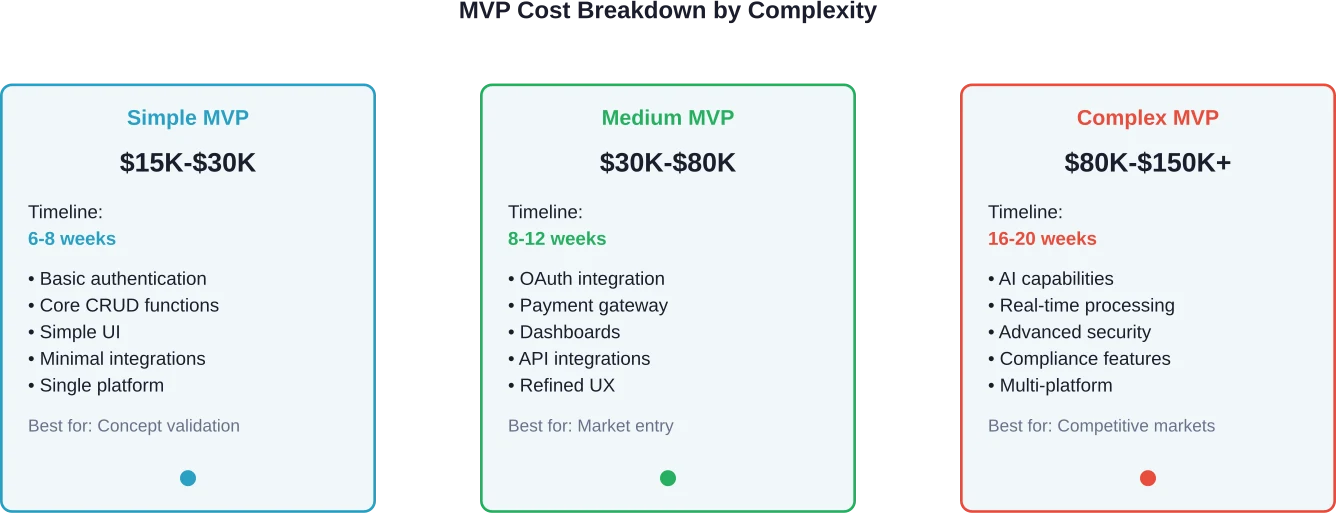
MVP complexity directly impacts development time and budget. Breaking projects into three tiers provides clearer estimation parameters.
Simple MVP: $15,000-$30,000
Simple MVPs focus on validating a core concept with minimal functionality. These typically include basic user authentication, core CRUD operations, and a simple UI built with standard components.
Most simple builds avoid complex integrations. They validate whether users want the product before investing in advanced features. Common examples include early-stage idea validation tools, basic booking systems, or simple content platforms.
Timeline? Expect 6-8 weeks from kickoff to launch.
Medium MVP: $30,000-$80,000
Medium complexity projects add third-party integrations, refined user experiences, and more sophisticated data handling. These MVPs often include payment processing, API integrations with existing platforms, and polished dashboards.
Development takes 8-12 weeks. According to calculators used by 2,800+ founders, these projects require more careful feature prioritization to avoid scope creep.
Examples include marketplace platforms connecting buyers and sellers, SaaS tools with analytics dashboards, or mobile apps with social features.
Complex MVP: $80,000-$150,000+
Complex builds incorporate AI capabilities, real-time data processing, advanced security requirements, or multi-platform deployment. These projects often serve regulated industries or require sophisticated algorithm development.
Timeline extends to 16-20 weeks or longer. Some sources note that AI-enabled builds can exceed $100,000 depending on model complexity and data requirements.
Real-time collaboration tools, fintech applications with compliance requirements, and healthcare platforms with HIPAA considerations fall into this category.
Key Factors That Drive MVP Development Budget
Several variables affect final costs beyond basic complexity. Understanding these helps refine estimates and prevent budget surprises.
Platform Choice
Building for web, iOS, Android, or multiple platforms simultaneously changes both timeline and cost. Web apps generally cost less than native mobile development.
Native iOS and Android apps require separate codebases, essentially doubling mobile development effort. Cross-platform frameworks like React Native reduce this duplication but may limit access to platform-specific features.
Many startups launch web-first, then expand to mobile after validating product-market fit.
Feature Scope and Integration Complexity
Each feature adds development hours. Some integrations look simple but hide complexity.
Email-based authentication requires approximately 12 engineering hours. OAuth integration with Google or Facebook takes 18-22 hours. Stripe payment gateway implementation (API plus UI) needs 38-45 hours.
Real-time features, video processing, or machine learning models multiply these numbers significantly. Even seemingly straightforward requirements like "users can upload photos" involve decisions about file size limits, storage solutions, image optimization, and content moderation.
Design Requirements
Design costs vary from template-based approaches to fully custom interfaces. Using pre-built UI component libraries dramatically reduces design and development time.
Custom designs require wireframing, mockups, user testing, and iteration. This adds 20-30% to the base development budget. However, for consumer-facing products where brand differentiation matters, this investment often pays dividends in user adoption.
B2B tools targeting internal workflows can often succeed with simpler, more functional designs.
Tech Stack Decisions
Technology choices impact both immediate costs and long-term maintenance. Modern stacks with strong developer communities tend to reduce debugging time and future hiring costs.
No-code and low-code platforms have gained traction recently. According to Gartner forecasts, by 2026, developers outside formal IT departments will make up at least 80% of the user base for low-code tools, up from 60% in 2021.
The global low-code/no-code development technologies market is projected to reach approximately $44.5 billion by 2026. For certain MVP types, these tools can reduce costs by 60-70% compared to traditional development.
But there's a tradeoff. Community discussions frequently mention scalability concerns and vendor lock-in as major drawbacks once products gain traction.
MVP Cost by Development Team Structure
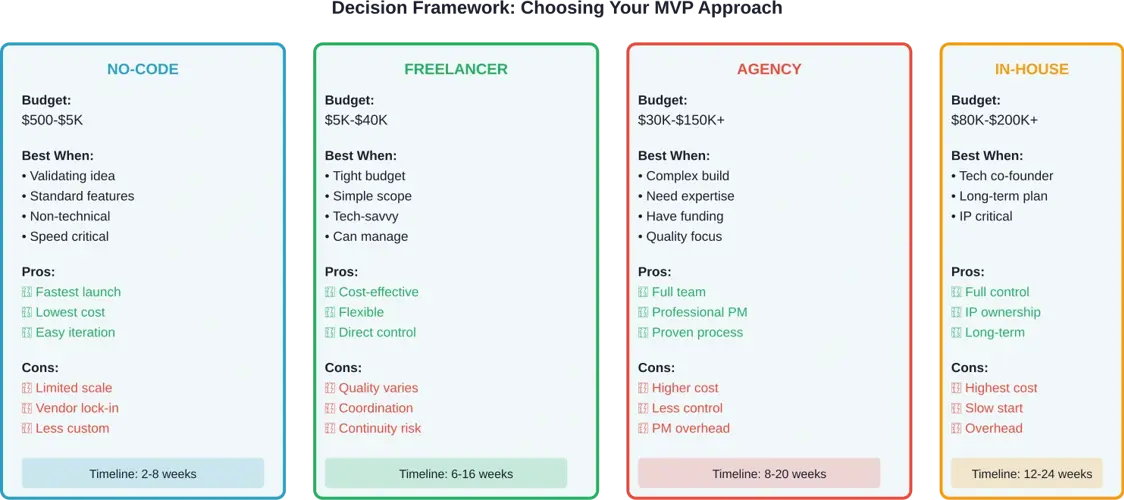
Team composition significantly affects budget. Different approaches suit different project types and risk tolerances.
|
Team Type |
Typical Cost Range |
Best For |
Key Considerations
|
|---|---|---|---|
|
Freelancers |
$5,000-$40,000 |
Tight budgets, simple projects |
Variable quality, coordination overhead, potential continuity issues |
|
Development Agency |
$30,000-$150,000+ |
Complex builds, faster delivery |
Higher hourly rates, project management included, established processes |
|
In-house Team |
$80,000-$200,000+ |
Long-term product development |
Salaries, benefits, equipment, slower initial ramp-up |
|
Hybrid Model |
$20,000-$100,000 |
Technical founders with gaps |
Fill specific skill gaps, maintain control of core development |
Geographic Location Impact
Developer rates vary dramatically by location. US and UK agencies typically charge $120-$200 per hour. Eastern European teams range from $50-$80 hourly. South Asian developers often quote $25-$50 per hour.
Lower rates don't automatically mean lower quality, but communication complexity increases with time zone differences and language barriers. Many successful projects use hybrid approaches: senior architects from high-cost regions paired with implementation teams from lower-cost areas.

Define Your MVP Budget the Right Way
An MVP should include only core functionality needed for validation. OSKI Solutions helps define minimal scope and estimates development effort accordingly. The focus is on practical launch requirements. This keeps the initial investment controlled.
Ready to Launch Your MVP With a Clear Budget?
Talk with OSKI Solutions to:
- prioritize essential features
- remove non critical functionality
- calculate minimum viable investment
👉 Request an MVP development cost estimate from OSKI Solutions.
Launch Your MVP Faster
We help startups turn ideas into market-ready MVPs with lean development, rapid validation, and scalable architecture.
Hidden Costs Most Startups Miss
Initial estimates often overlook expenses that surface mid-project or post-launch.
Pre-Development Costs
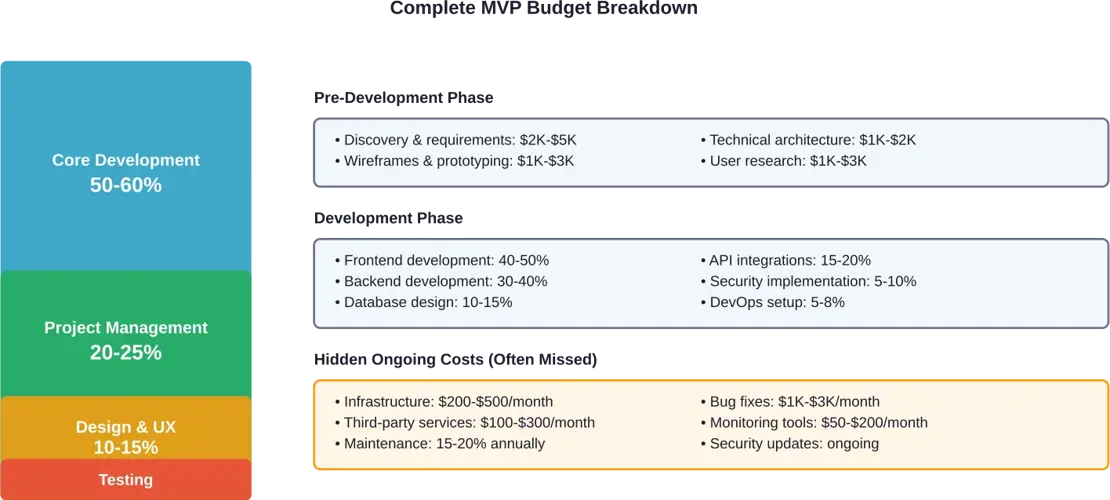
Before writing code, most projects require discovery and planning work. User research, competitive analysis, wireframing, and technical architecture planning consume time and budget.
These phases typically add $3,000-$10,000 to project costs but dramatically reduce the risk of building the wrong thing. Skipping discovery work is a common cause of project pivots that waste 50% or more of the initial development budget.
Project Management Overhead
Project management fees typically add 20-30% to base development costs. This covers sprint planning, daily standups, stakeholder communication, and risk management.
For agency projects, this is often bundled into quoted rates. With freelancers, founders assume this role themselves—an invisible cost in founder time.
Third-Party Service Costs
Cloud hosting, database services, email delivery, SMS notifications, payment processing fees, and API subscriptions add monthly recurring costs. These might seem small individually but compound quickly.
A typical MVP might spend $200-$500 monthly on infrastructure before gaining any users. As user counts grow, these costs scale—sometimes unpredictably if the architecture wasn't designed for efficiency.
Post-Launch Maintenance
Software requires ongoing maintenance even if no new features are added. Security patches, dependency updates, bug fixes, and infrastructure management demand continuous attention.
Budget roughly 15-20% of initial development cost annually for basic maintenance. More active products with frequent updates require larger allocations.
How to Reduce MVP Development Cost Without Sacrificing Quality
Smart cost reduction focuses on efficiency, not corner-cutting. Several strategies preserve quality while reducing budget requirements.
Start with Core Features Only
The "minimum" in minimum viable product matters. Each additional feature increases complexity exponentially, not linearly.
List every desired feature, then ruthlessly cut anything not essential for the core value proposition. User profiles? Maybe just email and password initially. Social sharing? Add it in version two if users request it.
This approach aligns with the "failing fast" philosophy emphasized by entrepreneurship programs. Testing assumptions quickly with minimal investment beats building comprehensive features nobody wants.
Leverage Existing Tools and Services
Building authentication from scratch wastes time and money. Use Auth0, Firebase Authentication, or similar services. Need payments? Stripe or PayPal handle the complexity.
These tools cost more per transaction than custom solutions but eliminate thousands in upfront development costs. For MVPs, that tradeoff makes sense—optimization can wait until there's revenue to optimize.
Consider No-Code for Validation
For certain product types, no-code platforms enable rapid validation at a fraction of traditional development costs. A medical booking app, e-commerce platform, or content management system can often be prototyped without writing code.
Learning platforms introducing entrepreneurs to no-code tools have attracted over 1,000 learners, demonstrating growing interest. However, user experiences in community discussions highlight scalability limitations as major concerns.
The strategy? Use no-code for initial validation, then rebuild with traditional development once product-market fit is proven.
Choose One Platform First
Multi-platform launches multiply costs. Pick the platform where the target audience concentrates most.
B2B software? Web application makes sense. Consumer social app? Start with iOS (higher spending users) or Android (larger market share), not both.
After validating demand on one platform, expansion becomes easier to fund through revenue or investment.
Use Agile Methodology with Strict Sprints
Agile development with defined sprint goals prevents scope creep—the silent budget killer. Two-week sprints with specific deliverables keep projects on track.
Historical velocity metrics from Agile teams help estimate hours more accurately. Projects using structured sprint planning typically stay within 10-15% of estimated budgets, compared to 40-50% overruns in waterfall projects.
Estimating Development Hours for Common Features
Understanding hour requirements for specific features helps build bottom-up estimates that complement top-down complexity assessments.
|
Feature |
Estimated Hours |
Complexity Factors
|
|---|---|---|
|
Email authentication |
12-16 hours |
Password reset, email verification |
|
OAuth integration |
18-22 hours |
Multiple providers add 6-8 hours each |
|
Payment gateway (Stripe) |
38-45 hours |
Subscription management adds 20+ hours |
|
User dashboard |
30-50 hours |
Complexity depends on data visualizations |
|
Admin panel (basic) |
40-60 hours |
User management, content moderation |
|
Search functionality |
25-40 hours |
Advanced filters add 15-25 hours |
|
File upload system |
20-30 hours |
Image processing adds 10-15 hours |
|
Push notifications |
25-35 hours |
Scheduling and targeting increase time |
|
Real-time chat |
60-80 hours |
Group chat adds 30+ hours |
When to Invest More in an MVP
Not all situations call for minimum investment. Sometimes spending more upfront makes strategic sense.
Competitive or Crowded Markets
Entering a space with established players requires differentiation. A bare-bones MVP might not gain traction when competing against polished alternatives.
In these scenarios, investing in superior UX, unique features, or better performance justifies higher initial costs. The product needs to be compelling enough to attract users away from existing solutions.
Regulated Industries
Healthcare, finance, and legal tech face compliance requirements from day one. HIPAA compliance, financial regulations, or data protection laws aren't optional—even for MVPs.
These requirements add $20,000-$50,000 or more to base development costs but can't be deferred. Launching without compliance creates legal liability that dwarfs the cost of doing it right initially.
Technical Founders with Domain Expertise
Founders who understand both the technical landscape and market opportunity can make sophisticated architectural decisions that reduce long-term costs even if initial development takes longer.
Building with scalability in mind from the start costs 15-20% more initially but avoids expensive rewrites when user numbers grow.
The Role of MVP Development in Funding Strategy
MVPs serve as de-risking tools for investors. Demonstrating traction through real user data transforms pitches from theoretical to proven.
Angel investors and VCs respond more favorably to MVPs showing user signups, retention metrics, or early revenue. A working product validates that the founding team can execute, not just ideate.
Startup funding progresses through stages. Pre-seed and seed rounds typically fund MVP development. Series A requires proven product-market fit—something an MVP helps demonstrate.
According to startup education resources, each funding stage supports specific growth phases. MVPs bridge the gap between concept and scalable business.
Real-World MVP Budget Scenarios
Concrete examples illustrate how different approaches affect budgets.
Scenario 1: Solo Founder, Web App, No-Code Approach
A founder validating a SaaS idea for project management uses Bubble or similar no-code platform. Three months of part-time work, plus $100 monthly platform fees.
Total cost: $300 plus founder time. Once validated, transition to custom development using initial revenue or seed funding.
Scenario 2: Two Technical Founders, Mobile App, In-House
Co-founders building a consumer mobile app split responsibilities: one handles iOS development, the other manages backend and API. Four months of full-time work.
Out-of-pocket costs: $2,000-$3,000 for tools, services, and infrastructure. Opportunity cost: eight person-months of salary (deferred compensation).
Scenario 3: Non-Technical Founder, Agency Build, Medium Complexity
Founder hiring an agency for marketplace MVP connecting service providers with customers. Includes payment processing, reviews, messaging, and admin dashboard.
Agency quote: $55,000 for 12-week build. Includes design, development, testing, and project management. Monthly infrastructure costs post-launch: $400.
Scenario 4: Startup Team, Complex AI Product, Hybrid Approach
Team building AI-powered analytics platform. Senior architect (in-house) designs system; offshore team implements under architect's guidance.
Costs: $15,000/month architect salary × 6 months = $90,000. Offshore team: $35,000 for implementation work. Total: $125,000 plus ongoing infrastructure costs of $800-$1,200 monthly.
Frequently Asked Questions
How much does a simple MVP typically cost?
Simple MVPs with basic features generally cost between $15,000 and $30,000. This range covers projects with standard authentication, core CRUD functionality, simple UI, and minimal third-party integrations. Timeline typically spans 6-8 weeks. Budget increases significantly when adding payment processing, complex integrations, or custom design work.
Should I hire freelancers or an agency for MVP development?
Freelancers work best for tight budgets and simple projects, costing $5,000-$40,000 but requiring more founder involvement in coordination. Agencies charge $30,000-$150,000+ but provide complete teams, project management, and established processes. Choose freelancers when budget-constrained and capable of technical oversight; choose agencies for complex builds requiring diverse expertise and faster delivery.
Can I build an MVP with no-code tools?
No-code platforms effectively validate certain product types at significantly lower costs—often $500-$5,000 versus $15,000-$50,000 for traditional development. They work well for standard web apps, booking systems, marketplaces, and content platforms. However, scalability limitations and vendor lock-in become concerns as products grow. Many successful startups use no-code for initial validation, then rebuild with custom development after proving demand.
What hidden costs should I budget for beyond development?
Pre-development costs (discovery, wireframes, architecture planning) add $3,000-$10,000. Project management overhead typically adds 20-30% to base development costs. Post-launch, budget $200-$500 monthly for infrastructure, $100-$300 for third-party services, and 15-20% of initial development cost annually for maintenance. These ongoing expenses often surprise first-time founders who focus exclusively on initial build costs.
How long does MVP development typically take?
Simple MVPs require 6-8 weeks, medium complexity projects take 8-12 weeks, and complex builds extend to 16-20 weeks or longer. Timeline depends on feature scope, team structure, and communication efficiency. No-code approaches can launch in 2-4 weeks. In-house teams may need longer initial ramp-up but maintain development velocity long-term. Rushed timelines often result in technical debt that costs more to fix than building properly initially.
When should I invest more than the minimum in an MVP?
Invest more when entering crowded markets requiring differentiation, building for regulated industries with compliance requirements, or targeting enterprise customers with higher quality expectations. Products needing AI capabilities, real-time processing, or multi-platform presence from launch justify higher budgets. Technical founders with domain expertise may also choose to invest in scalable architecture upfront, spending 15-20% more initially to avoid expensive rewrites during growth.
How do I estimate hours for specific features?
Use historical data from similar projects. Email authentication requires roughly 12-16 hours; OAuth integration takes 18-22 hours; Stripe payment implementation needs 38-45 hours; basic admin panels consume 40-60 hours. Complex features like real-time chat demand 60-80 hours or more. Working with experienced developers or agencies provides access to velocity metrics that improve estimate accuracy. Add 20-30% buffer for integration complexity and unexpected technical challenges.
Making Your MVP Investment Decision
MVP development costs reflect numerous variables: complexity, platform, team structure, location, and timeline all influence final budgets. The range spans from $5,000 for no-code validation projects to $150,000+ for complex, AI-enabled builds with compliance requirements.
Smart founders focus less on minimizing cost and more on maximizing learning per dollar spent. An MVP generating validated insights about customer needs and willingness to pay justifies its cost regardless of the specific number.
The real expense isn't building an MVP—it's building the wrong product at full scale without validation. Even a $100,000 MVP costs less than discovering product-market fit problems after investing $500,000 in complete development.
Start by clearly defining the one core hypothesis the MVP must test. Design the minimum feature set that generates meaningful validation data. Choose the development approach matching available budget and technical capabilities. Then build, launch, and learn quickly.
Ready to move forward with accurate cost estimation for your specific project? Work with experienced development teams who provide transparent pricing, detailed feature breakdowns, and realistic timelines. The investment in proper planning now prevents expensive pivots later.


