

MVP Development Cost 2026: Real Budget Breakdown

Summary: MVP development costs range from $5,000 to $50,000+ depending on complexity, features, and team location. Simple MVPs with basic CRUD functionality cost $5,000-$10,000 and take 3-7 days, while complex MVPs with AI integration or advanced features can reach $50,000+ and require 14-30 days. Hidden costs like infrastructure, third-party services, and maintenance can add 20-40% to initial estimates.
Building a Minimum Viable Product shouldn't feel like navigating a minefield of unclear quotes and hidden fees. Yet most founders searching for MVP development cost information hit the same wall: vague ranges, outdated numbers, and pricing that doesn't match reality.
Here's what actually matters. The cost to build an MVP in 2026 depends on three core factors: what features the product needs, who builds it, and how fast it needs to ship. Everything else is noise.
This breakdown covers real pricing tiers, the specific factors that push costs up or down, and the hidden expenses that catch founders off guard. No sales pitch. Just the numbers.
Why MVPs Matter Before We Talk Money
A Minimum Viable Product validates whether anyone wants what someone's building. That's it. According to Harvard Business School's research on failing fast published on April 3, 2025, a Global Entrepreneurship Monitor survey shows that 49 percent of people said they wouldn't start a business for fear of failure. An MVP reduces that risk by proving traction before major capital gets deployed.
The pattern shows up consistently across funding landscapes. Research from Kenya's innovation ecosystem at Strathmore University found that founders who document product decisions and test ideas quickly gain deeper trust from users, mentors, and investors. Even feedback from the first 30 users can reshape product direction entirely.
Building an MVP typically costs 10-30% of what a full product would cost. If an idea doesn't gain traction, far less capital gets risked. If it does work, real-world usage data guides what gets built next instead of assumptions.
Airbnb started with guests on air mattresses. Zappos launched by posting shoe photos without inventory. Both used MVPs to validate demand before scaling operations.
The Three MVP Cost Tiers
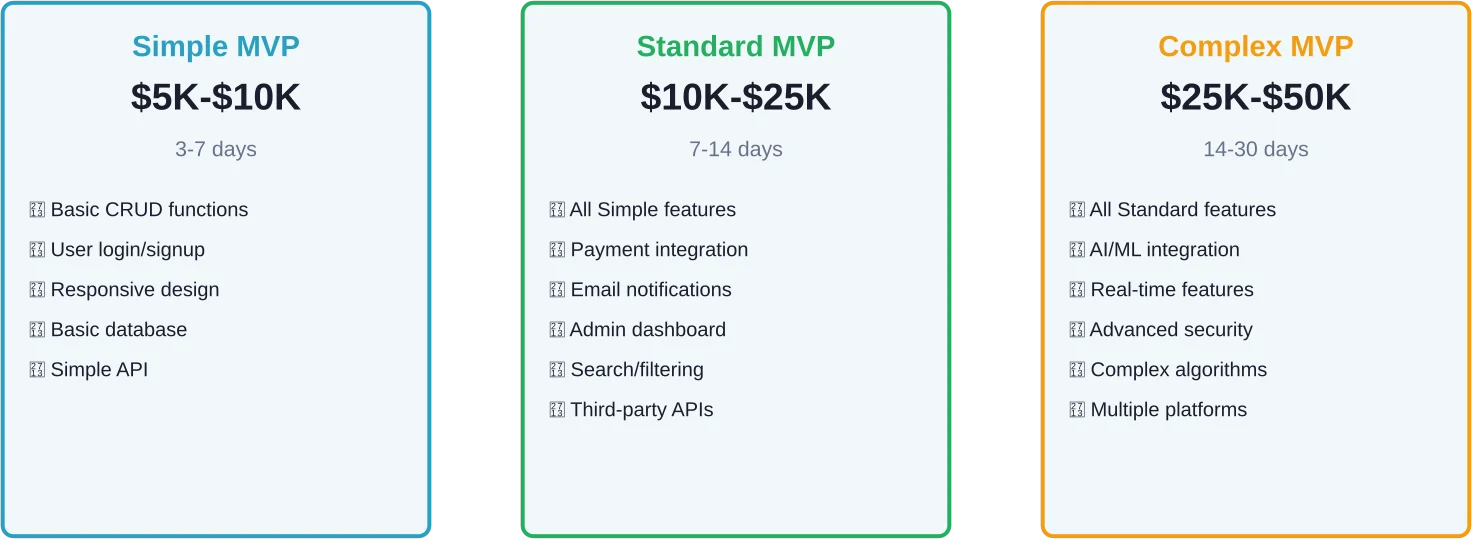
MVP development cost breaks into three clear categories based on complexity and feature scope. These ranges reflect 2026 market rates from agencies and experienced development teams.
Simple MVP: $5,000-$10,000
A simple MVP handles basic CRUD operations (Create, Read, Update, Delete), user authentication, and a clean responsive interface. Development takes 3-7 days. This tier works for straightforward concepts that need market validation without complex backend logic.
What gets included: basic database setup, simple user authentication with login and signup, responsive web interface, fundamental API endpoints, and basic error handling. These MVPs don't include payment processing, real-time features, or extensive third-party integrations.
This tier suits founders testing whether an audience exists for a concept before investing in advanced functionality. The product proves whether people will sign up and engage with core features.
Standard MVP: $10,000-$25,000
Standard MVPs add payment processing, email notifications, admin dashboards, search functionality, and third-party service integrations. Timeline extends to 7-14 days. This tier covers most SaaS platforms, marketplaces, and booking systems that need monetization from day one.
These builds include everything from the simple tier plus Stripe or PayPal integration, automated email workflows, content management capabilities, filtering and search functions, and integration with services like Twilio, SendGrid, or Google Maps.
The standard tier makes sense when the business model requires payment collection or when the product needs moderate backend complexity to demonstrate value.
Complex MVP: $25,000-$50,000+
Complex MVPs incorporate AI/ML features, real-time functionality (chat, live updates), advanced security requirements, sophisticated algorithms, or multi-platform deployment. Development spans 14-30 days or longer depending on technical requirements.
This category includes AI-powered recommendations, real-time collaboration features, complex data processing, advanced user permissions and security layers, or simultaneous web and mobile app development.
According to Gartner, 90% of companies will deploy GenAI as a workforce partner by 2025, making AI capabilities increasingly important to build into MVPs from the start. That architectural decision affects initial development cost but prevents expensive rebuilds later.
What Actually Drives MVP Development Cost
Five primary factors determine where an MVP lands within those pricing ranges. Understanding these helps founders make smart tradeoffs during planning.
Feature Scope and Complexity
Every additional feature adds development time and cost. But not all features carry equal weight. User authentication might add 4-6 hours of work. Real-time chat could add 40-60 hours. Payment integration typically requires 12-20 hours including testing and security implementation.
The complexity multiplier hits hardest with custom algorithms, AI integration, or features that require extensive testing across edge cases. A simple content feed might take 8 hours. A personalized recommendation engine could require 80+ hours of development and tuning.
Design Requirements
Design work ranges from using pre-built component libraries (lowest cost) to custom UI/UX design (moderate cost) to extensive user research and iterative design processes (highest cost). A simple MVP using Tailwind CSS or Bootstrap components might need 6-10 hours of design work. Custom design for 8-12 unique screens could require 30-50 hours.
Most MVPs benefit from clean, functional design using established patterns rather than innovative interfaces. Users understand familiar layouts. The product can differentiate through functionality first, then enhance design after validation.
Platform Decisions
Building for web only costs less than mobile apps, which cost less than both simultaneously. Web apps provide the fastest path to market and easiest iteration cycle. Native iOS or Android apps increase development time by 60-100% compared to web. Building both platforms typically doubles mobile development cost.
Progressive Web Apps (PWAs) offer a middle ground, delivering app-like experiences through web technology at web development costs. For many MVPs, a responsive web app proves sufficient for initial validation.
Third-Party Integrations
Every service integration adds complexity. Payment processors (Stripe, PayPal) typically require 8-15 hours including testing. Email services (SendGrid, Mailgun) need 4-8 hours. More complex integrations like CRM systems, analytics platforms, or specialized APIs can require 15-30 hours each depending on documentation quality and API complexity.
Some integrations introduce ongoing costs beyond development. Payment processors charge transaction fees. Email services bill by volume. SMS providers charge per message. These operational costs stack up as usage grows.
Team Location and Structure
Developer hourly rates vary dramatically by geography. US and UK agencies typically charge $120-$200 per hour. Eastern European developers average $50-$100 per hour. Asian markets range from $25-$75 per hour.
But hourly rate tells an incomplete story. A $200/hour senior developer who builds features correctly the first time often delivers better value than a $30/hour junior developer who needs extensive revisions. Communication overhead, timezone differences, and project management complexity also affect total cost.
|
Region |
Hourly Rate |
Simple MVP |
Standard MVP |
Complex MVP |
|---|---|---|---|---|
|
US/UK Agency |
$120-$200 |
$8,000-$15,000 |
$18,000-$35,000 |
$35,000-$75,000+ |
|
Eastern Europe |
$50-$100 |
$5,000-$10,000 |
$10,000-$20,000 |
$20,000-$40,000 |
|
Asia |
$25-$75 |
$3,000-$7,000 |
$7,000-$15,000 |
$15,000-$30,000 |
|
Freelancer (varies) |
$30-$150 |
$3,000-$12,000 |
$8,000-$22,000 |
$20,000-$45,000 |
Hidden Costs That Catch Founders Off Guard
The development quote represents just part of total MVP cost. Several categories of hidden expenses add 20-40% to initial estimates.
Pre-Development Research and Planning
Market research costs $1,000-$10,000 depending on depth. User interviews run $500-$5,000 for 10-20 participants. Competitive analysis adds $1,000-$7,500. Requirements documentation requires $2,000-$8,000 for detailed specifications.
Skipping this research might save money upfront but often leads to building the wrong features. According to research from Kenya's Strathmore University published in July 2025, founders who document product decisions and test ideas quickly gain deeper trust from investors. Even feedback from the first 30 users can reshape direction entirely.
Infrastructure and Hosting
Cloud hosting through AWS, Google Cloud, or Azure typically costs $50-$500 monthly for MVP-stage traffic. Domain registration runs $10-$50 yearly. SSL certificates cost $0-$200 annually (often free through Let's Encrypt). CDN services add $20-$200 monthly depending on traffic.
These costs scale with usage. A viral launch or press coverage can spike infrastructure costs unexpectedly. Building with serverless architecture or managed services reduces operations complexity but increases per-request costs.
Third-Party Service Subscriptions
Email sending services charge $10-$100 monthly based on volume. Payment processing takes 2.9% plus $0.30 per transaction typically. Analytics platforms run $0-$200 monthly. Error tracking services cost $25-$100 monthly. Authentication services charge $25-$500 monthly depending on active users.
These subscriptions seem modest individually but compound quickly. A standard MVP might carry $150-$400 in monthly service costs before hosting.
Ongoing Maintenance and Updates
Post-launch maintenance typically requires 15-25% of initial development cost annually. This covers security patches, dependency updates, bug fixes, and minor improvements. More active development for new features costs additional.
Technical debt accumulates when MVPs get rushed to market. That debt eventually requires repayment through refactoring or rebuilds. Discussion on Hacker News about development speed notes that releasing the right features matters more than development speed alone, and rushing without proper architecture creates maintenance challenges.
App Store Fees and Requirements
Apple App Store charges $99 yearly for developer accounts. Google Play costs $25 one-time. Both platforms take 15-30% revenue cuts on in-app purchases and subscriptions. For MVPs generating revenue through app stores, this represents significant overhead.
App store review processes also introduce timeline uncertainty. Apple reviews typically take 1-3 days but rejections require fixes and resubmission. Building web-first avoids these gatekeepers during initial validation.

Define Your MVP Development Cost Clearly
MVP cost depends on feature scope and technical complexity. OSKI Solutions helps limit the scope to essential functionality required for validation. The team estimates development hours based on concrete tasks and release requirements. This keeps the initial investment predictable.
Ready to Calculate Your MVP Budget?
Talk with OSKI Solutions to:
- prioritize core features
- remove non essential functionality
- receive a structured MVP cost estimate
👉 Request an MVP development quote from OSKI Solutions.
Launch Your MVP Faster
We help startups turn ideas into market-ready MVPs with lean development, rapid validation, and scalable architecture.
Development Approach Comparison
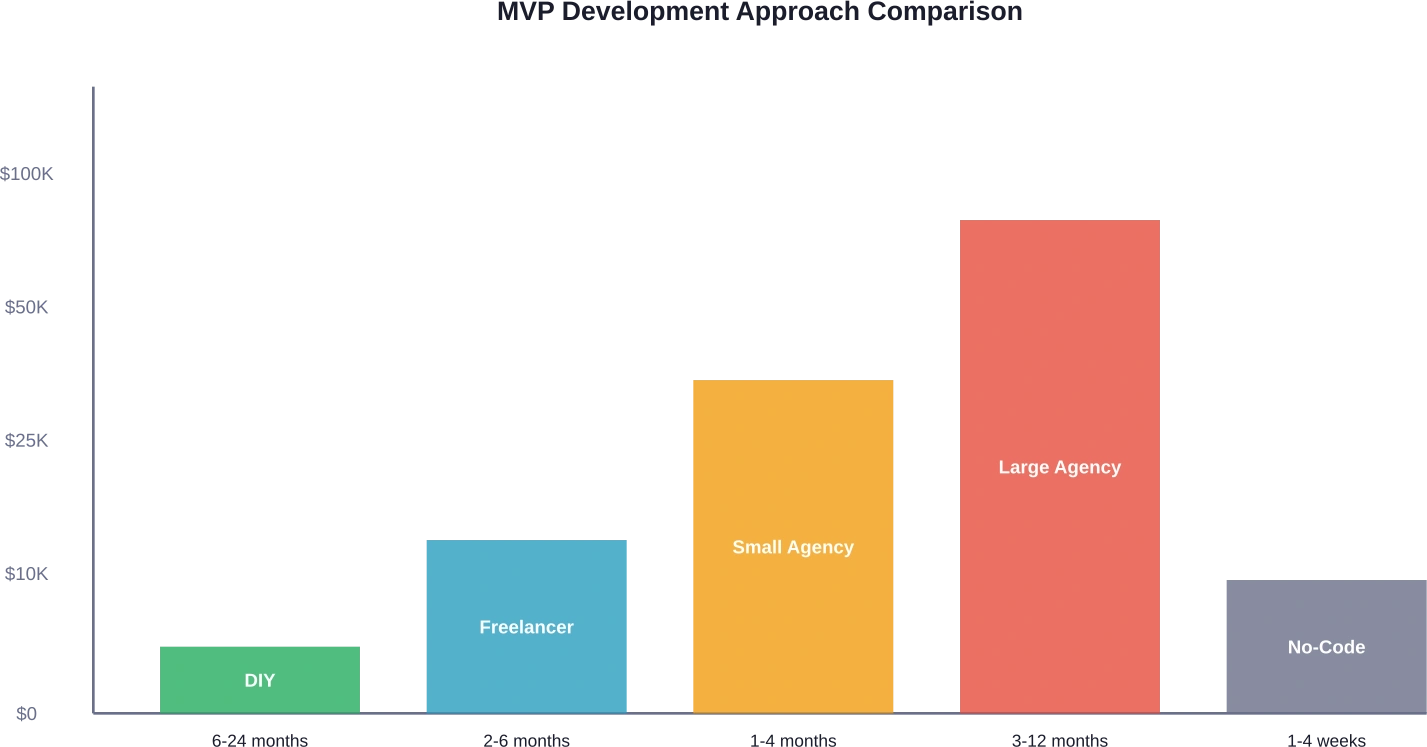
Founders face several paths to getting an MVP built, each with distinct cost profiles, timelines, and quality expectations.
DIY (Do It Yourself)
Building an MVP personally costs $0-$2,000 in tools and services but requires 6-24 months for non-developers to learn enough to ship a functional product. This path makes sense for technical founders or those willing to invest serious time in learning to code.
According to the U.S. Bureau of Labor Statistics, computer programmers held about 121,200 jobs in 2024 with a median annual wage of $98,670 in May 2024. That market rate represents the opportunity cost of time spent learning versus paying professionals.
Discussions on Hacker News about AI and subscription costs note that developers can now build weekend projects to replace expensive SaaS subscriptions using AI tools, though concerns about code quality and security remain valid for production applications.
Hiring Freelancers
Freelance developers charge $30-$150 per hour depending on experience and location. Total project costs range from $3,000-$15,000 for simple MVPs, with timelines of 2-6 months factoring in communication overhead and potential revision cycles.
Quality varies dramatically in the freelance market. Top-tier freelancers deliver excellent work but stay booked months in advance. Budget freelancers often under-estimate timelines or deliver code requiring extensive fixes. Vetting becomes critical—reviewing portfolios, checking references, and starting with small paid test projects reduces risk.
Development Agencies
Agencies range from small studios (2-10 people) to large firms (50+ employees). Small agencies typically charge $15,000-$50,000 for MVPs with 1-4 month timelines. Large agencies quote $50,000-$150,000+ with 3-12 month timelines but bring extensive project management, QA processes, and specialized expertise.
Agency work includes formal discovery processes, documented requirements, structured development sprints, quality assurance testing, and post-launch support. The structure reduces risk but increases cost compared to freelancers.
According to Forrester Research (as cited by DaptonCS), businesses using custom applications achieved 267% ROI over three years. That return depends heavily on building the right product—agencies often excel at helping define requirements before development starts.
No-Code and Low-Code Platforms
Tools like Bubble, Webflow, or Adalo enable non-technical founders to build functional MVPs for $500-$5,000 including platform subscriptions and template purchases. Timeline compresses to 1-4 weeks for moderately complex applications.
These platforms work exceptionally well for testing business model assumptions without technical investment. But they introduce constraints around customization, scalability, and vendor lock-in. Migrating from no-code to custom code later requires rebuilding from scratch.
For pure validation of whether a market exists, no-code often represents the smartest first step. For products that need unique functionality or plan to scale significantly, custom development makes more sense upfront.
Real-World MVP Cost Examples
Specific examples help ground abstract pricing discussions in concrete reality.
- Simple Task Management Tool: A basic to-do list app with user accounts, task creation/editing, and simple sharing features cost $7,500 and took 5 days. Technology stack used React for frontend, Node.js for backend, and PostgreSQL for the database. No payment integration or mobile apps included.
- Local Services Marketplace: A platform connecting service providers with customers, including user profiles, booking system, payment processing via Stripe, rating system, and email notifications, cost $22,000 over 12 days. The build included admin dashboard for managing users and resolving disputes.
- AI-Powered Content Tool: A writing assistant using OpenAI's API with user authentication, credit-based usage system, payment processing, content history, and export features cost $38,000 across 21 days. Additional $400 monthly ongoing costs covered AI API usage, hosting, and service subscriptions.
- Fitness Tracking App: A web and mobile app with workout logging, progress charts, social features, and third-party wearable integration cost $65,000 over 8 weeks. The complexity came from building both iOS and Android native apps plus backend API and admin panel.
These examples show how feature scope and platform decisions directly translate to cost differences even within similar product categories.
Smart Strategies to Reduce MVP Development Cost
Founders can significantly reduce development costs without sacrificing product viability through strategic planning and prioritization.
Ruthlessly Prioritize Features
The "minimum" in Minimum Viable Product gets overlooked constantly. Most MVPs ship with 50-70% unnecessary features. The lean startup methodology emphasized by Rasmussen University focuses on testing ideas quickly and learning from real customers rather than building comprehensive products upfront.
Start by identifying the single core action that delivers value. Everything else becomes secondary. A ride-sharing MVP needs requesting rides and matching drivers—it doesn't need fare splitting, scheduled rides, multiple payment methods, or driver ratings on day one. Each additional feature adds cost and delays learning.
One effective exercise: Write down every planned feature, then cross out half. Then cross out half again. Whatever remains represents the true minimum. Build that first, launch it, and add features based on actual user feedback rather than assumptions.
Choose Proven Technology Stacks
Established technology stacks have more developers, better documentation, and fewer unexpected challenges. React, Vue, or Angular for frontend work. Node.js, Python/Django, or Ruby on Rails for backend. PostgreSQL or MySQL for databases.
Exotic or cutting-edge technologies might seem appealing but introduce risk. Developers cost more. Problems take longer to solve. Documentation proves sparse. Hiring becomes harder if the original developer leaves.
According to GitHub's latest State of the Developer report, 92% of developers now use AI-powered coding tools, representing a 40% increase from just two years ago. These tools work best with popular languages and frameworks where training data was abundant. Using common stacks lets developers leverage AI assistance more effectively, increasing productivity.
Start Web-Only
Building responsive web apps costs 40-60% less than adding native mobile apps. Progressive Web Apps deliver app-like experiences including offline functionality, push notifications, and home screen installation without app store overhead.
Most startups validate core concepts through web products before investing in mobile development. Instagram launched web-only initially. Twitter started as a web app. Mobile apps came after validation proved worth the investment.
For founders certain their audience primarily uses mobile devices, hybrid frameworks like React Native or Flutter allow building for both iOS and Android from a single codebase, reducing costs compared to separate native development.
Use Managed Services and SaaS Tools
Building custom authentication, payment processing, email delivery, or analytics from scratch costs 3-5x more than integrating existing services. Auth0 handles authentication. Stripe processes payments. SendGrid delivers emails. These services cost monthly fees but slash development time.
The tradeoff: monthly costs and dependency on external services. But for MVPs, speed to market and reduced development cost outweigh those concerns. Switching services later if needed costs less than building custom solutions upfront.
Find the Right Development Partner
Geographic arbitrage provides real savings without sacrificing quality. Eastern European and Asian developers often deliver work comparable to Western agencies at 40-70% lower rates. But vetting becomes essential—check portfolios thoroughly, speak with past clients, and start with small projects before committing to full MVP development.
Clear communication matters more than location. Weekly video calls, documented requirements, and structured feedback loops prevent expensive misunderstandings. Tools like Loom for async video updates, Figma for design collaboration, and GitHub for code review make remote development manageable.
How AI Changes MVP Development Cost in 2026
AI coding assistants have fundamentally altered development economics over the past year. According to GitHub's latest State of the Developer report, 92% of developers now use AI-powered coding tools. Gartner's 2026 survey indicates that 87% of professional developers now use LLM-powered coding assistants daily.
This doesn't mean development costs dropped 50%. It means the same budget produces more functionality, or the same functionality ships faster. Productivity gains appear most clearly in routine code generation, boilerplate reduction, and debugging assistance.
However, according to analysis published in February 2026 on BuildMVPFast, roughly 90% of firms surveyed across the US, UK, Germany, and Australia reported zero measurable impact on productivity or employment from AI over the past three years. Companies spending $2.5 trillion globally on AI in 2026 struggle to point to concrete productivity improvements. The ones reporting AI impact expect just 1.4% productivity increases over three years.
For MVP development specifically, AI tools help most with:
Code Generation: Developers describe desired functionality and AI generates initial implementation, reducing time spent on routine tasks by 20-40%.
Debugging: AI identifies potential bugs and suggests fixes faster than manual code review, cutting debugging time by 15-30%.
Documentation: Automatic code documentation and comment generation saves 10-20 hours on typical MVP projects.
Learning: Developers quickly reference unfamiliar frameworks or APIs through AI assistance rather than extensive documentation reading.
But AI doesn't replace architectural decisions, business logic design, or understanding user needs. The strategic work of defining what to build and how it should work still requires human expertise. Discussion on Hacker News about software startups notes concerns about competitive moat, with the perspective that execution speed, market understanding, and customer relationships provide advantage over code.
Red Flags: When Quotes Signal Problems
Certain warning signs in development quotes or agency pitches indicate potential issues ahead.
Quotes That Seem Too Good
Developers quoting $3,000 for MVPs described by others as $15,000-$25,000 projects either misunderstand requirements or plan to deliver minimal functionality. Ultra-low quotes often come from inexperienced developers underestimating complexity or offshore teams planning to upsell additional costs later.
If a quote seems half the expected range, dig deeper. Ask specifically what features get included, how many revision rounds, what testing occurs, and what gets delivered. Vague answers reveal problems.
Fixed-Price Projects Without Detailed Specs
Fixed-price development makes sense only when requirements are thoroughly documented. Agencies offering fixed prices based on brief conversations set up conflict—either they'll cut corners to hit the price, or they'll add charges for "scope changes" constantly.
Legitimate fixed-price projects require extensive discovery phases where requirements get documented in detail. That discovery itself should have a cost, and the development quote should reference specific documented requirements.
No Questions About Business Goals
Developers who don't ask why features matter, what problem gets solved, or who the target users are treat development as order-taking rather than problem-solving. The best development partners challenge feature decisions and suggest alternatives based on experience.
According to research from Kenya's innovation ecosystem, investors reward proof over perfection. Developers should help identify the minimal feature set that demonstrates proof of concept rather than building everything requested.
Promises of Exact Timelines
Software development involves uncertainty. A developer promising "exactly 8 weeks" hasn't accounted for unexpected challenges, requirement clarifications, or testing iterations. Honest estimates include ranges and acknowledge assumptions: "6-8 weeks assuming requirements don't change significantly and third-party APIs work as documented."
Hacker News discussions about estimating work suggest developers should estimate until 80% confident the project won't exceed a certain timeline. That inherently involves ranges rather than precise dates.
No Discussion of Ongoing Maintenance
MVPs don't end at launch. Security updates, bug fixes, dependency updates, and hosting management require ongoing attention. Development partners who don't discuss post-launch support either assume founders will handle it (often unrealistic) or plan to charge additional fees later.
Clear agreements about what post-launch support includes and costs prevent surprises after the initial build completes.
Frequently Asked Questions
How much does it cost to build an MVP in 2026?
MVP development costs range from $5,000 for simple web apps with basic CRUD functionality to $50,000+ for complex products with AI integration, real-time features, or multi-platform deployment. Standard MVPs with payment processing and moderate complexity typically cost $10,000-$25,000. Hidden costs including infrastructure, third-party services, and maintenance add 20-40% to development quotes.
How long does MVP development take?
Simple MVPs take 3-7 days of development time. Standard MVPs require 7-14 days. Complex MVPs need 14-30 days or longer depending on technical requirements. Total timeline from concept to launch typically runs 4-12 weeks including planning, design, development, testing, and deployment. Working with agencies adds discovery and project management time compared to freelancers.
Should I build an MVP myself or hire developers?
Technical founders or those willing to invest 6-24 months learning to code can build MVPs for minimal cost beyond tools and hosting. Non-technical founders typically save time and money by hiring professionals—the opportunity cost of learning often exceeds development costs. No-code tools offer a middle path, enabling non-technical founders to validate concepts in 1-4 weeks for $500-$5,000 before investing in custom development.
What's the biggest mistake founders make with MVP budgets?
Including too many features represents the most common and expensive mistake. Most MVPs ship with 50-70% unnecessary functionality that adds cost and delays learning. The second biggest mistake is underestimating hidden costs—infrastructure, third-party services, maintenance, and pre-development research typically add 30-50% to development-only quotes. Smart founders focus ruthlessly on the single core feature that demonstrates value, then expand based on user feedback.
Can I build an MVP for under $5,000?
Yes, through three approaches: DIY development using free tools and frameworks, no-code platforms like Bubble or Webflow, or overseas freelancers in lower-cost markets. DIY requires significant time investment. No-code works well for validation but limits customization and scalability. Budget freelancers deliver variable quality—thorough vetting becomes essential. For $5,000, expect basic functionality, minimal design polish, and potential technical debt requiring future fixes.
How much should I budget beyond initial development?
Plan for 15-25% of initial development cost annually for maintenance, security updates, and bug fixes. Infrastructure costs $50-$500 monthly for MVP-stage traffic. Third-party services typically run $150-$400 monthly. Features added post-launch cost additional based on complexity. Reserve at least 30-40% of the initial development budget for the first year of operations, iteration, and scaling.
What's the ROI on MVP development?
According to Forrester Research (as cited by DaptonCS), businesses using custom applications achieved 267% ROI over three years. MVPs specifically reduce risk by costing 10-30% of full product development while validating whether markets exist for ideas. Failed MVPs that cost $15,000 prevent wasting $150,000 on full products nobody wants. Successful MVPs generate revenue, prove traction for fundraising, and provide usage data guiding efficient feature development. The ROI depends entirely on using MVP learnings to make better decisions rather than treating the MVP as a throwaway prototype.
Budget Your MVP Successfully
MVP development cost depends on feature scope, team location, design complexity, platform decisions, and integration requirements. Simple MVPs cost $5,000-$10,000 and take 3-7 days. Standard MVPs run $10,000-$25,000 over 7-14 days. Complex builds requiring AI, real-time features, or multi-platform deployment cost $25,000-$50,000+ across 14-30 days.
Hidden costs add 20-40% to development quotes. Pre-development research, infrastructure, third-party services, ongoing maintenance, and app store fees compound quickly. Smart founders account for these expenses upfront rather than encountering budget surprises post-launch.
The most effective cost reduction strategy remains ruthless feature prioritization. Most MVPs ship with unnecessary functionality that delays learning and wastes capital. Identifying the single core feature that demonstrates value, building only that, and expanding based on real user feedback costs less and teaches more than comprehensive initial releases.
Development approach matters significantly. DIY works for technical founders with time. No-code enables fast validation for non-technical founders. Freelancers offer flexibility and moderate costs. Agencies provide structure and reduced risk at premium pricing. The right choice depends on technical capability, timeline urgency, and budget constraints.
AI tools have improved developer productivity 20-40% for routine tasks, but the strategic work of defining what to build still requires human expertise. According to Harvard Business School's research on failing fast published on April 3, 2025, a Global Entrepreneurship Monitor survey shows that 49 percent of people said they wouldn't start a business for fear of failure. MVPs enable rapid testing that reduces that fear at 10-30% the cost of full products.
Ready to build an MVP? Start by documenting the single feature that delivers core value. Get quotes from 3-5 development partners. Ask detailed questions about what's included, what costs extra, and what happens post-launch. Expect ranges rather than exact prices. And remember—the goal isn't building software, it's learning whether anyone wants what that software does. Every dollar spent should generate learning. Every feature included should test an assumption. Build the minimum that teaches the maximum, then iterate based on reality rather than guesses.


