

How Much Does It Cost to Build a Mobile App in the Philippines in 2026?

The Philippines continues to be one of the most practical destinations for mobile app development, especially for companies that want solid engineering without Western price tags. Teams here work with modern stacks, communicate well in English, and offer pricing that still makes sense in 2026.
If you’re planning to build a mobile app for Android, iOS, or both, the big question is always the same: how much should you actually budget? This guide breaks down real-world costs, what drives them up or down, and what many companies underestimate when planning development in the Philippines, particularly in Metro Manila.
The State of Mobile App Development in the Philippines
The local software market keeps growing at a steady pace. Current projections show the Philippine software and IT services market expanding at roughly 8 percent annually through 2028, driven by demand from e-commerce, logistics, fintech, healthcare, and education.
Mobile apps play a large role in that growth. More local businesses are investing in digital products, while international companies continue outsourcing development to Philippine teams. The reason is simple: the balance between cost, technical skill, and reliability remains strong compared to many other outsourcing regions.
That said, development costs vary widely. Two apps built in Manila can have very different budgets depending on scope, quality expectations, and long-term plans.

A Smarter Approach to Mobile App Development With OSKI
At OSKI, we help businesses plan and build mobile apps that are practical, scalable, and cost-aware. When teams look at app development, we often step in to define the right scope, architecture, and delivery approach before development starts, helping avoid expensive missteps later.
We design, develop, deploy, and maintain software with a strong focus on clean code and long-term stability. Our teams work with cloud platforms like AWS, Azure, and Google Cloud, along with modern frontend frameworks including React, Vue, Angular, and React Native. This allows us to build mobile apps that perform well, scale smoothly, and stay maintainable over time.
We also support projects where AI adds real value, from machine learning to large-scale language models, always tying technology choices back to business goals rather than trends.
Our role goes beyond delivery. We help control costs by making smart technical decisions early, keeping communication clear, and supporting apps well after launch. For teams looking for a reliable development partner rather than just extra hands, we focus on building solutions that last.
Got a challenge? Our team will turn it into a solution.
Typical Mobile App Development Costs in the Philippines
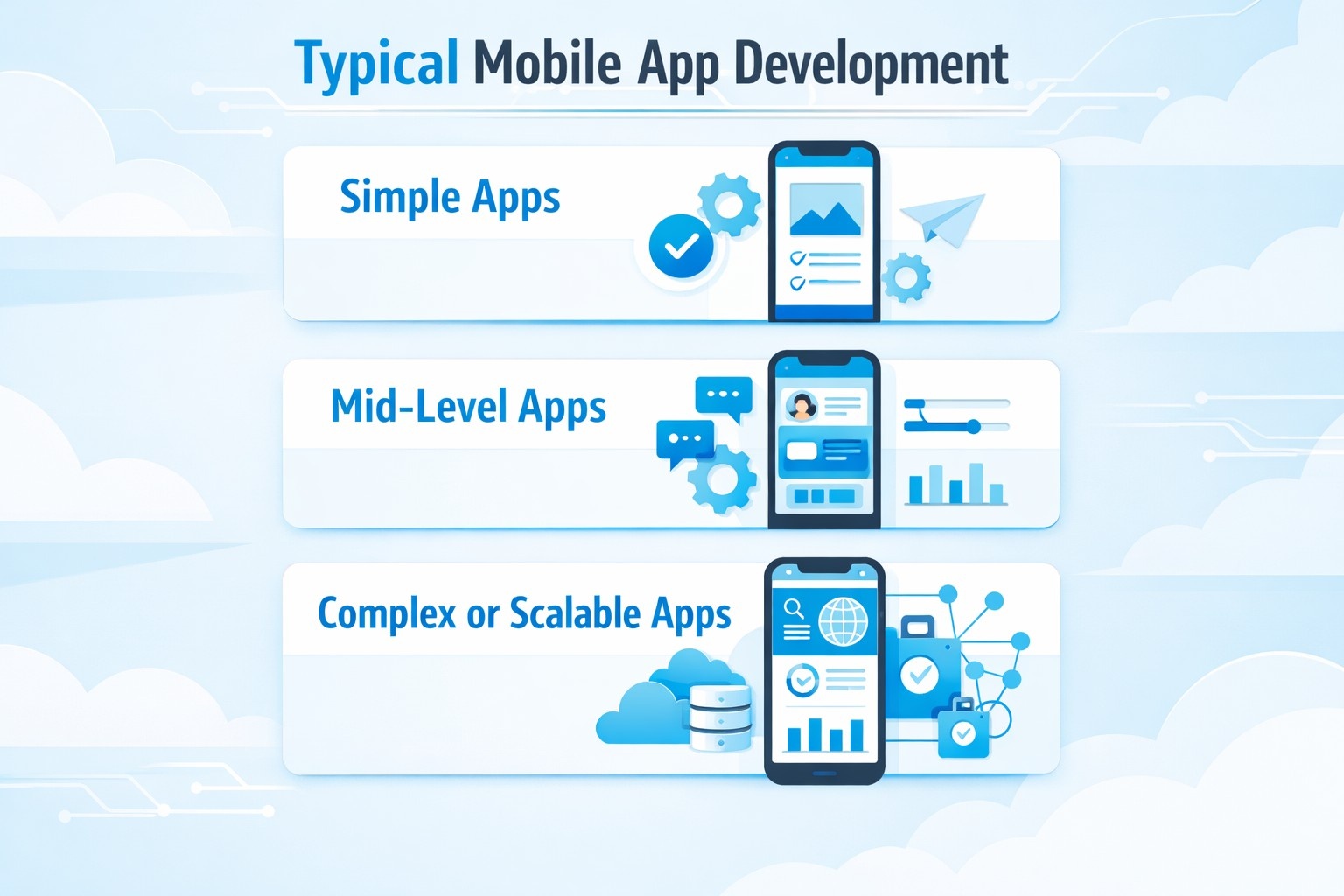
At a high level, most mobile app projects fall into these ranges:
- Simple apps: ₱300,000 to ₱800,000 ($5,000 to $13,500)
- Mid-level apps: ₱400,000 to ₱900,000 ($7,200 to $16,200)
- Complex or scalable apps: ₱2,000,000 to ₱5,000,000+ ($34,000 to $85,000+)
The rest of this guide explains why these numbers shift and what actually affects your final invoice.
Platform Choice and Its Impact on Cost
Native Apps
- Typical range: ₱900,000 to ₱1,800,000 (medium complexity)
Cross-Platform Apps
Using frameworks like Flutter or React Native allows a single codebase for both platforms. This saves time long-term but increases initial complexity.
- Typical range: ₱500,000 to ₱1,200,000
- Best for: startups that need faster market entry on both platforms
App Complexity: The Biggest Cost Driver
Basic Functionality
Apps with static content, simple navigation, or limited user interaction.
- Cost: ₱200,000 to ₱400,000
- Examples: info apps, internal tools, MVPs
Moderate Features
User accounts, dashboards, cloud storage, or payment flows.
- Cost: ₱400,000 to ₱800,000
- Examples: booking apps, small marketplaces, loyalty apps
Advanced Systems
Apps using AI, real-time sync, heavy backend logic, or custom infrastructure.
- Cost: ₱800,000 to ₱2,000,000+
- Examples: fintech platforms, healthcare apps, large SaaS products
Design and User Experience Costs
Design plays a major role in how long users stay with an app and how often they come back. In the Philippines, a basic UI and UX setup for a straightforward app usually falls between ₱100,000 and ₱200,000. This level of design focuses on clarity and usability without heavy customization.
For apps that need a more refined look, custom layouts, and smoother user flows, design costs typically range from ₱200,000 to ₱500,000. These projects involve deeper UX research and more detailed visual work. Teams that rush or skip UX planning often end up spending more later, fixing usability issues after launch rather than getting it right from the start.
Third-Party Integrations
Most modern apps rely on third-party services such as payment systems, maps, analytics tools, CRM platforms, or social login providers. Simple integrations, like basic social sign-ins or standard APIs, usually add around ₱50,000 to ₱100,000 to the project cost.
More complex integrations, especially those involving secure data handling or financial transactions, can increase costs to ₱100,000 to ₱300,000. Payment gateways and financial APIs tend to sit at the higher end of this range because they require additional security layers, compliance checks, and more extensive testing.
Quality Assurance and Testing
Testing is one of the most underestimated parts of mobile app development, yet it has a direct impact on stability and user trust. For simpler apps, in-house quality assurance carried out by the development team typically costs between ₱50,000 and ₱150,000. This usually covers functional checks, basic performance testing, and usability reviews.
More complex apps often require external or extended testing, especially when handling payments, personal data, or high traffic volumes. In these cases, QA costs can range from ₱100,000 to ₱300,000. Deeper testing helps catch edge cases and prevents costly issues after the app goes live.
Ongoing Maintenance and Support
Launching a mobile app is only the beginning. Once users start using it in real conditions, ongoing maintenance becomes essential to keep everything running smoothly, securely, and in line with platform updates. Operating systems change, devices evolve, and user expectations shift, all of which affect how an app performs over time.
- Light maintenance: ₱10,000 to ₱30,000 per month. This level of support usually covers essential updates such as compatibility with new iOS or Android versions, small bug fixes, and minor interface adjustments. It’s suitable for stable apps that don’t require frequent feature changes.
- Active development and updates: ₱30,000 to ₱80,000 per month. This option is more common for growing products. It includes regular performance improvements, feature enhancements, deeper monitoring, and faster response to user feedback. Apps in competitive markets often fall into this category.
Ongoing support typically includes OS updates, bug fixes, performance tuning, and basic security checks. Planning for maintenance from the start helps avoid rushed fixes and unexpected costs after launch.
Hidden Costs Many Teams Miss
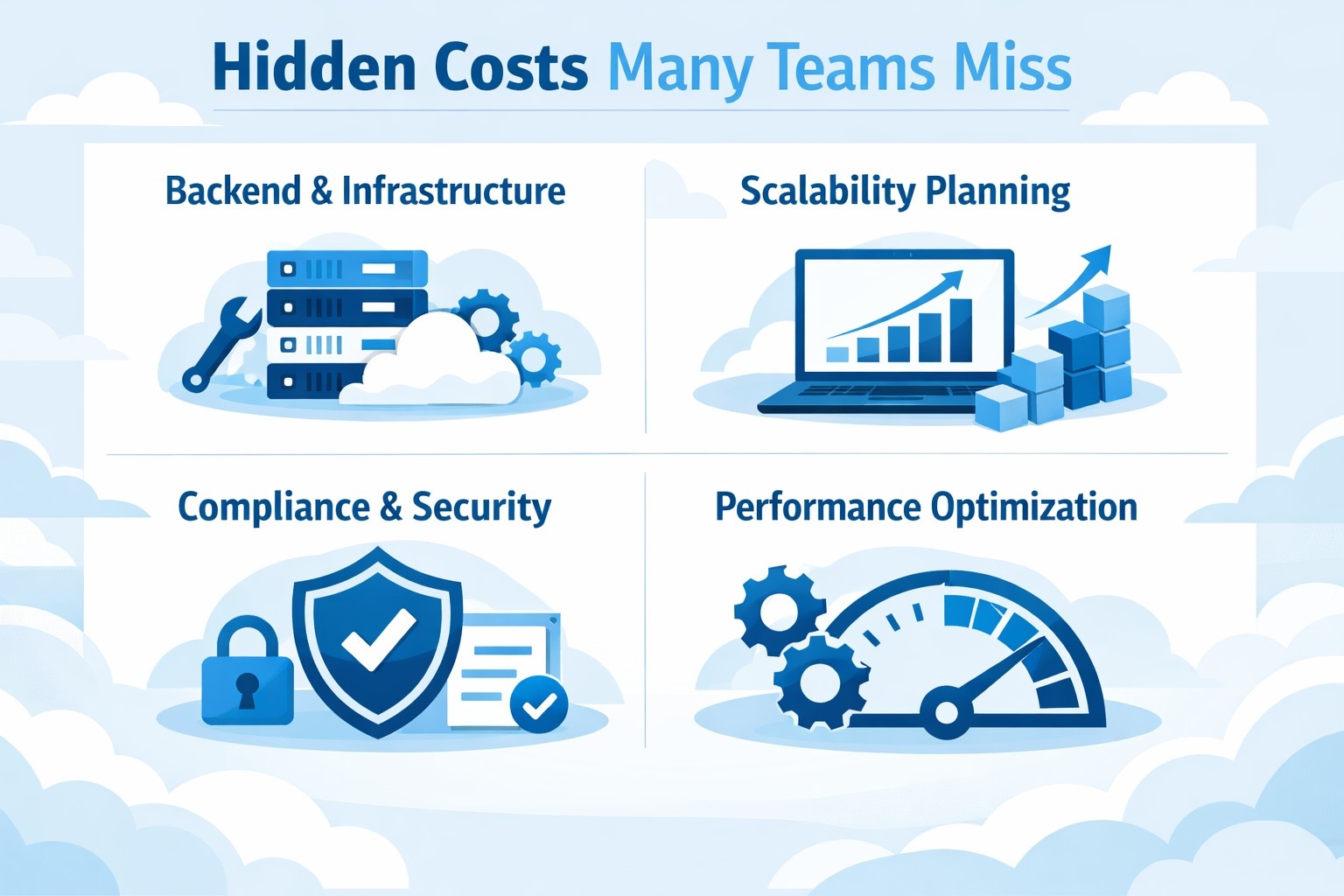
Some development costs don’t show up clearly in the initial estimate, but they often have a real impact on the final budget. These are the areas teams tend to underestimate when planning a mobile app project.
Backend and Infrastructure
Behind every functioning app is a backend that handles data, logic, and communication between systems. Setting up APIs, databases, servers, and cloud infrastructure usually adds between ₱100,000 and ₱500,000 to a project, depending on how much data the app processes and how many users it needs to support. More advanced backend systems also require additional security and monitoring, which further increases costs.
Scalability Planning
If an app is expected to grow, its architecture needs to support that growth from the start. Designing for scalability may add ₱200,000 to ₱700,000 to the initial budget, but it often prevents far more expensive rebuilds later. Apps that are not built to scale tend to slow down or break as user numbers increase, leading to rushed fixes and downtime.
Compliance and Security
Apps in industries such as fintech, healthcare, or e-commerce often face strict legal and security requirements. This can include encryption, secure data storage, user consent flows, audit trails, and compliance with local or international regulations. Meeting these standards typically adds ₱100,000 to ₱300,000 to development costs, depending on the level of protection required.
Performance Optimization
Performance issues are one of the most common reasons users abandon apps. Improving load times, reducing battery drain, and ensuring compatibility across different devices requires extra development and testing. Performance optimization usually adds between ₱50,000 and ₱150,000, but it directly affects user satisfaction and retention.
Multilingual Support
Apps targeting multiple regions or user groups often need to support more than one language. This involves localization, professional translation, UI adjustments, and testing across languages. Depending on the number of languages and complexity of the app, multilingual support can add ₱150,000 to ₱500,000 to the overall cost.
Data Backup and Recovery
For apps that handle sensitive or business-critical data, backup and recovery systems are essential. These systems protect against data loss caused by outages, crashes, or security incidents. Implementing reliable backup and recovery processes typically adds ₱50,000 to ₱200,000, depending on how frequently data is backed up and how quickly it needs to be restored.
Development Team Models, Timelines, and Budget Expectations
Development Team Models in the Philippines
The way a development team is structured plays a major role in both cost and delivery speed. In the Philippines, many companies start with smaller teams when budgets are tight or the scope is limited. A team of two to three people can handle simple apps or early MVPs, but progress is usually slower, and there is less flexibility if requirements change.
For most mid-sized apps, a dedicated team setup works best. Teams in the five to eight person range allow designers, developers, and QA specialists to work in parallel, which improves delivery speed and reduces bottlenecks. This model offers a good balance between cost, quality, and long-term stability. Agency-led projects are typically the most expensive option, but they come with stronger project management, established workflows, and clearer responsibility across the entire development cycle.
Timelines and Project Duration
Project timelines vary depending on app complexity and team size. Simple applications with limited functionality are often completed within two to three months. Medium-complexity apps that include custom design, user authentication, and third-party integrations usually require three to six months. Larger platforms with advanced features, scalability requirements, or complex backends can take six to twelve months or longer to complete.
How Timelines Affect Budget
Shorter timelines almost always increase monthly costs. Delivering faster requires larger teams and more parallel work, which raises expenses even if the total development period is shorter. Extending timelines can reduce monthly spend, but it may delay market entry. Setting realistic deadlines early helps balance budget control with delivery speed and avoids last-minute cost spikes.
Final Thoughts
Mobile app development in the Philippines remains one of the most cost-efficient ways to build reliable, modern apps in 2026. The key is not chasing the lowest quote, but understanding what you’re paying for and why.
Clear scope, realistic timelines, and proper planning around maintenance and scalability make a bigger difference than shaving off a few percent upfront. Whether you’re building a small MVP or a long-term product, Philippine development teams can deliver strong results when expectations are aligned from the start.
FAQ
How much does it usually cost to develop a mobile app in the Philippines?
Most mobile apps developed in the Philippines fall between ₱200,000 and ₱2,000,000 or more. Simple apps with limited features sit at the lower end, while complex platforms with custom design, integrations, and scalability requirements push costs higher. The final price depends on scope, platform, and long-term plans.
Is it cheaper to build an app in the Philippines compared to other countries?
In many cases, yes. The Philippines offers a strong balance between cost and quality. Rates are generally lower than in Western Europe, the US, or Australia, while technical skill levels and communication standards remain high. That makes it a popular outsourcing destination for mobile app development.
Which platform is more affordable, Android or iOS?
Android apps are usually slightly cheaper to build in the Philippines due to a larger developer pool and more flexible tooling. iOS apps often cost more because of Apple’s stricter guidelines, testing requirements, and specialized development environment.
Can I reduce costs by choosing cross-platform development?
Cross-platform development can reduce long-term costs by using a single codebase for both Android and iOS. However, the initial development cost is often higher than building a single native app. It works best when you need to launch on both platforms quickly and maintain feature parity.
What ongoing costs should I expect after launch?
After launch, most apps require monthly maintenance. Light support typically costs ₱10,000 to ₱30,000 per month, while active development and frequent updates range from ₱30,000 to ₱80,000 per month. These costs cover OS updates, bug fixes, performance improvements, and basic security checks.


