

Mobile App Development Cost Estimation Guide 2026

Key Takeaways: Mobile app development costs range from $10,000 for basic apps to $500,000+ for complex enterprise solutions. Key cost drivers include app complexity, platform choice, developer location, design requirements, and backend infrastructure. Accurate estimation requires breaking down project phases, evaluating feature requirements, and accounting for post-launch maintenance costs that typically run 15-20% of initial development annually.
Planning to build a mobile app? The first question that hits every project stakeholder is simple but loaded: how much will this actually cost?
The answer isn't straightforward. Development costs vary dramatically based on dozens of factors, from feature complexity to designer location to whether native or cross-platform development makes sense. But that uncertainty doesn't mean stakeholders should fly blind.
Understanding cost estimation methods transforms guesswork into strategic planning. This guide breaks down real-world pricing benchmarks, explores the factors that move the needle on budgets, and reveals systematic approaches to estimating what an app will actually cost before writing a single line of code.
Understanding Mobile App Development Cost Ranges
The global mobile app market continues its explosive trajectory, estimated to reach $756 billion by 2027 according to Statista data. With stakes this high, getting cost estimates right matters more than ever.
Here's the reality: a simple app with basic features such as user authentication and push notifications typically costs between $10,000 and $30,000, taking around 2-3 months to develop. That's the entry point for most projects.
But complexity changes everything. A moderate-complexity app with features like payment gateways, real-time chat, and API integrations may range from $30,000 to $70,000. Complex applications with advanced functionality push into six-figure territory, often running $120,000 to $300,000 or higher.
|
App Complexity |
Key Features |
Cost Range |
Timeline |
|---|---|---|---|
|
Simple/Basic App |
User authentication, basic UI, push notifications, simple content display |
$10,000 - $30,000 |
2-3 months |
|
Moderate Complexity |
Custom UI, payment integration, API connections, user accounts, real-time features |
$30,000 - $70,000 |
3-6 months |
|
Complex Application |
Advanced backend, multi-user roles, real-time sync, AI/ML features, extensive integrations |
$120,000 - $300,000 |
6-12 months |
|
Enterprise Solution |
Custom architecture, high security, scalability, multiple platforms, advanced analytics |
$300,000 - $500,000+ |
12+ months |
These ranges reflect real-world project data. But what drives costs from the lower to upper ends of each bracket?
Primary Cost Factors That Impact Development Budgets
Several core elements determine where a project lands on the cost spectrum. Understanding these factors helps teams make informed tradeoffs during planning.
App Complexity and Feature Set
Feature complexity represents the single biggest cost driver. Each capability added to an app multiplies development time and testing requirements.
Standard features include user registration, profile management, search functionality, and basic content display. These form the foundation most apps need. Intermediate features like payment processing, social media integration, push notifications, and geolocation services increase development effort substantially.
Advanced capabilities push costs higher still. Real-time chat, video streaming, augmented reality, machine learning algorithms, and complex data synchronization require specialized expertise and extended development cycles.
Platform Selection: iOS, Android, or Both
Platform choice directly impacts budget allocation. Developing for a single platform (iOS or Android only) costs roughly 40-50% less than building for both platforms simultaneously.
Native development for each platform separately typically costs $50,000 to $250,000+ per platform, depending on complexity. Cross-platform frameworks like React Native or Flutter offer middle-ground solutions, allowing code reuse across platforms while maintaining near-native performance.
Cross-platform approaches can reduce costs by 20-30% compared to dual native development, though some platform-specific optimization may still be necessary for the best user experience.
Design Requirements and User Experience
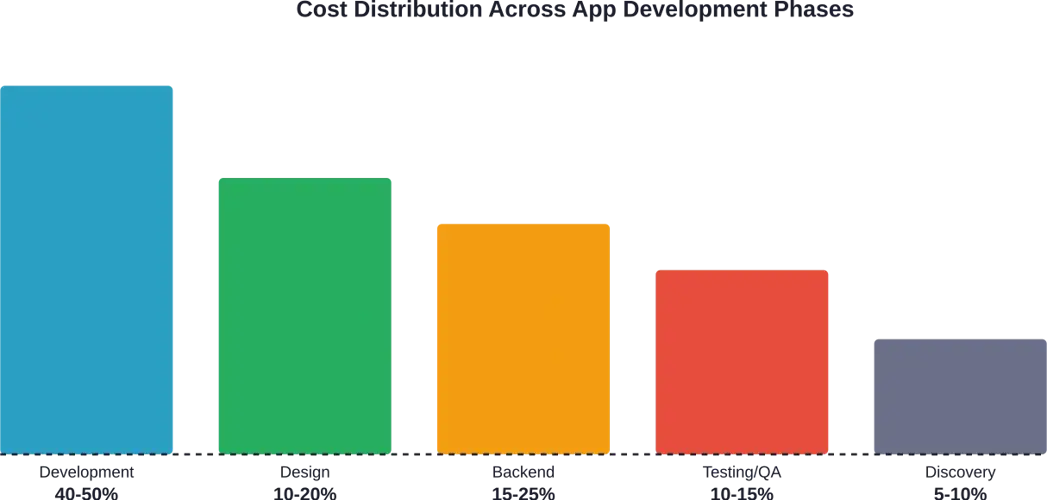
Design represents approximately 10-20% of total project costs. This phase encompasses wireframing, interface design, and user experience testing.
Basic template-based designs minimize costs but offer limited differentiation. Custom UI/UX design with brand-specific elements, animations, and polished interactions requires specialized design talent and iterative refinement.
High-end applications often invest heavily in design research, user testing, and iterative prototyping before development begins. This upfront investment pays dividends in user adoption and retention.
Backend Infrastructure and Third-Party Integrations
Backend development consumes roughly 15-25% of project budgets. This includes server architecture, databases, APIs, and the logic that powers app functionality.
Apps requiring real-time data synchronization, user-generated content management, or complex business logic demand robust backend systems. Cloud infrastructure costs scale with user load and data storage requirements.
Third-party service integrations add incremental costs. Payment gateways, mapping services, social media APIs, analytics platforms, and communication services each require implementation time and often carry ongoing subscription fees.
Developer Location and Hourly Rates
Geographic location of the development team significantly impacts total costs. According to the U.S. Bureau of Labor Statistics, computer programmers earned a median annual wage of $98,670 in May 2024, translating to $47.44 per hour.
Agency and freelance rates vary considerably by region. North American developers typically charge $100-$200+ per hour. Western European rates often fall between $80-$150 per hour. Eastern European and Latin American developers may charge $40-$80 per hour, while Asian markets sometimes offer rates of $20-$50 per hour.
Lower rates don't automatically translate to lower total costs, though. Communication challenges, time zone differences, and varying quality levels can extend project timelines and increase revision cycles.

Get a Precise Mobile App Development Cost Breakdown
Mobile app costs depend on platform, backend requirements, and integrations. OSKI Solutions reviews your feature list and defines the technical approach before estimating effort. The budget includes development, testing, and release preparation. You receive a clear breakdown instead of a rough range.
Ready to Get Your App Costed and Built?
Talk with OSKI Solutions to:
- clarify your functional requirements
- turn them into a structured cost estimate
- define timeline and delivery stages
👉 Request a mobile app development quote from OSKI Solutions.
Build a Mobile App That Users Love
We design and develop high-performance iOS and Android apps that combine seamless UX with scalable backend architecture.
Development Cost Estimation Models
Several systematic approaches exist for estimating software development costs. These models provide frameworks for translating project requirements into budget projections.
The COCOMO Model for Software Cost Estimation
The Constructive Cost Model (COCOMO) was proposed by Barry Boehm in 1981 and is based on the study of 63 projects. COCOMO predicts effort, cost, and schedule required for software development.
The model categorizes projects into three types: organic (small teams with good experience), semi-detached (medium teams with mixed experience), and embedded (developed within tight constraints). According to Carnegie Mellon's Software Engineering Institute, COCOMO and its variants help teams understand the inherent biases that exist in software cost estimation models.
Modern adaptations like Mobile-COCOMO specifically address mobile development characteristics, accounting for factors unique to mobile platforms such as device fragmentation, platform-specific design guidelines, and mobile-specific testing requirements.
Time and Material vs. Fixed Price Models
Development contracts typically follow one of two pricing structures. Fixed price models establish a set cost for defined scope, transferring risk to the development team. This approach works well for projects with clearly defined requirements that won't change.
Time and material models bill based on actual hours worked, offering flexibility as requirements evolve. Companies like Dev Technosys, Infosys, and ThoughtWorks typically use time and material or fixed price models depending on project scope.
Hybrid approaches combine elements of both, establishing fixed prices for core features while allowing time-based billing for optional enhancements or scope changes.
Feature-Based Estimation Approach
Breaking projects into discrete features allows granular cost estimation. Teams list every required feature, estimate development time for each, and aggregate to project totals.
This bottom-up approach improves accuracy compared to top-down estimates. It forces detailed thinking about requirements and reveals hidden complexity early. The tradeoff? It's time-intensive and requires technical expertise to estimate individual feature costs accurately.
Detailed Development Phase Breakdown
Understanding how costs distribute across project phases helps teams allocate resources effectively and identify where budget optimization opportunities exist.
Discovery and Planning Phase
Discovery encompasses business analysis, technical planning, and feature definition. This phase typically represents 5-10% of total costs but significantly impacts overall project success.
Activities include stakeholder interviews, competitive analysis, user research, technical feasibility assessment, and requirement documentation. Skipping or rushing discovery often leads to costly mid-project course corrections.
Design and Prototyping
Design work includes information architecture, wireframing, visual design, and interactive prototyping. Allocating 10-20% of budget to this phase ensures the app looks professional and functions intuitively.
User experience testing during design catches usability issues before development begins, when changes cost far less to implement. High-fidelity prototypes also help align stakeholder expectations before committing to code.
Core Development: Frontend and Backend
Development represents the largest cost center at 40-50% of total budget. Frontend development builds the user-facing interface, while backend development creates the server-side logic, databases, and APIs.
Development timelines stretch from weeks for simple apps to months for complex applications. A basic app might need 200-400 development hours, while enterprise applications can require 2,000+ hours across frontend, backend, and platform-specific implementations.
Quality Assurance and Testing
Testing consumes 10-15% of budgets and ensures apps function correctly across devices, operating system versions, and usage scenarios. QA encompasses functional testing, performance testing, security testing, and user acceptance testing.
Comprehensive testing catches bugs before launch, reducing support costs and preventing negative user reviews. Automated testing frameworks reduce long-term QA expenses for apps requiring frequent updates.
Deployment and Launch
Launch activities include app store submission, server deployment, analytics setup, and initial marketing. While representing a smaller budget slice, deployment requires careful coordination to ensure smooth releases.
App store review processes take time, particularly for iOS apps. Planning for potential rejections and resubmissions prevents launch delays.
Hidden Costs That Impact Final Budgets
Beyond obvious development expenses, several additional cost categories catch teams off guard. Planning for these prevents budget overruns.
App Store Fees and Developer Accounts
Apple's iOS Developer Program costs $99 annually. Google Play charges a one-time $25 registration fee. These modest costs are just the start.
App stores take 15-30% commission on in-app purchases and subscriptions. For apps with direct monetization, these fees significantly impact revenue projections and must factor into ROI calculations.
Ongoing Maintenance and Updates
Post-launch maintenance typically runs 15-20% of initial development cost annually. This covers bug fixes, operating system compatibility updates, security patches, and minor feature enhancements.
Apps requiring frequent updates or supporting multiple OS versions face higher maintenance costs. Neglecting maintenance leads to poor app store ratings, security vulnerabilities, and eventual obsolescence.
Infrastructure and Hosting Costs
Cloud hosting costs scale with user base and data usage. Small apps might run on $50-200 monthly hosting plans. Apps with significant user bases, media storage, or real-time features can incur thousands in monthly infrastructure costs.
Database services, content delivery networks, backup solutions, and monitoring tools add incremental monthly expenses that compound over time.
Marketing and User Acquisition
Development represents only half the battle. Marketing budgets often equal or exceed development costs for consumer apps in competitive categories.
App store optimization, paid advertising, content marketing, and influencer partnerships require dedicated budgets. User acquisition costs vary by category but can range from a few dollars to over $100 per install for finance and gaming apps.
Legal, Compliance, and Security
Privacy policies, terms of service, and regulatory compliance add costs depending on industry and target markets. Apps handling payments need PCI compliance. Healthcare apps require HIPAA compliance. Apps targeting European users must address GDPR requirements.
Security audits, penetration testing, and vulnerability assessments protect user data and brand reputation. These services typically cost $5,000-$50,000 depending on app complexity and compliance requirements.
Real-World Cost Examples by App Category
Looking at actual app categories helps ground abstract cost discussions in concrete examples.
Social Media and Communication Apps
Social platforms require real-time messaging, media sharing, user profiles, content feeds, and notification systems. Development costs typically range from $100,000 to $500,000+ depending on feature sophistication.
Backend infrastructure costs run high due to media storage and real-time synchronization requirements. Scalability becomes critical as user bases grow.
E-commerce and Marketplace Apps
E-commerce applications need product catalogs, search functionality, shopping carts, payment processing, order management, and customer accounts. Costs typically fall between $50,000 and $300,000.
Security requirements increase development and testing time. Payment gateway integration, inventory management, and logistics coordination add complexity.
On-Demand Service Apps
Ride-sharing, food delivery, and service marketplace apps require GPS tracking, real-time matching algorithms, payment processing, ratings systems, and dual interfaces (customer and provider). Development costs range from $100,000 to $500,000+.
These apps demand sophisticated backend systems, real-time data processing, and extensive testing across usage scenarios and edge cases.
Healthcare and Fitness Apps
Health apps range from simple fitness trackers ($50,000-$150,000) to telemedicine platforms with video consultations, medical records integration, and prescription management ($200,000-$500,000+).
Regulatory compliance, data security requirements, and integration with wearable devices increase development complexity and cost.
|
App Category |
Core Features Required |
Typical Cost Range |
Key Cost Drivers |
|---|---|---|---|
|
Social Media |
Profiles, messaging, feeds, media sharing, notifications |
$100,000 - $500,000+ |
Real-time features, scalable infrastructure |
|
E-commerce |
Product catalog, cart, payments, orders, search |
$50,000 - $300,000+ |
Security, payment integration, inventory systems |
|
On-Demand Services |
GPS tracking, matching algorithms, dual interfaces, payments |
$100,000 - $500,000+ |
Complex backend, real-time processing, testing |
|
Healthcare/Fitness |
Activity tracking, health data, device integration, compliance |
$50,000 - $500,000+ |
Regulatory compliance, device integration, security |
|
Education/E-learning |
Content delivery, progress tracking, quizzes, video streaming |
$40,000 - $250,000+ |
Content management, video infrastructure, testing |
Strategies to Optimize Development Costs
Smart planning and strategic decisions reduce costs without compromising quality. Here's what actually works.
Start with an MVP (Minimum Viable Product)
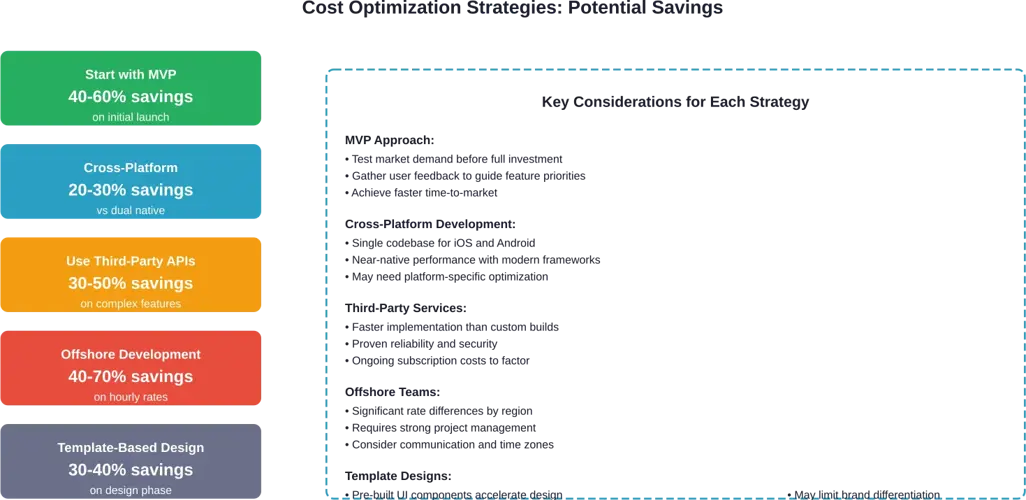
Launching with core features only reduces initial investment by 40-60%. This approach tests market fit before committing to full development.
MVPs focus on solving one key problem exceptionally well. Additional features roll out based on user feedback and demonstrated demand, ensuring development resources target features users actually want.
Choose the Right Development Approach
Cross-platform frameworks reduce costs when targeting both iOS and Android. React Native, Flutter, and similar technologies allow 60-80% code reuse across platforms.
Native development makes sense when apps need maximum performance, platform-specific features, or when targeting only one platform initially. The decision hinges on specific project requirements rather than blanket assumptions.
Leverage Existing Solutions and APIs
Third-party services handle common functionality faster and cheaper than custom development. Authentication services, payment processors, analytics platforms, and cloud infrastructure eliminate building complex systems from scratch.
The tradeoff involves ongoing subscription costs and reduced customization flexibility. For most projects, the cost savings and faster time-to-market justify these limitations.
Prioritize Features Ruthlessly
Not all features deliver equal value. Categorizing features as must-have, nice-to-have, or future enhancements focuses budgets on capabilities that directly support core value propositions.
User research and competitive analysis identify features that genuinely differentiate products versus those that simply bloat scope and budgets.
Plan for Iterative Development
Agile methodologies break projects into sprints, allowing course corrections based on testing and feedback. This approach prevents expensive late-stage pivots when fundamental assumptions prove incorrect.
Regular stakeholder reviews and user testing sessions throughout development catch issues early when fixes cost less to implement.
Selecting the Right Development Partner
Development partner selection significantly impacts project outcomes and costs. The wrong choice leads to delays, budget overruns, and subpar results.
In-House vs. Agency vs. Freelancers
In-house teams offer maximum control and deep product knowledge but require significant investment in salaries, benefits, and infrastructure. According to Bureau of Labor Statistics data from May 2024, computer programmers held about 121,200 jobs, with the largest concentration (31%) in computer systems design and related services.
Development agencies provide complete teams with specialized skills, established processes, and accountability. Costs run higher than freelancers but include project management, quality assurance, and comprehensive support.
Freelancers offer cost advantages and flexibility but require more hands-on management. Vetting skills, coordinating multiple specialists, and managing quality falls on the client.
Evaluating Technical Expertise
Review portfolios carefully, focusing on apps similar in complexity and category to the planned project. Request case studies showing how teams handled challenges and delivered results.
Technical interviews reveal depth of knowledge. Ask about architecture decisions, scalability approaches, security practices, and testing methodologies. Strong teams articulate tradeoffs clearly rather than claiming every approach is optimal.
Questions to Ask Potential Developers
What's the typical project timeline for similar complexity? How do you handle scope changes? What's included in maintenance agreements? How do you communicate progress and handle feedback?
Request references from previous clients. Direct conversations reveal how teams perform under pressure, communicate challenges, and deliver on commitments.
Creating Accurate Cost Estimates
Building reliable estimates requires systematic approaches and realistic assumptions. Here's the process that produces accurate projections.
Document Requirements Thoroughly
Comprehensive requirement documentation forms the foundation for accurate estimates. Vague requirements lead to mismatched expectations and budget surprises.
Detail every feature, user type, integration, platform requirement, and design expectation. Include user stories showing how different personas interact with the app. The more specific the requirements, the more accurate the estimate.
Break Down Features into Development Tasks
Decompose each feature into specific development tasks. User authentication breaks into interface design, API development, database schema, password recovery, social login integration, and security implementation.
Estimate hours for each task individually, then aggregate. This granular approach reveals hidden complexity and produces more reliable totals than top-down estimates.
Add Contingency Buffers
Even perfect estimates face unexpected challenges. Adding 15-25% contingency buffers accounts for requirement clarifications, technical obstacles, and scope refinements discovered during development.
Contingency isn't wasted budget, it's realistic planning for the inherent uncertainty in software projects. Teams that skip buffers consistently overrun budgets.
Use Cost Estimation Tools and Calculators
Several online calculators provide quick ballpark estimates. While not substitutes for detailed quotes, these tools establish reasonable ranges and help identify major cost drivers.
More sophisticated estimation software incorporates historical project data, complexity factors, and team velocity metrics to generate predictions based on actual outcomes rather than theoretical assumptions.
Post-Launch Cost Considerations
Launch day isn't finish line. Ongoing costs determine long-term viability and success.
Maintenance and Bug Fixes
Apps require continuous attention. Operating system updates break compatibility. Security vulnerabilities need patches. Users discover bugs missed during testing.
Budget 15-20% of initial development cost annually for maintenance. Apps with higher complexity or rapid OS update cycles face proportionally higher maintenance requirements.
Feature Enhancements and Updates
User feedback reveals desired improvements. Competitive pressure demands new capabilities. Technology advances enable better solutions.
Successful apps evolve continuously. Reserve budget for regular feature updates, performance improvements, and capability expansions based on user demand and business goals.
Scaling Infrastructure
Growing user bases require infrastructure scaling. Database optimization, caching layers, content delivery networks, and server capacity all scale with success.
Cloud platforms offer elastic scaling, but costs rise with usage. Monitoring infrastructure expenses prevents surprise bills as user bases expand.
Customer Support and Community Management
Users need help. App stores require review responses. Community forums need moderation. Support systems handle inquiries and feedback.
Customer support costs scale with user base but represent critical investment in retention and satisfaction. Poor support tanks app ratings and drives users to competitors.
Common Cost Estimation Mistakes to Avoid
Learning from common pitfalls helps teams avoid expensive mistakes that derail projects and blow budgets.
Underestimating Complexity
Simple-sounding features often hide substantial complexity. "Users can chat in real-time" encompasses messaging protocols, data synchronization, notification systems, message storage, media handling, and online status tracking.
Technical teams help translate feature descriptions into development reality. Involve developers early in scoping to surface hidden complexity before committing to budgets.
Ignoring Platform Differences
iOS and Android differ significantly in design guidelines, development approaches, and testing requirements. Assuming what works on one platform translates directly to another leads to rework and delays.
Platform-specific considerations affect costs even with cross-platform frameworks. Account for platform testing, optimization, and guideline compliance on both ecosystems.
Forgetting About Design
Design isn't decoration, it's core product functionality. Poor design drives users away regardless of technical capability. Allocating insufficient design budget produces functional but unmarketable apps.
Professional design encompasses research, wireframing, visual design, prototyping, and testing. Skipping these steps saves money initially but costs far more in poor adoption and expensive redesigns.
Skipping Discovery Phase
Jumping straight to development without proper discovery increases failure risk. Discovery validates assumptions, clarifies requirements, identifies technical challenges, and aligns stakeholder expectations.
The 5-10% budget allocated to discovery prevents costly mid-project pivots when fundamental assumptions prove incorrect.
Overlooking Post-Launch Costs
Launch budget covers only initial development. Maintenance, hosting, marketing, support, and enhancements require ongoing investment throughout the app's lifetime.
Sustainable app businesses budget for the full lifecycle, not just launch. Total cost of ownership extends far beyond initial development.
The Future of Mobile App Development Costs
Several trends shape how development costs evolve in coming years.
Low-Code and No-Code Platforms
Visual development platforms reduce coding requirements for standard functionality. These tools accelerate simple app development and reduce costs for straightforward use cases.
Limitations emerge with complex requirements, custom functionality, or unique user experiences. Low-code works brilliantly for internal tools and simple consumer apps but struggles with sophisticated applications.
AI-Assisted Development
Artificial intelligence tools help developers write code faster, catch bugs earlier, and optimize performance. These productivity gains gradually reduce development hours required for given functionality.
AI won't replace developers but amplifies their capabilities. Teams leveraging AI tools deliver more functionality in less time, potentially reducing costs while improving quality.
Progressive Web Apps
Web technologies increasingly match native app capabilities. Progressive web apps offer cross-platform solutions without app store distribution, potentially reducing development and deployment costs.
PWAs trade some platform integration and performance for reduced development complexity. The decision between PWA and native depends on specific feature requirements and target user expectations.
Frequently Asked Questions
How much does it cost to develop a simple mobile app in 2026?
A simple app with basic features like user authentication, simple UI, and push notifications typically costs between $10,000 and $30,000. Development takes approximately 2-3 months. Simple apps include basic functionality without complex backend systems, third-party integrations, or advanced features. Costs vary based on platform choice, developer location, and specific design requirements.
What's the difference between fixed price and time and material pricing?
Fixed price models establish a set cost for defined project scope, providing budget certainty but less flexibility for changes. Time and material models bill based on actual hours worked, offering flexibility as requirements evolve but less cost predictability. Companies like Dev Technosys, Infosys, and ThoughtWorks typically use both models depending on project characteristics. Fixed price works best for well-defined projects, while time and material suits projects with evolving requirements.
How can businesses reduce mobile app development costs without sacrificing quality?
Start with an MVP focusing on core features to reduce initial investment by 40-60%. Use cross-platform development frameworks to save 20-30% versus building native apps separately. Leverage third-party APIs for common functionality like payments and authentication rather than building from scratch. Prioritize features ruthlessly, implementing only capabilities that directly support core value propositions. These strategies reduce costs while maintaining quality through smart scoping and technology choices.
What ongoing costs should businesses plan for after app launch?
Maintenance and bug fixes typically cost 15-20% of initial development annually. Infrastructure and hosting costs range from $50-200 monthly for small apps to thousands monthly for apps with large user bases. App store fees include $99 annually for iOS Developer Program and one-time $25 for Google Play. Marketing and user acquisition often equal or exceed development costs. Plan also for customer support, feature updates, security patches, and OS compatibility updates throughout the app's lifetime.
How long does mobile app development typically take?
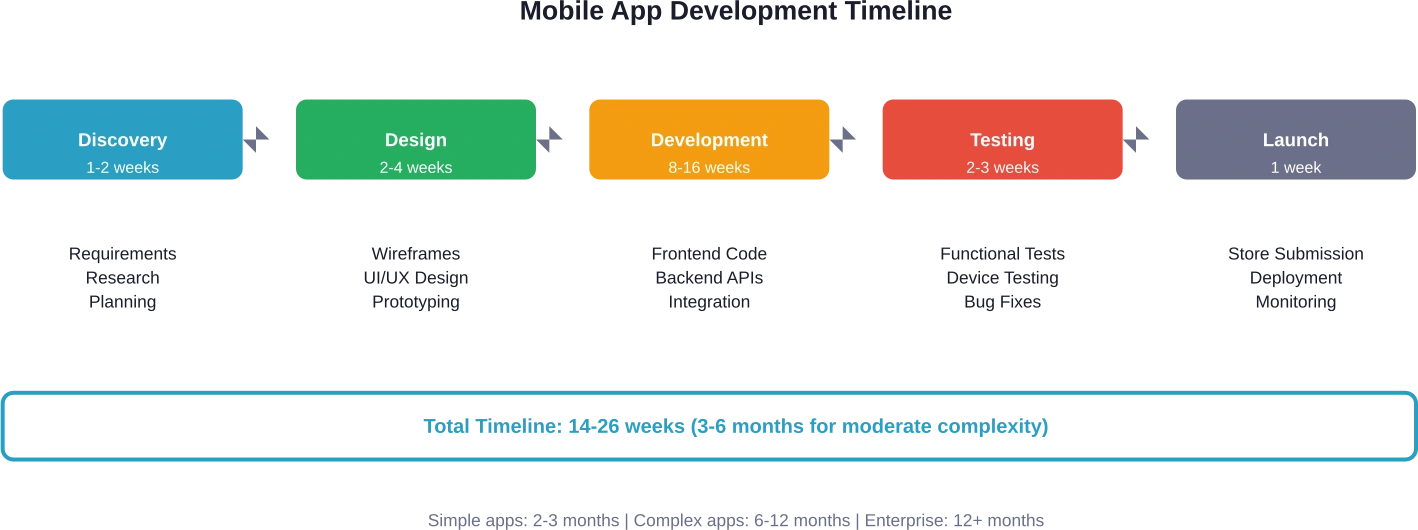
Simple apps require 2-3 months from concept to launch. Moderate complexity apps take 3-6 months, including discovery, design, development, and testing phases. Complex applications need 6-12 months, while enterprise solutions often require 12+ months. Timeline depends on feature scope, platform choice, team size, and design complexity. Discovery and planning consume 1-2 weeks, design takes 2-4 weeks, development requires 8-16 weeks for moderate apps, with testing adding 2-3 weeks before launch.
Should businesses develop for iOS, Android, or both platforms initially?
Developing for a single platform initially costs 40-50% less than building for both simultaneously. Platform choice depends on target audience demographics and geographic markets. iOS users typically show higher spending and engagement in developed markets, while Android dominates globally by user count. Cross-platform frameworks like React Native or Flutter offer middle-ground solutions, allowing code reuse across platforms while maintaining near-native performance, potentially reducing costs by 20-30% versus dual native development.
What factors have the biggest impact on mobile app development costs?
App complexity represents the single largest cost driver, with feature count and sophistication multiplying development time. Developer location significantly impacts rates, ranging from $20-50 hourly in Asian markets to $100-200+ hourly in North America. Platform choice affects costs, with dual-platform development nearly doubling expenses versus single-platform. Backend infrastructure requirements, especially for real-time features and data synchronization, substantially increase costs. Design sophistication, third-party integrations, and regulatory compliance requirements also significantly impact total project budgets.
Conclusion
Mobile app development cost estimation requires balancing multiple factors: feature complexity, platform choices, design requirements, team composition, and ongoing operational needs. Simple apps start around $10,000, while complex enterprise solutions exceed $500,000.
The systematic approach works. Document requirements thoroughly. Break features into development tasks. Estimate granularly rather than guessing at totals. Add realistic contingency buffers. Account for post-launch maintenance, infrastructure scaling, and continuous improvement.
Smart cost optimization strategies deliver quality results within budget constraints. MVP approaches validate market fit before full investment. Cross-platform frameworks maximize code reuse. Third-party services handle commodity functionality. Strategic offshore partnerships access global talent pools. Each approach carries tradeoffs requiring careful evaluation against specific project goals.
The IEEE's systematic review of software development cost estimation studies confirms what practitioners know: estimation remains complex, but structured methodologies produce more accurate predictions than intuition alone. According to Carnegie Mellon's Software Engineering Institute, understanding inherent biases in estimation models helps teams compensate for systematic errors.
Looking forward, overall employment in computer and information technology occupations is projected to grow much faster than the average for all occupations from 2024 to 2034. About 317,700 openings are projected each year, on average, in these occupations due to employment growth and the need to replace workers who leave the occupations permanently. This sustained demand reflects the critical role mobile applications play across industries.
Ready to move from estimation to execution? Start by documenting requirements in detail. Identify must-have features versus nice-to-have enhancements. Research development partners with relevant experience. Request detailed quotes breaking down costs by phase and feature. Compare proposals not just on price but on technical approach, timeline realism, and team expertise.
Successful apps balance ambition with pragmatism. Launch with core features that deliver clear value. Gather real user feedback. Iterate based on actual usage patterns rather than assumptions. Scale infrastructure as demand proves itself. This approach controls costs while building products users genuinely want.
The question isn't just how much an app costs to build. The real question is how much value it creates for users and the business. Cost estimation enables informed investment decisions, but user value determines ultimate success.
Don't let cost uncertainty delay strategic mobile initiatives. Use the frameworks, benchmarks, and strategies outlined here to develop realistic budgets and timelines. Then find the right development partner and start building.


