

Game Development Cost Estimation: 2026 Budget Guide

Quick Summary: Game development cost estimation involves calculating expenses based on platform, genre, team size, scope, and timeline. Simple 2D mobile games typically cost $20,000-$50,000, while complex 3D titles can exceed $10 million. Online calculators help developers estimate budgets by factoring in art, engineering, sound, QA, and marketing costs, though final prices depend on detailed project specifications.
Estimating game development costs isn't guesswork. It's a structured process that factors in dozens of variables, from platform choices to team composition. Getting this wrong can torpedo a project before it launches.
The gap between a simple mobile game and a AAA console title isn't just massive—it's exponential. According to competitor analysis data, a basic game like Flappy Bird cost less than $50,000 to develop, while complex titles like Witcher 3 exceeded $81 million.
Here's what drives those numbers and how to calculate them accurately.
Core Factors That Determine Game Development Costs
Every game development budget breaks down into predictable components. Understanding these elements helps create realistic estimates rather than optimistic fantasies.
Platform Selection Impact
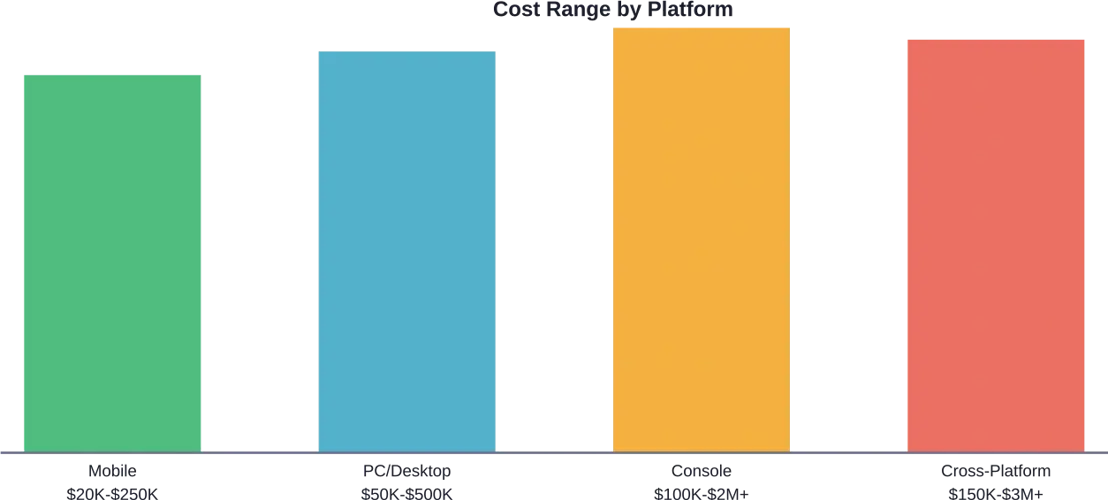
Platform choice dramatically affects development costs. Mobile games (iOS/Android) typically require less investment than PC titles, while console development demands additional certification expenses and hardware-specific optimization.
Cross-platform development multiplies complexity. Supporting multiple platforms simultaneously means adapting code, testing on different hardware configurations, and managing platform-specific requirements. But it also expands market reach significantly.
Genre and Complexity Levels
Genre dictates technical requirements. Puzzle games require different resources than open-world RPGs or battle royale shooters.
Complexity scales costs exponentially. Hyper-casual games might need just basic mechanics, while RPGs demand intricate systems for inventory, character progression, combat, dialogue trees, and quest management. Each additional system multiplies development time.
Team Size and Composition
According to the Bureau of Labor Statistics, computer programmers earned a median pay of $98,670 in May 2024. The largest employers were computer systems design and related services, accounting for 31% of computer programmers employed in 2024, with approximately 121,200 jobs total in the occupation.
Team composition matters as much as size. A typical game development team includes programmers, artists, sound designers, QA testers, and project managers. Based on competitor data, typical studio allocation breaks down across these specialized roles.
|
Team Size |
Typical Composition |
Best For |
Monthly Cost Range |
|---|---|---|---|
|
Solo Developer |
1 person handling all tasks |
Hyper-casual, simple puzzle games |
$5K-$10K |
|
Small Team (2-5) |
1-2 programmers, 1-2 artists, 1 designer |
Casual mobile games, simple 2D titles |
$20K-$40K |
|
Medium Team (6-15) |
4-6 programmers, 3-5 artists, 2-3 designers, 1-2 QA |
Mid-core games, 3D mobile, indie PC |
$50K-$120K |
|
Large Team (16+) |
10+ programmers, 8+ artists, multiple specialists |
AAA console/PC, complex multiplayer |
$150K-$500K+ |
The Cost Calculation Framework
Estimation starts with breaking down the project into measurable components. This isn't about pulling numbers from thin air—it's systematic analysis.
Timeline-Based Estimation
Development timeline directly correlates with budget. A six-month project with a five-person team costs fundamentally less than an eighteen-month project with fifteen people.
The formula: Team Size × Hourly/Monthly Rate × Development Duration. Based on competitor data showing a $60/hour global rate as a baseline, calculations become straightforward once scope is defined.
Feature-Driven Budgeting
Each feature adds cost layers. Multiplayer functionality requires server infrastructure, networking code, and ongoing maintenance. In-app purchases need payment integration and backend systems. Social features demand API integrations and community management tools.
Real talk: Feature creep destroys budgets. That cool idea that seems simple? It probably triples implementation time once edge cases and testing are factored in.
Using Cost Calculators Effectively
Online game development cost calculators streamline estimation. These tools process multiple variables—platform, genre, team size, features—to generate ballpark figures.
But here's the thing: Calculators provide starting points, not final answers. They can't account for project-specific complexities, unique technical challenges, or unforeseen complications that inevitably arise.
Based on competitor analysis, calculators typically ask for project type, game genre, platform selection, team size, and feature requirements. Some allow multiple platform selections since cross-platform development has become standard practice.
What Calculators Miss
Calculators can't predict scope creep, technical debt, or iteration cycles. They don't account for marketing budgets, which can equal or exceed development costs for commercial releases.
According to Roblox's 2025 reports, creators typically earn a commission rate, while the platform's Developer Exchange (DevEx) rate was recently increased by 8.5% in late 2025. These platform economics rarely appear in development calculators but dramatically impact ROI.

Calculate Game Development Costs Before You Build
Game development budgets depend on gameplay mechanics, platform choice, and asset volume. OSKI Solutions defines production stages and estimates effort per phase. The calculation reflects real development tasks and timeline. You get a practical cost overview before starting production.
Ready to Estimate Your Game Development Budget?
Talk with OSKI Solutions to:
- define gameplay scope and features
- estimate development stages
- calculate timeline and production cost
👉 Request a game development quote from OSKI Solutions.
Turn Your Game Idea into Reality
We design and develop high-performance games with immersive gameplay, stunning visuals, and scalable architecture.
Real-World Cost Examples
Context matters. A solo developer building a 2D puzzle game over three months might spend $20,000 on asset creation, sound design, and minimal marketing. That's vastly different from a ten-person team building a 3D action game over eighteen months.
Based on competitor case study data, a project called "Puzzle Pals"—a 2D puzzle-platformer with cartoon-style art—was estimated at $20,000 for a solo developer working three months. The budget covered basic art assets, sound, and a small marketing allocation.
The employment outlook supports continued investment in game development. Overall employment in computer and information technology occupations is projected to grow much faster than the average for all occupations from 2024 to 2034, with about 317,700 openings projected each year, on average, according to Bureau of Labor Statistics data.
Regional Cost Variations
Developer location significantly impacts costs. Studios in high-cost regions charge more than those in emerging markets, though quality and communication considerations balance pure cost savings.
Spain's game development sector provides useful benchmarks. According to academic data from UPC School, Catalonia continues to lead the sector in terms of turnover and remains the main hub of activity, with 790 active studios operating in Spain. Catalonia accounts for 30% of these studios, and 83% of workers have higher education degrees.
Budget Planning Best Practices
Smart estimation includes contingency buffers. Adding 20-30% cushion for unexpected complications isn't pessimism—it's realism.
Prioritize core features for initial release. Additional features can come in updates after launch, which spreads costs over time and validates market interest before investing in extensive feature sets.
Consider phased development. Build a prototype or minimum viable product first, test with target audiences, then iterate based on actual feedback rather than assumptions.
Common Estimation Mistakes
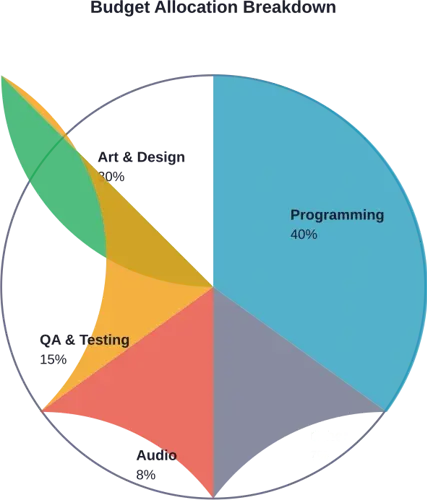
Underestimating QA and testing time ranks among the most frequent errors. Testing typically consumes 15-20% of total development time and budget, but many teams allocate far less.
Ignoring post-launch costs creates problems. Server maintenance, bug fixes, content updates, and community management require ongoing resources that don't stop when the game ships.
Confusing different game types leads to wildly inaccurate estimates. A hyper-casual mobile game shares almost nothing with a hardcore PC strategy game in terms of requirements, yet inexperienced planners sometimes apply similar budget frameworks.
Frequently Asked Questions
How much does it cost to develop a simple mobile game?
Simple mobile games typically cost between $20,000 and $50,000 for solo developers or small teams. This covers basic 2D graphics, simple mechanics, sound design, and minimal marketing. Complexity, platform requirements, and team composition can push costs higher.
What's the difference between 2D and 3D game development costs?
3D games generally cost 2-4 times more than comparable 2D games due to modeling, animation, lighting, and rendering requirements. 3D assets take longer to create, require specialized skills, and demand more extensive testing across different hardware configurations.
How do game development calculators generate estimates?
Calculators use algorithms that factor in platform, genre, team size, features, and average industry rates. Most apply a base hourly rate (around $60 globally) multiplied by estimated hours for each component. Results are approximations that require refinement based on specific project details.
Should marketing be included in game development cost estimates?
Absolutely. Marketing often equals or exceeds development costs for commercial releases. Without visibility, even excellent games fail. Budget at least 25-50% of development costs for marketing, community building, and user acquisition campaigns.
How long does typical game development take?
Timelines vary enormously. Hyper-casual mobile games might take 1-3 months. Casual games need 3-6 months. Mid-core titles require 6-18 months. AAA games often span 2-5 years. Timeline directly correlates with team size, scope, and budget.
What's the biggest factor affecting game development costs?
Team size and development duration together form the biggest cost driver. A five-person team working for twelve months costs far less than a fifteen-person team working for twenty-four months, even if hourly rates are identical. Scope creep extending timelines destroys budgets.
Can indie developers compete with larger studios on budget?
Yes, through focused scope and smart resource allocation. Indie success stories typically nail one or two core mechanics brilliantly rather than attempting feature parity with AAA titles. According to Statista, in the month ending December 31, 2024, more than 24,500 developers were registered in Roblox's Developer Exchange Program, earning $922 million annually—demonstrating viable paths for smaller creators.
Making Estimation Work for Your Project
Accurate cost estimation isn't about perfect prediction. It's about informed decision-making that accounts for known variables while building in flexibility for unknowns.
Start with clear scope definition. Document every feature, platform requirement, and technical specification before calculating costs. Vague requirements produce meaningless estimates.
Use multiple estimation methods. Calculator tools provide quick ballpark figures. Detailed spreadsheet breakdowns by feature and discipline offer precision. Historical data from previous projects grounds estimates in reality.
The game development landscape continues expanding, with new platforms, tools, and distribution channels emerging regularly. Cost estimation remains both art and science—requiring industry knowledge, technical understanding, and realistic assessment of team capabilities.
Ready to estimate costs for your project? Start with online calculators to establish baseline figures, then refine estimates with detailed feature breakdowns and team-specific rates. Build in contingency buffers, prioritize ruthlessly, and remember that shipping a focused game beats abandoning an overambitious one.


