

ERP Software Development Cost: 2026 Pricing Guide

Executive Summary: ERP software development costs range from $5,000 for small businesses to over $2 million for large enterprises. The total cost depends on business size, customization needs, deployment model, and implementation services. Organizations typically budget 1-2% of annual revenue for ERP projects, with the total cost of ownership spanning software licenses, implementation, training, maintenance, and ongoing support over 5-10 years.
Planning for ERP software development means facing one of the toughest questions in business technology: what's this actually going to cost?
The answer isn't simple. An ERP system for a small manufacturing company might run $15,000, while an enterprise solution for a multinational corporation could exceed $2 million. Between those extremes sits a complex landscape of pricing models, deployment options, and hidden costs that catch even experienced buyers off guard.
This guide breaks down ERP software development costs across every business size and deployment model. No fluff, no sales pitches—just the pricing data needed to build an accurate budget.
ERP Software Development Cost by Business Size
Business size drives ERP cost more than any other single factor. The number of users, transaction volume, and complexity requirements scale dramatically as organizations grow.
Here's what the pricing landscape looks like across different business sizes.
Small Business ERP Cost
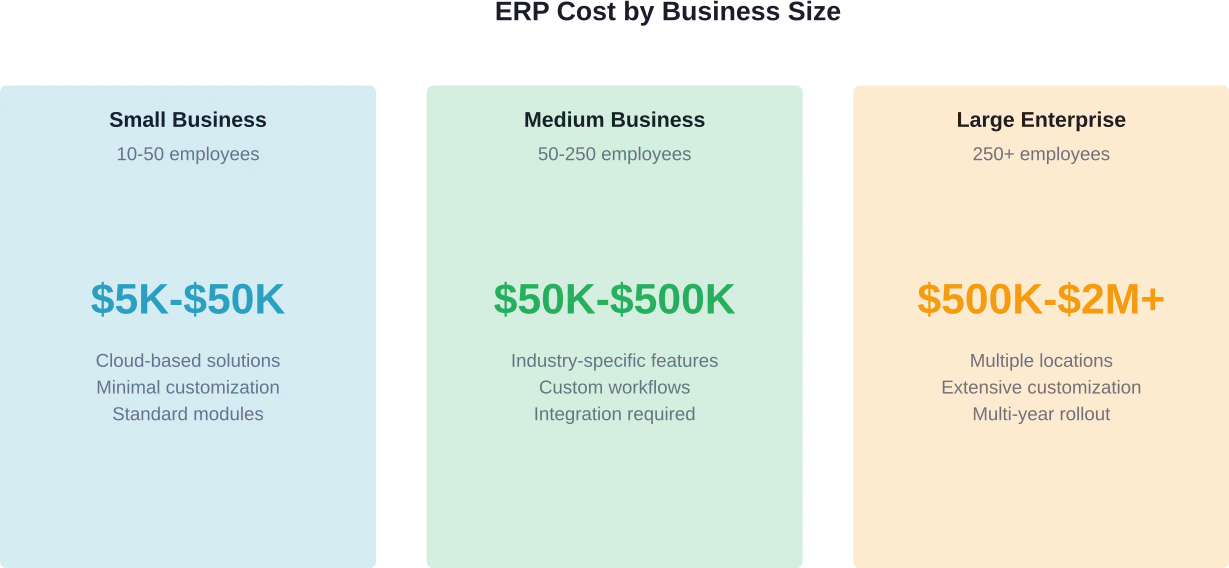
Small businesses typically spend between $5,000 and $50,000 on ERP software development. This range covers companies with 10-50 employees who need core functionality without extensive customization.
Cloud-based solutions dominate this segment because they eliminate infrastructure costs. A small retail operation might pay $50-100 per user monthly for a subscription model, while a growing service company could invest $15,000-30,000 in a more robust cloud platform.
The lower end of this range usually means off-the-shelf software with minimal configuration. Moving toward $50,000 brings customization, integration with existing tools, and more comprehensive implementation support.
Medium Business ERP Cost
Medium-sized businesses face costs between $50,000 and $500,000. Companies with 50-250 employees need more sophisticated features, better integration capabilities, and often industry-specific functionality.
This segment sees the widest variation in pricing because business needs diverge significantly. A distribution company with straightforward processes might spend $75,000, while a manufacturer with complex supply chain requirements could easily hit $400,000.
Customization becomes more important at this level. Standard modules rarely fit perfectly, so development work to adapt workflows, create custom reports, and integrate with specialized equipment or software drives costs upward.
Large Enterprise ERP Cost
Large enterprises typically invest $500,000 to $2 million or more. Organizations with multiple locations, hundreds or thousands of users, and complex operational requirements need comprehensive solutions with extensive customization.
These implementations take months or years. The software license might represent only 30-40% of total costs, with the remainder going to implementation services, data migration, customization, training, and change management.
Global corporations sometimes exceed $5 million on ERP projects when factoring in multi-year rollouts across dozens of locations, multiple languages, and diverse regulatory requirements.
Key Components of ERP Software Development Cost
Breaking down the cost structure reveals where money actually goes during an ERP project. Understanding these components helps create realistic budgets and avoid surprises.
Software Licensing Fees
The license itself forms the foundation of ERP cost. Two models dominate the market: perpetual licensing and subscription-based pricing.
Perpetual licenses require a one-time upfront payment for permanent software rights. A company might pay $1,000-5,000 per user initially, then 15-20% annually for maintenance and updates. This model front-loads costs but can prove economical over 7-10 years.
Subscription licensing spreads costs over time. Monthly or annual fees typically run $50-200 per user depending on functionality. Cloud ERP almost always uses this model, bundling hosting, updates, and support into the recurring fee.
|
Feature |
Perpetual Licensing |
Subscription Licensing |
|---|---|---|
|
Upfront Cost |
High ($1,000-5,000 per user) |
Low (first month/year only) |
|
Recurring Costs |
15-20% annual maintenance |
Monthly/annual subscription |
|
Total 5-Year Cost |
Lower for long-term use |
Higher but predictable |
|
Updates |
Optional, additional cost |
Included in subscription |
|
Hosting |
Self-hosted (on-premise) |
Vendor-hosted (cloud) |
|
Scalability |
Requires license purchases |
Add/remove users easily |
Implementation Services
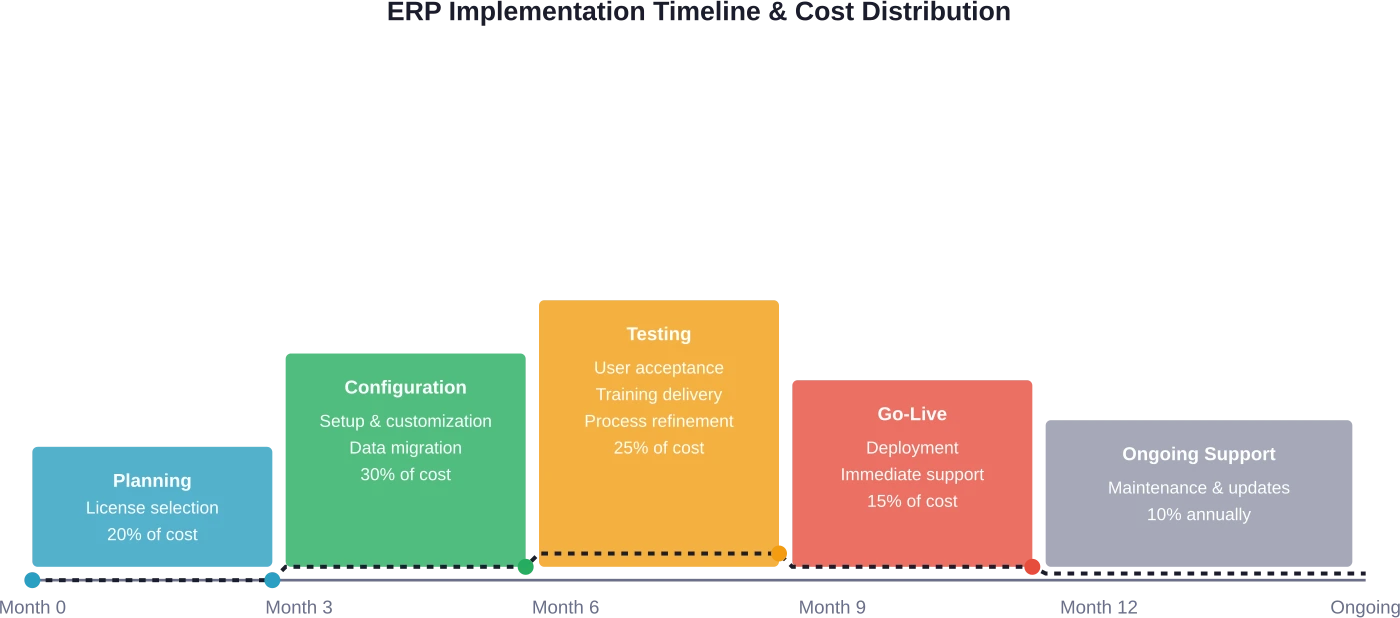
Implementation typically costs 1-3 times the software license price. This phase includes project management, system configuration, data migration, testing, and go-live support.
A $100,000 software license might require $150,000-300,000 in implementation services. Complex projects with extensive customization push toward the higher end, while straightforward deployments stay closer to 1:1.
Implementation timelines matter because consultant rates add up quickly. Projects lasting 6-12 months accumulate substantial professional services fees even when consultants work part-time.
Customization and Development
Custom development addresses gaps between standard functionality and specific business needs. This ranges from simple workflow modifications to building entirely new modules.
Development rates vary by vendor and complexity. Internal development teams might cost $75-150 per hour in loaded labor costs. External consultants and software vendors charge $150-300 per hour for custom development work.
A custom reporting module might take 40-80 hours ($6,000-24,000). Complex integrations with proprietary systems could require 200-500 hours ($30,000-150,000). These costs accumulate quickly when multiple customizations are needed.
Data Migration
Moving data from legacy systems into new ERP software proves more complex than most organizations expect. Data must be cleaned, standardized, mapped to new structures, and validated.
Simple migrations from modern systems might cost $10,000-30,000. Complex migrations from multiple disparate systems with years of accumulated data easily reach $50,000-200,000.
The challenge isn't just technical. Business stakeholders must validate that critical historical data transferred correctly and remains accessible for reporting and compliance.
Training and Change Management
User training often gets underestimated in ERP budgets. Employees need to learn new processes, navigate unfamiliar interfaces, and understand how the system impacts their daily work.
Training costs include course development, trainer time, and employee productivity loss during learning. Organizations typically spend $5,000-50,000 on training depending on user count and system complexity.
Change management extends beyond technical training. It addresses organizational resistance, process redesign, and cultural adaptation. Larger implementations might allocate $50,000-200,000 for comprehensive change management programs.
Infrastructure and Hardware
On-premise deployments require server hardware, networking equipment, and infrastructure software. A small on-premise implementation might need $20,000-50,000 in hardware. Large enterprise deployments can require $200,000-500,000 for robust server clusters, storage systems, and backup infrastructure.
Cloud deployments eliminate most infrastructure costs. The subscription fee covers hosting, but organizations still need adequate internet bandwidth and may need to upgrade workstations or mobile devices.
Ongoing Maintenance and Support
Annual maintenance for perpetual licenses typically costs 15-20% of the original license price. A $200,000 license means $30,000-40,000 yearly for updates, patches, and vendor support.
Subscription models bundle maintenance into the recurring fee. But organizations often need additional support beyond what vendors provide—internal IT staff, external consultants for issues, and periodic optimization work.
Plan for 2-5% of total project cost annually for ongoing enhancements, minor customizations, and process improvements after go-live.

Calculate ERP Software Development Cost
ERP development involves modules, user roles, workflows, and integrations with existing systems. OSKI Solutions defines architecture and business logic before estimating effort. The budget includes development, testing, and deployment stages. You get a realistic ERP cost breakdown based on defined requirements.
Ready to Plan Your ERP Budget?
Talk with OSKI Solutions to:
- define required ERP modules
- estimate integration complexity
- receive a detailed ERP development cost estimate
👉 Request an ERP software development quote from OSKI Solutions.
Build ERP Software That Unifies Your Business
We develop custom ERP systems that centralize operations, automate workflows, and provide real-time visibility across departments.
ERP Deployment Models and Their Cost Implications
Where the software runs dramatically impacts both initial and ongoing costs. Three deployment models dominate the market, each with distinct financial profiles.
Cloud-Based ERP
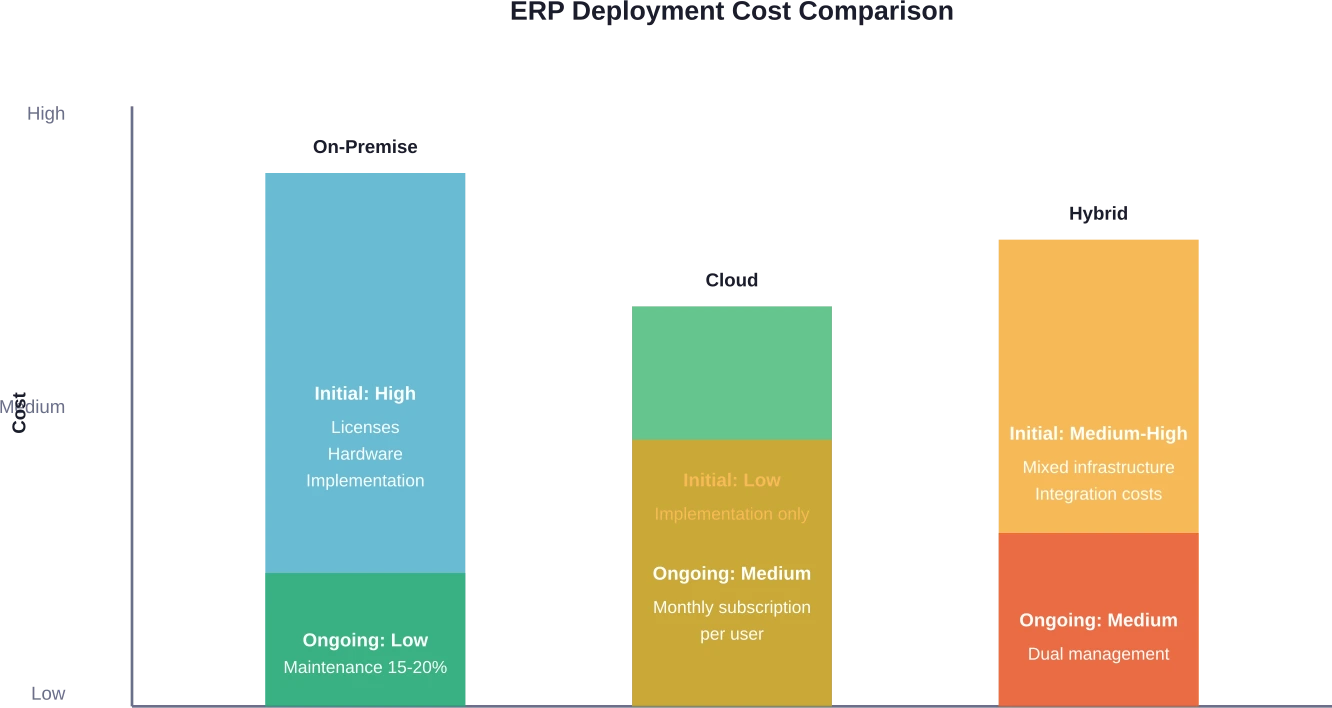
Cloud ERP shifts most costs from capital expenditure to operating expense. There's minimal upfront investment—typically just the first subscription payment and implementation services.
Monthly costs range from $50-200 per user depending on functionality. A 50-user organization might pay $3,000-10,000 monthly ($36,000-120,000 annually). Over five years, total cost of ownership reaches $180,000-600,000 plus implementation.
Cloud deployments implement faster than on-premise alternatives. The vendor handles infrastructure, security patches, and upgrades. But organizations lose some control over timing, customization depth, and data location.
On-Premise ERP
On-premise solutions require substantial upfront investment. Software licenses, server hardware, and implementation services create initial costs of $100,000-1,000,000+ depending on scale.
Ongoing costs include annual maintenance (15-20% of license cost), IT staff to manage infrastructure, utilities, and periodic hardware refreshes. A system with $300,000 in licenses might cost $60,000-75,000 annually to maintain.
This model suits organizations with strict data control requirements, complex customization needs, or long-term cost considerations. After 7-10 years, total cost of ownership often falls below equivalent cloud deployments.
Hybrid ERP Solutions
Hybrid approaches combine on-premise core systems with cloud modules for specific functions. A manufacturer might run production and inventory on-premise while using cloud-based CRM and e-commerce modules.
Costs blend both models. The on-premise portion requires capital investment and infrastructure, while cloud modules add recurring subscription fees. Integration between environments adds $20,000-100,000+ to implementation costs.
This approach offers flexibility but increases complexity. IT teams manage both on-premise infrastructure and cloud integrations, which can drive up ongoing support costs.
Factors That Influence ERP Software Development Cost
Beyond business size and deployment model, several factors push costs up or down. Understanding these variables helps refine budget estimates.
Industry-Specific Requirements
Some industries need specialized functionality that increases development costs. Manufacturing ERP requires shop floor control, bill of materials management, and quality tracking. Healthcare needs HIPAA compliance, patient tracking, and integration with medical devices.
Generic ERP might cost $80,000 for a mid-sized company. Adding industry-specific modules or customizations could push that to $120,000-180,000. Highly regulated industries like pharmaceuticals or aerospace face even steeper premiums for compliance and traceability features.
Integration Complexity
ERP systems rarely operate in isolation. They must integrate with CRM platforms, e-commerce sites, warehouse management systems, payment processors, and countless other tools.
Simple integrations using standard APIs might cost $5,000-15,000 each. Complex integrations requiring custom middleware or data transformation logic run $25,000-75,000 or more. Organizations with 5-10 critical integrations can easily add $100,000-300,000 to project costs.
Number of Users and Concurrent Access
User counts directly impact licensing costs in both perpetual and subscription models. But the relationship isn't always linear—vendors often offer volume discounts at certain thresholds.
Concurrent user licensing costs less than named user licensing. If only 40% of employees use the system simultaneously, concurrent licensing might reduce costs by 30-50%. But this requires careful analysis of usage patterns.
Geographic Scope and Localization
Multi-national implementations require localization for languages, currencies, tax regulations, and reporting standards. Each country adds complexity and cost.
A single-country implementation might cost $200,000. Expanding to three countries with different languages and tax systems could push that to $350,000-500,000. The incremental cost per country decreases after the first few, but never disappears entirely.
Data Volume and Complexity
Organizations with decades of transactional history or complex product catalogs face higher migration costs. More data means more cleaning, validation, and testing before go-live.
Database performance requirements also scale with data volume. Systems processing 100,000 transactions monthly need different infrastructure than those handling 10 million. Cloud subscriptions typically tier pricing by transaction volume or database size.
Mobile and Remote Access Requirements
Mobile functionality adds development and licensing costs. Some vendors include mobile access in base pricing, others charge separately for mobile apps or mobile-optimized interfaces.
Custom mobile apps for field workers, warehouse staff, or sales teams require additional development. Native iOS and Android apps cost $30,000-100,000+ depending on functionality. Web-based mobile interfaces cost less but may sacrifice performance or offline capability.
Building an Accurate ERP Budget
Creating a realistic budget requires more than adding up vendor quotes. Smart budgeting accounts for known costs, estimates variables, and builds in contingency for surprises.
The 1-2% Revenue Rule
Organizations typically budget between 1% and 2% of annual revenue for ERP projects. This rule of thumb provides a starting point grounded in business scale.
A company with $10 million annual revenue would budget $100,000-200,000. At $50 million revenue, the range becomes $500,000-1,000,000. This approach naturally scales investment with organizational capacity to fund and absorb change.
The percentage depends on implementation scope. Companies replacing multiple legacy systems, undertaking significant process redesign, or requiring extensive customization trend toward 2%. Those implementing relatively standard functionality with minimal disruption stay closer to 1%.
Total Cost of Ownership Calculation
TCO captures all costs over the system's expected lifespan, typically 5-10 years. The formula looks straightforward but requires careful estimation of each component.
TCO = purchase price + implementation costs + operating costs for 5-10 years
Operating costs include maintenance fees, IT staff time, infrastructure (for on-premise), occasional customizations, and ongoing training. These easily exceed initial implementation costs over a decade.
A $200,000 license with $300,000 implementation might seem like a $500,000 project. But add $50,000 annually in maintenance, $30,000 for IT staff time, and $20,000 for periodic enhancements. Over 10 years, TCO reaches $1.5 million—triple the initial outlay.
Building in Contingency
ERP projects notoriously run over budget. Implementation takes longer than planned, requirements change, data proves messier than expected, and unforeseen integrations emerge.
A 10% contingency budget provides cushion for minor overruns. More aggressive or complex projects warrant 15-20% contingency. This isn't wasted money—it's insurance against the inevitable gaps between planning and reality.
On a $400,000 project, a 15% contingency means budgeting $460,000. That extra $60,000 might cover additional consultant time, unexpected hardware needs, or extended training requirements.
Phased vs. Big Bang Budgeting
Implementation approach affects budget timing and structure. Big bang deployments go live with all modules simultaneously, front-loading costs into a concentrated timeframe.
Phased rollouts spread implementation across multiple stages—core financials first, then inventory, then manufacturing, then e-commerce integration. This distributes costs over 12-24 months and reduces per-phase risk.
Phased approaches cost 10-20% more overall due to duplicate effort and longer consultant engagement. But they reduce cash flow pressure and allow course correction between phases.
Hidden Costs That Catch Buyers Off Guard
Even detailed vendor quotes miss costs that only emerge during implementation. Being aware of common hidden expenses prevents budget-breaking surprises.
Process Reengineering Time
ERP implementations force examination of existing processes. Many don't translate cleanly to new systems and require redesign before configuration begins.
This work falls on internal staff—operations managers, department heads, and process owners who must document current state, design future state, and validate new workflows. Hundreds of hours of internal labor often go unbudgeted because it's not a line item on vendor invoices.
Additional User Licenses Post-Launch
Initial user counts often prove conservative. Organizations realize more people need access than originally planned, or growth adds users faster than expected.
Adding licenses costs less than the initial purchase in subscription models—just more monthly fees. But perpetual licenses require additional capital investment, and vendors charge full price for additional users regardless of implementation timing.
Report Development
Standard reports rarely satisfy all analytical needs. Custom reports, dashboards, and data exports require development work that's easily underestimated.
Each custom report might take 4-12 hours to build and test ($600-3,600). Organizations often need 20-50 custom reports, adding $12,000-180,000 to final costs. This work continues post-launch as new reporting needs emerge.
Legacy System Parallel Running
Many organizations run old and new systems simultaneously for weeks or months to ensure data accuracy and business continuity. This means maintaining two infrastructures, double data entry, and reconciliation work.
Extended parallel running can add $10,000-50,000 in infrastructure costs, staff overtime, and consultant time. But the risk reduction often justifies the expense for mission-critical systems.
Third-Party Add-Ons and Extensions
Functionality gaps sometimes require third-party applications or vendor-specific add-on modules. That advanced reporting tool costs $5,000. The e-commerce connector is $8,000. The mobile warehouse app adds $12,000.
These costs accumulate invisibly because they're not part of the core ERP quote. A $150,000 base system can grow to $200,000+ once all necessary extensions are included.
Custom vs. Off-the-Shelf ERP Cost Analysis
One of the biggest cost decisions involves building custom software versus configuring existing platforms. Each approach has financial implications that extend far beyond initial price tags.
Custom ERP Development
Custom development builds software specifically for one organization's needs. Development costs typically start at $100,000 for basic systems and easily exceed $500,000-1,000,000 for comprehensive platforms.
The advantage is perfect fit—every feature matches exact requirements without compromise. The disadvantage is time, cost, and ongoing maintenance burden. Custom software requires dedicated development resources for bug fixes, enhancements, and technology updates.
Organizations pursuing custom development often have truly unique processes that provide competitive advantage. A logistics company with proprietary routing algorithms or a manufacturer with unique production methods might justify custom development.
Configured Commercial Software
Commercial platforms offer pre-built functionality that's configured to match business processes. Initial costs range from $5,000 to $500,000+ depending on scale and vendor.
Configuration costs less than custom development because the foundation exists. But perfect fit is impossible—compromises happen where business processes differ from software assumptions.
This approach suits most organizations. Unless processes are genuinely unique, commercial software with 80-90% fit costs far less and implements faster than custom development.
Hybrid Approaches
Many implementations start with commercial platforms and add custom modules for truly unique requirements. A manufacturer might use standard financials and inventory modules while building custom shop floor control.
This balances cost, time, and fit. Standard modules benefit from vendor updates and support. Custom components address specific competitive advantages without rebuilding basic functionality.
|
Factor |
Custom Development |
Commercial Software |
|---|---|---|
|
Initial Cost |
$100K-$1M+ |
$5K-$500K+ |
|
Implementation Time |
12-36 months |
3-18 months |
|
Process Fit |
100% match |
80-90% match |
|
Ongoing Maintenance |
Full internal responsibility |
Vendor provides updates |
|
Flexibility |
Complete control |
Limited by vendor |
|
Risk |
High (project failure risk) |
Lower (proven platform) |
|
Scalability |
Requires development |
Built-in scaling |
Reducing ERP Software Development Costs
Smart buyers find ways to control costs without sacrificing critical functionality. Several strategies reduce expenditure while maintaining project success.
Start with Core Modules
Implementing only essential modules initially cuts costs by 30-50%. Financial management, basic inventory, and order processing might be sufficient for go-live. Advanced features like complex manufacturing or sophisticated analytics can phase in later.
This approach reduces implementation scope, shortens timeline, and allows learning from initial deployment before tackling more complex areas.
Minimize Customization
Every customization adds cost and complexity. Adapting processes to match software capabilities—where reasonable—costs far less than bending software to match processes.
The challenge is distinguishing between nice-to-have preferences and genuinely necessary customizations. Process owners naturally prefer familiar workflows, but often alternative approaches work equally well at a fraction of the cost.
Leverage Internal Resources
Using internal staff for training, testing, and project management reduces consultant costs. A project manager earning $80,000 annually costs $40 per hour in loaded labor—far less than external consultants at $150-300 per hour.
This requires available capacity and appropriate skills. Organizations running lean may lack bandwidth for major project work alongside daily responsibilities. But companies with IT staff, business analysts, or project managers can significantly reduce external costs.
Negotiate Vendor Terms
ERP pricing isn't fixed. Vendors negotiate on licensing costs, implementation service rates, payment terms, and included training. Multi-year subscription commitments often earn 15-25% discounts. Larger user counts unlock volume pricing.
Competitive bidding helps. Getting quotes from 3-4 vendors provides leverage for negotiation and reveals pricing ranges across alternatives.
Consider Open-Source Options
Open-source ERP platforms eliminate licensing costs, though implementation, customization, and support still require investment. Total costs typically run 40-60% of equivalent commercial solutions.
This approach demands technical capability. Organizations need development staff who can work with the codebase, or budget for consultants with open-source expertise. The trade-off is lower cost for higher technical responsibility.
Calculating Return on Investment
ERP costs make sense only when balanced against expected benefits. ROI calculation helps justify investment and set realistic expectations.
Quantifiable Benefits
Some benefits translate directly to dollars. Reduced inventory carrying costs from better planning might save $50,000 annually. Eliminating manual processes could free staff time worth $75,000 yearly. Fewer order errors might reduce customer credits by $30,000.
For a $400,000 ERP investment, these three benefits alone yield $155,000 annually—roughly 39% return. The system pays for itself in 2.6 years, then continues delivering value.
Intangible Benefits
Other benefits resist precise quantification but still matter. Better decision-making from real-time data, improved customer service, faster quote responses, and reduced staff frustration all create value that's hard to measure.
These intangibles often justify projects where pure financial ROI looks marginal. A system that enables growth, improves competitive position, or prevents key employee turnover delivers value beyond spreadsheet calculations.
Realistic Payback Periods
Most ERP investments achieve payback in 3-5 years. Faster payback suggests either very high benefits or very low costs—both worth verifying. Slower payback means either benefits are overstated, costs underestimated, or the project lacks business justification.
Organizations should be skeptical of vendor promises of 12-18 month payback unless concrete, measurable benefits support the claim. Conservative estimates based on documented savings provide better planning foundations.
Common Pricing Mistakes to Avoid
Buyers repeatedly make predictable errors when estimating ERP costs. Awareness helps avoid these traps.
Comparing Only License Costs
A $50,000 license looks better than a $100,000 license. But if the cheaper option requires $150,000 in customization while the expensive one needs only $50,000, total costs reverse.
Always compare total project cost including implementation, not just software pricing. The cheapest license rarely delivers the lowest TCO.
Ignoring Scalability Costs
A system perfect for current needs might cost a fortune to expand. Adding users, locations, or transaction volume shouldn't trigger complete replacement within 3-5 years.
Evaluate pricing for expected growth. If the plan calls for 50 users now but 80 in two years, understand the cost of those additional 30 licenses before committing.
Underestimating Internal Effort
Vendor quotes cover consultant time, not internal labor. But successful implementations demand hundreds of hours from business stakeholders who must document requirements, validate configurations, test functionality, and train colleagues.
This internal effort has real cost even when it's not invoiced externally. Organizations should account for staff time diverted from normal duties.
Forgetting About Change Management
Technical implementation represents only half the challenge. The other half involves helping people adapt to new processes, overcome resistance, and build new capabilities.
Projects that skimp on change management face higher failure rates. User adoption suffers, benefits don't materialize, and expensive software sits underutilized.
Industry-Specific Cost Considerations
Different industries face unique cost drivers that generic estimates miss. A few examples illustrate how vertical requirements impact pricing.
Manufacturing ERP
Manufacturing systems need production planning, bill of materials, shop floor control, and quality management. These specialized modules cost 20-40% more than basic financial and inventory functionality.
Integration with equipment—CNC machines, PLCs, automated production lines—adds another layer of cost. Each integration point represents development work and ongoing maintenance.
Retail and E-Commerce ERP
Retailers need point-of-sale integration, e-commerce connectivity, and multi-channel inventory visibility. Seasonal demand spikes require scalable infrastructure that doesn't break down during peak periods.
Real-time inventory synchronization between physical stores and online channels involves complex integration. Getting this right costs more but prevents overselling and customer disappointment.
Professional Services ERP
Service organizations need project accounting, time tracking, resource scheduling, and billing integration. These requirements differ fundamentally from product-focused systems.
Consultant utilization tracking, project profitability analysis, and sophisticated billing rules add complexity and cost beyond standard financial modules.
Healthcare ERP
Healthcare faces stringent compliance requirements. HIPAA privacy rules, patient data security, and integration with electronic health records create specialized needs that generic ERP doesn't address.
Healthcare-specific modules typically cost 30-50% more than equivalent general business functionality due to regulatory complexity and liability concerns.
Questions to Ask Vendors About Pricing
Smart buyers dig deeper than surface quotes. These questions reveal hidden costs and clarify what proposals actually include.
- What exactly is included in the base price? Does it cover all necessary modules, or are critical features priced separately? How many users does the quote include?
- What are the implementation service rates? Get hourly rates for consultants, project managers, and developers. Understand minimum engagement terms and how overages are billed.
- How do you charge for customization? Fixed price per customization, hourly rates, or packaged service bundles? What's the change request process if requirements evolve?
- What's included in annual maintenance? Updates, patches, and bug fixes should be standard. But does it include phone support? On-site visits? After-hours emergency assistance?
- How does pricing scale with growth? What happens when user count increases 25%? What if transaction volume doubles? How much does adding another location cost?
- Are there any mandatory add-ons? Some vendors require specific modules or services as prerequisites. Database licenses, middleware, or integration platforms might be mandatory extras.
- What's the payment schedule? Full upfront payment, milestone-based installments, or monthly subscriptions? Payment terms affect cash flow significantly.
Frequently Asked Questions
How much does ERP software cost for a small business?
Small businesses typically spend between $5,000 and $50,000 on ERP software development. Companies with 10-50 employees using cloud-based solutions with minimal customization stay toward the lower end, while those requiring industry-specific features or modest customization approach the higher range. The average cost per user runs approximately $50-100 monthly for subscription models, or $1,000-2,000 per user for perpetual licenses plus annual maintenance of 15-20%.
What percentage of annual revenue should be budgeted for ERP implementation?
Organizations typically budget 1-2% of annual revenue for ERP projects. Companies undertaking straightforward implementations with minimal process changes stay near 1%, while those replacing multiple legacy systems or requiring significant customization trend toward 2%. A business with $10 million in annual revenue would budget $100,000-200,000, including both software costs and implementation services.
Is cloud ERP cheaper than on-premise ERP?
Cloud ERP has lower upfront costs but higher ongoing expenses. Initial investment might be 50-70% less because cloud eliminates infrastructure purchases. But monthly subscription fees accumulate over time. For deployments lasting 7-10 years, on-premise total cost of ownership often equals or falls below cloud alternatives. Organizations with shorter planning horizons or limited capital typically find cloud more economical.
How long does ERP implementation take and how does that affect cost?
Small business implementations typically take 3-6 months, mid-market projects run 6-12 months, and enterprise deployments often require 12-24 months. Timeline directly impacts cost through consultant engagement length and internal resource allocation. A project taking twice as long costs significantly more in professional services, even if software licensing remains constant. Phased implementations extend timelines but reduce per-phase risk and cash flow requirements.
What are the hidden costs in ERP implementation?
Common hidden costs include internal staff time for process documentation and testing, additional user licenses beyond initial estimates, custom report development, third-party add-ons and extensions, data migration complexity, training beyond vendor basics, parallel running of legacy systems, and post-launch optimization work. These collectively add 20-40% to vendor-quoted costs. Building a 10-15% contingency budget helps cover unexpected expenses.
Can ERP costs be reduced without sacrificing functionality?
Several strategies reduce costs while maintaining core functionality: implement essential modules first and phase in advanced features later, minimize customization by adapting processes to software where reasonable, use internal resources for project management and training instead of consultants, negotiate vendor terms including multi-year discounts and volume pricing, and consider open-source platforms that eliminate licensing costs. These approaches can reduce total project costs by 20-40%.
How do you calculate the total cost of ownership for ERP?
TCO equals purchase price plus implementation costs plus operating costs over the expected system lifespan (typically 5-10 years). Operating costs include annual maintenance (15-20% of license cost for perpetual licenses, or monthly subscriptions for cloud), IT staff time for system administration, periodic customizations and enhancements, ongoing training for new employees, infrastructure costs for on-premise deployments, and integration maintenance. A system with $200,000 initial cost might have $1.5 million TCO over 10 years.
Making the Investment Decision
ERP represents one of the largest technology investments most organizations make. The decision demands careful financial analysis, realistic expectations, and clear understanding of both costs and benefits.
Total costs span far beyond software licenses. Implementation services, customization, training, data migration, and ongoing maintenance collectively exceed initial licensing fees in most projects. Organizations that budget only for software invariably face unpleasant surprises mid-project.
But ERP done right delivers substantial value. Better inventory management, streamlined processes, reduced errors, improved decision-making, and enhanced customer service create measurable benefits that justify investment. Research indicates that approximately 60% of implementations achieve partial success when properly planned and executed.
The key is matching investment to organizational readiness. Companies clear on requirements, committed to process improvement, and willing to allocate necessary resources see strong returns. Those treating ERP as a pure technology purchase without addressing process and people often struggle.
Taking the Next Step
Armed with realistic cost expectations, the path forward involves three critical actions.
First, document current processes and pain points. Understanding what needs to improve clarifies requirements and helps vendors provide accurate quotes. Vague requirements lead to vague proposals that prove inadequate when reality hits.
Second, request detailed proposals from multiple vendors. Compare not just license costs but total project pricing including implementation, training, and support. Ask the tough questions about scalability, customization costs, and what's really included in maintenance fees.
Third, build a comprehensive budget that accounts for the full TCO over 5-10 years. Include contingency for inevitable surprises. Get executive buy-in for the complete investment, not just year-one costs.
ERP software development costs range from thousands to millions depending on business size, complexity, and approach. But organizations that plan carefully, budget realistically, and commit to comprehensive implementation see returns that justify the investment many times over.
The question isn't whether ERP costs significant money—it does. The question is whether the benefits justify the investment for specific business needs and whether the organization can execute successfully. With clear cost understanding and realistic expectations, that question becomes answerable.
Ready to explore ERP options for your organization? Start by defining clear objectives, documenting current process challenges, and building a preliminary budget using the frameworks outlined above. Then engage vendors with specific questions about how their solutions address your needs and what the true total cost of ownership looks like.


