

Enterprise Software Development Cost: 2026 Pricing Guide

Brief Overview: Enterprise software development costs typically range from $100,000 to $1,000,000+ depending on complexity, scope, and team composition. Key cost drivers include project architecture, security requirements, integration needs, and whether teams are in-house or outsourced. According to the U.S. Bureau of Labor Statistics, computer programmers earned a median of $98,670 per year in May 2024, while systems analysts earned a median annual wage of $103,790 in May 2024, directly impacting project budgets.
Enterprise software projects aren't small undertakings. The financial commitment stretches well beyond the initial development phase, touching everything from architecture planning to post-launch maintenance.
But here's what makes budgeting challenging: no two enterprise projects carry identical price tags. A customer relationship management (CRM) system for a 200-person company costs dramatically less than a comprehensive enterprise resource planning (ERP) platform serving 5,000 users across multiple continents.
Real talk: most enterprises spend between $100,000 and $1,000,000 on software development. Some projects push past $5,000,000 when they involve complex integrations, regulatory compliance, and custom AI capabilities.
This guide breaks down actual costs, pricing structures, and the factors that'll either keep budgets reasonable or send them spiraling. The data comes from current market rates, government labor statistics, and real project examples.
Enterprise Software Development Cost Ranges: The Reality Check
The short answer? Enterprise software development starts around $100,000 for basic applications and can exceed $1,000,000 for comprehensive systems.
Here's what that looks like across different project scales:
|
Project Complexity |
Timeline |
Cost Range |
Typical Examples |
|---|---|---|---|
|
Basic Enterprise Tool |
3-6 months |
$100,000 - $250,000 |
Internal dashboard, workflow automation, simple mobile companion app |
|
Mid-Level Platform |
6-12 months |
$250,000 - $500,000 |
CRM system, inventory management, HR platform with integrations |
|
Complex Enterprise System |
12-18 months |
$500,000 - $1,000,000 |
ERP platform, multi-tenant SaaS, financial management system |
|
Mission-Critical Infrastructure |
18-36+ months |
$1,000,000 - $5,000,000+ |
Banking systems, healthcare platforms, supply chain orchestration |
These ranges reflect 2026 market rates for development teams based in North America. Projects using offshore or nearshore teams typically cost 30-60% less, though with trade-offs in timezone coordination and sometimes communication efficiency.
The U.S. Bureau of Labor Statistics reports that computer programmers held about 121,200 jobs in 2024, with 31% working in computer systems design and related services. This concentration affects pricing, especially in tech hubs where competition for talent drives rates higher.

Calculate Enterprise Software Development Cost
Enterprise software development involves complex business logic, integrations, and scalability requirements. OSKI Solutions defines system architecture and modules before estimating development effort. The budget includes backend, frontend, testing, and deployment stages. This provides a realistic enterprise project cost overview.
Ready to Estimate Your Enterprise Software Budget?
Talk with OSKI Solutions to:
- define core modules and integrations
- estimate development effort by stage
- receive a detailed enterprise software cost breakdown
👉 Request an enterprise software development quote from OSKI Solutions.
Build Enterprise Software That Scales
We design and develop secure, high-performance custom enterprise systems tailored to your infrastructure and long-term business goals.
What Actually Drives Enterprise Software Costs Higher
Project complexity isn't a vague concept. It's measurable through specific technical requirements that directly impact development hours.
Architecture and Scalability Requirements
Enterprise systems need to handle hundreds or thousands of concurrent users without performance degradation. This architectural foundation costs significantly more than single-user applications.
Microservices architecture, distributed databases, and load-balanced infrastructure all add development complexity. Each component requires additional planning, testing, and integration work.
A simple e-commerce website will cost far less than a comprehensive enterprise resource planning (ERP) system. The difference lies in how many systems need to communicate, how data flows between components, and how the application scales under load.
Security and Compliance Demands
Regulated industries face stricter requirements. Healthcare software must comply with HIPAA, financial applications need SOC 2 certification, and international platforms require GDPR compliance.
Security audits, penetration testing, encryption implementation, and compliance documentation aren't optional extras. They're mandatory cost centers that can add 15-25% to base development budgets.
Integration Complexity
Enterprise software rarely operates in isolation. Most projects require integration with existing systems: legacy databases, third-party APIs, authentication services, payment processors, and analytics platforms.
Each integration point introduces potential failure modes, requires custom middleware, and demands ongoing maintenance. Projects with 5-10 major integrations typically cost 20-40% more than standalone applications.
User Experience and Interface Design
Enterprise users expect consumer-grade interfaces. Complex workflows need intuitive design, responsive layouts work across devices, and accessibility standards ensure usability for all employees.
Professional UX research, iterative design sprints, and extensive usability testing add weeks or months to timelines. But they're critical—poor interfaces lead to low adoption rates and wasted investment.
The Real Cost of Development Teams
Labor represents the single largest cost component in enterprise software projects. According to the U.S. Bureau of Labor Statistics (May 2024), computer programmers earned a median of $98,670 per year in May 2024.
But that's just programmers. Enterprise projects require diverse skill sets:
- Junior developers: $60,000-$90,000 annually
- Mid-level developers: $90,000-$130,000 annually
- Senior developers: $130,000-$200,000+ annually
- Systems analysts: $103,790 median (BLS data)
- Project managers: $80,000-$140,000 annually
- UX/UI designers: $70,000-$120,000 annually
- DevOps engineers: $110,000-$170,000 annually
- QA specialists: $65,000-$110,000 annually
A typical mid-sized enterprise project requires 6-10 team members working for 9-12 months. That's where the $250,000-$500,000 range comes from—it's not arbitrary.
In-House vs. Outsourced Development
Building internally with full-time employees adds overhead beyond base salaries. Benefits, office space, equipment, and training typically add 25-40% to direct compensation costs.
Development agencies bundle these costs differently. Agency rates typically range from $70–$200 per hour in the United States, with common mid-range rates between $100–$150 per hour.
Offshore development teams in Eastern Europe, Latin America, or South Asia charge $30-$80 per hour. The cost savings look attractive, but timezone differences, communication gaps, and project management overhead can reduce the effective savings to 30-40% rather than the apparent 50-70%.
Hidden Costs That Surprise Most Organizations
Initial development represents only 60-70% of total ownership costs. The remaining expenses emerge during deployment and ongoing operations.
Infrastructure and Hosting
Enterprise applications require robust hosting infrastructure. Cloud services (AWS, Azure, Google Cloud) cost $500-$5,000+ monthly depending on user load, data storage, and processing requirements.
High-availability configurations with redundancy, backup systems, and disaster recovery capabilities push costs higher. Mission-critical systems often require multi-region deployments that double or triple infrastructure expenses.
Maintenance and Updates
Software isn't a one-time purchase. Maintenance typically consumes 15-25% of initial development costs annually. This covers bug fixes, security patches, dependency updates, and minor feature enhancements.
Teams need to plan for ongoing development support. Most organizations allocate 1-2 full-time developers for maintenance on systems originally built by 6-8 person teams.
Third-Party Services and APIs
Enterprise systems integrate with numerous paid services: payment processors (2-3% per transaction), authentication services ($500-$5,000 monthly), analytics platforms ($1,000-$10,000 monthly), and specialized APIs for mapping, communications, or data enrichment.
These recurring costs add up. A project with 8-10 service integrations easily spends $5,000-$15,000 monthly on API fees alone.
Training and Change Management
New software requires user training. Enterprises typically invest $100-$300 per employee for comprehensive training programs, including materials development, instructor time, and productivity loss during the learning curve.
For a 500-person organization, training costs reach $50,000-$150,000. Larger deployments with complex workflows require more extensive programs.
Security Audits and Compliance Certification
Annual security audits cost $15,000-$75,000 depending on scope and certification requirements. SOC 2 audits run $20,000-$50,000 annually, while HIPAA compliance assessments range from $10,000-$40,000.
These aren't optional for regulated industries. Budget for them from day one.
Development Pricing Models: How Agencies Structure Costs
Agencies and development firms offer several pricing structures, each with distinct advantages and risks.
Fixed-Price Contracts
Fixed-price agreements establish a set cost for defined deliverables. This model works well when requirements are crystal clear and unlikely to change.
The upside: budget certainty and predictable cash flow. The downside: scope changes trigger expensive change orders, and vendors pad estimates to cover risk.
Fixed-price contracts typically cost 10-20% more than time-and-materials arrangements because vendors price in contingency buffers.
Time and Materials
Time-and-materials pricing bills actual hours worked at agreed-upon rates. This flexibility suits projects where requirements evolve during development.
Benefits include adaptability and alignment of incentives—teams focus on building the right solution rather than hitting arbitrary deadlines. Risks center on budget overruns if scope isn't carefully managed.
Most enterprise projects over $300,000 use time-and-materials with not-to-exceed caps that provide some budget protection.
Dedicated Team Model
The dedicated team approach allocates specific developers, designers, and project managers to work exclusively on one client's projects. Clients pay monthly retainers covering team costs plus agency overhead.
This model suits organizations with ongoing development needs. Monthly costs for a 5-person dedicated team range from $50,000-$100,000 depending on seniority and location.
Hybrid Approaches
Many projects combine models: fixed-price for initial MVP development, then time-and-materials for iterative enhancements. This balances budget predictability with flexibility.
|
Pricing Model |
Best For |
Risk Level |
Typical Premium |
|---|---|---|---|
|
Fixed-Price |
Well-defined projects, compliance needs |
Low budget risk, high scope risk |
+10-20% over T&M |
|
Time & Materials |
Evolving requirements, complex projects |
Higher budget risk, low scope risk |
Baseline cost |
|
Dedicated Team |
Ongoing development, long-term needs |
Medium (managed through oversight) |
+5-15% vs. contractors |
|
Hybrid |
Phased projects, MVP-first approach |
Balanced |
Varies by phase |
How AI Integration Affects Enterprise Software Budgets
AI capabilities have shifted from luxury features to standard expectations. But they're not free.
AI integration typically increases development costs by 10-20% for mid-to-large projects. The added expense covers data preparation, model training or API integration, testing across edge cases, and ongoing monitoring.
Common AI features in enterprise software include:
- Predictive analytics for forecasting and trend analysis
- Natural language processing for search and document analysis
- Recommendation engines for personalized experiences
- Anomaly detection for security and quality control
- Automated data extraction and categorization
Third-party AI APIs (OpenAI, Google Cloud AI, AWS AI services) cost $0.002-$0.20 per request depending on model complexity. High-volume applications easily spend $1,000-$10,000 monthly on API fees.
Custom machine learning models require specialized talent. ML engineers command $130,000-$200,000 annually, adding significant labor costs to projects.
Cost Comparison: Build vs. Buy for Enterprise Software
Off-the-shelf solutions tempt organizations looking to avoid custom development costs. The decision hinges on specific business needs and competitive advantages.
When Off-the-Shelf Makes Sense
Generic business processes (email, document management, basic CRM) rarely justify custom development. SaaS platforms like Salesforce, Microsoft 365, or Workday offer proven functionality at predictable monthly costs.
For a 100-person company, enterprise SaaS typically costs $50-$200 per user monthly. That's $60,000-$240,000 annually for software that works immediately.
But wait. Configuration, integration, data migration, and training add 50-100% to first-year costs. Still usually cheaper than custom development, though.
When Custom Development Wins
Unique business processes, competitive differentiation, complex integrations, or strict data control requirements push organizations toward custom solutions.
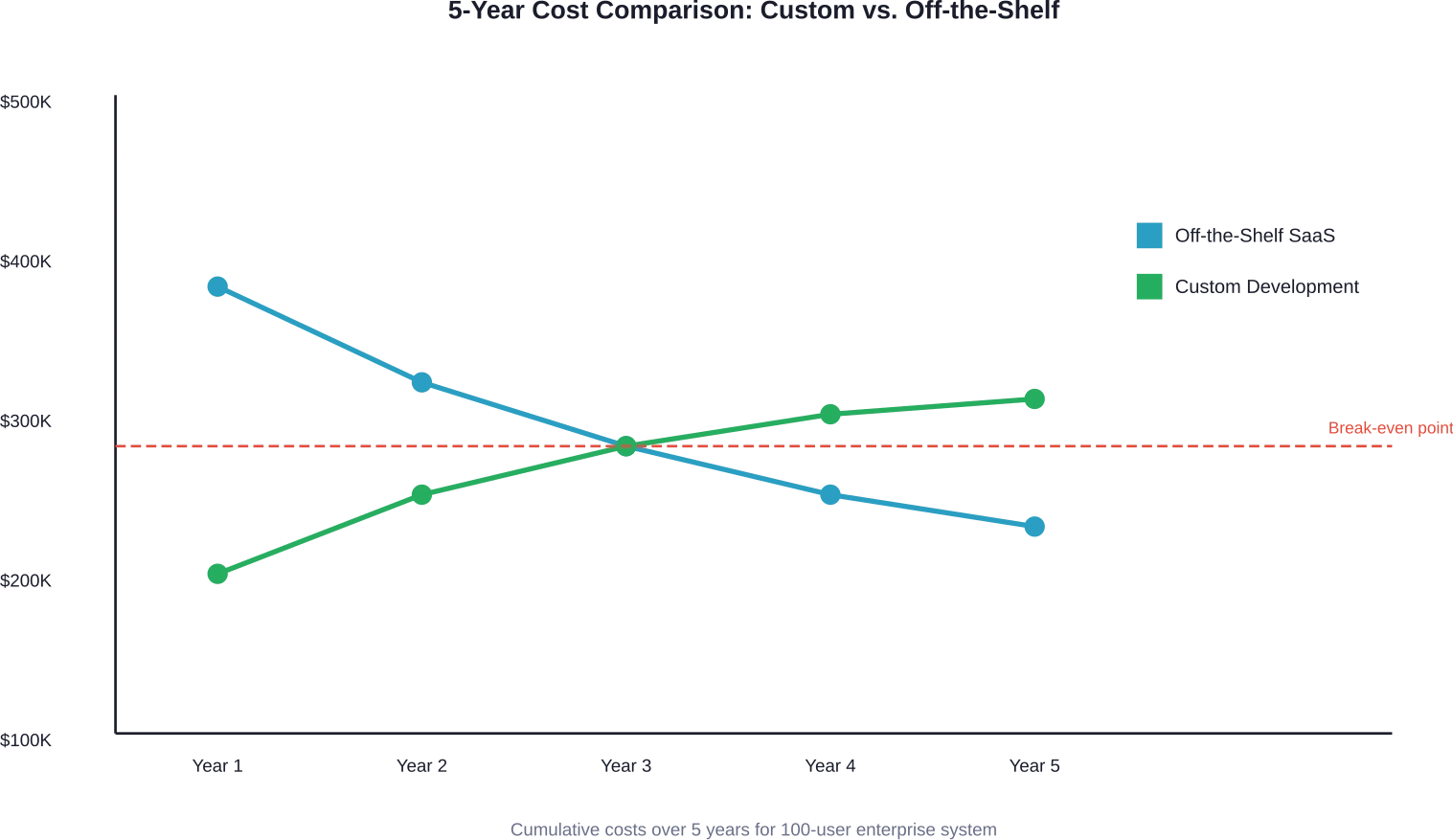
A $500,000 custom system costs more upfront but offers ownership, flexibility, and no recurring licensing fees. The break-even point typically arrives in years 3-5 compared to enterprise SaaS alternatives.
Industries with specialized workflows (manufacturing, logistics, healthcare) often find off-the-shelf options require so much customization that custom development becomes more cost-effective.
Regional Cost Variations: Where Development Happens Matters
Geography significantly impacts development costs. Rates vary based on local talent pools, cost of living, and market competition.
North American Rates
United States development teams charge the highest rates globally. Major tech hubs (San Francisco, New York, Seattle) see hourly rates of $150-$250 for senior developers.
Mid-tier cities (Austin, Denver, Atlanta) offer 20-30% lower rates while maintaining strong talent pools. Remote teams spanning multiple U.S. locations typically charge $100-$175 per hour.
Canadian development costs run slightly lower than U.S. rates. Custom software in Canada typically ranges from CAD 55,000 to 550,000 ($40,000 to $400,000 USD) depending on scope.
Eastern European Development
Poland, Ukraine, Romania, and Czech Republic have established tech industries with strong technical education systems. Rates range from $40-$80 per hour for experienced developers.
Language proficiency is generally excellent, timezone overlap with Western Europe is complete, and partial overlap with U.S. Eastern time makes real-time collaboration feasible.
Latin American Nearshore
Mexico, Argentina, Brazil, and Colombia provide nearshore options for North American companies. Timezone alignment enables daily stand-ups and collaborative sessions.
Rates typically range from $35-$70 per hour. English proficiency varies more than Eastern Europe, so team selection requires careful vetting.
Asian Offshore Markets
India, Philippines, and Vietnam offer the lowest hourly rates ($25–$50/hr in Asia) but present timezone challenges for North American and European clients.
Asynchronous communication works, but slows iteration cycles. Projects requiring frequent client input or rapid pivots face friction with 12-hour timezone gaps.
Strategies to Control Enterprise Software Development Costs
Smart planning reduces waste without compromising quality. Here's what actually works.
Invest in Discovery Before Development
Discovery phases cost $15,000-$50,000 but prevent far more expensive mistakes. Proper requirements gathering, technical feasibility analysis, and architecture planning identify problems before they become costly rework.
Projects that skip discovery typically experience 30-50% budget overruns from scope changes and technical debt.
Build MVPs First, Not Full Feature Sets
Minimum viable products focus on core functionality needed to validate concepts and gather user feedback. MVPs typically cost 40-60% less than full-featured systems.
The MVP approach enables earlier market entry, faster user feedback, and the option to pivot before investing heavily in potentially unwanted features.
Adopt Modular Architecture
Modular systems allow incremental development. Teams can build and deploy individual modules independently, spreading costs over longer timeframes and enabling prioritization based on business value.
This approach also simplifies maintenance. Updates affect specific modules rather than requiring full system regression testing.
Use Established Frameworks and Libraries
Custom solutions aren't always necessary. Mature frameworks (React, Angular, Vue for frontends; Django, Rails, Laravel for backends) provide tested foundations that reduce development time by 30-50%.
Open-source libraries solve common problems: authentication, payment processing, file handling, and data validation. Teams can focus resources on unique business logic rather than reinventing standard functionality.
Plan for Technical Debt
Rushing to market creates shortcuts that require future rework. Budget 10-15% of development time for refactoring and technical debt reduction.
Controlled technical debt is acceptable in MVPs. Uncontrolled debt becomes maintenance nightmares that cost 3-5 times more to fix later than building correctly initially.
How Project Timeline Impacts Costs
Faster isn't always cheaper. Aggressive timelines require larger teams working in parallel, which introduces coordination overhead and communication costs.
A 12-month project compressed to 6 months might require doubling the team size, but costs typically increase 60-80% rather than 100%. The inefficiency comes from coordination complexity and the fact that some tasks can't be effectively parallelized.
Conversely, stretching timelines too long increases costs through team retention challenges, technology changes requiring rework, and market shifts invalidating requirements.
The optimal timeline balances team efficiency with business urgency. Most enterprise projects hit efficiency sweet spots with 9-15 month timelines.
Technology Stack Choices and Their Cost Implications
Technology decisions affect both immediate development costs and long-term maintenance expenses.
Modern Web Technologies
React, Angular, and Vue dominate frontend development. All three have mature ecosystems, extensive libraries, and large talent pools. Development costs are comparable across these frameworks.
Backend choices include Node.js, Python (Django/Flask), Ruby on Rails, Java (Spring), and .NET. Node.js and Python typically see slightly faster development cycles, while Java and .NET offer stronger enterprise tooling and corporate support.
Mobile Development Approaches
Native development (Swift for iOS, Kotlin for Android) provides best performance and user experience but requires separate codebases. This essentially doubles mobile development costs.
Cross-platform frameworks (React Native, Flutter) enable single codebases serving both platforms. Development costs decrease 30-50% compared to native approaches, though with some performance trade-offs for complex applications.
Cloud vs. On-Premise Infrastructure
Cloud-native architectures dominate new enterprise development. AWS, Azure, and Google Cloud offer managed services that reduce infrastructure management overhead.
On-premise deployments require additional infrastructure planning, hardware procurement, and operations expertise. Total costs typically run 40-70% higher than equivalent cloud deployments.
Hybrid approaches make sense for organizations with existing data centers and regulatory requirements preventing full cloud migration.
Industry-Specific Cost Considerations
Certain industries face unique requirements that impact development budgets.
Healthcare Software
HIPAA compliance, electronic health record integrations, and patient data security add 25-40% to base development costs. Healthcare applications require extensive audit logging, encryption, and access controls.
Clinical validation and potential FDA oversight for diagnostic tools introduce additional testing and documentation requirements.
Financial Services
Banking and fintech applications require PCI DSS compliance for payment processing, SOC 2 certification, and often multi-factor authentication. Security requirements add 20-35% to development costs.
Transaction processing needs robust concurrency handling and data consistency guarantees, requiring more sophisticated architecture than typical business applications.
Manufacturing and Supply Chain
Integration with industrial IoT devices, ERP systems, and logistics platforms creates complex technical requirements. Real-time data processing, inventory synchronization, and supply chain visibility features add significant complexity.
These systems often require on-premise components for factory floor integration, increasing infrastructure costs.
E-Commerce and Retail
High-availability requirements (99.9%+ uptime), payment gateway integrations, inventory management, and customer data platforms create moderate complexity.
Seasonal traffic spikes require auto-scaling infrastructure, and personalization features often incorporate machine learning for product recommendations.
Questions to Ask Before Starting Enterprise Development
Smart cost management begins before signing development contracts. These questions expose potential budget risks:
What specific business problems does this software solve? Vague answers indicate unclear requirements that lead to scope creep.
Which features are must-haves versus nice-to-haves? This prioritization determines MVP scope and prevents over-engineering.
What existing systems require integration? Each integration adds cost—knowing them upfront prevents surprises.
What compliance requirements apply? HIPAA, GDPR, SOC 2, and industry regulations significantly impact budgets.
Who owns the code and intellectual property? Ensure contracts specify ownership rights to avoid vendor lock-in.
What does post-launch support include? Clarify whether maintenance, hosting, and updates fall under initial contracts or require separate agreements.
What happens if requirements change? Understand change order processes and costs before they become urgent.
Real-World Enterprise Software Cost Examples
Actual projects illustrate how different requirements translate into budgets.
Mid-Market CRM System
A 300-employee manufacturing company needed a custom CRM integrating with their ERP and production systems.
- Timeline: 10 months
- Team: 6 developers, 1 designer, 1 project manager, 1 QA specialist
- Total cost: $425,000
- Included: Web application, mobile companion app, ERP integration, custom reporting
- Ongoing: $60,000 annually for hosting, maintenance, and minor enhancements
Healthcare Patient Portal
A regional healthcare network built a patient portal for appointment scheduling, medical records access, and telehealth.
- Timeline: 14 months
- Team: 8 developers, 2 designers, 1 compliance specialist, 1 project manager, 2 QA specialists
- Total cost: $780,000
- Included: HIPAA-compliant infrastructure, EHR integration, video consultation, prescription management
- Ongoing: $95,000 annually plus annual security audits ($25,000)
Financial Services Trading Platform
An investment firm developed a proprietary trading platform with real-time market data and algorithmic trading capabilities.
- Timeline: 22 months
- Team: 12 developers, 2 DevOps engineers, 3 QA specialists, 2 project managers
- Total cost: $1,850,000
- Included: High-frequency trading engine, market data feeds, risk management, compliance reporting
- Ongoing: $280,000 annually for infrastructure, data feeds, and development team
How to Evaluate Development Partner Proposals
Not all estimates are created equal. Here's how to assess proposals:
Look Beyond the Bottom Line
The lowest bid often signals incomplete requirements analysis or unrealistic timelines. Proposals should itemize costs by development phase, feature category, and team composition.
Assess Technical Approach
Strong proposals outline technical architecture, technology stack rationale, and risk mitigation strategies. Vague technical sections suggest vendors haven't thoroughly analyzed requirements.
Verify Experience
Request case studies in similar industries or with comparable technical requirements. Generic experience matters less than relevant expertise.
Understand Team Composition
Who actually works on the project? Some agencies propose senior developers but staff projects with junior team members. Contracts should specify team experience levels.
Review Timeline Realism
Unrealistically short timelines indicate either misunderstood requirements or plans to cut corners. Compare timelines across multiple proposals to identify outliers.
The True Total Cost of Ownership
Initial development represents roughly 60% of five-year ownership costs. The remaining 40% breaks down approximately as:
- Maintenance and bug fixes: 15-20%
- Feature enhancements: 10-15%
- Infrastructure and hosting: 5-10%
- Security and compliance: 3-5%
- Training and support: 2-4%
Organizations that budget only for initial development face cash crunches when ongoing costs emerge. Realistic financial planning accounts for total ownership costs from the start.
|
Cost Category |
Year 1 |
Year 2 |
Year 3 |
Year 4 |
Year 5 |
5-Year Total |
|---|---|---|---|---|---|---|
|
Initial Development |
$500,000 |
— |
— |
— |
— |
$500,000 |
|
Maintenance |
$25,000 |
$75,000 |
$80,000 |
$85,000 |
$90,000 |
$355,000 |
|
Infrastructure |
$36,000 |
$42,000 |
$48,000 |
$54,000 |
$60,000 |
$240,000 |
|
Security/Compliance |
$30,000 |
$25,000 |
$25,000 |
$25,000 |
$25,000 |
$130,000 |
|
Training/Support |
$50,000 |
$15,000 |
$15,000 |
$15,000 |
$15,000 |
$110,000 |
|
Annual Total |
$641,000 |
$157,000 |
$168,000 |
$179,000 |
$190,000 |
$1,335,000 |
Common Budgeting Mistakes That Inflate Costs
Organizations repeatedly make the same financial planning errors.
Skipping the Discovery Phase
Jumping straight to development without proper planning leads to requirement changes, technical debt, and rework. The $20,000-$40,000 saved upfront typically costs $100,000+ in corrections later.
Ignoring Integration Complexity
"Just connect it to our existing systems" sounds simple but rarely is. Each integration requires API development, data mapping, error handling, and ongoing maintenance. Underestimating integration costs by 50-100% is common.
Treating Software as a One-Time Purchase
Software requires feeding and care. Organizations that don't budget for ongoing maintenance face a choice: let systems decay or scramble for unplanned funds.
Demanding Unrealistic Timelines
Aggressive deadlines force larger teams, reduce code quality, and increase coordination overhead. Rushed projects typically cost 40-70% more than reasonably paced ones while delivering lower quality.
Choosing the Lowest Bid
Development is not a commodity. The cheapest option usually means cut corners, junior developers, or incomplete understanding of requirements. The resulting rework and quality issues eliminate any initial savings.
Frequently Asked Questions About Enterprise Software Development Costs
How much does it cost to develop enterprise software in 2026?
Enterprise software development typically ranges from $100,000 to $1,000,000+ depending on complexity, team composition, and timeline. Basic enterprise tools start around $100,000-$250,000, mid-level platforms run $250,000-$500,000, and complex mission-critical systems exceed $1,000,000. Total cost of ownership over five years is approximately 1.7-2x the initial development investment when accounting for maintenance, hosting, security, and enhancements.
What factors have the biggest impact on development costs?
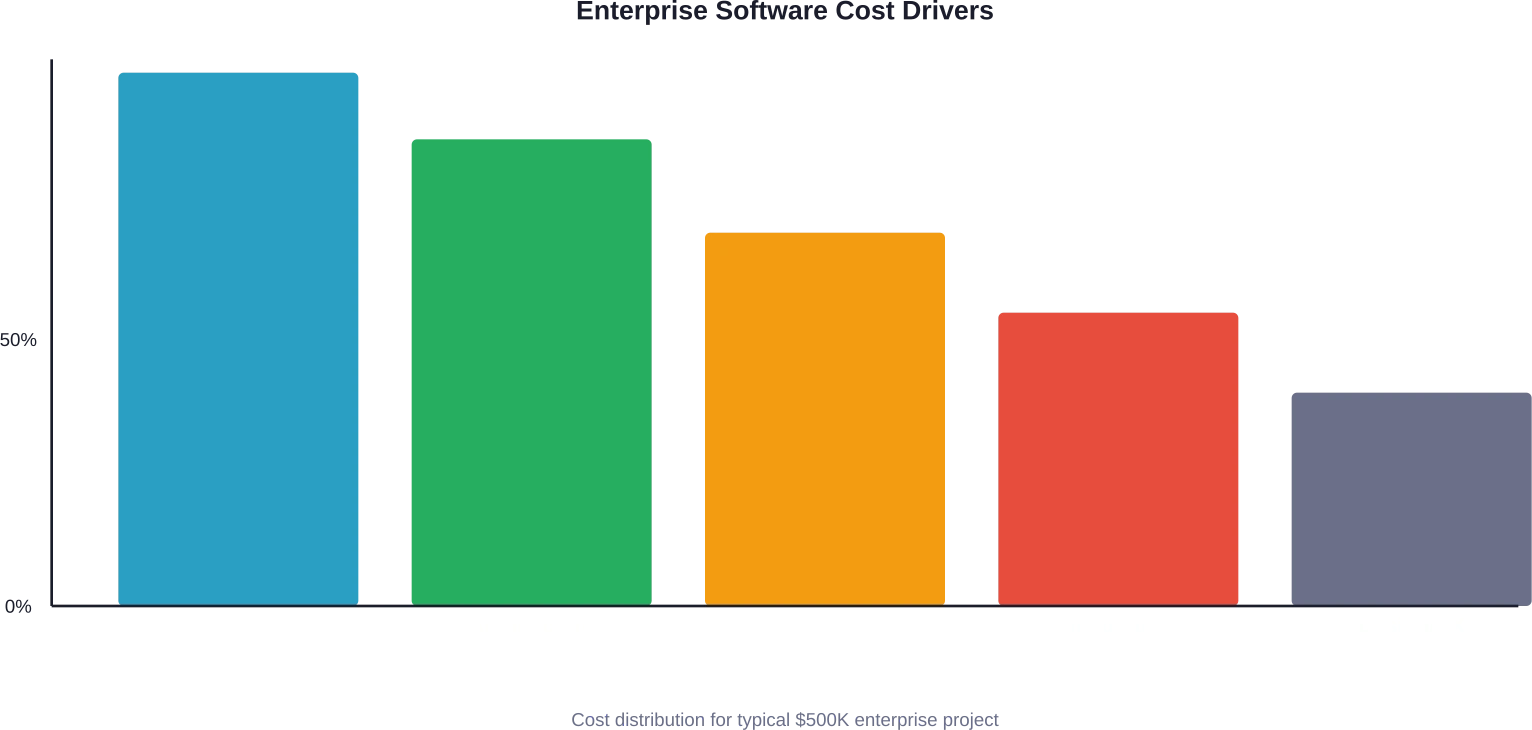
Team composition and hourly rates represent 40-50% of total costs. According to the U.S. Bureau of Labor Statistics, computer programmers earned a median of $98,670 per year in May 2024, while systems analysts earned a median annual wage of $103,790 in May 2024. Other major cost drivers include architectural complexity (20-25%), security and compliance requirements (15-20%), system integrations (10-15%), and UX design (5-10%). Project scope, timeline, and whether teams are in-house, agency-based, or offshore also significantly affect budgets.
Is custom development cheaper than buying off-the-shelf software?
Custom development costs more upfront but can become more economical over 3-5 years for organizations with specific needs. Off-the-shelf enterprise SaaS typically costs $50-$200 per user monthly ($60,000-$240,000 annually for 100 users), plus configuration and integration costs that add 50-100% in year one. Custom development provides ownership, eliminates recurring licensing fees, and offers complete flexibility. The break-even point typically arrives in years 3-5 depending on user count and customization requirements.
How do offshore development teams affect costs?
Offshore teams in Eastern Europe ($40-$80/hour), Latin America ($35-$70/hour), or Asia ($25-$50/hour) cost 40-70% less than North American teams ($100-$200/hour). However, effective savings typically reach only 30-50% after accounting for timezone coordination, communication overhead, and potential quality issues. Offshore works best for well-defined projects with minimal real-time collaboration needs. Nearshore options in Latin America provide better timezone alignment for North American companies.
What ongoing costs should we budget for after launch?
Annual maintenance typically consumes 15-25% of initial development costs. A $500,000 project requires $75,000-$125,000 annually for bug fixes, security patches, and minor enhancements. Additional ongoing expenses include hosting and infrastructure ($3,000-$60,000+ annually), third-party API fees ($1,000-$15,000 monthly), security audits ($15,000-$75,000 annually), and feature enhancements (varies by business needs). Total five-year cost of ownership is approximately 1.7-2x the initial development investment.
How long does enterprise software development take?
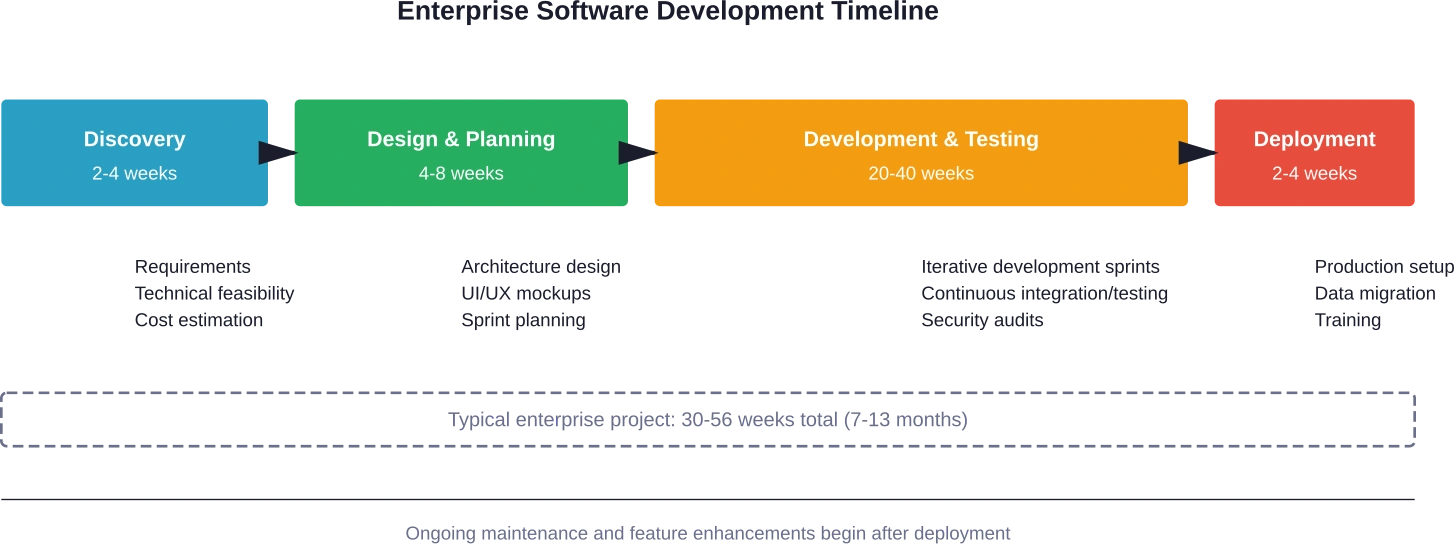
Typical enterprise projects span 9-15 months from requirements gathering through deployment. Basic tools take 3-6 months, mid-level platforms require 6-12 months, and complex systems need 12-24+ months. The timeline breaks down approximately as: discovery (2-4 weeks), design and planning (4-8 weeks), development and testing (20-40 weeks), and deployment (2-4 weeks). Aggressive timeline compression requires larger teams and typically increases costs by 40-70% due to coordination overhead.
Should we build an MVP first or go straight to the full system?
MVPs focusing on core functionality cost 40-60% less than full-featured systems and enable earlier market validation. This approach reduces risk by validating concepts before major investment, provides faster time-to-value, and allows course corrections based on real user feedback. MVP development typically takes 3-6 months and costs $75,000-$250,000 for enterprise applications. Teams can then iterate toward full functionality based on proven user needs rather than assumptions. This phased approach often results in better final products at lower total costs.
Making the Investment Decision
Enterprise software development represents significant capital allocation. The decision deserves thorough analysis.
Start by calculating total cost of ownership, not just initial development. Include five years of maintenance, hosting, security, and enhancement costs. Compare that figure to off-the-shelf alternatives accounting for licensing, configuration, and integration expenses.
Evaluate competitive advantage. Does custom software enable unique capabilities competitors can't match? If so, development costs become strategic investments rather than discretionary expenses.
Consider implementation risk. Organizations without strong technical leadership face higher risks with complex custom development. In those cases, proven SaaS platforms might offer safer paths forward.
Assess organizational readiness. Successful custom software requires committed stakeholders, available subject matter experts, and executive support throughout multi-month projects. Without these prerequisites, initiatives often stall or deliver suboptimal results.
Getting Started: Next Steps
Organizations ready to pursue enterprise software development should follow a structured approach.
First, document business requirements and pain points. Clear problem statements enable accurate scoping and cost estimation. Involve end users early—their input prevents building solutions nobody wants.
Second, request proposals from 3-5 qualified development partners. Look for relevant industry experience, technical expertise in required technologies, and cultural fit with your organization. Check references thoroughly.
Third, invest in proper discovery. Allocate $20,000-$50,000 for requirements analysis, technical architecture planning, and detailed cost estimation before committing to full development.
Fourth, start with an MVP when feasible. Validate core assumptions before investing in comprehensive feature sets. This approach reduces risk and often leads to better outcomes.
Finally, establish clear governance. Assign an executive sponsor, form a steering committee, and create decision-making processes for scope changes. Projects with strong governance deliver on time and within budget far more frequently than those without clear leadership.
Enterprise software development demands significant investment, but it enables competitive advantages, operational efficiencies, and capabilities impossible with off-the-shelf solutions. Organizations that approach development strategically—with realistic budgets, experienced partners, and clear requirements—consistently achieve strong returns on their investments.
The key lies in treating software development as a strategic initiative requiring executive attention, not a technical project delegated entirely to IT departments. When business leadership engages actively throughout planning and development, projects deliver software that genuinely transforms operations and drives measurable business value.


