

Ecommerce Website Development Cost 2026: Real Pricing

Overview: Building an ecommerce website in 2026 costs anywhere from $3,000 for template-based stores to over $150,000 for enterprise custom builds. Platform fees, design, development, apps, and ongoing maintenance all factor into total investment. Most businesses starting out spend $5,000–$15,000 initially, with $200–$500 in monthly operating costs.
Planning to launch an online store? The cost question hits everyone first. And the answer frustrates most people because it's genuinely complicated.
Here's the thing though—ecommerce website development costs in 2026 aren't mysterious once the components break down clearly. The range spans from a few thousand dollars to six figures, but that's not helpful without context.
This guide walks through actual pricing for different business stages, platform options, and feature sets. Real numbers, not vague estimates.
What Actually Determines Ecommerce Website Development Cost
Several factors push costs up or down significantly. The platform choice matters most—going with Shopify versus custom Laravel development creates entirely different budget realities.
Business size and revenue targets play a major role. A startup testing product-market fit needs different infrastructure than an established brand processing thousands of daily orders.
Feature complexity directly impacts development time. Basic product catalogs cost less than sophisticated systems with dynamic pricing, multi-vendor marketplaces, or custom configurators.
Design requirements add substantial variation. Using a pre-built theme runs $0–$500, while custom design work starts around $3,000 and scales to $20,000+ for premium branding.
Integration needs change the equation too. Connecting to existing ERP systems, custom CRMs, or specialized logistics platforms requires developer hours that template solutions can't provide.
According to London Business School research, platforms like Shopify enable entrepreneurs to launch scalable online ventures "for just a few hundred dollars, and zero knowledge of coding."
Ecommerce Website Cost by Business Type
Different business stages require different investment levels. Here's how costs map to actual business scenarios.
|
Business Stage |
Initial Development Cost |
Monthly Operating Cost |
Platform Type |
|---|---|---|---|
|
Startup (testing concept) |
$3,000 – $8,000 |
$100 – $300 |
Shopify Basic, WooCommerce |
|
Small Business (established) |
$8,000 – $25,000 |
$300 – $800 |
Shopify, BigCommerce Standard |
|
Growing Business ($500K+ revenue) |
$25,000 – $75,000 |
$800 – $2,500 |
Shopify Plus, Magento, custom builds |
|
Enterprise (multi-channel) |
$75,000 – $250,000+ |
$2,500 – $10,000+ |
Custom development, headless commerce |
These ranges include design, development, initial setup, and essential integrations. They don't include inventory, marketing, or product photography.
Startups benefit most from template-based solutions. The U.S. Small Business Administration has promoted webinars on platforms like Shopify specifically for entrepreneurs looking to establish their brand online without design skills.
Small businesses often outgrow basic plans within 12–18 months. Budget for platform upgrades as transaction volume increases.
Growing businesses hit a critical decision point around $500K in annual revenue—stick with platform solutions or invest in custom development for competitive advantages.

Calculate Your Ecommerce Website Development Cost
Ecommerce website cost depends on catalog size, payment integrations, custom features, and backend logic. OSKI Solutions defines store architecture and calculates development effort accordingly. The estimate includes checkout logic, integrations, and testing. This gives you a realistic online store budget.
Ready to Plan Your Ecommerce Website Budget?
Talk with OSKI Solutions to:
- define product catalog and features
- estimate payment and integration effort
- receive a structured e commerce cost estimate
👉 Request an e commerce website development quote from OSKI Solutions.
Build an Ecommerce Website That Sells
We develop high-performance ecommerce websites optimized for conversions, seamless checkout, and scalable growth.
Platform-Specific Cost Breakdown
Each major ecommerce platform has distinct pricing structures. Understanding these differences helps match solutions to budget realities.
Shopify Cost Structure
Shopify dominates the small-to-medium business ecommerce space with predictable monthly pricing.
The Basic plan runs $29/month with 2.9% + 30¢ transaction fees. This works for stores doing under $50K annually. Theme costs add $0 (free themes) to $500 (premium themes). Essential apps typically add $50–$150/month.
The Shopify plan costs $79/month with reduced fees of 2.6% + 30¢. Most businesses migrate here once monthly sales exceed $10K. Better reporting and more staff accounts justify the upgrade.
Advanced Shopify at $299/month drops fees to 2.4% + 30¢ and adds advanced report building. This tier makes sense above $100K in monthly sales.
Shopify Plus starts at $2,000/month with negotiated transaction rates. Enterprise features include dedicated support, unlimited API calls, and checkout customization. Most Plus merchants have crossed $1M in annual revenue.
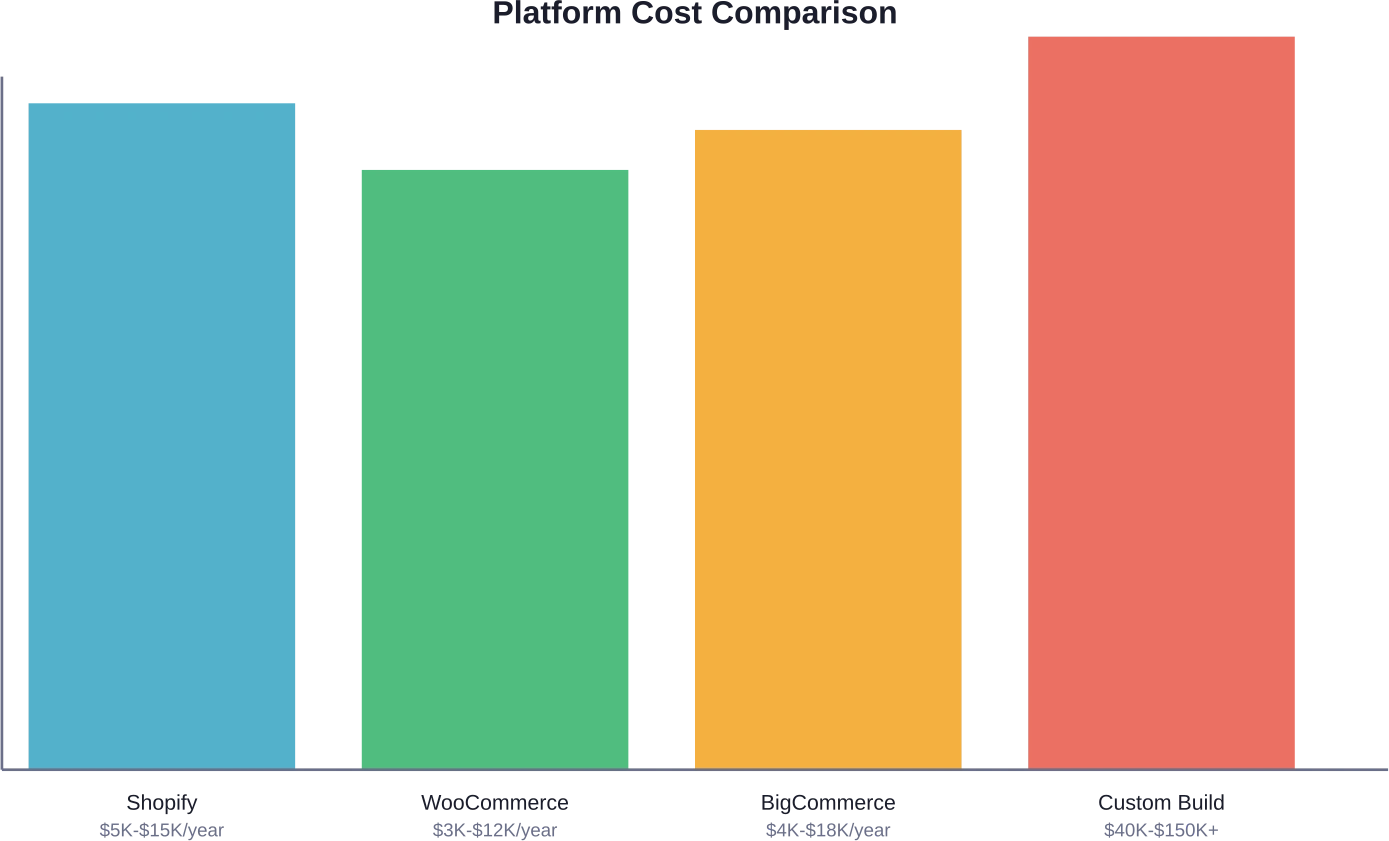
Total first-year costs for a typical Shopify store range from $5,000 to $15,000 including setup, theme customization, apps, and monthly fees.
WooCommerce Cost Reality
WooCommerce appears free but requires hosting, security, and extensions that add up quickly.
Hosting costs $5–$250/month depending on traffic. Shared hosting works initially but performance degrades above 1,000 monthly visitors. Managed WordPress hosting from providers like WP Engine starts around $30/month.
SSL certificates cost $0–$200/year. Many hosts include free certificates, but some charge separately.
Essential extensions add $200–$800 initially. Payment gateways, shipping calculators, and inventory management typically require paid plugins.
Development for customization runs $50–$150/hour. Even basic theme modifications often need 10–20 developer hours.
Total first-year WooCommerce costs typically land between $3,000 and $12,000 for comparable functionality to Shopify—but require more technical knowledge to maintain.
BigCommerce Pricing
BigCommerce positions between Shopify and custom solutions with no transaction fees.
Standard at $29/month allows up to $50K in annual sales. The fee-free model saves money compared to Shopify for stores with healthy margins.
Plus at $79/month increases the threshold to $180K annually and adds customer groups and stored credit cards.
Pro at $299/month extends to $400K in annual sales with Google customer reviews and custom SSL.
Enterprise at $1,500+/month provides unlimited sales thresholds with custom pricing and priority support.
The revenue caps force upgrades that can feel arbitrary. A store doing $51K needs to jump from $29/month to $79/month immediately.
Custom Development Costs
Custom ecommerce builds using Laravel, Node.js, or similar frameworks start around $40,000 and frequently exceed $150,000.
Developer rates range from $75–$200/hour in the U.S. A basic custom platform requires 400–800 development hours minimum.
Design work adds $5,000–$25,000 depending on complexity and brand requirements.
Infrastructure costs run $200–$2,000/month for hosting, CDN, security, and monitoring.
Ongoing maintenance requires dedicated development resources—either in-house staff or retainer agreements with agencies.
Custom makes sense when competitive advantages require unique features that platforms can't deliver, or when transaction volumes make platform fees prohibitively expensive.
Detailed Cost Components Breakdown
Ecommerce websites consist of multiple cost layers that stack together. Understanding each component helps build accurate budgets.
Domain and Hosting
Domain registration costs $10–$30 annually for standard .com domains. Premium or short domains can run thousands, but most businesses use standard domains.
Hosting varies dramatically by platform. Shopify and BigCommerce include hosting in monthly fees. WooCommerce requires separate hosting from $5–$250/month based on traffic and performance needs.
Dedicated hosting for high-traffic custom builds runs $200–$2,000/month with managed services adding another $500–$3,000/month.
Design and User Experience
Free themes work for testing but often look generic. Premium themes cost $100–$500 and provide better starting points.
Custom theme modification by developers runs $2,000–$8,000 for medium complexity adjustments.
Fully custom design projects start at $5,000 and reach $25,000+ for sophisticated brand experiences with custom illustrations, animations, and interactive elements.
Mobile responsiveness is now standard, but testing across devices still requires time. Budget 20–30 hours for thorough device and browser testing.
Core Development Work
Platform setup and configuration takes 8–20 hours for straightforward implementations.
Product catalog development depends on SKU count. Simple catalogs with under 100 products need minimal work. Complex catalogs with variants, custom fields, or dynamic attributes require 40+ hours.
Payment gateway integration is straightforward for Stripe or PayPal but complex for custom solutions or international payment processors.
Shipping logic grows complicated fast. Flat-rate shipping works easily. Real-time carrier rates, dimensional weight calculations, or multi-warehouse logic require custom development.
Essential Extensions and Apps
Most ecommerce sites need 5–15 paid apps or extensions. Typical costs:
Email marketing integration: $0–$300/month depending on subscriber count. Omnisend and Klaviyo dominate this space with pricing tied to contact lists.
Inventory management: $50–$500/month for systems that sync across channels and track stock levels.
Customer reviews: $0–$100/month. Free options exist but paid solutions offer better moderation and display options.
Abandoned cart recovery: $0–$200/month. Platform-dependent features often handle basics, but dedicated tools provide better conversion rates.
SEO optimization: $0–$100/month for plugins that improve meta tags, sitemaps, and structured data.
Security and Compliance
SSL certificates cost $0–$200/year. Most platforms include these now, but custom implementations may need separate certificates.
PCI compliance is mandatory for processing payments. Platform solutions handle this automatically. Custom builds need annual audits costing $5,000–$50,000 depending on transaction volume.
Security monitoring and malware protection cost $20–$200/month for automated services.
GDPR compliance tools for cookie consent and data management add $0–$100/month depending on traffic.
Content Creation
Product photography represents a major often-overlooked cost. Professional product shots run $25–$150 per product depending on complexity.
Lifestyle and brand photography costs $500–$5,000/day for professional shoots.
Product descriptions written by professionals cost $10–$50 per product. This matters more than most businesses realize for conversion rates.
Video content adds $500–$10,000 depending on production quality and length.
Ongoing Monthly and Annual Costs
Launch costs represent only part of the financial picture. Monthly operating expenses continue indefinitely.
|
Cost Category |
Startup Range |
Small Business Range |
Growing Business Range |
|---|---|---|---|
|
Platform fees |
$29 – $79 |
$79 – $299 |
$299 – $2,000+ |
|
Apps and extensions |
$50 – $150 |
$150 – $400 |
$400 – $1,500 |
|
Payment processing |
2.9% + 30¢ |
2.6% + 30¢ |
2.4% + 30¢ or less |
|
Hosting (if separate) |
$5 – $30 |
$30 – $150 |
$150 – $2,000 |
|
Security and backups |
$10 – $50 |
$50 – $150 |
$150 – $500 |
|
Maintenance and updates |
$0 – $200 |
$200 – $800 |
$800 – $5,000 |
Payment processing fees become the largest ongoing cost for successful stores. A store doing $50,000/month pays roughly $1,450–$1,500 in processing fees alone.
Transaction fee differences matter significantly at scale. The gap between 2.9% and 2.4% equals $250/month on $50K in sales—$3,000 annually.
Software subscriptions creep upward as businesses add tools. What starts as $100/month often reaches $400–$600/month within two years as email lists grow and feature needs expand.
Marketing Technology Costs
Marketing tools sit adjacent to ecommerce development but deserve mention because they're functionally required for success.
According to guidelines from the University of Rhode Island, small businesses are advised to expect to spend $1,000–$2,000/month for local business trying to generate steady website traffic or leads.
Email marketing platforms scale with contacts. Expect $20–$50/month initially, growing to $200–$600/month as lists reach 10,000+ subscribers.
Social media advertising represents a separate budget line but integrates closely with ecommerce operations.
Analytics tools beyond basic Google Analytics cost $50–$500/month for enhanced tracking, heat mapping, and conversion funnel analysis.
Hidden Costs That Catch Businesses Off Guard
Several expense categories surprise ecommerce business owners after launch. Planning for these prevents budget shocks.
Transaction fees add up faster than expected. Many founders calculate platform costs but forget to model payment processing at scale. On $500K in annual revenue, processing fees alone exceed $14,000.
App subscription creep happens gradually. Businesses add one tool at a time, each solving a specific problem. Twelve months later, monthly SaaS costs have doubled from launch.
Custom feature requests emerge once the site goes live. Users request features that seemed unnecessary during planning. Budget $5,000–$15,000 for first-year enhancements.
Mobile optimization issues surface post-launch despite responsive themes. Real-world testing reveals checkout friction that requires developer attention.
International expansion costs get underestimated. Multi-currency support, translation, international shipping logic, and tax compliance require significant development work.
Integration maintenance breaks periodically. Third-party APIs change, requiring updates to connectors. Budget 10–20 hours annually for integration maintenance.
Performance optimization becomes necessary as product catalogs grow. Sites slow down with 1,000+ products without dedicated performance work costing $3,000–$10,000.

Cost Optimization Strategies
Smart businesses reduce development costs without sacrificing essential functionality. Several approaches work consistently.
Start Lean, Scale Gradually
Launch with minimum viable features rather than building everything upfront. Get revenue flowing before investing in advanced capabilities.
Use free or low-cost tools initially. Upgrade when growth justifies the expense. Many apps offer free tiers adequate for early-stage businesses.
Prioritize features by revenue impact. Build checkout optimization before custom product configurators. Focus spending where conversion improvements are measurable.
Template Customization Over Full Custom
Premium themes provide 70–80% of needed functionality at 5% the cost of custom development. Strategic customization hits brand requirements without full rebuilds.
Many agencies offer theme customization packages for $3,000–$8,000 that deliver custom-looking sites at fraction of full custom costs.
Negotiate Platform Costs
Enterprise platform pricing is negotiable once revenue scales. Shopify Plus, BigCommerce Enterprise, and similar tiers offer flexible pricing for established businesses.
Transaction fee negotiations become possible at volume. Processing $100K+/month creates leverage for rate reductions.
Annual Billing Discounts
Most SaaS tools offer 10–20% discounts for annual prepayment. This adds up across 10–15 subscriptions.
Platform annual billing typically saves two months of fees—$158 on a $79/month plan.
Developer Selection Strategy
Offshore development reduces hourly rates to $25–$75/hour versus $100–$200 domestically. Quality varies significantly, so thorough vetting matters.
Freelancers cost less than agencies but require more project management. This works when internal staff can coordinate work effectively.
Development agencies provide full service but charge premium rates. Best for businesses without technical staff.
When Custom Development Makes Financial Sense
Platform solutions work for most businesses, but specific scenarios justify custom development investment.
Unique business models that don't fit standard ecommerce patterns need custom builds. Subscription boxes with complex customization, made-to-order manufacturing, or multi-vendor marketplaces often outgrow platforms.
Transaction volume creates crossover points where platform fees exceed custom development costs. Processing $2M+ annually means $50K+ in platform fees—custom builds with lower processing rates recoup investments quickly.
Competitive differentiation through unique features can't happen on platforms where everyone uses similar tools. Brands building sustainable competitive advantages often need proprietary technology.
Complex integrations with existing business systems sometimes require custom development. ERP connections, custom logistics systems, or specialized manufacturing interfaces may not work through platform APIs.
According to MIT research on digital platform designs, companies that effectively manage platform architectures show above-average financial performance. But this applies to businesses with sufficient scale to leverage platform advantages.
Regional Development Cost Variations
Geographic location significantly impacts development costs due to wage differences.
North American developers (U.S. and Canada) charge $100–$200/hour for ecommerce work. Quality tends to be high with strong communication, but costs add up quickly.
Western European developers run $75–$150/hour with similar quality standards to North America.
Eastern European developers cost $40–$100/hour and have gained strong reputations for ecommerce development. Countries like Poland, Ukraine, and Romania produce skilled developers at mid-range pricing.
Asian developers charge $25–$75/hour with significant quality variation. Established firms in India and the Philippines deliver solid work, while untested providers carry higher risk.
Latin American developers price at $30–$80/hour and benefit from timezone overlap with North American clients.
Remote work has reduced but not eliminated these gaps. Top talent commands premium rates regardless of location.
Calculating Total Cost of Ownership
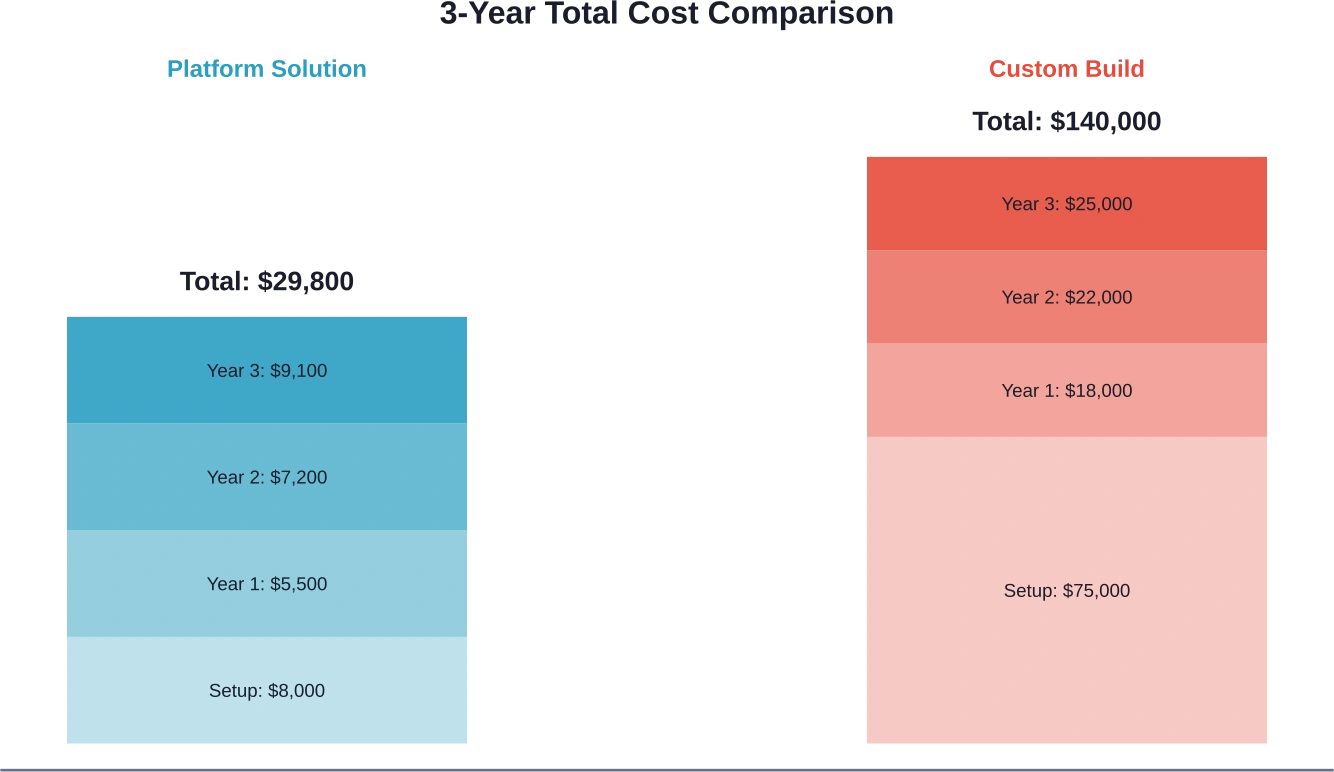
True ecommerce website costs span three to five years, not just launch expenses. Total cost of ownership includes all spending through the useful life of the platform.
For a typical small business on Shopify:
Initial development and setup: $8,000
- Year 1 operating costs: $5,500 (platform, apps, minor enhancements)
- Year 2 operating costs: $7,200 (platform upgrade, growing app costs)
- Year 3 operating costs: $9,100 (additional features, performance optimization)
Three-year total cost of ownership: $29,800
Compare this to a custom build:
Initial development: $75,000
- Year 1 operating costs: $18,000 (hosting, maintenance, security)
- Year 2 operating costs: $22,000 (enhancements, performance work)
- Year 3 operating costs: $25,000 (ongoing development, scaling infrastructure)
Three-year total cost of ownership: $140,000
The custom build costs 4.7× more over three years. It only makes financial sense if it generates substantially more revenue or reduces other costs sufficiently to justify the investment.
Choosing the Right Development Partner
Development partner selection impacts both costs and outcomes significantly. Several factors separate strong choices from poor ones.
Portfolio review matters most. Look for projects similar in scope and complexity to your needs. An agency that builds enterprise marketplaces may not be cost-effective for a 50-product store.
Technical expertise in your chosen platform is non-negotiable. Shopify specialists shouldn't build custom Laravel applications and vice versa.
Communication quality predicts project success better than technical skills. Responsive, clear communication prevents expensive misunderstandings.
Project management processes separate professional operations from amateur hour. Ask about sprint planning, status updates, and change management procedures.
Pricing transparency matters. Fixed-bid projects work for well-defined scopes. Hourly billing suits exploratory or evolving requirements. Avoid agencies that can't explain their pricing model clearly.
Post-launch support availability prevents situations where launch partners disappear when bugs surface.
ROI Considerations and Break-Even Analysis
Ecommerce website costs should be evaluated against revenue potential, not just absolute dollar amounts.
Calculate break-even based on average order value and margin. A store with $75 average order value and 40% margin generates $30 profit per transaction. An $8,000 website requires 267 orders to break even on initial investment.
According to Statista's eCommerce - Worldwide market forecast, revenue is projected to reach US$3.89tn in 2026, with expected annual growth rate (CAGR 2026-2030) of 6.27%, resulting in a projected market volume of US$4.96tn by 2030. The market opportunity is substantial for businesses that execute well.
Time-to-revenue matters significantly. Platform solutions launch faster—typically 4–8 weeks versus 3–6 months for custom builds. Earlier revenue generation impacts overall ROI.
Conversion rate improvements justify website investments. Professional design and optimized checkout flows increase conversion rates by 20–50% compared to basic implementations. This compounds over time.
Customer lifetime value multiplies initial transaction value. Ecommerce platforms with strong email marketing and retention features increase repeat purchase rates, improving returns on website investment.
Future-Proofing Your Ecommerce Investment
Building for tomorrow's needs prevents expensive rebuilds. Several considerations help websites scale with business growth.
Platform selection should account for growth trajectories. A business planning to scale to $5M+ in revenue within three years should skip entry-level platforms and invest in more robust solutions initially.
Mobile-first design isn't optional anymore. Mobile commerce continues growing—designs must work flawlessly on phones first, desktops second.
API-first architectures enable future integrations without platform limitations. Headless commerce separates frontend and backend, allowing flexibility as needs evolve.
Multi-channel capability matters increasingly. Businesses sell across websites, marketplaces, social media, and physical locations. Platform choice should support omnichannel commerce.
International expansion readiness includes multi-currency support, translation capabilities, and tax compliance tools—even if not needed immediately.
Frequently Asked Questions
How much does it cost to build a basic ecommerce website in 2026?
A basic ecommerce website costs $3,000–$10,000 for initial development using platform solutions like Shopify or WooCommerce. This includes setup, theme customization, essential apps, and initial product catalog configuration. Monthly operating costs add $150–$400 for platform fees, apps, and hosting. Basic sites work well for startups with under 100 products testing market viability.
What's the difference between Shopify and custom development costs?
Shopify-based sites typically cost $5,000–$15,000 initially with $200–$600 in monthly expenses. Custom development starts at $40,000–$75,000 with $1,500–$5,000 in monthly operating costs. Custom builds provide more flexibility and unique features but require significantly larger budgets and longer development timelines. Most businesses under $1M in annual revenue benefit more from platform solutions.
What hidden costs should I budget for?
Budget for transaction fees (2.4%–2.9% of revenue), app subscription increases ($100–$300 more than planned within 12 months), post-launch feature requests ($5,000–$15,000 first year), performance optimization ($3,000–$8,000 as catalogs grow), and integration maintenance (10–20 developer hours annually). These commonly surprise business owners after launch.
How much do ongoing maintenance and updates cost?
Platform-based sites require $200–$800/month for maintenance including app updates, security monitoring, content changes, and minor enhancements. Custom builds need $800–$5,000/month for ongoing development, security patches, performance monitoring, and feature additions. Maintenance costs typically equal 15–20% of initial development costs annually.
When does custom development make more sense than platforms?
Custom development makes financial sense when transaction volumes exceed $2M annually (platform fees become prohibitive), business models don't fit standard ecommerce patterns (complex customization, multi-vendor marketplaces), competitive advantages require unique proprietary features, or complex integrations with existing business systems need capabilities beyond platform APIs.
What's the typical timeline for different types of ecommerce projects?
Template-based platforms launch in 4–8 weeks including design, setup, and testing. Semi-custom builds with theme modifications take 8–12 weeks. Fully custom ecommerce websites require 3–6 months for design, development, testing, and launch. Enterprise implementations often extend to 6–12 months with complex integrations and custom features.
How should I calculate ROI on ecommerce website investment?
Calculate break-even using profit per transaction multiplied by transaction count needed to recoup investment. Factor in conversion rate improvements (typically 20–50% better with professional design), time-to-revenue differences between platforms and custom builds, and customer lifetime value from repeat purchases. Most well-executed ecommerce sites achieve positive ROI within 12–18 months for platform builds, 18–36 months for custom development.
Making the Investment Decision
Ecommerce website development represents a significant business investment that requires careful analysis of needs, budget, and growth plans.
Start by defining business objectives clearly. Revenue targets, product complexity, and competitive positioning all influence appropriate technology choices.
Match platform capabilities to business stage. Startups benefit from low-cost platform solutions that enable quick market testing. Growing businesses need scalability. Established brands often require custom features for differentiation.
Budget realistically for three-year costs, not just launch expenses. Ongoing costs often exceed initial development within two years.
Prioritize revenue-generating features over nice-to-have additions. Checkout optimization, mobile performance, and payment flexibility drive sales more than fancy animations.
Plan for growth but launch lean. Overbuilding wastes money on features customers don't use. Start with core functionality and add capabilities as revenue validates investments.
According to academic sources on ecommerce trends, a staggering 95% of all purchases are forecast to occur through ecommerce platforms by 2040. The digital commerce transformation accelerates continuously. Businesses that invest strategically in ecommerce capabilities position themselves for long-term success.
The ecommerce market continues expanding—according to Statista, the eCommerce market is projected to reach US$4.96tn by 2030 with 6.27% annual growth. Opportunity exists for businesses at every scale.
But success requires more than just building a website. Strategic investment in the right technology foundation, matched appropriately to business stage and budget, creates sustainable competitive advantages.
Take time to evaluate options thoroughly. Rushed technology decisions create expensive problems later. But analysis paralysis prevents revenue generation. Find the balance that moves your business forward.
Whether spending $5,000 on a Shopify store or $150,000 on custom development, make decisions based on business fundamentals, realistic budgets, and clear ROI expectations. The right ecommerce website investment pays returns for years when planned strategically.


