

Digital Transformation in Utilities: 2026 Guide

Quick Summary: Digital transformation in utilities modernizes aging infrastructure through smart grids, IoT sensors, AI analytics, and cloud platforms to improve operational efficiency, enhance customer service, and integrate renewable energy sources. The Department of Energy reports America's electric grid spans over 600,000 miles of transmission lines connecting 9,200 generating units. ABI Research forecasts US$713 billion in grid digitalization spending over the next six years as utilities transition from reactive maintenance to predictive, data-driven operations.
The utility sector stands at a crossroads. Decades of legacy infrastructure meet mounting pressure for efficiency, sustainability, and customer satisfaction. Digital transformation isn't just a buzzword here—it's the survival strategy for modern utilities.
According to the Department of Energy, America's electric grid connects more than 11,000 electric generating units having over 1.2 million megawatts of generating capacity. But that same grid faces vulnerabilities to outages, cybersecurity threats, and the challenge of integrating distributed energy resources.
ABI Research forecasts that energy companies will spend US$713 billion on grid digitalization over the next six years. That's not speculative investment—it's utilities responding to real operational pressures and customer expectations.
What Digital Transformation Actually Means for Utilities
Digital transformation in the utilities sector isn't about installing a few sensors and calling it a day. It's a comprehensive reimagining of how utilities collect data, manage assets, interact with customers, and operate the grid.
The process involves connecting data, assets, and people inside cohesive workflows. Think foundational enterprise systems, real-time monitoring, and intelligent forecasting working together rather than in isolated silos.
Smart grid technology represents a class of innovations bringing utility electricity delivery systems into the 21st century. These technologies enable two-way communication between utilities and customers, automated fault detection, and dynamic load balancing.
The Core Technologies Driving Change
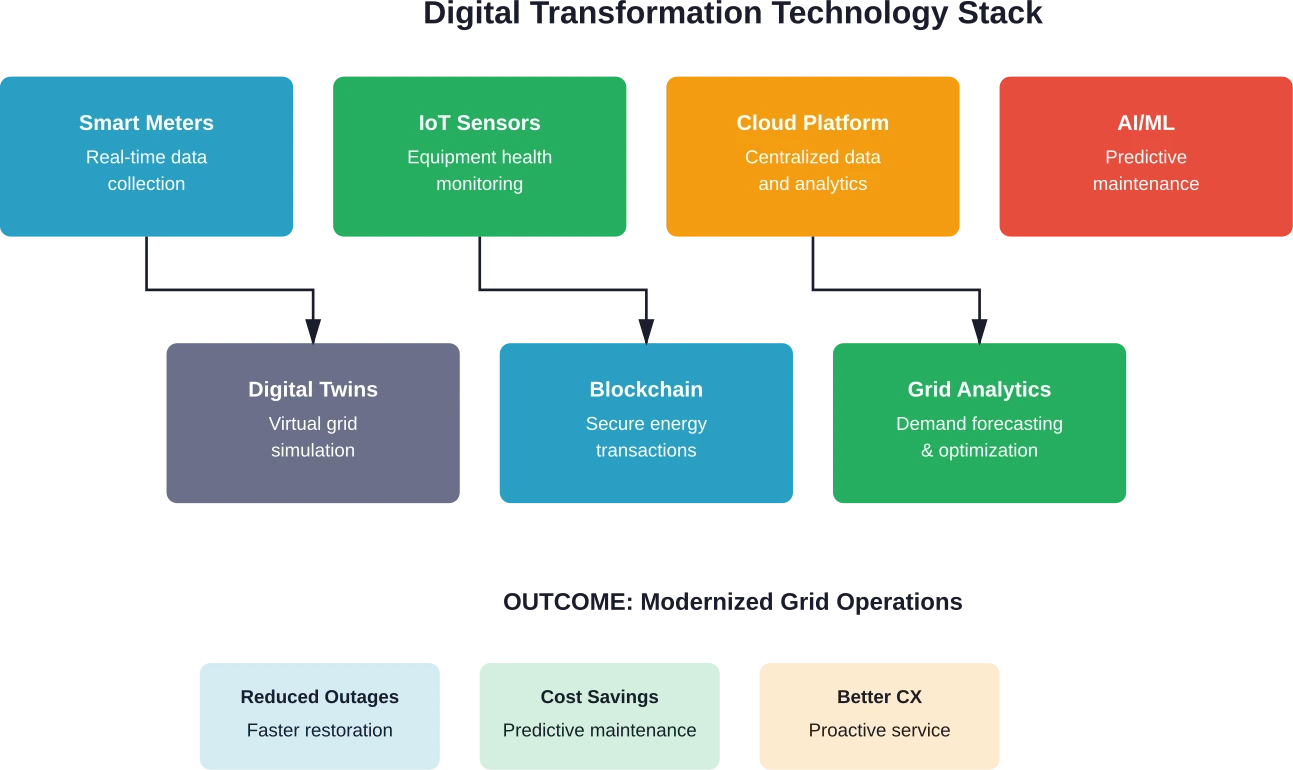
Several key technologies power digital transformation in utilities:
- Smart Meters and Advanced Metering Infrastructure (AMI): Replace manual meter reading with real-time consumption data
- IoT Sensors: Monitor equipment health, environmental conditions, and grid performance across the distribution network
- Cloud Platforms: Centralize data storage and enable scalable computing for analytics
- AI and Machine Learning: Predict equipment failures, optimize energy distribution, and forecast demand
- Digital Twins: Create virtual replicas of physical infrastructure for simulation and planning
- Blockchain: Enable secure transactive energy markets and prevent transaction repudiation
Key Drivers Pushing Utilities Toward Digital
Multiple forces converge to make digital transformation essential rather than optional for utilities.
Aging Infrastructure and Maintenance Costs
Much of America's grid infrastructure dates back decades. Reactive maintenance—fixing things after they break—drains resources and causes customer disruptions.
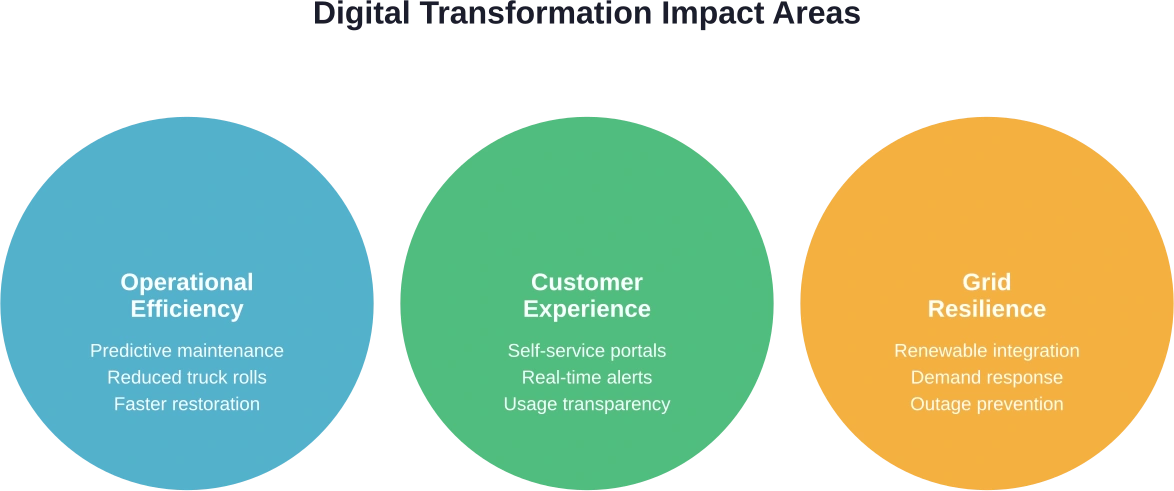
Digital sensors enable condition-based monitoring. Equipment communicates its health status, allowing utilities to schedule maintenance before failures occur. That shift from reactive to predictive saves money and improves reliability.
Renewable Energy Integration
Solar panels and wind turbines don't generate power on predictable schedules like coal or natural gas plants. Integrating these distributed energy resources requires sophisticated forecasting and real-time grid balancing.
Digital systems manage the complexity. IEEE research highlights how grid-enhancing technologies like Dynamic Line Rating and advanced power flow control optimize renewable integration across regions like the Southwest Power Pool.
Customer Expectations
Modern customers expect digital experiences. Online account management, usage tracking, outage notifications—these aren't luxury features anymore.
Evidence shows digital engagement impacts payment behavior. One study by a US-based power provider found customers receiving e-bills were about 20% more likely to make on-time payments and about 60% less likely to call customer service than those receiving paper bills.
Regulatory Pressure and Decarbonization Goals
The United States has set a goal to reach 100% carbon pollution-free electricity by 2035. Achieving those goals requires digital systems that can manage complexity at scale.
|
Challenge |
Traditional Approach |
Digital Solution |
|---|---|---|
|
Equipment failure |
Reactive repairs after outages |
Predictive maintenance using IoT sensors |
|
Demand forecasting |
Historical averages and manual adjustments |
AI-powered real-time prediction models |
|
Outage management |
Customer calls to report problems |
Automated detection and crew dispatch |
|
Renewable integration |
Limited distributed generation capacity |
Smart inverters and dynamic grid balancing |
|
Customer service |
Phone calls and paper billing |
Self-service portals and mobile apps |
Real-World Applications Transforming Operations
Digital transformation manifests in concrete operational improvements across the utility value chain.
Smart Metering and AMI Networks
Advanced Metering Infrastructure replaces monthly manual meter reading with continuous, two-way communication. Utilities gain granular consumption data while customers see real-time usage.
This foundation enables time-of-use pricing, demand response programs, and instant outage detection. When meters stop communicating, utilities know about outages before customers call.
Virtual Substations and Automation
Traditional substations require on-site equipment and manual intervention for many processes. Virtual substations leverage software-defined networking and remote control capabilities.
Processes automate that previously required truck rolls. Configuration changes happen remotely. Costs drop while response times improve.
Digital Twins for Grid Planning
Digital twins create virtual replicas of physical grid infrastructure. Engineers test scenarios, model failures, and optimize configurations in simulation before implementing changes on live equipment.
IEEE research on digital twins for IoT-driven energy systems demonstrates how these virtual environments support better planning decisions and training simulations without risking actual infrastructure.
AI-Powered Grid Management
Artificial intelligence analyzes massive datasets from meters, sensors, weather systems, and market signals to optimize grid operations in real-time.
Machine learning models predict equipment failures days or weeks in advance. Generative AI assists operators with decision support during complex grid events. The technology becomes the brain behind smarter energy networks.
Challenges Slowing Digital Adoption
Despite compelling benefits, utilities face real obstacles implementing digital transformation.
Financial Investment Requirements
Grid modernization requires substantial capital. That US$713 billion forecast from ABI Research represents massive investments spread across thousands of utilities.
Financing becomes a critical challenge. Utilities must justify spending to regulators and rate payers while managing return-on-investment timelines that span decades.
Legacy System Integration
Utilities operate infrastructure built across different eras using incompatible standards. Integrating modern digital systems with decades-old equipment creates technical complexity.
Generally speaking, utilities need middleware solutions and careful migration strategies rather than wholesale replacement. That gradual approach extends timelines but reduces risk.
Cybersecurity Concerns
Connected infrastructure creates attack surfaces. The Department of Energy notes today's electric grid faces vulnerability to cybersecurity threats alongside physical risks.
Utilities must implement security-by-design principles, continuous monitoring, and incident response capabilities as they digitize operations.
Workforce Skills Gap
Traditional utility workers excel at electrical engineering and field operations. Digital transformation demands new skills: data science, software development, cybersecurity expertise.
Closing that gap requires training programs, strategic hiring, and partnerships with technology vendors who understand both domains.

Make Your Utility Systems Work Together Before You Build
Digital transformation in utilities often means connecting systems that were never designed to work together - billing, metering, field operations, customer platforms. The risk is jumping into development without a clear structure and ending up with fragmented systems.
OSKI Solutions helps define that structure first. They work with teams to map processes, plan integrations, and turn operational needs into a clear technical scope before development starts. Their experience covers custom software, cloud systems, and integration-heavy platforms built around real workflows.
With OSKI, you can:
- map utility workflows into system requirements
- plan integrations across legacy and new systems
- understand cost and timeline before development
If your systems don’t connect yet - start by figuring out what they should look like with OSKI Solutions.
Transform Utilities with Digital Innovation
Modernize utility operations with smart, scalable digital solutions. From grid management and IoT integration to analytics and automation, we help utility providers improve efficiency, reliability, and service delivery.
Building a Successful Digital Transformation Strategy
Utilities that succeed with digital transformation share common strategic approaches.
Start with Clear Business Objectives
Technology for its own sake delivers limited value. Successful transformations begin with specific business goals: reduce outage duration by X%, improve customer satisfaction scores, cut maintenance costs by Y%.
Those objectives guide technology selection and measure success objectively.
Prioritize Quick Wins
Research from the Electric Power Research Institute emphasizes identifying digital transformation quick wins—projects that deliver visible value quickly and build organizational momentum.
Smart meter deployments, customer portals, and automated outage detection often qualify as quick wins with measurable ROI.
Build Interoperable Foundations
Data siloes undermine digital transformation. Utilities need enterprise data platforms that aggregate information from meters, sensors, billing systems, and asset management tools.
Standardized data models and APIs enable applications to share information seamlessly. That interoperability multiplies the value of individual technology investments.
Partner with Experienced Vendors
Few utilities possess all needed expertise in-house. Strategic partnerships with technology providers who understand utility operations accelerate transformation while reducing risk.
Look for vendors with utility industry experience, proven implementations, and long-term support commitments rather than just technology features.
The Future of Digitally-Enabled Utilities
Current digital transformation efforts set the foundation for fundamentally different utility business models.
Transactive energy markets enabled by blockchain allow peer-to-peer energy trading. Customers with solar panels sell excess generation to neighbors automatically based on real-time pricing.
Virtual power plants aggregate thousands of distributed resources—batteries, electric vehicles, smart thermostats—to provide grid services that traditionally required central power stations.
Utilities evolve from commodity electricity providers to platform operators managing complex energy ecosystems. That transition requires the digital infrastructure being deployed today.
Frequently Asked Questions
What is digital transformation in the utility industry?
Digital transformation in utilities refers to adopting connected technologies like smart meters, IoT sensors, AI analytics, and cloud platforms to modernize grid operations, improve customer service, and integrate renewable energy sources. It replaces manual processes with automated, data-driven workflows.
How much are utilities investing in digital transformation?
According to ABI Research, energy companies will spend US$713 billion on grid digitalization over the next six years. Individual utility investments vary based on service territory size and current infrastructure maturity.
What are the main benefits of smart grid technology?
Smart grids enable real-time monitoring, automated outage detection, predictive maintenance, demand response programs, and renewable energy integration. Benefits include reduced outage durations, lower operational costs, improved customer satisfaction, and greater grid resilience.
What challenges do utilities face implementing digital transformation?
Major challenges include financing large infrastructure investments, integrating modern systems with legacy equipment, addressing cybersecurity risks, closing workforce skills gaps, and navigating regulatory approval processes for new technology deployments.
How does AI improve utility operations?
AI analyzes data from meters, sensors, and external sources to predict equipment failures before they occur, optimize power distribution in real-time, forecast energy demand accurately, and provide decision support during grid events. This shifts operations from reactive to predictive.
What are digital twins in utilities?
Digital twins are virtual replicas of physical grid infrastructure that enable utilities to simulate scenarios, test configuration changes, model failure conditions, and train personnel without risking actual equipment. IEEE research shows they improve planning decisions and operational safety.
How does digital transformation impact utility customers?
Customers gain access to self-service portals, real-time usage data, mobile apps, automated outage notifications, and time-of-use pricing options. Research shows customers using digital channels like e-billing are 20% more likely to pay on time and 60% less likely to call customer service.
Conclusion: The Digital Imperative
Digital transformation isn't optional for utilities anymore. Aging infrastructure, renewable energy integration, customer expectations, and regulatory requirements make modernization essential.
The utilities that thrive over the next decade will be those embracing digital technologies now—building smart grid foundations, implementing predictive analytics, and creating seamless customer experiences.
Start by identifying clear business objectives. Focus on quick wins that demonstrate value. Build interoperable data foundations. Partner with experienced vendors. And commit to the multi-year journey required for comprehensive transformation.
The grid of tomorrow takes shape through investments made today. Is your utility ready to lead that transformation?


