

Digital Transformation in Retail: 2026 Guide and Trends

Quick Summary: Digital transformation in retail is the strategic integration of digital technologies across all business operations to enhance customer experience, streamline processes, and remain competitive. According to the U.S. Census Bureau, e-commerce sales increased 5.3% in Q4 2025, while NRF data shows 40% of enterprise applications will include AI agents by end of 2026. Successful transformation requires focusing on customer data, omnichannel experiences, and employee enablement.
The retail industry just crossed a historic threshold. In the 2024 holiday season, in-store shopping remained the dominant channel, although online growth continued to outpace physical retail.
That's the paradox retailers face right now. Customers move fluidly between digital and physical channels, expecting seamless experiences everywhere. And retailers who can't deliver? They get left behind.
But here's the thing: digital transformation isn't about throwing technology at every problem. It's about strategic integration of digital tools to fundamentally reshape how retailers operate and serve customers.
What Is Retail Digital Transformation?
Retail digital transformation is the process of integrating digital technologies into every aspect of retail operations—from customer interactions to supply chain management. It fundamentally changes how retailers deliver value to customers and how they run their business.
This isn't just about building an e-commerce site or adding self-checkout kiosks. Real transformation rewires the entire business model.
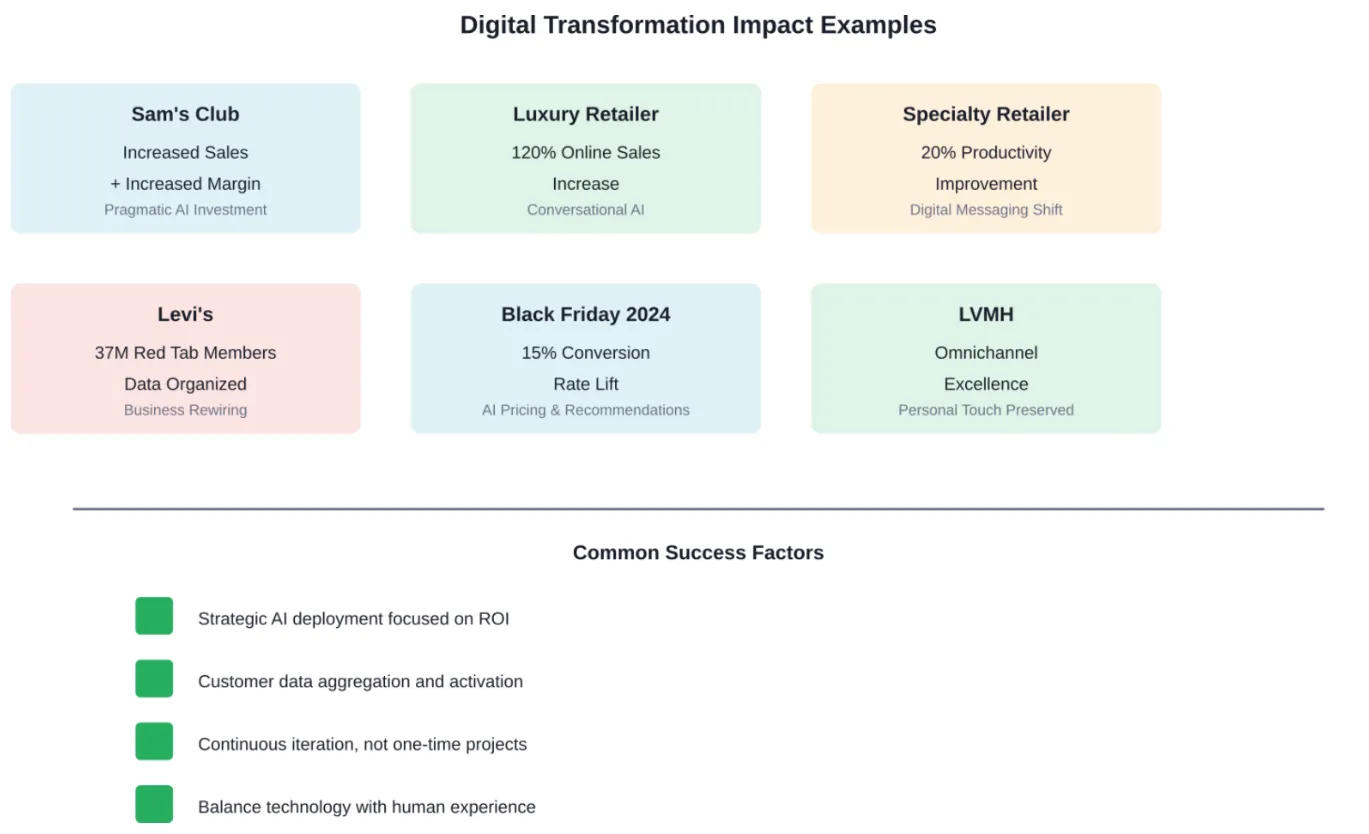
Look at what Levi's has been doing. For the last two years, Levi's has been aggregating and leveraging vast amounts of customer data—including to organize its 37 million Red Tab members—to evolve the product assortment and create a digital flagship experience. Jason Gowans, Levi's Chief Digital Officer, described it as "rewiring the whole business" with three value streams: consumer experiences, employee experiences, and platforms.
That's what genuine transformation looks like. It touches everything.
Why Digital Transformation Matters Now
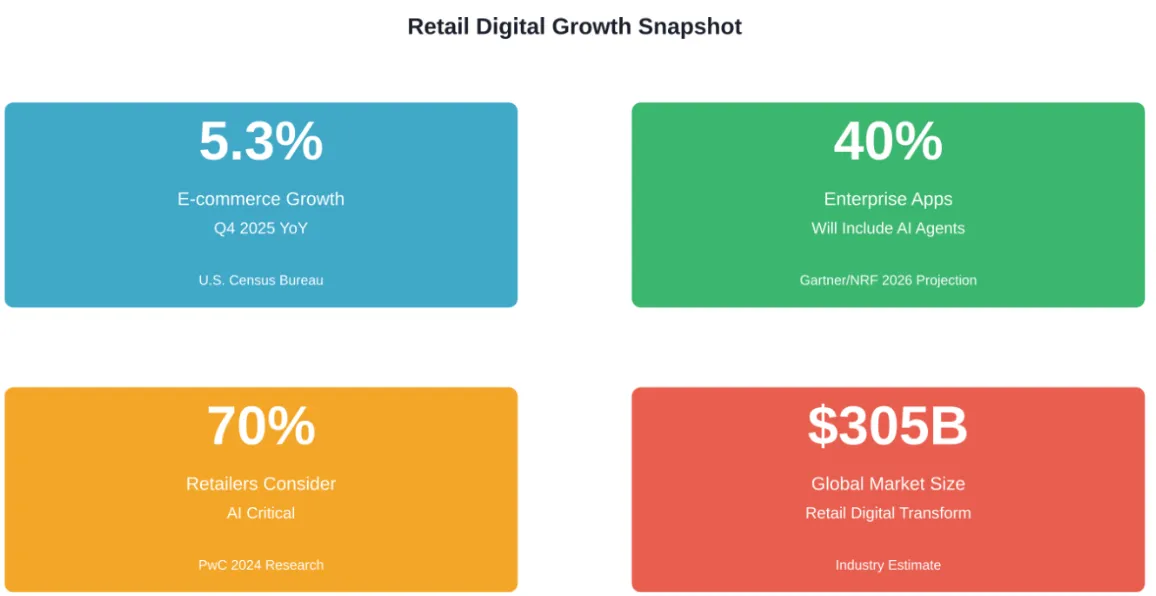
The numbers tell a compelling story. According to the U.S. Census Bureau, total retail sales for Q4 2025 were estimated at $1,900.5 billion, with e-commerce sales increasing 5.3% from Q4 2024 (±1.8%) while total retail sales increased 2.7% (±0.5%) in the same period.
E-commerce growth (5.3% YoY) is roughly double the rate of overall retail growth (2.7% YoY) in Q4 2025. Retailers who ignore digital channels are watching competitors capture increasingly larger market shares.
But there's more to it than e-commerce growth. According to PwC's 2024 U.S. Responsible AI Survey cited by NRF, 70% of retail organizations consider AI critical, with industry research indicating 65% see generative AI as essential to e-commerce operations.
The global market for retail digital transformation was estimated at US$305 billion, reflecting massive industry investment in staying competitive.
Key Technologies Driving Retail Transformation
Several technologies form the backbone of retail transformation. Let's break down what's actually working.
Artificial Intelligence and Machine Learning
AI is transforming how retailers connect with customers. According to industry data, 70% of retail organizations consider AI critical, with 65% seeing generative AI as essential to e-commerce operations.
Real-time recommendation engines and price optimization lifted Black Friday conversion rates by 15% in 2024, according to industry data. AI powers demand forecasting, inventory optimization, chatbots, and personalized marketing.
Gartner projects that by the end of 2026, 40% of enterprise applications will include task-specific AI agents, with agentic AI potentially generating nearly 30% of enterprise application software revenue by 2035 in a best-case scenario. These aren't hypothetical future scenarios—retailers are deploying these systems right now.
Data Analytics and Customer Intelligence
Data infrastructure has become table stakes. As PwC consumer markets leaders emphasized to NRF, strong data governance practices for collection, cleaning, labeling, and storage have never been more important.
Investment in data infrastructure and security measures is a baseline requirement to enter this space and maintain customer trust.
Starbucks provides a strong example. According to Deb Hall Lefevre, Executive Vice President and Chief Technology Officer of Starbucks, the company is leveraging architecture, data, and business processes to create value through digital transformation. The focus wasn't just collecting data—it was organizing and activating it.
Omnichannel Integration
Customers don't think in channels. They expect to research online, buy in-store, return via app, and get help wherever it's convenient.
LVMH demonstrated how luxury brands balance personalization with omnichannel excellence. At NRF 2026, company leaders discussed using technology to support seamless experiences across touchpoints while maintaining the personal touch luxury customers expect.
Successful omnichannel strategies require unified inventory visibility, consistent pricing, integrated customer profiles, and seamless fulfillment options.

Build Your Retail System Around How You Actually Sell
Digital transformation in retail is not just about launching new channels - it is about connecting inventory, sales, customer data, and operations into one working system. Without that, tools stay disconnected and hard to manage.
OSKI Solutions helps structure this before development starts. They work with teams to define how systems should connect, what needs to be built, and how data flows across platforms. Their experience includes e-commerce platforms, integrations, and custom software that supports real retail workflows.
With OSKI, you can:
- map retail operations into clear system requirements
- plan integrations across sales channels and tools
- understand cost and scope before building
If your retail tech stack feels disconnected - start by figuring out the system first with OSKI Solutions.
Transform Retail with Digital Innovation
Enhance retail operations with scalable digital solutions. From omnichannel platforms and inventory management to analytics and customer experience tools, we help retailers improve efficiency and drive sales.
Real Examples of Digital Transformation Success
Theory is nice. But what does transformation actually look like when executed well?
Sam's Club: Pragmatic AI Investment
Todd Garner, Chief Product Officer at Sam's Club, spoke at NRF 2025 about the company's transformation approach. The company has seen increased sales at the same time as increased margin, allowing for further pragmatic investments. The key? Agility and speed.
Sam's Club operates 600 membership clubs across the United States. That's the virtuous cycle transformation can create—improved efficiency funds further innovation.
C&A: Constant Iteration
As Paulo Correa, CEO of C&A, emphasized at NRF 2025, retail transformation requires constant iterations and reinventions, especially in the age of AI.
The company focused on leveraging AI to revolutionize business operations while remaining creative and pragmatic about where to invest.
Louis Vuitton and LVMH: Luxury Meets Digital
Luxury presents unique challenges for digital transformation. Customers expect white-glove treatment and personalized service that feels exclusive.
At NRF 2026, Louis Vuitton's Soumia Hadjali and LVMH's Gonzague de Pirey discussed how the brands use technology to support omnichannel excellence without losing the personal touch that defines luxury retail.
Conversational AI Impact
According to industry examples, one luxury retail business increased online sales by 120% through conversational AI-powered shopping. According to industry examples, a specialty retailer improved agent productivity by 20% by shifting from phone calls to digital messaging.
These aren't marginal improvements. Digital transformation, when done right, creates step-change performance gains.
Critical Success Factors for Transformation
Not all transformation initiatives succeed. What separates winners from those who waste millions on failed projects?
Start With Customer Experience
Personalized shopping experiences can increase basket size by up to 40%, according to retail industry research. But personalization requires data, infrastructure, and the right technology stack.
The shift from transactional to relationship-based business models isn't just about satisfaction—it's about financial performance.
Focus on Three Value Streams
Levi's approach offers a useful framework: consumer experiences, employee experiences, and platforms.
Many retailers focus exclusively on customer-facing technology while neglecting employee tools. That's a mistake. Empowered employees deliver better customer experiences.
Build Strong Data Foundations
As NRF emphasized based on PwC research, investment in data infrastructure and security measures is baseline to enter this space.
Strong data governance for collection, cleaning, labeling, and storage creates the foundation everything else builds on. Skip this step and transformation efforts crumble.
Be Agile and Quick
Sam's Club's Todd Garner said it simply: "You've got to be agile, and you've got to be quick."
Retail moves fast. Transformation can't be a three-year planning exercise followed by a two-year implementation. Deploy, learn, iterate.
|
Success Factor |
Key Actions |
Expected Outcome |
|---|---|---|
|
Customer Data Strategy |
Aggregate customer data across touchpoints, implement unified profiles, enable real-time activation |
Personalization at scale, increased basket size, improved retention |
|
Employee Enablement |
Invest in employee-facing tools, provide training, streamline workflows |
Better customer service, increased productivity, reduced turnover |
|
Technology Infrastructure |
Build scalable data platforms, ensure security, integrate systems |
Foundation for innovation, customer trust, operational efficiency |
|
Agile Implementation |
Deploy quickly, measure results, iterate based on learnings |
Faster ROI, reduced risk, continuous improvement |
Common Barriers and How to Overcome Them
Transformation sounds great in theory. In practice, retailers hit predictable roadblocks.
Legacy Systems Integration
Many retailers run on technology infrastructure built decades ago. Integrating modern AI and analytics with legacy systems creates technical debt.
The solution isn't always ripping everything out. Sometimes it's building API layers that allow new and old systems to communicate.
Organizational Resistance
Digital transformation requires change management, not just technology implementation. Employees who've done things one way for years resist new processes.
C&A's approach emphasized creativity alongside pragmatism. Change management needs executive sponsorship, clear communication, and demonstrable quick wins.
Budget Constraints
An understanding of just how much retail companies will invest in AI and how they will parcel the capital is nebulous at best, according to NRF analysis citing Gartner perspectives. Capital allocation across competing priorities creates tension.
The key is pragmatic investment tied to measurable outcomes. Sam's Club's success came from seeing increased sales and margin, which funded further investment.
Data Privacy and Security Concerns
Strong data governance isn't optional. Security measures and customer trust go hand-in-hand.
Retailers need transparent data policies, robust security infrastructure, and compliance with evolving regulations.
The Role of AI Agents in Retail's Future
Gartner's projection that 40% of enterprise applications will include task-specific AI agents by the end of 2026 represents a fundamental shift.
What does that actually mean for retailers?
AI agents handle specific tasks autonomously—managing inventory replenishment, responding to customer inquiries, optimizing pricing, or scheduling staff. They're not general-purpose AI but specialized tools for defined functions.
In a best-case scenario, agentic AI could generate significant productivity gains. But implementation requires careful planning around which tasks to automate and how to maintain human oversight.
Measuring Digital Transformation ROI
Transformation initiatives need clear success metrics. Otherwise, it's impossible to know what's working.
Key performance indicators vary by focus area but might include conversion rate improvement, average order value increase, customer lifetime value growth, operational cost reduction, inventory turnover improvement, and employee productivity gains.
The retailers seeing success—like Sam's Club with increased sales and margin, or the luxury retailer with 120% online sales growth—tied initiatives to measurable business outcomes from the start.
|
Metric Category |
Example KPIs |
Transformation Driver |
|---|---|---|
|
Customer Experience |
NPS, conversion rate, basket size, retention rate |
Personalization, omnichannel, AI recommendations |
|
Operational Efficiency |
Inventory turnover, fulfillment speed, cost per order |
Supply chain optimization, automation, analytics |
|
Revenue Growth |
Same-store sales, online revenue, cross-sell rate |
Digital channels, targeted marketing, loyalty programs |
|
Employee Productivity |
Sales per employee, task completion time, turnover |
Workflow tools, training, mobile enablement |
Employment Impact of Retail Transformation
Digital transformation inevitably raises questions about workforce impact. According to the U.S. Bureau of Labor Statistics, total employment is projected to grow from 170.0 million in 2024 to 175.2 million in 2034, an increase of 3.1 percent, which is much slower than the 13.0-percent employment growth recorded over the 2014–24 decade.
For retail specifically, the BLS notes that employment experienced strong growth from 2010 to 2017 while recovering from the Great Recession. But the rise of e-commerce has created shifts in where retail jobs exist and what skills they require.
Some retail jobs are declining while others emerge. The transformation creates demand for data analysts, digital marketing specialists, e-commerce managers, and technology support roles while potentially reducing traditional store associate positions.
The key for retailers is reskilling existing workers rather than simply replacing them with technology.
Getting Started With Digital Transformation
So where should retailers actually begin?
First, assess current state. Understand existing technology infrastructure, customer data capabilities, employee tools, and pain points across the customer journey.
Second, identify high-impact opportunities. Not every initiative delivers equal value. Focus on areas where digital tools can create measurable customer or operational improvements.
Third, start with pilot projects. Test approaches on a limited scale, measure results, and iterate before full rollout.
Fourth, invest in foundations. Data infrastructure, security, and integration capabilities enable everything else.
Fifth, prioritize change management. Technology implementation without organizational buy-in fails.
Frequently Asked Questions
What is the difference between digitization and digital transformation in retail?
Digitization is converting analog information to digital format—like moving paper receipts to digital. Digital transformation is fundamentally changing business models and operations through technology. As NRF research indicates, digitization is table stakes, but transformation requires rewiring how the business operates.
How much should retailers invest in digital transformation?
Investment levels vary widely based on company size and maturity. The global market for retail digital transformation reached US$305 billion, but individual retailer budgets depend on specific needs. The key is pragmatic investment tied to measurable ROI, as demonstrated by Sam's Club's approach of letting increased sales and margin fund further innovation.
How long does retail digital transformation take?
Transformation isn't a one-time project with a fixed timeline. As C&A's CEO emphasized, it requires constant iterations and reinventions. Initial pilots might show results in months, but building comprehensive capabilities takes years of continuous improvement.
What role does AI play in retail digital transformation?
AI is central to modern retail transformation. According to PwC's 2024 U.S. Responsible AI Survey cited by NRF, 70% of retail organizations consider AI critical, with industry research indicating 65% see generative AI as essential to e-commerce operations. Gartner projects 40% of enterprise applications will include AI agents by end of 2026. AI powers personalization, demand forecasting, pricing optimization, and customer service.
Can small retailers compete with digital transformation?
Absolutely. While large retailers have bigger budgets, smaller retailers can be more agile. Cloud-based solutions make sophisticated technology accessible without massive infrastructure investment. The key is focusing on high-impact areas rather than trying to do everything at once.
What are the biggest risks in retail digital transformation?
Common risks include poor data governance leading to security breaches, inadequate change management causing employee resistance, legacy system integration challenges, and investing in technology without clear ROI. Strong data governance practices and pragmatic, iterative implementation reduce these risks.
How does digital transformation affect the in-store experience?
Physical retail remains important—it still accounts for over 80% of transactions. Digital transformation enhances in-store experiences through tools like mobile checkout, inventory visibility, clienteling apps for associates, and seamless integration with online channels. The goal is omnichannel excellence, not replacing stores.
The Path Forward
Digital transformation in retail isn't slowing down. E-commerce continues growing faster than overall retail. AI adoption accelerates. Customer expectations keep rising.
Retailers who embrace transformation strategically—focusing on customer experience, building strong data foundations, empowering employees, and iterating quickly—will thrive. Those who treat it as optional will struggle to compete.
The retailers profiled here—Levi's, Sam's Club, C&A, LVMH, Starbucks—share common traits. They invest pragmatically, measure results, iterate constantly, and never consider transformation "done."
The question isn't whether to pursue digital transformation. That ship sailed years ago. The question is how to execute it effectively, balancing technology investment with change management, short-term wins with long-term strategy, and innovation with pragmatism.
Start with high-impact pilots. Build strong foundations. Empower your people. Measure everything. And keep iterating.
The retail landscape is changing faster than ever. But for retailers willing to transform, the opportunities are enormous.


