

Digital Transformation in Manufacturing 2026 Guide

Quick Summary: Digital transformation in manufacturing integrates advanced technologies like AI, IoT, and automation into production processes to improve efficiency, reduce costs, and enable data-driven decision-making. According to NIST research, digital twins are foundational to achieving smart manufacturing transformation. This shift is reshaping how manufacturers operate, with spending projected to exceed $1 trillion by 2031 as companies modernize legacy systems and adopt Industry 4.0 principles.
Manufacturing floors worldwide are experiencing a fundamental shift. Gone are the days when production relied solely on manual processes and isolated machinery. Today's factories integrate sensors, artificial intelligence, and real-time data analytics to create adaptive, intelligent systems.
This transformation isn't just about adopting new tools. It represents a complete rethinking of how products move from concept to customer.
Manufacturers' spending on digital technology for operational transformation is projected to grow at an average annual rate of 17% to 24% over the next several years, with spending expected to top $1 trillion by 2031. That's significant investment driven by real competitive pressure.
What Is Digital Transformation in Manufacturing?
Digital transformation in manufacturing is the application of technology to maximize revenue, reduce cost, improve quality, and increase flexibility. It fuses information technology and operational technology to enable connected, intelligent, and adaptive factories.
This goes beyond simply installing new equipment. The transformation involves:
- Integrating data across the entire production ecosystem
- Automating decision-making processes using AI and machine learning
- Creating digital representations of physical assets through digital twins
- Connecting supply chains, production lines, and customer feedback in real-time
- Enabling predictive rather than reactive operations
According to NIST research published in 2024, digital twins serve as a foundation for digital transformation and are critical for achieving smart manufacturing. These virtual replicas allow manufacturers to simulate, predict, and optimize operations before implementing changes on the physical production floor.
The NIST Digital Thread for Manufacturing project focuses on providing research advances in product-definition standardization, conformance testing, and cybersecurity of data assets—all essential components for successful transformation.
Core Technologies Driving Manufacturing Transformation
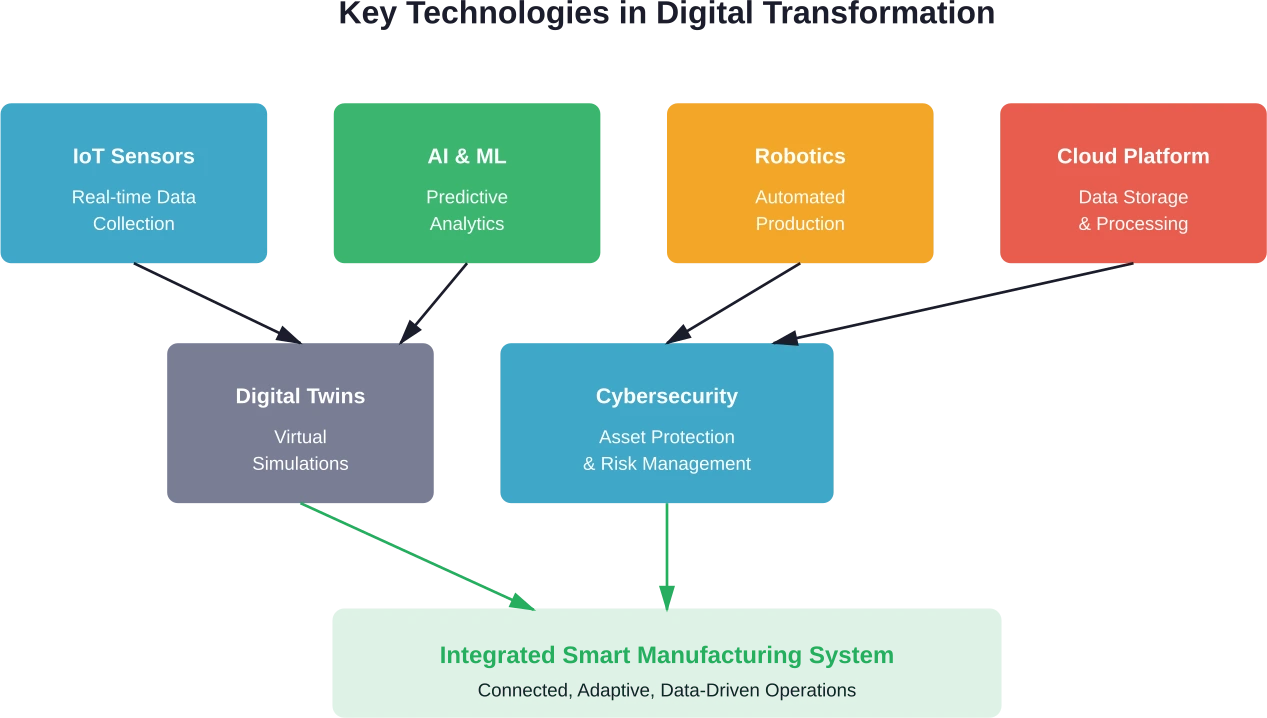
Several technologies work together to enable this shift. Understanding these components helps clarify how transformation actually happens on the factory floor.
Industrial Internet of Things
IoT sensors collect real-time data from machinery, products, and environmental conditions. This constant stream of information enables manufacturers to monitor operations with unprecedented precision.
Connected devices communicate equipment status, production rates, quality metrics, and maintenance needs automatically. The data flows into centralized systems where it becomes actionable intelligence.
Artificial Intelligence and Machine Learning
AI analyzes patterns in manufacturing data that humans cannot detect. Machine learning algorithms improve over time, becoming more accurate at predicting failures, optimizing schedules, and identifying quality issues.
According to World Economic Forum data, 80% of executives believe AI will boost productivity and 95% say it will enhance creativity. However, 84% of executives report struggles in training existing talent on new technologies, revealing that workforce development remains a critical challenge.
Robotics and Automation
Modern robots perform tasks with high precision and speed, particularly relevant for industries with high production volumes and strict quality standards. At Tesla's Gigafactory in Shanghai, 95% of operations are automated, allowing the company to reach cycle times that would be impossible with manual processes alone.
The Bureau of Labor Statistics notes that productivity gains through adoption of emerging technologies like robotics and drones are expected to drive changes across sectors including mining, quarrying, and oil and gas extraction.
Cloud Computing
Cloud platforms provide the infrastructure needed to store, process, and analyze massive amounts of manufacturing data. They enable real-time collaboration across global operations and support scalable digital solutions without requiring massive on-premise infrastructure investments.
Digital Twins
Digital twins create virtual models of physical assets, processes, or systems. Manufacturers use these simulations to test scenarios, optimize performance, and predict outcomes before making costly physical changes.
NIST's Manufacturing Digital Twin Standards work emphasizes that as a foundation of digital transformation, digital twins are critical for achieving smart manufacturing capabilities.
Benefits of Digital Transformation in Manufacturing
The investment in digital transformation delivers measurable returns across multiple operational areas. Here's what manufacturers actually gain.
Reduced Operational Costs
Digital technologies identify inefficiencies that drain resources. Automated systems reduce labor costs for repetitive tasks while improving consistency.
One Fortune 100 technology manufacturer working with SYSTEMA on their digital transformation reported a 50% reduction in certain operational costs after implementing smart manufacturing systems.
Improved Production Efficiency
Real-time monitoring and optimization increase throughput without adding capacity. Machines run at optimal speeds, changeovers happen faster, and production scheduling becomes more responsive to demand.
Digital transformation drives improved quality control, makes huge efficiency gains, and creates a better product with reduced costs and superior execution.
Enhanced Quality Control
Automated inspection systems catch defects earlier in the production process. AI-powered quality management identifies patterns that lead to problems before they create significant waste.
Continuous monitoring ensures consistency that manual inspection simply cannot match at scale.
Predictive Maintenance
Equipment failures bring production to a halt. Research has shown that annual losses from unplanned downtime for the world's largest manufacturers are equivalent to 11% of revenue.
Predictive maintenance uses sensor data and machine learning to forecast when equipment will need service. This allows maintenance teams to schedule repairs during planned downtime rather than scrambling to fix unexpected breakdowns.
Increased Flexibility and Customization
Digital systems enable rapid reconfiguration of production lines. Manufacturers can shift from mass production to mass customization, producing personalized products at scale.
This flexibility helps companies respond quickly to changing market demands without major retooling investments.
Better Decision-Making
Data-driven insights replace gut feelings. Managers access real-time dashboards showing performance across every aspect of operations.
Analytics reveal which products are most profitable, which processes need improvement, and where resources should be allocated for maximum impact.
Supply Chain Optimization
Connected systems extend visibility beyond the factory floor. Manufacturers track materials from suppliers, monitor inventory levels in real-time, and coordinate deliveries with production schedules.
This integration reduces inventory carrying costs while ensuring materials arrive exactly when needed.
|
Benefit Area |
Impact |
Key Technology |
|---|---|---|
|
Operational Costs |
Up to 50% reduction in specific areas |
Automation, AI optimization |
|
Unplanned Downtime |
Reduces losses equivalent to 11% of revenue |
Predictive maintenance, IoT sensors |
|
Production Efficiency |
Higher throughput without capacity increases |
Real-time monitoring, digital twins |
|
Quality Control |
Earlier defect detection, consistent standards |
AI-powered inspection, automated systems |
|
Customization |
Mass customization at scale |
Flexible automation, cloud platforms |

Plan Your Manufacturing Software Before You Build
Digital transformation in manufacturing usually means replacing manual processes with systems that actually connect operations - production, inventory, logistics. The hard part is not the idea, but turning it into a clear technical plan and realistic budget.
OSKI Solutions works with businesses at this early stage. They help define what needs to be built, how systems should integrate, and what the project will actually cost before development starts. Their work covers custom software, integrations, and process automation based on real operational needs.
With OSKI, you can:
- map your workflows into software requirements
- estimate cost and timeline before development
- plan integrations between systems and tools
Get a clear scope and cost for your manufacturing system - talk to OSKI Solutions.
Transform Manufacturing with Digital Innovation
Optimize production and operations with advanced digital technologies. From automation and IoT integration to data analytics and smart systems, we help manufacturers improve efficiency and reduce costs.
Real Examples of Digital Transformation
Theory matters less than execution. Here's how manufacturers are actually implementing these technologies.
Tesla Gigafactory Shanghai
Tesla's Shanghai facility operates with 95% automation. This level of integration allows the factory to achieve cycle times that support the company's aggressive production targets.
The facility demonstrates how robotics, AI, and connected systems can work together at massive scale.
Jubilant Ingrevia Acetic Anhydride Plant
The Acetic Anhydride plant in Bharuch, Gujarat, India, implemented predictive models and advanced analytics to achieve higher yields. This transformation supported the organization's ability to capture over 20% of the global market share.
Beyond production improvements, optimizing processes through digital tools delivered significant environmental benefits by reducing waste and energy consumption.
Fortune 100 Technology Manufacturer
SYSTEMA worked with a Fortune 100 technology manufacturer on comprehensive digital transformation. The company reported a 50% reduction in specific operational costs after implementing integrated smart manufacturing systems.
The transformation involved connecting previously siloed systems, implementing predictive analytics, and automating decision-making processes across multiple facilities.
Key Challenges in Manufacturing Digital Transformation
Transformation isn't simple. Manufacturers face real obstacles that can derail or delay implementation.
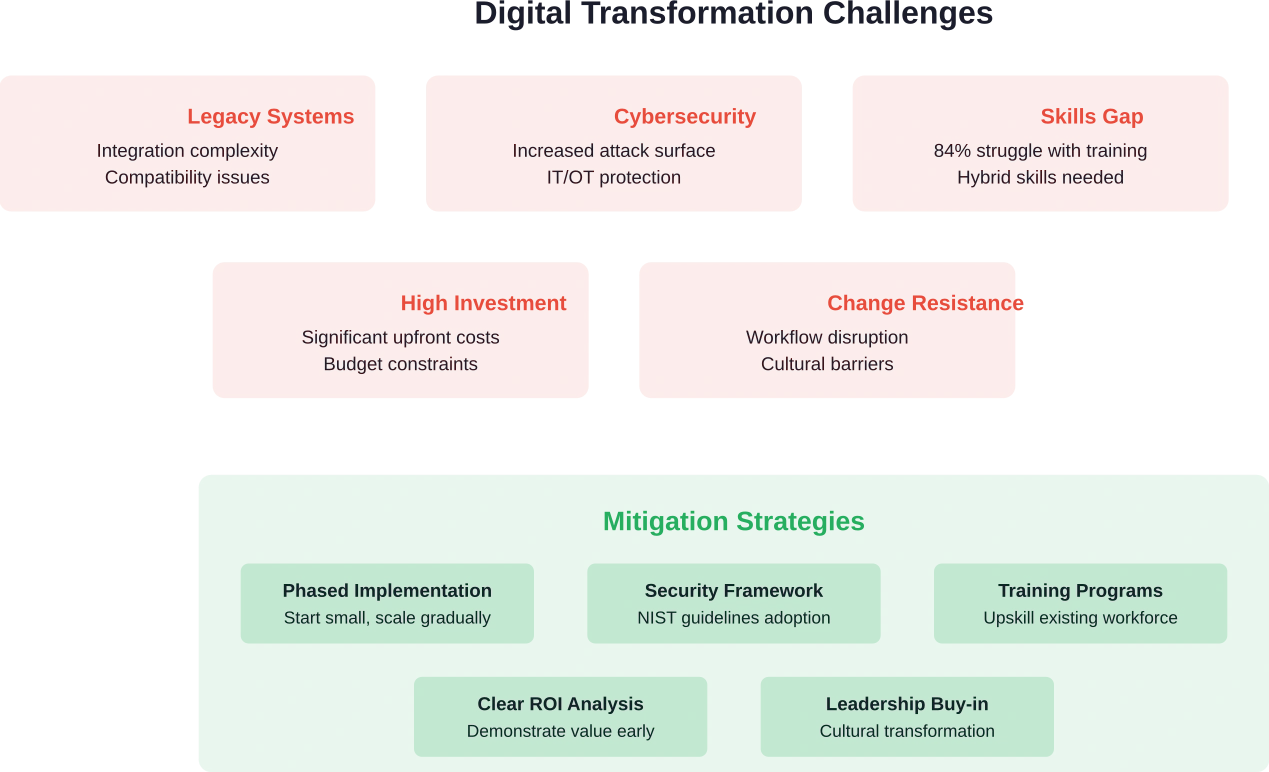
Legacy System Integration
Existing equipment and software weren't designed to connect with modern digital platforms. NIST research on supporting digital transformation with legacy components highlights that many manufacturers operate technology environments mixing decades-old systems with cutting-edge solutions.
Michael Pease from NIST's Engineering Lab, with more than 25 years of experience supporting information technology and cybersecurity programs for operational technology environments, focuses on cybersecurity for industrial control systems in these mixed environments.
Bridging this gap requires careful planning, middleware solutions, and sometimes complete system replacements.
Cybersecurity Risks
Connected systems create new attack surfaces. The NIST Cybersecurity Framework helps organizations better understand and improve their management of cybersecurity risk.
Manufacturing facilities must protect both information technology and operational technology networks. A breach could halt production, compromise intellectual property, or even create safety hazards.
Workforce Skills Gap
New technologies require new skills. According to World Economic Forum data, 84% of executives report struggles in training existing talent on new technologies.
The U.S. Bureau of Labor Statistics projects total employment to increase to 175.2 million from 2024 to 2034, growing 3.1 percent. However, workforce development challenges mean many manufacturing positions remain difficult to fill with qualified candidates.
Manufacturers need workers who understand both traditional production processes and digital technologies. Finding or training these hybrid-skilled employees takes time and resources.
High Initial Investment
Digital transformation requires significant upfront capital. Equipment, software licenses, infrastructure upgrades, and training all demand budget allocation.
Smaller manufacturers particularly struggle with this barrier, even though they stand to gain substantial competitive advantages from transformation.
Change Management Resistance
People resist change, especially when it affects established workflows. Factory floor workers may fear job loss from automation. Managers might resist data-driven decision-making that challenges their experience-based intuition.
One CEO described successful transformation as requiring a "mental revolution"—fundamentally rethinking how operations work and whom companies hire.
Trends Shaping Manufacturing's Digital Future
The transformation continues to evolve. Several emerging trends are reshaping what's possible.
Sustainability Integration
Digital tools optimize resource usage and reduce waste. Manufacturers track energy consumption in real-time, identify inefficiencies, and implement corrective measures immediately.
According to World Economic Forum sources, a new manufacturing paradigm is emerging where sustainability, intelligence, and resilience are mutually reinforcing strengths. Supply chains are at a transformative crossroads where the convergence of sustainability and innovation requirements is reshaping value creation.
Edge Computing
Processing data at the source rather than sending everything to centralized cloud systems reduces latency and bandwidth requirements. Edge computing enables faster decision-making for time-sensitive manufacturing processes.
Generative AI
Advanced AI systems generate design variations, optimize production parameters, and even create maintenance procedures. According to World Economic Forum data, 80% of executives believe AI will boost productivity and 95% say it will enhance creativity.
Generative AI represents the next frontier beyond traditional analytics.
Augmented Reality for Training and Maintenance
AR overlays digital information onto the physical world. Technicians wearing AR glasses see step-by-step repair instructions superimposed on equipment. New workers receive visual guidance that accelerates training.
Blockchain for Supply Chain Transparency
Blockchain creates immutable records of materials, components, and products as they move through supply chains. This technology enables complete traceability and helps verify authenticity.
Implementation Strategies for Success
Knowing what to do matters less than knowing how to actually do it. Here's a practical approach.
Start with Assessment
Understand current capabilities before planning transformation. Map existing processes, identify pain points, and establish baseline performance metrics.
This assessment reveals where digital tools will deliver the most value.
Define Clear Objectives
Vague goals like "become more digital" don't work. Set specific, measurable targets: reduce downtime by 20%, cut quality defects by 15%, or improve inventory turns by 30%.
Clear objectives guide technology selection and provide benchmarks for measuring success.
Prioritize Quick Wins
Demonstrate value early to build momentum and secure ongoing support. Identify projects that can deliver measurable results within 6-12 months.
These early successes create advocates for transformation across the organization.
Build a Cross-Functional Team
Transformation affects every department. Include representatives from operations, IT, engineering, quality, and finance in planning and implementation.
This diversity ensures different perspectives are considered and reduces resistance.
Invest in Training
Technology only delivers value when people know how to use it effectively. Develop comprehensive training programs that address technical skills and change management.
Upskilling existing employees often proves more effective than trying to hire externally for all needed capabilities.
Implement in Phases
Complete transformation doesn't happen overnight. Break the journey into manageable phases, each building on previous successes.
Phased implementation reduces risk and allows for course corrections based on lessons learned.
Establish Governance
Create clear accountability for transformation initiatives. Define roles, decision-making processes, and escalation paths.
Strong governance prevents projects from stalling when obstacles arise.
Measuring Transformation Success
Transformation requires investment. Stakeholders rightfully demand evidence of returns.
Key Performance Indicators
Track metrics that directly tie to business outcomes:
- Overall Equipment Effectiveness (OEE)
- First-pass yield rates
- Mean time between failures
- Inventory turnover
- Order fulfillment cycle time
- Cost per unit produced
- On-time delivery percentage
These metrics show whether transformation initiatives translate into operational improvements.
Financial Metrics
Ultimately, transformation must improve financial performance:
- Return on investment for digital initiatives
- Operating margin improvements
- Working capital reduction
- Revenue growth from new capabilities
Financial results validate the business case and support continued investment.
|
Metric Category |
Example KPIs |
Target Improvement |
|---|---|---|
|
Equipment Performance |
OEE, MTBF, Downtime |
10-30% improvement |
|
Quality |
First-pass yield, Defect rate |
15-40% reduction in defects |
|
Efficiency |
Cycle time, Labor productivity |
20-50% efficiency gains |
|
Cost |
Cost per unit, Operating expenses |
10-50% cost reduction |
|
Delivery |
On-time delivery, Lead time |
95%+ on-time rate |
The Human Element in Digital Manufacturing
Technology enables transformation, but people make it happen. Ignoring the human side guarantees failure.
Digital innovation in manufacturing is enhancing, not replacing, human capabilities. The most successful implementations augment worker skills rather than simply automating them away.
Operators need data visualization tools that help them make better decisions. Maintenance technicians need AI assistants that diagnose problems faster. Engineers need simulation environments where they can test ideas without risking production.
The World Economic Forum emphasizes that business processes must account for people's role in this transformation. Companies that invest in workforce development alongside technology deployment see significantly better outcomes than those focused solely on equipment.
Cybersecurity Considerations
Connected factories create connected vulnerabilities. The NIST Cybersecurity Framework provides essential guidance for manufacturers implementing digital transformation.
Key considerations include:
- Segmenting IT and OT networks to limit breach impact
- Implementing strong authentication and access controls
- Regularly updating and patching systems
- Monitoring network traffic for anomalies
- Establishing incident response procedures
- Training employees on security awareness
NIST research on cybersecurity for smart manufacturing emphasizes that security cannot be an afterthought. It must be integrated into transformation initiatives from the beginning.
Organizations need expertise in both information technology cybersecurity and operational technology environments to properly protect modern manufacturing facilities.
Future Outlook
Manufacturing transformation will accelerate over the coming years. Spending projected to exceed $1 trillion by 2031 reflects both the opportunity and the competitive necessity.
According to the Bureau of Labor Statistics, employment projections from 2024 to 2034 show the U.S. economy is projected to add 5.2 million jobs. Mining, quarrying, and oil and gas extraction declines are expected to be driven in part by productivity gains through the adoption of emerging technologies, such as robotics and drones.
These workforce shifts highlight how automation changes employment patterns even as overall employment grows.
Manufacturers that embrace transformation will gain significant competitive advantages. Those that delay face increasing pressure from more agile, data-driven competitors.
The factories exemplifying what's possible have undergone what one CEO described as a "mental revolution"—fundamentally rethinking how they operate and whom they hire.
This mindset shift matters more than any specific technology.
Frequently Asked Questions
What is the main goal of digital transformation in manufacturing?
The main goal is to maximize revenue, reduce costs, improve quality, and increase flexibility by integrating digital technologies throughout manufacturing operations. This creates connected, intelligent, and adaptive factories that respond dynamically to changing conditions and demands.
How much does digital transformation in manufacturing cost?
Costs vary significantly based on facility size, existing infrastructure, and transformation scope. Manufacturers' spending on digital technology for operational transformation is projected to grow at 17-24% annually, with total industry spending expected to exceed $1 trillion by 2031. Individual projects can range from tens of thousands to hundreds of millions of dollars depending on scale.
What are digital twins in manufacturing?
Digital twins are virtual models of physical assets, processes, or systems. According to NIST research, they serve as a foundation for digital transformation and are critical for achieving smart manufacturing. Manufacturers use digital twins to simulate scenarios, optimize performance, and predict outcomes before making costly physical changes to production systems.
How long does manufacturing digital transformation take?
Complete transformation typically takes 3-7 years depending on starting point and scope. However, phased implementation allows manufacturers to achieve measurable results within 6-12 months for initial projects. The transformation is ongoing rather than a one-time project, with continuous improvement and technology adoption.
What is the biggest challenge in manufacturing digital transformation?
According to World Economic Forum data, 84% of executives report struggles in training existing talent on new technologies, making workforce skills gaps one of the most significant challenges. Other major obstacles include legacy system integration, cybersecurity risks, high initial investment requirements, and organizational change resistance.
How does digital transformation improve manufacturing quality?
Digital transformation improves quality through automated inspection systems that catch defects earlier, AI-powered analytics that identify patterns leading to problems, continuous monitoring ensuring consistency, and real-time adjustments that prevent quality issues before they occur. These systems achieve precision and consistency that manual processes cannot match at scale.
What industries benefit most from manufacturing digital transformation?
All manufacturing sectors benefit, but industries with high production volumes, strict quality standards, or complex supply chains see particularly significant gains. Automotive, aerospace, electronics, pharmaceuticals, and food processing have led adoption. However, small and medium manufacturers across all industries can achieve substantial competitive advantages through digital transformation.
Conclusion
Digital transformation represents more than a technology upgrade. It's a fundamental reimagining of how manufacturing works.
The integration of IoT sensors, artificial intelligence, robotics, cloud computing, and digital twins creates production systems that are more efficient, flexible, and responsive than ever before. Real examples from Tesla, Jubilant Ingrevia, and Fortune 100 manufacturers demonstrate measurable results: 50% cost reductions, 95% automation rates, and market share gains.
But the path isn't easy. Legacy systems, cybersecurity concerns, skills gaps, investment requirements, and change resistance all present real obstacles. Success requires clear objectives, phased implementation, cross-functional collaboration, and strong leadership commitment.
The manufacturers that thrive will be those that embrace transformation not just as a technology initiative, but as a complete operational and cultural shift. NIST research, World Economic Forum insights, and Bureau of Labor Statistics projections all point to the same conclusion: digital transformation isn't optional anymore.
The question isn't whether to transform. It's how quickly and effectively your organization can execute the journey. Start with assessment, prioritize quick wins, invest in your people, and build momentum through measurable results.
The future of manufacturing is digital. The time to begin transformation is now.


