

Digital Transformation in Insurance: 2026 Strategy Guide

Quick Summary: Digital transformation in insurance leverages AI, cloud computing, and data analytics to modernize operations, enhance customer experiences, and improve decision-making. Insurers are investing over 50% of their budgets in digital initiatives to streamline claims processing, automate underwriting, and meet evolving customer expectations while addressing cybersecurity risks and regulatory compliance.
The insurance industry stands at a crossroads. Legacy systems clash with customer expectations shaped by Netflix, Amazon, and instant everything. It's not just about staying competitive anymore—it's about survival.
According to industry reports (such as those from Aite-Novarica), while digital transformation is a top priority, typical IT spending as a percentage of GWP remains between 3-5%, and 'digital transformation' specific allocation rarely exceeds 50% of the total IT budget for the majority of carriers. That's a massive shift from even five years ago. But what exactly does digital transformation mean for insurers, and how are leading companies making it work?
What Digital Transformation Actually Means for Insurance
Digital transformation in insurance goes far beyond digitizing paperwork or launching a mobile app. It's the fundamental integration of technology into every aspect of operations—from underwriting and claims processing to customer service and risk assessment.
For insurers, this transformation touches the entire value chain. Underwriting becomes faster and more accurate with AI-powered risk assessment. Claims processing that once took weeks now completes in days or hours. Customer interactions shift from phone calls and paper forms to seamless digital experiences.
Research examining Indonesian insurance firms found that digital business transformation significantly increases organizational ambidexterity—the ability to simultaneously optimize existing operations while exploring new business models. This dual capability proves critical for sustainable performance in the digital age.
Core Technologies Driving Insurance Innovation
Several key technologies are reshaping how insurers operate and compete.
Artificial Intelligence and Machine Learning
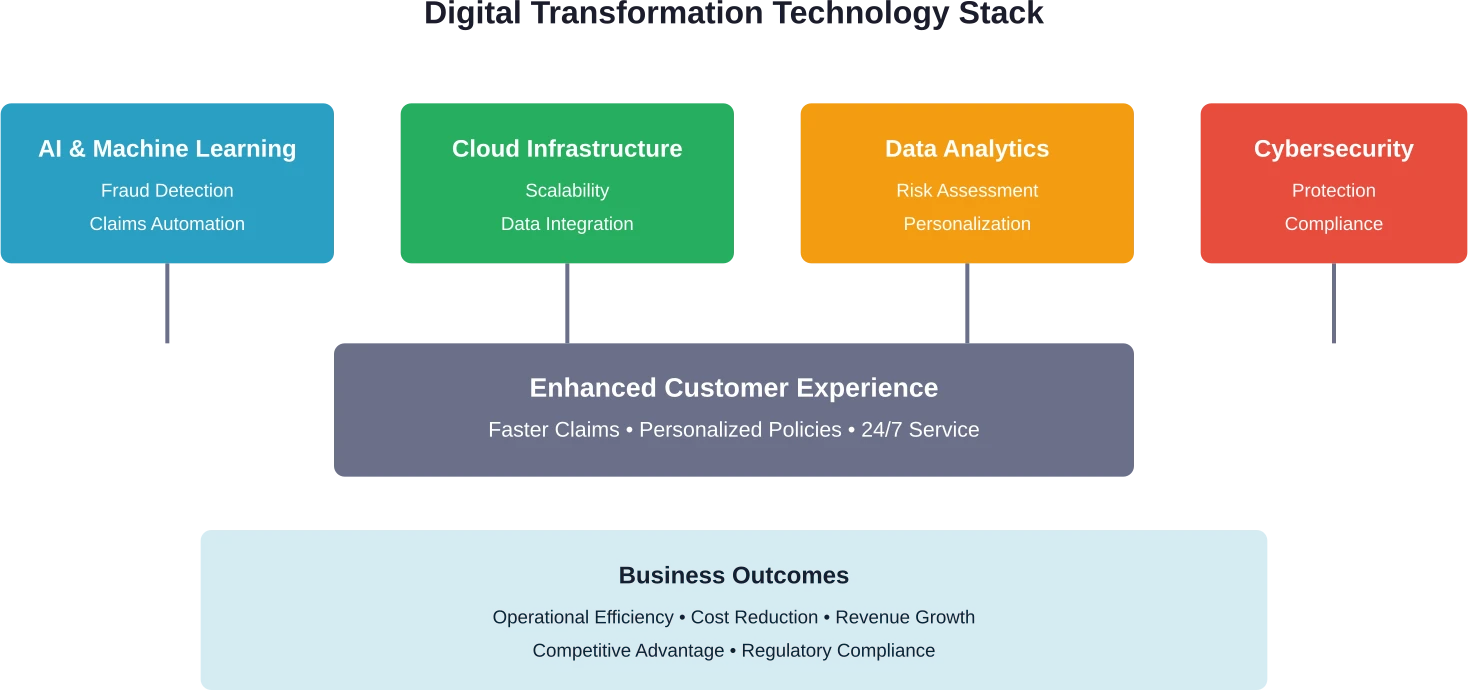
AI has moved from buzzword to business necessity. Insurers deploy machine learning algorithms for fraud detection, claims triage, and predictive analytics. At the 9th Conference on Global Insurance Supervision in Frankfurt on September 3, 2025, international insurance regulators—including North Dakota Insurance Commissioner Jon Godfread—discussed AI's expanding role in the sector.
Generative AI particularly stands out as transformative technology for 2025 and beyond. It handles customer inquiries, generates policy documents, and even assists underwriters in evaluating complex risks.
Cloud Computing and Data Analytics
Cloud infrastructure enables insurers to scale operations rapidly and access advanced analytics capabilities previously available only to the largest players. Discovery Benefits demonstrated this effectively, leveraging a single enterprise information management platform to grow from serving 1.25 million people to over 5 million while saving over $500,000.
Data analytics transforms raw information into actionable insights. Insurers can now identify emerging risks, optimize pricing models, and personalize customer offerings with unprecedented precision.
Critical Challenges Insurers Face
Digital transformation isn't without obstacles. Legacy systems pose significant barriers—decades-old mainframes that still process millions of policies but can't easily integrate with modern APIs and cloud services.
Cybersecurity and Regulatory Compliance
The SEC has established strict rules for cybersecurity risk management, strategy, governance, and incident disclosure. Insurance companies must balance innovation with robust security measures that protect sensitive customer data.
According to SEC guidance, aspects of cybersecurity span multiple government agencies, but every market participant bears responsibility. Insurers face the dual challenge of modernizing systems while strengthening defenses against increasingly sophisticated cyber threats.
Research on emerging technological risks shows that digital transformation introduces new vulnerabilities even as it creates opportunities. Insurers must develop comprehensive risk management frameworks that address both operational and cyber risks.
Data Imbalance and Quality Issues
Academic studies examining digital transformation in Indian insurance highlight persistent challenges around data security and data imbalance in risk assessment. Historical data may not reflect current risk profiles, particularly as climate change and emerging technologies reshape the risk landscape.

Stop Guessing Your Insurance Tech Budget
Insurance projects get complicated fast - claims systems, policy management, integrations, compliance. Costs can spiral if the scope isn’t clear from the start.
OSKI Solutions helps teams figure this out early. They break down what needs to be built, how systems connect, and what the project will realistically cost before development begins. That way, you’re not making decisions based on rough estimates or assumptions.
With OSKI, you can:
- turn insurance workflows into clear technical requirements
- understand integrations before development starts
- get a realistic cost and timeline upfront
If you want clear answers - talk to OSKI Solutions first.
Transform Insurance with Digital Innovation
Modernize insurance operations with secure, scalable digital solutions. From claims automation and policy management to analytics and customer platforms, we help insurers improve efficiency and enhance customer experience.
Real-World Implementation Success
Several insurers have achieved measurable results through strategic digital initiatives.
The single platform approach proves particularly effective. When systems communicate seamlessly, operations accelerate, errors decrease, and customer satisfaction improves. This integration—often called the central nervous system approach—connects underwriting, claims, customer service, and billing into one coherent ecosystem.
|
Implementation Area |
Key Benefits |
Typical Timeline |
|---|---|---|
|
Claims Automation |
60-80% faster processing, reduced errors |
6-12 months |
|
AI Underwriting |
Improved accuracy, faster decisions |
9-18 months |
|
Cloud Migration |
Scalability, cost optimization |
12-24 months |
|
Customer Portal |
Enhanced satisfaction, reduced service costs |
4-8 months |
Looking Ahead: 2026 and Beyond
The Asia-Pacific region demonstrates what's possible. Deloitte's 2026 Insurance Outlook projects life insurance premiums growing 5.3% annually until 2035, fueled by strong demand in China, India, and Southeast Asia. This growth depends heavily on digital capabilities that enable insurers to reach new markets efficiently.
Property and casualty insurers face different pressures. Many are moving beyond a prolonged hard market cycle into periods of margin pressure and slower premium growth. Advanced technology, agile capital models, and alternative revenue streams become essential for maintaining profitability.
Research on InsurTech in Chinese insurance enterprises from 2011 to 2020 reveals that InsurTech development has significantly improved the technological innovation of insurance companies. The effect proves particularly strong for non-state-owned and smaller enterprises, suggesting digital transformation levels the competitive playing field.
Building Your Digital Transformation Strategy
Successful transformation requires more than technology purchases. It demands organizational change, new skills, and often cultural shifts.
Start with clear objectives. What specific problems need solving? Where do customer pain points create the most friction? Which operational inefficiencies drain the most resources?
Prioritize initiatives based on impact and feasibility. Quick wins build momentum and stakeholder confidence. But don't neglect the harder, longer-term projects that create sustainable competitive advantages.
Invest in talent development. Technology only delivers value when people know how to use it effectively. Training programs, hiring for new skill sets, and sometimes partnering with technology specialists all play important roles.
Frequently Asked Questions
What is digital transformation in insurance?
Digital transformation in insurance involves integrating advanced technologies like AI, cloud computing, and data analytics into all aspects of insurance operations to improve efficiency, customer experience, and decision-making. It goes beyond simple digitization to fundamentally reshape how insurers operate and deliver value.
How much are insurers investing in digital transformation?
According to industry analysts Novarica and SMA, more than 50% of insurance budgets are dedicated to digital transformation projects. This represents a significant commitment reflecting the strategic importance of digital capabilities.
What are the main benefits of digital transformation for insurance companies?
Key benefits include faster claims processing, more accurate underwriting, improved customer experience, operational cost reduction, better risk assessment, enhanced fraud detection, and the ability to scale operations efficiently. Companies also gain competitive advantages through data-driven insights and personalized offerings.
What cybersecurity challenges does digital transformation create?
Digital transformation expands the attack surface for cyber threats while increasing the volume of sensitive data insurers process. The SEC requires comprehensive cybersecurity risk management and incident disclosure. Insurers must balance innovation with robust security measures and regulatory compliance.
How long does insurance digital transformation take?
Timeline varies by scope and complexity. Individual initiatives like customer portals may deploy in 4-8 months, while comprehensive transformations spanning multiple systems typically require 18-36 months. Cloud migrations alone often take 12-24 months depending on existing infrastructure complexity.
What role does AI play in insurance digital transformation?
AI powers fraud detection, claims automation, customer service chatbots, risk assessment, and predictive analytics. Generative AI specifically enables automated document generation, customer inquiry handling, and decision support for underwriters. AI capabilities discussed at the 2025 Global Insurance Symposium highlight growing regulatory attention to these technologies.
How can smaller insurers compete in digital transformation?
Research shows InsurTech development has stronger positive effects on small and non-state-owned insurance enterprises. Cloud-based solutions, partnerships with technology providers, and focused investments in high-impact areas enable smaller insurers to access capabilities once available only to large carriers. The key is strategic prioritization rather than trying to match larger competitors across all dimensions.
Moving Forward With Confidence
Digital transformation isn't optional anymore. Customer expectations, competitive pressures, and operational realities all point in the same direction. The question isn't whether to transform but how to do it effectively.
Start where you are. Assess current capabilities honestly, identify the highest-impact opportunities, and build a roadmap that balances quick wins with strategic investments. Learn from both successes and setbacks—digital transformation is iterative, not a one-time project.
The insurance companies thriving in 2026 and beyond won't necessarily be those with the biggest technology budgets. They'll be the ones that thoughtfully integrate digital capabilities to deliver genuine value to customers while building more resilient, efficient operations. That's the real promise of digital transformation.


