

Digital Transformation in Finance and Accounting 2026

Quick Summary: Digital transformation in finance and accounting involves integrating advanced technologies like AI, cloud computing, and automation to modernize financial operations, enhance decision-making, and shift finance professionals from traditional compliance roles to strategic business advisors. According to AICPA & CIMA, finance teams face unique opportunities to evolve beyond transactional work, though most transformations fail without proper planning and digital readiness.
Finance departments aren't what they used to be. Gone are the days when accounting meant endless spreadsheets, manual reconciliations, and closing the books weeks after month-end. Technology has fundamentally reshaped how financial information gets collected, analyzed, and reported.
But here's the thing—transformation isn't just about adopting new software. It's about fundamentally rethinking how finance functions operate and contribute to business strategy. According to AICPA & CIMA, adopting digital practices offers finance teams a unique opportunity to evolve beyond traditional roles and become strategic leaders within their organizations. Digital financial transformation is challenging, and accounting and finance professionals stand at the forefront of driving enterprise-wide digital transformation in finance.
The challenge? Most finance transformations fail. That's not speculation—it's a reality that organizations across industries face when they underestimate the complexity of change management, talent development, and technology integration.
What Digital Transformation Actually Means for Finance
Digital transformation in finance involves integrating advanced technologies and data-driven strategies to optimize financial operations, enhance decision-making capabilities, and deliver strategic business insights. It's not just automation—though that's certainly part of it.
The transformation fundamentally changes three core areas:
- Operational processes: Moving from manual, repetitive tasks to automated workflows that reduce errors and free up time for analysis
- Decision-making: Shifting from backward-looking reporting to predictive analytics and real-time insights
- Strategic role: Evolving from scorekeepers to strategic advisors who drive business value
As IFAC notes in their recent publications, the role of accountants is evolving beyond compliance and reporting, moving towards becoming strategic advisors and data guardians. This shift requires finance professionals to develop new skills and embrace technologies that many didn't learn in traditional accounting education.
Core Technologies Driving Finance Transformation
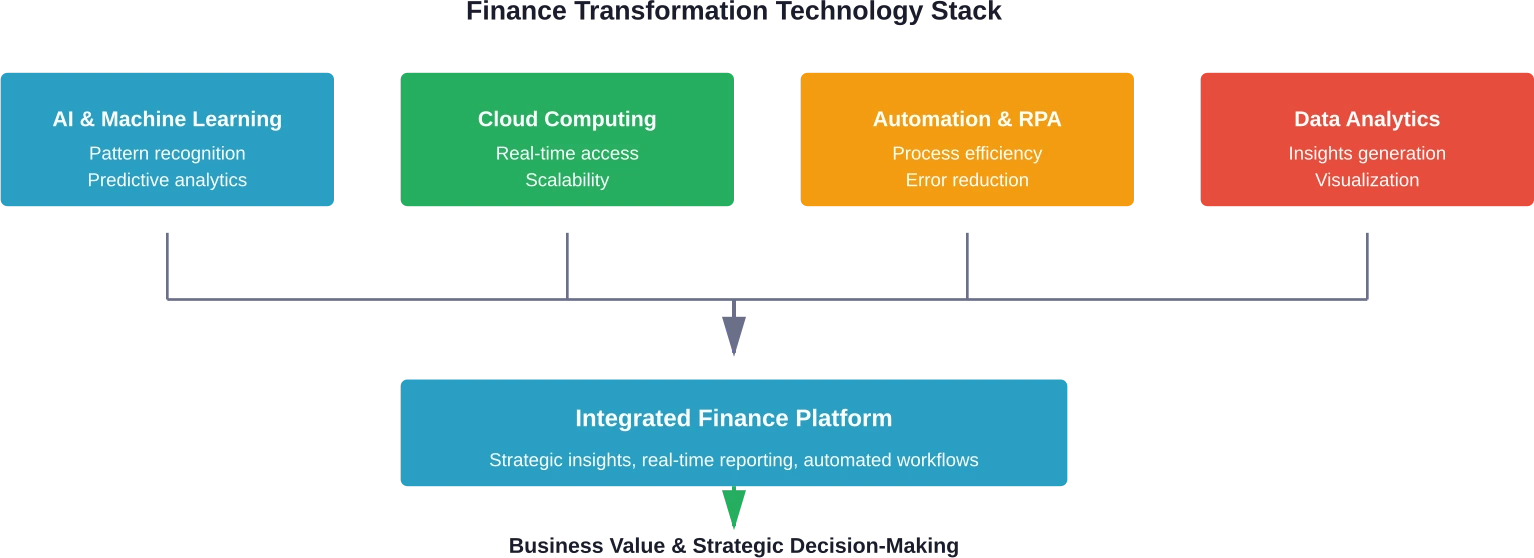
Several key technologies form the foundation of modern finance operations. Understanding how they work together matters more than implementing them in isolation.
Artificial Intelligence and Machine Learning
AI isn't just a buzzword in finance—it's actively changing how teams work. According to IFAC's exploration of responsible AI use in finance and accounting, AI capabilities are rapidly evolving, making it increasingly crucial for finance functions to experiment and identify valuable applications.
Machine learning algorithms can analyze patterns in financial data, predict cash flow trends, identify anomalies that might indicate fraud, and automate complex reconciliations. The technology excels at repetitive pattern recognition—exactly the kind of work that traditionally consumed hours of accountant time.
But IFAC emphasizes an important caveat: it's equally important to recognize AI's limitations and implement proper checks and balances to ensure responsible use. AI systems can perpetuate biases, make errors when encountering unfamiliar scenarios, and require human oversight for complex judgment calls.
Cloud Computing and Real-Time Data
Cloud-based financial systems have fundamentally changed how organizations access and share financial information. Real-time data availability means finance teams can provide current insights instead of waiting for month-end close processes.
Cloud platforms enable collaboration across distributed teams, reduce IT infrastructure costs, and provide scalability that traditional on-premise systems can't match. They've become particularly critical as remote work has become standard practice.
Automation and Robotic Process Automation
Research examining the impact of digital technology on accounting activities found that automation and AI adoption significantly enhance operational efficiency, with AI use increasing from 5% to 30% over five years. Similarly, cloud software adoption rose from 20% to 70%.
RPA handles repetitive, rule-based tasks like data entry, invoice processing, and report generation. At Plaid, major digital initiatives reduced manual billing by over 50% through strategic automation—demonstrating the tangible impact these technologies can deliver.
Data Analytics and Visualization
Modern analytics tools transform raw financial data into actionable insights. Interactive dashboards replace static reports, enabling business leaders to explore data, identify trends, and make informed decisions quickly.
Advanced analytics capabilities include predictive modeling, scenario analysis, and variance explanations that help finance teams move from describing what happened to explaining why it happened and what might happen next.
Strategic Benefits Beyond Cost Reduction
Organizations often approach finance transformation focused on efficiency gains and cost reduction. Those benefits are real—automation can reduce processing time by 50% or more for certain tasks. But the strategic advantages extend much further.
Enhanced Decision-Making Capabilities
Real-time financial data and advanced analytics enable faster, more informed decision-making. Finance teams can run scenario models, conduct what-if analyses, and provide insights that help business leaders evaluate strategic options before committing resources.
Improved Accuracy and Compliance
Automated processes reduce human error in data entry and calculations. Consistent application of rules improves compliance with accounting standards and regulatory requirements. Audit trails become more comprehensive and transparent.
Strategic Business Partnership
When finance professionals spend less time on manual tasks, they have more capacity for strategic work. This shift enables them to partner with business units, provide forward-looking insights, and contribute to strategic planning processes.
As IFAC observed, in an era where artificial intelligence is reshaping the professional landscape, finance professionals face a dual challenge: embracing technology while ensuring their continued relevance. The answer lies in focusing on uniquely human capabilities—judgment, strategic thinking, relationship building, and ethical decision-making.

Start with a Clear Finance System Plan
Digital transformation in finance and accounting usually breaks down at the same point - unclear scope. Too many tools, too many integrations, and no clear view of what the system should actually do.
OSKI Solutions helps sort that out before development starts. They work with teams to define system logic, integrations, and data flows so you know exactly what needs to be built and how it will work. Their focus is on turning accounting and finance processes into structured, buildable systems.
With OSKI, you can:
- turn financial workflows into clear system requirements
- plan integrations between accounting tools and platforms
- get a realistic view of cost and timeline
If your finance setup feels messy - define it properly before building with OSKI Solutions.
Transform Finance & Accounting with Digital Innovation
Modernize financial operations with secure, scalable digital solutions. From automation and real-time reporting to analytics and compliance systems, we help organizations improve accuracy, efficiency, and decision-making.
Critical Success Factors and Common Pitfalls
AICPA & CIMA research makes one thing clear: most finance transformations fail. Understanding why helps organizations beat those odds.
Digital Readiness Assessment
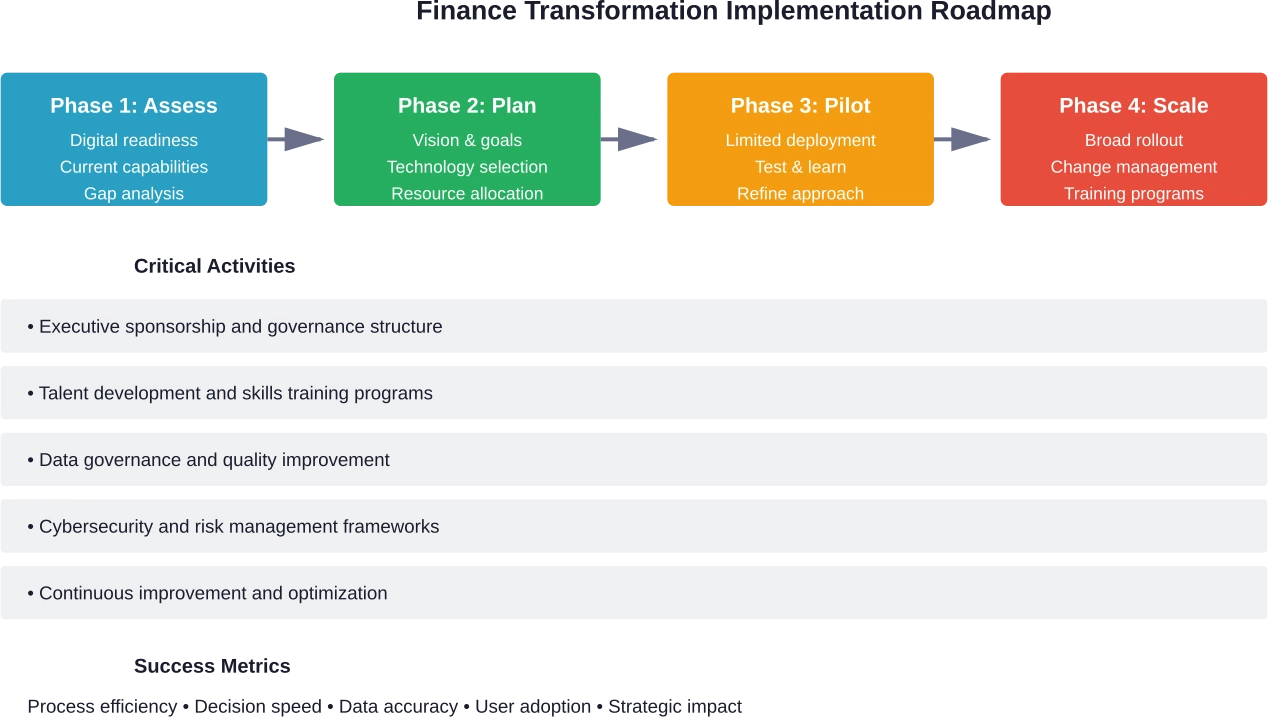
Organizations need honest assessments of their current state before launching transformation initiatives. This includes evaluating technology infrastructure, data quality, process documentation, and team capabilities.
According to ISACA's State of Digital Trust 2024 report, 77% of participants stated that digital trust is extremely important for organizational success. Regarding budgets, 37% of organizations are increasing their budgets for digital trust initiatives—creating a significant gap between priorities and action.
Talent Development and Change Management
Technology alone doesn't transform finance functions. People do. Organizations need deliberate strategies for developing digital skills, managing resistance to change, and helping team members transition to new ways of working.
The finance professional with over 12 years of experience across multiple organizations demonstrated this principle—transformation success came from focusing on people alongside technology, not technology in isolation.
Data Quality and Governance
Advanced analytics and AI only work well with high-quality data. Organizations need strong data governance frameworks, clear ownership, consistent definitions, and processes for maintaining data integrity.
|
Success Factor |
Why It Matters |
Common Mistake |
|---|---|---|
|
Executive sponsorship |
Provides resources and removes barriers |
Delegating transformation to IT without business leadership |
|
Clear vision and goals |
Aligns efforts and measures progress |
Technology-first approach without business objectives |
|
Change management |
Ensures adoption and realizes benefits |
Focusing solely on technical implementation |
|
Phased implementation |
Manages risk and demonstrates value |
Attempting complete overhaul simultaneously |
|
Skills development |
Enables teams to use new capabilities |
Assuming existing staff will adapt without training |
Choosing the Right Transformation Approach
AICPA research on tax technology and digital optimization notes that digital transformation can take a "phoenix" or "evolutionary" approach—the path organizations take depends on risk appetite, budget, and business strategy.
Phoenix approaches involve complete rebuilds—replacing legacy systems entirely. Evolutionary approaches build incrementally on existing foundations. Neither is universally better; context determines the appropriate strategy.
Cybersecurity and Risk Management Considerations
Digital transformation expands the attack surface for cyber threats. As ISACA highlights, 67% of organizations will face at least one attack on their digital transformation initiative. The number, sophistication, and magnitude of cyberattacks continue to rise alongside digital adoption.
Finance systems contain sensitive data—financial records, employee information, strategic plans, and competitive intelligence. Protection requires more than firewalls and antivirus software.
Building Digital Trust
According to ISACA's Digital Trust Ecosystem Framework, digital trust reflects the fundamental need for systems to operate as intended, protect sensitive information, and maintain integrity. This is especially critical in financial services, where trust forms the foundation of customer relationships.
Organizations need comprehensive approaches that include:
- Regular security assessments and penetration testing
- Access controls and authentication protocols
- Encryption for data at rest and in transit
- Incident response plans and business continuity procedures
- Vendor risk management for third-party systems
ISACA research found that organizations should adopt robust measurement frameworks like the Digital Trust Ecosystem Framework, which provides detailed practices and metrics for assessing digital trust maturity.
Ethical Considerations and Responsible Technology Use
As IFAC explored in their work on ethics, technology, and the professional accountant in the digital age, change is here—and more is coming. The profession has adapted through past technological revolutions, but success isn't guaranteed.
Responsible AI implementation requires clear executive leadership, well-integrated governance, and diligent risk management. According to ISACA's Responsible AI Playbooks, enterprises committed to responsible artificial intelligence usage must establish frameworks that address:
- Algorithmic bias and fairness
- Transparency and explainability
- Data privacy and security
- Accountability for AI-driven decisions
- Human oversight and intervention capabilities
Finance professionals have ethical obligations that technology doesn't change. Accuracy, integrity, objectivity, and professional competence remain paramount—regardless of whether humans or algorithms perform specific tasks.
Emerging Trends Shaping the Future
The pace of technological change continues accelerating. Several trends are reshaping what's possible in finance and accounting.
Blockchain and Digital Assets
AICPA & CIMA have published extensive resources on digital assets and blockchain. The technology offers potential for transparent, immutable transaction records and could fundamentally change how financial information gets recorded and verified.
While cryptocurrency volatility dominates headlines, the underlying blockchain technology has applications in supply chain finance, contract management, and audit verification that extend far beyond digital currencies.
Advanced Analytics and Predictive Modeling
Machine learning models continue improving at forecasting financial performance, identifying risks, and optimizing working capital. As algorithms access more data and computing power increases, predictive capabilities will expand.
Natural Language Processing
NLP enables systems to read and understand contracts, extract relevant terms, identify risks, and automate compliance monitoring. Finance teams can query systems in plain language rather than learning complex query languages.
Integrated Reporting Platforms
According to IFAC's work on the accounting revolution and digital transformation, changes in what information corporates report are underway with moves to global climate and sustainability reporting. But what about how that information is reported?
The corporate reporting approach hasn't changed much despite giant leaps in available technology. The nature and complexity of audiences has evolved, creating pressure for more dynamic, interactive reporting capabilities.
Building the Right Team for Digital Finance
Digital transformation changes the skills finance teams need. Traditional accounting education provides strong foundations in standards, principles, and compliance. But digital finance requires additional capabilities.
Essential Digital Skills
Finance professionals need comfort with data analytics tools, understanding of how algorithms make decisions, ability to visualize and communicate insights, and critical thinking about data quality and limitations.
Technical skills matter, but equally important are soft skills—communication, collaboration, change management, and strategic thinking. The most valuable finance professionals combine technical competence with business acumen.
Continuous Learning Requirements
Technology evolves rapidly. Finance professionals must commit to continuous learning to maintain relevance. AICPA offers courses on digital transformation and underpinning technologies as a Digital Strategist bundle, providing baseline understanding of transformation concepts and enabling technologies.
|
Skill Category |
Traditional Finance |
Digital Finance |
|---|---|---|
|
Technical accounting |
GAAP/IFRS expertise, manual reconciliations |
Standards knowledge plus system configuration, automation design |
|
Analysis |
Variance analysis, trend identification |
Predictive modeling, scenario planning, statistical analysis |
|
Tools |
Excel, ERP systems |
BI platforms, Python/R, cloud analytics, AI tools |
|
Communication |
Financial reporting, presentations |
Data visualization, storytelling, cross-functional collaboration |
|
Strategy |
Budget management, cost control |
Business partnering, value creation, digital strategy |
Practical Implementation Strategies
Knowing what to do matters less than knowing how to do it. Several practical strategies increase transformation success rates.
Start With High-Impact Use Cases
Organizations don't need to transform everything simultaneously. Identify processes that are high-volume, rule-based, and time-consuming. These are ideal automation candidates that can demonstrate quick wins and build momentum.
Invest in Data Infrastructure
Advanced analytics require solid data foundations. Before implementing sophisticated AI models, ensure data is accurate, accessible, consistently defined, and properly governed. Data quality problems compound when algorithms process flawed inputs.
Create Centers of Excellence
Dedicated teams can develop expertise, establish best practices, and support broader organizational adoption. Centers of excellence accelerate learning curves and prevent isolated departments from solving the same problems repeatedly.
Measure and Communicate Results
Track transformation impact through relevant KPIs. AICPA research emphasizes finding the right KPIs for business context. Metrics might include process cycle time, error rates, time spent on analysis versus data gathering, or stakeholder satisfaction with finance insights.
Regular communication about progress, challenges, and wins helps maintain momentum and executive support.
Frequently Asked Questions
What is digital transformation in finance and accounting?
Digital transformation in finance and accounting involves integrating advanced technologies like AI, automation, cloud computing, and data analytics to modernize financial operations, enhance decision-making, and shift finance professionals from transactional roles to strategic business advisors. It's not just technology implementation—it requires changes to processes, skills, and organizational culture.
Why do most finance transformations fail?
According to AICPA & CIMA research, most finance transformations fail due to insufficient change management, lack of executive sponsorship, inadequate talent development, poor data quality, and technology-first approaches that ignore business objectives. Organizations often underestimate the complexity of changing how people work and overestimate technology's ability to solve process and culture problems.
What technologies are most important for finance transformation?
The most impactful technologies include artificial intelligence and machine learning for pattern recognition and predictive analytics, cloud computing for real-time data access and scalability, robotic process automation for repetitive task elimination, and advanced data analytics and visualization tools for generating actionable insights. The specific technology mix depends on organizational needs and current capabilities.
How should finance professionals prepare for digital transformation?
Finance professionals should develop digital skills including data analytics, understanding of AI and automation capabilities, and proficiency with modern business intelligence platforms. Equally important are soft skills like strategic thinking, communication, and change management. AICPA offers digital transformation courses designed for finance leaders. Continuous learning and willingness to experiment with new technologies are essential.
What role does cybersecurity play in finance transformation?
Cybersecurity is critical as digital transformation expands attack surfaces. According to ISACA research, 67% of organizations will face at least one cyberattack on their digital transformation initiative. Finance systems contain sensitive data requiring comprehensive protection including access controls, encryption, regular security assessments, incident response plans, and vendor risk management. Digital trust frameworks help organizations assess and improve security maturity.
How long does finance transformation typically take?
Transformation timelines vary widely based on organizational size, current state, scope, and approach. Phased implementations might show initial results within 3-6 months for specific use cases, while comprehensive transformations can take 2-3 years or more. Evolutionary approaches deliver incremental value over time, while phoenix approaches involve complete rebuilds with longer implementation periods but potentially faster capability transitions once deployed.
What's the difference between finance automation and digital transformation?
Automation focuses on using technology to perform specific tasks faster with fewer errors—it's a component of transformation but not the entire picture. Digital transformation is broader, encompassing process redesign, new capabilities like predictive analytics, role redefinition, skills development, and cultural shifts. Automation can happen without transformation, but transformation typically includes automation as one element within a comprehensive change initiative.
Moving Forward: Taking the First Steps
Digital transformation in finance isn't optional anymore. Organizations that delay risk falling behind competitors who leverage technology for strategic advantage. But rushing into transformation without proper planning increases failure probability.
Start with honest assessment. Where does the finance function currently stand? What capabilities exist? What gaps need addressing? What business outcomes matter most?
Build the case for investment. Transformation requires resources—budget, time, and attention. Executives need clear understanding of expected benefits, required investments, and implementation risks.
Focus on people alongside technology. The most sophisticated systems fail without user adoption. Change management, training, and communication determine whether technology investments deliver promised value.
Think strategically about the role finance should play. Digital transformation creates opportunities for finance teams to become true business partners—providing insights that shape strategy, identifying opportunities and risks before they materialize, and helping organizations navigate uncertainty.
As IFAC noted, finance professionals face a dual challenge: embracing technology while ensuring continued relevance. Success comes from focusing on uniquely human capabilities that complement technological strengths—judgment, ethics, strategic thinking, and relationship building.
The transformation journey isn't easy. Most organizations stumble along the way. But with clear vision, strong leadership, proper planning, and commitment to continuous improvement, finance teams can successfully navigate the transition and emerge as strategic assets driving business value.
Ready to begin your finance transformation journey? Start by assessing your organization's digital readiness, identifying high-impact use cases, and building the business case for investment. The technology exists. The question is whether organizations will commit to the comprehensive change required to fully realize its potential.


