

Digital Transformation Cost Guide 2026: What to Expect

Key Points: Digital transformation costs vary widely based on company size, industry, and scope, with enterprise projects averaging $27.5 million. However, initial investments are offset by long-term savings through automation, cloud adoption, and improved efficiency. Hidden costs like training, integration, and change management can increase budgets by 20-40% if not properly planned.
The pace of digital transformation accelerated dramatically during COVID-19, speeding up adoption timelines by roughly three years in the US alone. Over 80 percent of enterprises experienced digital transformation acceleration during this period, fundamentally changing how businesses approach technology investments.
But here's the thing—while everyone agrees digital transformation is essential, the actual cost remains one of the biggest question marks for leadership teams.
Global spending on digital transformation is projected to reach nearly $3.9 trillion by 2027, growing at a compound annual growth rate of 16.1% from 2023. That's a staggering amount of investment. And with 67% of organizations under incredible pressure to accelerate digital initiatives, understanding what you'll actually spend has never been more critical.
This guide breaks down the real costs, the hidden expenses that catch most companies off guard, and practical strategies to keep your transformation project on budget without sacrificing results.
What Is the Average Cost of Digital Transformation?
Let's get straight to the numbers. The average cost for an enterprise digital transformation sits at approximately $27.5 million.
But that's just an average. The reality? Transformation costs differ dramatically depending on your organization's needs, size, and industry.
Small businesses might spend anywhere from $50,000 to $500,000 on focused digital initiatives. Mid-market companies typically invest between $1 million and $10 million. Large enterprises often exceed $20 million, with some complex transformations reaching $50 million or more.
According to Deloitte's 2025 Tech Value Survey, 74% of surveyed organizations reported investments in AI and generative AI capabilities, with AI and generative AI capturing the lion's share of new spending. This shift reflects how digital transformation priorities are evolving—not just digitizing existing processes, but fundamentally reimagining how work gets done.
The other critical point? Poor planning can devastate your budget. Failed digital adoption of tools and processes doesn't just waste the initial investment—it creates downstream costs in lost productivity, employee frustration, and delayed competitive advantage.

Understand Your Digital Transformation Cost
Digital transformation may include system modernization, automation, integrations, and cloud migration. OSKI Solutions evaluates your current infrastructure before estimating required changes. The cost calculation reflects real implementation steps and technical dependencies. This gives you a clear investment overview.
Ready to Estimate Your Digital Transformation Project?
Talk with OSKI Solutions to:
- assess existing systems and gaps
- define modernization scope
- receive a structured transformation cost estimate
👉 Request a digital transformation quote from OSKI Solutions.
Accelerate Your Digital Transformation
Modernize processes, integrate advanced technologies, and build a future-ready digital infrastructure.
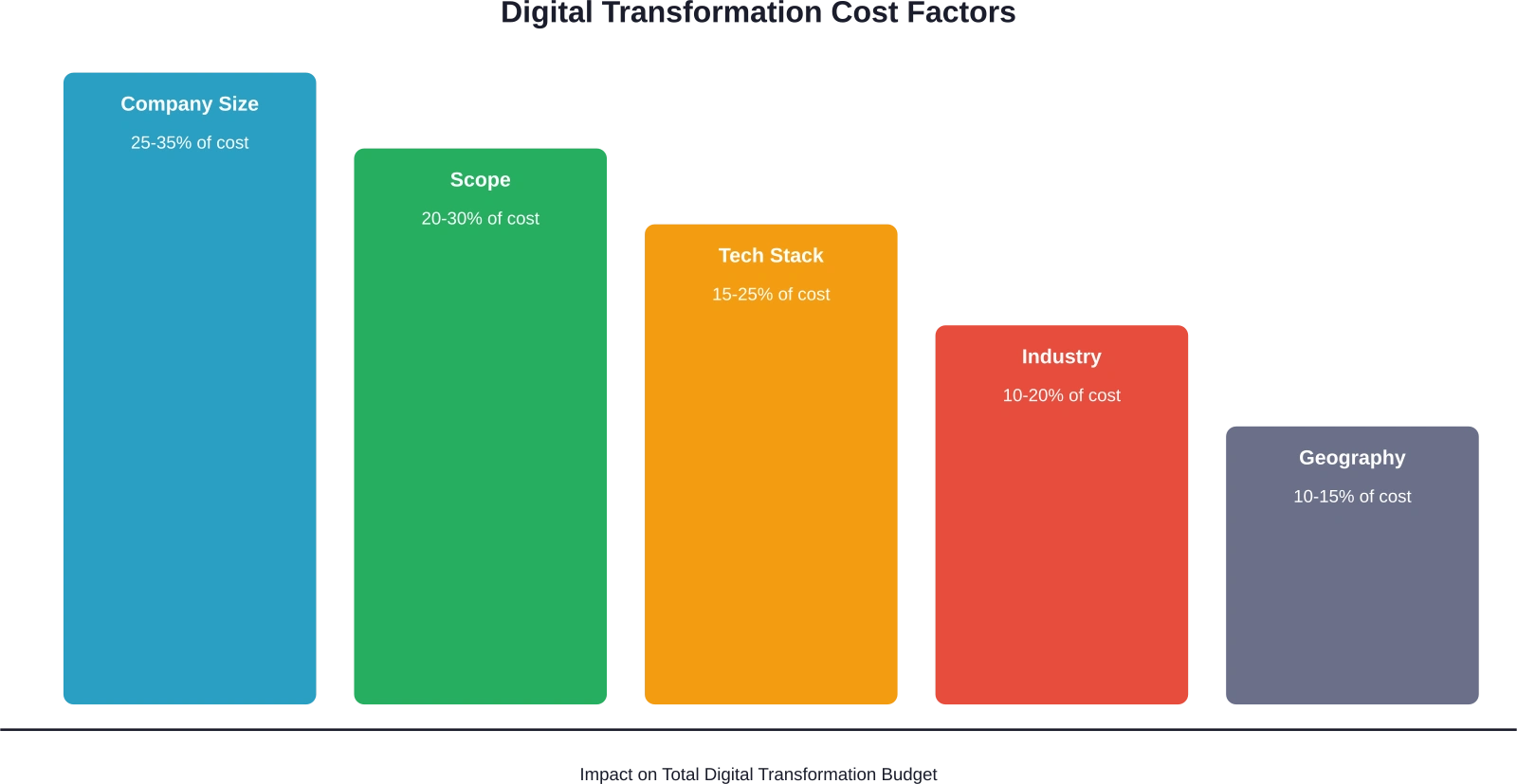
Key Factors That Impact Digital Transformation Cost
Not all transformation projects cost the same. Several factors determine whether you'll spend closer to $100,000 or $10 million.
Company Size and Complexity
Larger organizations face exponentially higher costs. More employees mean more training. More legacy systems mean more integration work. More departments mean more change management.
A 50-person startup can roll out new cloud-based tools in weeks. A 10,000-person enterprise might spend 18 months just on the planning and integration phases.
Industry Requirements
Highly regulated industries like financial services, healthcare, and energy face additional compliance costs. Data security, regulatory reporting, and industry-specific certifications all add to the bottom line.
Digital transformation initiatives in financial institutions, for example, must balance innovation with rigorous cybersecurity governance. According to ISACA cybersecurity research, 67% of organizations will face at least one attack on their digital transformation initiative, making security investments non-negotiable.
Scope of Transformation
Are you digitizing one department or overhauling the entire enterprise? The scope dramatically affects costs.
Process-specific transformations (like moving accounting to the cloud) cost significantly less than enterprise-wide overhauls that touch every department, system, and workflow.
Technology Stack Choices
Off-the-shelf solutions cost less upfront but may require expensive customization. Custom development offers perfect fit but demands higher initial investment and ongoing maintenance.
Cloud computing generally lowers infrastructure costs by replacing on-premise solutions, but migration itself requires significant investment in planning, execution, and training.
Geographic Distribution
Companies with multiple locations or international operations face higher costs. Each region may have different systems, compliance requirements, and training needs.
Real talk: if you're managing operations across three continents, your integration and change management costs will be substantially higher than a single-location business.
The Hidden Costs That Destroy Budgets
Here's where most digital transformations go off the rails. The visible costs—software licenses, hardware, implementation fees—are easy to budget. It's the hidden costs that blindside leadership teams.
Training and Productivity Loss
New systems require training. But here's what most budgets miss: the real cost isn't just the course fees, it's the combined expense of course fees plus employee time.
If you're training 100 employees at $50/hour for 8 hours of training, that's $40,000 in lost productivity—on top of whatever you paid the training vendor. Many organizations should set aside a recurring training budget of 2-3% of payroll annually for ongoing learning as systems evolve.
And it doesn't stop after initial training. System updates, new hires, and process refinements all require continuous learning investments.
Integration Complexity
Legacy systems don't play nice with modern cloud platforms. Data migration takes longer than anyone expects. APIs don't always work as advertised.
Best practice? Assign a 20-40% contingency reserve specifically for integration work. That might sound excessive, but integration problems are the number one cause of transformation delays and cost overruns.
Change Management
Technology is the easy part. People are the hard part.
Without proper change management, even the best technology fails. Employees resist new workflows. Managers struggle to lead teams through transitions. Productivity drops during adjustment periods.
Change management typically consumes 10-15% of transformation budgets in successful projects. When it's underfunded or ignored, transformation failure rates skyrocket.
Compliance and Security
Cybersecurity costs often get underestimated. Digital transformation initiatives have become a major investment priority, but they also expand the attack surface.
Digital transformation projects carry significant security risks. A data breach during transformation can devastate budgets—the City of Hamilton's breach reached CAD $18.3 million in costs by 30 June 2025, with their insurer denying the claim due to policy exclusions.
Ongoing Maintenance and Support
Digital transformation isn't a one-time project. Systems require updates, patches, and ongoing support. Cloud services have recurring subscription costs. Technical debt accumulates if not actively managed.
Factor in 15-20% of initial implementation costs as annual maintenance expenses. This covers everything from software updates to technical support to system optimization.
|
Hidden Cost Category |
Typical Budget Impact |
Common Mistake |
|---|---|---|
|
Training & Productivity Loss |
2-3% of annual payroll |
Only counting course fees, ignoring employee time |
|
Integration Work |
20-40% contingency needed |
Underestimating legacy system complexity |
|
Change Management |
10-15% of project budget |
Treating it as optional or afterthought |
|
Security & Compliance |
8-12% of project budget |
Assuming existing security is sufficient |
|
Ongoing Maintenance |
15-20% of initial cost annually |
Treating transformation as one-time expense |
Does Digital Transformation Reduce Operational Costs?
Yes—but not immediately. The initial investment is substantial, but long-term savings can be significant.
Process Automation Benefits
Automation reduces manual work and errors, improving efficiency across operations. Repetitive tasks that consumed hours of employee time can be completed in minutes.
According to Deloitte research on AI ROI, some organizations achieved 100% ROI on specific projects—for every euro invested, they generated two to three euros per year in benefits. The value created definitively exceeded the cost of initiatives.
Cloud Computing Savings
Moving to cloud infrastructure eliminates expensive on-premise data centers. Companies no longer need to maintain server rooms, pay for cooling, or employ large IT infrastructure teams.
Cloud computing lowers infrastructure costs substantially, though migration itself requires upfront investment.
Data-Driven Decision Making
Better data analytics leads to smarter business decisions. Companies can identify inefficiencies, optimize inventory, predict customer behavior, and allocate resources more effectively.
The long-term competitive advantage and cost savings from improved decision-making often exceed the entire transformation investment.
The Payback Timeline
Most organizations see positive ROI within 18-36 months. Complex enterprise transformations may take longer. Focused initiatives like process automation often pay back within 12 months.
The key is setting realistic expectations. Digital transformation is a strategic investment, not a quarterly expense.
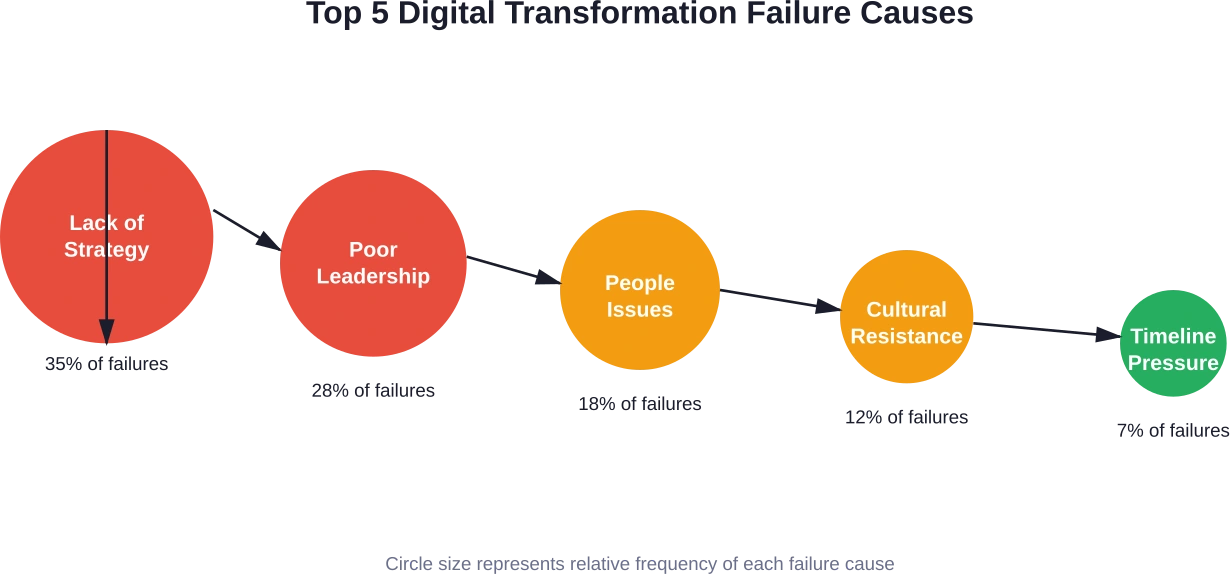
Why Most Digital Transformations Fail
Somewhere between 67% and 84% of digital transformation projects fail to meet their objectives. That's a sobering statistic.
Why do so many fail despite massive investments?
Lack of Clear Strategy
Technology for technology's sake doesn't work. Successful transformations start with clear business objectives, then identify technology solutions to achieve them.
Too many companies do it backwards—buying trendy technology and then figuring out how to use it.
Insufficient Leadership Buy-In
When executives treat digital transformation as an IT project rather than a business transformation, it fails.
Transformation requires visible leadership commitment, consistent communication, and willingness to make difficult decisions about processes and people.
Underinvestment in People
According to CIO research on transformation costs, the obligation of technology leaders is to prioritize investment in training, change management, and mentoring colleagues during transformation.
Organizations that view employees as transformation partners—not obstacles—dramatically increase success rates.
Ignoring Cultural Change
Digital transformation requires cultural transformation. Companies with rigid hierarchies, risk-averse cultures, or siloed departments struggle regardless of technology quality.
The most successful transformations treat culture change as seriously as technology implementation.
Unrealistic Timelines
Rushing transformation leads to poor planning, inadequate testing, and insufficient training. The result? Failed implementations and wasted investment.
Better to take an extra quarter and do it right than push too fast and have to redo everything.
How to Calculate Your Digital Transformation Cost
Accurate budgeting starts with honest assessment. Here's a framework for estimating costs.
Step 1: Define Scope and Objectives
What exactly are you transforming? Be specific. "Become more digital" isn't a plan. "Migrate customer service to cloud-based CRM with AI-powered chatbot support" is a plan.
Clear scope prevents scope creep—the budget killer that turns $5 million projects into $15 million nightmares.
Step 2: Inventory Current Systems
Document every system, platform, and process that will be affected. Identify integration points. Note data migration requirements.
This unglamorous work prevents expensive surprises during implementation.
Step 3: Break Down Cost Categories
Create detailed estimates for each major category:
- Software licenses and subscriptions
- Hardware and infrastructure
- Implementation and consulting fees
- Training and change management
- Integration and custom development
- Data migration and cleanup
- Security and compliance
- Ongoing maintenance and support
Step 4: Add Contingency
Never budget to the penny. Digital transformations always encounter unexpected challenges.
Add 25-30% contingency for complex enterprise projects. Even focused initiatives should include 15-20% buffer.
Step 5: Project Multi-Year Costs
Don't just budget for year one. Project costs over the full transformation timeline—typically 3-5 years for enterprise initiatives.
Include ongoing costs like subscriptions, maintenance, training for new hires, and periodic system upgrades.
Proven Strategies to Reduce Digital Transformation Cost
Smart organizations find ways to reduce costs without compromising results. Here's how.
Start with High-Impact, Low-Complexity Projects
Build momentum and prove value before tackling the hardest challenges. Quick wins generate stakeholder support and provide learning for larger initiatives.
According to Deloitte research on AI ROI, successful organizations use generative AI for quick wins while deploying agentic AI for deeper transformational change.
Leverage Existing Technology
Before buying new platforms, maximize what you already own. Most organizations use less than 50% of their existing software capabilities.
Sometimes the best transformation investment is training employees to fully utilize current tools.
Choose Scalable Solutions
Solutions that grow with your organization prevent expensive replacements as you scale. Pay slightly more upfront for platforms that can handle 10x growth.
Invest Heavily in Change Management
This sounds counterintuitive—spend more to save money? But organizations that prioritize change management see lower failure rates, faster adoption, and better ROI.
A $1 million project with poor change management costs more than a $1.5 million project with excellent change management—because the first one fails and requires expensive remediation.
Partner with Experienced Vendors
Cheap consultants cost more in the long run. Experienced vendors prevent common mistakes, accelerate implementation, and transfer knowledge to internal teams.
The U.S. General Services Administration demonstrated this through the OneGov Strategy launched in April 2025. By executing 17 agreements with leading technology companies and acting as one unified buyer, GSA fundamentally transformed federal IT procurement. GSA has driven more than $60 billion in contract savings across the federal government since January 20, 2025.
Phase Implementation Thoughtfully
Trying to transform everything simultaneously guarantees chaos. Phased approaches allow learning, adjustment, and course correction between stages.
Each phase should deliver standalone value while building toward the complete vision.
Build Internal Capability
Over-reliance on consultants creates expensive dependencies. Transfer knowledge to internal teams throughout the project.
This approach costs more initially but dramatically reduces long-term expenses.
|
Cost Reduction Strategy |
Potential Savings |
Implementation Difficulty |
|---|---|---|
|
Start with quick wins |
10-15% through learning |
Low |
|
Maximize existing tech |
20-30% on new purchases |
Medium |
|
Scalable solutions |
40-60% on future upgrades |
Low |
|
Strong change management |
30-50% through lower failure risk |
Medium |
|
Experienced vendors |
25-40% through efficiency |
Low |
|
Phased implementation |
15-25% through better planning |
Medium |
|
Build internal capability |
50-70% on long-term support |
High |
The Role of AI in Modern Transformation Costs
AI has fundamentally shifted digital transformation economics. According to Deloitte's 2025 Tech Value Survey, 74% of surveyed organizations reported investments in AI and generative AI capabilities in their digital investment budgets.
But here's the paradox: while AI investment is rising, ROI remains elusive for many organizations.
AI Investment Trends
According to Deloitte's 2025 AI Survey, 91% of organizations plan to spend more on AI this year. This surge reflects belief in AI's long-term potential despite short-term measurement challenges.
Leading organizations treat AI as core organizational transformation and fund accordingly. Ninety-five percent of AI ROI Leaders allocate more than 10% of their technology budget to AI.
The AI Cost-Benefit Equation
Some organizations report dramatic returns. One energy sector executive noted: "In some projects we had a 100% ROI—for every euro we invested, we got back benefits of two to three euros per year."
But not everyone achieves these results. Success depends on treating AI strategically, not tactically. Organizations that bolt AI onto existing processes see minimal benefit. Those that redesign processes around AI capabilities see transformational results.
AI-Specific Cost Considerations
AI adds unique cost elements:
- Data preparation and cleaning (often 60-80% of AI project effort)
- Specialized talent (AI engineers, data scientists command premium salaries)
- Computing infrastructure (training large models requires significant resources)
- Ongoing model maintenance and retraining
- Ethical review and bias mitigation
Organizations must factor these costs into transformation budgets or risk underfunding critical AI initiatives.
Industry-Specific Cost Considerations
Digital transformation costs vary significantly by industry due to regulatory requirements, legacy system complexity, and competitive pressures.
Financial Services
Financial institutions face some of the highest transformation costs due to stringent regulatory compliance, security requirements, and complex legacy systems.
According to academic research on AI's impact on financial services, the adoption of artificial intelligence transforms decision-making, value creation, and competitive advantage across financial institutions—but requires substantial investment in data infrastructure and governance.
Healthcare
Healthcare transformation must address HIPAA compliance, electronic health record integration, and patient data security. Costs run high but are offset by improved patient outcomes and operational efficiency.
Manufacturing
Manufacturing digital transformation often involves IoT sensors, robotics integration, and supply chain optimization. Physical-digital integration adds complexity and cost compared to purely software transformations.
Retail
Retail transformation focuses on omnichannel customer experience, inventory management, and personalization. E-commerce integration with physical locations creates unique technical challenges.
Government
Government transformation involves unique challenges around legacy systems, procurement regulations, and public accountability. However, the GSA's OneGov Strategy demonstrates that coordinated approaches can generate significant savings—GSA's streamlined IT policy modernization efforts are projected to save taxpayers $900 million over the next decade.
Measuring Digital Transformation ROI
How do you know if your transformation investment is paying off? Measuring ROI requires both quantitative metrics and qualitative assessment.
Financial Metrics
Track direct financial impact:
- Revenue growth from digital channels
- Cost reduction from automation and efficiency
- Productivity improvements measured in time saved
- Customer acquisition cost reduction
- Reduced operational errors and rework
Operational Metrics
Monitor operational improvements:
- Process cycle time reduction
- System uptime and reliability
- Employee productivity metrics
- Customer service response times
- Data accuracy and quality
Strategic Metrics
Assess strategic positioning:
- Market share changes
- Customer satisfaction scores
- Employee engagement levels
- Innovation velocity (time from idea to market)
- Competitive position relative to industry
The key is establishing baseline metrics before transformation begins, then tracking consistently throughout the project and beyond.
Frequently Asked Questions
How long does a typical digital transformation take?
Enterprise digital transformations typically take 18-36 months for initial implementation, with ongoing optimization continuing for years. Focused initiatives like single-process automation can be completed in 3-6 months. Complex, organization-wide transformations may extend beyond three years. Phased approaches allow organizations to realize value incrementally rather than waiting for complete transformation.
What percentage of digital transformation budget should go to change management?
Successful transformations allocate 10-15% of the total project budget specifically to change management activities. This includes communication planning, stakeholder engagement, training development, and ongoing support. Organizations that underfund change management face significantly higher failure rates. The investment in people and process change is just as critical as technology investment.
Can small businesses afford digital transformation?
Absolutely. Small businesses don't need enterprise-scale budgets to transform digitally. Focused initiatives ranging from $50,000 to $500,000 can deliver substantial value through cloud adoption, process automation, and customer experience improvements. The key is prioritizing high-impact areas and leveraging scalable cloud solutions rather than expensive custom development. Many small businesses actually transform more successfully than enterprises because they're more agile and have fewer legacy constraints.
What's the biggest mistake organizations make with digital transformation budgets?
The most common mistake is underestimating hidden costs—particularly training, change management, and integration work. Organizations budget for visible expenses like software licenses and implementation fees but fail to account for the 20-40% in additional costs that emerge during execution. Another critical mistake is treating transformation as a one-time project expense rather than an ongoing investment requiring annual maintenance and optimization funding.
How do you justify digital transformation costs to leadership?
Build a comprehensive business case that includes both quantitative ROI projections and qualitative strategic benefits. Document current pain points and their costs. Project financial returns over 3-5 years, not just year one. Include competitive risk assessment—what happens if you don't transform? Present phased approaches that deliver incremental value rather than all-or-nothing proposals. Use case studies from similar organizations to demonstrate realistic outcomes.
Should we build custom solutions or buy commercial software?
Most organizations should favor commercial solutions for 80% of needs and reserve custom development for truly unique competitive differentiators. Commercial software offers lower total cost of ownership, faster implementation, regular updates, and established support. Custom development makes sense when commercial solutions don't exist or when unique processes provide competitive advantage. A hybrid approach—commercial platforms with custom integrations and extensions—often provides the best balance.
What happens if we exceed our digital transformation budget?
Budget overruns are common but manageable with proper planning. First, review whether the additional cost comes from scope creep or legitimate unforeseen complexity. If scope creep, reset priorities and defer non-critical features. If legitimate complexity, assess whether the original budget was realistic. Consider phased implementation to spread costs over time. Most importantly, evaluate whether continuing provides positive ROI—sometimes the best decision is to pause, reassess, and adjust the approach rather than throwing good money after bad.
Final Thoughts: Investing Wisely in Digital Transformation
Digital transformation costs are substantial—there's no getting around it. With average enterprise projects hitting $27.5 million and global spending approaching $3.9 trillion by 2027, these are significant investments requiring serious planning.
But here's what matters: done right, digital transformation isn't an expense—it's an investment that pays dividends for years. Organizations that automate processes, leverage cloud infrastructure, and make data-driven decisions consistently outperform competitors stuck with legacy approaches.
The keys to success?
Start with clear business objectives, not technology fascination. Invest heavily in change management and training—technology fails without people who know how to use it. Budget realistically, including the hidden costs that destroy most transformation projects. Phase implementation to learn and adjust. Measure ROI rigorously to prove value and justify ongoing investment.
And remember: the cost of transformation must be weighed against the cost of staying static. In industries where competitors are transforming successfully, standing still isn't an option—it's a slow decline disguised as stability.
Whether you're planning a focused $200,000 process improvement or a $30 million enterprise overhaul, the principles remain the same. Plan thoroughly, invest in people as much as technology, expect challenges, and stay focused on business outcomes.
Digital transformation done well doesn't just modernize technology—it positions organizations to compete, innovate, and thrive in an increasingly digital economy. That's worth the investment.
Ready to start planning your digital transformation? Begin with a thorough assessment of current systems, clear definition of business objectives, and honest conversation about budget realities. The organizations that transform successfully are the ones that plan carefully and execute deliberately.


