

Design Specifications vs Design Constraints: Understanding the Real Difference

In product development, two concepts quietly influence almost every decision made along the way: design specifications and design constraints. They are often mentioned together, but they serve very different purposes. One describes what the product should be. The other defines what the product must work around.
Teams that understand the difference early tend to move faster, make fewer mistakes, and avoid painful rework later. Those that don’t often struggle with unrealistic expectations, budget overruns, or designs that look good on paper but fall apart in execution.
This article breaks down what design specifications and constraints actually mean, how they differ, and how to manage both in real-world projects without losing clarity or momentum.
What Is a Design Specification?
A design specification is a clear description of what a product is expected to do, how it should perform, and how users should experience it. It acts as a shared reference point for designers, engineers, stakeholders, and clients throughout the development process.
Think of it as a practical blueprint. It does not describe how something will be built step by step, but it defines the outcome the team is working toward. When written well, it removes ambiguity and keeps everyone aligned, even as the project evolves.
Design specifications are especially important in complex projects where multiple teams are involved. Without them, small assumptions turn into large mismatches, and those mismatches often surface late, when changes are expensive.
What Design Specifications Usually Include
While the level of detail varies by project, most design specifications cover a few common areas:
Functional Requirements
These describe what the product must be able to do. In software, this could be user actions, system behaviors, or integrations. In physical products, it might be mechanical functions or operating modes.
Performance Expectations
This covers how well the product should perform under normal and edge conditions. Speed, stability, load handling, response times, and efficiency often live here.
User Experience and Usability
Specifications often outline how users should interact with the product. This includes ease of use, accessibility, navigation flow, and general experience goals.
Visual and Physical Characteristics
For many products, appearance matters. Size, layout, materials, color, and overall look are often documented to ensure consistency and market fit.
A Simple Example of Design Specifications
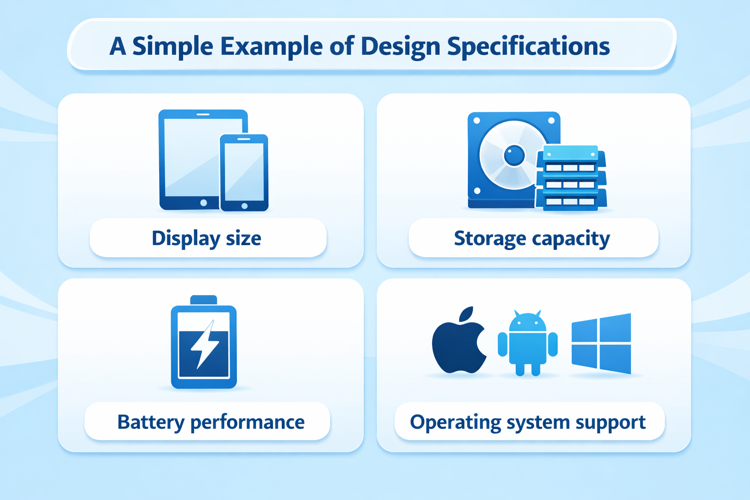
Take a smartphone as an example. A design specification translates the product idea into clear, testable requirements that guide the entire development process.
A typical specification might include:
- Display size and type: A 6.5 inch OLED screen with defined resolution and brightness levels
- Storage capacity: A minimum of 128 GB of internal storage for apps, media, and system files
- Battery performance: At least a full day of use under normal conditions such as browsing, calls, and media playback
- Operating system support: Compatibility with a specific version of the operating system and defined update policies
- Core functionality: Support for essential features like calling, messaging, camera use, and app installation
Each requirement is specific and measurable. That level of clarity removes guesswork for designers and engineers, making it easier to build, test, and validate the product against a shared set of expectations.
What Are Design Constraints?
Design constraints are the limits within which the product must be developed. They do not describe what the product should achieve, but what it must respect in order to be feasible.
Constraints usually come from outside the design team. Budgets, deadlines, regulations, available technology, and material supply all impose boundaries that shape what is realistically possible.
Ignoring constraints rarely leads to innovation. More often, it leads to stalled projects, rushed compromises, or products that never make it to market.
Common Types of Design Constraints
Budget Constraints
Financial limits affect nearly every decision, from materials and tooling to team size and testing depth. A design that cannot be produced at a sustainable cost is unlikely to succeed.
Time Constraints
Launch dates, seasonal windows, or contractual deadlines can restrict how much iteration and experimentation is possible.
Material and Supply Constraints
Availability, durability, weight, cost, and environmental impact of materials all influence design choices.
Regulatory and Compliance Constraints
Many industries operate under strict rules. Medical, financial, and consumer electronics products must meet defined standards before they can be released.
Technical Limitations
Current technology may not support every desired feature. Battery capacity, processing power, or infrastructure limits often shape final designs.
Constraints in Practice
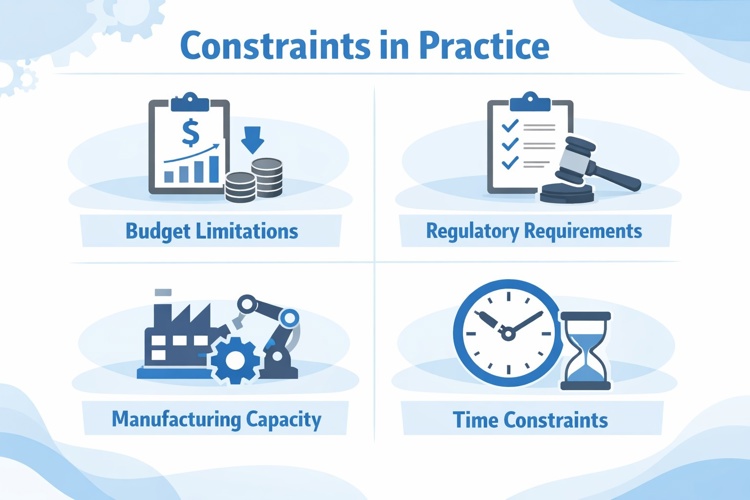
Returning to the smartphone example, design constraints shape many of the decisions made during development. They do not describe the ideal product, but they determine what can realistically be delivered within real-world limits.
Common constraints in this case might include:
- Budget limitations: Cost ceilings may rule out premium materials like ceramic or titanium, pushing the design toward more affordable alternatives
- Regulatory requirements: Limits on radio emissions, safety standards, and environmental regulations must be met before the device can be sold
- Manufacturing capacity: Available production methods and supplier capabilities can restrict design complexity or component choices
- Time constraints: A fixed launch date may reduce the number of testing cycles or limit how much refinement is possible
- Technical limitations: Current battery technology or chipset availability may cap performance expectations
None of these factors define what the smartphone should ideally be. Instead, they set the boundaries within which the design team must work, shaping how the original specifications are translated into a product that can actually be built, certified, and released.
How Specifications and Constraints Work Together
Design specifications and design constraints are not opposing forces. They work together to shape a product from idea to reality. Specifications define what the product is meant to achieve. Constraints define the environment in which those goals must be reached.
Specifications are usually shaped from the inside. They reflect user needs, business priorities, and the overall vision for the product. Constraints often come from the outside and are less flexible, shaped by budgets, regulations, timelines, and technical limits.
Strong product teams constantly balance the two. When specifications ignore constraints, projects tend to become unrealistic and difficult to deliver. When constraints dominate without clear specifications, products often lose focus and fail to deliver real value.
Flexibility vs Fixed Limits
Specifications are typically flexible, especially in the early stages of a project. Features can be refined, priorities can change, and requirements can evolve as teams learn more through research, testing, and feedback.
Constraints are usually far more rigid. Budgets rarely expand, regulatory rules do not change mid-project, and deadlines are often fixed. The real challenge is not choosing one over the other, but finding smart ways to meet the most important specifications while staying within these limits.

Turning Ideas Into Scalable, High-Quality Software With OSKI
At OSKI, we turn strong ideas into software that actually holds up in the real world. We work with teams that care about quality, long-term value, and clean engineering, not quick fixes. From early concept to deployment and ongoing growth, we combine technical depth with a clear understanding of business goals.
Our work spans cloud solutions, modern web and frontend development, and custom AI integrations. Whether it’s building scalable cloud architectures, designing intuitive user interfaces, or integrating machine learning into existing systems, we focus on solutions that are reliable, maintainable, and ready to evolve.
We believe great software is engineered with intention. That means thoughtful specifications, realistic constraints, and close collaboration at every stage. When those pieces come together, the result is software that performs well today and continues to deliver value tomorrow.
Practical Ways to Manage Specifications and Constraints
Balancing ambition with reality is one of the hardest parts of product development. A few practical strategies can make that balance easier to maintain:
- Leave room for adjustment. Instead of locking every value early, define acceptable ranges where possible. This gives teams flexibility when materials change or technical challenges appear.
- Prioritize what matters most. Not every feature carries the same weight. Clear prioritization helps teams make informed trade-offs when time or budget tightens.
- Involve the right people early. Bringing engineers, designers, and stakeholders into early discussions often prevents late-stage redesigns and misaligned expectations.
- Document and revisit assumptions. Specifications should not live in isolation. Keeping them visible and up to date helps everyone stay aligned as constraints evolve.
- Plan for risk. Supply issues, approval delays, or technical hurdles are common. Having fallback options in place reduces disruption when something goes wrong.
A Real-World Scenario: Building a Mobile App for the App Store
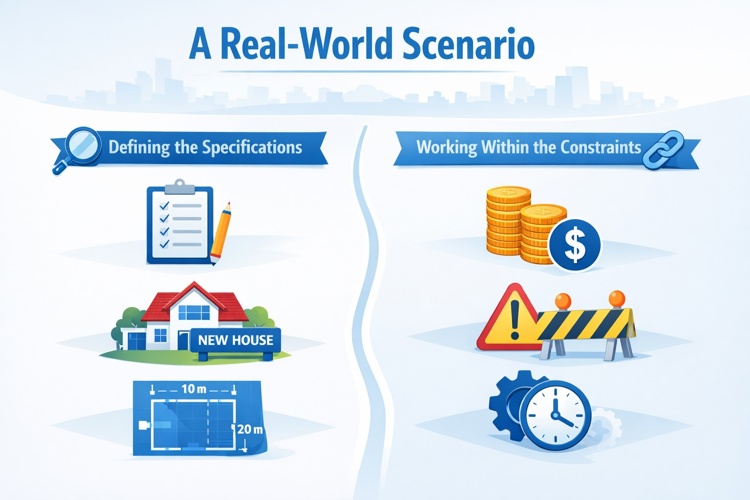
Consider a mobile application developed for release on the App Store. From the outside, the goal may sound simple. Build a useful app, submit it, and launch. In practice, the process is shaped by a careful balance between what the app is expected to deliver and the limits the team must work within.
1. Defining the Specifications
Design specifications in this scenario describe how the app should function, look, and perform from a user’s point of view. These often include smooth and intuitive navigation, strong data protection, and consistent behavior across current iOS devices with different screen sizes and hardware capabilities. Specifications also cover adherence to Apple’s interface guidelines, which influence layout, interaction patterns, and overall user experience.
Together, these requirements set a clear standard for quality and usability, giving the development team a shared target to work toward.
2. Working Within the Constraints
At the same time, the project is shaped by constraints that limit how those specifications can be implemented. A fixed development budget may restrict the use of certain tools or advanced features. A marketing-driven launch date can shorten testing cycles and reduce room for experimentation. App Store review rules impose strict requirements around privacy, data usage, and feature behavior, ruling out some ideas entirely.
Success depends on how well the team balances these forces. The app must feel polished and reliable to users while staying within budget, meeting compliance requirements, and shipping on schedule.
What Teams Often Learn from These Projects
Projects like this highlight how important clear communication and realism really are. When specifications and constraints are discussed openly from the start, teams are able to make better decisions and avoid last-minute surprises that slow everything down.
Clear expectations help everyone understand what success actually looks like, while honest trade-offs prevent frustration when limits appear. Continuous alignment keeps the project grounded as new information emerges, making it far more likely that the final product feels both appealing to users and practical to build, launch, and maintain.
Final Thoughts
Design specifications and design constraints play different roles, but neither works well in isolation. Specifications define the vision. Constraints keep that vision grounded.
The most successful products come from teams that respect both. They aim high, but they also understand the limits of time, money, technology, and regulation.
When specifications and constraints are treated as partners rather than opponents, product development becomes more focused, more efficient, and ultimately more successful.
Frequently Asked Questions
What is the main difference between design specifications and design constraints?
Design specifications describe what a product should do and how it should perform. Design constraints define the limits the team must work within, such as budget, time, regulations, or technology. One sets the goal, the other sets the boundaries.
Can design specifications change during a project?
Yes. Specifications are often refined as the team learns more through testing, feedback, or technical discovery. Changes are common, especially early on, as long as they stay aligned with project goals.
Are design constraints always fixed?
Most constraints are relatively fixed. Budgets, deadlines, and regulations usually do not change easily. Some technical constraints may shift over time, but they still limit what is realistically achievable at any given moment.
Why is it risky to ignore design constraints?
Ignoring constraints can lead to designs that are too expensive, impossible to build, or non-compliant with regulations. This often results in delays, rework, or projects being canceled entirely.
Do constraints limit creativity in product design?
Not necessarily. While constraints restrict options, they often encourage smarter problem-solving. Clear limits can push teams to focus on what truly matters and find more efficient or innovative solutions.


