

Dedicated Software Development Team Cost Guide 2026

Summary: A dedicated software development team typically costs between $8,000-$45,000 per month depending on location, team size, and expertise. Eastern European teams average $15,000-$28,000 monthly, while Asian teams range from $8,000-$18,000. Beyond base salaries, factor in infrastructure, management overhead, and hidden operational costs that can add 20-30% to quoted rates.
The math behind software team costs has changed dramatically. Companies wrestling with the question of dedicated development team pricing now face a landscape where traditional hiring models clash with global talent availability and AI-augmented workflows.
According to Gartner research cited in competitor content, businesses are expanding their use of external development resources. But here's the thing: most decision-makers still evaluate dedicated team costs by looking at hourly rates, then wonder why projects drift or quality slides.
This comprehensive breakdown cuts through the noise. Real numbers, transparent cost structures, and the hidden fees that can bloat a budget by 30% or more.
What Is a Dedicated Software Development Team?
A dedicated development team operates as an extension of internal operations. The provider handles recruitment, infrastructure, and HR logistics while the client maintains full control over daily workflows, priorities, and technical direction.
This model differs fundamentally from project-based outsourcing. Instead of handing off a spec and waiting for delivery, teams integrate directly into existing processes. Daily standups, sprint planning, direct communication—all standard practice.
The financial structure reflects this integration. Companies pay a predictable monthly cost per full-time engineer. No invoicing surprises based on changing scope or feature creep.
According to data from the U.S. Bureau of Labor Statistics, computer programmers held about 121,200 jobs in 2024, with the largest employer segment being computer systems design and related services at 31%. The median annual wage was $98,670 in May 2024. These domestic benchmarks help contextualize the cost advantages of dedicated offshore and nearshore arrangements.
Dedicated Development Team Cost Breakdown by Region
Geographic location remains the primary cost driver. Not just because of wage differences, but due to variations in operational overhead, tax structures, and provider maturity.
Regional Rate Comparison
|
Region |
Hourly Rate Range |
Monthly Cost (per developer) |
Primary Countries |
|---|---|---|---|
|
United States / Western Europe |
$100-$200+ |
$16,000-$32,000 |
US, UK, Germany, Netherlands, Switzerland |
|
Eastern Europe |
$50-$99 |
$8,000-$16,000 |
Ukraine, Poland, Czech Republic, Bulgaria |
|
Latin America |
$40-$80 |
$6,400-$12,800 |
Mexico, Brazil, Argentina, Colombia |
|
Asia |
$25-$65 |
$4,000-$10,400 |
India, Vietnam, Philippines, Pakistan |
These ranges reflect mid-level developer rates. Senior architects and specialized roles command 40-80% premiums. Junior developers cost 30-50% less but require more oversight.
Eastern Europe has emerged as a sweet spot for many North American and Western European companies. Hourly rates typically fall between $50-$99, delivering substantial savings without the communication friction common in more distant time zones.
Asian markets offer maximum cost efficiency. Research indicates that companies can hire top performers for approximately 50% of North American salaries in these regions. However, time zone differences require careful workflow planning.
Team Size Impact on Monthly Costs
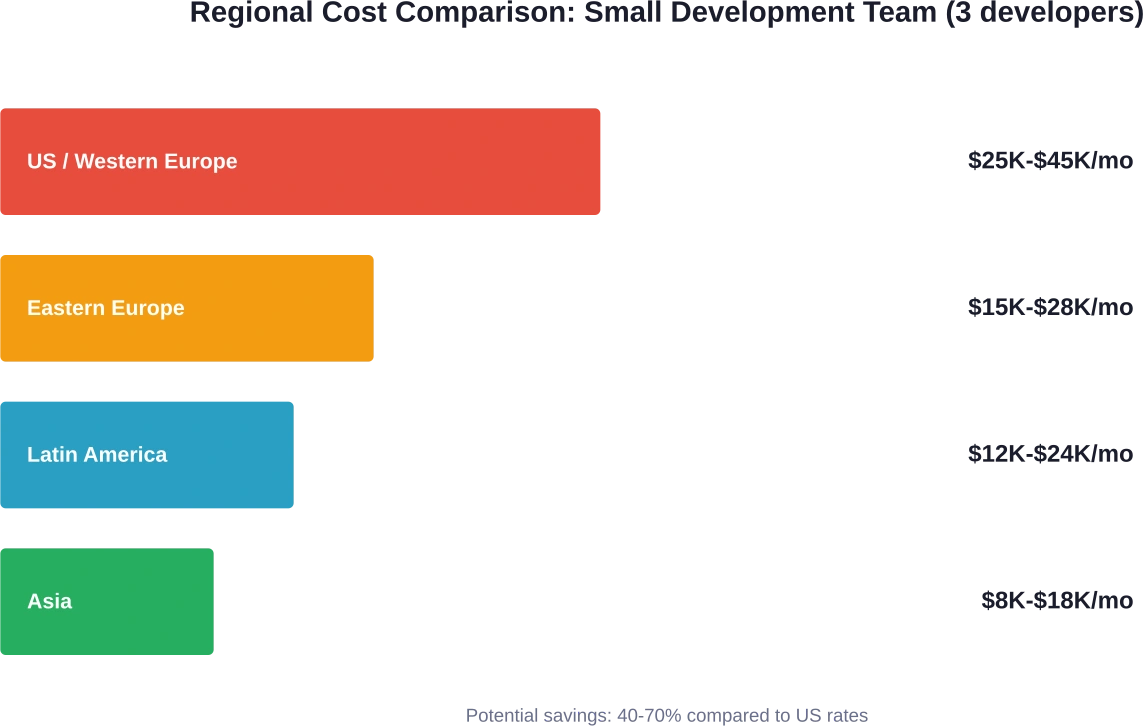
Real-world team compositions scale non-linearly. Smaller teams require proportionally higher management overhead, while larger teams introduce coordination complexity.
|
Team Size |
US/Western Europe |
Eastern Europe |
Asia |
|---|---|---|---|
|
Small (2-3 developers) |
$25,000-$45,000/month |
$15,000-$28,000/month |
$8,000-$18,000/month |
|
Medium (4-6 developers) |
$50,000-$90,000/month |
$30,000-$55,000/month |
$16,000-$36,000/month |
|
Large (7-10 developers) |
$85,000-$150,000/month |
$52,000-$92,000/month |
$28,000-$60,000/month |
According to Deloitte survey data, 70% of respondents listed cost reduction as the main reason for outsourcing development work. The regional arbitrage remains compelling even as global wage levels gradually converge.

Understand Dedicated Software Development Team Cost
Dedicated team cost depends on team size, required roles, and engagement duration. OSKI Solutions defines team composition based on project scope before calculating monthly investment. The estimate reflects developer rates, project management, and delivery structure. This gives you a predictable team budget.
Ready to Calculate Your Dedicated Team Budget?
Talk with OSKI Solutions to:
- define required roles and expertise
- estimate team size and timeline
- receive a clear dedicated development team cost estimate
👉 Request a dedicated software development team quote from OSKI Solutions.
Build Your Dedicated Development Team
Scale your engineering capacity with a dedicated team focused entirely on your product and business goals.
Role-Specific Cost Analysis
Not all developers cost the same. Specialization, seniority, and technology stack create significant rate variations within the same geographic region.
Developer Roles and Pricing Tiers
Junior developers handle straightforward implementation tasks. Mid-level engineers solve complex problems independently. Senior developers architect systems and mentor teams.
The premium for seniority isn't just about years of experience. Senior engineers reduce technical debt, make better architectural decisions, and accelerate junior team members. That efficiency often justifies the 60-100% rate premium.
Specialized roles command additional premiums:
- DevOps Engineers: 15-25% above standard developer rates
- Security Specialists: 20-35% premium
- Machine Learning Engineers: 30-50% premium
- Blockchain Developers: 40-60% premium in high-demand markets
- Mobile (iOS/Android) Specialists: 10-20% premium
According to Bureau of Labor Statistics data on computer and information technology occupations, employment in these fields is projected to grow much faster than average from 2024 to 2034, with about 317,700 openings projected each year, on average. This sustained demand puts upward pressure on rates across all engagement models.
Technology Stack Considerations
Legacy technology expertise often costs more due to scarcity. Developers proficient in modern, widely-adopted frameworks cost less because supply exceeds demand.
Common stacks and their relative cost positions:
- Lower cost tier: PHP, Ruby on Rails, Python/Django, React, Vue.js, Angular, Node.js
- Mid-range tier: Java enterprise, .NET/C#, Swift/iOS, Kotlin/Android, Go
- Premium tier: Scala, Elixir, Rust, specialized AI/ML frameworks, SAP, Salesforce customization
But here's what most budgets miss: technology stack affects ongoing costs beyond initial development. Rare stacks limit talent pools for replacements and reduce knowledge transfer efficiency.
Hidden Costs That Inflate Budgets
Quoted hourly rates tell only part of the story. Mature providers bundle operational components that would otherwise land on internal balance sheets.
Infrastructure and Tooling
Development teams require licenses, cloud infrastructure, testing environments, and collaboration tools. Reputable providers include these in monthly rates. Budget-focused providers itemize them separately.
Typical infrastructure costs per developer:
- Development tools and IDE licenses: $50-$200/month
- Cloud infrastructure for development/staging: $100-$500/month
- Project management and collaboration tools: $30-$100/month
- Code repository and CI/CD services: $20-$150/month
- Design and prototyping tools: $40-$100/month
These line items add $240-$1,050 per developer monthly. Multiply by team size and the numbers compound quickly.
Management Overhead
Dedicated teams require coordination. Project managers, team leads, and account managers facilitate communication between client stakeholders and development resources.
Management overhead typically adds 15-30% to base developer costs. Some providers absorb this into quoted rates. Others break it out as a separate line item.
Red flag: providers quoting rock-bottom rates but excluding management. The coordination burden falls back on internal teams, eroding the efficiency gains that justify outsourcing in the first place.
Onboarding and Knowledge Transfer
New team members require 2-6 weeks to reach full productivity. During this ramp-up period, teams consume resources while delivering limited output.
Smart providers build this into pricing models. Others charge full rates from day one regardless of actual productivity. Clarify this before signing contracts.
Turnover and Replacement Costs
Developer turnover in outsourcing arrangements averages 15-25% annually. When team members leave, replacements need onboarding and knowledge transfer.
Providers with strong retention practices (competitive compensation, career development, workplace culture) experience lower turnover. This stability reduces hidden costs that degrade long-term value.
Dedicated Team vs. Alternative Engagement Models
The dedicated team model competes with several alternatives. Each fits different scenarios and carries distinct cost structures.
|
Model |
Best For |
Cost Structure |
Key Advantage |
Main Drawback |
|---|---|---|---|---|
|
Dedicated Team |
Long-term projects, ongoing development |
Monthly per-developer rates |
Full control, team continuity |
Higher monthly commitment |
|
Project-Based |
Defined scope, fixed deliverables |
Fixed price for project |
Predictable total cost |
Scope change friction |
|
Staff Augmentation |
Filling specific skill gaps |
Hourly or monthly per resource |
Flexibility, quick scaling |
Less team cohesion |
|
In-House Hiring |
Core competency, proprietary tech |
Salary + benefits + overhead |
Maximum control and IP security |
Highest cost, longest ramp-up |
Cost Comparison: In-House vs. Dedicated Team
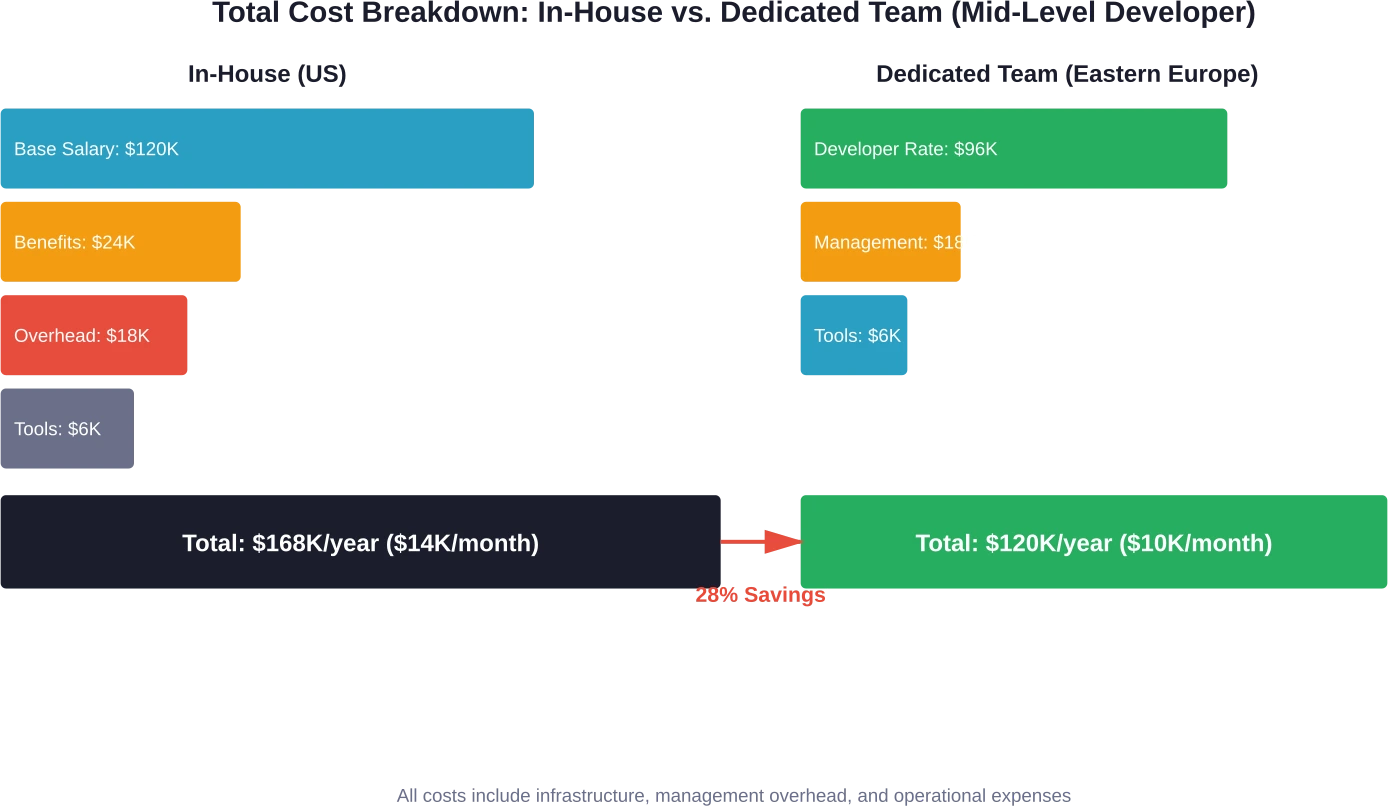
The true cost of an in-house developer extends far beyond salary. Benefits, payroll taxes, office space, equipment, training, and management overhead compound quickly.
Real talk: a $120,000 salary translates to $150,000-$180,000 in total annual cost once all factors are included. That's roughly $12,500-$15,000 monthly per developer.
Compare that to Eastern European dedicated team rates of $8,000-$16,000 monthly for comparable talent, infrastructure included. A senior software engineer commanding $120,000-$150,000 annually in Silicon Valley might cost 50% less when hired through a dedicated team partner in Southeast Asia. The math becomes even more compelling for Asian teams at $4,000-$10,400 monthly.
The arbitrage closes somewhat when factoring in coordination overhead and potential communication friction. But even with a 20% efficiency penalty, offshore dedicated teams deliver 30-50% cost savings versus domestic hiring.
How Provider Selection Affects Costs
Not all dedicated team providers operate identically. Business models, service tiers, and operational maturity create pricing variations within the same geographic market.
Provider Categories and Cost Positioning
Enterprise-class consultancies target Fortune 500 clients and major government contracts. Rates start at $400+ per hour, with some firms charging $900 hourly. Project minimums often exceed $750,000.
These premium providers deliver polish, process maturity, and established methodologies. For complex enterprise integrations with strict compliance requirements, the premium proves worthwhile. For startups and mid-market companies, the cost structure rarely makes sense.
Mid-market development companies occupy the sweet spot for most organizations. Rates fall between $150,000-$5,000,000 per project, with dedicated team arrangements running $50-$150 per hour depending on region and specialization.
Boutique agencies and smaller providers often quote the most competitive rates. However, capacity constraints and thinner operational buffers introduce risk. When key team members leave, smaller providers struggle to backfill quickly.
Evaluating Provider Value Beyond Hourly Rates
The lowest rate rarely delivers the best value. Several factors determine whether a provider will deliver ROI or become a resource drain:
- Developer retention rates: Providers with low turnover (under 15% annually) deliver better continuity. Ask for retention statistics during vendor evaluation.
- Bench depth: Can the provider quickly replace team members or scale up? Providers with shallow talent pools create bottlenecks when projects accelerate.
- Process maturity: Well-defined development processes, code review standards, and quality assurance protocols reduce defects and rework. These practices aren't free—they show up in rates—but they prevent expensive problems.
- Communication infrastructure: Time zone overlap, English proficiency, and communication tools matter enormously. Providers investing in these areas charge slightly more but deliver smoother collaboration.
According to a Sphere Partners analysis, 87% of IT businesses surveyed considered nearshore outsourcing specifically to reduce costs during economically tight times. But cost reduction alone doesn't determine outcomes—operational fit matters just as much.
Strategies to Optimize Dedicated Team Costs
Several approaches reduce costs without sacrificing quality. The key is identifying which levers create genuine efficiency versus false economy that increases downstream expenses.
Hybrid Geographic Models
Mixing team locations balances cost and capability. A common pattern: senior architects and project leads in nearshore locations (Latin America for US companies, Eastern Europe for EU organizations) with implementation teams in lower-cost offshore markets.
This structure maintains communication quality for critical decision-making while maximizing cost efficiency for execution-heavy work. The blended rate falls between pure nearshore and pure offshore, typically landing 15-25% lower than single-location nearshore arrangements.
Right-Sizing Team Composition
Teams skewed too senior waste budget on overqualified talent handling routine tasks. Teams too junior struggle with complex problems and require excessive oversight.
Optimal composition for most projects: 30% senior developers, 50% mid-level developers, 20% junior developers. This ratio balances capability and cost while maintaining knowledge transfer and mentorship paths.
Long-Term Commitments and Volume Discounts
Providers offer discounts for longer contract terms. A 12-month commitment typically yields 10-15% savings versus month-to-month arrangements. Two-year contracts can deliver 20-25% discounts.
The math works because providers gain revenue predictability and reduce sales costs. But lock-in creates risk if team fit proves poor or project requirements shift dramatically.
Balanced approach: negotiate a 6-month initial term with discount tiers kicking in at 12 and 24 months. This structure rewards long-term partnership while preserving flexibility during initial validation.
Scope Definition and Change Management
Poorly defined requirements create waste. Teams build features that get scrapped. Rework consumes hours without advancing functionality.
Investment in upfront requirements gathering and iterative refinement pays dividends. Even 40 hours of skilled business analysis can prevent hundreds of wasted development hours downstream.
Change management discipline matters just as much. Establishing clear processes for evaluating and prioritizing changes prevents scope creep that inflates costs.
ROI Calculation Framework
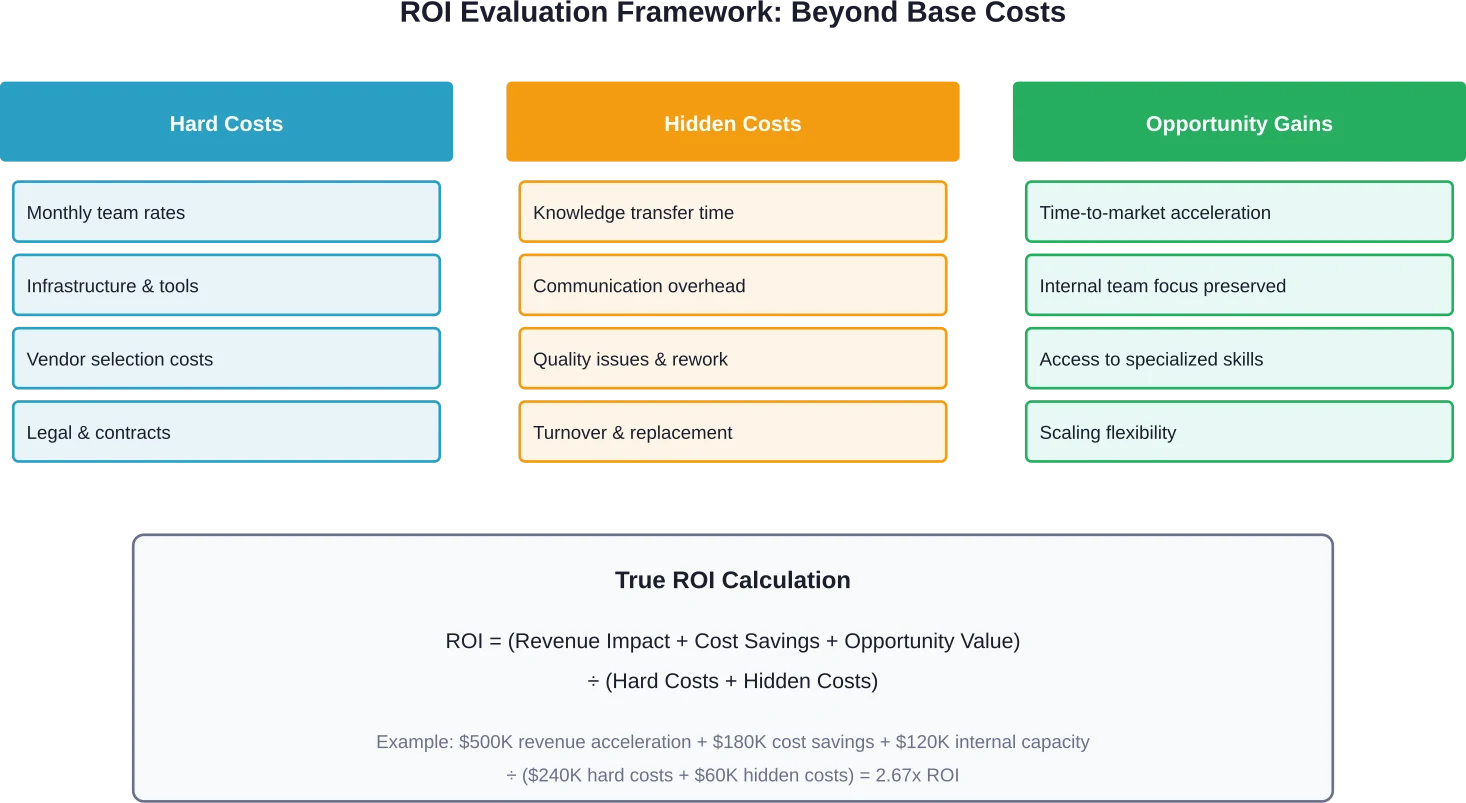
Evaluating dedicated team costs requires looking beyond monthly invoices. Several metrics capture true return on investment.
Time-to-Market Acceleration
Dedicated teams that reduce time-to-market by 30% don't just save development costs. They capture revenue earlier and gain competitive positioning advantages.
For a product expected to generate $2M in first-year revenue, a 3-month acceleration delivers approximately $500K in additional early-stage revenue. That dwarfs the incremental cost of a slightly more expensive but faster team.
Opportunity Cost of Internal Resources
Building teams internally consumes senior leadership time for recruiting, interviewing, and onboarding. For technical founders and CTOs, this represents opportunity cost—time not spent on architecture, strategy, or technical debt reduction.
Quantifying this: if a CTO earning $200K annually (roughly $100/hour) spends 200 hours on hiring, that's $20K in opportunity cost beyond the hard costs of recruiting fees and advertising.
Total Cost of Ownership
TCO calculations span the full engagement lifecycle:
- Vendor evaluation and selection costs
- Onboarding and knowledge transfer investment
- Monthly team costs (base rates plus overhead)
- Management time spent on coordination
- Quality issues and rework
- Turnover and replacement costs
Teams with lower monthly rates but higher defect rates often carry higher TCO. Rework typically costs 3-10x the initial implementation cost depending on when issues surface.
Contract Structure and Payment Models
How contracts are structured affects both cost predictability and risk distribution.
Monthly Retainer Model
The standard dedicated team arrangement operates on monthly retainers. Fixed cost per developer, paid regardless of exact hours worked (within reasonable full-time employment bounds).
This structure provides budget predictability. Finance teams can forecast expenses accurately. The tradeoff: paying for full capacity even during slower periods or holidays.
Hybrid Time-and-Materials
Some providers offer hybrid models where base capacity is retained monthly, but additional hours are billed at agreed hourly rates. This accommodates sprint-based workloads with variable intensity.
The flexibility costs slightly more—hourly overages typically run 10-20% above the blended monthly rate. But for projects with unpredictable demand spikes, the premium proves worthwhile.
Performance-Based Pricing
Emerging model: base monthly rate plus performance bonuses tied to delivery milestones, quality metrics, or business outcomes.
This aligns incentives beautifully but requires sophisticated measurement frameworks. Works best for mature relationships where trust and baseline performance are established.
When Dedicated Teams Make Financial Sense
The dedicated team model isn't universally optimal. Certain project characteristics and organizational contexts favor this engagement approach.
Long-term product development: Projects spanning 6+ months with ongoing feature development, maintenance, and iteration benefit from team continuity.
Complex domains requiring deep context: Healthcare, fintech, logistics, and other domains with intricate business rules reward teams that accumulate domain knowledge over time.
Rapid scaling requirements: Organizations needing to grow development capacity quickly without 3-6 month hiring cycles find immediate value in dedicated teams.
Cost-conscious scaling: Companies seeking 30-60% cost reduction versus domestic hiring while maintaining quality find the model compelling.
When Alternatives Work Better
Short-term projects with fixed scope suit project-based fixed-price engagements better. Clear requirements, definite end dates, and minimal expected changes favor this model.
Highly specialized one-time tasks (security audits, performance optimization, specific integrations) often work better with staff augmentation or freelance specialists.
Core competency development—building internal capabilities in strategic technology areas—justifies the premium of in-house hiring despite higher costs.
2026 Market Trends Affecting Costs
Several forces are reshaping dedicated team pricing dynamics heading into late 2026 and beyond.
AI-Augmented Development
According to IEEE Spectrum analysis, AI's impact on the job market is reshaping software engineering roles. However, experienced developers leveraging AI tools show significant productivity gains.
This creates bifurcation: junior developer rates face downward pressure as AI tools handle routine coding tasks. Senior developer rates increase as their judgment, architecture skills, and AI tool mastery become more valuable.
Some providers have begun integrating AI productivity gains into pricing. Rates may not drop proportionally, but delivery velocity increases—effectively reducing cost per feature even if cost per developer remains stable.
Global Wage Convergence
Wage levels in traditional offshore markets continue gradual upward movement. India, Vietnam, and Eastern European markets see annual wage inflation of 5-12% as tech sectors mature and living costs rise.
The arbitrage window narrows slowly over time. Markets that offered 80% savings a decade ago now deliver 50-60% savings. Still significant, but the trend continues.
Nearshore Premium Narrowing
Time zone alignment and cultural affinity command premiums in nearshore markets. However, improved communication tools and async work practices reduce these premiums gradually.
Latin American rates historically ran 20-30% above Asian markets for US companies. That gap has compressed to 10-20% as global work practices evolve.
Red Flags in Vendor Pricing
Certain pricing patterns signal potential problems:
- Rates significantly below market averages: If Eastern European developers quote at Asian market rates, question how they maintain quality and retain talent.
- Vague or missing overhead itemization: Providers unclear about what's included in quoted rates often surprise clients with additional fees later.
- No volume discounts or long-term incentives: Suggests provider prioritizes short-term revenue over partnership relationships.
- Resistance to transparency: Reluctance to discuss retention rates, bench depth, or developer compensation structures may indicate operational weaknesses.
- Aggressive upselling during initial discussions: Pushing premium services or larger teams before understanding actual requirements prioritizes vendor revenue over client needs.
Frequently Asked Questions
What is the average monthly cost of a dedicated software development team?
Average monthly costs range from $8,000-$45,000 depending primarily on location and team size. Eastern European teams of 2-3 developers typically cost $15,000-$28,000 monthly, while Asian teams run $8,000-$18,000. US-based teams cost $25,000-$45,000 for the same configuration. These figures include base developer salaries plus standard overhead for management, infrastructure, and tools.
How do dedicated team costs compare to hiring in-house developers?
In-house developers cost approximately $150,000-$180,000 annually when factoring in salary, benefits, payroll taxes, equipment, and overhead—roughly $12,500-$15,000 monthly per developer. Dedicated offshore teams deliver comparable talent for $4,000-$10,000 monthly, yielding 30-70% savings. Even accounting for coordination overhead and communication investments, most organizations achieve 25-50% cost reduction versus domestic hiring.
What hidden costs should I expect when hiring a dedicated development team?
Hidden costs include knowledge transfer time during onboarding (2-6 weeks of reduced productivity), management overhead (15-30% above base rates if not included), infrastructure and tooling ($240-$1,050 per developer monthly), turnover and replacement expenses (15-25% annual turnover is typical), and communication coordination costs. Reputable providers bundle most of these into quoted rates, while budget providers itemize them separately, potentially inflating total costs by 20-40%.
How long should I commit to a dedicated team engagement?
Most projects benefit from minimum 6-month engagements. Teams require 4-6 weeks to reach full productivity, making shorter engagements inefficient. Many providers offer 10-15% discounts for 12-month commitments and 20-25% for 24-month agreements. Balance long-term savings against flexibility needs—consider starting with 6 months, then extending with discount tiers once team fit is validated.
Which geographic region offers the best value for dedicated teams?
Eastern Europe currently offers the strongest balance of cost, quality, and communication for most Western companies. Rates run 40-60% below North American levels while maintaining time zone overlap and strong English proficiency. Asian markets provide maximum cost savings (60-75% below US rates) but require more deliberate communication planning. Latin America works well for US companies prioritizing cultural alignment despite 10-20% premiums over Asian markets.
How do I calculate ROI for a dedicated development team?
Calculate ROI by comparing total costs (monthly rates plus hidden costs) against value delivered (revenue impact from faster delivery, cost savings versus alternatives, and opportunity value of internal resources preserved). Example: if a team costing $300K annually accelerates launch by 3 months, capturing $500K in early revenue while saving $180K versus in-house hiring, ROI is approximately 2.3x. Include both hard financial returns and strategic benefits like scaling flexibility.
What team composition minimizes costs while maintaining quality?
Optimal composition typically follows a 30-50-20 split: 30% senior developers for architecture and complex problem-solving, 50% mid-level developers handling most implementation, and 20% junior developers for routine tasks under supervision. This ratio balances cost (senior developers cost 60-100% more than juniors) with capability and mentorship. All-senior teams waste budget on overqualified resources; all-junior teams struggle with complex problems and require excessive oversight.
Making the Investment Decision
Dedicated software development team costs represent significant budgetary commitments. But framing the decision purely as an expense misses the strategic value.
The question isn't whether a dedicated team costs $15,000 or $35,000 monthly. The question is whether that investment delivers $45,000-$105,000 in monthly value through accelerated delivery, higher quality, preserved internal capacity, and strategic flexibility.
Organizations succeeding with dedicated teams approach vendor evaluation systematically. They look beyond hourly rates to assess retention, communication infrastructure, process maturity, and technical capabilities. They structure contracts with balanced risk allocation and performance incentives.
Most critically, they measure success not by how little they spend but by business outcomes delivered per dollar invested.
The dedicated team model continues evolving. AI augmentation changes productivity equations. Global talent markets gradually converge. Communication tools reduce geographic friction.
But the fundamental value proposition remains: access to global talent at transparent, predictable costs while maintaining control over priorities and technical direction. For organizations willing to invest in the relationship infrastructure, dedicated teams deliver compelling returns.
Ready to explore dedicated development teams for your organization? Start by defining clear success metrics beyond cost—delivery velocity, defect rates, and business impact. Evaluate 3-5 providers across different geographic regions, focusing on operational transparency and cultural fit alongside pricing. Structure initial engagements as 6-month pilots with clear performance benchmarks before committing to long-term contracts.
The right dedicated team becomes an invisible extension of internal capabilities. The wrong team becomes an expensive coordination burden. Due diligence on the front end prevents costly mistakes on the back end.


