

Custom Website Development Cost Guide 2026

Quick Summary: Custom website development costs range from $500 to $300,000+ depending on complexity, features, and development partner. Small business sites typically cost $3,000-$15,000, e-commerce platforms $10,000-$50,000, and enterprise solutions $50,000-$300,000+. Ongoing maintenance adds $500-$5,000 annually.
Here's the uncomfortable truth about custom website development costs: that number someone threw at a networking event? Probably wrong for your situation.
Most businesses discover this the hard way. They budget for a "simple website," then watch costs balloon when reality hits—integrations break, custom features emerge, and suddenly that $5,000 estimate becomes $15,000.
But here's what actually matters: understanding where money goes and why. Because custom website development isn't just about picking a number. It's about matching investment to business goals, knowing which corners can be cut, and spotting the hidden costs that derail budgets.
This guide breaks down real-world pricing across different website types, development partners, and complexity levels. No fluff. Just the numbers businesses actually pay in 2026.
Understanding Custom Website Development in 2026
Custom website development means building a site from scratch or heavily modifying existing frameworks to meet specific business requirements. Unlike template-based solutions where design and functionality come pre-packaged, custom development creates unique solutions.
The distinction matters for budgeting. Template sites might cost $500-$3,000. Custom builds start around $5,000 and climb rapidly based on requirements.
According to the U.S. Bureau of Labor Statistics, the median annual wage for computer programmers was $98,670 in May 2024, with computer systems design and related services employing 31% of these professionals. These salary benchmarks directly influence development costs—particularly when hiring U.S.-based teams.
What Makes a Website "Custom"
Custom development involves unique design work, specialized functionality, or complex integrations that templates can't handle. Common scenarios include:
- Proprietary business logic or workflows
- Custom database architectures
- Third-party API integrations (CRM, ERP, payment processors)
- Advanced user authentication and permissions
- Unique UI/UX requirements that match brand identity
The more custom features required, the higher the cost. A site pulling real-time inventory data from multiple external systems costs substantially more than one displaying static product information.
Price Ranges by Website Type
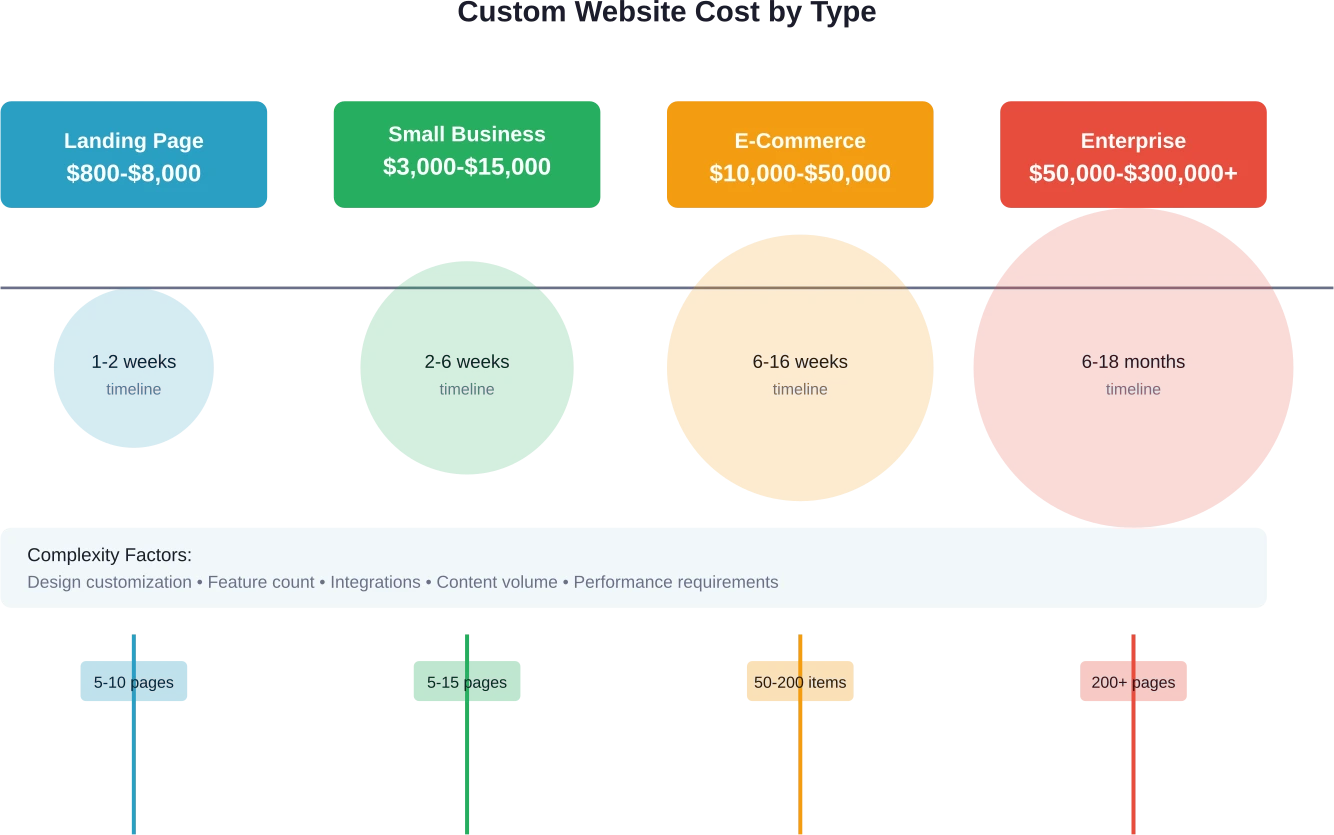
Different website categories carry different baseline costs. Here's what businesses actually pay:
Landing Page Development
Single-page sites focused on one conversion goal. Think product launches, campaign microsites, or lead capture pages.
Basic freelancer builds run $800-$3,000. Agency projects with strategy, copywriting, and A/B testing infrastructure cost $2,500-$8,000.
Timeline: 1-2 weeks for straightforward builds.
Small Business Websites
Typically 5-15 pages covering services, about, contact, and maybe a blog. These sites establish credibility and generate leads but don't handle transactions.
Cost range: $3,000-$15,000 depending on design complexity and custom features. A basic brochure site hits the lower end. Custom animations, advanced forms, or CRM integration push toward $15,000.
Most small business websites land between $5,000-$10,000 when working with experienced developers.
E-Commerce Platforms
Online stores handling product catalogs, inventory, checkout flows, and payment processing.
Basic Shopify or WooCommerce setups with light customization: $3,000-$10,000. Fully custom e-commerce platforms with proprietary features: $10,000-$50,000+.
The complexity multiplier here is massive. A store with 50 products and standard checkout might cost $8,000. Add custom product configurators, subscription billing, multi-vendor functionality, or complex shipping logic, and costs easily hit $30,000-$50,000.
SaaS and Web Applications
Software platforms delivered through web browsers. These aren't traditional websites—they're applications with user dashboards, data processing, and complex functionality.
Entry-level MVP builds: $25,000-$75,000. Full-featured platforms: $75,000-$300,000+.
Development time stretches to 3-8 months minimum. These projects require backend developers, database architects, security specialists, and extensive testing.
Enterprise Solutions
Large-scale websites for corporations, often with multiple sub-sites, content management systems, user portals, and extensive integrations.
Starting point: $50,000. Complex builds easily exceed $300,000.
According to the Bureau of Labor Statistics, overall employment in computer and information technology occupations is projected to grow much faster than the average for all occupations from 2024 to 2034, with about 317,700 openings projected each year. This growing demand influences market rates for enterprise development work.
|
Website Type |
Cost Range |
Timeline |
Page Count |
Best For |
|---|---|---|---|---|
|
Landing Page |
$800 - $8,000 |
1-2 weeks |
1 page |
Campaigns, product launches |
|
Small Business |
$3,000 - $15,000 |
2-6 weeks |
5-15 pages |
Local services, consultants |
|
E-Commerce |
$10,000 - $50,000+ |
6-16 weeks |
50-200+ products |
Online retail, subscriptions |
|
SaaS/Web App |
$25,000 - $300,000+ |
3-8 months |
Complex functionality |
Software platforms, tools |
|
Enterprise |
$50,000 - $300,000+ |
6-18 months |
200+ pages |
Large corporations, portals |

Estimate Your Custom Website Development Cost
Custom website cost depends on design depth, functionality, and integration requirements. OSKI Solutions defines structure and technical stack before calculating development hours. The estimate includes frontend development, backend logic if required, and testing. You get a clear project budget based on defined scope.
Ready to Plan Your Custom Website Budget?
Talk with OSKI Solutions to:
- define structure and required features
- estimate design and development effort
- receive a detailed custom website cost estimate
👉 Request a custom website development quote from OSKI Solutions.
Custom Websites Built to Scale
From corporate sites to complex web platforms, we create secure, scalable solutions tailored to your business goals.
Development Partner Cost Structures
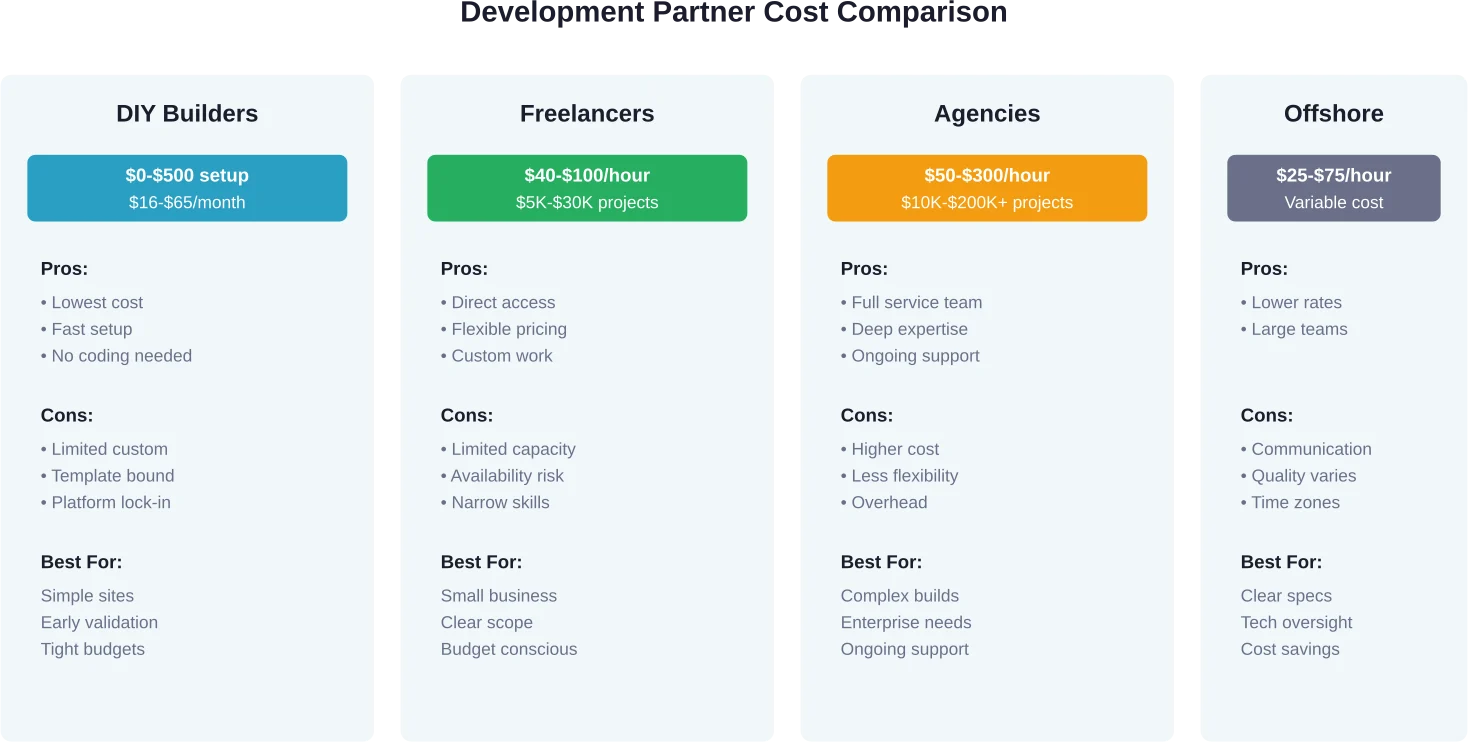
Who builds the site matters as much as what gets built. Different development partners bring different cost structures, expertise levels, and trade-offs.
DIY Website Builders
Platforms like Wix, Squarespace, and Shopify offer template-based solutions with drag-and-drop editors.
Setup costs: $0-$500 for theme purchases and apps. Monthly fees: $16-$65 for hosting and platform access.
Timeline: Days to 2 weeks for simple sites.
The catch? Limited customization. These platforms work for straightforward needs but hit walls quickly when requirements get specific. Custom functionality often requires expensive apps or isn't possible at all.
Freelance Developers
Independent contractors working solo or in small partnerships.
U.S.-based freelancers charge $40-$100+ per hour. Project costs for small to intermediate custom sites: $5,000-$30,000.
Advantages: Lower overhead, direct communication, and flexibility. Disadvantages: Limited bandwidth, potential availability issues, and narrower skill sets compared to agencies.
Freelancers work well for businesses with clear requirements and some technical knowledge. Projects needing extensive strategy, design, and ongoing support often outgrow freelance capacity.
Development Agencies
Full-service teams with designers, developers, project managers, and strategists.
Small to mid-size agencies: $50-$150 per hour. Large agencies or specialized firms: $150-$300+ per hour.
Project minimums often start at $10,000-$15,000. Enterprise projects routinely exceed $100,000.
Agencies bring structure, redundancy, and diverse expertise. When a developer takes vacation, someone else covers. When a project needs UX research, they have specialists.
The premium pays for reduced risk and professional project management. But smaller businesses might find agency overhead excessive for straightforward builds.
Offshore Development Teams
Teams based in regions with lower labor costs—Eastern Europe, Asia, Latin America.
Rates: $25-$75 per hour depending on location and expertise.
Cost savings look attractive on paper. A project costing $30,000 domestically might run $15,000-$20,000 offshore.
Real talk: offshore development introduces communication complexity, timezone coordination, and quality variability. Some offshore teams deliver excellent work. Others produce technically functional sites that miss nuances in design, UX, and business logic.
Offshore works best when businesses have detailed specifications, technical oversight, and patience for iteration.
Cost Factors That Actually Matter
Two websites that look similar from the outside can have wildly different price tags. Understanding the underlying cost drivers helps explain why.
Design Complexity and Customization
Template modifications with minor styling changes: minimal cost impact. Fully custom designs with unique layouts, animations, and brand-specific elements: substantial cost increase.
Custom illustration work, photography, video production, and interactive elements all add expense. A site using stock photos and standard layouts costs significantly less than one with commissioned photography and custom graphics.
Functionality and Feature Set
Every feature adds development time. User registration systems, search functionality, filtering systems, booking calendars, payment processing, member areas—each represents hours or days of development work.
Complex features like real-time chat, custom calculators, API integrations, or multi-step workflows can add thousands to project costs.
Content Volume and Migration
A 10-page site costs less to build than a 100-page site. More pages mean more templates, more content entry, more testing, and more complexity.
Migrating content from existing sites adds work. If the old site has 500 blog posts, someone needs to transfer that content, fix broken links, redirect old URLs, and ensure proper formatting. Content migration alone can add $2,000-$10,000 to project costs.
Third-Party Integrations
Each external system connection requires development time, testing, and often ongoing maintenance. Common integrations include:
- CRM systems (Salesforce, HubSpot)
- Email marketing platforms (Mailchimp, Constant Contact)
- Payment processors (Stripe, PayPal)
- Analytics tools (Google Analytics, custom dashboards)
- Inventory management systems
- Shipping calculators
Simple integrations might add $500-$2,000. Complex multi-system integrations can add $5,000-$20,000+.
Mobile Responsiveness and Performance Optimization
Modern websites must work across devices—phones, tablets, desktops, and everything in between. Responsive design is standard practice now, but doing it well requires additional development and testing time.
Performance optimization—making sites load quickly—involves image optimization, code minification, caching strategies, and content delivery networks. Basic optimization comes standard. Advanced performance work for high-traffic sites adds cost.
Security and Compliance Requirements
Sites handling sensitive data need enhanced security measures. HIPAA compliance for healthcare, PCI compliance for payment processing, GDPR for EU users—each adds development requirements.
Security features like SSL certificates, secure authentication, data encryption, and regular security audits all carry costs. Basic security comes standard. Enhanced security for regulated industries adds $2,000-$10,000+.
Hidden Costs Most Businesses Miss
The sticker price for website development rarely tells the whole story. These ongoing and ancillary costs catch businesses off guard:
Domain Registration and Renewal
$10-$50 annually for standard domains. Premium domains cost more—sometimes thousands or tens of thousands if purchasing from existing owners.
Hosting and Infrastructure
Shared hosting: $5-$25 per month. Works for small sites with limited traffic.
VPS or dedicated hosting: $50-$500+ monthly. Required for higher traffic or custom server configurations.
Cloud hosting (AWS, Google Cloud, Azure): $100-$1,000+ monthly depending on traffic and resource needs.
Web hosting options range from institutional solutions to custom server setups. Custom domains can cost additional amounts beyond base server costs, and websites require ongoing infrastructure investment.
SSL Certificates
Basic SSL certificates are often free through hosting providers. Extended validation certificates for e-commerce sites: $100-$300 annually.
Content Creation and Copywriting
Development budgets often exclude content creation. But sites need words, images, and videos.
Professional copywriting: $100-$300 per page. Photography: $500-$5,000+ for a shoot. Video production: $1,000-$10,000+ per video.
Many businesses discover too late they budgeted for building the site but not filling it with quality content.
Ongoing Maintenance and Updates
Websites aren't set-and-forget investments. They require ongoing attention:
- Software updates (CMS, plugins, security patches)
- Content updates and additions
- Bug fixes and troubleshooting
- Performance monitoring
- Security monitoring
- Backup management
According to competitor research, most small businesses spend $500-$5,000 annually on maintenance, updates, and improvements they didn't initially budget for.
Maintenance contracts typically cost 15-25% of initial development costs annually. A $20,000 site might require $3,000-$5,000 yearly maintenance.
SEO and Marketing
Building the site is one thing. Getting people to visit is another.
Basic on-page SEO optimization might be included in development. Ongoing SEO campaigns, content marketing, and paid advertising require separate budgets.
Third-Party Tools and Subscriptions
Many sites rely on paid tools: email marketing platforms, analytics tools, form builders, appointment schedulers, chat widgets.
These subscriptions add up. Budget $50-$500+ monthly depending on tool requirements.
Website Development Pricing Models
How developers structure pricing affects both total cost and payment timing.
Hourly Billing
Pay for actual time spent. Rates vary by developer skill level and location.
Advantages: Flexibility for changing requirements. Only pay for work done.
Disadvantages: Unpredictable final costs. Requires trust that developers work efficiently.
Hourly billing works best for ongoing maintenance, small updates, or projects with unclear scope.
Fixed-Price Projects
Single price for defined deliverables. Common for website development once requirements are clear.
Advantages: Predictable budgeting. Clear scope definition upfront.
Disadvantages: Less flexibility for changes. Scope creep causes friction.
Fixed pricing requires detailed specifications before work begins. Changes mid-project trigger additional costs.
Package-Based Pricing
Pre-defined tiers—Bronze, Silver, Gold—with set features at set prices.
Advantages: Simple decision-making. Clear feature comparisons.
Disadvantages: May include unnecessary features or exclude needed ones.
Package pricing works for standardized website types but struggles with unique requirements.
Value-Based Pricing
Price based on business value delivered rather than time or features.
A website generating $100,000 in annual revenue justifies higher investment than one generating $10,000. Some developers price accordingly.
This model aligns developer incentives with business outcomes but requires transparency about business metrics.
Retainer Arrangements
Ongoing monthly fee for maintenance, updates, and support.
Common after initial development completes. Provides predictable costs and priority access to developer time.
Typical retainers: $500-$3,000 monthly depending on site complexity and support needs.
Regional Cost Variations
Location significantly impacts development costs. Not just offshore versus domestic, but regional variations within the United States.
Major Tech Hubs
San Francisco, New York, Seattle, Boston. Higher cost of living translates to higher rates.
Agency rates in these markets: $150-$350+ per hour. Freelancers: $75-$150+ per hour.
Secondary Markets
Austin, Denver, Portland, Atlanta. Growing tech scenes with slightly lower costs.
Agency rates: $100-$200 per hour. Freelancers: $50-$100 per hour.
Smaller Markets
Midwest and smaller cities. Lowest domestic rates.
Agency rates: $75-$150 per hour. Freelancers: $40-$75 per hour.
The Bureau of Labor Statistics data shows computer systems design and related services employ 31% of computer programmers, with median pay of $98,670 in May 2024. These salary benchmarks vary regionally, directly affecting development costs.
Budgeting Strategies for Different Business Sizes
Smart budgeting matches website investment to business stage and growth plans.
Startups and Early-Stage Companies
Limited budgets, uncertain product-market fit, rapid iteration needs.
Strategy: Start minimal. Use templates or simple custom builds. Budget $2,000-$10,000 initially.
Calculating startup costs before launch helps ensure adequate funding. Website development represents one piece of overall startup expenses.
Focus spending on core functionality. Skip fancy animations and complex features until the business model proves viable.
Plan for iteration. Startups change direction frequently. Invest in flexibility rather than polish.
Established Small Businesses
Proven business model, steady revenue, specific website goals.
Strategy: Invest in professional custom development. Budget $5,000-$25,000 depending on complexity.
At this stage, the website serves as a primary business tool—generating leads, establishing credibility, or directly driving sales. The investment justifies higher quality and more features.
Include maintenance and marketing budgets from the start. Plan for $1,000-$5,000 annually in ongoing costs.
Mid-Size Companies
Multiple products or services, larger teams, integration requirements.
Strategy: Full-service agency partnership. Budget $25,000-$100,000 for comprehensive solutions.
At this scale, websites integrate with CRM systems, marketing automation, customer portals, and other business systems. Complexity increases accordingly.
Consider phased rollouts. Build core functionality first, then add advanced features in subsequent phases. This spreads costs over time and allows learning from user feedback.
Enterprise Organizations
Large teams, complex requirements, multiple stakeholder groups.
Strategy: Enterprise agency partnership or internal development team. Budget $100,000-$500,000+ for major website projects.
Enterprise projects span months or years and involve extensive planning, multiple rounds of user testing, security audits, and compliance verification.
Budget should include post-launch optimization, ongoing development, and dedicated support resources.
How to Evaluate Development Quotes
Comparing proposals requires more than looking at bottom-line numbers. Here's what actually matters:
Scope Clarity
Does the proposal detail exactly what's included? Vague proposals like "modern responsive website" leave too much open to interpretation.
Look for specific deliverables: page count, feature list, design rounds, revision allowances, timeline, and what happens when requirements change.
Timeline Realism
Suspiciously short timelines often mean rushed work or missed deadlines. Complex projects need adequate time.
Generally speaking, small business sites require 4-8 weeks minimum. E-commerce platforms need 8-16 weeks. Enterprise projects span months.
Post-Launch Support
What happens after launch? Many proposals include 30-90 days of warranty support for bugs.
Clarify what's covered under warranty versus what costs extra. Training, documentation, and ongoing maintenance should be explicitly addressed.
Portfolio Relevance
Review the developer's past work. Do they have experience with similar projects? Sites in comparable industries?
A developer experienced in e-commerce builds different sites than one focused on corporate brochure sites.
Technology Choices
What platform or framework will they use? Is it well-supported and commonly used, or a proprietary system that locks in the relationship?
Open-source platforms (WordPress, Drupal, Shopify) offer flexibility to switch developers if needed. Custom proprietary systems create dependency.
Communication and Process
How does the developer communicate? How often? Through what channels?
What's their design and feedback process? How many revision rounds are included?
Clear communication processes prevent misunderstandings that blow up budgets.
When to Build Custom Versus Using Templates
The custom-versus-template decision significantly impacts costs.
Template Solutions Make Sense When:
- Requirements fit standard patterns (basic business site, simple online store)
- Budget is constrained (under $5,000)
- Speed to launch matters more than uniqueness
- The business is still validating product-market fit
Templates provide 80% of what most small businesses need at 20% of custom development costs.
Custom Development Makes Sense When:
- Unique functionality requirements that templates can't handle
- Brand differentiation depends on unique design
- Complex integrations with existing business systems
- Scalability requirements beyond template limitations
- The website drives significant business value
Custom website projects for clients with unique needs should emphasize mobile responsiveness, accessibility, search engine optimization, and security—key indicators of when custom work becomes necessary.
The Middle Ground: Customized Templates
Start with a quality template or theme, then customize extensively.
This approach costs more than basic templates ($3,000-$10,000) but less than full custom development. Works well for businesses that need some unique features but can accept standard patterns for most functionality.
Cost-Cutting Strategies That Actually Work
Tight budgets don't automatically mean cheap-looking websites. These strategies reduce costs without sacrificing quality:
Phase the Project
Launch with core features, then add advanced functionality later. Spreading costs over time eases cash flow pressure.
A business might launch with a basic brochure site for $5,000, then add e-commerce capabilities six months later for another $8,000.
Provide Your Own Content
Writing copy and sourcing images yourself saves thousands. Developers charge premium rates for content creation because it's time-intensive.
If internal resources can handle content, allocate developer time to technical work where their expertise matters most.
Limit Custom Design Elements
Custom illustrations, animations, and complex layouts add cost. Prioritize custom work where it matters most—homepage, key landing pages—and accept more standard designs elsewhere.
Reduce Page Count
Do you really need 20 separate service pages, or could you consolidate to 5 more comprehensive pages?
Fewer pages mean less design work, less content, less testing, and lower costs.
Simplify Integrations
Each third-party integration adds complexity. Question whether integrations are truly necessary or just nice-to-have.
Sometimes manual processes work fine initially, with automation added later once the business grows.
Accept Some Template Elements
Even in custom builds, using pre-built components for standard features (contact forms, blog layouts) reduces development time.
Do Your Own Testing
Thorough user acceptance testing takes time. Taking on some testing work yourself—checking links, reviewing content, testing forms—reduces billable hours.
Red Flags in Development Proposals
Some warning signs indicate potential problems:
Dramatically Low Pricing
Quotes far below market rates often mean cut corners, inexperienced developers, or misunderstood requirements.
If the market rate for a project is $15,000 and someone quotes $3,000, something's wrong.
Vague Scope Definitions
Proposals lacking specific deliverables leave room for endless disputes about what's included.
No Contract or Terms
Professional developers use contracts specifying deliverables, timelines, payment terms, and what happens when things go wrong.
Requesting Full Payment Upfront
Standard payment structures involve deposits (25-50%) with remaining payments tied to milestones. Requesting 100% upfront is unusual and risky.
Poor Communication During Sales Process
If getting clear answers during the sales process is difficult, expect worse once the project starts.
Pressure Tactics
"This price is only available if you sign today" or similar urgency-creating tactics suggest prioritizing closing deals over delivering value.
No Portfolio or References
Established developers have past work to show and clients willing to provide references. New developers should still have portfolio projects, even if personal or pro bono.
Planning for Long-Term Website Costs
The initial build is just the beginning. Plan for these ongoing expenses:
Year One Post-Launch
Expect to spend 20-30% of initial development costs on refinements, feature additions, and fixes.
A $20,000 site might require another $4,000-$6,000 in first-year adjustments as the business learns what works.
Annual Maintenance and Hosting
$500-$5,000 annually depending on site complexity. This covers hosting, domain renewal, security updates, backup monitoring, and minor content updates.
Content Updates and Marketing
Fresh content keeps sites relevant and supports SEO. Budget for ongoing blog writing, page updates, or content marketing efforts.
DIY content creation costs time. Outsourced content: $500-$2,000+ monthly for regular publishing.
Platform and Technology Updates
Every few years, major platform updates or redesigns become necessary. Technology ages, design trends evolve, and business needs change.
Plan for major refresh cycles every 3-5 years. These mini-redesigns typically cost 30-50% of the original build.
Feature Additions and Optimization
Successful websites evolve. New features get added, existing features get optimized, and continuous improvement drives better results.
Growing businesses should budget ongoing development resources—whether monthly retainers or periodic project work.
Questions to Ask Before Starting Development
These questions clarify requirements and prevent costly misunderstandings:
About the Project Scope
- What specific business goal does this website need to achieve?
- Who is the target audience and what actions should they take?
- What websites do we like and why?
- What features are absolutely required versus nice-to-have?
- How much content exists, and how much needs creation?
- What integrations with other systems are needed?
About the Developer
- What similar projects have you completed?
- Can we speak with past clients?
- Who exactly will work on our project?
- What's your communication process and frequency?
- How do you handle change requests?
- What happens if we're not satisfied with the work?
About Timeline and Process
- What's the realistic timeline from kickoff to launch?
- What could delay the project?
- What do you need from us and when?
- How many revision rounds are included?
- What's the testing and quality assurance process?
About Costs and Contracts
- What's included in the quoted price?
- What costs extra?
- What's the payment schedule?
- What happens if the project goes over budget or timeline?
- Who owns the code and design files?
- What post-launch support is included?
Frequently Asked Questions
How much does a basic custom website cost in 2026?
A basic custom business website typically costs between $3,000 and $15,000 depending on design complexity, page count, and features. Simple 5-10 page sites with standard functionality land around $5,000-$8,000 when working with freelancers or small agencies. More complex designs, custom features, or agency partnerships push costs toward the higher end.
What's the difference between template and custom website costs?
Template-based websites using platforms like Wix or Squarespace cost $0-$500 for setup plus $16-$65 monthly for platform fees. Custom website development starts around $3,000-$5,000 and can exceed $300,000 for complex enterprise builds. Templates offer faster deployment and lower costs but limited customization. Custom development provides unlimited flexibility and unique functionality but requires significantly higher investment.
How much should I budget annually for website maintenance?
Plan for $500-$5,000 annually for website maintenance depending on site complexity. Small business sites with basic needs might spend $500-$1,500 yearly. E-commerce platforms or sites requiring frequent updates typically need $2,000-$5,000 annually. This covers hosting, security updates, backups, minor content changes, and troubleshooting. Many businesses budget 15-25% of initial development costs for annual maintenance.
Do offshore developers actually save money?
Offshore developers charge lower hourly rates ($25-$75) compared to U.S.-based developers ($40-$150+), potentially reducing project costs by 30-50%. However, savings come with trade-offs including communication challenges, timezone coordination, potential quality variability, and longer timelines. Projects with detailed specifications and technical oversight succeed better with offshore teams. Projects requiring significant collaboration or nuanced understanding of U.S. market preferences often see eroded savings from extended timelines and revisions.
How long does custom website development take?
Timeline varies by project complexity. Simple small business sites require 2-6 weeks. E-commerce platforms need 6-16 weeks. Complex web applications take 3-8 months. Enterprise websites span 6-18 months or longer. These timelines assume clear requirements, timely client feedback, and no major scope changes. Delays commonly occur when content isn't ready, feedback cycles extend, or requirements change mid-project.
What hidden costs do businesses typically overlook?
Common overlooked costs include content creation ($100-$300 per page for copywriting), professional photography ($500-$5,000+), ongoing hosting beyond basic shared plans ($50-$500+ monthly for adequate performance), third-party tool subscriptions ($50-$500 monthly), SSL certificates for e-commerce ($100-$300 annually), and post-launch refinements (typically 20-30% of initial development costs in year one). Most small businesses end up spending $500-$5,000 annually on maintenance and improvements they didn't initially budget.
When should a business invest in custom development versus templates?
Templates work well for businesses with standard requirements, budgets under $5,000, need for quick launch, or those still validating business models. Custom development makes sense when businesses need unique functionality that templates can't support, require brand differentiation through distinctive design, need complex integrations with existing systems, have scalability requirements beyond template limitations, or depend on the website for significant revenue generation. Many businesses successfully start with templates then migrate to custom solutions as they grow.
Making the Investment Decision
Website development costs vary dramatically because websites serve dramatically different purposes.
A local service business needs a credible online presence. A $5,000-$10,000 investment typically suffices.
An e-commerce company depends on its website for revenue. Investing $20,000-$50,000 in proper platform development, user experience optimization, and performance makes business sense.
An enterprise organization uses its website as a comprehensive digital ecosystem. $100,000-$300,000+ investments reflect the complexity and business impact.
The question isn't "what do websites cost?" It's "what does this particular website need to accomplish, and what investment justifies that value?"
According to the Bureau of Labor Statistics, software developers earn a median of $133,080 per year, and the field is projected to add 267,700 new jobs from 2024 to 2034—demonstrating strong demand and competitive pricing in the development market.
Smart businesses start with clear goals, honest budget assessments, and realistic timelines. They plan for ongoing costs, not just initial builds. They choose development partners based on fit and capability, not just lowest price.
And they recognize that while building a website costs money, the right website generates value far exceeding its development cost.
Next Steps for Your Website Project
Ready to move forward? Here's a practical action plan:
Define Your Requirements
Document what the website needs to accomplish, who will use it, what features are required, and what success looks like. Clarity here prevents expensive changes later.
Set a Realistic Budget
Based on the ranges discussed here, establish a budget that matches project scope. Include 20-30% buffer for unexpected needs.
Business planning resources exist to help frame website investment within overall business budgets and startup cost calculations.
Research Potential Developers
Review portfolios, check references, and interview 3-5 potential development partners. Look for relevant experience and communication fit, not just price.
Start with Strategy
Before diving into design, invest time in strategic planning. Who are users? What are their needs? How does the website support business goals? This groundwork prevents expensive revisions.
Plan for the Long Term
Budget for ongoing maintenance, content updates, and future enhancements. Websites are living assets requiring continued investment, not one-time projects.
The right website investment matches business stage, growth plans, and revenue potential. Start with clarity about goals and constraints. Choose partners carefully. Plan realistically. And recognize that quality development costs money—but delivers value.


