

Custom Software Development Cost: 2026 Pricing Guide

Key Takeaways: Custom software development costs in 2026 range from $15,000 for simple applications to $500,000+ for enterprise solutions. Hourly rates vary by location: North American developers charge $80-$250/hour, while offshore teams cost $25-$80/hour. The final price depends on project complexity, team composition, timeline, and ongoing maintenance requirements.
Getting a straight answer about custom software development cost feels impossible. Search online and the responses range from "it depends" to price ranges so broad they're meaningless.
But here's the thing. Businesses need real numbers to make informed decisions, not vague estimates that don't help with budgeting.
This guide breaks down what custom software actually costs in 2026, using real pricing data from the industry. No fluff, no evasive answers—just the benchmarks needed to plan a software project properly.
What Custom Software Development Actually Costs in 2026
The short answer? Projects start around $15,000 and scale up based on what's being built.
According to current market data, here's how costs break down by project complexity:
|
Project Complexity |
Timeline |
Cost Range (2026) |
Typical Examples |
|---|---|---|---|
|
Simple Application |
1-3 months |
$15,000 - $50,000 |
Basic mobile app, simple web portal, MVP prototype |
|
Medium Complexity |
4-8 months |
$50,000 - $150,000 |
Business management system, e-commerce platform, custom CRM |
|
Complex System |
9-16 months |
$150,000 - $500,000 |
Enterprise resource planning, multi-platform solutions, integrated systems |
|
Enterprise-Grade |
16+ months |
$500,000+ |
Large-scale infrastructure, government systems, complex integrations |
These ranges reflect North American pricing. The same project built offshore costs 40-60% less, though that comes with tradeoffs we'll cover shortly.
A simple CRM requiring 300 development hours at $50/hour runs about $15,000. But a multi-platform application needing 1,500+ hours at $100/hour? That jumps to $150,000 or more.

Estimate Your Custom Software Development Cost
Custom software requires defined architecture and feature scope. OSKI Solutions structures system logic before calculating effort. The estimate includes development, testing, and deployment stages. You receive a realistic project budget based on requirements.
Ready to Budget Your Custom Software Project?
Talk with OSKI Solutions to:
- define technical architecture
- estimate development effort
- receive a full cost breakdown
👉 Request a custom software development quote from OSKI Solutions.
Custom Software Built for Your Business
We design and develop scalable, secure software tailored to your unique workflows, goals, and infrastructure.
How Developers and Agencies Price Their Work
Most software development follows hourly billing, though fixed-price projects exist for well-defined scopes.
Current hourly rates vary significantly by location and expertise level:
|
Team Type |
Hourly Rate (CAD) |
Hourly Rate (USD Equivalent) |
|---|---|---|
|
Senior Developers (Canada) |
$80 - $160 |
$60 - $120 |
|
Local Agency (North America) |
$125 - $250 |
$95 - $190 |
|
Offshore Developers |
$25 - $80 |
$20 - $60 |
According to the Bureau of Labor Statistics, computer programmers in the U.S. earned a median annual wage of $98,670 in 2024, which translates to $47.44 per hour.
The computer systems design and related services industry was the largest employer of computer programmers, employing 31%.
The Six Factors That Determine Custom Software Cost
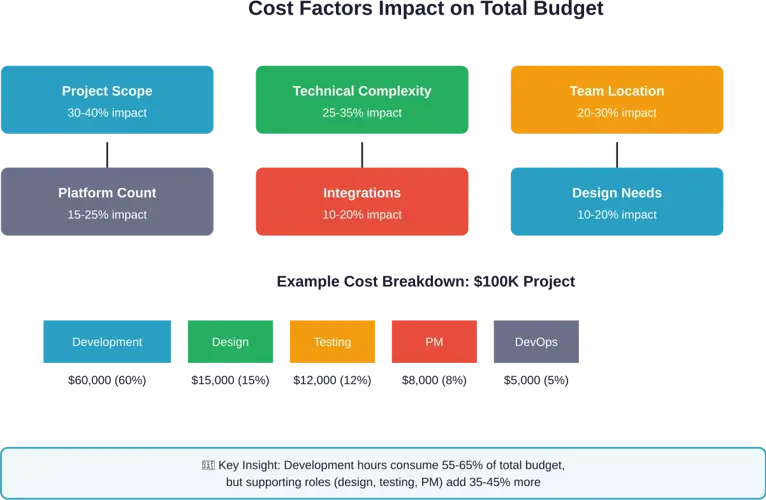
Project complexity drives pricing more than anything else. But six specific factors determine where a project lands within those ranges.
1. Project Scope and Feature Set
More features mean more development hours. A basic user authentication system differs dramatically from one with multi-factor authentication, single sign-on integration, and role-based permissions.
Each feature requires design, development, testing, and documentation. The cost compounds quickly as the feature list grows.
2. Technical Complexity and Architecture
Not all features cost the same to build. Real-time data synchronization costs more than basic CRUD operations. AI and machine learning components add substantial expense:
- Basic data sync: $5,000 - $15,000
- Enterprise-grade real-time collaboration: $50,000+
- Machine learning integration: $30,000 - $100,000+
The underlying architecture matters too. Microservices-based systems cost more upfront than monolithic applications, though they offer better scalability long-term.
3. Platform Requirements
Building for one platform costs less than supporting multiple. A web-only application requires fewer development hours than one that needs iOS, Android, and web versions.
Each additional platform adds development, testing, and maintenance overhead. Cross-platform frameworks can reduce costs, but native development on multiple platforms roughly doubles or triples the base price.
4. Design Requirements
Custom UI/UX design adds 10-20% to project costs. Pre-built templates and component libraries reduce design expenses but limit customization.
Complex animations, custom illustrations, and extensive user testing push costs higher. A basic functional interface costs significantly less than a polished, brand-specific design system.
5. Integration Needs
Software rarely exists in isolation. Integration with existing systems, third-party APIs, payment processors, or legacy databases adds complexity.
Simple API integrations might add $3,000-$8,000. Complex enterprise system integrations can add $20,000-$100,000 depending on the systems involved and data transformation requirements.
6. Team Composition and Location
Where the development team operates dramatically affects pricing. North American and Western European developers command premium rates. Eastern European, Latin American, and Asian developers cost less.
Team size matters too. A two-person team working part-time costs less per month than a full dedicated team, though the project takes longer to complete.
Regional Pricing Differences: Where Location Changes Everything
Geography remains one of the biggest cost variables in software development. The same project costs vastly different amounts depending on where the team sits.
North American development teams—particularly in tech hubs like Toronto, San Francisco, New York, or Seattle—charge premium rates. Local agencies in Canada typically bill $125-$250 per hour, while senior individual developers charge $80-$160 per hour.
That premium buys several advantages. Local developers understand regional business practices, comply with local data regulations (like Canada's PHIPA for healthcare data), and work in compatible time zones. Communication happens in real-time without waiting overnight for responses.
Offshore development teams in Eastern Europe, Latin America, or Asia charge $25-$80 per hour. A project costing $150,000 with a North American team might cost $60,000-$90,000 offshore.
But lower rates come with challenges. Time zone differences complicate communication. Language barriers can cause misunderstandings. Quality varies widely between offshore providers. Project management requires more oversight.
According to a Reddit discussion, one business owner reported spending six months and $30,000 on custom software, only to face unexpected maintenance fees ($650/month or $7,800 annually) that weren't clearly disclosed in the original contract.
That said, many offshore teams deliver excellent work at significant savings. The key is thorough vetting and clear contracts that specify all ongoing costs upfront.
The Hidden Costs Nobody Mentions Upfront
The development quote rarely tells the full story. Several additional costs emerge during and after the project that businesses need to budget for.
Maintenance and Support
Software requires ongoing maintenance. Bugs need fixing, security patches need applying, and hosting infrastructure needs monitoring.
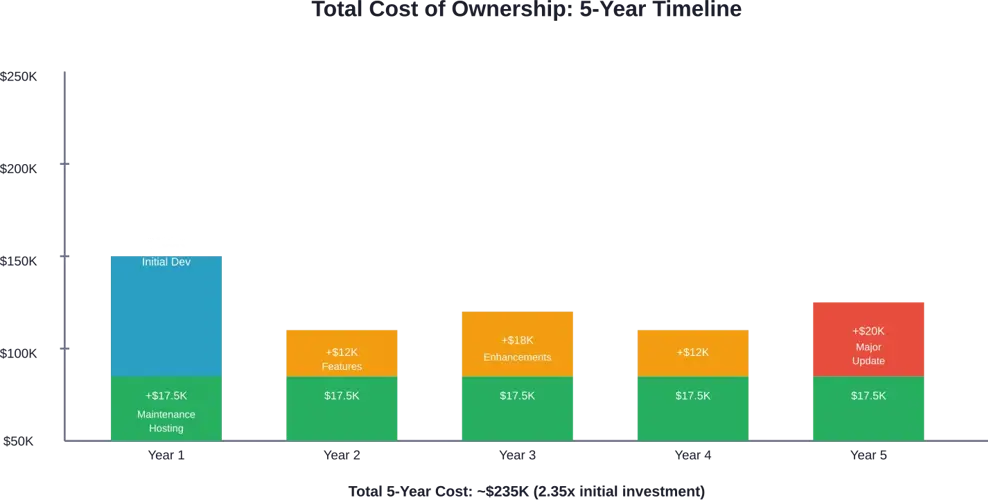
Annual maintenance typically costs 15-25% of the initial development price. A $100,000 project needs $15,000-$25,000 per year for basic upkeep.
Some contracts include 30-90 days of post-launch support. After that, separate maintenance agreements kick in—sometimes at rates not clearly disclosed during initial negotiations.
Infrastructure and Hosting
Cloud hosting costs money. AWS, Azure, Google Cloud, and other platforms charge based on usage, storage, and data transfer.
A small application might cost $50-$200 monthly to host. Larger systems with significant traffic can run $1,000-$10,000+ per month depending on scale and performance requirements.
Third-Party Services and APIs
Most modern software integrates with external services—payment processors, email delivery, SMS notifications, mapping services, analytics platforms.
These services charge monthly or usage-based fees. A payment processor takes 2-3% of transactions. Email services charge per message sent. These costs scale with usage and aren't always estimated accurately during initial planning.
Licensing and Subscriptions
Development tools, libraries, and frameworks sometimes require commercial licenses. Database systems, monitoring tools, and security services add monthly expenses.
Enterprise-grade tools cost substantially more than developer-tier options. Budget $200-$2,000+ monthly for the various subscriptions needed to keep production software running.
Future Enhancements
Software rarely stays static. User feedback drives feature requests. Business needs evolve. Technology changes.
Plan to spend 20-40% of the original development cost annually on enhancements and new features if the software remains actively used.
Custom Software vs. Off-the-Shelf Solutions
Before committing to custom development, consider whether existing software meets the need.
Off-the-shelf solutions cost less upfront. SaaS platforms charge monthly subscription fees—typically $50-$500 per user depending on the tool. Implementation takes days or weeks instead of months.
But off-the-shelf software comes with limitations. Features can't be modified. Workflows might not match business processes. Data lives on third-party servers. Monthly costs accumulate over time.
Custom software costs more initially but offers complete control. Every feature aligns with specific needs. The business owns the code and data. Long-term costs can be lower than perpetual SaaS subscriptions.
Generally speaking, custom development makes sense when:
- Existing solutions don't support critical workflows
- The business requires unique features competitors don't need
- Data security or regulatory compliance demands on-premise hosting
- Long-term total cost of ownership favors building over subscribing
- The software provides competitive advantage through differentiation
For commodity functions—accounting, email, project management—existing tools usually work better. For core business processes that differentiate the company, custom development often delivers better ROI.
How Project Timeline Affects Cost
Development speed and project cost connect directly. Rushing a project costs more. Extending timelines reduces monthly burn but increases total cost.
A project estimated at six months with a four-person team can't simply be compressed to three months by doubling the team. Adding developers creates communication overhead and coordination costs that offset some efficiency gains.
Real talk: Most projects take 20-30% longer than initial estimates. Requirements evolve during development. Unexpected technical challenges emerge. Third-party dependencies cause delays.
Budget timeline contingency into cost projections. A $100,000 project with a six-month timeline might actually take seven or eight months and cost $115,000-$130,000.
Conversely, rushing to meet aggressive deadlines forces shortcuts—cutting testing, reducing documentation, accumulating technical debt. These shortcuts cost more later when bugs need fixing or features need extending.
Breaking Down a Real Project: Cost Estimation Example
Consider a mid-sized e-commerce platform with custom inventory management integration. Here's how costs break down:
Project Requirements:
- Customer-facing e-commerce website
- Custom admin dashboard
- Integration with existing inventory system
- Payment processing integration
- Order management and fulfillment tracking
- Customer account management
Estimated Timeline: 6-7 months
Team Composition:
- 1 Project Manager (25% time)
- 1 UI/UX Designer (50% time, first 2 months)
- 2 Full-stack Developers (100% time)
- 1 QA Tester (50% time, last 3 months)
- 1 DevOps Engineer (25% time)
|
|
|
|
|
|---|---|---|---|
|
Project Manager |
280 |
$120/hr |
$33,600 |
|
UI/UX Designer |
320 |
$100/hr |
$32,000 |
|
Full-stack Developers (×2) |
2,240 |
$110/hr |
$246,400 |
|
QA Tester |
480 |
$75/hr |
$36,000 |
|
DevOps Engineer |
280 |
$130/hr |
$36,400 |
|
Total Development Cost |
3,600 |
$384,400 |
Additional Costs:
- Payment gateway setup and integration: $5,000
- SSL certificates and security audit: $3,000
- Cloud infrastructure setup: $4,000
- Stock photography and assets: $2,000
- Project contingency (15%): $57,660
Total Project Cost: $456,060
This falls within the complex system range for enterprise-level solutions. Ongoing costs include $2,500/month for hosting, $70,000-$90,000 annually for maintenance and updates.
How to Reduce Custom Software Development Cost Without Sacrificing Quality
Several strategies can lower development expenses without compromising the final product.
Start with an MVP
Minimum viable products include only core features needed to launch. Additional capabilities get added in later phases based on user feedback.
An MVP costs 40-60% less than a full-featured version. It validates assumptions before investing in nice-to-have features that users might not value.
Use Existing Frameworks and Libraries
Building everything from scratch takes longer. Modern frameworks, component libraries, and pre-built modules speed development significantly.
Open-source solutions exist for most common functionality—authentication, payment processing, data visualization, file handling. Leveraging these tools reduces custom coding requirements.
Prioritize Features Ruthlessly
Not every feature needs to ship in version 1.0. Categorize requirements into must-have, should-have, and nice-to-have tiers.
Build must-haves first. Add other features in subsequent releases after validating that the core functionality works and users actually want the additional capabilities.
Consider Hybrid Teams
Combining local project management with offshore development can balance cost and communication. A local PM maintains close contact with stakeholders while an offshore team handles implementation.
This approach reduces the pure hourly rate while maintaining better oversight than fully offshore arrangements.
Document Requirements Thoroughly
Scope changes mid-project cost significantly more than getting requirements right upfront. Each change requires redesign, recoding, retesting.
Invest time in detailed requirements documentation before development starts. Use prototypes and mockups to validate understanding. Reducing mid-project changes saves substantial money.
Questions to Ask Before Signing a Development Contract
Protecting against unexpected costs and project failures requires asking the right questions before work begins.
What exactly does the quoted price include? Get line-item breakdowns. Understand what's covered and what costs extra. Clarify whether hosting, third-party services, and post-launch support are included.
What happens if the project takes longer than estimated? Determine whether the quote is fixed-price or time-and-materials. Understand who pays for timeline overruns and what contingencies exist.
Who owns the code and intellectual property? Ensure contracts clearly state that the business owns all developed code, designs, and related IP. Some developers retain ownership, which limits future flexibility.
What testing and quality assurance is included? Understand the testing approach—unit testing, integration testing, user acceptance testing. Clarify who performs testing and what happens when bugs are found.
What does post-launch support look like? Get specifics on included support duration and scope. Understand ongoing maintenance costs, response time commitments, and how bug fixes are handled.
How are change requests handled? Establish a clear process for scope changes. Understand how changes are estimated, approved, and billed.
What happens if we need to switch developers mid-project? Clarify code documentation standards and handover procedures. Ensure the business can transition to a different team if needed.
Industry-Specific Cost Considerations
Certain industries face unique development requirements that affect pricing.
Healthcare: HIPAA compliance, patient data security, and electronic health records integration add complexity. Healthcare software typically costs 30-50% more than comparable non-regulated applications. Local developers in regions like Toronto who understand Canadian privacy laws (PHIPA) help avoid expensive re-work.
Financial Services: Banking regulations, PCI compliance for payment data, fraud prevention, and financial reporting requirements increase development costs. Security audits and penetration testing add $15,000-$50,000 to project budgets.
E-commerce: Payment gateway integration, inventory management, shipping calculations, and tax handling across jurisdictions create complexity. Multi-currency and international shipping support add 20-30% to base costs.
Manufacturing: ERP integration, supply chain management, and IoT device connectivity for equipment monitoring require specialized expertise. Real-time data processing from factory floor equipment adds substantial technical complexity.
Understanding industry-specific requirements during the estimation phase prevents costly surprises later.
The Real ROI of Custom Software Development
Cost matters, but return on investment matters more. Custom software that delivers substantial business value justifies higher development expenses.
According to Total Economic Impact studies commissioned by Forrester (including studies on Figma Dev Mode showing 351% ROI and GitHub Enterprise Cloud showing 376% ROI), properly implemented development tools and platforms can deliver measurable productivity gains and cost savings.
Benefits to measure against development costs include:
- Time saved through process automation
- Revenue generated through new capabilities
- Costs reduced by eliminating manual work
- Customer satisfaction improved through better experiences
- Competitive advantages gained through unique features
A $150,000 custom CRM that saves each salesperson five hours per week generates substantial ROI. With ten salespeople earning $75,000 annually, that's 2,600 saved hours per year worth roughly $93,000 in labor value—paying back the investment in under two years.
Software that enables new revenue streams or improves conversion rates can pay for itself even faster.
Government Contract Pricing for Software Development
Government agencies access software development through various contract vehicles that establish pricing frameworks.
The U.S. General Services Administration manages several contract programs for federal IT procurement. Governmentwide Acquisition Contracts (GWACs) provide pre-competed, multiple-award contracts that give federal agencies access to IT solutions from vetted vendors.
Programs like OASIS+ offer labor-based contracting with defined labor categories and rates. The Multiple Award Schedule (MAS) program provides another avenue for government software procurement.
Government contract rates typically fall within or slightly below commercial rates for comparable services, though compliance requirements and paperwork add administrative overhead for vendors.
For agencies considering custom software, these contract vehicles streamline procurement while ensuring competitive pricing and vendor qualifications.
Employment and Salary Data for Software Developers
Understanding the employment market for software developers provides context for development costs.
According to Bureau of Labor Statistics data published in August 2025, computer programmers earned a median annual wage of $98,670 in 2024, which translates to approximately $47.44 per hour for full-time employment.
Computer programmers held about 121,200 jobs in 2024, with the computer systems design and related services industry as the largest employer of computer programmers, employing 31% of these professionals.
Overall employment in computer and information technology occupations is projected to grow much faster than the average for all occupations from 2024 to 2034, with about 317,700 openings projected each year.
These employment statistics explain why contract and agency rates run $80-$250 per hour—significantly above base employment wages. Contractors must cover their own benefits, overhead, business expenses, and profit margin, resulting in effective billing rates that are 1.5-3x the equivalent salaried wage.
Common Mistakes That Increase Development Costs
Certain pitfalls consistently drive up software development expenses. Avoiding these saves substantial money.
- Inadequate Requirements Gathering: Vague requirements lead to misunderstandings, rework, and scope creep. Time invested upfront in detailed requirements documentation pays off through fewer expensive changes later.
- Choosing Price Over Quality: The cheapest developer rarely delivers the best value. Low rates often correlate with inexperience, poor communication, or cut corners. Fixing problems from a budget developer often costs more than hiring qualified professionals initially.
- Ignoring Maintenance Costs: Budgeting only for initial development without planning for ongoing maintenance creates financial stress when post-launch costs emerge.
- Building Too Many Features: Feature bloat increases development time and complexity while often adding functions users don't need. Focus on core value first.
- Poor Project Management: Weak oversight leads to timeline slippage, miscommunication, and inefficient development. Good project management costs money but saves more through better coordination.
- Inadequate Testing: Skimping on quality assurance puts buggy software into production. Fixing bugs post-launch costs 5-10x more than catching them during development.
- Unclear Ownership Terms: Contracts that don't clearly establish code ownership can trap businesses into dependency on specific developers or lead to expensive legal disputes.
Frequently Asked Questions
How much does it cost to build custom software in 2026?
Custom software development costs range from $15,000 for simple applications to $500,000+ for enterprise-grade systems in 2026. Most business applications fall in the $50,000-$150,000 range. The final cost depends on complexity, features, platforms, integrations, and team location. North American developers charge $80-$250 per hour, while offshore teams cost $25-$80 per hour.
What factors have the biggest impact on custom software development cost?
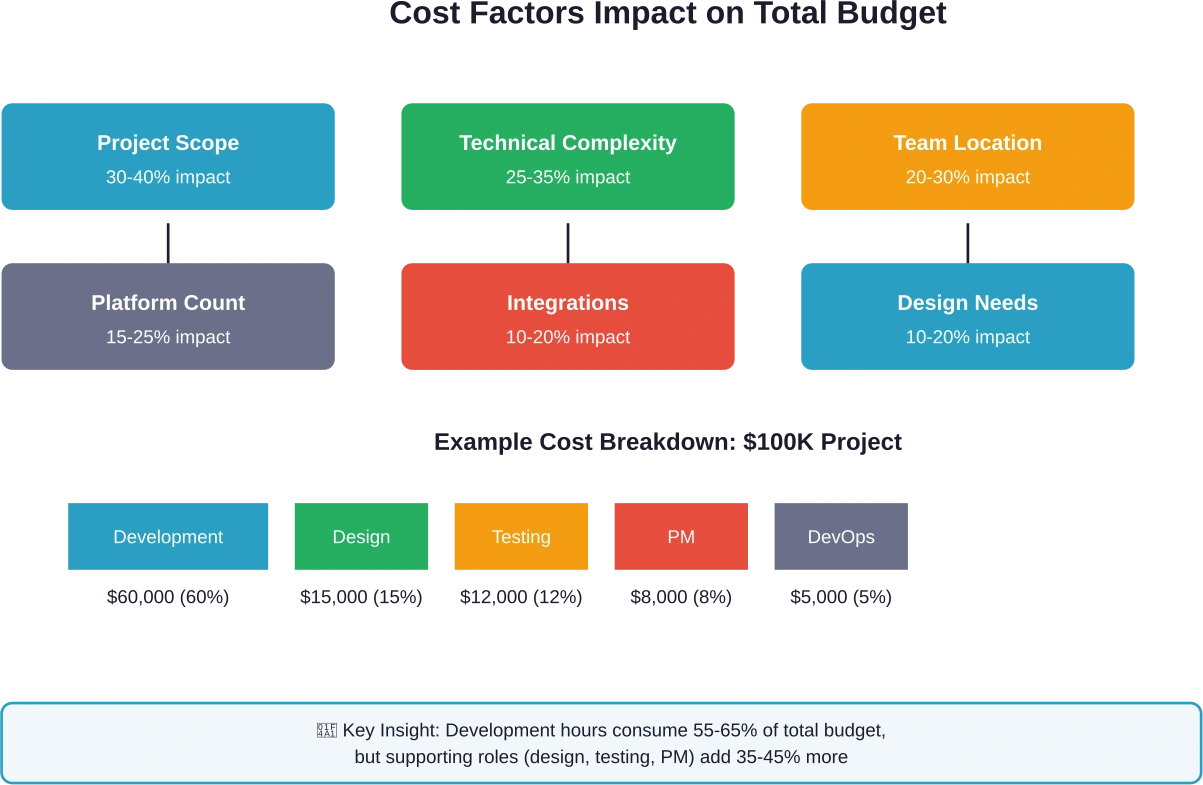
Project scope and feature count drive costs more than any other factor, typically accounting for 30-40% of price variation. Technical complexity follows at 25-35% impact, then team location at 20-30%. Platform requirements, integration needs, and design complexity each contribute 10-20% to total cost variation. A simple mobile app costs vastly less than an enterprise system with AI components and multiple integrations.
Is it cheaper to hire offshore developers or local teams?
Offshore development costs 40-60% less per hour than North American teams. However, total project cost depends on more than hourly rates. Time zone differences, communication challenges, and quality variations can reduce the effective savings. Local developers understand regional regulations, work in compatible time zones, and often require less project management overhead. The best approach depends on project complexity and internal management capacity.
What ongoing costs should I budget for after the software launches?
Plan to spend 15-25% of initial development cost annually on maintenance and support. This covers bug fixes, security patches, hosting, and minor updates. Budget an additional $200-$2,000 monthly for infrastructure, third-party services, and tool subscriptions. For active feature development and enhancements, allocate another 20-40% of the original development cost per year. A $100,000 project typically needs $40,000-$65,000 annually for full ongoing support and enhancement.
How long does custom software development typically take?
Simple applications take 1-3 months, medium complexity projects need 4-8 months, and complex systems require 9-16 months or longer. Most projects run 20-30% over initial timeline estimates due to requirement changes, technical challenges, and coordination delays. An MVP can launch in 2-4 months, with additional features added in subsequent phases. Rush projects rarely finish faster and typically cost 30-50% more due to coordination overhead and required shortcuts.
Should I build custom software or use existing SaaS solutions?
Use existing SaaS solutions for commodity functions like email, accounting, and project management. Consider custom development when existing tools don't support critical workflows, when unique features provide competitive advantage, when data security requires on-premise hosting, or when long-term total cost favors ownership over perpetual subscriptions. Custom software costs more initially but offers complete control and potentially lower lifetime costs for core business processes.
How can I reduce custom software development costs without sacrificing quality?
Start with an MVP containing only essential features—this reduces initial cost by 40-60%. Use existing frameworks, libraries, and pre-built components instead of coding everything from scratch. Prioritize features ruthlessly and defer nice-to-have functionality to later releases. Document requirements thoroughly before development starts to minimize expensive mid-project changes. Consider hybrid teams with local project management and offshore development to balance cost and communication.
Making the Investment Decision
Custom software development represents a significant financial commitment. The costs are real, substantial, and extend beyond the initial development phase.
But for businesses where software enables competitive advantage, automates critical processes, or creates new revenue opportunities, the investment delivers measurable returns.
The key is approaching the decision with realistic expectations. Understand what the project will actually cost—including ongoing expenses. Evaluate whether the benefits justify the investment. Choose partners based on capabilities, not just price. Plan for contingencies.
Armed with accurate cost information and clear understanding of the factors that drive pricing, businesses can make informed decisions about custom software development. The investment might be substantial, but when aligned with strategic objectives and executed well, custom software delivers value that far exceeds its cost.
Ready to explore what custom software could do for your business? Start by documenting your specific requirements, identifying your budget range, and researching developers with relevant experience in your industry. Request detailed proposals that break down all costs—initial development, ongoing maintenance, and infrastructure expenses.
The right software solution, priced fairly and built well, becomes a strategic asset that drives growth for years to come.


