

How Much Does It Cost to Integrate Zoho CRM and What Drives the Budget?

Zoho CRM integration often sounds simpler than it turns out to be. The platform is flexible, the APIs are well documented, and there are plenty of connectors available. That combination creates an expectation that integration is mostly a setup task with a predictable price tag. In reality, costs vary widely, even for projects that look similar on paper.
The real cost of integrating Zoho CRM depends less on the software itself and more on how your systems, data, and workflows behave in the real world. Clean data, clear processes, and limited customization keep budgets under control. Complex automation, legacy systems, and custom logic push costs up quickly. This article breaks down what companies typically pay to integrate Zoho CRM, what drives those numbers, and where teams most often underestimate the effort involved.
Typical Zoho CRM Integration Cost Ranges
Based on recent projects, partner pricing, and market benchmarks, Zoho CRM integration costs in 2026 usually fall into these ranges:
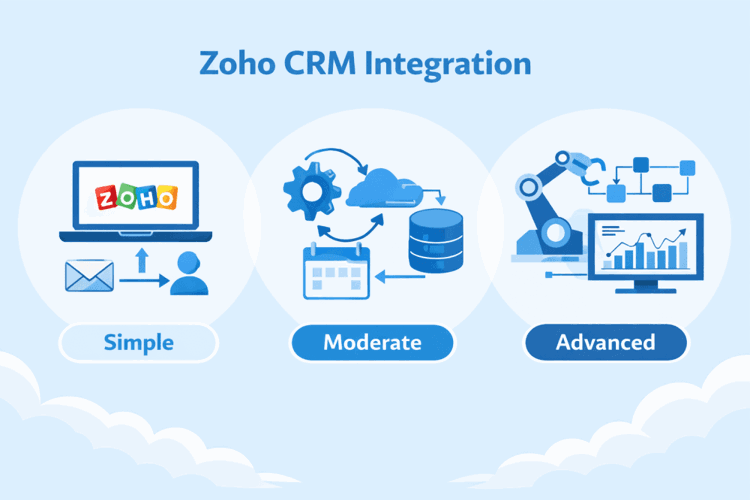
- Simple integrations: $1,500 to $5,000
- Moderate integrations: $5,000 to $15,000
- Advanced integrations: $15,000 to $40,000+
These ranges assume professional implementation and do not include Zoho license costs. They also assume production-ready integrations, not quick proof-of-concept builds.
The sections below explain what typically fits into each range and why costs scale the way they do.
Zoho CRM Integration Cost Ranges Explained
Zoho CRM integration costs are usually discussed in broad ranges, but those ranges only make sense when you understand what sits behind them. Integration is not a single service. It scales with scope, data complexity, and how deeply Zoho CRM is woven into daily operations.
In practice, most integration projects fall into one of three categories: simple, moderate, or advanced. Each level reflects a different stage of business maturity and a different set of expectations from the CRM.
Simple Zoho CRM Integrations: $1,500 to $5,000
Simple integrations focus on a narrow scope and minimal customization. They are most common among small teams, startups, or companies that are just beginning to formalize their CRM processes.
Typical Characteristics
- One-way or basic two-way data synchronization
- One or two systems involved
- Standard Zoho CRM fields with little or no transformation
- Minimal automation rules
Common Examples
- Website contact forms pushing leads into Zoho CRM
- Email integration with Gmail or Outlook
- Syncing Zoho CRM contacts to a basic email marketing tool
Most of the cost at this level comes from configuration, testing, and basic data mapping. These projects often rely on native Zoho connectors or widely used third-party tools rather than custom development.
What keeps costs low is not the connector itself, but the absence of edge cases. Clean data, consistent field naming, and simple workflows reduce both development time and testing effort.
Moderate Zoho CRM Integrations: $5,000 to $15,000
This is the most common cost range for established businesses. At this stage, integration is no longer just about moving data. It starts to reflect how the business actually operates day to day.
Moderate integrations usually involve multiple systems and a noticeable level of customization.
Common Features
- Bi-directional data synchronization
- Custom field mapping and data transformations
- Workflow automation triggered by CRM events
- Integration with accounting, ERP, or marketing platforms
- Scheduled syncs with basic error handling
Common Examples
- Zoho CRM integrated with accounting software to display invoice or payment status
- CRM and marketing automation platforms syncing lead status and campaign engagement
- Sales pipeline updates triggering actions in downstream systems
Costs rise at this level because integration logic becomes more specific. Developers must account for exceptions, mismatched data formats, and timing conflicts between systems. Testing also takes longer, especially when multiple teams depend on the integration working correctly from day one.
Advanced Zoho CRM Integrations: $15,000 to $40,000+
Advanced integrations turn Zoho CRM into part of a broader system architecture rather than a standalone tool. These projects are common in larger organizations or regulated industries where CRM data feeds multiple business-critical processes.
At this level, integration work closely resembles software development rather than configuration.
Typical Characteristics
- Multiple internal and external systems connected to Zoho CRM
- Complex business rules and conditional logic
- Custom APIs or middleware platforms
- High data volumes or near real-time synchronization
- Detailed security, access control, and compliance requirements
Common Examples
- Zoho CRM integrated with ERP, data warehouse, and customer support platforms
- Industry-specific workflows with regulatory or audit constraints
- Custom dashboards built from combined data across multiple systems
Costs here reflect more than development time. They include architecture design, documentation, extended testing cycles, and planning for long-term maintainability. The goal is not just to make systems talk to each other, but to ensure they keep doing so reliably as the business grows and changes.
One-Time Integration Costs vs Ongoing Expenses
Integration budgets often focus on the initial setup, but long-term expenses matter just as much. Many Zoho CRM integrations work well at launch, then slowly become more expensive over time as systems, processes, and data evolve.
Understanding both one-time and ongoing costs helps teams plan more realistic budgets.
One-Time Integration Costs
These are the upfront expenses required to design, build, and launch the integration.
- Architecture and design: $500 to $3,000. Covers requirement analysis, data flow design, and defining how systems interact. Costs increase with the number of systems and business rules involved.
- Development and configuration: $1,000 to $25,000+. The largest cost component. Simple connector-based setups sit at the low end, while custom API integrations and complex automation push costs higher.
- Testing and deployment: $500 to $5,000. Includes functional testing, edge-case handling, and validation across systems. Advanced integrations require longer testing cycles.
- Initial documentation: $300 to $2,000. Documentation for workflows, data mappings, and maintenance guidelines. Often overlooked, but essential for long-term stability.
In total, one-time Zoho CRM integration costs typically range from $1,500 to $40,000+, depending on complexity and scope.
Ongoing Integration Costs
These are recurring or periodic expenses required to keep integrations stable and useful.
- Monitoring and support: $100 to $1,000 per month. Covers issue detection, troubleshooting, and performance checks. Costs vary based on uptime expectations and system criticality.
- API changes and updates: $500 to $5,000 per year. APIs evolve, authentication methods change, and systems are upgraded. Periodic updates are unavoidable.
- New fields or workflows: $300 to $3,000 per change. Business needs change. Each new field, rule, or workflow may require updates to the integration logic.
- Platform subscription fees (if middleware is used): $30 to $500+ per month. Third-party integration platforms charge recurring fees based on usage, volume, or connected systems.
Many companies underestimate maintenance costs. Even stable integrations require occasional updates to stay compatible with changing systems. Planning for ongoing expenses upfront helps avoid unexpected budget pressure later.

Zoho CRM Integrations Built for Real-World Business at OSKI
At OSKI, we treat Zoho CRM integration as an engineering task first, not a checkbox. Our goal is not just to connect systems, but to make sure those connections actually support how a business runs day to day. That means spending time upfront understanding workflows, data ownership, and where automation genuinely saves effort instead of adding noise.
We build Zoho CRM integrations that are dependable, scalable, and designed to last. Whether the task involves a straightforward system connection or a more complex setup across cloud platforms, APIs, and internal tools, we focus on clean architecture, predictable behavior, and long-term maintainability. Our experience across cloud solutions, frontend systems, AI integrations, and enterprise software allows us to design integrations that grow with the business rather than needing to be rebuilt every year.
When teams work with us, they get more than implementation. They get a technical partner who thinks about reliability, performance, and future changes from the start. Because for us, great software is not just built. It is engineered.
Unlock the Full Potential of Zoho CRM
Integrate your sales, marketing, finance, and support tools into one centralized system that drives smarter decisions.
Key Factors That Drive Zoho CRM Integration Costs
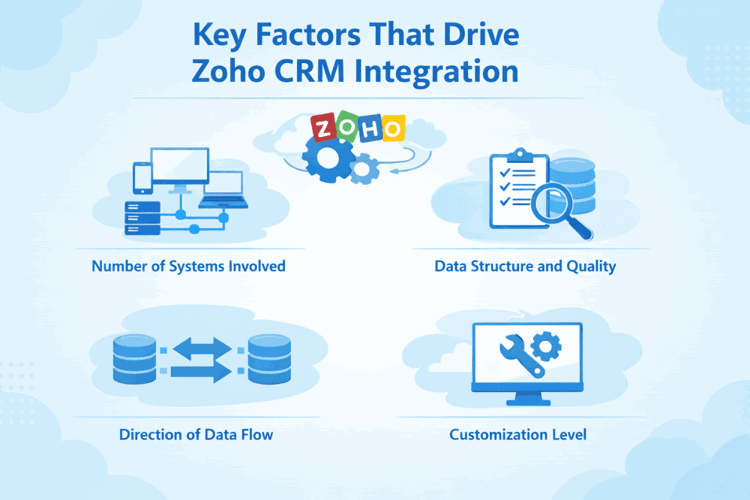
Zoho CRM integration costs are rarely driven by the CRM alone. In most projects, the real budget drivers sit outside Zoho, in the systems it connects to and the way the business expects data to move between them. Understanding these factors early makes estimates more accurate and helps avoid scope creep later.
Number of Systems Involved
Each additional system increases integration complexity in a non-linear way. Integrating Zoho CRM with one external platform is usually straightforward. Adding a second or third system introduces coordination challenges between all participants, not just Zoho.
Every system has its own data model, API limits, authentication methods, and update cycles. Even when APIs are well documented, developers still need time for mapping, testing, and monitoring. Integrating Zoho CRM with two systems is rarely twice the effort of one. It is often closer to three or four times once dependencies and failure scenarios are considered.
The more systems involved, the more important architecture and error handling become, and that work adds cost.
Data Structure and Quality
Data quality is one of the most underestimated cost drivers in Zoho CRM integration projects.
Duplicate records, inconsistent formats, missing values, and outdated entries all require attention. Sometimes this means building cleanup logic directly into the integration. Other times it requires manual data preparation before integration even begins. Either way, time adds up quickly.
For example, syncing customer records sounds simple until phone numbers follow different formats, addresses are incomplete, or multiple systems disagree on which record is the source of truth. Fixing these issues is rarely visible in early estimates, but it often becomes one of the most time-consuming parts of the project.
Clean, well-structured data can reduce integration effort significantly. Poor data can double it.
Direction of Data Flow
The direction data moves between systems has a direct impact on cost.
One-way synchronization is usually cheaper because logic is simpler. Zoho CRM either sends data out or receives it, and there are fewer decisions to make when conflicts arise.
Bi-directional integrations are more complex. They must decide which system owns which data, how updates are prioritized, and what happens when changes occur simultaneously. Timing issues, overwrite rules, and conflict resolution all require careful design and testing.
The more critical the data, the more cautious teams need to be. That caution translates into additional development and testing time.
Customization Level
Zoho CRM works best with standard objects and workflows, and those are the easiest to integrate. As customization increases, so does integration effort.
Custom modules, custom fields, and industry-specific logic often require special handling. Integrations must account for non-standard relationships, calculated fields, and unique validation rules that do not exist in out-of-the-box setups.
Highly customized CRMs also tend to change more frequently. Each change increases the risk of breaking integrations, which raises both initial build cost and long-term maintenance effort.
Automation and Business Logic
Moving data is relatively simple. Interpreting data is not.
Basic integrations focus on synchronization. More advanced ones automate decisions, trigger workflows, and enforce business rules. For example, creating tasks based on deal stages or routing leads differently depending on region or deal size.
Every decision an integration makes adds logic that must be tested and maintained. Edge cases become more common, and failures are harder to diagnose. As automation increases, so does the need for logging, monitoring, and refinement.
Automation delivers value, but it also raises integration costs in a predictable way.
Security and Compliance Requirements
Security requirements add another layer of effort to Zoho CRM integration projects.
Role-based access, permission checks, audit logs, encryption, and secure credential handling all require careful implementation. In regulated industries such as healthcare, finance, or education, compliance requirements often dictate how data can move and where it can be stored.
These controls are not optional, and they cannot be bolted on at the end. They must be designed into the integration from the start. That design work increases planning and testing time, which is reflected in the overall cost.
Zoho CRM Integration Methods and Their Cost Impact
Zoho CRM can be integrated in several different ways, and the method you choose has a direct impact on both upfront cost and long-term maintenance. Some approaches favor speed and simplicity, while others prioritize flexibility and control. The right option depends on how complex your workflows are and how much customization your business requires.
The table below compares the most common Zoho CRM integration methods and how they affect cost.
|
Integration method |
What it involves |
Pros |
Cons |
Typical cost impact |
Best suited for |
|
Native Zoho integrations |
Built-in connectors within the Zoho ecosystem |
Lower setup cost Vendor-supported Faster deployment |
Limited customization Less control over edge cases |
Lowest upfront cost |
Simple to moderate integrations using Zoho tools |
|
Third-party integration platforms |
Middleware tools that connect Zoho CRM with external systems |
Faster than custom code Reusable integration templates Good monitoring tools |
Ongoing subscription costs Requires configuration expertise |
Moderate setup cost plus monthly fees |
Moderate integrations with multiple external systems |
|
Custom API integrations |
Fully custom development using Zoho and third-party APIs |
Tailored to business logic Better performance for complex workflows Easier to extend long-term |
Higher upfront cost Ongoing maintenance required |
Highest initial cost |
Advanced integrations with unique or regulated requirements |
How Long Zoho CRM Integration Takes
Time and cost are closely linked when it comes to Zoho CRM integration. Short timelines usually mean limited scope and minimal customization, while longer projects reflect deeper automation, more systems, and higher expectations around reliability.
Typical Timelines
- Simple integrations: 1 to 3 weeks. These projects usually involve one or two systems, standard data fields, and minimal automation. Most of the time is spent on configuration, basic testing, and confirming that data flows correctly between systems.
- Moderate integrations: 4 to 8 weeks. Integrations at this level include bi-directional sync, custom field mapping, and workflow automation. Extra time is needed for handling edge cases, coordinating between teams, and running more thorough testing before launch.
- Advanced integrations: 2 to 4 months. Complex projects often involve multiple systems, custom APIs, and detailed security or compliance requirements. Timelines extend due to architecture design, staged testing, documentation, and preparation for long-term maintenance.
Delays usually come from unclear requirements, slow feedback cycles, or unexpected data issues. In many cases, integration work moves quickly once decisions are finalized, but stalls when assumptions about data or processes turn out to be wrong. Clear scope and early testing are the best ways to keep timelines predictable.
Is Zoho CRM Integration Worth the Cost?
For most growing businesses, the answer is yes, but only when integration is approached with clear intent. A well-executed Zoho CRM integration reduces manual work, improves data accuracy, and gives teams a more reliable view of customers, sales, and operations. Over time, those improvements usually outweigh the initial investment.
The value comes from alignment, not scale. Integration works best when the scope reflects real business needs rather than assumptions about future growth. Overengineering is a common mistake. Building complex automation before teams are ready to use it drives costs up without delivering proportional returns. At the same time, underengineering creates fragile setups that break under pressure, forcing costly fixes later.
The most effective integrations focus on a few high-impact workflows first, then expand gradually. This approach keeps costs controlled while allowing the system to evolve as the business grows. When planned this way, Zoho CRM integration becomes less of a one-time expense and more of a foundation for long-term operational efficiency.
Final Thoughts
Zoho CRM integration costs are not fixed numbers. They reflect how a business operates behind the scenes. The CRM is just the visible layer.
Companies that invest time upfront in defining processes, cleaning data, and setting realistic expectations tend to stay within budget. Those that rush into integration often pay more later through rework and maintenance.
A realistic pricing breakdown is less about finding the cheapest option and more about building an integration that still works two years from now.
Frequently Asked Questions
How much does it usually cost to integrate Zoho CRM?
In most real-world projects, Zoho CRM integration costs range from $1,500 to $40,000+. Simple integrations with one system and minimal automation sit at the lower end. Complex setups involving multiple platforms, custom logic, and security requirements land at the higher end. The final cost depends on scope, data quality, and how deeply Zoho CRM is embedded into business processes.
Does Zoho CRM include integration for free?
Zoho CRM includes native connectors and APIs, but integration itself is not free. Built-in tools can reduce setup costs for simple use cases, but configuration, testing, and customization still require time and expertise. More advanced integrations usually involve additional development or third-party tools.
Why do Zoho CRM integration costs vary so much?
Costs vary because integration reflects how a business operates behind the scenes. Factors like the number of connected systems, data consistency, automation rules, and compliance requirements all influence effort. Two companies using the same Zoho CRM plan can have very different integration costs based on these variables.
How long does Zoho CRM integration take?
Timelines depend on complexity. Simple integrations usually take 1 to 3 weeks, moderate integrations take 4 to 8 weeks, and advanced integrations can take 2 to 4 months. Delays often come from unclear requirements or unexpected data issues rather than development itself.


