

How Much Does It Cost to Integrate Third-Party APIs?

Connecting with external services through APIs can save you months of development time. But the cost? That part’s trickier. It’s not just about writing a few lines of code and calling it a day. Whether you’re syncing a payment gateway or wiring up customer data across platforms, API integration has layers – some obvious, others hiding in maintenance fees or unexpected rate limits.
In this guide, we’ll walk through what actually drives those costs, from one-off builds to long-term upkeep. You’ll get a clear picture of what to expect when planning API integration, especially if you want it done right and not patched together with duct tape.
What Is Third-Party API Integration?
A third-party API is a set of tools provided by an external company that lets you connect their service to your software. You’re not building the functionality from scratch – you’re tapping into something that already works, like Stripe for payments or Google Maps for location.
Integration means writing the code to make your system talk to theirs. That includes setting up authentication, sending and receiving data, handling errors, and sometimes reshaping the API’s response to fit your needs.
How much should you expect to spend? On average, third-party API integration can cost anywhere from $2,000 to $150,000 depending on the project’s complexity. Small one-way connections might land at the lower end, while custom enterprise setups with bi-directional sync, strict security requirements, and ongoing support can run well into six figures over time.
A Quick Look at Average API Integration Costs
To keep it simple, here's a breakdown of typical cost ranges by complexity level:
| Integration Complexity | Estimated Cost | Examples |
|---|---|---|
| Basic | $2,000 – $15,000 | One-way sync like form submissions to a CRM |
| Moderate | $15,000 – $40,000 | Bi-directional sync between e-commerce and inventory |
| Complex | $40,000 – $150,000+ | Real-time payment integration with advanced security |
Keep in mind: this is just the initial development cost. Ongoing maintenance, vendor fees, and infrastructure costs often add 10-20% per year.

How We Approach Third-Party API Integration in Real Projects
When it comes to third-party API integration, we at OSKI Solutions, usually see cost issues arise not from the API itself, but from everything around it. Our work often starts at the architecture level – understanding how external services will fit into an existing system, how data should flow, and where failure points might appear. We design integrations with long-term stability in mind, not just a quick connection that works on day one but breaks after the first API update or traffic spike.
A big part of controlling integration costs is choosing the right technical approach early. We work with cloud environments, serverless setups, and hybrid architectures, which allows us to adapt integrations to real usage patterns rather than overbuilding infrastructure. This matters for third-party APIs, where rate limits, response times, and vendor changes directly affect both performance and ongoing expenses. Our focus is on clean integration logic, predictable behavior, and clear separation between core systems and external services.
Seamless API Integration Services
Connect your systems, automate workflows, and streamline operations with secure and scalable API integrations.
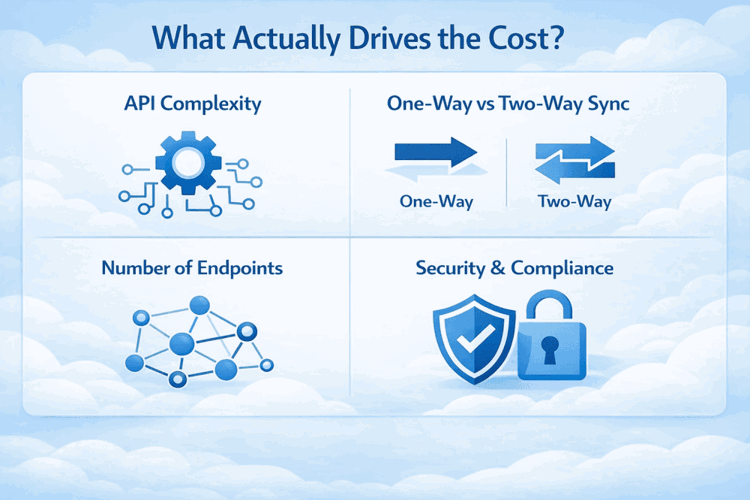
What Actually Drives the Cost?
Let’s dig into the key factors that influence how much you’ll pay for an integration project.
1. API Complexity
Some APIs are clean, well-documented, and easy to use. Others? Not so much.
The more complex the data structure, the more time it takes to handle. If the API involves nested JSON responses, inconsistent formats, or limited documentation, you’re looking at extra hours just to understand how things work.
If it’s a REST API with good docs, great. If it’s a legacy SOAP service or uses non-standard authentication, budget more time for research, debugging, and error handling.
2. One-Way vs Two-Way Sync
Sending data in one direction is fairly straightforward. You’re pushing a form, an order, or a notification somewhere else.
But when you need data to move both ways, like syncing product inventory, customer records, or payment statuses, that’s where things get tricky. You’ll need to build in conflict resolution, timestamp logic, and rules to prevent data from looping endlessly or overwriting itself.
The difference between one-way and two-way isn’t just technical. It can triple the scope of your integration if not planned properly.
3. Number of Endpoints and Functions
Each function or feature adds more moving parts. Connecting just a payment gateway is one thing. Connecting that plus a CRM, analytics tool, and inventory platform? That’s an ecosystem.
Every new endpoint means more requests, more mapping, more error handling, and more edge cases to cover. Complexity grows fast with each additional service or integration point.
4. Security and Compliance
If the integration touches sensitive customer data or financial information, your cost jumps. You'll need to handle:
- OAuth 2.0 or token-based authentication.
- Secure credential storage.
- Data encryption in transit.
- Compliance with standards like HIPAA, PCI DSS, or GDPR.
These aren’t optional. They’re non-negotiable requirements in most industries, and they require experienced developers and possibly external audits.
5. Error Handling and Monitoring
What happens when the API is down, slow, or returns a bad response? A good integration includes fail-safes.
This might mean:
- Retrying failed requests.
- Logging errors with detailed context.
- Sending fallback messages to users.
- Triggering alerts when external services are unavailable.
You’re not just wiring something together – you’re building a resilient system. And that resilience adds time and cost.
The Full Cost Picture: Beyond Development
The actual build is just the start. To understand what you’re really paying for, you need to consider the long-term picture.
Here’s a more complete view of costs associated with third-party API integrations:
Upfront Development Costs
The initial development phase is where most of the budget goes, especially when you're building from scratch. You'll need developers to write the actual integration logic, test it thoroughly, and run QA to make sure everything behaves as expected. This stage also includes project management time – someone has to coordinate the work, track progress, and keep everything moving.
In many cases, developers will need to spend time digging through third-party API documentation, which can be hit or miss in terms of clarity. Then there's the technical setup: managing authentication keys, permissions, and configuring access. On top of that, you’ll likely need custom logic to map data between systems and ensure the formats align properly.
Deployment & Infrastructure
Once the integration is built, it needs a place to live. That usually means setting up hosting through cloud platforms. If you're working with serverless functions or container-based services, those environments also need to be configured and tested. You'll also need tools to log requests and monitor system behavior, especially for production use. And if your system is going to scale with users or data volume, load balancing and other performance tuning steps become necessary to keep everything stable.
Maintenance & Support
After deployment, the real work begins. You’ll need ongoing monitoring to catch performance dips or outages before they affect users. APIs aren’t static – providers roll out new versions, change endpoints, or deprecate features. Each of these changes requires updates on your side. There’s also regular security upkeep: applying patches, rotating credentials, and adjusting to updated compliance rules. And inevitably, there will be moments when something breaks unexpectedly. Whether it’s a malformed response or a third-party system acting up, someone has to dig in and fix it.
Hidden Costs
Some costs are harder to spot on paper but still very real. If a third-party provider goes down or delivers delayed responses, your app might suffer without warning. Troubleshooting vendor-side issues eats into your team's time and adds friction for users. Another common hidden cost shows up in planning – if you underestimate how complex the integration will be, deadlines slip and other features get delayed. And then there’s the opportunity cost. Every hour your internal team spends patching an unstable integration is an hour they’re not building something new or improving your core product.
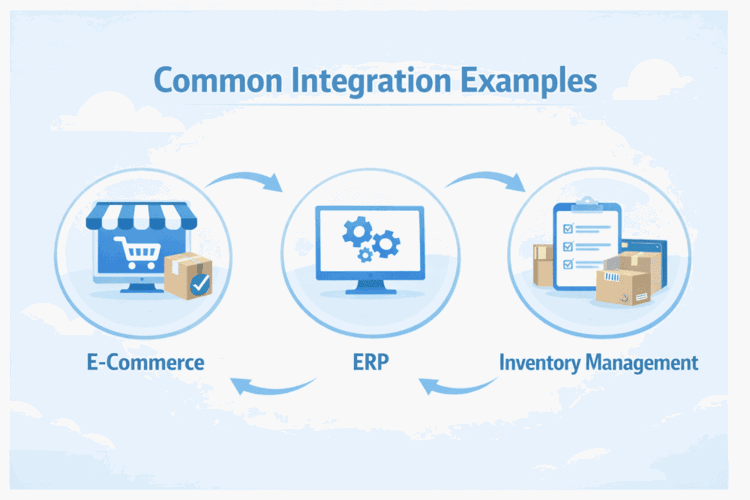
Common Integration Examples and Their Costs
To make this more concrete, let’s look at real-world examples of third-party API integrations and the kind of budgets they often require:
E-Commerce Integration
Connecting a storefront with a shipping provider, inventory system, and analytics tool:
- Initial build: $15,000 to $30,000
- Annual maintenance: $5,000 to $10,000
- Why it’s costly: Requires syncing orders, stock, delivery statuses, and promotional data across platforms.
CRM Integration
Hooking up CRM with your app’s user database or marketing system:
- Initial build: $20,000 to $40,000
- Annual maintenance: 15% of initial cost
- Challenges: CRM APIs can be massive, and syncing across multiple teams and tools adds layers of testing and logic.
Payment Gateway Integration
Integrating payment systems with custom logic, multi-currency support, and fraud handling:
- Simple use case: $10,000 to $25,000
- Advanced fintech use case: $100,000+
- Why: High compliance, detailed error handling, and real-time updates make this one of the most sensitive types of integration.
What to Do Before Starting the Integration
API integration can be deceptively complex. Before diving in, it helps to prepare properly:
- Read the documentation thoroughly: If it’s hard to follow or incomplete, that’s a red flag.
- Review rate limits and pricing: Some APIs charge per request or usage tier, which can hit you later.
- Test before you commit: Use tools to validate requests and simulate edge cases.
- Understand the versioning policy: Will the API change next month? Can you rely on stable endpoints?
- Ask what happens when things go wrong: Check for timeout behavior, error codes, and retry recommendations.
How to Estimate Your Integration Budget
To estimate the cost of integrating a third-party API, you can start with a basic formula:
Build Cost = (Dev Hours × Hourly Rate) + QA + PM
In practice, development hours will vary depending on how complex the integration is. A straightforward use case might only take 80 hours, while something more involved could push past 500. Hourly rates depend on who’s doing the work. Freelancers generally fall somewhere between $75 and $150 per hour, while agencies often charge in the $150 to $250 range or more. Quality assurance adds time as well, usually around 10 to 20 percent of the total development effort. Then there's project management, which tends to account for another 10 percent to keep everything organized and moving forward.
Once you've got your build cost, it's smart to look at the longer-term financial picture using this formula:
TCO (3-Year Estimate) = Build Cost + (Annual Maintenance × 3) + Infrastructure + Vendor Fees
Annual maintenance covers updates, monitoring, and adjusting the integration if the third-party API changes. This typically adds 10 to 20 percent of the original build cost each year. Infrastructure costs are also part of the equation, especially if you're using cloud services to host the integration. Finally, vendor fees will vary depending on how the third-party API charges for usage. Some use flat-rate plans, others bill by request volume, and a few follow a tiered pricing model. Bringing all of this together gives you a much more accurate idea of what the integration will truly cost over its full lifecycle, not just what you’ll pay to get it up and running.
Smart Ways to Keep Costs Down
A few smart planning choices can reduce your costs without cutting corners:
- Use SDKs or wrappers from the API provider if available.
- Cache data when real-time sync isn’t required.
- Plan for reusability if you’ll integrate similar systems later.
- Avoid overengineering on the first pass – launch with what you need now.
- Negotiate vendor pricing for higher-volume or long-term usage.
These decisions can trim both upfront and long-term costs.
Final Thoughts
Third-party API integration isn’t a copy-paste job. It’s a build. It’s infrastructure. And it’s maintenance. Whether you’re working with a SaaS platform, a payments provider, or a mapping service, the cost comes down to how deeply you want to integrate and how much you care about performance and reliability.
For basic setups, $2,000 to $10,000 might do the trick. For more advanced integrations, especially ones involving multiple systems or regulatory compliance, expect $40,000 and up. And remember, integration is never truly done. Once it’s live, you’ll need to keep it healthy, secure, and ready for whatever comes next.
If you’re budgeting for integration, don’t just look at the build. Look at the full lifecycle. That’s where the real cost lives.
FAQ
1. Why is third-party API integration so expensive sometimes?
The API itself might be free or low-cost, but getting it to work smoothly inside your own system is where the effort goes. You’re paying for developer time, error handling, data mapping, authentication setup, infrastructure, and long-term support. If the API is complex or poorly documented, the price climbs even faster. It’s not just plugging in a cable and calling it a day.
2. Can I just have my in-house devs handle API integration?
You can, if they’ve done it before and have time to maintain it afterward. But keep in mind, integrations tend to touch multiple systems, require constant upkeep, and introduce outside dependencies that don’t always behave the way you expect. If your team’s juggling other priorities, outsourcing may end up saving both time and post-launch stress.
3. What’s the cheapest type of integration I can expect?
A one-way sync using a well-documented API with no sensitive data and minimal logic is about as cheap as it gets. Think sending a form submission to a CRM or pulling product listings from a marketplace. These can run as low as $2,000 to $5,000 if scoped tightly and done by a small, focused team.
4. Do third-party APIs break often?
They don’t always break, but they do change. Endpoints get deprecated, response formats shift, rate limits tighten. If you don’t build with flexibility and monitoring in place, these small changes can quietly break your system without warning. That’s why good error handling and version control are part of any serious integration plan.
5. How do I avoid vendor lock-in with third-party APIs?
Design the integration so it sits behind a clean layer of abstraction. In plain terms, keep your business logic separate from direct API calls. That way, if you need to switch providers later, you’re not ripping out half your system to do it. A little planning upfront here saves a lot of pain down the line.
6. What’s the biggest hidden cost people forget about?
Maintenance. Once the integration goes live, it still needs updates, monitoring, and occasional rework. That quiet drip of support time adds up fast. Many teams budget for the build and forget the next two or three years of small but constant adjustments.


