

NetSuite ERP Integration Cost: Real Budgets and Pricing Factors

Integrating NetSuite ERP almost always sounds simpler than it turns out to be. On paper, it’s just connecting systems and keeping data in sync. In practice, integration is where many NetSuite projects quietly become more expensive than expected.
The cost of integrating NetSuite depends far less on the ERP itself and far more on what surrounds it. The number of systems involved, how clean your data is, how much automation you expect, and how reliable the integration needs to be once it’s live all shape the final budget. Some companies spend a few thousand dollars and move on. Others invest tens of thousands to avoid operational risks later.
This article breaks down what NetSuite ERP integration really costs, why estimates vary so widely, and which decisions tend to push budgets up after the project has already started.
Typical NetSuite ERP Integration Cost Ranges
Before breaking down cost drivers, it helps to anchor expectations with realistic numbers. These are common ranges seen across small, mid-sized, and enterprise environments.
Simple, Single-System Integration
- $2,000 to $6,000 upfront
- $300 to $1,000 per month ongoing
Standard Multi-System Integration
- $8,000 to $25,000 upfront
- $800 to $3,000 per month ongoing
Complex or Enterprise-Grade Integration
- $30,000 to $100,000+ upfront
- $3,000 to $8,000+ per month ongoing
These ranges assume production-ready integrations, not proof-of-concept setups. They include design, configuration, testing, and stabilization. They do not include NetSuite license costs themselves.
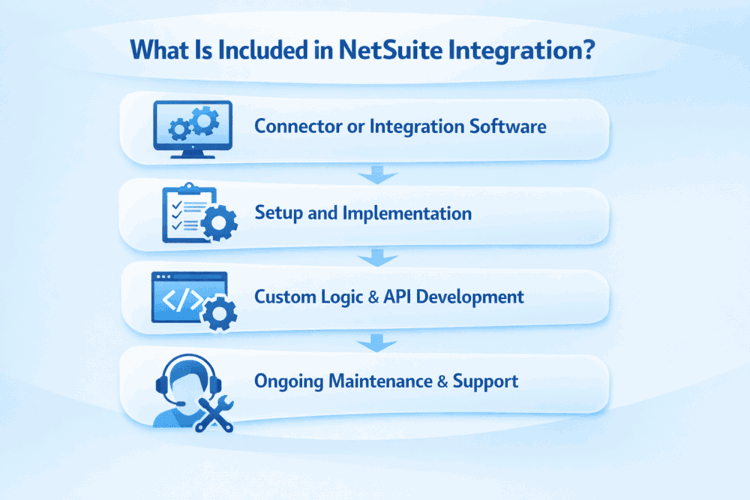
What Is Actually Included in NetSuite Integration Cost
Many teams underestimate NetSuite integration cost because they look only at the connector or middleware subscription. In reality, integration is a layered investment. Software is just one part. Design, setup, customization, and long-term support usually account for most of the spend.
Understanding these layers upfront makes budgeting far more realistic.
Connector or Integration Software
Most NetSuite integrations start with integration software. This can be a prebuilt connector, an iPaaS platform, or an internally managed API framework.
What Drives Software Pricing
Subscription pricing typically depends on:
- Number of connected systems
- Monthly transaction or record volume
- Access to features like real-time sync, retries, logging, and error handling
Typical Price Range
- $400 to $800 per month for simple, low-volume integrations
- $1,000 to $2,500 per month for standard multi-system setups
- $3,000+ per month for high-volume or enterprise-grade usage
Software costs scale over time. An integration that looks affordable in year one can move into a higher pricing tier as the business grows.
Setup and Implementation
Buying integration software does not make data move. Implementation is where integrations become usable and reliable.
What Implementation Usually Includes
- Data mapping between NetSuite and external systems
- Workflow configuration and sync rules
- Security, permissions, and role handling
- Initial testing, validation, and go-live support
Even basic integrations require focused setup work. Once workflows involve finance, inventory, or order lifecycles, effort increases quickly.
Typical Price Range
- $2,000 to $5,000 for simple, out-of-the-box connectors
- $8,000 to $20,000 for multi-system or two-way integrations
- $25,000 to $50,000+ for complex or enterprise environments
In many real projects, implementation costs equal or exceed the first year of software fees.
Custom Logic and API Development
Prebuilt connectors are designed for common use cases. Real businesses often operate outside those assumptions.
When Custom Development Becomes Necessary
Custom logic is typically required for:
- Multi-entity or multi-subsidiary accounting
- Complex pricing, tax, or discount rules
- Industry-specific compliance workflows
- Partial fulfillment, returns, or advanced inventory handling
Custom work increases upfront cost but usually prevents fragile workarounds and manual fixes later.
Typical Price Range
- $5,000 to $15,000 for limited custom workflows
- $20,000 to $50,000+ for deeply tailored integrations
Custom API work is most common in finance-heavy or regulated environments where accuracy matters more than speed.
Ongoing Maintenance and Support
NetSuite integrations are not set-and-forget systems. APIs change. Platforms release updates. Volumes increase. Without monitoring, failures often go unnoticed until finance or operations reports missing or incorrect data.
What Ongoing Support Usually Covers
- Monitoring and alerting
- Fixing failed syncs and data mismatches
- Adjustments after NetSuite or third-party updates
- Minor enhancements as workflows evolve
Typical Price Range
- $500 to $1,000 per month for basic support
- $1,500 to $3,000+ per month for proactive monitoring and SLAs
For mission-critical integrations, ongoing support is not optional. It is part of keeping NetSuite usable at scale.
Setup and Implementation Fees Explained
Implementation fees are often the largest upfront cost and the most misunderstood.
Typical Drivers
- Number of endpoints
- Data mapping complexity
- Custom workflows
- Testing requirements
- Training and handover
Common Ranges
- Basic integration: $2,000 to $5,000
- Multi-system setup: $10,000 to $25,000
- Enterprise integration: $25,000 to $75,000+
Cutting corners here usually leads to higher maintenance costs later.

Why Teams Trust OSKI With Their NetSuite Integrations
At OSKI, we treat NetSuite integration as an engineering problem first, not a connector exercise. Our focus is on building integrations that work reliably in real business conditions, not just in demos or test environments.
We help teams connect NetSuite with ecommerce platforms, CRMs, payment systems, and internal tools in a way that supports growth instead of limiting it. That means clear data models, thoughtful workflow design, and integrations that are easy to monitor and adapt as requirements change. Whether it’s a straightforward sync or a complex, multi-system setup, we design integrations with long-term stability in mind.
Our team combines deep experience in cloud architecture, .NET, modern frontend frameworks, and AI-driven automation to deliver integrations that fit naturally into broader systems. From early planning to post-launch support, we work closely with our clients to make sure NetSuite becomes a reliable core of their operations, not another system that needs constant fixing.
If you are planning a NetSuite integration and want clarity on scope, cost, and technical trade-offs before committing, we are always open to a direct, practical conversation.
Seamless NetSuite ERP Integration
Connect finance, operations, CRM, and third-party systems into one unified, real-time enterprise ecosystem.
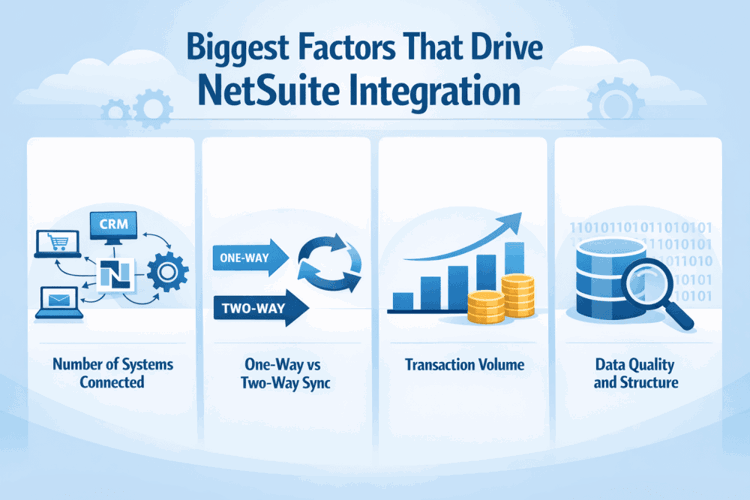
The Biggest Factors That Drive NetSuite Integration Cost
Several variables consistently have the biggest impact on budget.
1. Number of Systems Connected
Integrating NetSuite with one platform is manageable. Adding CRM, ecommerce, payment gateways, logistics, and analytics tools increases complexity fast. Each additional system introduces new data models and failure points.
2. One-Way vs Two-Way Sync
One-way syncs are cheaper. Two-way integrations require conflict resolution, validation rules, and stronger error handling. They also demand more testing, which increases cost.
3. Transaction Volume
Many pricing models scale with usage. What works for hundreds of orders per month may become expensive at tens of thousands. Planning for growth early prevents surprise tier upgrades.
4. Data Quality and Structure
Clean data reduces effort. Inconsistent IDs, duplicate records, or missing fields increase mapping complexity and testing time. Data cleanup is rarely budgeted upfront but often unavoidable.
5. Reliability Expectations
A nightly batch sync is cheaper than real-time processing with alerts, retries, and audit logs. The more critical the data, the higher the integration cost.
Integration Approaches and Their Cost Trade-Offs
There is no single best way to integrate NetSuite. The right approach depends on how complex your workflows are, how many systems you need to connect, and how much flexibility you expect over time. Some options prioritize speed and simplicity. Others trade higher upfront cost for long-term control.
The table below compares the most common NetSuite integration approaches, showing how they differ in cost, flexibility, and ongoing effort.
|
Integration Approach |
Typical Upfront Cost |
Ongoing Cost |
Key Advantages |
Key Limitations |
Best Fit For |
|
Middleware / iPaaS platforms |
$5,000 to $25,000 |
$800 to $3,000+ per month |
Faster deployment, built-in monitoring and retries, easier long-term maintenance |
Subscription costs increase with volume, pricing tied to usage and features |
Growing companies with multiple systems and limited internal integration expertise |
|
Custom API integrations |
$15,000 to $50,000+ |
$500 to $3,000+ per month (support and maintenance) |
Maximum flexibility, full control over logic, performance, and data handling |
Higher upfront development cost, ongoing maintenance responsibility |
Enterprises with unique workflows or strict regulatory and compliance requirements |
|
Prebuilt or native connectors |
$2,000 to $6,000 |
$400 to $1,200 per month |
Lower setup cost, faster time to value, simpler configuration |
Limited customization, feature roadmap controlled by vendor |
Small to mid-sized businesses with standard workflows and predictable data flows |
How Pricing Models Affect Long-Term Cost
Understanding how integration vendors structure their pricing is critical to avoiding budget surprises later. The initial monthly fee rarely tells the full story. How pricing scales over time often matters more than what you pay at the start.
Subscription-Based Pricing
Most integration platforms use tiered subscription models. Pricing typically scales with transaction volume, number of connections, and access to advanced features.
This model is easy to budget for in the early stages, especially for smaller workloads. Over time, however, costs can increase quickly as order volumes grow, new systems are added, or real-time processing becomes necessary. What starts as a modest monthly fee can double or triple as the business scales.
Pay-Per-Connector Pricing
Some vendors charge a fixed monthly fee for each connector, such as Shopify to NetSuite or Salesforce to NetSuite.
This approach simplifies forecasting and makes ROI easier to calculate, especially for businesses with a limited number of stable integrations. The trade-off is flexibility. If workflows grow more complex or data volume spikes, per-connector pricing can become restrictive or require upgrades.
Custom or Enterprise Pricing
Larger organizations often receive tailored pricing based on their environment. Quotes usually factor in the number of systems, transaction volume, security requirements, and support expectations.
This model offers flexibility but requires careful review. Without clear caps or defined usage thresholds, costs can expand over time. Detailed contracts and transparent pricing assumptions are essential here.
Freemium and Trial Plans
Free tiers and trials are helpful for testing connectors or validating workflows. They are rarely suitable for production use.
Most free plans limit transaction volume, features, or support. Teams often outgrow them quickly once real data and operational requirements are introduced. These plans work best as short-term evaluation tools, not long-term solutions.
Estimating NetSuite Integration Cost for Your Business
A realistic NetSuite integration estimate starts with structure, not guesswork or vendor promises. The more clearly you define your needs upfront, the fewer surprises you will face once implementation begins.
- List every system that needs to connect to NetSuite. Include current tools like ecommerce platforms, CRMs, payment gateways, warehouses, and reporting tools. Also think ahead. Systems planned for the next 12 to 24 months should be part of the conversation, even if they are not integrated on day one.
- Define critical data flows and sync frequency. Identify which data actually matters to operations. Orders, invoices, inventory, customers, and payouts often have very different accuracy and timing requirements. Real-time sync costs more than scheduled batches, so only use it where delays create real business risk.
- Decide what must be real-time versus batch. Not everything needs instant updates. Finance teams may be fine with hourly or daily syncs, while order processing or inventory availability might require near real-time data. Being selective here can significantly reduce cost.
- Assess internal technical capability. Be honest about what your team can realistically maintain. Custom APIs require ongoing attention. Middleware reduces internal workload but adds subscription costs. The cheapest option on paper is often the most expensive if it strains internal resources.
- Request detailed cost breakdowns from vendors. Ask for clarity on setup fees, subscription tiers, support costs, upgrade paths, and what happens when transaction volumes grow. Vague proposals usually lead to higher final spend.
As a rule of thumb, add 10 to 20 percent contingency to your NetSuite integration budget. API changes, data issues, and scope adjustments are common, even in well-planned projects. That buffer often makes the difference between a controlled rollout and a reactive one.
Final Thoughts
NetSuite ERP integration cost is not about connectors or licenses alone. It reflects how complex your business really is and how much reliability you expect from your systems.
Cheap integrations exist. Durable ones cost more. The difference usually becomes clear only after go-live.
Teams that plan for growth, maintenance, and data quality upfront spend more initially but avoid painful rebuilds later. Those that focus only on setup cost often pay twice.
The right budget is not the lowest number. It is the one that keeps your operations running when things inevitably change.
Frequently Asked Questions
How much does it usually cost to integrate NetSuite ERP?
Most NetSuite ERP integrations fall between $10,000 and $40,000 for the initial setup, with ongoing costs ranging from $500 to $3,000+ per month. Simple, single-system integrations can be cheaper, while multi-system or finance-heavy integrations often cost more.
Why do NetSuite integration costs vary so widely?
Costs vary because integrations are shaped by the business, not just the software. The number of connected systems, data complexity, transaction volume, real-time requirements, and customization needs all influence the final price. Two companies using NetSuite can end up with very different integration budgets.
Is a prebuilt connector enough for most businesses?
Prebuilt connectors work well for standard workflows like basic ecommerce or CRM syncing. However, once a business needs custom pricing rules, multi-entity accounting, or advanced inventory logic, prebuilt tools often require customization or replacement.
What is cheaper long term, middleware or custom APIs?
Middleware usually costs less upfront and is easier to maintain, but subscription fees add up over time. Custom APIs cost more initially but can be more cost-effective in the long run for businesses with stable, highly specific workflows. The right choice depends on scale and internal technical capacity.
Are NetSuite integration costs a one-time expense?
No. Integration always comes with ongoing costs. APIs change, platforms update, and volumes grow. Even well-built integrations require monitoring, occasional fixes, and adjustments. Ongoing support should be part of the budget from day one.


