

How Much Does It Cost to Integrate HubSpot? Budgets, Factors, and Trade-Offs

Integrating HubSpot almost always sounds simpler than it turns out to be. On paper, the platform offers plenty of native integrations and a well-documented API. In reality, the cost of integrating HubSpot depends less on HubSpot itself and more on how your existing systems, data, and processes behave once they’re forced to work together.
Some integrations are genuinely straightforward. Others uncover years of technical debt, inconsistent data, or workflows that were never designed to sync across systems. This article looks at what companies actually pay to integrate HubSpot, why estimates vary so widely, and how to think about integration costs without relying on optimistic guesses or vendor marketing.
Typical HubSpot Integration Cost Ranges
Based on current market pricing and real-world projects, most HubSpot integration work falls into these ranges:
- Simple native integrations: $1,000 to $5,000
- Standard third-party integrations: $3,000 to $12,000
- Custom API integrations: $10,000 to $35,000
- Complex multi-system integrations: $25,000 to $75,000+
- Enterprise-grade integrations with ERP and custom logic: $50,000 to $120,000+
These numbers reflect implementation only. They do not include HubSpot licensing, onboarding fees, or long-term support costs.
The wide range exists because integration work scales with complexity much faster than most teams expect.
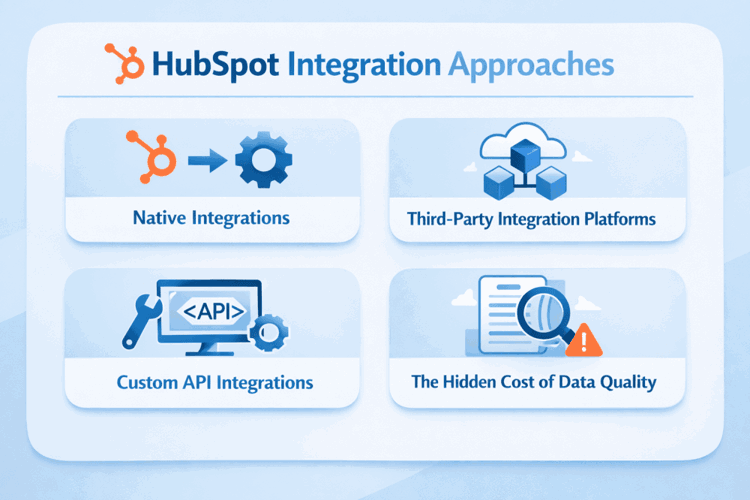
HubSpot Integration Approaches and Their Cost Implications
Not all HubSpot integrations are created equal. Some can be switched on in an afternoon. Others require weeks of planning, custom logic, and ongoing oversight. The difference usually comes down to how closely your business fits HubSpot’s default assumptions, and how much flexibility you need once real data starts flowing.
Below are the main integration approaches companies use, along with the cost ranges and trade-offs that matter in practice.
Native Integrations: The Lowest-Cost Entry Point
HubSpot offers a wide range of native integrations for common tools such as Gmail, Outlook, Slack, Zoom, Shopify, and popular accounting platforms. These are built to cover standard use cases with minimal setup.
What Typically Drives The Cost
Most native integrations can be handled internally or with light external help. Costs usually come from:
- Initial configuration
- Field mapping adjustments
- Light testing
- Basic user training
Typical Budget Range
$1,000 to $3,000, and in some cases $0 if handled fully in-house.
The Trade-Off
Native integrations are efficient but opinionated. They work well as long as your processes match HubSpot’s defaults. Once your data model or workflows deviate, flexibility drops off quickly.
Third-Party Integration Platforms and Middleware
When native integrations are not enough, many teams turn to middleware platforms or HubSpot-focused integration tools. These solutions sit between systems and manage data flow without heavy custom development.
Where The Costs Come From
Middleware introduces two main cost components:
- Initial setup and configuration
- Ongoing subscription fees
Typical Budget Range
- Setup: $2,000 to $8,000 depending on scope
- Monthly fees: $500 to $1,500, scaling with volume and complexity
When This Approach Makes Sense
Middleware is often a good fit when:
- Multiple systems need to be connected
- Data flows are moderately complex
- Speed matters more than deep customization
The Trade-Off
Over time, subscription fees can exceed the cost of building a custom integration. You gain speed and flexibility early, but accept higher long-term operating costs.
Custom API Integrations: Where Costs Rise Quickly
Custom integrations use HubSpot’s API directly and are designed specifically around your systems and workflows. This is the most flexible approach, and also the most demanding.
Common Use Cases
Custom API work is typically required when:
- Integrating with ERP systems such as NetSuite, SAP, or Dynamics
- Connecting proprietary internal software
- Handling complex business logic or transformations
- Requiring high accuracy and strict data control
Typical Budget Range
- $10,000 to $35,000 for a single custom system connection
- $50,000+ for complex or multi-system integrations
What Actually Drives The Cost
The main effort is not coding. It usually sits in:
- Data modeling
- Edge case handling
- Sync conflict resolution
- Testing across real scenarios
- Documentation and handover
The Trade-Off
Custom integrations cost more upfront, but they tend to be more stable and predictable over time than layered middleware solutions.
The Hidden Cost of Data Quality
Data quality is one of the most underestimated cost drivers in HubSpot integration projects.
Common Issues Discovered During Integration
Most companies uncover problems such as:
- Duplicate contacts and companies
- Inconsistent field formats
- Missing or unreliable identifiers
- Legacy data that no one fully trusts
Before integration can work reliably, this data must be cleaned, standardized, and validated.
Typical Data Preparation Costs
- $3,000 to $8,000 for smaller datasets
- $8,000 to $20,000 for larger or messier environments
The Trade-Off
Skipping data cleanup saves money early and creates constant problems later. Poor data quality turns integrations into ongoing firefighting exercises.
Custom Objects and Advanced Data Models
HubSpot’s custom objects allow the platform to reflect more complex businesses, but they also increase integration complexity.
When Custom Objects Are Involved
Custom objects are common when tracking:
- Subscriptions
- Contracts
- Products with lifecycle states
- Licenses or assets
- Properties, locations, or installations
Integrations must then manage relationships between objects, not just flat records.
Cost Impact
Custom objects usually add:
- Additional design time
- More complex field mapping
- Higher testing effort
- Increased maintenance overhead
Expect integration costs to rise by $5,000 to $15,000 when custom objects are involved.
The Trade-Off
You gain accuracy and structure, but lose simplicity. Custom objects require careful planning to avoid long-term maintenance issues.
Ongoing Maintenance and Support Costs
Integration does not stop at go-live. Systems change, data grows, and processes evolve.
Common Sources of Ongoing Cost
- API changes
- Platform updates
- Business process adjustments
- Growing data volumes
- Error handling and fixes
Typical Annual Maintenance Budgets
- $2,000 to $6,000 for simple integrations
- $6,000 to $15,000 for complex or custom builds
The Trade-Off
Teams that plan for maintenance early avoid downtime and expensive emergency fixes later.

A Practical Approach To HubSpot Integration at OSKI
At OSKI, we look at HubSpot integration as an engineering problem first and a marketing tool second. Our goal is not just to connect systems, but to make sure those connections hold up when your business grows, your data volume increases, and your processes evolve.
We work end to end. From integration strategy and data modeling to custom API development, cloud architecture, and ongoing support. Whether it’s a straightforward HubSpot setup or a complex environment involving ERP systems, custom objects, and AI-driven workflows, we focus on building integrations that are dependable, scalable, and easy to live with long term.
Our team combines deep experience in cloud platforms, .NET, modern frontend frameworks, and AI integrations. That lets us design HubSpot integrations that fit naturally into broader business systems instead of sitting on top of them as fragile add-ons. We pay close attention to data quality, error handling, and maintainability, because those are the areas that quietly decide whether an integration succeeds or becomes a recurring headache.
If you’re planning a HubSpot integration and want it engineered with long-term stability in mind, we’re always open to a practical conversation about what makes sense for your business.
Unlock Full Power of HubSpot Integration
Connect your CRM, marketing, sales, and automation tools into one seamless growth engine.
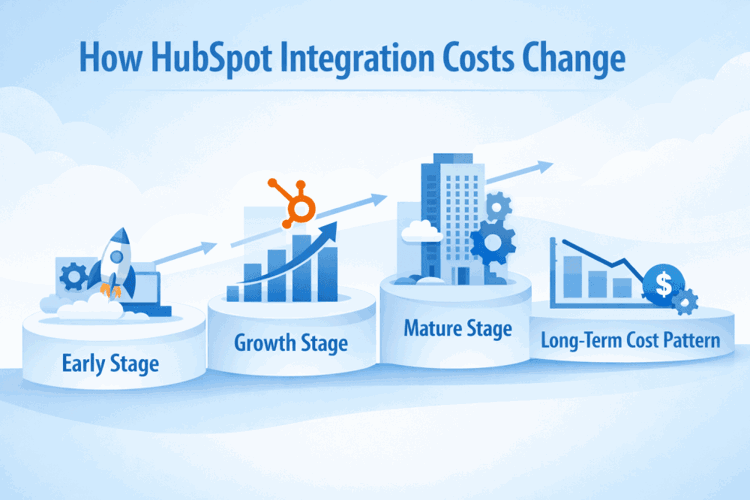
How HubSpot Integration Costs Change As Your Business Scales
HubSpot integration costs rarely stay flat over time. What feels reasonable during the initial setup can become restrictive or unexpectedly expensive as the business grows and processes evolve. Systems that worked well for a small team often struggle once data volume increases, new tools are added, or responsibilities spread across departments.
Understanding how integration costs change at different stages helps teams plan ahead and avoid rushed rebuilds later.
Early Stage: Setup And Stabilization
During the first three to six months, most integration costs are tied to getting the foundation in place. This includes configuring the initial connections, cleaning and validating existing data, aligning basic workflows, and fixing issues that surface shortly after go-live.
Budgets are usually fairly predictable at this stage because the scope feels contained. The biggest risk is not overspending, but underestimating how much iteration is needed once real users begin working in the system. Early assumptions often need adjustment, and teams that plan time and budget for this phase tend to stabilize faster.
Growth Stage: Complexity And Expansion
As the organization grows, integration costs tend to increase quietly rather than all at once. New tools are added to the stack, contact or transaction volumes expand, and additional teams or regions begin relying on shared data. Reporting requirements also become more demanding as leadership looks for deeper insight.
At this stage, middleware fees often rise, custom logic accumulates, and maintenance work becomes more visible. Annual integration costs commonly increase by 30 to 50 percent, even when there is no single large change driving the growth. The cost creep usually comes from many small adjustments rather than one major rebuild.
Mature Stage: Optimization Or Rebuild Decisions
For more mature organizations, integration costs become a strategic topic rather than a technical one. Teams are often faced with a choice between continuing to maintain layered integrations, simplifying the architecture through consolidation, or rebuilding critical connections for long-term stability.
This is where earlier trade-offs begin to show their impact. Businesses that prioritized speed and short-term savings often pay more later to regain control. Those that invested early in clean data models, clear ownership, and scalable design usually experience slower and more predictable cost growth.
The Long-Term Cost Pattern To Expect
Across most HubSpot environments, integration spending follows a similar curve. There is a higher upfront investment during setup, followed by moderate increases as the business grows, and eventually a decision point where optimization or rebuilding becomes unavoidable.
Teams that expect this pattern and plan for it early tend to make calmer, more deliberate decisions. Those that treat integration as a one-time task often encounter urgent and expensive corrections when growth exposes the limits of earlier choices.
What Most Companies Underestimate
Across dozens of HubSpot integration projects, the same blind spots appear again and again. They are rarely technical failures. They are planning failures. These costs tend to be invisible during early scoping discussions, but very real once the work starts.
- Data Cleanup Effort. Existing data is almost never as clean as teams assume. Duplicates, outdated records, inconsistent field formats, and missing identifiers slow integrations down and require manual work. Data cleanup often becomes a project inside the project, adding both time and cost.
- Testing Time. Integration testing is not just about checking whether data moves. It involves validating edge cases, failure scenarios, sync conflicts, and user behavior across systems. Rushed testing leads to silent errors that only surface after go-live, when fixes are more expensive.
- Internal Coordination Cost. Integrations touch multiple teams. Sales, marketing, operations, finance, and IT often need to align on data ownership and process rules. Meetings, reviews, approvals, and rework consume more internal time than most budgets account for.
- Post-Launch Fixes. No integration launches in a perfect state. Once real users interact with the system, gaps and assumptions surface. Small adjustments, additional mappings, and workflow tweaks are common and should be expected, not treated as exceptions.
- Long-Term Maintenance. APIs change, platforms update, and business processes evolve. Even stable integrations require monitoring and periodic adjustments. Teams that ignore this reality often end up paying more later to repair or rebuild integrations under pressure.
These costs rarely appear in vendor quotes or initial estimates, but they almost always appear in real budgets. Planning for them upfront is usually cheaper than reacting to them later.
Final Thoughts
HubSpot integration is not expensive because vendors want it to be. It is expensive because connecting real business systems is hard.
The platform itself is rarely the problem. The challenge is aligning data, processes, and expectations across tools that evolved independently.
If you treat integration as a strategic foundation rather than a technical afterthought, the cost becomes easier to justify. If you treat it as a shortcut, the cost simply appears later, often higher and under more pressure.
The most successful teams are not the ones that spend the least. They are the ones that understand what they are paying for and why.
Frequently Asked Questions
How much does a typical HubSpot integration cost?
For most small and mid-sized businesses, HubSpot integration costs range from $8,000 to $50,000 in the first year. Simpler setups with native integrations may cost far less, while complex environments involving multiple systems, custom objects, or ERP platforms can exceed that range. The final cost depends on scope, data quality, and how much customization is required.
Why do HubSpot integration costs vary so much?
Integration costs vary because businesses rarely look alike under the surface. Differences in data quality, system complexity, sync frequency, and internal processes all affect effort. Two companies using the same tools can end up with very different integration budgets depending on how clean their data is and how tightly systems need to work together.
Is middleware cheaper than custom API integration?
Middleware often looks cheaper at the start because setup costs are lower and development time is shorter. However, ongoing subscription fees can make middleware more expensive over time. Custom API integrations usually cost more upfront but may be more cost-effective long term for critical or complex workflows.
How long does a HubSpot integration project take?
Simple integrations can be completed in a few days to a few weeks. More complex projects usually take 6 to 12 weeks, especially when data cleanup, testing, and internal coordination are involved. Timelines often stretch when requirements change mid-project or when internal decision-making slows progress.


