

Cost Estimation in Agile Development Projects 2026

Executive Summary: Cost estimation in Agile development projects relies on iterative, relative techniques like story points and planning poker instead of traditional fixed-price models. Teams break work into smaller increments, estimate collaboratively, and adjust forecasts continuously based on velocity data. This approach accommodates scope changes, reduces budget overruns, and delivers more accurate projections as projects progress.
Estimating costs for software development has always felt like predicting weather six months out. But when Agile methodologies entered the scene, they fundamentally changed how teams approach project estimation.
Traditional waterfall methods demanded upfront commitments to scope, timeline, and budget. Agile flipped that script. Instead of pretending teams can predict every requirement at project kickoff, Agile embraces uncertainty and builds estimation into ongoing work cycles.
The result? More accurate forecasts that evolve as teams learn. But it requires rethinking everything about how project cost estimation works.
Why Traditional Cost Estimation Fails in Agile Environments
Fixed-price contracts and detailed upfront planning worked fine when requirements stayed frozen. That rarely happens anymore.
Software projects face constant change. Market conditions shift. User needs evolve. Technical constraints emerge. Traditional estimation assumes stability that doesn't exist in modern development.
Agile methodologies acknowledge this reality. They replace comprehensive upfront planning with continuous refinement. Rather than locking down every detail before writing code, Agile teams estimate iteratively as understanding deepens.
This fundamental difference makes traditional estimation techniques incompatible with Agile workflows. When scope changes every sprint, fixed budgets based on initial specifications become meaningless. Budget overruns become inevitable when estimates don't adapt.
Agile estimation solves this by treating costs as fluid projections rather than rigid commitments. Teams refine estimates sprint by sprint, adjusting forecasts as velocity data accumulates.
The Core Principles of Agile Cost Estimation
Agile estimation rests on three foundational concepts that diverge sharply from traditional methods.
Relative Estimation Over Absolute Precision
Traditional methods obsess over precision. Developers spend hours calculating whether a feature takes 37 or 41 hours. That false precision wastes time without improving accuracy.
Agile teams use relative estimation instead. Rather than assigning specific hour counts, they compare items against each other. Is this feature bigger or smaller than that one? Roughly how much bigger?
This approach works because humans excel at relative comparisons but struggle with absolute predictions. Saying "Feature A is about twice as complex as Feature B" feels natural. Declaring "Feature A requires exactly 23 hours" requires guesswork wrapped in false confidence.
Abstract Units Replace Time-Based Estimates
Most Agile teams estimate using story points or similar abstract measures rather than hours or days. Story points represent relative effort, complexity, and uncertainty combined into a single metric.
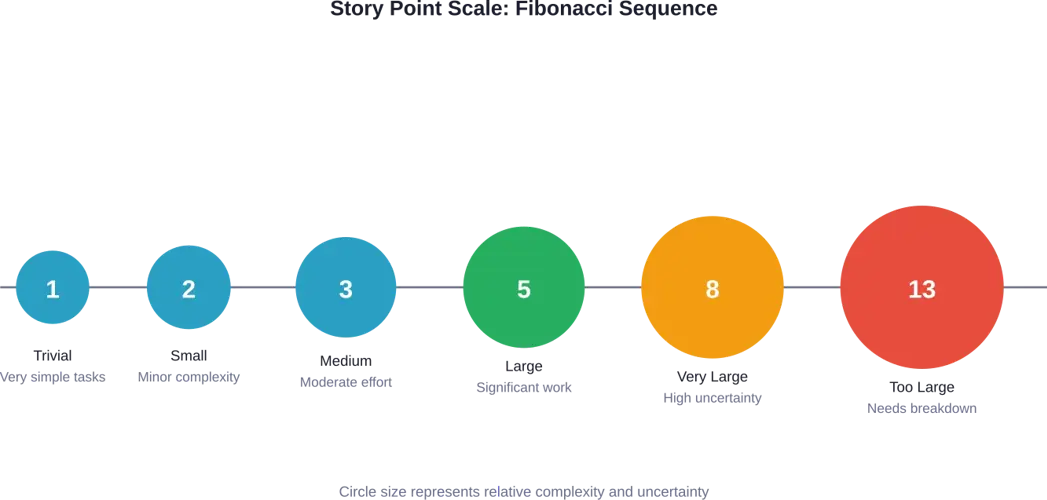
A story worth one point might represent the simplest possible work item. A three-point story contains roughly three times the effort, complexity, or risk. An eight-point story signals significant uncertainty that might require further breakdown.
Abstract units avoid the psychological anchoring that plagues time estimates. When teams estimate in hours, they unconsciously commit to specific durations. Story points preserve flexibility while still enabling meaningful comparison.
Collaborative Team Estimation
Traditional estimation often falls to project managers or senior developers working in isolation. Agile estimation demands full team participation.
Developers, testers, designers, and other team members contribute to estimates. This collaborative approach captures diverse perspectives and surfaces assumptions that individuals miss. A backend developer might overlook frontend complexity. A QA engineer spots testing challenges that developers underestimate.
Planning poker formalized this collaborative process. Teams simultaneously reveal their estimates, discuss discrepancies, and converge toward consensus. This technique prevents groupthink while ensuring everyone's expertise shapes the forecast.
Story Points: The Foundation of Agile Estimation
Story points form the backbone of how Agile teams estimate work at the product backlog level. Understanding how they work matters for accurate cost projections.
When teams estimate work items at the product backlog level, estimates are relative. These relative estimates are expressed with an abstract measure like story points or ideal days. Teams assign numerical values that represent effort, complexity, and uncertainty rather than calendar time.
The Fibonacci sequence (1, 2, 3, 5, 8, 13, 21) provides a common scale. The growing gaps between numbers reflect increasing uncertainty for larger items. Distinguishing between a 1-point and 2-point story feels manageable. Differentiating between 13 and 14 points would be pointless precision.
Converting Story Points to Cost Estimates
Story points don't directly translate to budget numbers. The conversion requires velocity tracking over multiple sprints.
Velocity measures how many story points a team completes per sprint. After three to five sprints, patterns emerge. A team consistently completing 25 points per sprint establishes a predictable pace.
Combining velocity with known team costs yields cost per point. If a five-person team costs $50,000 per two-week sprint and completes 25 points, each point represents $2,000. A 100-point feature therefore projects to roughly $200,000.
This approach adapts as teams evolve. Velocity naturally increases as teams mature and streamline workflows. Cost per point decreases accordingly, making later sprints more efficient than early ones.
When Story Points Break Down
Story points work brilliantly for established teams with stable composition. They struggle during formation stages or when team membership fluctuates significantly.
New teams lack velocity history. Their early estimates contain wider variance. Cost projections remain rough until several sprints establish baseline performance.
Team changes also disrupt velocity. Adding or removing developers shifts capacity. Story point values remain constant, but team throughput changes. Recalibration takes two to three sprints as the new configuration stabilizes.
Planning Poker: Collaborative Estimation in Action
Planning poker transformed Agile estimation from individual guesswork into structured team dialogue. The process deserves attention because it directly impacts estimate quality.
Each team member receives cards numbered with story point values (typically 1, 2, 3, 5, 8, 13, 20, 40, 100). The product owner presents a user story. Team members privately consider their estimates, then simultaneously reveal their cards.
When estimates cluster tightly, the team quickly reaches consensus. When estimates diverge significantly—say one developer chose 3 while another picked 13—discussion begins.
The highest and lowest estimators explain their reasoning. Often, they've made different assumptions or spotted complexities others missed. These discussions surface hidden requirements and technical constraints before development starts.
After discussion, the team re-estimates. Estimates typically converge toward consensus. If they don't, the team might need to research unknowns or split the story into better-understood pieces.
Why Simultaneous Revelation Matters
The simultaneous reveal prevents anchoring bias. When senior developers speak first, junior team members unconsciously defer to their estimates. Simultaneous revelation ensures everyone's independent assessment gets heard.
This small procedural detail significantly improves estimate accuracy. Research on group estimation consistently shows that independent judgments combined after-the-fact outperform sequential discussion where early voices dominate.

Improve Cost in Agile Development Projects
Agile projects require estimation by sprints and backlog priorities. OSKI Solutions calculates expected effort per iteration. The cost model reflects team velocity and planned scope. This helps manage budget during ongoing development.
Ready to Structure Agile Costs Properly?
Talk with OSKI Solutions to:
- estimate development effort per sprint
- align backlog scope with budget
- define a predictable cost structure
👉 Request a sprint based cost estimate from OSKI Solutions.
Build Faster with Agile Development
Deliver high-quality software through iterative sprints, continuous feedback, and transparent collaboration.
Key Factors Affecting Agile Project Costs
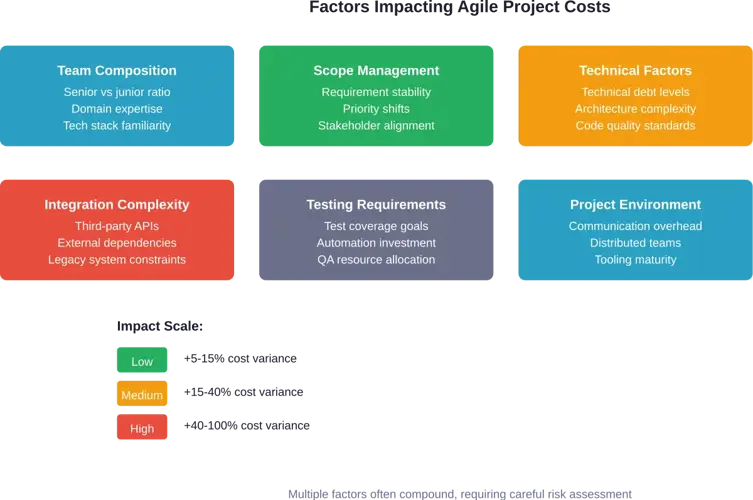
Several variables influence how accurately teams can estimate and control costs in Agile projects. Recognizing these factors helps set realistic expectations.
Team Composition and Expertise
Developer skill levels create massive cost variance. Senior developers command higher salaries but often deliver faster. Junior developers cost less per hour but may require more time and support.
The optimal mix depends on project complexity. Straightforward applications can lean toward junior talent supervised by a few seniors. Complex systems requiring architectural decisions need senior-heavy teams.
Team familiarity with the technology stack also matters enormously. Developers working in familiar languages and frameworks estimate more accurately and deliver faster than those learning new tools mid-project.
Scope Volatility
Agile embraces scope changes, but volatility still impacts costs. Frequent priority shifts and requirement changes introduce inefficiency. Developers context-switch, abandon partially-completed work, and restart planning cycles.
Some scope evolution is healthy—it means the team is learning and adapting. Excessive churn indicates unclear product vision or stakeholder alignment issues. When sprint goals change multiple times before completion, velocity drops and costs rise.
Technical Debt Accumulation
Rushing features without adequate testing or refactoring creates technical debt. This invisible cost multiplier slows future development as the codebase becomes harder to modify.
Teams must balance feature delivery with technical health. Allocating 15-20% of sprint capacity to debt reduction maintains sustainable pace. Ignoring technical debt for short-term speed gains compounds interest rapidly.
Integration Complexity
Modern applications rarely stand alone. They integrate with payment processors, authentication providers, analytics platforms, and numerous APIs. Each integration point introduces uncertainty.
Third-party APIs change without notice. Documentation proves incomplete or outdated. Authentication flows contain undocumented edge cases. These integration surprises routinely exceed initial estimates.
Building buffer into integration-heavy stories mitigates this risk. Experienced teams treat any external dependency as higher complexity than equivalent internal functionality.
Practical Estimation Techniques for Agile Teams
Beyond story points and planning poker, several estimation techniques help teams forecast costs more accurately.
T-Shirt Sizing for Early-Stage Estimation
When requirements remain fuzzy, story points feel too precise. T-shirt sizes (XS, S, M, L, XL) provide coarser granularity suitable for initial planning.
Product owners use T-shirt sizing during backlog grooming before stories receive detailed definition. This rough categorization helps prioritize which items merit further analysis.
Teams eventually translate T-shirt sizes into story points. An S might become 2-3 points, M becomes 5-8, L becomes 13. This two-stage approach matches estimation precision to requirement maturity.
The Bucket System for Large Backlogs
Estimating 200 backlog items through individual planning poker sessions takes forever. The bucket system accelerates bulk estimation while preserving relative accuracy.
Teams create buckets representing story point values (1, 2, 3, 5, 8, 13, 20, etc.). Working together, they rapidly sort stories into buckets based on perceived complexity. The emphasis shifts from precision to quick relative placement.
After bulk sorting, teams review edge cases and adjust placement. This approach estimates large backlogs in hours rather than days while maintaining sufficient accuracy for roadmap planning.
Bottom-Up Task Breakdown
For stories requiring concrete hour estimates—often the case when translating sprint commitments into detailed schedules—bottom-up task breakdown provides granularity.
Teams decompose user stories into specific technical tasks. According to available data, for instance, user requirements for viewing specific data might break down into discrete tasks: ability to view all records (8 hours), filtration by field 1 (8 hours), filtration by field 2, and so forth.
Each technical task receives an hour estimate. Frontend work, backend development, QA test case preparation, and testing execution all get separate line items. Summing these task-level estimates provides story-level projections.
This technique surfaces hidden work that story point estimation might miss. Database migration scripts, deployment automation, and documentation often become visible only during task breakdown.
Reference Class Forecasting
Teams often estimate based on the specific story in front of them, ignoring broader patterns. Reference class forecasting corrects this by anchoring estimates to historical performance data.
Before estimating a new e-commerce checkout flow, teams review how long previous checkout implementations took. Historical data grounds estimates in reality rather than optimistic assumptions.
This technique works best for teams with rich project history and good tracking. Organizations building similar applications repeatedly benefit most from reference class forecasting.
Converting Agile Estimates into Budget Projections
Story points and velocity provide development effort estimates. Converting these into financial budgets requires additional calculations and assumptions.
Calculating Team Costs
Start with fully-loaded team costs. This includes not just salaries, but benefits, equipment, software licenses, office space, and overhead. A developer earning $100,000 annually often costs the organization $150,000 when all factors are included.
For a five-person team (three developers, one designer, one QA engineer) with average fully-loaded costs of $150,000 per person, annual team cost reaches $750,000. Divided across 26 two-week sprints, each sprint costs roughly $29,000.
If that team completes 30 story points per sprint, cost per point equals approximately $967. A 180-point feature therefore projects to about $174,000 in team costs.
Adding Buffer for Risk and Uncertainty
Raw story point calculations provide baseline estimates. Smart project management adds buffers for inevitable uncertainties.
Teams should build buffers strategically by adding 10-20% for individual tasks with known complexity. Higher uncertainty warrants larger buffers.
Early-stage projects with immature requirements need more substantial buffers—often 30-50% above baseline estimates. Mature projects with stable teams and clear requirements can operate with tighter margins.
Accounting for Non-Development Costs
Development team costs represent only part of total project expense. Project managers, product owners, infrastructure, third-party services, and compliance work add overhead.
A common rule of thumb allocates 20-30% additional budget beyond core development for these surrounding costs. A $200,000 development estimate might require $240,000-260,000 total budget.
Infrastructure costs especially need explicit planning. Cloud hosting, CDN services, database licenses, and monitoring tools create ongoing expenses beyond one-time development investment.
|
Budget Component |
Typical % of Total |
Key Considerations |
|---|---|---|
|
Core Development Team |
60-70% |
Developer, designer, QA salaries and overhead |
|
Product Management |
8-12% |
Product owner, business analyst time allocation |
|
Project Management |
5-10% |
Scrum master, project coordination overhead |
|
Infrastructure & Tools |
8-15% |
Cloud hosting, CI/CD, monitoring, licenses |
|
Risk Buffer |
10-20% |
Contingency for scope changes and unknowns |
Avoiding Common Estimation Pitfalls
Even experienced Agile teams fall into predictable estimation traps. Recognizing these patterns helps prevent costly mistakes.
The Optimism Bias
Developers are chronic optimists about their own work. They estimate based on ideal conditions: no interruptions, no bugs, perfect understanding of requirements.
Reality involves Slack messages, production incidents, requirement clarifications, and inevitable rework. Tasks that should take four hours stretch to six. Multiplied across hundreds of tasks, optimism bias creates significant cost overruns.
Combat this by tracking estimation accuracy. When teams consistently underestimate, apply correction factors. If stories average 25% over estimates, build that into future projections.
Anchoring on Initial Estimates
First estimates create psychological anchors that persist despite new information. A feature initially estimated at 13 points might clearly need 20 as understanding improves, but teams resist major revisions.
This anchoring effect makes early estimates dangerous when locked into contracts or stakeholder expectations. Agile estimation should remain fluid, with teams updating projections as understanding evolves.
Organizations that treat initial estimates as firm commitments force teams into either padding estimates defensively or accepting inevitable overruns. Neither outcome serves project success.
Ignoring Velocity Trends
Velocity isn't constant. It increases as teams mature and establish shared practices. It decreases when technical debt accumulates or team composition changes.
Using average velocity from early sprints to project long-term costs often creates unrealistic expectations. Better to analyze velocity trends and project based on recent performance rather than historical averages.
Teams should track velocity over rolling windows—perhaps the most recent six sprints—to capture current performance levels while smoothing sprint-to-sprint variance.
Estimating Too Far Ahead
The cone of uncertainty describes how estimation accuracy improves as projects progress. Early-stage estimates contain massive variance. Locking budgets based on incomplete understanding guarantees problems.
Agile's iterative nature helps manage this. Rather than estimating the entire project upfront, teams estimate near-term work in detail while keeping distant work at coarse granularity.
A product roadmap might show detailed sprint planning for the next quarter, rough story point estimates for quarters two and three, and only t-shirt sizing for work beyond that horizon. Precision matches certainty.
Tools and Practices That Improve Estimation Accuracy
The right practices and tooling help teams refine their estimation capabilities over time.
Velocity Tracking and Trend Analysis
Manual velocity tracking quickly becomes tedious. Modern project management tools automate this, generating charts that show velocity trends across sprints.
Teams should review velocity during retrospectives. Is it increasing, decreasing, or stable? What factors drove changes? This analysis surfaces process improvements and helps calibrate future estimates.
Consistent velocity with low variance indicates predictable delivery. High variance suggests estimation inconsistency or sprint planning issues that need addressing.
Estimation Calibration Sessions
Periodically, teams should review completed stories and their actual effort against initial estimates. This calibration builds shared understanding of what different point values represent.
When multiple stories estimated at five points actually required very different effort, the team's calibration needs adjustment. These sessions gradually align team members' estimation frameworks.
Breaking Down Uncertainty
Large, uncertain stories generate poor estimates. When planning poker reveals wide estimate spreads, that signals insufficient understanding to commit.
The solution isn't forcing consensus—it's breaking the story down or conducting research to reduce uncertainty. Spikes, time-boxed investigation tasks, help teams explore unknowns before estimation.
After a spike confirms technical feasibility or clarifies requirements, re-estimation typically produces tighter estimates with higher confidence.
Real-World Cost Estimation Example
Seeing estimation principles applied to concrete scenarios helps solidify understanding. Consider a mid-sized e-commerce platform enhancement.
The Scenario
An established team maintains an e-commerce platform. The product owner wants to add advanced filtering and sorting for product catalogs. Initial requirements include filtering by price range, category, brand, ratings, and availability, plus sorting by multiple criteria.
Initial Estimation
During backlog refinement, the team uses t-shirt sizing. The overall feature feels Large based on complexity and scope. Breaking it into user stories produces:
- Basic category filtering (M - 5 points)
- Price range slider (S - 3 points)
- Brand multi-select (M - 5 points)
- Rating filter (S - 3 points)
- Availability filter (XS - 2 points)
- Multi-criteria sorting (L - 8 points)
- Backend performance optimization (M - 5 points)
- Mobile responsive design (M - 5 points)
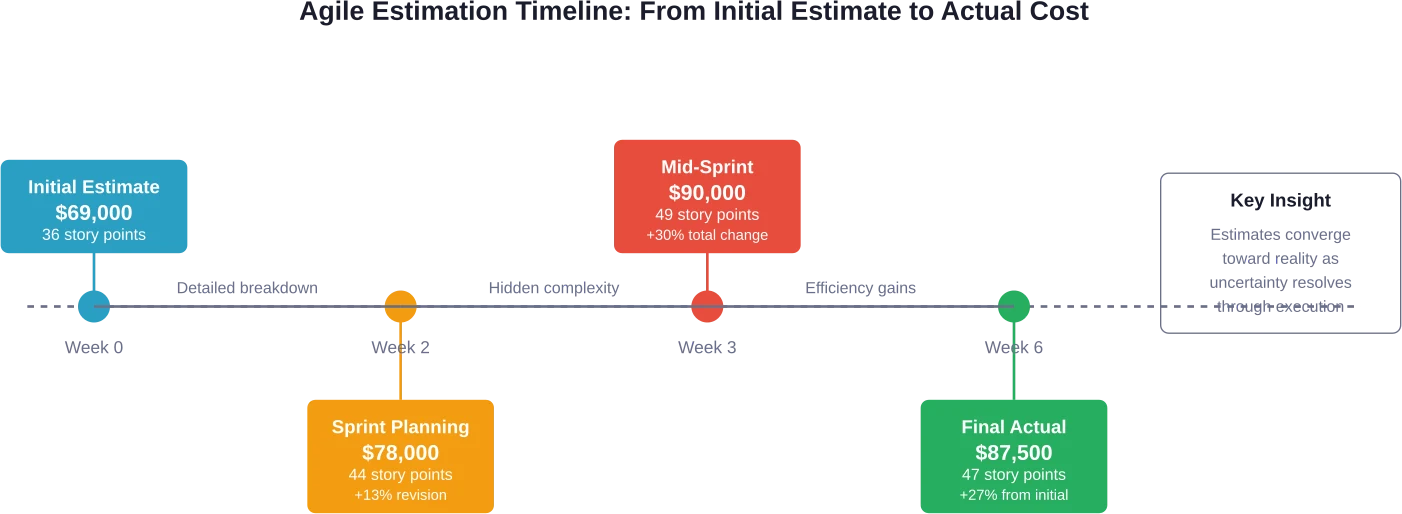
Total estimated effort: 36 story points.
Cost Calculation
The team's historical velocity averages 24 points per two-week sprint. This feature represents roughly 1.5 sprints of development work.
Team cost per sprint runs $32,000 (four developers plus one QA engineer). Development cost therefore projects to approximately $48,000.
Adding 15% buffer for uncertainty and integration challenges raises the estimate to $55,200. Project management overhead (10%) and infrastructure costs (5%) bring total project budget to approximately $69,000.
Reality Check
During sprint planning for the first increment, detailed task breakdown reveals complexity in backend performance. The team splits the optimization story into two separate efforts (database indexing and query optimization), adding 8 points.
Brand filtering integration discovers the product database lacks normalized brand data, requiring schema migration. Another 5 points of unplanned work.
Revised total: 49 story points, or about 2 sprints. Cost projection adjusts to approximately $90,000—a 30% increase from initial estimate.
This scenario illustrates normal Agile estimation evolution. Initial estimates provide directional guidance. As work begins and uncertainty resolves, projections refine. Organizations expecting locked estimates from day one misunderstand Agile's adaptive nature.
Managing Stakeholder Expectations Around Agile Estimates
Technical estimation accuracy matters less than stakeholder communication. Executives and clients accustomed to fixed-price contracts struggle with Agile's adaptive estimates.
Educating Stakeholders on Estimation Uncertainty
Stakeholders need to understand the cone of uncertainty. Early estimates contain high variance—perhaps ±50% or more. Demanding precision where none exists sets projects up for perceived failure.
Frame initial estimates as planning guidance, not contractual commitments. Present ranges rather than point estimates: "This initiative will likely cost between $150,000 and $250,000 based on current understanding."
As work progresses and uncertainty resolves, ranges narrow. After two sprints, estimates might tighten to ±20%. This progressive refinement reflects learning, not estimation failure.
Demonstrating Value Delivery Over Cost Adherence
Agile prioritizes working software over comprehensive documentation—and delivered value over budget precision. Stakeholders fixated on original estimates miss the point.
A project that delivers 80% of planned features at 70% of estimated cost might outperform one that delivers 100% at 100% if the omitted 20% proved low-value.
Regular sprint reviews let stakeholders assess delivered functionality and make informed trade-off decisions. Should the team build the remaining features or redirect effort toward higher-value work that emerged during development?
Creating Budget Buffers and Release Plans
Organizations need financial planning despite estimation uncertainty. The solution involves tiered release planning with protected buffers.
Minimum viable product scope receives detailed estimation and full budget allocation. Enhancement tiers get progressively rougher estimates with conditional budget approval. This structure provides financial control while preserving flexibility.
If MVP development proves more expensive than projected, teams defer enhancement tiers. If it comes in under budget, they pull forward additional scope. This approach aligns financial discipline with Agile adaptability.
The Future of Cost Estimation in Agile Development
Estimation techniques continue evolving as teams accumulate more data and tooling improves.
Machine Learning and Predictive Analytics
Organizations with extensive project history can apply machine learning to estimation. Algorithms analyze thousands of completed stories, identifying patterns between story characteristics and actual effort.
These models consider story complexity, team composition, technology stack, and historical velocity to generate estimates. Early implementations show promise, though they require substantial training data.
The combination of algorithmic suggestions and team judgment likely outperforms either alone. Models provide data-grounded baselines that teams refine through domain expertise.
Continuous Forecasting and Dynamic Budgeting
Traditional annual budgeting cycles clash with Agile's adaptive nature. Organizations are experimenting with continuous forecasting models that update projections monthly or quarterly.
This approach treats budgets as rolling forecasts rather than fixed allocations. As teams deliver functionality and velocity stabilizes, financial projections become more accurate, enabling better resource allocation.
Value-Based Prioritization
Cost estimation matters less when value quantification improves. Teams increasingly estimate expected business value alongside development effort.
Combining value and cost estimates enables ROI-based prioritization, helping teams prioritize high-value features over lower-impact work.
This shift from cost focus to value focus better aligns technical work with business objectives.
Best Practices for Sustainable Cost Estimation
Pulling together the key threads, several best practices emerge for teams seeking sustainable estimation accuracy.
|
Practice |
Benefit |
Implementation Tip |
|---|---|---|
|
Estimate as a team |
Captures diverse perspectives, surfaces assumptions |
Use planning poker or similar collaborative techniques |
|
Use relative sizing |
Faster than absolute estimates, more accurate for humans |
Establish reference stories as calibration points |
|
Track velocity consistently |
Enables data-driven projections |
Automate tracking in project management tools |
|
Re-estimate regularly |
Adjusts for learning and changing understanding |
Review and refine estimates during backlog grooming |
|
Break down uncertainty |
Reduces estimation variance |
Use spikes to investigate unknowns before committing |
|
Build appropriate buffers |
Protects against inevitable surprises |
Scale buffers to uncertainty level: 10-20% stable, 30-50% volatile |
|
Review estimation accuracy |
Improves team calibration over time |
Compare estimates to actuals during retrospectives |
|
Communicate ranges |
Sets realistic stakeholder expectations |
Present estimates as ranges that narrow over time |
Sustainable estimation isn't about perfection—it's about continuous improvement. Teams that track accuracy, analyze variance, and adapt techniques steadily improve forecasting ability.
Frequently Asked Questions
What's the difference between story points and hours in Agile estimation?
Story points represent relative effort, complexity, and uncertainty combined into an abstract unit. Hours attempt to measure absolute calendar time. Story points work better for Agile estimation because they avoid false precision and account for varying developer productivity. A five-point story might take one developer eight hours and another twelve hours, but both agree it's a five-point story based on relative complexity. Hours also create psychological commitment problems that story points avoid.
How many sprints does a team need before velocity becomes reliable for cost estimation?
Teams typically need three to five sprints before velocity patterns stabilize enough for meaningful cost projections. The first sprint often includes setup overhead and team formation dynamics that skew velocity. By sprint three, teams generally establish consistent rhythm and communication patterns. However, velocity reliability depends on team stability—significant membership changes reset this timeline. Conservative organizations might wait six to eight sprints before using velocity for firm budget commitments.
Should Agile teams estimate bug fixes and technical debt?
Yes, bug fixes and technical debt work should receive story point estimates just like feature development. This practice ensures velocity calculations reflect total team capacity, not just new feature work. Many teams allocate a percentage of each sprint to bug fixes and technical debt—commonly 15-20%—and estimate these items during sprint planning. Failing to estimate maintenance work creates artificially inflated velocity that doesn't reflect sustainable pace.
How do distributed or remote teams handle collaborative estimation?
Remote teams use digital planning poker tools that replicate simultaneous estimate revelation virtually. Team members select estimates privately, then reveal simultaneously on screen. Many tools include timers, discussion threads, and automated averaging. The key principle—preventing anchoring through simultaneous revelation—works equally well remotely. Some distributed teams find async estimation workflows effective for initial sizing, followed by synchronous discussion of discrepancies during video calls.
What should teams do when actual effort consistently exceeds estimates?
Consistent underestimation indicates systematic bias that requires correction. First, analyze whether specific story types or team members drive the variance. Technical integration stories might consistently run over while UI work hits estimates. Second, consider whether the team is accounting for all work—QA time, code review, deployment often get overlooked. Third, apply historical correction factors. If stories average 30% over estimates, either increase future estimates or reduce sprint commitments by 30%. Finally, examine if external interruptions or poor requirements are causing estimation drift rather than inherent estimation error.
How do Agile cost estimates work for fixed-price contracts?
Fixed-price contracts and pure Agile estimation philosophies conflict fundamentally. Organizations typically use one of three approaches: First, estimate an MVP scope with large buffer (40-50%) and fix that price while treating enhancements as separate scope. Second, use time-and-materials contracts with scope flexibility and budget caps. Third, create phased contracts where each phase receives fixed pricing after completing a discovery sprint that reduces uncertainty. The worst approach is forcing detailed upfront estimates into fixed-price commitments before requirements crystallize—this guarantees either project failure or contentious change order negotiations.
Can Agile estimation techniques work for non-software projects?
Absolutely. The core principles—relative estimation, collaborative sizing, iterative refinement—apply to any project with uncertainty and evolving requirements. Marketing campaigns, content production, event planning, and process improvement initiatives all benefit from Agile estimation approaches. The key is identifying appropriate units. Story points work for tasks with similar characteristics. Some teams use effort days, complexity levels, or custom scales. The technique matters less than the principles: estimate relatively, collaborate, refine continuously, and track actual performance to improve forecasting.
Conclusion: Embracing Estimation as a Continuous Process
Cost estimation in Agile development projects fundamentally differs from traditional approaches. Rather than seeking false precision upfront, Agile embraces uncertainty and treats estimation as an ongoing learning process.
The most successful teams recognize that initial estimates provide directional guidance, not contractual commitments. They estimate collaboratively using relative sizing techniques like story points. They track velocity to convert abstract estimates into financial projections. They build appropriate buffers that scale with uncertainty levels.
Most importantly, they continuously refine estimates as understanding improves. Each sprint provides new data. Velocity trends emerge. Team capabilities evolve. Estimation accuracy improves through deliberate practice and retrospective analysis.
Organizations that demand waterfall-style fixed estimates while claiming to practice Agile create impossible situations. True Agile cost estimation requires embracing progressive refinement, communicating ranges rather than point estimates, and focusing on delivered value rather than budget adherence.
The estimation techniques covered here—story points, planning poker, velocity tracking, reference class forecasting—provide practical tools for generating increasingly accurate cost projections. But tools alone don't create accuracy. Teams must commit to honest assessment, collaborative dialogue, and continuous improvement.
Start simple. Use story points for relative sizing. Track velocity over several sprints. Calculate cost per point. Present estimates as ranges that narrow over time. Review estimation accuracy during retrospectives. Adjust techniques based on what works for your team's context.
Cost estimation in Agile isn't about predicting the future perfectly. It's about making informed decisions with the best available information, then adapting as reality unfolds. Teams that embrace this mindset deliver more successfully than those clinging to illusory precision.
Ready to improve your team's estimation accuracy? Start by implementing collaborative planning poker sessions and tracking velocity consistently. The data-driven insights that emerge within just a few sprints will transform how your organization approaches project cost forecasting.


